



Abstract
Background:
We assessed the effectiveness of administering subcutaneous levothyroxine in a medically complex patient, a 51-year-old male who previously underwent total thyroidectomy for papillary thyroid carcinoma. His thyrotropin (TSH) worsened to >100 mIU/L, caused by encapsulating sclerosing peritonitis that led to thyroxine malabsorption and enteral loss of protein-bound thyroxine. Several routes of levothyroxine were evaluated prior to subcutaneous levothyroxine.
Methods:
Subcutaneous levothyroxine was initiated at a low dose of 100 mcg thrice a week. A pharmacokinetic absorption study was performed to assess the bioavailability of subcutaneous levothyroxine against oral levothyroxine.
Results:
A 103% increase in free thyroxine at 6 hours post-subcutaneous levothyroxine 100 mcg confirmed effective absorption. Area-under-curve analysis showed that the relative bioavailability of subcutaneous levothyroxine was 8.75 times of oral levothyroxine for our patient. Hence, subcutaneous levothyroxine was initiated, with TSH normalizing 20 days later.
Conclusions:
Subcutaneous levothyroxine may be an alternative in patients with oral malabsorption.
Introduction
Refractory primary hypothyroidism 1 is characterized by persistently elevated thyrotropin (TSH) levels despite the administration of oral levothyroxine that exceeds the standard recommended dosage (1.6–1.8 mcg/kg/day). Several factors may contribute to an increased requirement for oral levothyroxine, including nonadherence to medications, impaired absorption from co-ingestion with calcium and iron supplements, impaired gastric acid secretion, incomplete dissolution or absorption of levothyroxine from tablet excipients, or a protein-losing state from enteropathy or nephropathy. 1 When absorption is inadequate despite optimization efforts, non-oral routes of levothyroxine administration should be considered. Alternative methods of administration via the intramuscular, subcutaneous, and rectal routes have been reported with promising results over the course of weeks to months (Supplementary Table S1).2–11 However, only a few studies have reported the use of levothyroxine given through the subcutaneous route.2–4,12
We present a case report of a patient with refractory primary hypothyroidism who failed an oral levothyroxine absorption test despite optimized conditions. Given the limited formulary options and our patient’s clinical context, we initiated an off-label trial of subcutaneous levothyroxine and confirmed its bioavailability through a pharmacokinetic absorption study. Institutional Ethics Board (National Healthcare Group Domain Specific Review Board) review is waived for case reports with one patient. Written informed consent for publication was obtained from the patient.
Case Presentation
Our patient was a 51-year-old male with papillary thyroid carcinoma (PTC). He underwent total thyroidectomy with right central neck dissection, and histopathological examination revealed a 14 mm PTC with lymphatic and vascular invasion and involvement of 8 out of 10 central compartment lymph nodes. He had TNM Stage 1 (T1bN1M0) PTC with American Thyroid Association (ATA) intermediate risk of recurrence. 13 Taking into consideration his end-stage renal failure, he received 49.9mCi iodine-131. Post-therapy whole-body scintigraphy demonstrated faint iodine-131 uptake in the anterior neck, likely representing remnant thyroid tissue, without distant metastases. He had an indeterminate treatment response based on serum thyroglobulin (stimulated: 3.9–5.4 mcg/L, non-stimulated: 0.4–1.7 mcg/L) and neck ultrasonography showing a largely stable non-specific heterogeneous nodule in the left thyroid bed measuring about 0.7 × 0.1 × 0.5 cm. His prior TSH goals were guided by the 2015 version of ATA guidelines 13 that suggested a TSH target of 0.5–2.0 mIU/L. This study was completed before the release of the new ATA 2025 guidelines, 14 and clinical decisions were made in accordance to the ATA 2015 guidelines. 13 Even though the European Thyroid Association guidelines 15 recommends a TSH target of 0.1–0.5 mIU/L, in view of his underlying ischemic heart disease, his prior target TSH was set at 0.5–2.0 mIU/L. Prior to the admission, he received oral levothyroxine 175 mcg on weekdays and 200 mcg on weekends, equivalent to 3.16 mcg/kg/day (weight 57.7 kg). He was on peritoneal dialysis since 2017 and converted to hemodialysis in 2023 due to psoriasis-related inflammation of the peritoneal membrane.
He was admitted for progressive abdominal bloating, left iliac fossa pain, increasing dry weight, and a recent episode of intra-dialytic hypotension. On admission, he was clinically euthyroid, and his TSH was 0.24 mIU/L, within target, with a free thyroxine (fT4) at 20.6 pmol/L (reference: 90–19.1 pmol/L) (Fig. 1). He was subsequently diagnosed with encapsulating sclerosing peritonitis, likely secondary to recurrent ascites and chronic peritoneal inflammation.
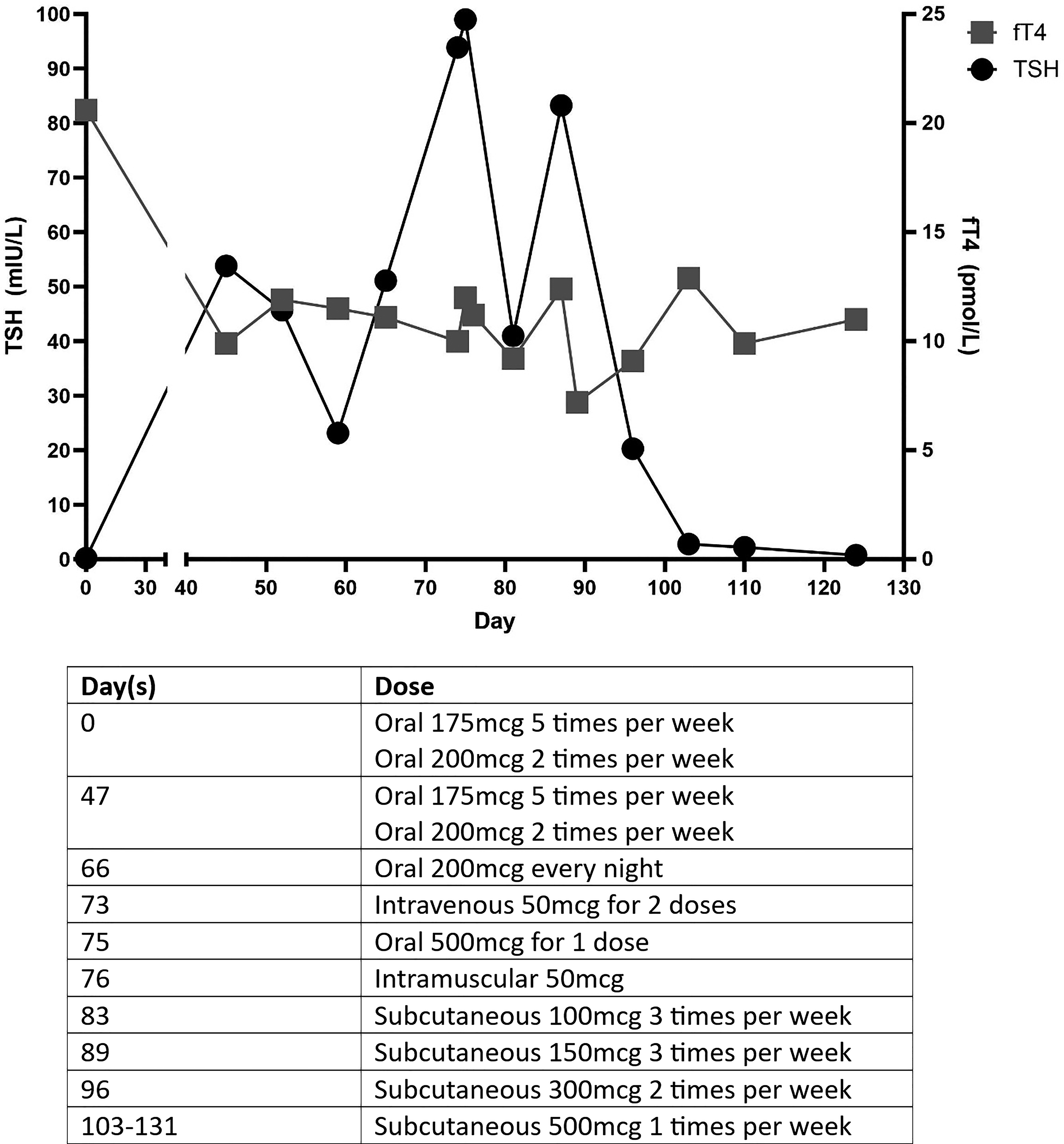
Thyroid function tests trend of our patient with respective routes of administration and doses of levothyroxine given during admission. fT4, free thyroxine; TSH, thyrotropin; mcg, micrograms.
A routine thyroid function test (TFT) conducted 6 weeks into his hospitalization revealed primary hypothyroidism (TSH: 53.83mIU/L; fT4: 9.9 pmol/L). Administration of oral levothyroxine was shifted to bedtime, 4 hours apart from thrice daily calcium carbonate and meals to enhance gastrointestinal absorption. Follow-up TFT in 2 weeks remained unsatisfactory (TSH: 51.12 mIU/L; fT4: 11.1 pmol/L). Consequently, we increased the oral levothyroxine dose to 200 mcg every night. However, his TFTs continued to deteriorate (TSH: >100 mIU/L; fT4: 9.7 pmol/L). In view of persistent hypothyroidism with suspected malabsorption, two doses of intravenous levothyroxine 50 mcg (50% of the oral levothyroxine dose at 1.6 mcg/kg/day in view of this ischemic heart disease) were administered 16 hours apart.
As oral levothyroxine was administered under direct supervision, nonadherence was excluded. Given his ongoing gastrointestinal pathology, malabsorption of oral levothyroxine was suspected. A 500 mcg oral levothyroxine absorption test 16 confirmed impaired gastrointestinal absorption (Fig. 2A). The peak rise 16 in fT4 was 40%, and the calculated percentage of levothyroxine absorbed 16 based on total thyroxine was 25%, significantly below expected values (>60%). Alternative causes of refractory hypothyroidism were sought. Serological screening for celiac disease was negative. His serum albumin level was low, ranged 17–25 g/L (reference: 35–52 g/L). Given that he was anuric and was unlikely to have renal protein losses, protein-losing enteropathy from encapsulating sclerosing peritonitis, leading to chronic intestinal inflammation and lymphatic obstruction, could have contributed to enteral losses of protein-bound thyroxine. Otherwise, his transaminases were <2 times of upper normal limit. Reverse triiodothyronine levels were elevated at 51 ng/dL (reference: 10–24 ng/dL). This could be elevated in non-thyroidal illness or in consumptive hypothyroidism from type 3 deiodinase-producing tumor. As his fT4 at 24 hours after oral levothyroxine absorption study did not show any rapid decrease in levels, there was unlikely to be rapid thyroxine metabolism from consumptive hypothyroidism. Taken together, he had gastrointestinal dysfunction leading to both levothyroxine malabsorption and enteral loss of protein-bound thyroxine.

Incremental area under the curve (AUC) of oral levothyroxine absorption test
Intravenous levothyroxine is a standard alternative for patients with malabsorption. However, weekly high-dose intravenous levothyroxine posed a potential risk of precipitating acute cardiac events, given the patient’s underlying ischemic heart disease and an episode of atrial flutter that occurred while on intravenous levothyroxine. The nephrology team advised that administering intravenous levothyroxine during thrice-weekly hemodialysis sessions was unsuitable due to his cardiovascular risks.
Given the patient’s significant gastrointestinal pathology, the rectal route was unsuitable. An initial off-label use of daily intramuscular levothyroxine at 50 mcg/day using the same levothyroxine intravenous formulation (Fresenius Kabi) 17 was initiated. After 1 week, TFTs showed biochemical improvement (TSH: 41.02 mIU/L; fT4: 9.2 pmol/L). However, the patient experienced substantial discomfort with daily intramuscular injections, making this option unsustainable for long-term use. Daily injections also incurred high costs and drug wastage, as each 500 mcg vial of reconstituted thyroxine was stable for only 4 hours and largely discarded after a 50 mcg dose.
Subsequently, a trial of subcutaneous levothyroxine was initiated at a dose of 100 mcg thrice weekly, guided by the total weekly intramuscular dose requirements. Prior to this, only case reports of subcutaneous levothyroxine use have been documented using other formulations of IV levothyroxine such as L-Thyroxin Henning® inject 2 and L-thyroxine Serb®. 4 We proceeded with the subcutaneous use of the Fresenius Kabi levothyroxine formulations, 17 taking into consideration the lack of available local subcutaneous formulations and similarities in active ingredients and excipients with the formulations used in case reports2–4,12 (Supplementary Table S2). The undiluted injection technique was performed with reference to Naman 4 using the “pinch-up” technique with a 25-gauge needle at a 45-degree angle.
However, follow-up TFTs after the second subcutaneous levothyroxine dose demonstrated biochemical deterioration (TSH: 83.24 mIU/L; fT4: 6.1 pmol/L). At this juncture, the differential diagnosis included either inadequate dosing or ineffective absorption via the subcutaneous route. To evaluate this, a subcutaneous levothyroxine absorption test was performed using 100 mcg of the intravenous formulation administered subcutaneously with Naman’s technique. 4 fT4 levels were measured at 0 (baseline), 2, 4, 6, and 48 hours postinjection (as our patient declined blood extraction at 24-hour, fT4 level at 24-hour was interpolated from 6-hour and 48-hour levels). A peak increase in fT4 of 103% at the 6-hour mark indicated effective subcutaneous absorption (Fig. 2B). We then increased the subcutaneous levothyroxine dose to 150 mcg thrice weekly. After 1 week, his TFTs improved (TSH: 20.31 mIU/L; fT4: 9.1 pmol/L). He did not report any adverse effects such as chest pain, palpitations, or injection site reactions. With the improvements in TFTs and to minimize drug wastage, we further increased the subcutaneous levothyroxine dose to 300 mcg twice weekly (after 1 week, TSH: 2.8 mIU/L; fT4: 12.9 pmol/L) and eventually consolidated the subcutaneous levothyroxine dose to 500 mcg weekly (fully utilize the contents of one vial of levothyroxine). Finally, the patient’s TFTs stabilized (TSH: 2.23 mIU/L; fT4: 9.9 pmol/L).
We evaluated the relative bioavailability
18
of subcutaneous levothyroxine in comparison to oral levothyroxine in this patient. The incremental area under the curve between time zero and 24-hour (AUC0−24h) of fT4 was calculated using the trapezoidal rule.
18


Comparing the incremental AUC0−24 per dose, the subcutaneous levothyroxine absorption was 8.75 times of oral levothyroxine absorption in our patient (Fig. 2A and 2B, Supplementary Tables S3 and 4).
Discussion
Refractory primary hypothyroidism may arise from diverse causes, including poor adherence, drug or food interactions, impaired gastrointestinal absorption, or increased hormone loss in protein-losing states. 19 In this patient, the profound hypoalbuminemia and underlying encapsulating sclerosing peritonitis provided a unifying explanation for both the malabsorption of oral levothyroxine and the enteric loss of circulating, protein-bound thyroxine. As levothyroxine undergoes hepatic metabolism and partial enterohepatic circulation, concurrent impairment in intestinal absorption and enteric protein loss would further reduce circulating thyroxine levels through decreased uptake and increased loss of protein-bound hormone. This dual mechanism accounted for his refractory hypothyroidism despite high-dose oral therapy. Assuming his degree of protein loss was comparable during both oral and subcutaneous levothyroxine treatment periods, the improvement of TSH with subcutaneous levothyroxine suggests that impaired oral absorption remained a principal contributor to his refractory hypothyroidism.
Subcutaneous administration will bypass gastrointestinal barriers that hinder drug absorption, but there are other absorption barriers in the subcutaneous tissue to consider. Water-soluble excipients in this preparation may reduce drug solubility in the lipophilic environment of the subcutaneous tissue, prolonging the time required to enter the bloodstream. 20 This can delay the time-to-peak concentration (Tmax) of the drug in the systemic circulation. This may explain our absorption study findings of Tmax at approximately 6 hours (Fig. 2B). Despite these limitations, we observed that levothyroxine can still be absorbed when given through the subcutaneous route, giving rise to a peak concentration (Cmax) of 12.4 pmol/L (Fig. 2B). This could be attributed to the chemical structure of levothyroxine, which contains two aromatic rings that improve its lipid solubility. Due to the limited use of this route of administration, the absolute bioavailability of subcutaneous levothyroxine is not well established. Ideally, we would have performed another absorption study to evaluate the AUC of intravenous levothyroxine in this patient. However, the AUC of intravenous levothyroxine was not done in view of cardiac concerns. It would be inaccurate to establish absolute bioavailability using AUC of intravenous levothyroxine derived from literature due to differences in clearance between individuals.
Different formulations of levothyroxine may exhibit different rates and extents of absorption, and the absorption test could assess if water-soluble preparations were suitable for subcutaneous administration, an off-label route. Only 2 formulations of intravenous levothyroxine preparations (L-Thyroxin Henning® inject, 2 L-thyroxine Serb®4,12) have been given subcutaneously and documented in case reports, making our levothyroxine (Fresenius Kabi 17 ) the third report. In addition, patient factors such as age, weight, and body-fat percentage can play a role in levothyroxine absorption. Hence, in the absence of any established administration protocol, an absorption test can be considered in patients before commencing regular subcutaneous levothyroxine.
Although there are currently no FDA-approved subcutaneous levothyroxine formulations available, one potential molecule by Xeris Pharmaceuticals, Chicago, Illinois, USA (XP-8121), offers promising results in their Phase 1 trials. 21 Fitch et al. showed a slower absorption rate (prolonged Tmax) and lower maximum serum concentration (Cmax) with their 600 mcg subcutaneous levothyroxine compared to 600 mcg oral levothyroxine. 21 At these doses, the mean AUC of their molecule was 35% greater than oral levothyroxine, as compared to 875% in our patient. However, an important caveat to note is that this Phase 1 study was conducted in 60 healthy subjects, while our case report presents an ill patient with renal and gastrointestinal impairments. Despite the differences in study population, our study, along with previous case reports2–4,12 supports subcutaneous levothyroxine as an effective alternative for patients who cannot tolerate conventional routes of levothyroxine administration.
Conclusion
This case highlights the complexity of managing refractory primary hypothyroidism in patients with significant comorbidities affecting levothyroxine metabolism. The subcutaneous levothyroxine absorption test suggested adequate systemic absorption and guided subsequent dosing adjustments, ultimately leading to improved biochemical control. Off-label, subcutaneous levothyroxine may represent a tolerable long-term strategy in patients with refractory hypothyroidism who are unable to absorb or tolerate oral or intravenous formulations. Further studies are warranted to establish standardized protocols, dosing regimens, and long-term efficacy of subcutaneous levothyroxine in broader patient populations.
Authors’ Contributions
L.S.-C.L.: Clinician involved with patient care and the writing of the article (equal). N.W.X.K.: Pharmacist who contributed to the writing of the article (equal). M.H.T.L.: Clinician involved with patient care and the writing of the article (supporting). S.F.Y.: Consultant pharmacist who contributed to the study conception and design (lead). S.P.Y.: Consultant in-charge of this patient’s care and oversaw the writing of the article (lead).
Footnotes
Author Disclosure Statement
No competing financial interests exist.
Funding Information
No funding was received by any of the authors in this report.
Supplemental Material
References
Supplementary Material
Please find the following supplemental material available below.
For Open Access articles published under a Creative Commons License, all supplemental material carries the same license as the article it is associated with.
For non-Open Access articles published, all supplemental material carries a non-exclusive license, and permission requests for re-use of supplemental material or any part of supplemental material shall be sent directly to the copyright owner as specified in the copyright notice associated with the article.
