



Abstract
Background:
The prognostic value of unstimulated serum thyroglobulin (Tg) levels for structural recurrence in patients with low- to intermediate-risk differentiated thyroid cancer (DTC) who underwent total thyroidectomy but did not receive radioactive iodine (RAI) therapy remains unclear. This study aimed to determine Tg cutoff values and evaluate the role of dynamic Tg monitoring in risk stratification in these patients.
Methods:
We retrospectively analyzed 9753 patients with low- to intermediate-risk DTC who underwent total thyroidectomy without RAI at 11 Korean tertiary hospitals. Serum Tg levels were measured under thyrotropin suppression (<2 mIU/L) at 6, 12, and 24 months postoperatively using high-sensitive assays (functional sensitivity, <0.2 ng/mL). Optimal Tg cutoffs were determined by receiver operating characteristic curves and survival analyses.
Results:
Higher postoperative unstimulated Tg levels consistently predicted structural recurrence, with an optimal cutoff of 0.3 ng/mL (area under the curve: 0.815, 0.772, and 0.816 at 6, 12, and 24 months, respectively). A Tg ≥ 0.2 ng/mL, the Korean Thyroid Association (KTA) guideline cutoff for biochemical remission (excellent response), showed high sensitivity for recurrence. Tg ≥ 5.0 ng/mL at 6 months, a KTA-defined threshold for a biochemical incomplete response, independently predicted an elevated recurrence risk. Kaplan–Meier curves showed stepwise declines in recurrence-free survival with increasing Tg levels. Notably, even Tg < 0.2 or < 0.3 ng/mL were associated with recurrence if levels rose over time.
Conclusion:
Unstimulated Tg levels are strongly associated with the risk of structural recurrence in patients with DTC who have undergone total thyroidectomy without RAI. The current cutoff values of 0.2 ng/mL and 5.0 ng/mL were clinically relevant, and Tg kinetics over time further improved risk stratification. These findings provide the first large-scale evidence from an East Asian cohort and underscore the importance of early, serial Tg assessment in this growing patient population.
Keywords
Introduction
The management of differentiated thyroid cancer (DTC) has shifted toward a risk-adapted and individualized approach, particularly for patients with low- to intermediate-risk disease.1–4 Although radioactive iodine (RAI) remains a valuable adjuvant therapy for DTC, an emerging expert consensus now emphasizes its selective use, recognizing that many patients derive minimal benefit from adjuvant RAI therapy. 5 Consequently, an increasing number of patients have undergone total thyroidectomy or lobectomy without subsequent RAI ablation. 6 Although this approach minimizes overtreatment, it presents new challenges for postoperative surveillance, especially in the interpretation of serum thyroglobulin (Tg) levels.
Serum Tg, a thyroid-specific glycoprotein secreted by follicular thyroid cells and differentiated thyroid carcinomas, is a sensitive marker for detecting residual, persistent, or recurrent disease after total thyroidectomy. 7 In patients treated with both total thyroidectomy and RAI, undetectable or suppressed Tg levels are generally considered indicative of remission, whereas detectable or rising Tg levels suggest disease persistence or recurrence.1,4 However, in patients not treated with RAI, thyroid remnants often remain, which can result in measurable Tg levels even in the absence of malignancy.8,9 Therefore, the Tg values established in RAI-treated populations cannot be reliably applied to those managed without RAI.
To address this issue, several studies have attempted to identify clinically relevant Tg cutoffs for predicting recurrence risk in patients not treated with RAI. The 2019 European Society for Medical Oncology (ESMO) guidelines proposed unstimulated Tg thresholds of 0.2 and 5.0 ng/mL, defining biochemical remission (excellent response) and biochemical incomplete response, respectively, for this population, and the 2024 Korean Thyroid Association (KTA) guidelines similarly adopted these values, although these recommendations are based on limited evidence.2,10 A recent systematic review suggested Tg values between 1.0 and 2.5 ng/mL as alternative cutoffs for clinical decision-making, 11 and this range has now also been incorporated into the 2025 American Thyroid Association (ATA) guidelines as a recommended cutoff for defining an excellent response. 4 However, most previous studies were limited by their small sample sizes, short follow-up durations, and heterogeneous inclusion criteria. Moreover, data from East Asian cohorts remain scarce, and no large-scale multicenter study has evaluated Tg kinetics and its prognostic significance in patients who did not receive RAI after total thyroidectomy.
To address this knowledge gap, we conducted a large multicenter retrospective study to evaluate the prognostic value of unstimulated Tg levels at 6, 12, and 24 months after total thyroidectomy in patients with low- to intermediate-risk DTC who were not treated with RAI. We aimed to identify clinically relevant Tg cutoffs for recurrence risk stratification and determine whether longitudinal Tg trends provide additional prognostic value beyond single time-point measurements.
Materials and Methods
Patient selection and study design
This multicenter retrospective cohort study included 9753 consecutive patients with DTC who underwent total thyroidectomy between January 2000 and January 2021 at 11 tertiary care hospitals in South Korea. The eligible patients were those who did not receive RAI therapy after total thyroidectomy. Patients who developed structural recurrence during follow-up received appropriate treatment, including RAI therapy when indicated, as well as surgery and/or other loco-regional or systemic therapies according to clinical judgment. For each postoperative time point (6, 12, and 24 months), patients with inadequate thyrotropin (TSH) suppression (TSH ≥ 2 mIU/L) and/or positive thyroglobulin antibody (TgAb) levels (≥60 IU/mL) were excluded,1–3 resulting in 5869, 5767, and 5848 patients eligible for further screening at 6, 12, and 24 months, respectively. Additional exclusions were applied to those with missing Tg values or laboratory data and those who had developed structural recurrence prior to the respective Tg measurement. After applying all the exclusion criteria, 5736, 5637, and 5723 patients were included in the 6-, 12-, and 24-month analyses (Supplementary Fig. S1).
This study was conducted in accordance with the Declaration of Helsinki and was approved by the Institutional Review Board at all participating institutions (Chung-Ang University Hospital, 2409-006-19539; Chungnam National University Hospital, 2024-10-034; Chungbuk National University Hospital, CBNUH 2525-03-024; Chonnam National University Hwasun Hospital, CNUHH-2024-065; Korea University Hospital, 2024AN0236; National Cancer Center, NCC2024-0130; Dankook University Hospital, 2024-03-011; Pusan National University Hospital, 2402-034-136; Seoul National University Hospital, H-2403-129-1524; Seoul St. Mary’s Hospital, KC24RIDI0227; and Asan Medical Center, 2024-0781). The requirement for informed consent was waived due to the retrospective design of the study.
Definitions
To classify patients according to their postoperative serum Tg levels, we combined the guideline-based threshold with the cutoff values derived in our study. We applied the ESMO and KTA guidelines (unstimulated Tg < 0.2 ng/mL as “excellent response” and Tg ≥ 5.0 ng/mL as “biochemical incomplete response”),2,3 and additionally incorporated 2.5 ng/mL from the 2025 ATA guidelines. 4 Beyond these guideline cutoffs, Supplementary Figure S2 displays Kaplan–Meier estimated 10-year recurrence rates by 6-month Tg stratified in 0.5 ng/mL increments (with ≥ 10.0 ng/mL grouped), demonstrating a gradual, stepwise rise in risk with notable inflection around 2.5 and 5.0 ng/mL. Receiver operating characteristic (ROC) analyses using Tg levels at 6, 12, and 24 months postoperatively identified an optimal cutoff of approximately 0.3 ng/mL for predicting structural recurrence. Therefore, we categorized patients into seven Tg groups for subsequent analyses. Tg values were interpreted under conditions of adequate TSH suppression (TSH < 2 mIU/L) and in the absence of interfering anti-TgAb (TgAb < 60 IU/mL), consistent with the current recommendations for Tg monitoring in patients with non-RAI-treated DTC.1–3 Consistent with prior practice, our primary analyses considered TSH < 2 mIU/L; however, considering the 2025 ATA guideline recommending a “normal-range” TSH target for patients with an excellent response, we conducted a prespecified sensitivity analysis using TSH < 4 mIU/L. 4 In addition to analyses conducted in the full cohort, we performed a predefined subgroup analysis restricted to patients with papillary thyroid carcinoma (PTC), excluding all follicular thyroid carcinoma (FTC) and mixed PTC+FTC cases.
We classified patients using the Korean Risk Stratification System (K-RSS), as proposed in the 2024 KTA guidelines, which defines 10-year recurrence probability thresholds (low ≤5%; intermediate >5% to ≤30%; and high >30%) based on a comprehensive literature synthesis.12,13 In the K-RSS, gross extrathyroidal extension (ETE) confined to the strap muscles is categorized as intermediate-risk.12,13 The primary clinical outcome was recurrence-free survival (RFS), defined as the time from total thyroidectomy to documented structural recurrence according to the dynamic risk stratification system for DTC1. Structural recurrence was defined as newly detected loco-regional or distant metastasis confirmed by cytology, histopathology, or unequivocal radiological findings, consistent with the current guidelines.1,14 Radiological confirmation included cross-sectional imaging (computed tomography or magnetic resonance imaging) findings consistent with metastatic lesions or radioiodine uptake on diagnostic or therapeutic I-131 whole-body scans. When available, cytological or histopathological examination was performed to verify the diagnosis. Importantly, biochemical abnormalities alone (elevated Tg or TgAb levels without corresponding structural evidence) were not considered as a structural recurrence.
Serum Tg measurement using high-sensitive assays
Serum Tg was measured in each institution using one of the following high-sensitivity immunoassays: B·R·A·H·M·S Tg plus® RIA (radioimmunoassay, Thermo Scientific; functional sensitivity, 0.2 ng/mL), RIAKEY Thyroglobulin IRMA Tube II (immunoradiometric assay, Shinjin Medics Inc.; functional sensitivity, 0.1 ng/mL), DIAsource Tg RIA (radioimmunoassay, DIAsource Immunoassays; functional sensitivity, 0.2 ng/mL), CIS BIO RIA-gnost® Tg (radioimmunoassay, CIS BIO International; functional sensitivity, 0.2 ng/mL), Abbott Architect Tg assay (chemiluminescent microparticle immunoassay, Abbott Laboratories; functional sensitivity, 0.1 ng/mL), and Roche Elecsys Tg assay (electrochemiluminescence immunoassay, Roche Diagnostics; functional sensitivity, 0.05 ng/mL). All assays were second-generation or higher, with functional sensitivities consistently below 0.2 ng/mL, ensuring reliable detection of low serum Tg concentrations and minimizing potential interference from TgAb. Assays were performed in accordance with the standard operating procedures of the respective institutions and manufacturer’s instructions.
Statistical analyses
All statistical analyses were performed using R software (version 4.3.3; R Foundation for Statistical Computing, Vienna, Austria). Continuous variables are presented as mean ± standard deviation or median with interquartile range (IQR); categorical variables are reported as frequencies and percentages. ROC curve analyses were used to identify the optimal Tg cutoff for predicting structural recurrence at 6, 12, and 24 months postoperatively. The cutoff values were selected using Youden’s index, and the area under the curve (AUC), sensitivity, and specificity were calculated for each time point. RFS curves were estimated using the Kaplan–Meier method, and differences between groups were assessed using the log-rank test. Multivariable logistic regression analysis was performed to determine independent prognostic factors for structural recurrence. Variables with statistical significance in the univariate analysis—age, sex, DTC type, primary tumor size, multifocality, nodal stage, ETE, and Tg levels—were included in the multivariable model. The adjusted odds ratios (ORs) and corresponding confidence intervals (CIs) were calculated. All p-values were two-sided, and a p-value of < 0.05 was considered statistically significant.
Results
Baseline characteristics of patients with DTC
Table 1 summarizes the baseline clinical and pathological characteristics of the 9753 patients with DTC included in this study. The mean age at diagnosis was 54.7 ± 21.0 years, with 3762 patients (38.6%) aged ≥ 55 years. The cohort was predominantly female (n = 8259, 84.7%), and most patients had PTC (n = 9597, 98.4%), whereas only 134 patients (1.4%) were diagnosed with FTC. The mean primary tumor size was 0.9 ± 0.7 cm. Microscopic ETE was observed in 2624 patients (26.9%), and strap muscle-only gross ETE was noted in 184 patients (1.9%). Multifocal tumors were present in 2774 patients (28.4%). Central lymph node (LN) metastasis (N1a) was identified in 875 patients (9.0%) and lateral LN metastasis (N1b) in 191 patients (2.0%). Metastatic LNs measured 0.59 ± 0.64 cm on average, with no extra-nodal extension observed. According to the eighth edition of the American Joint Committee on Cancer staging system, 9135 patients (93.7%) were classified as stage I, 608 (6.2%) as stage II, and 10 (0.1%) as stage III. Applying K-RSS to the study cohort, 94.5% of patients were low-risk and 5.5% were intermediate-risk; no high-risk cases were identified. The subgroup characteristics of the patients included in each time-point cohort are summarized in Table 1. The demographic and pathological profiles were generally consistent across time points. Baseline characteristics of the PTC-only cohort are provided in Supplementary Table S1, and these clinicopathologic features remained broadly consistent across the 6-, 12-, and 24-month analytic subgroups.
Baseline Clinical and Pathological Characteristics of Patients with Differentiated Thyroid Carcinoma

Date presented as mean ± standard deviation or number (%).
AJCC/TNM, American Joint Committee on Cancer/Tumor–Node–Metastasis; CND, central neck dissection; DTC, differentiated thyroid carcinoma; FTC, follicular thyroid carcinoma; LN, lymph node; LND, lateral neck dissection; PTC, papillary thyroid carcinoma.
Diagnostic performance of postoperative serum Tg levels
ROC curve analyses were performed to evaluate the prognostic utility of postoperative serum Tg levels for structural recurrence. As shown in Figure 1, the optimal Tg cutoffs were 0.30 ng/mL at 6 months (AUC = 0.815), 0.28 ng/mL at 12 months (AUC = 0.772), and 0.32 ng/mL at 24 months (AUC = 0.816). Each model demonstrated strong diagnostic performance, with both sensitivity and specificity exceeding 70%. Analyzing local and distant events separately, distant metastasis was observed in 7.4% (5/68) of patients at 6 months, 6.9% (4/58) at 12 months, and 7.9% (5/63) at 24 months (others were local). At 6 months, the optimal Tg cutoffs were 0.33 ng/mL for local recurrence (AUC 0.807; sensitivity 81%; specificity 76%) and 0.30 ng/mL for distant metastasis (AUC 0.921; sensitivity 100%; specificity 74%). Figure 2 shows the distribution of Tg values among recurrence-free patients and further supports the clinical specificity of the 0.3 ng/mL threshold. The boxplots show that most of these patients had Tg levels below 0.3 ng/mL across all time points, with IQRs of 0.1–0.3 ng/mL at 6 months, 0.1–0.24 ng/mL at 12 months, and 0.1–0.21 ng/mL at 24 months. Consistent findings were observed in the PTC-only cohort, in which ROC curve analyses at 6, 12, and 24 months demonstrated similar diagnostic performance and yielded comparable optimal Tg cutoffs (Supplementary Fig. S3).
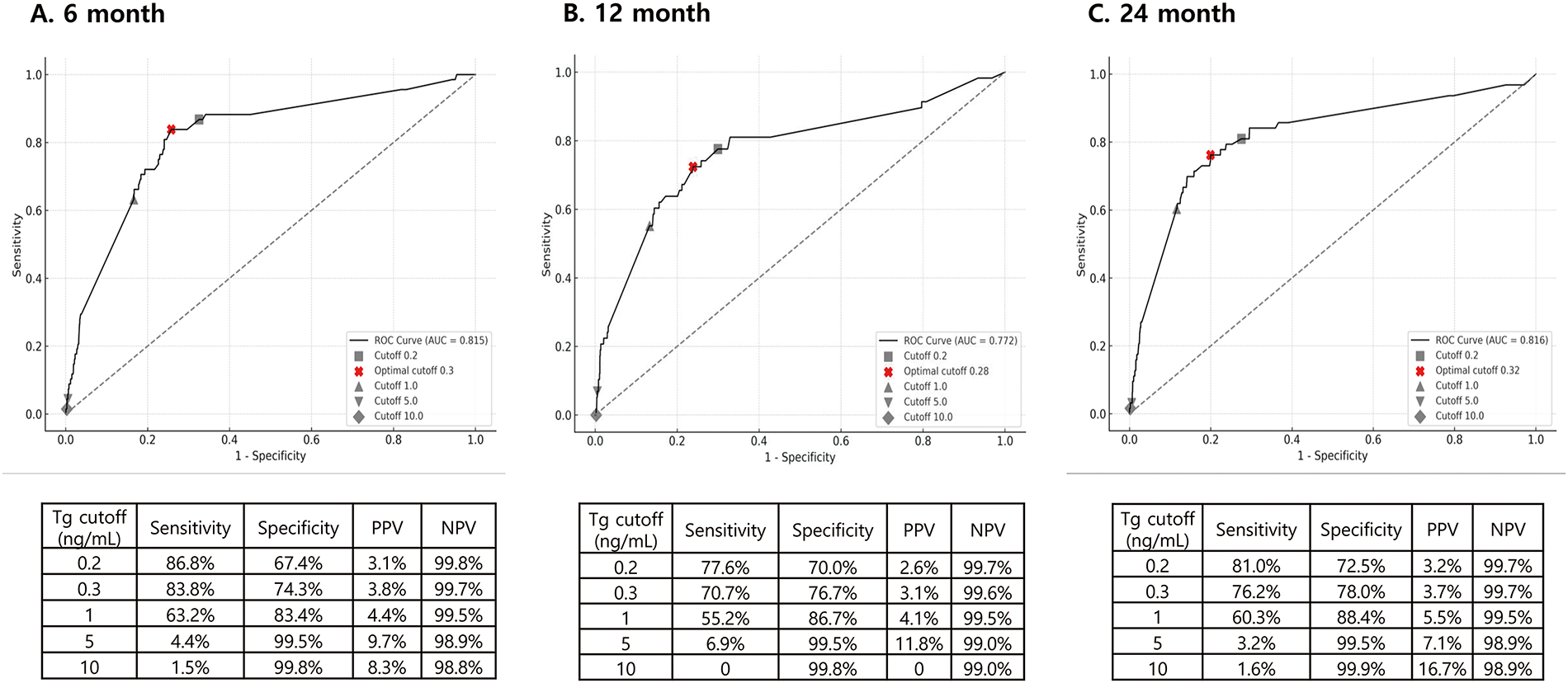
Receiver operating characteristic curves for the prediction of structural recurrence based on postoperative serum thyroglobulin (Tg) levels at three time points.

Distribution of unstimulated Tg levels in patients without structural recurrence at each time point. Boxplots show the median and interquartile range on a logarithmic scale. Horizontal dashed lines indicate reference thresholds at 0.1 and 0.3 ng/mL, derived from this recurrence-free cohort.
Association between postoperative Tg levels and structural recurrence
Serum Tg levels measured at 6, 12, and 24 months after total thyroidectomy were significantly associated with the risk of structural disease recurrence. As presented in Table 2, patients with Tg < 0.2 ng/mL exhibited extremely low recurrence rates, with 10-year cumulative recurrence remaining below 0.3% at all time points. In contrast, recurrence rates increased incrementally with increasing Tg levels. In the 6-month cohort, the 10-year recurrence rate rose from 2.6% for Tg = 0.3–1.0 ng/mL to 10.5% for Tg ≥ 5.0 ng/mL. Comparable stepwise trends were observed at 12 and 24 months, including shorter median time to recurrence with higher Tg categories. A sensitivity analysis limited to patients with TSH < 4 mIU/L showed similar trends, with 10-year recurrence rates of 2.5% for Tg = 0.3–1.0 ng/mL and 10.0% for Tg ≥ 5.0 ng/mL at 6 months (Supplementary Table S2). Similar stepwise increases in recurrence risk across Tg categories were observed in the PTC-only cohort, with 10-year cumulative recurrence rates closely paralleling those of the overall population (Supplementary Table S3). Kaplan–Meier analyses (Fig. 3) demonstrated a clear, statistically significant stepwise decline in RFS with increasing postoperative Tg levels across all time points. The differences in RFS were statistically significant under both stratification schemes (Tg < 0.3, 0.3–5.0, and ≥ 5.0 ng/mL; and Tg < 0.2, 0.2–5.0, and ≥ 5.0 ng/mL), with all log-rank p-values less than 0.001.

Recurrence-free survival (RFS) according to postoperative Tg levels. Kaplan–Meier curves for RFS stratified by unstimulated serum Tg levels measured at 6, 12, and 24 months following total thyroidectomy in patients with differentiated thyroid carcinoma who did not receive radioactive iodine therapy.
Recurrence Rates According to the Serum Tg Level Group in Differentiated Thyroid Carcinoma Patients Following Total Thyroidectomy Without Radioactive Iodine Therapy

5YR, 5-year recurrence rate; 10YR, 10-year recurrence rate; IQR, interquartile range; N/A, not available.
Independent prognostic value of 6-month postoperative Tg
On multivariable logistic regression in the 6-month Tg cohort (Fig. 4 and Supplementary Table S4), a primary tumor size > 2 cm (OR = 2.56 [CI 1.23–5.00], p = 0.008), central and lateral neck LN (OR = 4.55 [CI 2.41–8.30], p < 0.001 and OR = 4.90 [CI 1.81–11.98], p < 0.001, respectively), and gross ETE (OR = 3.16 [CI 1.04–8.24], p = 0.028) were all independently associated with recurrence. Although multivariable models showed comparable adjusted odds across N1 categories, the crude recurrence proportions were 3.9% (18/459) for N1a and 12.5% (8/64) for N1b. Notably, a 6-month Tg level ≥ 5.0 ng/mL was independently associated with a markedly increased risk of structural recurrence, regardless of whether the reference group was Tg < 0.3 ng/mL (OR = 30.39 [CI 6.19–112.67], p < 0.001) or < 0.2 ng/mL (OR = 32.37 [CI 6.46–124.69], p < 0.001). These results highlighted the robust prognostic value of early postoperative Tg levels in patients with non-RAI-treated DTC. These associations were similarly observed in the PTC-only cohort, in which larger tumor size, nodal metastasis, gross ETE, and higher 6-month Tg levels remained significant independent factors of recurrence (Supplementary Table S5).

Forest plot of adjusted odds ratios (ORs) for structural recurrence based on the 6-month cohort. ORs are shown on a logarithmic scale; the vertical dashed line indicates OR = 1. Variables with statistical significance in univariate analysis—age, sex, differentiated thyroid cancer type, primary tumor size, multifocality, nodal stage, extrathyroidal extension, and Tg levels—were included in the multivariable model.
Longitudinal trends in Tg by recurrence status
Figure 5 illustrates the longitudinal patterns of unstimulated Tg levels at 6, 12, and 24 months, stratified by recurrence status and baseline Tg categories. In recurrence-free patients, Tg levels were generally stable or gradually declined over time. In contrast, patients who developed structural recurrence exhibited a progressive increase in Tg levels, even among those who initially presented with low Tg concentrations. This dynamic was observed across both stratification models: (A) Tg < 0.3, 0.3–5.0, and ≥ 5.0 ng/mL and (B) Tg < 0.2, 0.2–5.0, and ≥ 5.0 ng/mL. In addition, among patients with a 6-month Tg < 5.0 ng/mL, recurrence was 0.9% with stable/decreasing Tg versus 2.8% with rising Tg, highlighting the prognostic value of Tg trends below 5.0 ng/mL. These patterns underscore the importance of sequential Tg monitoring, as upward Tg trends, even from initially low values, may be associated with an increased risk of subsequent structural recurrence.
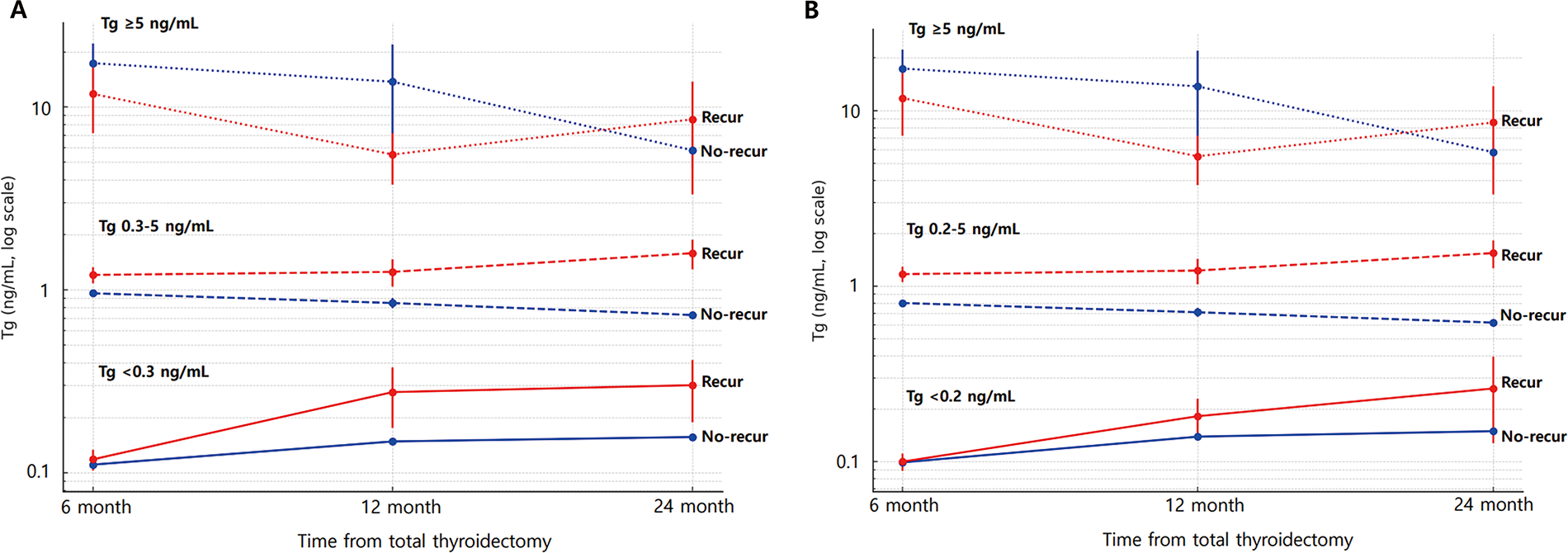
Longitudinal changes in serum Tg levels according to postoperative Tg group and recurrence status.
Discussion
In this large multicenter Korean cohort study of over 5700 patients per time point, we provide robust evidence supporting the prognostic utility and optimal cutoffs of unstimulated serum Tg levels in patients with DTC who have undergone total thyroidectomy without RAI. Tg levels measured at 6, 12, and 24 months postoperatively were consistently associated with long-term structural recurrence, with an optimal cutoff of 0.3 ng/mL across all time points. We also analyzed local and distant recurrences separately, and the results were concordant with the primary analysis. Notably, Tg levels ≥ 5.0 ng/mL at any time point were associated with a 10-year recurrence rate exceeding 5–10%. Serial monitoring further showed that rising Tg levels over time, even when initially low, predicted subsequent recurrence. These findings underscore the importance of incorporating both early and longitudinal Tg assessments into individualized surveillance strategies for patients with non-RAI-treated DTC. While contemporary practice often favors lobectomy for small, low-risk PTC, future analyses reflecting contemporary treatment patterns would be informative.
Under the 2015 ATA guidelines, gross ETE is generally considered high-risk. 1 However, the K-RSS, derived from quantified 10-year recurrence probabilities, reclassifies strap-muscle-limited gross ETE as intermediate-risk, consistent with reported recurrence rates (approximately 6–29% overall and 6–11% in a Korean series).12,13 In our cohort, after classification by the K-RSS, we further stratified the intermediate-risk group by the presence of gross ETE and evaluated 10-year outcomes; patients without gross ETE had a 10-year recurrence rate of 4.8%, whereas those with gross ETE had a rate of 10.1%, supporting their placement within the intermediate-risk category under the K-RSS framework.
According to current guidelines, low-risk FTC is often managed with hemithyroidectomy, and completion total thyroidectomy is typically reserved for higher-risk features.1,4,14 However, our cohort comprises patients diagnosed with DTC between 2000 and 2021, and a substantial proportion underwent surgery before the 2015 ATA and 2016 KTA guideline updates, when clinical practice commonly followed the 2009 ATA and 2010 KTA frameworks. 15 During this era, among patients with follicular neoplasms, the extent of surgery was frequently individualized through shared decision-making, considering multifocal disease, co-existent PTC, clinically significant contralateral nodules, underlying functional thyroid disease, and anticipated diagnostic or therapeutic RAI. 15 Within this historical context, total or completion thyroidectomy could reasonably be selected even in the absence of classic high-risk FTC features. In our cohort, among the 156 patients with FTC, 123 underwent initial total thyroidectomy and 33 underwent completion thyroidectomy after initial lobectomy without intervening recurrence. When we readjudicated all FTC cases using the K-RSS, all were classified as low- or intermediate-risk; none met the high-risk criteria.12,13
Our findings agree with prior reports underscoring the prognostic value of both early postoperative Tg and its longitudinal trend.16–18 In a postoperative cohort, Signore et al. 16 showed that the first Tg measurement (approximately 40 days after surgery) strongly predicted subsequent persistence or metastatic progression, supporting low early Tg as a marker of a favorable prognosis. Stevic et al. 17 documented a transient early rise in Tg immediately after RAI ablation, followed by a decline below baseline by 6 months, a pattern likely reflecting Tg release from remnant destruction and inflammation, emphasizing that this time course should be considered when interpreting early Tg. Extending beyond single time points, Li et al. 18 demonstrated that increasing Tg levels in patients with biochemical incomplete response were associated with adverse outcomes. Taken together, these data align with our observation that very low early Tg levels identify a group with minimal long-term recurrence, whereas dynamic Tg trends over time provide incremental prognostic information to refine follow-up intensity in contemporary thyroid cancer management.
Several previous studies have investigated serum Tg thresholds to define response categories in patients with DTC after total thyroidectomy without RAI therapy, thereby contributing to the refinement of dynamic risk stratification in this setting.2,10,11 Momesso et al. assessed a modified response-to-therapy system in patients who underwent total thyroidectomy without RAI and reported that an unstimulated Tg < 0.2 ng/mL was associated with no structural recurrence during a median 8.4-year follow-up. 10 Similarly, Nascimento et al. and Mourao et al. demonstrated that initial Tg levels measured within the first 9 months after total thyroidectomy that remained below 0.3 ng/mL were consistently associated with an extremely low risk of recurrence in patients who did not receive RAI therapy, thereby supporting the rationale for less intensive follow-up in this subgroup.19,20
Expanding on these observations, our study provides large-scale, longitudinal evidence confirming that Tg levels < 0.2 ng/mL at 6, 12, and 24 months are consistently associated with a 10-year recurrence risk below 0.3%, reinforcing this cutoff as a robust indicator of “excellent response.” Although 0.3 ng/mL was identified as the optimal cutoff across all time points in our ROC analysis, and the upper bound of the IQR range in recurrence-free patients also approached 0.3 ng/mL, the difference between 0.2 and 0.3 ng/mL was minimal, and their overall diagnostic performance was comparable. Thus, continued clinical use of the established 0.2 ng/mL threshold remains reasonable. Conversely, even moderately elevated Tg levels (0.3–5.0 ng/mL) were linked to a stepwise increase in recurrence risk, reinforcing the need of Tg-based, risk-adapted surveillance in this patient population.
A key strength of our study is the identification of a postoperative Tg threshold of ≥ 5.0 ng/mL at 6 months, which was independently associated with an increased risk of recurrence, thereby validating and extending the cutoff proposed by the ESMO and KTA guidelines, as well as recent studies.2,3,10 Notably, Tg levels ≥ 5.0 ng/mL at 6, 12, and 24 months were each associated with a 10-year recurrence rate exceeding 5–10% (9.7%, 11.8%, and 7.1%, respectively). Although a biochemical incomplete response has widely been defined as Tg ≥ 10.0 ng/mL in RAI-treated patients,1,21 emerging evidence suggests that a lower cutoff of 5.0 ng/mL may be more appropriate for patients not receiving RAI.10,22 This threshold also aligns with the recurrence risk definition for low-risk patients (approximately 5% at 10 years) in the postoperative risk stratification system of the KTA, 12 further supporting its clinical relevance. Importantly, a 6-month Tg level ≥ 5.0 ng/mL remained independently associated with recurrence after adjusting for established clinicopathological factors. Additionally, we evaluated multiple prespecified thresholds, including 2.5 ng/mL per the 2025 ATA guidelines, and observed consistent directional performance across time points. Nevertheless, this finding highlights that even moderately elevated Tg levels during the first postoperative year, well below the conventional “biochemical incomplete” threshold, carry prognostic significance. This insight is increasingly critical as a growing proportion of patients with DTC worldwide are managed without RAI.
Although a single postoperative Tg measurement provides useful information, our study demonstrated that the longitudinal monitoring of unstimulated Tg levels adds substantial prognostic value to patients managed without RAI therapy. Specifically, we observed that patients who developed structural recurrence often showed a progressive increase in Tg levels over time, even among those with initially low Tg values, whereas recurrence-free patients typically exhibited stable or declining Tg levels throughout the follow-up period. Even with Tg < 5.0 ng/mL early postoperatively, rising trends conveyed a significantly higher risk than stable or declining patterns. These dynamic trends have been highlighted in previous non-RAI cohorts.8,20,23 Durante et al., 8 Mourao et al., 20 and Rosario et al. 23 each reported that an increasing Tg trajectory was strongly associated with recurrence, whereas no recurrence was observed among patients with stable or decreasing Tg levels. Collectively, these results underscore the clinical importance of serial Tg measurements, as upward trends, particularly in patients with borderline or mildly elevated Tg levels, may enable the earlier identification of recurrence before the structural disease becomes apparent on imaging.
This study had several strengths, including a large sample size, multicenter design, stringent exclusion criteria to minimize Tg assay interference, and detailed analyses at multiple postoperative time points. However, this study had several limitations. First, the retrospective design inherently introduces a risk of selection bias, missingness, and unmeasured confounding factors. Inferences are associational and not causal, although selection bias was mitigated by enrolling consecutive eligible patients across centers. Second, the exclusively Korean, high-volume, tertiary-center cohort may limit external generalizability to non-Asian settings with different iodine intakes, surgical practices (and thus the extent of remnant tissue after total thyroidectomy), and Tg assay selection and standardization. In our study, patients were treated at high-volume tertiary centers, where total thyroidectomy aimed to minimize remnant tissue. Because postoperative Tg reflects residual normal thyroid tissue, settings with different operative techniques, surgeon experience, or routine acceptance of larger remnants could yield higher baseline Tg levels and shift the operating characteristics of the Tg cutoff values. In addition, although all participating centers used second-generation, high-sensitivity Tg assays with functional sensitivity < 0.2 ng/mL, residual interassay variability likely persists; moreover, in settings that employ lower-sensitivity Tg assays, direct application of our proposed cutoffs may be limited and should be approached with caution. Accordingly, multinational, multiethnic prospective validations across diverse iodine nutritional backgrounds, surgical practices, and Tg assays are warranted to confirm transportability and refine assay-specific thresholds. Third, patients with positive TgAb levels or suboptimal TSH suppression were excluded, which may limit the generalizability of our findings to these subgroups. In addition, we were unable to adjust for interkit variability in the TSH assays, 24 which may have led to the misclassification of patients near the 2.0 mIU/L threshold. For instance, patients with true TSH values below 2.0 mIU/L might have been excluded if their measured TSH exceeded the threshold due to assay-specific differences, and vice versa. Nonetheless, a sensitivity analysis restricted to patients with TSH levels <4.0 mIU/L yielded similar Tg cutoff values, supporting the robustness of our findings under a normal-range TSH target framework. Fourth, the follow-up duration in our cohort may have influenced the apparent prognostic value of early postoperative Tg levels. Current guidelines advise against using Tg levels in isolation for prognostication and instead recommend interpreting Tg levels within both initial and dynamic risk stratification frameworks during follow-up, incorporating absolute levels and temporal trends. Paradoxically, the possibility of very late recurrence (>10 years) necessitates long-term surveillance. Further studies are needed to establish evidence-based Tg cutoffs and optimize follow-up intervals.
This large multicenter Korean study demonstrated that postoperative unstimulated Tg level is a significant prognostic marker for recurrence in patients with DTC managed without RAI therapy. Our findings validate and extend current dynamic risk stratification frameworks, confirming that Tg thresholds of 0.2 ng/mL and 5.0 ng/mL effectively guide follow-up intensity and clinical decision-making in this population. Importantly, even patients with initially low Tg levels showed an increased risk of recurrence when Tg levels progressively increased over time, highlighting the clinical significance of dynamic Tg monitoring. These results provide an evidence-based foundation for individualized surveillance strategies based on both Tg cutoffs and trends in patients with non-RAI-treated DTC.
Authors’ Contributions
Conceptualization, formal analysis, and writing—original draft: M.K., E.K.L., Y.J.P., and B.H.K. Data curation and writing—review and editing: M.K., E.K.L., K.J.K., S.M.S., J.J., M.J., J.Y.S., J.S.B., K.K., W.G.K., M.J.J., S.H.K., H.K.K., J.H.Y., Y.E.K., H.Y.A., Y.J.P., and B.H.K.
Footnotes
Author Disclosure Statement
The authors have no relevant financial or nonfinancial interests to disclose.
Funding Information
E.K.L. reports funding from the Patient-Centered Clinical Research Coordinating Center, funded by the Ministry of Health & Welfare, Republic of Korea (grant number: RS-2024-00398702). B.H.K. reports funding from the Korean Thyroid Association Clinical Research Award 2024. No other authors have funding to declare. This study was supported by the Korean Thyroid Association Clinical Research Award 2024 and the Patient-Centered Clinical Research Coordinating Center, funded by the Ministry of Health & Welfare, Republic of Korea (grant number: RS-2024-00398702).
Supplemental Material
References
Supplementary Material
Please find the following supplemental material available below.
For Open Access articles published under a Creative Commons License, all supplemental material carries the same license as the article it is associated with.
For non-Open Access articles published, all supplemental material carries a non-exclusive license, and permission requests for re-use of supplemental material or any part of supplemental material shall be sent directly to the copyright owner as specified in the copyright notice associated with the article.
