



Abstract
Musculoskeletal disorders (MSDs) and chronic fatigue are prevalent issues in the dairy industry, driven by repetitive tasks, poor posture, and biomechanical strain. Studies reveal strong connections between postural stress, tendon strain, and increased injury rates among workers. Effective interventions, such as task rotation, workstation adjustments, and ergonomic training, have been shown to reduce MSD risks and improve worker health. Holistic approaches that combine ergonomic enhancements with education address physical and environmental challenges comprehensively. These findings emphasize the need for early ergonomic strategies to boost productivity, reduce absenteeism, and ensure safer working environments in the dairy sector.
Keywords
Respected sir,
As a physiotherapist specializing in community rehabilitation and rural occupational health, I have found that Work: A Journal of Prevention, Assessment, and Rehabilitation is a priceless asset for my research, especially regarding musculoskeletal disorders (MSDs) and chronic fatigue within the dairy sector. The findings from the journal's research on biomechanical overload and ergonomics have enriched my comprehension of the physical obstacles encountered by dairy workers.
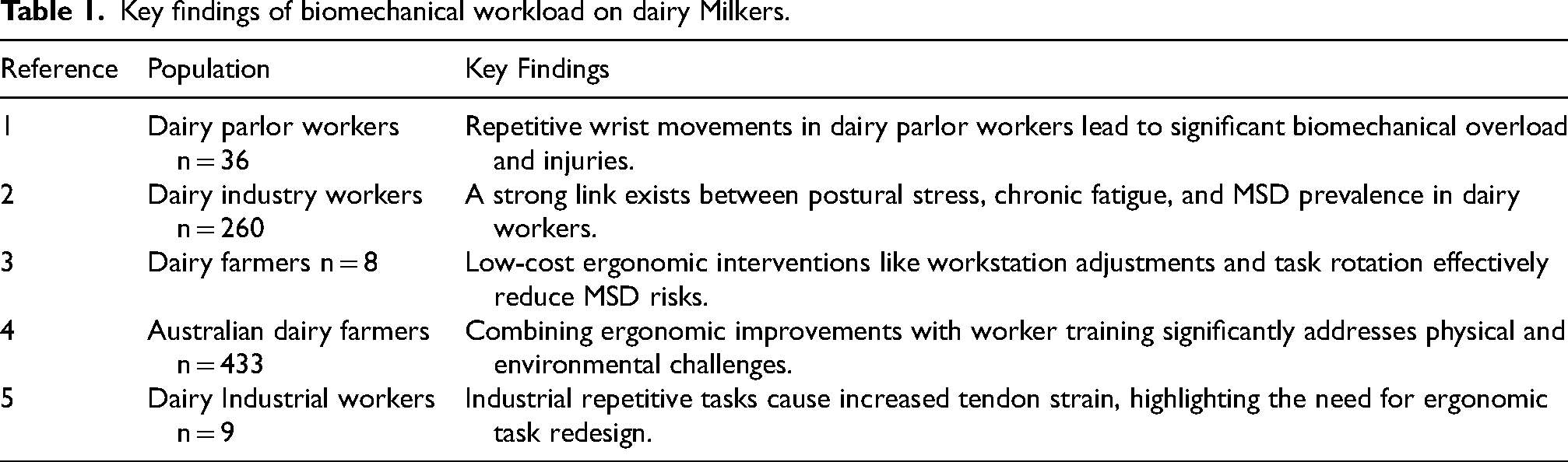
A study conducted by Masci explored the biomechanical strain experienced by workers in dairy parlors, emphasizing the considerable impact of repetitive wrist motions in leading to injuries. 1 In the same vein, Vosoughi, in his studies, highlighted a significant connection between postural stress, chronic fatigue, and the incidence of musculoskeletal disorders (MSDs), underscoring the dangers linked with improper posture while performing everyday tasks. 2 Mokarami and colleagues, in another study, evidence emerged showing that ergonomic interventions, like revising workstations and rotating tasks, effectively decreased risk factors for musculoskeletal disorders at a low cost and further highlighted that the repetition of industrial duties can lead to increased strain on tendons, emphasizing the significance of redesigning tasks. 3 Innes and Walsh highlighted the importance of taking a holistic approach that integrates ergonomic enhancements and employee training to tackle physical and environmental factors 4 effectively.
These results underscore the pressing need for preventive measures. Implementing early ergonomic interventions, such as task rotation, workstation adjustments, and posture correction, is crucial for reducing musculoskeletal disorders (MSDs) and chronic fatigue.. 5 It has also been found that the prevalence of MSDs is higher than that of chronic fatigue. The application of these strategies enhances the physical well-being of workers while boosting productivity and decreasing absenteeism in the dairy industry.
In summary, as shown in Table 1 the studies highlight the significance of tackling occupational health issues in the dairy industry with precise, evidence-supported actions. By incorporating ergonomic solutions and promoting awareness, organizations can create safer working environments and enhance efficiency and employee satisfaction.
I am grateful for the journal's ongoing dedication to occupational health. It has significantly influenced my understanding and approach to addressing these critical issues and helped with my research.
Key findings of biomechanical workload on dairy Milkers.
Footnotes
Acknowledgment
The authors have no acknowledgments.

Ethical approval
Not Applicable.
Informed consent
Not Applicable.
Funding
The authors received no financial support for the research, authorship, and/or publication of this article.
Declaration of conflicting interests
The authors declared no potential conflicts of interest with respect to the research, authorship, and/or publication of this article.