




Abstract
Background
Agricultural hand tools such as khurpi, fork, and sickle are widely used for various farm operations in the hill regions of Uttarakhand, India. However, these tools are not ergonomically designed, resulting in increased fatigue, health risks, and accidents among agricultural workers.
Objectives
This study aims to collect the anthropometric data of hill farmers in Uttarakhand and propose design modifications for commonly used agricultural hand tools to improve their efficiency, safety, comfort, and acceptance.
Methods
Anthropometric measurements of 36 dimensions were collected from 200 male agricultural workers across different villages in the hill regions of Uttarakhand. The collected data were analyzed to determine the mean, range, standard deviation, and 5th, 50th, and 95th percentile values. These anthropometric and strength data were used to design new hand tools and optimize existing ones.
Results
The hand grip strength (5th and 95th percentile values) of hill farmers was found to be lower compared to the national average of Indian farmers. Based on the collected data, the appropriate handle diameter for the hand tools, including the khurpi, fork, and sickle, was found to be tapered, measuring 32 mm at one end and 34.1 mm at the other end. While the appropriate handle length was 115.6 mm for all three tools.
Conclusions
Ergonomically designed hand tools with optimized dimensions can significantly reduce drudgery, enhance efficiency, and improve the safety and comfort of agricultural workers in the hill regions of Uttarakhand.
Introduction
Uttarakhand, situated at 28°43’ N latitude and 81°02’ E longitude, has a total geographical area of 53,483 square kilometers. The state comprises both hill and plain regions, with the hill region covering approximately 46,035 square kilometers and the plain region spanning 7448 square kilometers. The population of the state is approximately 100.86 lakh*, with males comprising about 51% (51.43 lakh) and females accounting for 49% (49.42 lakh) of the total population. Uttarakhand has a population density of approximately 189 persons per square kilometer, with 70% of the state's population residing in rural areas. This highlights rural localities as key sources of human capital in the state. Due to the domination of hilly tracts, the state is termed a hilly state. Agriculture plays a vital role in the economy and more than 75% of the people living in hills have taken agriculture as their main occupation for their livelihood.1,2 A significant proportion of agricultural workers in the hills remain unaffected by modernization and lack knowledge of new agricultural techniques and tools, leading to low productivity.
The role of crop production machinery, from tillage to post-harvest operations, is crucial. Farm productivity is directly linked to the level of mechanization. Agricultural machinery ensures timely operations and facilitates the efficient use of inputs.3,4 Additionally, it significantly reduces drudgery, making farm labor more efficient and productive. Farm machinery benefits not only large-scale farms but also small and marginal farmers, including hill farmers, whose land is fragmented and located in challenging terrain.
In most of the villages of hilly region, local implements such as nasooda (plough), danala (interculture implement), damala (paddy puddler) and wooden patela are primarily used. In addition, hand tools such as kutla, kassi, spade, daranti and thamali are also prevalent. The farmers also use improved sickles for harvesting grain crops as well as fodder/grass, hand-operated winnowing fans and chaff cutters are also largely used.
Agricultural tools are typically fabricated by local artisans without considering ergonomic design, leading to discomfort, increased drudgery, and, in many cases, accidents among agricultural workers.5,6 Incorporating proper anthropometric data has been suggested as a way to aid in designing new hand tools and modifying existing ones for safer and more efficient use.7,8 Ergonomically designed tools significantly impact workers’ capabilities and limitations. The design of equipment and hand tools must balance the operator's biological needs, determined by ergonomic guidelines, with the physical requirements of the machinery or equipment.9–11
Anthropometric data of the user population are crucial for designing and improving farm equipment and implements to reduce drudgery, enhance efficiency, and improve safety and comfort. 12 The anthropometric differences between Nigerian and north-eastern Indian agricultural workers emphasize the need for region-specific data to improve ergonomic equipment design. 13 A study in Enugu State, Nigeria, further highlighted the importance of such data for optimizing agricultural tool design. 13
Farm equipment and hand tools used in the hills are often designed based on general Indian anthropometric data. 9 However, due to the significant variability in the physique of farm workers from plain and hilly regions, this study was conducted with the objectives of collecting anthropometric data of hill farmers in Uttarakhand and making design modifications to commonly used agricultural hand tools to improve efficiency, comfort, safety, and acceptance.
Methodology
Study area
The farm workers of Uttarakhand have distinct physical characteristics compared to the broader Indian population. Therefore, an ergonomic survey was conducted on agricultural workers in the hill region. The anthropometric survey was carried out in the villages of Debuajala, Bakarkhor, Betalghat, Amel, Tiwarigaon, Raulia, Bhidapani, Tanda, Khansyu, Ban Pokhra, Kador, Majela, Talla Okhalkanda, Galni, Bhadretha, Turshar, Dhalkandya, Talli Pokhri, Lowaldoba, Matela, Pashya, Amjar, Gonyaro, Gaulapar, and Hedakan, located in the Nainital district of Uttarakhand. The survey covered two hundred male farm workers (Figure 1).
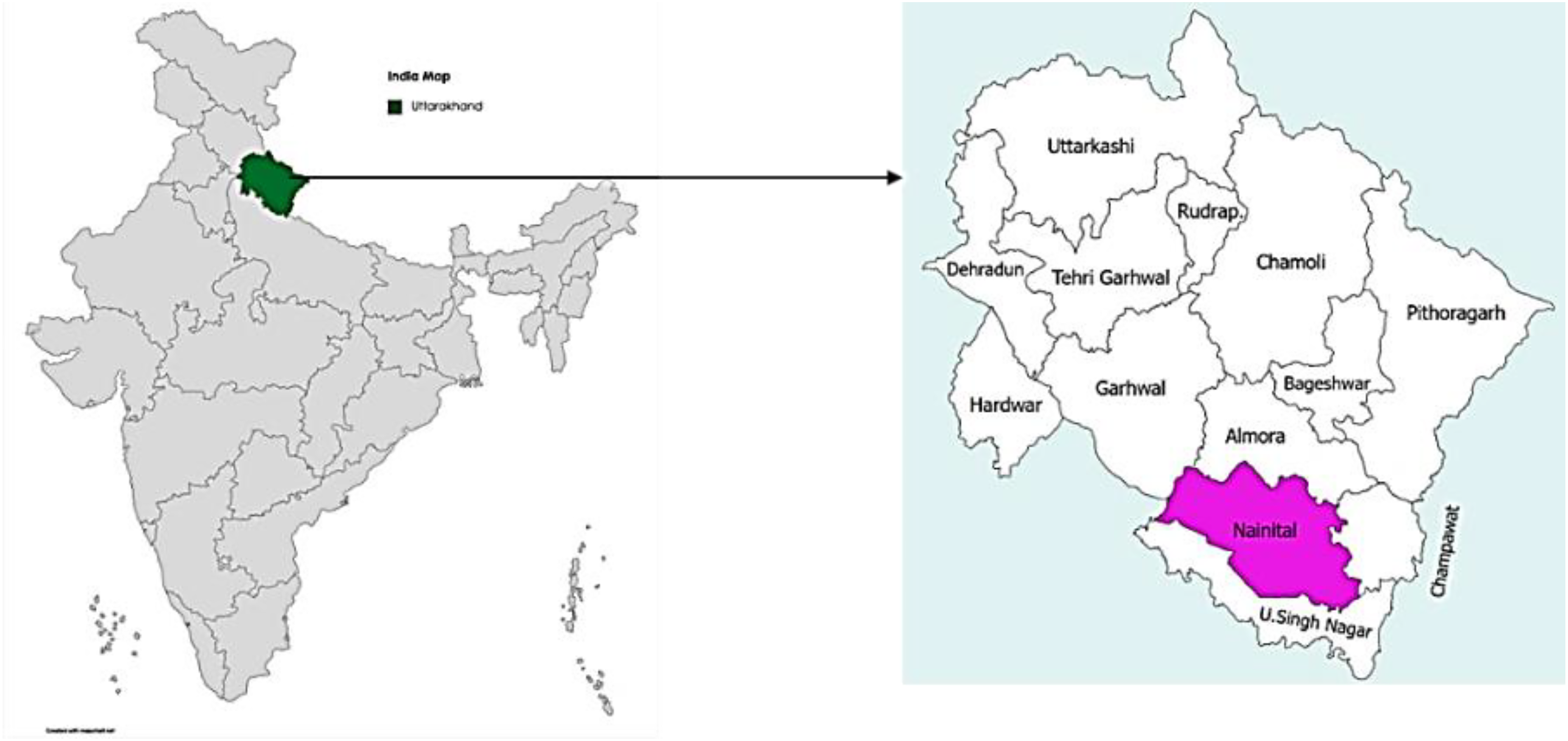
Study area of anthropometric survey in Uttarakhand, India.
Hand tools used by hill agricultural workers
In the hilly regions, traditional agricultural tools play a vital role in farming operations. The khurpi (Figure 2(a)), made of steel with a wooden handle (145 mm in length and a grip diameter of 27–31 mm), is particularly effective for weed cutting, intercultural tasks, and nursery planting, especially in stony and heavy soils. It typically weighs between 0.3 and 0.45 kg. The hill fork (Figure 2(b)) is available in various sizes, with wooden handles (155 mm in length and a grip diameter of 25–27 mm) and mild steel forks, used for stone and weed collection, intercultural operations, and soil pulverization. It weighs between 0.40 and 0.75 kg. Sickles (Figure 2(c)), with serrated steel blades and wooden handles (120 mm in length and a grip diameter of 25–35 mm), are used for crop harvesting, while plain blades are used for grass cutting. Sickles typically weigh around 0.25 kg. These traditional tools remain essential for sustainable farming practices in the hilly regions.
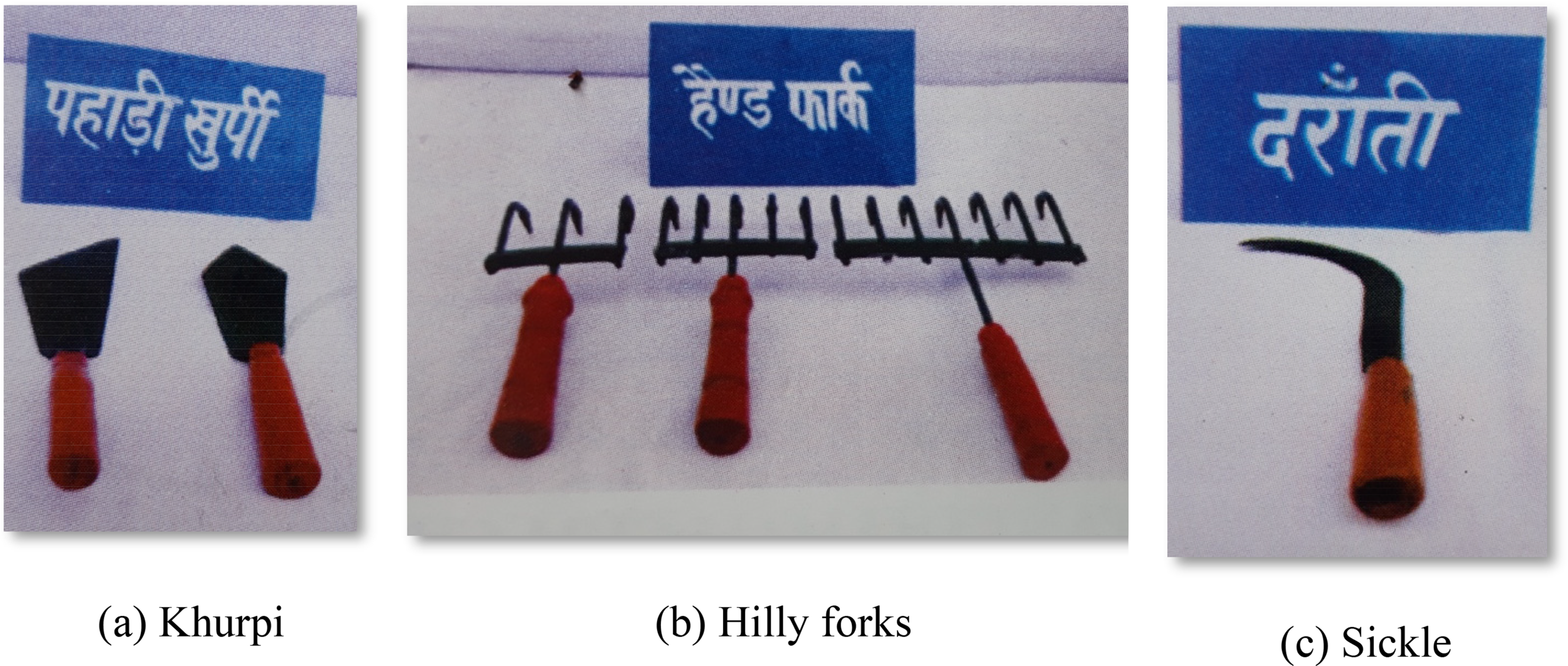
Common hand tools used by hill farmers.
Sample size
The subjects were selected randomly among existing male farm workers performing different agricultural operations in the selected villages. For this selection process, a representative sample size was taken. For determining the sample size, the relationship
14
was adopted; sample size is defined by applying equation (1).

Where, N = required sample size, S = estimated standard deviation of the data, d = the desired accuracy of the measurement and k = (4.14) is a value chosen for the statistic of interest (for 5th and 95th percentile statistic).
The sample size was calculated based on the required dimension i.e., metacarpal height, inside grip diameter, middle finger palm grip diameter and hand breadth across the thumb. It was observed that 200 would be the minimum sample size for the anthropometric survey hence 200 male farm workers in the age group of 18–60 years were randomly chosen as per guidelines. 15 Personal information such as hand use (left or right), occupation and address of selected male farm workers were also collected. All the subjects selected for anthropometric measurements were free from physical abnormalities, musculoskeletal problems and history of chronic or acute illness.
Anthropometric measurements
Anthropometric measurements were taken for each individual in the selected sample using a Harpenden anthropometric kit. The parameters measured included height, eye height, acromial height, elbow height, olecranon height, illiocrystale height, iliospinal height, trochanteric height, metacarpal height, knee height, medial malleolus height, lateral malleolus height, waist-back length, bideltoid breadth, and sitting height. A wooden cone-type grip span meter was used to measure grip diameter, while a wooden rod with a hold-on cylinder measured the middle finger palm grip diameter. The index finger diameter, hand breadth across the thumb, grip span, and outside grip diameter were measured with a Vernier caliper. Subject weight was recorded using a Krups weighing machine with a capacity of 125 kg and a minimum graduation of 0.5 kg. A handgrip dynamometer was employed to measure the maximum isometric strength of the hand and forearm muscles and assess handgrip strength. The range of the grip dynamometer was 5–100 kgf (Figure 3(x)).

Anthropometric Measurements of different body dimension: (a) Stature, (b) Vertical Reach, (c) Vertical Grip Reach, (d) Acromial Height, (e) Eye Height, (f) Elbow Height (g) Olecranon height (h) Illiocrystale Height, (i) Illiospinale Height, (j) Trochanteric Height, (k) Metacarpal III Height, (l) Knee Height, (m) Sitting Height, (n) Sitting Eye Height, (o) Waist Back Length, (p) Bideltoid breadth, (q) Span, (r) Arm reach from the Wall, (s) Thumb Tip Reach, (t) Shoulder Grip Length, (u) Hand & palm length, (v) Hand breadth across thumb, (w) Middle finger palm grip diameter, (x) Hand grip strength, (y) Anthropometric Kit, (z) Grip Diameter.
Collection of data
Thirty-six body dimensions including age and body weight 16 were measured. The anthropometric measurements in this study have been referenced against ISO 7250 to ensure consistency and comparability with standardized definitions and other studies. 17 To collect anthropometric measurements, it was made sure that the persons selected were in normal health, free from physical abnormalities and musculoskeletal disorders. 18 Before data collection, the subjects were familiarized with the measurement setup and the process. They were instructed to be barefoot and wear light clothing to minimize measurement errors. During the measurement of body dimensions, care was taken to avoid excessive compression of underlying tissues. When measurements were taken in a standing posture, the subjects were asked to stand upright with their feet together and their body aligned vertically, ensuring that their heels, buttocks, and shoulders were in contact with the vertical plane. The anthropometric rod was adjusted according to the subject's height.
Similarly For measurements in the sitting posture, the subjects were instructed to sit with their body aligned vertically, ensuring that their shoulders and heads touched the same vertical plane. In this posture, the subjects’ feet were placed flat on the base platform. Both postures were maintained as naturally as possible throughout the survey, following the recommended guidelines. 19 Handgrip and weight measurements were taken twice to have an average value, the remaining measurements were taken just once only. In order to achieve greater uniformity, all lateral dimensions were taken from left-hand side of the subject while transverse dimensions from the ground and were noted to the nearest millimeter.
Analysis of data
The observed anthropometric values for each subject were analyzed using SPSS (Statistical Package for the Social Sciences) version 18 to calculate the mean, range (maximum and minimum), standard deviation (SD), 5th percentile, 50th percentile, and 95th percentile.
Design criteria
Ergonomic considerations were applied in the design and proposed modifications of the selected agricultural hand tools in this study. The handle grip and handle length of the tools were designed based on anthropometric data, as discussed below:
Handle grip
Gite 20 suggests that the desired shape of the handle grip should be cylindrical, with a diameter that ensures the operator's longest finger does not touch the palm while holding the grip. Additionally, the grip should not exceed the internal grip diameter. Since the tool is intended for use by male workers, the 95th percentile of the middle finger palm grip diameter represents the lower limit, and the 5th percentile of the inside grip diameter serves as the upper limit. Therefore, the recommended handle grip diameter should fall within the 5th percentile range of the inside grip diameter.
Handle length
Based on anthropometric considerations, the length of the handle should accommodate the maximum hand breadth across the thumb. The handle length should be designed using the 95th percentile value of hand breadth across the thumb, with a 5 mm clearance on each side of the grip.
Results and discussion
Thirty-six body dimensions of two hundred male farm workers were analyzed. The various observations as presented in (Table 1) were included to evaluate mean, standard deviation, range, minimum, maximum, 5th and 95th percentile, values of different body dimensions including age, weight and strength parameters.
Anthropometric data of male agricultural workers of a hilly region in Uttarakhand in the age group of18–60 years (n = 200).
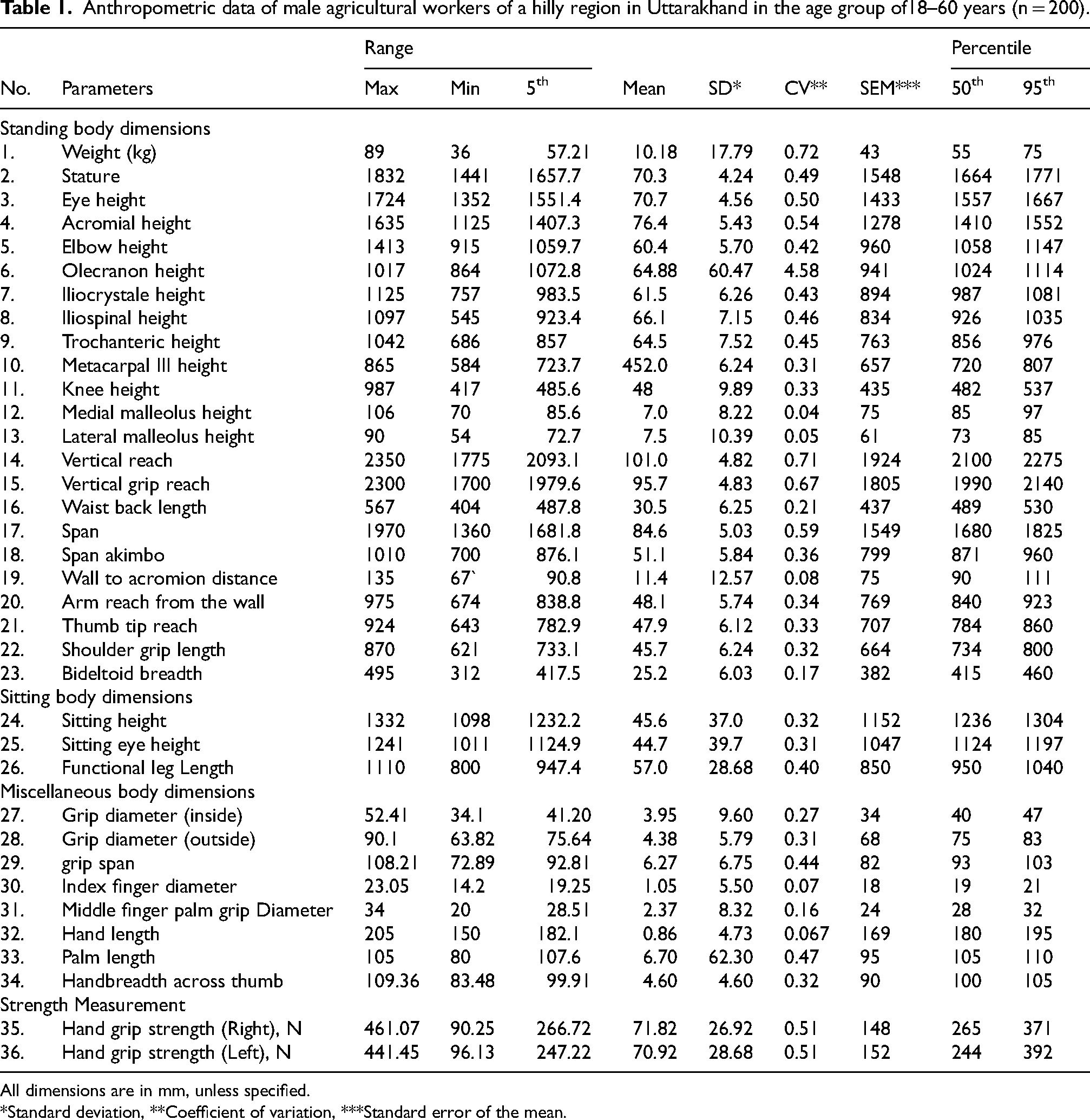
All dimensions are in mm, unless specified.
*Standard deviation, **Coefficient of variation, ***Standard error of the mean.
Analysis of anthropometric data
The measurements were taken in three postures: standing, sitting, and miscellaneous. The mean weight and stature of the farm workers were 57.21 ± 10.18 kg and 1657.7 ± 70.3 mm, respectively. In the standing posture, dimensions such as stature, eye height, vertical reach, and vertical grip reach had higher standard error of the mean (SEM), with values ranging from 0.49 to 0.71. The sitting height, sitting eye height, and functional leg length had SEM values of 0.32, 0.31, and 0.40, respectively. The coefficient of variation (CV) ranged from 3.70% to 62.30% for all selected dimensions. Notably, the CV of palm length was 62.6% higher compared to other body dimensions.
The metacarpal height, inside grip diameter, middle finger palm grip diameter, and hand breadth across the thumb were used for design purposes. The 5th and 95th percentile values of metacarpal height for farmers in Uttarakhand were 720.5 mm and 807.1 mm, respectively, with a CV of 6.24%, a standard deviation (SD) of 452, and a SEM of 0.31. The 5th and 95th percentile values for inside grip diameter and middle finger palm grip diameter were 34.11 mm, 47.29 mm, and 24 mm, 32 mm, respectively. For inside grip diameter, the CV, SD, and SEM were 9.60%, 3.95 mm, and 0.27 mm, respectively. For middle finger palm grip diameter, the CV, SD, and SEM values were 8.32%, 2.37 mm, and 0.16 mm, respectively. These values were used to determine the optimal handle grip diameter. The 5th and 95th percentile values for hand breadth across the thumb were 90.23 mm and 105.66 mm, respectively, with a CV of 4.60%, an SD of 4.60 mm, and a SEM of 0.32 mm. The 5th and 95th percentile values for elbow height were 959.7 mm and 1147.0 mm, respectively, with an SD of 60.4 mm, a CV of 5.70%, and a SEM of 0.42 mm. The olecranon height had 5th and 95th percentile values of 941 mm and 1114.1 mm, respectively, with an SD of 64.88 mm, a CV of 60.47%, and a SEM of 4.58 mm. The range for right-hand grip strength was 370.18 ± 71.82 N, and for left-hand grip strength, it was 345.31 ± 70.92 N. Both strength parameters had SEM values of 0.51 and 26.92% CV for right-hand grip strength, and 0.51 and 28.68% CV for left-hand grip strength, respectively.
Percentage variation of 5th and 95th percentile of different anthropometric parameters of farm workers of hilly region Uttarakhand
The 5th and 95th percentile values of various anthropometric measurements of hill farmers, along with comparative data, 13 are presented in Table 2. The table reveals that the percentage variation in the 5th percentile values of hill farmers compared to all Indian farmers ranged from −28.09% to 82.88%, while for the 95th percentile values, the variation ranged between −27.29% and 49.07%. Notably, the maximum percentage variation for the 5th percentile was observed in grip span, while the minimum was found in right-hand grip strength. Similarly, for the 95th percentile, the highest percentage variation was observed in sitting eye height, while the lowest was recorded for right-hand grip strength. The 5th and 95th percentile values for the weight of hill farmers were found to be 2.38% and 4.89% higher, respectively, than those of all Indian farmers. Additionally, the 5th and 95th percentile values for standing measurements, such as stature, eye height, acromial height, elbow height, olecranon height, iliocrystale height, iliospinal height, trochanteric height, metacarpal III height, knee height, medial malleolus height, lateral malleolus height, vertical reach, and waist back length, were higher for hill farmers compared to all Indian farmers. However, the 5th and 95th percentile values for vertical grip reach and span were lower for hill farmers than for all Indian farmers. Moreover, the percentage variation in the 5th percentile values for span akimbo, wall-to-acromial distance, arm reach from the wall, thumb tip reach, shoulder grip length, and bideltoid breadth was higher for hill farmers compared to all Indian farmers. In contrast, the percentage variation in the 95th percentile values for these parameters was lower for hill farmers, as shown in Table 2. It was also observed that the percentage of variation of hill farmers with all Indian farmers for 5th and 95th percentile of sitting height, sitting eye height and functional leg length were 54.59 and 43.31%, 62.31and 49.07% and −3.44 and −4.14% respectively. For sitting height and sitting eye height of hill farmers had higher values of 5th and 95th percentile than all Indian farmers whereas for functional leg length values were less.
Percentage variation of 5th and 95th percentile of different parameters of hill region farm workers.

* Source: Gite and Chatterjee, 1999
The observation on miscellaneous body dimensions indicated that the values of 5th and 95th percentile of grip diameter (inside and outside) were less for hill farmers than the all-Indian farmers. The percentage variations of 5th and 95th percentile values for grip diameter (inside and outside) were −12.53 and −18.46%, and −7.716 and −21.60% respectively. It was also observed that the 5th percentile values of index finger diameter, middle finger palm grip diameter, hand length, palm length and hand breadth across the thumb for hill farmers were higher than all Indian farmers, whereas 95th percentile values were less. Grip span of hill farmers was higher 5th and 95th percentile values than the all-Indian farmers, the percentage variation of 5th and 95th percentile were 82.88 and 23.98% respectively.
The strength parameters presented in Table 2 indicate that the 5th and 95th percentile values of hand grip strength (right and left) for hill farmers were lower compared to all Indian farmers. The percentage variation in hand grip strength for the 5th and 95th percentiles was −28.09% and −27.29% for the right hand, and −22.02% and −20.88% for the left hand, respectively.
For metacarpal height, the percentage variation for the 5th and 95th percentiles was observed to be 5.93% and 4.91%, respectively. Similarly, the percentage variation for inside grip diameter at the 5th and 95th percentiles was −12.53% and −18.46%, respectively. For middle finger palm grip diameter, the percentage variation was 33.33% for the 5th percentile and −15.78% for the 95th percentile. For hand breadth across the thumb, the percentage variation for the 5th and 95th percentiles was 6.15% and −3.94%, respectively.
Application of anthropometric data for agricultural tools of a hilly region
The anthropometric database was used for design of agriculture hand tools such as hill khurpi, fork and sickle. These tools consist of various parts viz. functional part, handle and handle grip. The design of handle depends on various factors like shape, material, mode of operation and anthropometric data of farm workers.
Design of handle length and grip diameter of khurpi
The grip diameter should be designed such that, when held, the operator's longest finger does not touch the palm, while also ensuring the grip does not exceed the internal grip diameter. Since the equipment is intended for use by male workers, the 95th percentile value of the middle finger palm grip diameter (32 mm) was considered the lower limit, and the 5th percentile value of the internal grip diameter (34.1 mm) was taken as the upper limit, as shown in Table 4. Consequently, the recommended grip diameter was 34.1 mm. Additionally, the handle length was designed to accommodate the 95th percentile of the hand breadth across the thumb, which was 105.7 mm. With a clearance of 5 mm on each side of the grip, the total recommended handle length was 115.7 mm. The proposed design dimensions of the khurpi are illustrated in Figure 4(a).

Design of handle length and grip diameter of hand tools.
Design of handle length and grip diameter of hill fork
The handle of the hill fork is ideally cylindrical in shape. Therefore, the handle diameter was proposed based on the 5th percentile value of the internal grip diameter (34.1 mm) and the 95th percentile value of the middle finger palm grip diameter (32 mm). The 95th percentile value of the middle finger palm grip diameter was taken as the lower limit, while the 5th percentile value of the internal grip diameter served as the upper limit. The handle length of the fork was determined using the 95th percentile value of the hand breadth across the thumb, with an additional clearance of 5 mm on each side of the handle. Consequently, the total recommended handle length was 115.7 mm, ensuring comfort for the majority of farm workers in the hill region. The proposed dimensions of the hill fork handle are illustrated in Figure 4(b).
Design of handle length and grip diameter of sickle
The handle length and grip diameter of the sickle were designed based on the 5th and 95th percentiles of the internal grip diameter, middle finger palm grip diameter, and hand breadth across the thumb, as presented in Table 2. The proposed handle dimensions for hill farmers are as follows:
Handle grip diameter: The 5th percentile of the internal grip diameter was considered the upper limit, and the 95th percentile of the middle finger palm grip diameter was taken as the lower limit. The observed values were 32 mm (lower limit) and 34.1 mm (upper limit).
Handle length: Based on the 95th percentile of the hand breadth across the thumb, the handle length was calculated as 105.66 mm, with an additional clearance of 5 mm on each side. Therefore, the total proposed handle length is 115.7 mm (105.7 + 5 + 5).
The proposed design dimensions of the sickle handle are illustrated in Figure 4(c).
Comparison between existing and proposed dimensions of hill agricultural hand tools
The existing dimensions and proposed based on anthropometric study for the hand tools like khurpi, fork and sickle are shown in Table 3.
Existing and proposed dimensions of different hand tools used by hill farmers.

* All dimensions are in mm
Relation between body dimensions and relevant product dimensions with percentile variations.

Conclusions
The comparison between existing and anthropometrically proposed dimensions indicates the following:
The handle of khurpi used by local hill farmers is normally 145 mm long however than the anthropometrically suitable length is 115.6 mm. The diameter of the handle of the khurpi is required to be in the range of 32 to 34.1 mm i.e., 3 to 5 mm more than the existing diameter in order to provide better grip to the user. The handle of fork used by local hill farmers is normally 155 mm long than the anthropometrically suitable length of 115.6 mm. The diameter of the handle of the fork is required to be in the range of 32 to 34.1 mm i.e., 5 to 7 mm more than the existing diameter in order to provide better grip to the user. The handle of sickle used by local hill farmers is normally 120 mm long than the anthropometrically suitable length (115.6 mm). The diameter of the handle of the sickle is required to be in the range of 32 to 34.1 mm i.e., 3 to 5 mm more than the existing diameter in order to provide better grip to the user.
It is therefore suggested that these hand tools may be modified using the proposed dimensions and a detailed study may be initiated to establish comfort work efficiency satisfaction amongst the user handling tools made of proposed dimensions.
Limitations
This study was focused exclusively on male agricultural workers in the hill regions of Uttarakhand, which may not fully represent the anthropometric and ergonomic needs of female workers. The sample size, though adequate for preliminary analysis, may not capture the full anthropometric diversity of hill populations across different districts or altitudes. The design modifications were based on static anthropometric and hand grip strength measurements, without accounting for dynamic postural variations during actual tool use.
Footnotes
Acknowledgments
This work was supported and facilities were provided by ICAR-AICRP on Utilization of Animal Energy project at G.B. Pant University of Agriculture and Technology, Pantnagar, Uttarakhand, India. We are also thankful to hill farmers (Uttarakhand) for helping us by sparing their time for interactions.
Ethical considerations
Most of the hill farmworkers were illiterate. However, they were informed about the study, and verbal consent was obtained for their participation. Moreover, no treatment/interference was done in their routine work; only observations were recorded. The Institute is a crop-based Institute, and the Advisory Committee looks after all the aspects of student research. Only after their approval is the work carried out.
Informed consent
The workers were informed about the study and consent was obtained. These were regular farm workers and were willing to participate in the study. Oral consent was taken as most of them were illiterate. However, the images are masked for privacy.
Funding
This work was supported by ICAR-AICRP on Utilization of Animal Energy project.
Declaration of conflicting interests
The authors declared no potential conflicts of interest with respect to the research, authorship, and/or publication of this article.