



Abstract
Background
The growing psychophysical challenges related to display use in workplaces highlight the need for reliable visual ergonomic assessment tools.
Objective
This study aimed to develop and validate the Evaluating Environmental Conditions Based on Visual Ergonomics (ECVD-20), a novel tool for evaluating visual ergonomic conditions in display-based work environments.
Methods
A cross-sectional study was conducted in 2022. The ECVD-20 was developed through a semi-systematic literature review and expert consultation. Structural validity was examined using exploratory factor analysis (EFA). Three trained experts applied the tool in 236 workplaces. An index was created based on item influence coefficients, and its reliability was assessed.
Results
The ECVD-20 demonstrated strong validity (content validity ratio (CVR) = 0.865, content validity index (CVI) = 0.946) and acceptable internal consistency (Cronbach's α = 0.644). The EFA revealed a four-factor structure luminance, lighting systems, ergonomic work tools, and working postures, explaining 55.58% of variance. The receiver operating characteristic (ROC) analysis established a cutoff score of 31.01, effectively classifying total score of ECVD-20 into requires corrective action and no action needed categories.
Conclusions
The ECVD-20 indicates good validity and reliability for assessing visual ergonomics across diverse settings. Its practical application can guide interventions to improve workplace health and productivity.
This is a visual representation of the abstract.
Introduction
The widespread integration of displays into administrative structure and modern workplaces has heightened concerns regarding associated physical and psychological health issues, particularly visual and musculoskeletal disorders.1–4 Studies indicate that over 75% of display users experience at least one such complaint, leading to significant productivity losses and economic burdens.5,6 Moreover, Various research have been conducted on computer and video display terminals (VDT) users to identify and investigate physical-psychological risk factors of the visual environment, which show the high statistics of eye complaints such as eye disorders, vision disorders (blurred vision and diplopia), and other complaints not related to the vision (such as musculoskeletal disorders of the neck, back, wrist).7,8
Visual ergonomics plays a critical role in mitigating these risks. Visual ergonomics is the interaction between humans and other system elements, such as visual environment conditions (lighting and workstation), visual work demands, visual performance and efficiency, visual comfort and safety, lighting modifications, and other auxiliary tools. 9 As a result, insufficient lighting, arrangement, and spacing of work tools such as computers and continuous use of computers are associated with increased visual discomfort and musculoskeletal problems such as neck pain.10–12
Research demonstrates that lighting system characteristics including intensity, color temperature, viewing angles, and blending of natural-artificial light, significantly influence visual performance, productivity, and fatigue.13–16 Inadequate vertical illumination exacerbates fatigue, while proximity to windows enhances luminance levels, directly impacting visual function.17,18 However, improper placement of light sources or windows within the field of view can induce glare, headaches, or intraocular pressure. Optimal design requires balanced natural light distribution, supplemental artificial lighting, and glare-reducing window configurations.14,19
Visual workplace studies reveal interconnected effects of lighting, ergonomic tools, and psychosocial factors on ocular health, musculoskeletal comfort, and circadian rhythms.20,21 Daylight access and environmental control markedly improve outcomes. one study noted 15% higher task efficiency among employes with adjustable daylight conditions. 20 Large-scale field studies corroborate that window proximity combined with glare mitigation strategies (e.g., curtains, protective glasses) heightens satisfaction and visual comfort. 22
Glare from artificial lights or windows directly reduces visual task performance and is linked to discomfort and neck-shoulder pain. 23 Interventions focusing on luminance optimization and glare reduction prove effective in alleviating these issues. 24 Additionally, insufficient display luminance strains visual accommodation, increasing reading difficulty and visual demand. 24 Precision lighting metrics such as 2420 cd/m² luminance and 6351 lux vertical illumination at eye level are proposed as comfort thresholds in mixed-light environments. 25
Current evidence underscores the necessity of preventing visual and musculoskeletal disorders and improving productivity and work performance through environmental adjustments.26–28
While existing tools assess user-reported symptoms,29–34 they often neglect objective environmental measurements like luminance mapping 35 and a significant gap remains in the availability of comprehensive, expert-evaluated tools that objectively assess visual ergonomic conditions across diverse work environments. Most existing tools focus narrowly on subjective perceptions, neglecting integrative evaluation of environmental metrics such as luminance, illuminance, and ergonomic setup. This highlights a critical need for integrated assessment strategies combining empirical environmental data with ergonomic evaluations to develop comprehensive intervention frameworks. Therefore, the development and improvement of standard measurement tools that experts evaluate in visual environments can help provide solutions for training users and controlling and mitigating risks in various workplaces.
To address these limitations, this study designed and validated the ECVD-20 as a novel, expert-administered tool for holistic visual ergonomics assessment. Combining systematic measurement with observational analysis, the ECVD-20 enables precise identification of risk factors and facilitates targeted interventions to enhance workplace health and productivity.
Materials and method
Study design
In this cross-sectional descriptive analysis study conducted between 2021 and 2022. In the first stage, the ECVD-20 visual ergonomic evaluation questionnaire was designed based on the identified items. In the subsequent stages, the validity and reliability of the tool were determined, and the final index was developed. The validity of the tool, including face, content, and construct validity, was assessed by 11 occupational health and ergonomics experts. To develop the final index, the researchers accurately measured the illuminance and luminance of the evaluated environments based on the ISO 8995-1:2002 standard. To introduce the developed tool, this section provides a brief review of the applied methodology (Figure 1).
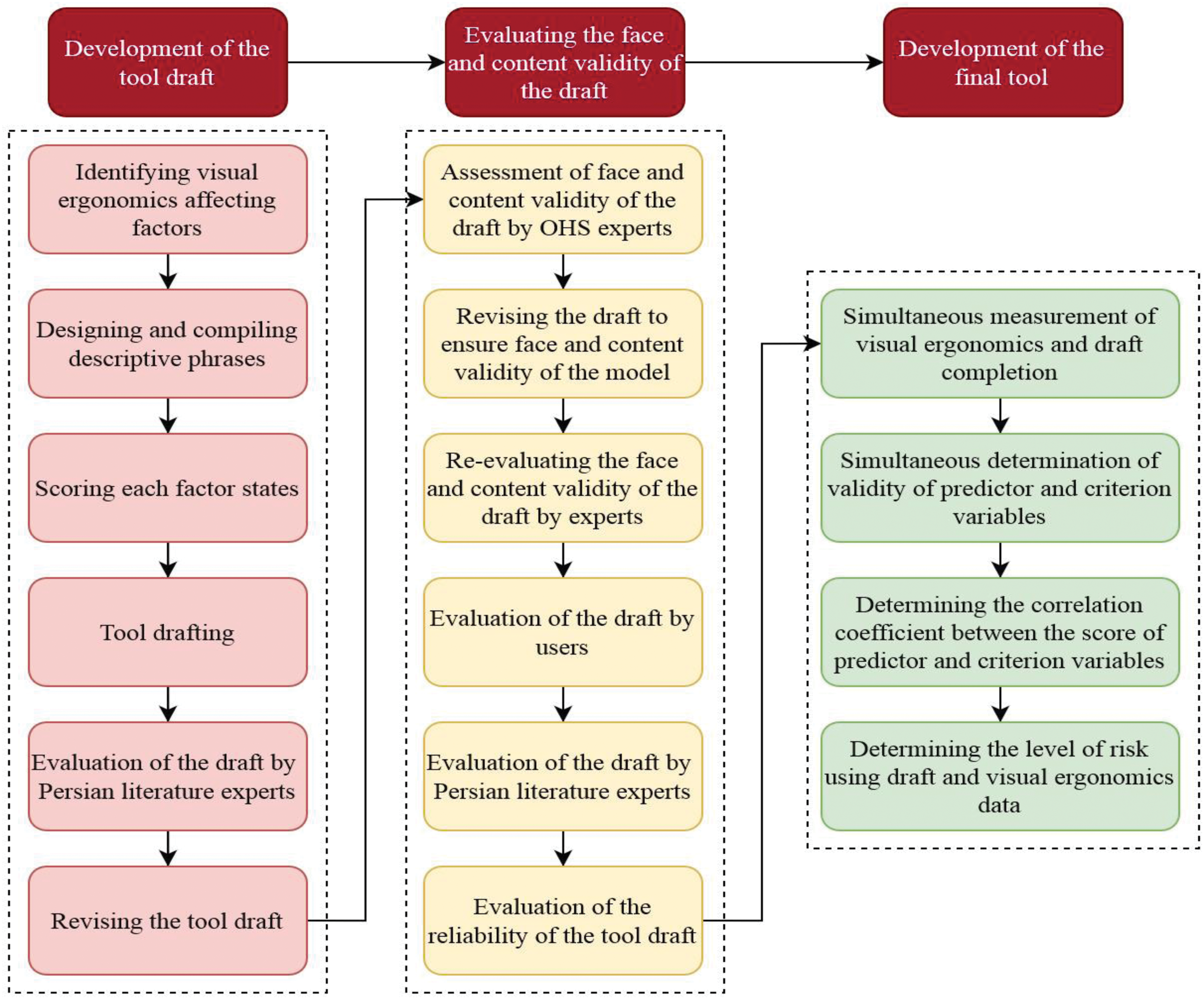
ECVD-20 tool design and validation steps.
The development and validation process, as outlined in Figure 1, consisted of three main phases: The initial phase involved the design of the preliminary instrument and item generation through a semi-systematic literature review and expert consultations. The second phase encompassed face and content validity assessment, followed by structural validation using EFA, instrument refinement, and reliability testing with Cronbach's alpha. The final phase concluded with the development of a diagnostic index through the ROC analysis.
Measurement tools
A lux meter (model TES-1339R with 0.01 Lux and 0.001fc accuracy) was used to measure the illuminance of the work environment. Moreover, a luminance meter (model TES-137 with ±(3%rdg + 5dgt) accuracy) was used to measure the luminance and light reflections from lighting sources and the environment. During this period, the researchers completed observational questionnaires. Some of the questions were completed based on the measurement results (Table 1).
Evaluation of the content validity of the formulated questionnaire (the values of CVR and CVI of remained questions).

Noted: *Merged with (question no.1), **This question deleted base on CVR less than 0.59, *** Excluded due to not being fit and a factor loading less than 0.3, CVR: Content Validity Ratio, CVI: Content Validity Index.
All light measurement devices were calibrated by reputable companies and approved by the faculty of safety and health prior to the study commencement. Measurements were conducted during standard working hours (9:00 AM to 4:00 PM) in the autumn of 2022 to control for seasonal variations in natural light. For each workstation, measurements were taken both with and without artificial lighting to account for the contribution of daylight, and the final values reflected the actual working conditions.
Participants
Three researchers and ergonomics and occupational health experts were employed to investigate visual workplaces. A standardized 4-h training session in visual ergonomics was held for each of them to evaluate the workplaces conditions and complete the questionnaire. The curriculum covered the theoretical principles of visual ergonomics, the operational protocols for all measurement devices, and the standardized criteria for observational assessments.
According to previous studies on the calculation of sample size for structural equation modeling (SEM), a minimum sample size of 100 or 200 cases (5 to 10 cases for each item) has been suggested as an estimate.36,37 Researchers evaluated 236 workplaces (this number is based on the number of items and considering 10 visual environments for each item). To enhance the validity of data, researchers have attempted to select and examine different work environments with wide and diverse visual ergonomic conditions. To carry out this task, researchers meticulously examined the work environment conditions and selected the tasks and work stations.
Item development
At this stage, the first version of the questionnaire was designed through a semi-systematic literature review, considering the scientific foundations. The semi-systematic review methodology was employed to comprehensively explore interdisciplinary literature on visual ergonomics, allowing for thematic integration of diverse research traditions without adhering to strict systematic review protocols. 38
The questionnaire to identify and classify items related to visual ergonomics and working environment conditions that affected the user was developed by reviewing the literature through searching in known databases (including pubmed, science direct, google scholar, and web of science) and interviewing professors and experts in the field of ergonomics and occupational health. Keywords such as visual ergonomics, daylight, illuminance, luminance, ergonomic workspace, ergonomic tools, ergonomic displays, and computers were searched to identify research articles on environmental visual ergonomics between 2000 and 2020. According to the search results, about 3400 articles related to the topic were found, and among these, about 350 articles were studied by the research team through in-depth reviews. Then, some items were combined or eliminated based on their similarities or redundancy to reach a strong and comprehensive tool. Finally, 25 items related to environmental visual ergonomic conditions were identified. Based on experts’ opinions using the nominal group technique (NGT), these items were classified into five groups: workplace lighting, lighting system, workspace, work tools, and work postures.
Responding to some of these items requires objective measurements, and several measurements were designed for each question. A comparative rating scale was used for item scoring, with criteria developed based on established international standards (e.g., ISO 9241 and CIE guidelines) and expert consensus derived through the NGT. 39 To quantify the items, the equivalent points for each response were determined using subject-matter expertise and later modified based on the opinions of several experts. Inappropriate items for qualitative question design were also excluded.
After preparing the questionnaire, an expert panel consisting of two English language experts, two Persian language experts, and two occupational health experts with a background in research on ergonomics and lighting compared the original and translated versions of the questionnaire and checked any contradictions, and made the necessary corrections for clarification of the concept, meaning, and quality of the questions. To develop the questionnaire, it was analyzed by expert researchers in the field of ergonomics and occupational health. After developing the questionnaire, it can be completed by other people.
Assessing the validity of ECVD-20
Expert panel selection and consensus process
The expert panel including 11 occupational health and ergonomics specialists was selected based on the following criteria: (1) possession of a PhD in Occupational Health or Ergonomics, and (2) current affiliation as faculty members with at least 5 years of academic or professional experience in the field. The preliminary version of the tool was distributed through email to these experts, whose ages ranged from 30 to 60 years. The panel consisted of two lighting specialists, three cognitive ergonomics experts, and the remainder specialized in environmental ergonomics. Feedback was collected individually and analyzed using a combination of quantitative and qualitative methods.
Face and content validity
In the qualitative evaluation, the face and content validity, the level of difficulty, the degree of inconsistency, and ambiguity are evaluated by the experts. 40 In most of the previous studies, the perspectives of 6 to 8 experts have been used. 41 In the present study, the form and content validity were evaluated by expert panel, including the objectives of the study and the draft questionnaire that was sent to them. Experts evaluated the questions regarding necessity, relevance, clarity, and simplicity using a 4-point scale. Lawshe, waltz, and Basel's approaches were used to estimate the CVR and CVI. Then, the answers were evaluated based on CVR and CVI formulas. CVR and CVI values greater than 0.59 and 0.79 were accepted, respectively.42,43 Questions with CVI values from 0.70 to 0.79 were also revised. Moreover, the mean CVI and CVR values of the remaining questions were calculated.
Construct validity
Construct validity refers to the degree to which a measurement tool accurately assesses the theoretical construct or characteristic it is intended to measure, ensuring that the instrument aligns with established theoretical frameworks. Checking the structure of a tool before determining its validity is often suggested in studies. 44 The factorial structure of the present tool was investigated using EFA. Principal axis factoring (PAF) was selected as the extraction method to account for common variance among variables. The varimax rotation method was applied as an orthogonal rotation technique used without modifications to maximize the variance of factor loadings across factors. 45 Factor retention was determined based on eigenvalues > 1, scree plot inflection point, and interpretability criteria.
Factor-item loading values greater than 0.3 were considered satisfactory for assigning an item to a specific factor. The sample size sufficiency to perform factor analysis was evaluated through Kaiser-Meyer-Olkin (KMO) measurement (Values > 0.7), and the existence of a correlation between items to perform factor analysis was evaluated using bartlett's test of sphericity (p < 0.05). The general structure of the visual ergonomics questionnaire was formulated based on the extracted factors.
Reliability assessment
Reliability is one of the technical characteristics of the measurement tool, which means the stability of the measurement unit, and it means whether the results of repeating the implementation of the research tool will yield the same results. 46 To assess the reliability, a draft of a modified observational questionnaire was completed by 3 researchers specializing in ergonomics and occupational health at 236 workstations working with displays. Then cronbach's alpha coefficients (α) were calculated for all questions and each group of questions. In addition, the coefficient of correlation with the factor was calculated for each question, and questions with a correlation of less than 0.3 were excluded. The minimum acceptable value of α was equal to 0.70. 47 However, studies often omit the qualification that 0.70 was recommended for early stages of research.48,49
Index development
The direct influence coefficients of each item were calculated by EFA. Each of these coefficients was multiplied by the score of the corresponding item, and the resulting values were added to calculate the new index's total score. Finally, the ROC curves analysis was used to determine the specificity, sensitivity, and classification of the new index score (in the present study, two classes of requiring corrective action and not requiring corrective action). In ROC curves, the points closest to the ideal condition were considered the optimal cut points of the developed index. 50 The area under the curve (AUC) compares the diagnostic value of different tests. AUC is calculated as a value between 0 and 1, and higher values indicate an increased diagnostic value for the test. 51 AUC values are divided into four categories according to their predictive abilities: < 0.5 (not predictive), 0.7 to <0.8 (acceptable), 0.8 to < 0.9 (excellent), and ≥ 0.9 (outstanding). 52
Data analysis
The collected data were analyzed using the Statistical Package for the Social Sciences (SPSS, version 26; SPSS Inc., Chicago, IL, USA) and Excel v.2019. The normality of data distribution was assessed using the Shapiro-Wilk test at a significance level of 0.05. Statistical analyses were performed chronologically: (1) CVI and CVR for content validity; (2) EFA for construct validation; (3) Reliability analyses (internal consistency); (4) ROC analysis for index development.
Results
Item identification and tool development
Initially, 25 items relevant to visual and ergonomic environments were identified and classified into five groups, which were formed as follows: the ambient lighting included 5 questions, the lighting system included 5 questions, the workspace included 6 questions, the work tools included 2 questions, and work postures included 7 questions (Table 1).
After identifying the items, according to the nature of the factor, a descriptive sentence or phrase was formulated for it to measure its amount by observation and measurement. For the different states of that item, options were designed and formulated based on the reviewed articles and scientific sources. Then a draft questionnaire was designed to evaluate these items.
ECVD-20 validity results
Evaluation of face and content validity
The content validity assessment, conducted by a panel of 11 experts, resulted in the refinement of the initial item pool. The criteria for item retention were a CVR value ≥ 0.59 and a CVI value ≥ 0.79. One item (Q23: pertaining to neck muscle contraction) was removed due to a CVR value below the critical threshold (0.59), indicating a lack of consensus among experts on its necessity. Furthermore, two items (original questions no. 1 and no. 7) were identified by experts as having significant conceptual overlap. Based on qualitative feedback, these items were revised and merged into a single, more comprehensive question to avoid redundancy and improve clarity. The CVR and CVI values for all remaining items are reported in Table 1. The high mean scores for both CVR (0.865) and CVI (0.946) across the remaining 23 items demonstrate excellent content validity for the final ECVD-20 tool.
Construct validity
The EFA was used to categorize tool questions, identify and analyze the construct's structure, and determine hidden variables among the 23 variables. The number of factors was identified according to the correlation matrix of the variables. Based on the KMO and bartlett's test values and its significance level (KMO = 0.779, P < 0.001). Exploration of EFA based on the correlation matrix of the studied variables was justifiable and based on these data; hidden factors were extracted.
By performing the EFA on 23 variables, and based on Table 2, a total of 4 factors were identified, and the predictive power of this model based on the total share of the variance of the factors was equal to 55.580%. Moreover, variables Nos.5, 6, and 10 were excluded due to not being fit and a factor loading less than 0.3.
Factor loading (rotational matrix), items correlation, and factors’ variance.

In this model, the environmental conditions of visual ergonomics were influenced by 4 hidden factors (Figure 2). These factors, labeled as F1, F2, F3, and F4, encompass distinct sets of observable or measurable variables. The first factor (F1) was characterized as “luminance” based on the nature of its 5 associated variables. The second factor (F2), comprising 6 variables, was identified as “lighting system” due to the variables loaded onto it during the EFA. Similarly, the third factor (F3), encompassing 5 variables, was named “ergonomic condition of working tools” reflecting the close association and nature of its constituent variables. Lastly, the fourth factor (F4) was termed “working postures” aligned with the nature of its 4 variables. These factors provide a structured framework for understanding and assessing the diverse components influencing environmental conditions related to visual ergonomics in the study.

Scores of identified factors of the ECVD-20.
Reliability results
The internal consistency of the tool's subscale was evaluated using Cronbach's alpha. The total scale's alpha for final questionnaire with 20 questions was 0.644. While this value is below the conventional threshold of 0.70, it is considered acceptable for a newly developed scale with a broad scope and is consistent with similar tools in the early stages of validation. The alpha values for the subscales were as follows: F1 (luminance) = 0.675, F2 (lighting systems) = 0.774, F3 (ergonomic condition of working tools) = 0.654, and F4 (Working Postures) = 0.503. The lower alpha for the F4 subscale is likely attributable to its limited number of items (3 items), as Cronbach's alpha is sensitive to the scale length.
Index development
The final ECVD-20 index was developed to provide a quantitative score reflecting the overall visual ergonomic quality of a workstation. The weighting coefficients used in the equation were derived from the statistical strength of each item's relationship to its underlying construct, specifically their factor loadings obtained from the EFA using principal axis factoring with Promax rotation.
The index is calculated exclusively from the 20 items that were retained in the final factor analysis solution. It is noteworthy that subjects can choose multiple answers to the questions. The equation (1) is as follows: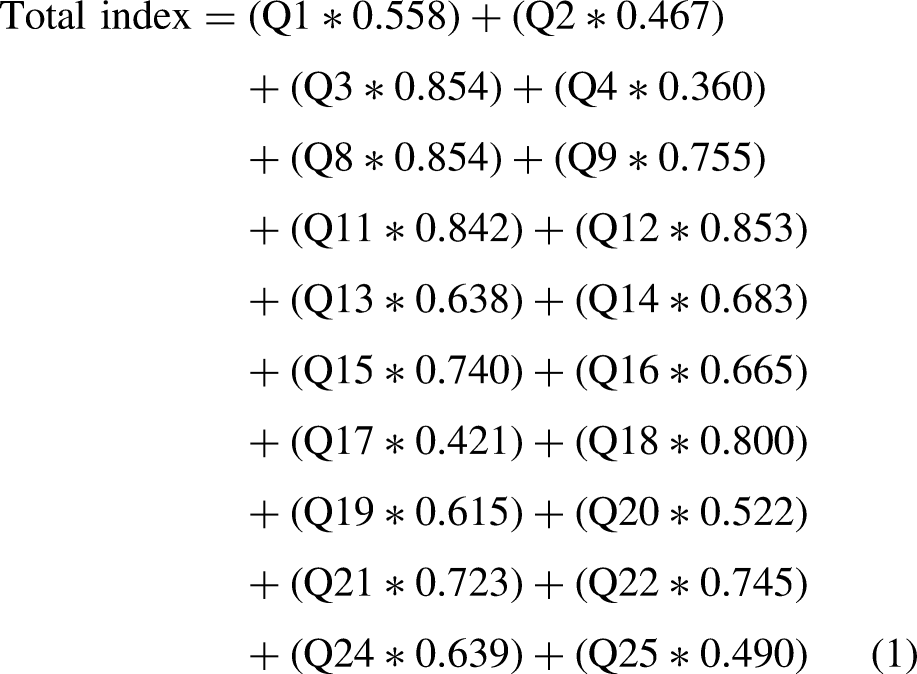
Any items that were removed during the earlier stages of analysis (e.g., based on low CVR, CVI, or low communality in EFA) are not included in this final equation. The numbering of the questions (e.g., Q5, Q6, Q7, Q10, Q23) reflects their original position in the initial item pool; however, only the items constituting the final validated 20-item scale are used.
Categorization of risk levels
Based on the ROC chart, the final scores of the ECVD-20 index were categorized into two levels base on interpretive Table 3.
Total ECVD-20 score ranges and corresponding risk levels.

These cutoff points were determined based on the ROC chart to effectively differentiate between workstations that require corrective measures related to visual ergonomics and those that do not.
Figure 3 shows the ROC curves for different levels of environmental assessment based on a cut-off point of 25. The cut-off point of 25 was calculated based on the weighting of the total scores of the rapid office strain assessment (ROSA) method 53 and the objective measurement of illuminance and luminance, taking into account the standard of the Iranian occupational exposure limit. The results showed that the optimal cut-off points of the boundary between areas requiring corrective action and not requiring corrective action in the visual environment were equal to 31.01 (sensitivity: 0.88 and specificity: 0.62). The area under the AUC of the ROC in Figure 3 was equal to 0.822 (95% CI: 0.768, 0.875) (p < 0.001).

Optimal risk score cut-offs and area under the curve (AUC) in the ROC curve.
Discussion
This study introduces a novel method for evaluating environmental conditions based on visual ergonomics among display users. The research identified and categorized 25 items that impact workplace conditions related to visual ergonomics into five distinct groups: workplace lighting, lighting system, workspace, work tools, and work posture. In contrast, Heiden et al. identified 18 items and classified them into 8 groups for assessing the visual workplace. 29 In this study, a broader range of relevant factors and cases pertaining to the visual workplace were identified compared to other studies. However, during the validity and reliability evaluation stage, questions related to 4 items were excluded, and two questions were merged. Ultimately, the questionnaire includes assessments for the remaining 20 items, evaluated by raters alongside objective measurements of workplace conditions. These evaluations are fundamental for assessing overall lighting conditions, the lighting system, workspace setup, ergonomic tools, and posture. A high-quality assessment tool should demonstrate strong internal consistency across its components.
The ECVD-20 tool demonstrated strong validity and reliability in the studied stations, primarily involving display use by students, with CVR and CVI values of 0.865 and 0.946, respectively. The Cronbach's alpha coefficient was calculated as 0.644, indicating acceptable internal consistency. In the 4-part VERAM tool designed by Zetterberg et al. And Heiden et al., reliability ranged from 0.57 to 0.85 (Kappa coefficients), and agreement ranged from 69 to 91%.29,54 Moreover, in the study by Pereira et al., 55 an observation-based checklist that assesses ergonomic risk factors among administrative personnel was developed recently. The kappa coefficient was used to assess inter-rater reliability, and κ values ranging from 0.38 to 0.74 as moderate to good reliability were obtained. It should be noted that both VERAM and the checklist report unadjusted κ coefficients, and CVI and CVR values are not reported. However, reliability may be improved by providing training in rating situations and more customized training in technical measurements for raters.
In the present research model, environmental items, including illuminance and luminance, the ergonomics of work tools, and occupational ergonomic status, had significantly affected the visual ergonomics of the working environment. Among these factors, the luminance items were the most effective. Based on the definition of visual ergonomics, which includes the visual environment, such as illuminance and luminance, visual tasks, lighting conditions, and other auxiliary tools, it applies knowledge and methods to design systems and improve people's visual performance. 9 Therefore, the findings are reasonable because the environment directly affects people's perception of the identified factors.22,56,57
The ECVD-20 hybrid methodology represents a significant advancement over conventional approaches. While tools such as ROSA 53 focus exclusively on musculoskeletal aspects and Pereira's checklist 55 relies on observational ratings without physical measurements, our instrument integrates: (1) expert-based evaluations of ergonomic conditions; (2) standardized physical measurements of illuminance and luminance according to ISO 8995-1:2002 and Iranian occupational exposure limits; and (3) structured assessment of workspace organization. This tripartite approach enables more objective risk identification compared to purely perceptual tools, though it requires trained evaluators proficient in both ergonomic assessment and technical measurements.
According to our review, there is no similar tool for evaluating environmental risk factors based on visual ergonomics. Unlike previous tools that primarily rely on self-reported data,32,34,53,55 our approach combines expert observational assessment with objective physical measurements, creating a more comprehensive evaluation system. The ECVD-20, which employs a novel expert-based ranking approach, facilitates the identification of areas requiring intervention. For instance, a low score in glare may recommend the elimination of glaring light sources or adjustment of screen brightness. Similarly, a low score in workstation posture may suggest modifications to chair height, monitor height, or keyboard position. Ultimately, based on the assessments, specialists can provide corrective recommendations to enhance visual performance and work efficiency in accordance with visual ergonomic conditions.
Moreover, the ECVD-20 method, unlike some observational-perceptual indicators of visual ergonomics, categorizes the levels of corrective action and provides an interpretation table (Table 3) for the level of the necessity of corrective action in visual environments. Therefore, the ECVD-20 method can reveal the main risk factors (items with a high score) in each workplace so that the required corrective actions can be focused on them first. Therefore, after completing the ECVD-20 questionnaire by the expert, the final score can be easily determined using the equation.
Implications for practice
The ECVD-20 index can be utilized by occupational health professionals and ergonomists to conduct rapid assessments of visual ergonomics in workplaces. This can lead to timely interventions that mitigate risks associated with poor visual ergonomics, ultimately improving employe well-being and performance.
The ECVD-20 demonstrates particular strength in its adaptability to various work environments. In educational settings (where initial validation occurred), it effectively identifies specific issues like screen glare and improper workstation height. However, its design allows for modification of threshold values to accommodate different sectors: industrial environments might require stricter luminance controls, while healthcare settings may need enhanced emphasis on screen visibility during medical imaging review. The tool's structure also permits cultural and climatic adaptations for instance, adjusting glare assessment protocols for regions with high solar exposure or modifying illumination standards for areas with limited natural light.
Strengths, limitations and future research
Nevertheless, each study has several limitations. Firstly, the participant sample was primarily drawn from a university setting, which may limit the generalizability of the findings to other occupational groups and more diverse work environments, such as industrial or healthcare settings. Furthermore, the validation was conducted in a specific geographic and climatic context. Future studies are essential to test the tool's validity and reliability across different geographic regions, occupational groups, and working conditions. Specifically, the scale should be retested under varying climate and lighting conditions, and cultural adaptation studies should be conducted to ensure its global applicability. The utilization of precise sensor-based optical measurement techniques58,59 and the assessment of musculoskeletal disorders60,61 such as computer vision-based approaches, 62 as well as their comparison with conventional methods, could also be explored in future studies.
In the present study, the raters needed a training course in visual ergonomics to use the ECVD-20 method. Although these rates carefully examine visual environments, this can be both a strength and a limitation. As a result, the comprehensive ECVD-20 method, which is quick and easy to use, requires experienced raters with knowledge and expertise in technical measurements, which in most cases, requires thorough training in visual ergonomics. However, it is possible that if the content and structure of the raters’ training course are revised, including the training of measurement techniques, updating the standards of luminance and luminance of the workplace, collaborative learning techniques, and more practical exercises, the reliability and usability of this tool will be improved. The ability of a tool to detect change overtime is critical for its use in evaluating interventions designed to improve the visual workplace. For the ECVD-20 to be useful in practice and interventional studies, its reliability and validity should be reevaluated in a longitudinal study.
Furthermore, it is important to note that this analysis assessed internal consistency only. Therefore, additional reliability analyses, such as test-retest or inter-rater reliability, were not conducted in this phase of the study. This constitutes a limitation, and the evaluation of these properties is a crucial recommendation for future research to further establish the tool's robustness.
Conclusion
The present study showed that ECVD-20 is a valid and reliable tool for evaluating visual workplaces and computer users. Identifying the risk factors of visual ergonomics and objective measurements of the workplace can be a good basis for necessary interventions in computer users’ workplace. However, its practical application can significantly contribute to workplace health by identifying specific areas for intervention. We recommend its integration into routine occupational health screenings and ergonomic training programs. For policy development, it offers a data-driven metric for setting environmental standards. Future research should focus on longitudinal studies to link ECVD-20 scores to health outcomes, test its efficacy in intervention studies, and validate it across a wider range of industries and cultures. Moreover, the reliability of this method may be further increased by improving the quality of training for raters.
Footnotes
Acknowledgments
We hereby appreciate the support of the research institute for primordial prevention of non-communicable disease (PPNCD) of Isfahan university of medical sciences and student research committee of Shahid Beheshti University of Medical Sciences.
Ethical considerations
This study was conducted according to the guidelines of the declaration of Helsinki, and approved by the ethics committee of Isfahan university of medical sciences (IR.MUI.RESEARCH.REC.1401.022).
Informed consent
Informed consent was obtained from all subjects involved in the study.
Funding
The authors received no financial support for the research, authorship, and/or publication of this article.
Declaration of conflicting interests
The authors declared no potential conflicts of interest with respect to the research, authorship, and/or publication of this article.
Data availability statement
The datasets used and/or analyzed during the current study are available from the corresponding author on reasonable request.
