



Abstract
Background
Spanish companies with ≥50 employees must have ≥2% of their workforce with a recognised disability.
Objectives
The aim of this study was to describe new employees with a recognised disability and compare them to official data and the rest of the workforce.
Methods
A transversal study was carried out. 149 new employees with recognised disabilities joined a Spanish bank last year, out of 33,190 employees in Spain. Statistical analysis considered variables such as gender, age, workplace location, disability percentage, type of disability, and the need for workplace ergonomic adaptations. Data comparison of the collected data used Pearson's Chi-square test and logistic regression.
Results
79% shown mild disabilities, 71% were physical disabilities and 21% were sensory disabilities. 88% didn’t require ergonomic workplace adaptations. Significant differences were found compared to the state's working-age disability statistics: females, under 35 years, locations outside Madrid, physical disabilities, and mild disabilities (p < 0.001). Differences compared to the total workforce included females and those under 44 years (p < 0.001), and locations outside Madrid (p < 0.01).
Conclusions
Only 12% of new employees with recognised disabilities needed workplace adaptations. The process to integrate workers with disabilities is complex but it is doable. Jobs with few physical requirements are favourable for employees with recognized disabilities. It is easier in young employees, women, workers from outside Madrid, with mild disabilities and physical disabilities.
Introduction
The rights of individuals with recognized disabilities, including the right to life, autonomy, and active participation in society, have been long-standing principles1–5 Disability, encompassing a person's deficiencies, activity limitations, and participation restrictions, is formerly known as ‘handicap’.
6
Disability is a complex phenomenon that arises from the interaction between individuals and society. Disabilities are generally classified into 5 groups according to the international classification of functioning, disability, and health.
6
Physical disability, which includes two subtypes: Motor or functional: Involves neuromuscular and/or skeletal system alterations that hinder or limit movement and motor skills, thereby restricting daily activity and participation. Organic: Affect physiological processes and internal organs, including the digestive, metabolic, endocrine, respiratory, excretory, and circulatory systems. Mental disability: Including disorders in adaptive behaviour, which affect mental faculties and neurological structures. Intellectual disability: Comprising disorders in intellectual function, results in below-average abilities to comprehend and respond to various daily life situations. Sensory disability: Involving disorders impacting sensory structures, including auditory (affecting hearing), visual (affecting sight), or other senses (touch, taste, smell, or the nervous system). Multiple disabilities: Combines various types of disabilities, often involving deficits in psychomotor and sensory development, along with other health issues.
6
Individuals with
Another different concept is
As part of an integrative effort, companies in Spain with more than 50 employees are required to employ ≥2% of the workforce with recognised disabilities.7,11 The company studied in the present paper fully meets this requirement.
Objective: The aim of this study was to compare the new hires with recognised disabilities at a Spanish multinational company last year with the Spanish government's state database and the company's remaining workforce.
The initial hypothesis was that new hires would mainly consist of young individuals, women, employees from outside Madrid
The relevance of this study is to show a real practical example of the incorporation of employees with disabilities into a Spanish multinational company in a context where, despite the legal obligations to hire 2% of the workforce with recognized disabilities, the unemployment rate is still double that of the rest of the population.
Methods
In a Spanish multinational banking company, where over 99% of the 33,190 employees in Spain perform intellectual office tasks involving data visualization screens, 12 it was conducted a descriptive study on 149 newly hired employees, with recognised disabilities. More than 660 people at this company had a recognized disability before these 149 new employees were hired. Once again, like previous years, the newly hired employees last year were attended an initial medical examination in the medical service of the centralized occupational risk prevention service in Madrid, between June 1, 2022, and May 31, 2023. It was scheduled an occupational health examination for them during a mandatory three-day training period for new employees in Madrid. They were provided with the possibility of accommodation. Risk assessment is conducted before employees start work. During the medical examination, the results are compared with the fitness assessment issued by the medical service to determine if any workplace adjustments are necessary.
Inclusion criteria
Be an active worker in the business group, having been hired in the last 6 months.
Have informed the company of having a disability certificate with a degree of disability equal to or greater than 33%.
Agree to attend an initial occupational health examination and provide confidential medical information.
Exclusion criteria: Not meeting any of the three previous inclusion criteria.
The company is demanding, including with employees with recognized disabilities. Not all of them stayed with the company for more than a year after being hired. It's a dynamic workforce, and the company is demanding, including with employees with recognized disabilities.
Once the employee was recognised, the information was entered into the Medical Service computer program. In cases requiring it, agreements were made with the technical part of the Group's Joint Occupational Risk Prevention Service. In weekly clinical sessions, maintaining patient anonymity and fostering collegiality, comprehensive medical reports, including necessary ergonomic adaptations, were issued to employees. Per protocol, 13 a brief individual fitness criterion was provided to the Human Resources department while upholding employee privacy and medical confidentiality. The same usual evaluation or follow-up is carried out as in all cases.
This paper followed STROBE guidelines for observational studies. 14 Data collection entailed extracting information from the Medical Service computer program, which contained 149 initial medical examinations of employees with recognised disabilities. These records were individually consulted and anonymised to safeguard privacy by replacing personal identifiers such as names, surnames, and IDs boxes with unique identification numbers unrelated to the workers, all within a Microsoft Excel database. The variables recorded in the database included anonymised demographic data: gender (dichotomus categorical: female, male), age in years, workplace location (dichotomous: Madrid or outside Madrid), disability percentage, categorised as 33–45 (mild), 45–64 (moderate), 64–75 (severe), more than 75 (very severe), disability type (physical, mental, intellectual, sensory, multiple disabilities) and disability subtypes included functional or organic for physical disabilities and visual or auditory for sensory disabilities. 6 Whether adaptation in the job was required (dichotomous: yes, no), and if needed, the type of adaptation.
To account for the higher number of men in the Community of Madrid than women, this factor was considered in the calculation of both variables to prevent it from being a potential confounding factor.
Authors conducted a prevalence study, employing frequency measurements and percentages. It is not necessary to calculate the sample size, but it was determined, for teaching reasons, using the free Epi Info program. 15 based on the total company workforce nationwide, which stood at 33,190 employees as of January 1, 2023. Considering a population prevalence of 7.1% in Spain, 8 a maximum error of 5%, and a 95% confidence level, a sample size of 101 individuals was calculated. In any case, these figures were exceeded when studying the 149 initial new employees with recognised disabilities.
Comparisons were made with data from the company's overall workforce in Spain and official data from the Government of Spain. 8
Statistical analysis was carried out using R software, version 4.2.2. 16 It was employed the Pearson Chi-square test for categorical variables, including dichotomous gender, age (using 35 years as a threshold for government data 8 and 43.99 years to compare with the company's workforce reflecting the average age, location (dichotomised into Madrid and outside Madrid), type of disability, and disability percentage by level. Statistical significance was determined if p < 0.05.
This examination is considered mandatory as falls under one of the three exceptions to the voluntary nature of health surveillance. 13 In all instances, employees explicitly consented to the data processing for epidemiological purposes in accordance with Organic Law 3/2018, dated December 5, on Personal Data Protection. 17 Stringent medical ethics principles were adhered to, informed patient consent was obtained, and it received approval from the Ethics Research Committee (UNIR; Exp. PI007/2023).
Results
In a company with 33,190 employees in Spain, 149 employees with recognised disabilities joined last year. Of these, 88% of new hires with a threshold of 33% disability didńt require any accommodation. Only 18 (12%) required ergonomic workplace adaptations. Most of the disabilities (79%) were classified as mild, falling within the 33–45% degree range. Physical disabilities predominated (71%), with a notable emphasis on motor or functional aspects (59%). Among sensory disabilities (21%), auditory impairments were prominent (55%). Of those requiring adaptations, 67% had physical disabilities, with motor or functional issues being the most prevalent (83%). Additionally, 28% had sensory disabilities, with 80% of them being visual.
Figure 1 provides a flowchart summarising the characteristics by gender, age, and location of the company's entire workforce (33,190 employees), newly hired employees with recognised disabilities exceeding 33% (149 employees), those requiring workplace adaptations (18 employees), and the types of ergonomic adaptations implemented.
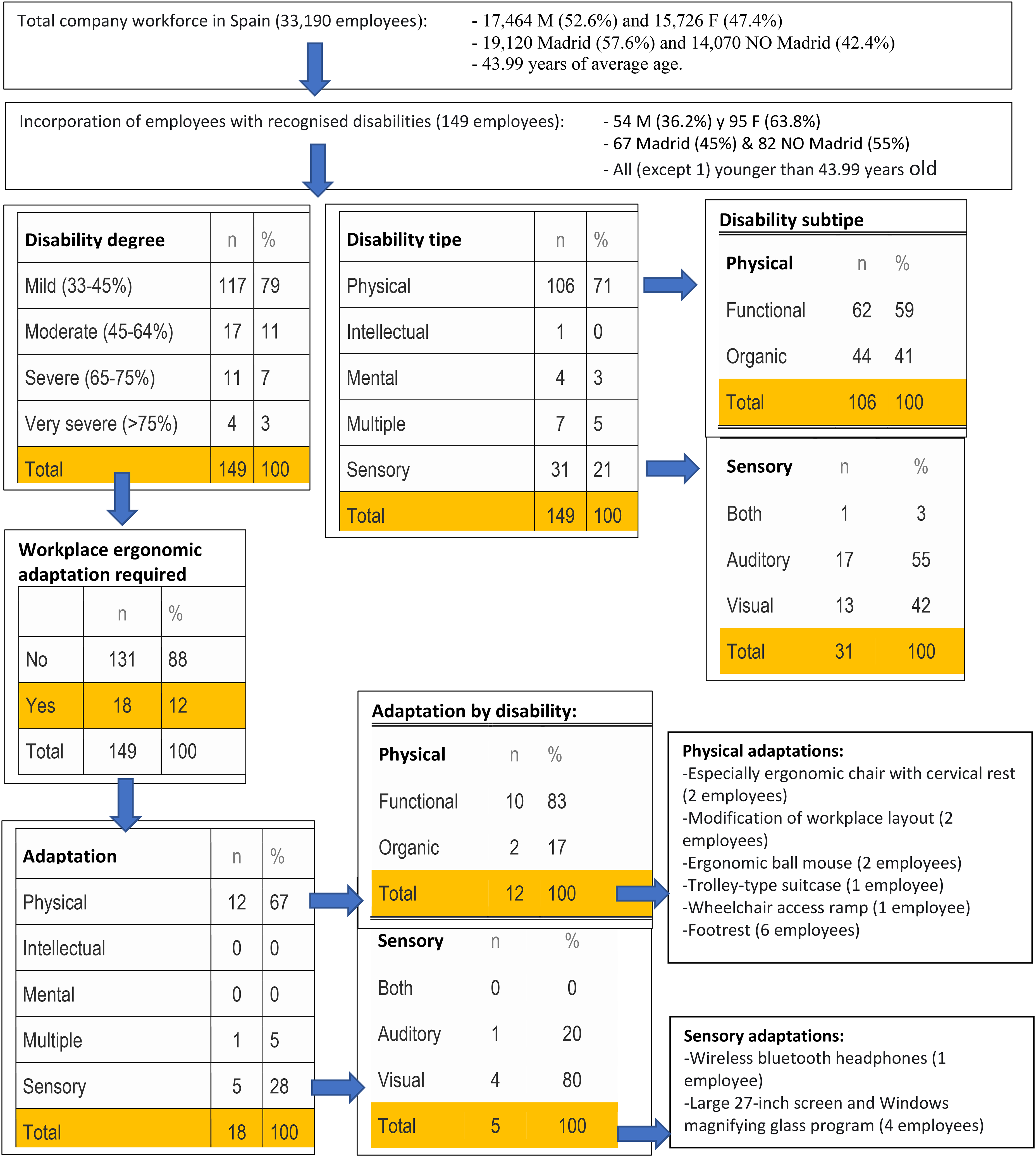
Flow diagram of the total workforce of the multinational banking company in Spain, last year. The incorporations of employees with recognised disabilities, by gender, age and location. The required job adaptations. In absolute numbers (n) and percentage (%). M: man. F: woman.
Among the 7 employees with multiple disabilities, 3 shown a combination of functional and mental disabilities, 2 shown organic and visual disabilities, 1 shown organic and hearing disabilities, and 1 shown organic and mental disabilities.
When comparing these initial employees with recognised disabilities to the total workforce, it's notable that the newly hired disabled employees were predominantly women (p < 0.001), under 44 years of age (p < 0.001), and from outside Madrid (p < 0.01).
Table 1 compares the initial employees with disabilities to the company's total workforce in Spain, based on gender (woman, man), age (over or under 43.99 years), and location (within or outside the Community of Madrid).
Characteristics according to gender (woman, man), workplace (Madrid, outside Madrid), and age (< 44 years, ≥44 years) of the “total employees in Spain of the business group” and “new employees with a recognised disability in Spain”.
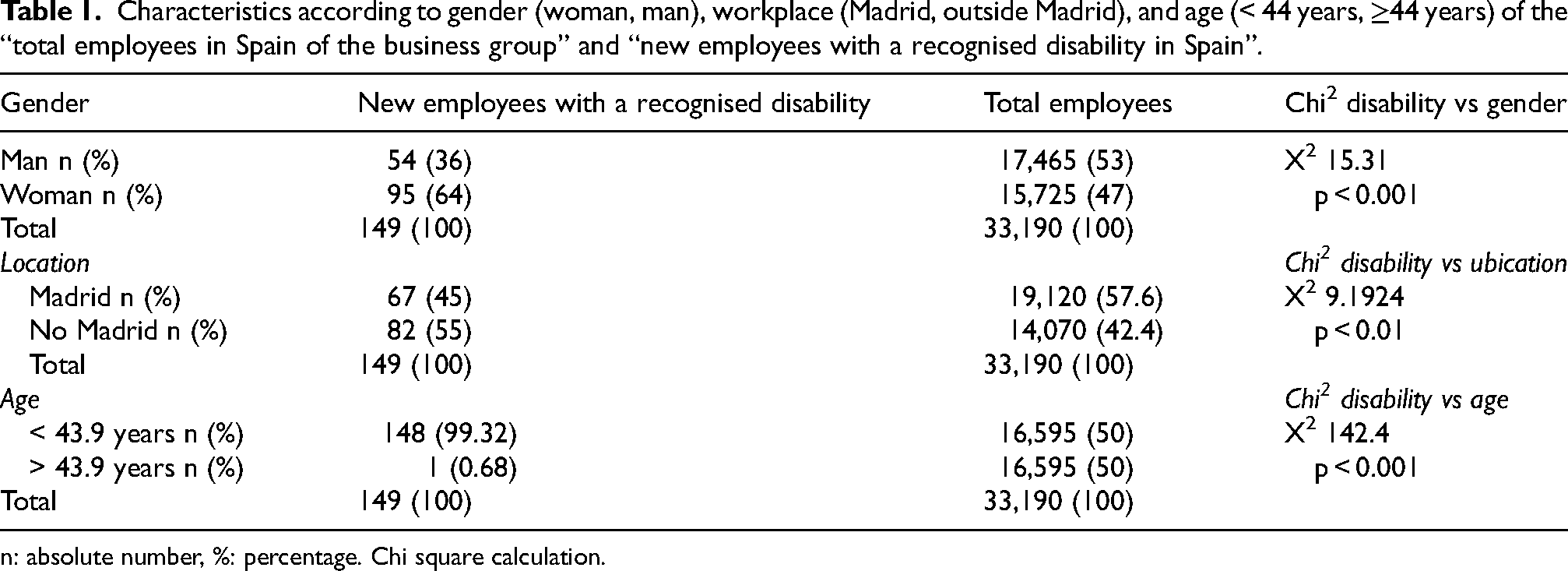
n: absolute number, %: percentage. Chi square calculation.
In terms of age distribution, newly hired employees with recognised disabilities had a median age of 29 years, a mean age of 29.34 years, a standard deviation of 4.62 years, with the maximum age being 48 years (only one employee with a disability exceeds 43.99 years), and the minimum age is 22 years.
Comparing these initial employees with recognised disabilities to the state's database of disabled individuals of working age, 8 it is evident that our sample comprises mainly women (p < 0.001), individuals under 35 years of age (p < 0.001), showing differences in location (p < 0.001), predominantly with physical disabilities (p < 0.001), and mild degrees of disability (p < 0.001).
Table 2 compares the results of initial employees with disabilities to the most recent data published by the Spanish government 8 in January 2023, representing the general working-age population with disabilities (1,597,657 people). The comparison is based on gender (female, male), age (below or above 35 years), location (within or outside the Community of Madrid), degree of disability (mild, not mild), and disability type (physical, non-physical).
Characteristics according to age (over or under 35 years) and percentage of recognised disability (mild 33-45%, non-mild >45%) of the “initial employees with recognised disabilities in the business group”, according to the data from “disability at working age in Spain, Government data 2022.” 8
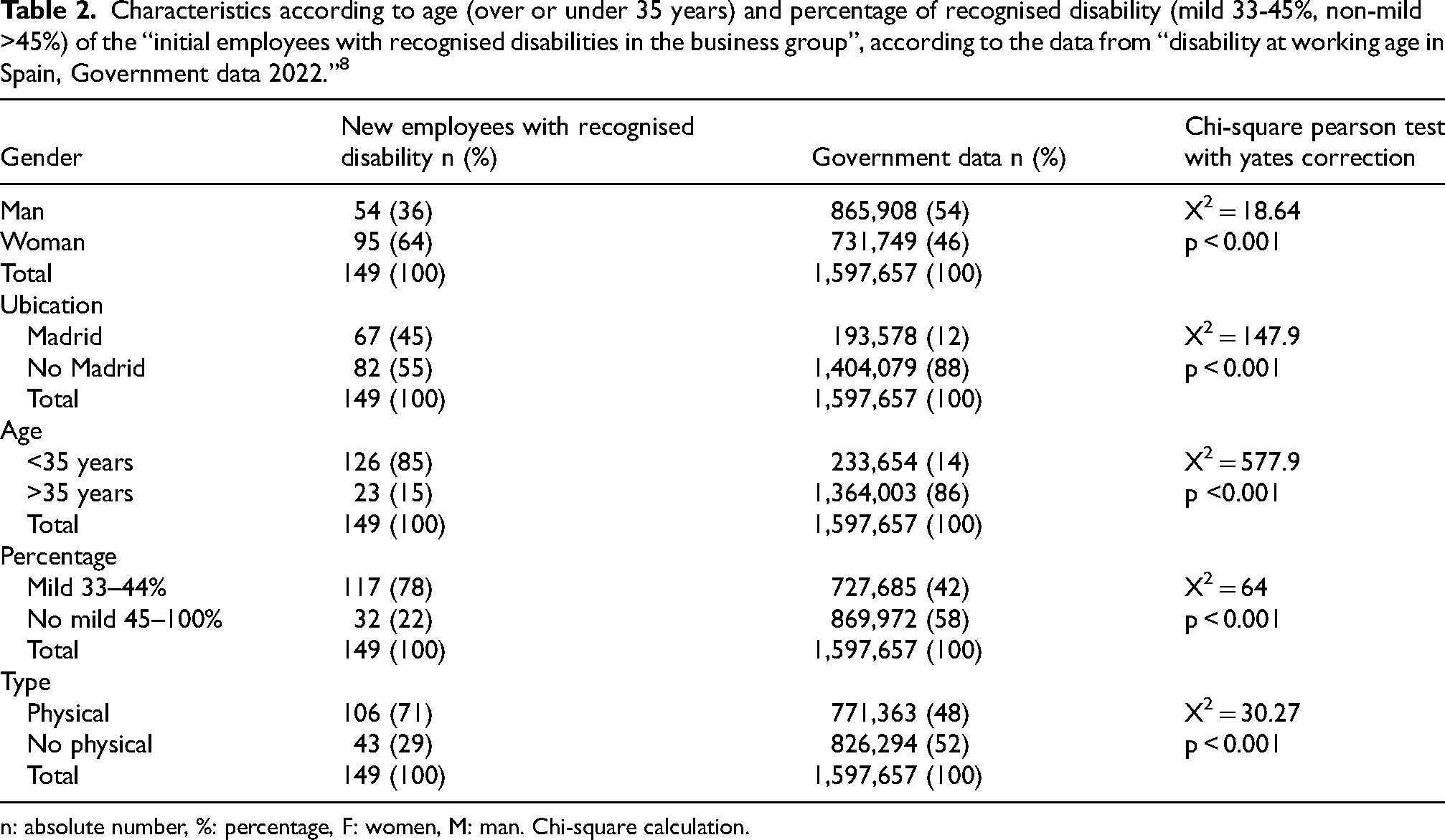
n: absolute number, %: percentage, F: women, M: man. Chi-square calculation.
Table 2 reveals differing proportions of women with disabilities between the national level and within the company (p < 0.001).
Table 2 indicates differing locations (Madrid / outside Madrid) of individuals with disabilities between the national level and within the company (p < 0.001).
Table 2 illustrates differing proportions of individuals with disabilities within each of the age groups between the national level and within the company (p < 0.001).
Statistically significant differences (p < 0.001) exist in the proportions of disability levels between the national level and within the company.
Statistically significant differences (p < 0.001) exist in the types of disabilities between the national level and within the company.
Figure 2 reveals that 46.3% of recognised disabilities fall within the 33–35% disability range, with a median disability of 36%, a mean of 40.86%, a standard deviation of 11.48%, a maximum of 86%, and a minimum of 33%. Regression analysis (p = 0.26) found no relationship between qualitative disability severity and the gender of initial employees with disabilities when compared to total employees. Furthermore, there is no association between the degree of disability and the type of disability or the need for adaptation.
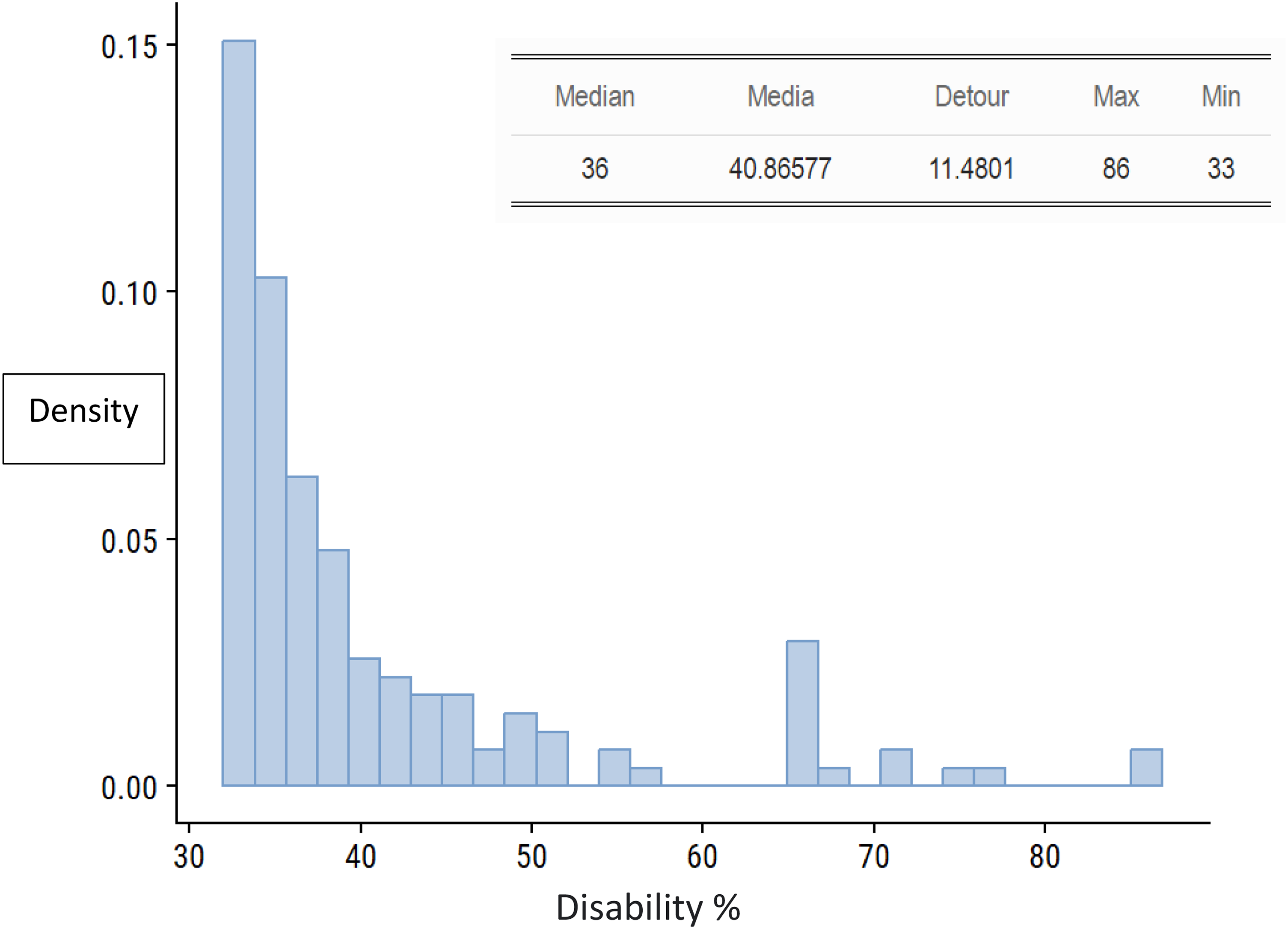
Number of “density” employees with recognised disabilities newly incorporated into the Business Group from June 2022 to May 2023, classified by “% disability” percentage.
During logistic regression analysis to assess the relationship between age (over or under 34 years), workplace (Madrid or other), and gender with the degree of disability, only the workplace variable was found to be significant. The other variables did not exhibit significance.
Discussion
Key idea: This paper reveals significant differences from government statistics concerning women, youth, regions outside Madrid, mild disability, and physical disability. Only 12% required ergonomic adaptations. Jobs with few physical requirements are favourable for employees with recognized disabilities.
Limitations:
The findings suggest healthy worker bias and selection bias, consistent with the limited presence of severe disabilities, as well as mental and intellectual disabilities. Nomenclature discrepancies exist between data sources. In the official summary from the Government of Spain (8), ‘physical motor or functional disability’ is described as ‘osteoarticular’ and ‘neuromuscular’. Similarly, ‘organic physical disability’ is referred to as ‘chronic disease’ (8). However, the remaining nomenclature aligns perfectly. This change in nomenclature is suggested for better understanding and monitoring in future research or policies. One of the objectives is to assess differences based on gender and location (Madrid, outside Madrid). Both variables were considered in the calculations, ensuring no confounding factors.
The population was statistically homogeneous; a chi-square analysis found no differences in the proportion of women and men in each study location (p = 0.3517). Therefore, it is supported that there were no differences in gender distribution based on the workplace.
Regarding gender, Table 1 supports a distinct distribution between total employees and those with recognised disabilities (p < 0.001). Regarding location, Table 1 supports a differing proportion of employees working in Madrid compared to elsewhere between total employees and those with recognised disabilities (p < 0.01). Concerning age, Table 1 reveals a distinct age distribution between total employees and those with recognised disabilities (p < 0.001).
Interpretation: Disability is a complex phenomenon that acknowledges the individual's interaction with their society. The current definition of disability recognizes the social context as a significant factor.1–6 Deficiencies refer to issues affecting body structure or function. Activity limitations refer to difficulties in performing actions or tasks, while participation restrictions pertain to challenges in engaging and participating in life situations.1–6 In Spain, the assessment process results in the recognition of a specific degree of disability. 7 Our initial hypothesis was that new hires would mainly consist of young individuals, particularly women from outside Madrid. Our results, compared to the Group's total workforce in Spain, support this expectation in a statistically significant manner. This aligns with the current trend of an increasing female presence in the business group, nearing 50%, which is consistent with the prevalence of younger employees. This year, the plan was to introduce personnel with recognised disabilities into the bank's nationwide network of offices. Consequently, it's logical to observe a higher presence of such personnel outside Madrid than within the city. In essence, our initial hypotheses are supported.
Comparing the new hires to the state database of working-age individuals with disabilities 8 support what was already known: female predominance, youth, and employees from outside Madrid. Additionally, our initial hypothesis regarding the prevalence of mild disabilities (33–45% of recognised disability) and physical disabilities, particularly motor or functional ones, is supported. These results support those obtained by other authors in physical,18–22 mental9–20 and sensory 21 disability.
Most of the adaptations were related to the physical environment, possibly because the most prevalent disability in this particular sample is physical. Furthermore, it is the disability we consider most easily addressed.
This is in alignment with Spain's overall disability statistics 8 and the nature of tasks within the company, which primarily involve intellectual work with minimal musculoskeletal demands.
The present study did not establish the significance of the ‘level of disability’ variable in explaining the need for ergonomic adaptations, but highlighted the workplace's importance in determining the recognised disability level.
Occupational Medicine, as a specialty, significantly contributes to integrating employees with disabilities into Spain's business landscape, enabling their active participation and autonomy in healthy and secure work environments.23,24
Occupational Medicine plays a vital role in integrating employees with disabilities into the Spanish business sphere, enabling their effective autonomy and active participation in healthy and secure work environments.23,24 The COVID-19 pandemic has heightened public awareness of health-related lifestyles and the importance of medical checkups. This increased interest in health-related lifestyles requires greater support from studies on preventive checkups that screen a large number of the population for health-related risk factors. 20 Occupational health services have internationally recognized core functions, including advising employers and workers; surveillance of the working environment and workers’ health; prevention and early detection of work-related problems; health promotion; and facilitating access to appropriate clinical care when needed. 25
We believe there is a genuine willingness to make the necessary adjustments. The workforce is large enough to allow for all possible options. However, our subjective impression is that most employees with recognized disabilities prefer not to disclose their disability and to keep it as inconspicuous as possible, for fear that it might be perceived as a weakness in a competitive environment.
Generalisability: The obtained sample of 149 new employees with recognised disabilities exceeds the required 101 participants based on Spain's disability prevalence. 8 Thus, the study's conclusions possess external validity, applicable to companies with similar characteristics in our environment. The future goal is to follow these workers over time. Using this cross-sectional study as a starting point, the aim is to develop it into a prospective cohort study.
We concur with other authors on the societal advantages of diversity: diverse groups surpass homogeneous ones in problem-solving, benefiting workplaces both financially and culturally through inclusive approaches to disabled individuals. 1
Conclusion
Only 12% of the total employees needed workplace adaptations, with the majority related to the physical work environment, while a smaller portion was due to sensory disabilities, primarily visual. These findings do not negate the complexity of the integration process but demonstrate the feasibility of efforts to accommodate individuals with specific needs. Jobs with few physical requirements are favourable for employees with recognized disabilities. It is easier in young, women, from outside Madrid, with mild disabilities and physical disabilities.
Footnotes
Acknowledgments
This research was supported by the 2023/2024 Grant for Translating Scientific Articles and Covering Open Access Journal Publication Fees provided by the International University of La Rioja (UNIR). The translation was reviewed by Sonia Cal, a professional translator. The authors express their gratitude to Drs. María Gutierrez-Aguiló, María-Antonia de-Miguel, and the nursing and administrative staff of the Santander Group's Medical Service for their valuable and active participation in this study.
Ethics approval
The International University of La Rioja, Spain (UNIR in Spanish) Research Ethics Committee has reviewed the ethical evaluation request for this study. Based on the documentation submitted, the Committee has approved it with the code PI007/2023.
Informed consent
Every worker signed a written informed consent.
Funding
The authors disclosed receipt of the following financial support for the research, authorship, and/or publication of this article: This research has received financial support from the 2023/2024 Grant for Translating Scientific Articles and Open Access Journal Publication Fees provided by the International University of La Rioja (UNIR).
Universidad Internacional de La Rioja, (grant number 2023/2024).
Declaration of conflicting interests
The authors declared no potential conflicts of interest with respect to the research, authorship, and/or publication of this article.
