




Abstract
Background
Healthcare workers face challenges such as intense work tempo, irregular working hours and high patient expectations. This situation may affect the happiness and performance of employees, as well as the quality of health services.
Objective
The aim of this study is to reveal the relationship between organizational health perceptions, happiness and job performance of health personnel working in a university hospital.
Method
The data were collected from 350 healthcare workers between December 2023 and January 2024 by face-to-face survey method. Organizational Health Scale, Oxford Happiness Scale and Employee Performance Scale were used as measurement tools. Data were analyzed with SPSS 22.0 and AMOS 26.0 programs; descriptive statistics, correlation analysis and Structural Equation Modeling (SEM) were applied.
Results
According to the correlation analysis, there was a positive and low level relationship between organizational health and happiness (r = .359) and a very weak but significant relationship with performance (r = .136). A moderately significant relationship was found between happiness and performance (r = .252). According to SEM findings, organizational health significantly predicted happiness (β = 0.98, p < .001), while happiness predicted performance (β = 0.14, p = .002). The direct effect of organizational health on performance was not significant (β = 0.23, p = .077). In subgroup analyses, differences were observed according to occupational groups and length of experience.
Conclusions
Organizational health is a determinant of employee happiness, and happiness increases job performance. Therefore, it is recommended that healthcare organizations develop strategies that focus on employee well-being.
Keywords
Introduction
With increasing globalization and competition, organizations now view employees as internal customers and aim to improve productivity and quality of working life by retaining qualified personnel and enabling them to effectively utilize their skills. 1 Intense competition drives organizations to attract and retain talented individuals; however, time pressure, limited resources, and performance demand often diminish employees’ quality of work life, happiness, and performance. 2
In the healthcare sector, the emotionally taxing nature of responsibilities combined with long and irregular shifts, intensive work schedules, high patient expectations, and often inadequate institutional support mechanisms not only cause physical fatigue but also severely impact job satisfaction and well-being of healthcare workers.3,4 Furthermore, the quality of healthcare services is directly influenced by the well-being and performance of care-providing professionals. 5 Thus, understanding how organizational health and well-being relate to employee performance is crucial in healthcare institutions, where human capital is an asset.6,7
Employee happiness and organizational health are even more vital in the healthcare sector. Healthcare institutions heavily rely on their workforce to deliver uninterrupted, high-quality care that directly affects patient satisfaction and clinical outcomes.8–11 Therefore, effectively managing human resources to enhance employee performance becomes critical to maintaining competitive advantage. 12 Happiness and satisfaction among healthcare professionals can improve organizational performance, while dissatisfaction can reduce service quality; particularly in hospitals, employee happiness directly affects the quality of patient care. 13 Many healthcare organizations lack structured strategies to promote employee happiness and organizational well-being; therefore, it is essential for managers to prioritize employee welfare and implement measures to improve satisfaction and overall organizational health. 14 Although happiness, organizational health, and performance are discussed separately in the existing literature, their combined study among hospital staff is limited.
Social Exchange Theory (SET)15,16 posits that interactions within organizations are based on the principle of mutual benefit; employees respond to organizational support with positive attitudes and behaviors. In this context, key organizational elements such as organizational health are assumed to have significant effects on employee happiness and performance. 17 Based on SET, this study investigates how healthcare employees’ perceptions of organizational health influence their happiness and performance. Accordingly, the research aims to provide valuable insights for healthcare managers and policymakers in designing employee-centered strategies that enhance both organizational outcomes and healthcare service quality. Unlike many previous studies that examined these constructs separately, this study combines organizational health, well-being, and employee performance in a healthcare context into a single structural model, providing a more holistic explanation of employee functioning in high-demand work environments such as hospitals.
Happiness
Happiness is widely regarded as a fundamental human goal. 18 Happiness is universally considered a desirable state. Many scholars have emphasized the central role of happiness in human life. 19
Commonly, happiness is associated with one's condition and mood. A happy person is often seen as fortunate and cheerful, 20 reflecting the fact that happiness was originally linked to luck and fortune. 21 In defining happiness, both subjective and objective aspects are emphasized. According to the subjective perspective, happiness is the individual's satisfaction or contentment with their life, 20 making the person themselves the ultimate judge of their experience. 22 Thus, happiness is viewed as a positive internal experience that motivates human behavior. 23 From an objective standpoint, happiness means possessing a satisfactory amount of what one deems important in life. 20 The concept of “well-being,” which refers to a person's holistic emotional and rational assessment of their life, is frequently used as a measure of happiness. 24 Objective happiness largely depends on the cognitive evaluation of well-being.
Over time, the terms “happiness” and “well-being” have become increasingly used interchangeably. When used in this way, well-being has been linked to mental health and utilized to explain why some individuals are happier than others and to develop interventions aimed at increasing happiness, particularly in the workplace.25–27 Happiness functions as a psychological resource supporting success and health. Therefore, initiatives aimed at enhancing happiness have become increasingly significant for both individuals and organizations. 19
Happiness is also crucial for health. It is suggested that happiness can help individuals maintain and protect their health, 28 and it is known to have positive societal effects in terms of health, achievement, improved social relationships, and prosocial behavior. 19 With the growing importance of psychological factors at the workplace, the investigation of workplace happiness has become a significant area of research.27,29,30 Studies confirm that happiness positively impacts organizational competitiveness, employee engagement, sustainable development, and job performance. Happy employees demonstrate superior performance, higher productivity, and are less likely to exhibit counterproductive behaviors.31–33 Additionally, being happy at work increases employee productivity 34 and improves health levels. 29
Thus, the organizational climate in which employees perform their duties is of great importance. Since employees spend a significant portion of their day at work, workplace factors can positively or negatively impact their happiness and performance. 13 As seen, workplace happiness is a critical factor for employee performance and matters to both employees and institutions. Hence, fostering a respectful, supportive, and healthy organizational climate is deemed essential for increasing workplace happiness. Therefore, organizations must consider conditions that enhance employee happiness and/or well-being.30,35
Organizational health
A healthy organization is not only one that survives within its environment but also one that develops and expands its long-term capacity to adapt and thrive. 36 It is characterized by both financial success (i.e., profitability) and a workforce that is physically and psychologically healthy. This definition inherently includes employee well-being. Healthy organizations can sustain a positive and satisfying work environment and organizational culture even during turbulent markets and periods of intense change. 37 The terms “healthy organization” and “organizational health” are used interchangeably to refer to the same concept,38,39 yet the latter is often viewed as a more holistic and comprehensive construct. 40
The roots of organizational health can be traced back to research conducted in the United States during the 1960s. Researchers with a humanistic perspective expressed concerns regarding how employees were treated in work organizations, which played a significant role in the emergence of the concept.36,41,42 Since then, employee health and well-being have remained significant concerns for organizations. In today's work environment, organizational health, alongside employee health and well-being, has become a vital issue for employers.
With the development of the concept, researchers have recognized the importance of employee happiness and well-being in creating a healthy and effective workplace. Studies have linked job content to well-being in the context of effective organizational environments.1,38,43–45 Indeed, one of the most notable characteristics of healthy organizations is their prioritization of employee well-being, happiness, and satisfaction. 36
A central question regarding organizational health is: for whom is the organization healthy? Definitions often focus primarily on the organization itself, which raises this question. 46 However, a truly healthy organization includes interventions designed to improve both the health of the organization and that of its employees. These include initiatives aimed at enriching job content, enhancing motivation, aligning employee goals with organizational goals, increasing feedback, recognition, participation, and accountability, and providing opportunities for personal and professional development. 47 This is particularly important in healthcare institutions, which are labor-intensive organizations that provide uninterrupted services. Hence, focusing on organizational health from the employees’ perspective is of critical importance. Healthcare institutions must be open to change and development to improve organizational health and elevate employee health levels. 40
In healthy organizations, employee stress levels and absenteeism tend to be low, while organizational commitment and job satisfaction are high. 37 Such an organizational climate can only be realized through the establishment of a healthy organizational structure. Developing and maintaining organizational health increases organizational productivity, employee job satisfaction, and organizational commitment. Moreover, healthy organizations positively affect both employee health and overall organizational performance. Likewise, they promise improvements in employee performance. 1
Employee performance
The term “performance” originates from the phrase “job performance” or “actual performance,” referring to the actual accomplishments achieved by an individual. It is defined as the quality and quantity of work produced by an employee in accordance with the responsibilities assigned to them. 48 Similarly, employee performance is described as behavioral responses that reflect an employee's learning or training and, thus, is a product of their mental and psychological capacities. 49 According to another definition, employee performance pertains to the degree to which tasks and activities are carried out appropriately, 50 and it is essential to ensure the right individuals are selected for the right tasks. 51
As a concept of significant importance for both individuals and organizations, employee performance has drawn the interest of many researchers in the field of management sciences. 49 Human capital, being one of the most critical resources in any organization, plays a crucial role in achieving organizational objectives. For organizational success, it is imperative to utilize this human capital optimally. Employee performance has a direct influence on overall organizational performance. 52
Hence, organizations must prioritize employee performance. For an organization to survive, achieving the targeted performance levels is essential. 53 Similarly, understanding the link between happy employees and excellent performance is vital for organizational success. High-performing employees are often at the forefront of the factors that drive organizations toward success or failure. 51 To enhance employee performance, effective management is required. 52
Performance management involves measuring and improving employee performance to ensure that tasks are performed in alignment with predetermined goals. For this purpose, it is important to assess employee performance at regular intervals (e.g., annually or quarterly). Performance evaluation refers to the effort and level of achievement shown by an employee in meeting expectations within a specific task, job, or timeframe. These evaluations help identify the areas where performance must be improved and the personnel who require development.50,54 Improving employee performance benefits not only the organization but also the individual. Theoretically, high performance can lead to better career development for the employee. One of the ways organizations strive to have optimally performing employees is by supporting robust career development programs. As a result of such career development, employees are likely to exhibit positive behaviors beneficial to both the organization and themselves, and they are more likely to hold a favorable attitude toward the organization. 52
Materials and methods
This section provides detailed information regarding the research model, sample, and measurement tools used in the study. A model incorporating the variables of organizational health, happiness, and job performance was developed. The research model is presented in Figure 1.

Conceptual model of the study.
Purpose
This study aims to investigate the relationships between organizational health, employee happiness, and job performance among hospital staff. The research is grounded in Social Exchange Theory,15,16 which explains how reciprocal relationships within organizations influence employee behavior. Specifically, the study examines how perceptions of organizational health affect employee happiness and job performance and provides theoretical and practical insights into workforce management in healthcare settings.
Hypotheses development
Organizational health encompasses management strategies that support employees’ physical and psychological well-being and foster a positive organizational environment. 37 The theoretical foundation of this study is based on Social Exchange Theory (SET), which explains how interactions within organizations shape employee attitudes and behaviors. Initially proposed by Homans (1958) and later expanded by Blau (1964), SET posits that employees engage in social and economic exchanges with their organizations by balancing rewards and costs to maintain mutually beneficial relationships.15,16 In the workplace, when employees perceive organizational support, fairness, and a positive working environment, they are more likely to respond with higher job satisfaction, commitment, and performance. 17
Organizational health can be considered as the structural and psychological resources provided to employees. In organizations with high levels of health, employees are more likely to feel valued, respected, and emotionally secure factors that contribute to increased workplace happiness.
3
Research shows that when employees perceive their work environments as healthy and inclusive, they tend to be more satisfied and happier in their roles.
8
Thus, it is expected that increased perceptions of organizational health among hospital staff will positively influence their levels of happiness. H1: Organizational health predicts employee happiness.
Organizational health refers to the structural and psychological resources provided to employees, including supportive leadership, effective communication, and a fair working environment. These components enhance motivation, commitment, and ultimately lead to better job performance. Previous studies emphasize that employees who perceive their organizations as healthy are more likely to exhibit higher levels of job satisfaction and performance.38,55 In labor-intensive settings such as hospitals, it is expected that organizational health will have a direct and positive effect on employee performance. These resources are likely to generate positive emotions among employees, which in turn are expected to reflect their job performance.
56
H2: Organizational health predicts employee performance.
Happiness in the workplace is associated with higher motivation, autonomy, and engagement, which are essential for high performance. Happy employees are more task-oriented, collaborate more effectively with colleagues, and demonstrate greater resilience under stress.
57
Previous research shows that workplace happiness contributes to greater work productivity.
34
According to social exchange theory, in healthy and supportive work environments, employees tend to respond with positive psychological states such as happiness, which in turn improves their performance.
17
This suggests that happiness acts as a psychological mechanism that transforms organizational health into improved job performance. Previous studies have highlighted this mediating role of emotional well-being in the link between activity levels and job performance.34,45 Thus, the functioning of the work system mediates the transfer between health and performance outcomes. H3: Organizational health indirectly predicts employee performance through employee happiness.
Population and sample of the study
The population of the study consists of healthcare workers employed at a university hospital in Isparta, Türkiye (N = 1474). No predetermined sampling method was applied; instead, the data collection instrument was distributed to all hospital employees who voluntarily agreed to participate. The inclusion criterion was being a full-time employee at the time of data collection. Employees on leave or those who declined to participate were excluded from the study.
Data collection process
The data collection process took place between December 25, 2023, and January 25, 2024. Surveys were distributed in person, and a total of 520 responses were collected. The survey was administered in paper format and delivered directly to hospital staff by the research team. Ultimately, 350 usable responses were obtained, yielding a response rate of 67.3%. Participation was voluntary, and respondents were informed about the confidentiality of their answers.
Data Collecting Tools
A structured questionnaire comprising four sections—demographics, organizational health, employee happiness, and job performance—was used. The validity and reliability of the scales were assessed through factor analysis and Cronbach's alpha reliability coefficients.
The questionnaire included three measurement scales and seven demographic questions (age, gender, marital status, education level, income, occupation, and years of experience). To measure participants’ perceptions of organizational health, the “Organizational Health Scale” developed by Lyden and Klingele 58 and adapted into Turkish by Doğan and Bozkurt 59 was employed. The scale includes 11 dimensions, and 20 items rated on a 5-point Likert scale. The reliability coefficient of the scale in this study was found to be 0.928.
To measure happiness, the “Oxford Happiness Questionnaire” developed by Hills and Argyle 57 and validated in Turkish by Doğan and Akıncı Çötok 60 was used. The scale consists of seven items under a single dimension, with two reverse-coded items. Responses were recorded using a 5-point Likert scale (1 = Strongly Disagree, 5 = Strongly Agree). The reliability coefficient of this scale was 0.710 in this study.
To assess perceptions of employee performance, the “Employee Performance Scale” developed by Kirkman and Rosen, 61 shortened by Sigler and Pearson, 62 and adapted into Turkish by Çöl 63 was used. This scale comprises four items under a single dimension and is also rated on a 5-point Likert scale (1 = Strongly Disagree, 5 = Strongly Agree). The reliability coefficient for this scale was 0.782.
Confirmatory Factor Analysis (CFA) indicated that the three-factor model comprising organizational health, employee happiness, and employee performance provided a better fit than alternative CFA models (χ2 = 0.00004, p = .995; CFI = 1.02; TLI = 1.07; RMSEA = 0.00; GFI = 0.9999).
Data analysis
The data obtained from the questionnaires were analyzed using SPSS 22.0 and IBM AMOS 26.0 software. Initially, descriptive statistics, correlation coefficients, and reliability analyses (Cronbach's alpha) were performed in SPSS. Subsequently, Structural Equation Modeling (SEM) was conducted using AMOS to test the hypothesized model (Figure 1).
Results
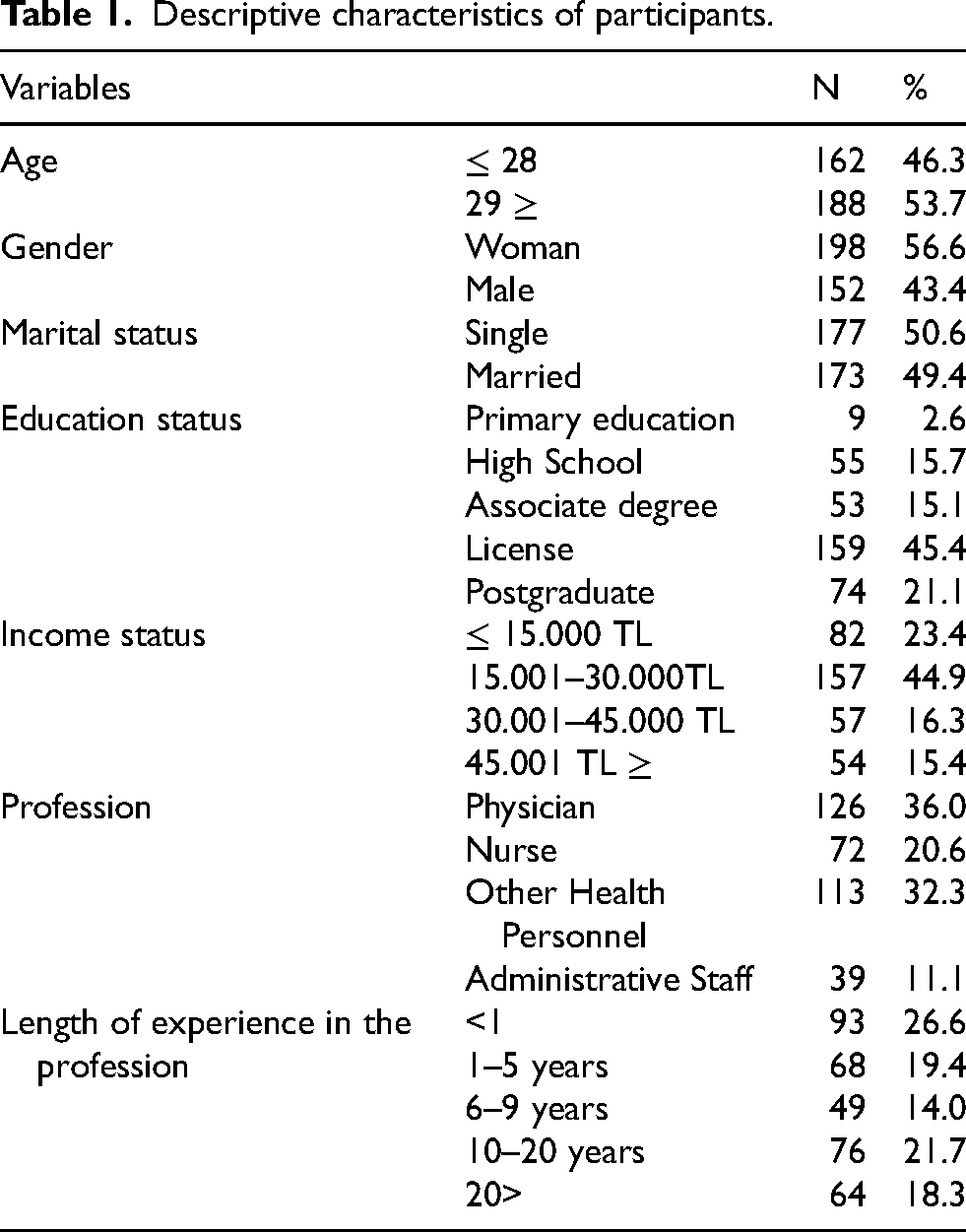
An analysis of the descriptive characteristics of the participants revealed that 56.6% were female, 50.6% were single, and 53.7% were aged 29 or older. Regarding education level, 45.4% of the participants held a bachelor's degree, and 44.9% reported a monthly income between 15,001 and 30,000 Turkish Lira. In terms of occupational distribution, 36% were physicians, 20.6% were nurses, 32.3% were other healthcare personnel, and 11.1% were administrative staff. Concerning professional experience, 26.6% of the participants had less than one year of experience, while 18.3% had more than 20 years (Table 1).
Descriptive characteristics of participants.
The descriptive analysis showed that the mean score for the Organizational Health Scale was X̄ = 3.12, for the Happiness Scale X̄ = 3.21, and for the Employee Performance Scale X̄ = 4.24. Correlation analysis revealed a significant, positive, and low-level relationship between organizational health and happiness (r = .359, p < 0.01), while the relationship between organizational health and employee performance was positive but very weak (r = .136, p < 0.05). Additionally, a significant, positive, and low-level correlation was found between happiness and employee performance (r = .252, p < 0.01) (Table 2).
Descriptive statistics, correlation values and reliability results for variables.

**p < 0.01, *p < 0.05, SD: Standard deviation, Cronbach alpha values in parentheses.
The findings of the study indicated that the relationships among organizational health, happiness, and performance varied significantly depending on the participants’ professional experience and occupational groups. For employees with more than 20 years of experience, organizational health was negatively correlated with happiness (r = −0.460, p < 0.01); among those with 1–5 years of experience, organizational health was negatively correlated with both happiness (r = −0.410, p < 0.01) and performance (r = −0.290, p < 0.05). Similarly, for other healthcare personnel, organizational health showed a significant negative correlation with both happiness (r = −0.310, p < 0.01) and performance (r = −0.350, p < 0.01). Among physicians, a significant negative relationship was observed only between organizational health and happiness (r = −0.320, p < 0.01), while no significant relationship was found between organizational health and either happiness or performance among nurses and administrative staff (p > 0.05).
Confirmatory Factor Analysis (CFA) and Structural Equation Modeling (SEM) results supported the proposed three-factor model comprising organizational health, employee happiness, and employee performance. The model demonstrated excellent fit with the data (χ2 = 0.00004, p = .995; CFI = 1.02; TLI = 1.07; RMSEA = 0.00; GFI = 0.9999), indicating that the hypothesized structure accurately reflected the observed data patterns.
In the structural model, organizational health significantly and positively predicted employee happiness (β = 0.98, S.E. = 0.15, z = 6.65, p < 0.01), and employee happiness significantly predicted job performance (β = 0.14, S.E = 0.045, z = 3.10, p < 0.05). However, the direct effect of organizational health on job performance was not statistically significant (β = 0.23, S.E. = 0.13, z = 1.77, p = .077), indicating that the effect of organizational health on performance is primarily mediated through employee happiness. Although a bootstrap analysis was not conducted at this stage, the structural model results support a partial mediation pathway in which organizational health indirectly affects employee performance through employee happiness. Future studies may confirm the significance of this indirect effect by using confidence intervals through bootstrapping methods. 64
Discussion
This study examined the relationships among organizational health, employee happiness, and performance perceptions of healthcare professionals working in a university hospital. A review of the literature revealed that few studies have investigated the relationships between health, happiness, and performance variables, and none have comprehensively examined these three variables together among healthcare professionals. This gap formed the fundamental rationale for the present research.
The organizational health framework offers a theory-based approach that explains how individual and organizational factors interact to shape employee happiness and performance. A study that examined research results across different occupational groups within the context of organizational health concluded that organizational health is a strong predictor of both employee happiness and job performance. 25 In a comprehensive study involving 4035 participants aged between 16 and 39, the relationships between workplace happiness, health, and productivity were explored. Results indicated that happiness and health at work are major drivers of productivity. It was found that happy employees were three times more productive than unhappy ones. This finding suggests that employee health and workplace happiness increase productivity. 65 Previous studies consistently report strong associations between organizational health, well-being, and happiness. 66
Consistent with previous studies, organizational health emerged as one of the key determinants of employee happiness. Although the overall SEM results indicated positive effects of organizational health on happiness and performance, subgroup analyses revealed negative associations for certain healthcare workers.
The SEM results further support the mediating role of happiness in the relationship between organizational health and employee performance. 31 However, the lack of a statistically significant direct effect of organizational health on performance suggests that happiness plays a central mediating role.
The subgroup analyses revealed that, for some healthcare workers, this relationship was negative. This contradictory finding suggests that the effects of organizational health practices may differ based on group characteristics. Consistent with previous studies, organizational health emerged as a key determinant of employee happiness. While overall SEM results showed positive effects on happiness and performance, subgroup analyses revealed negative associations for some health workers. These findings can be interpreted within the framework of the Job Demands-Resources model 67 Indeed, it suggests that in certain groups, high organizational demands or prolonged exposure to stressful working conditions may reduce the positive effects of organizational health practices, leading to lower perceptions of happiness and performance. Therefore, these subgroup results should be considered exploratory and warrant further theoretical research. A study by Shi et al. 68 showed that high-performance work systems can sometimes increase employee stress levels, intensify workloads, and negatively impact health. Employees may be more likely to experience anxiety, burnout, and fatigue. Among employees with more than 20 years of experience, the negative correlation with happiness may point to burnout or desensitization toward organizational practices due to prolonged exposure to demanding work environments. 3
Among employees with 1–5 years of experience, the negative correlations with both happiness and performance could be attributed to difficulties in adapting to the workplace or unmet expectations of organizational support.69–71 The absence of significant relationships among nurses and administrative staff may be explained by differing job roles or lower levels of emotional demand. These subgroup-based negative correlations highlight the need for context-specific organizational health policies. For instance, burnout prevention programs for highly experienced employees, onboarding support for new hires, and emotional support initiatives for physicians may be effective. 72 The mediating role of happiness underscores the importance of well-being-focused organizational interventions. Another study emphasized the mediating role of happiness. Ahmadiyan et al., 73 in a study involving medical faculty staff, found that happiness played a significant and positive mediating role (0.32) in the relationship between organizational health and quality of work life. Singh and Jha 45 focused on the relationship between employee well-being and organizational health, explaining well-being through the presence of happy and healthy employees. Their findings demonstrated a strong positive relationship (0.729) between employee well-being and organizational health.
In a study conducted by Gül 55 on healthcare professionals, a significant and positive relationship was found between organizational health and job performance, with organizational health explaining 21.6% of the variance in job performance. Another study by Kaczmarek 26 proposed a model to assess organizational health aimed at improving employees’ quality of work life and performance. The model identifies employee health, well-being, and happiness as precursors to organizational processes and effectiveness. It argues that to optimize work processes and achieve organizational effectiveness, organizations must evaluate long-term employee performance. According to the model, a culture shaped by organizational values and goals constitutes the strategic purpose of the institution, and the work climate shaped by this culture defines the context between employee health and performance.
In contrast, the current study's findings reveal that perceptions of organizational health do not directly influence performance perceptions among healthcare workers. Rather, the mediating role of happiness is more prominent. These findings suggest that simultaneously focusing on employee happiness and performance is essential. As noted in the literature, having happy employees adds little value to an organization unless they also perform well. Similarly, pursuing high performance at the expense of employee happiness is also seen as unsustainable. 37
Numerous studies have demonstrated the positive effect of happiness on job performance.27,34,74–77 For example, Awanda et al. 34 found that happiness explained 72.7% of the variation in public employees’ performance and health. A case study by Wheaton et al. 75 revealed that happiness measurably improved job performance by 12–17%. According to a study conducted by Çalık et al. 13 on hospital employees, workplace happiness had a significant positive effect on job performance (β = 0.652; p < 0.001). Similarly, Ay 78 found that organizational happiness had a direct and positive impact on nurses’ job performance (β = 0.122; p < 0.001). According to Shmailan, 51 unhappy employees are unable to perform well at work, which undermines overall organizational success. One of the most critical organizational outcomes of workplace happiness is that happy employees exhibit higher performance, positively reflecting on overall institutional performance. 76 These findings indicate that employee happiness enhances job performance and, through this pathway, contributes to overall organizational and broader system performance. See and Yen 66 conducted a performance analysis to examine the impact of happiness on the efficiency of health systems and found that happiness significantly contributes to system performance. Their study revealed that more content societies have more efficient healthcare systems. Therefore, enhancing individual happiness is proposed to have a beneficial effect on public health. As a result, the burden on health systems may decrease, and the overall system performance may improve. All findings from this study should be interpreted since organizational culture significantly influences a healthcare provider's ability to perform their duties. 79 In line with the study by Khan et al., 80 which showed the mediating role of workplace happiness in the relationship between organizational factors and individual performance, the current findings also confirm the central role of employee happiness in linking organizational conditions to performance outcomes. The cultural context should also be considered, as healthcare professionals in Türkiye may encounter different organizational structures, cultural expectations, and social hierarchies compared to those in other systems.
Conclusion
Until now, organizational health has not received adequate attention in healthcare institutions. However, in today's fast-paced and competitive environment, the concept of organizational health has become more important than ever for healthcare organizations. In order to become competitive and efficient institutions, healthcare organizations must possess a healthy organizational structure. Healthy organizations are employee-focused and prioritize the well-being, happiness, and development of their workforce—their most valuable resource—for long-term success. An organization's competitiveness is reflected in the skills and performance of its employees. One of the factors influencing employee performance is competence. To reach targeted performance levels, institutions must cultivate more professional employees. Supporting employee career development is one way to achieve this goal. Healthcare institutions, which are inherently professional environments, should be equipped with robust career development programs to support the advancement of their healthcare workers.
The performance of healthcare professionals plays a critical role in delivering quality healthcare services. One of the factors affecting this performance is employee happiness. To increase happiness, healthcare institutions should organize or encourage participation in training and development programs that support personal growth. Based on the findings of this study, healthcare managers should implement structured programs that promote organizational well-being through supportive leadership, transparent communication, and employee involvement. In-service training, workshops, and career development initiatives may enhance employee well-being, ultimately improving job performance. Policies that prioritize psychological safety, work-life balance, and recognition of employee contributions can enhance both individual and institutional outcomes. Future organizational strategies should include actions aimed at improving employee well-being to establish resilient healthcare systems.
Limitations and future research
Several limitations should be acknowledged. First, the cross-sectional design restricts the ability to determine causal relationships among organizational health, employee happiness, and performance. Future research should employ longitudinal designs to clarify the temporal dynamics among these variables.
Second, data collection from a single state university hospital in Türkiye limits the generalizability of the findings to other healthcare institutions, private hospitals, or international healthcare systems.
Third, reliance solely on self-report measures may introduce biases, including common-method and social-desirability bias. Future studies should incorporate multi-source data collection, such as manager evaluations or objective performance indicators.
Finally, the study did not examine potential moderator variables, such as leadership styles, organizational justice, psychological safety, or job demands. The unexpected negative correlations observed, particularly within certain occupational groups, suggest the presence of contextual and underlying dynamics. Future qualitative research should further investigate these issues. The mediation effect was evaluated based on the significance of the structural paths; however, future research is encouraged to confirm the indirect effect using bootstrap resampling techniques.
Footnotes
Acknowledgements
We would like to thank all the hospital employees who participated in this study.

Ethical approval
Ethical approval for this study was obtained from the Non-Interventional Clinical Research Ethics Committee of Süleyman Demirel University on October 31, 2023 (Decision No: 141/5).
Informed consent
Informed consent was obtained from all participants prior to data collection. Participants were informed about the purpose of the study, the voluntary nature of their participation, and their right to withdraw at any time without any consequences. Confidentiality and anonymity of the data were assured.
Funding
The author received no financial support for the research, authorship, and/or publication of this article.
Declaration of conflicting interests
The authors declared no potential conflicts of interest with respect to the research, authorship, and/or publication of this article.