




Abstract
Background
Workplace adaptation among employees with psychiatric disabilities is heterogeneous. This study identified workplace-adaptation profiles and examined their associations with proactive behavior and retention-relevant differences, particularly turnover intention.
Objective
To clarify distinctive characteristics of workplace adaptation by examining how proactive-behavior types are associated with workplace-adaptation profiles and whether those types differ across tenure categories.
Methods
Using survey data from Japanese private-sector companies and special-purpose subsidiaries with 1–3 years of organizational tenure, we conducted hierarchical agglomerative cluster analyses to derive workplace-adaptation profiles and proactive-behavior types and examined their associations, including with tenure categories.
Results
Three workplace-adaptation profiles were identified, representing distinct configurations of socialization, affective commitment, job satisfaction, and turnover intention, and proactive-behavior types showed patterned associations with these profiles. Higher proactive-behavior types were more frequent in the high-adaptation, low-turnover-intention profile, whereas lower proactive-behavior types were more common in profiles characterized by lower adaptation and higher turnover intention. Proactive-behavior types were not significantly associated with tenure categories within the restricted 1–3-year range.
Conclusions
Workplace adaptation among employees with psychiatric disabilities is heterogeneous, and proactive behavior is linked to workplace-adaptation profiles in patterned rather than uniform ways. These findings support profile-informed workplace support, although the results should be interpreted as correlational.
Keywords
Introduction
Research background
Employees with disabilities in private-sector companies tend to have shorter job tenure than employees without disabilities, and turnover is more likely to occur during the early stage of employment. In Japan, some employees with disabilities also work in special-purpose subsidiaries, legally recognized affiliate companies established in part to promote the employment of persons with disabilities under the national disability employment system. Brucker et al. reported that employees with disabilities are more likely to have less than one year of tenure and less likely to have ten or more years of tenure. 1 Among this population, employees with psychiatric disabilities may face greater difficulty sustaining employment because they are more likely to encounter fluctuating symptoms, stigma, and unequal access to reasonable workplace accommodations. Schur et al. noted that employees with psychiatric disabilities request accommodations more frequently than other employees. 2
Previous research has identified several workplace barriers that may undermine continued employment among employees with psychiatric disabilities. First, the availability and fit of accommodations vary considerably for people with psychiatric disabilities. 3 Second, psychosocial resources, such as perceived organizational support and self-efficacy, shape the process of requesting and receiving accommodations, and these processes are associated with job satisfaction and employment retention.4,5 Evidence from Japan's special-purpose subsidiaries also indicates that supervisory and coworker support buffers the association between role overload and turnover intention among employees with psychiatric disabilities. 6 Third, employees with invisible or concealable disabilities may be particularly vulnerable to prejudice and negative stereotyping, which can constrain disclosure, help-seeking, and workplace inclusion. 7 In addition, stigma-related concerns about disclosure may further constrain everyday help-seeking and workplace adaptation. 8
Taken together, these findings suggest that supporting the retention of employees with psychiatric disabilities requires not only reasonable accommodations but also broader support systems that include workplace resources and support pathways that make such accommodations easier to access and use. In particular, a workplace environment that enables employees to disclose mental health concerns more easily is an important component of such a support system. Lyubykh et al. showed that stronger organizational support for disclosing mental health concerns is associated with greater willingness to disclose and more favorable work outcomes. 9 This evidence suggests that understanding continued employment among employees with psychiatric disabilities requires attention not only to individual difficulties but also to the quality of supportive workplace environments. However, even when such workplace resources and support pathways are available, employees with psychiatric disabilities are unlikely to show a uniform pattern of workplace adaptation. Understanding workplace adaptation among employees with psychiatric disabilities therefore requires attention both to supportive workplace environments and to the factors that shape different patterns of adaptation.
Factors influencing workplace adaptation
In this study, workplace adaptation is conceptualized as employees’ cognitive, affective, and behavioral alignment with their organization and job context.10,11 We operationalize this concept using occupational socialization, cultural socialization, affective commitment, job satisfaction, and turnover intention as an inverse indicator. These variables were selected to capture workplace adaptation as a multidimensional state during the early stage of employment, consistent with prior research on organizational socialization, newcomer adjustment, and adaptation-related job attitudes and turnover intentions.10–15
Workplace adaptation, as captured by these indicators, is shaped by both workplace-based factors and employees’ own actions. Workplace-based factors include organizational practices that facilitate socialization and role learning, organizational support, high-quality leader–member exchange (LMX), and team psychological safety. These contextual resources support newcomers’ acquisition of role knowledge and skills, facilitate sensemaking and role clarity, and thereby support workplace adaptation.16–18
By contrast, proactive behavior is an important factor derived from employees’ own actions. Here, proactive behavior refers to anticipatory, self-initiated action.19,20 Previous research suggests that proactive behavior is associated with workplace adaptation through at least three complementary mechanisms. First, it may reduce uncertainty. Information seeking and feedback seeking support sensemaking and reduce ambiguity.21,22 Second, it may help build resources within the Job Demands–Resources framework. Through networking, relationship building, and adjustments resembling job crafting, employees may expand both job resources and personal resources, such as autonomy, feedback, social support, and self-efficacy. These resources, in turn, are associated with engagement and adaptation.23,24 Third, it may enhance fit. By aligning tasks and relationships with their own abilities and needs, employees may strengthen person–job fit and person–organization fit, which are further linked to adaptation-related attitudes and retention.25,26
For employees with psychiatric disabilities, proactive behavior may be particularly important. For example, proactive accommodation negotiation, selective disclosure, career self-management, networking, and feedback seeking may help secure individualized support, navigate stigma-related concerns, and create more workable person–job and person–organization fit. Previous research has shown that these behaviors are associated with satisfaction, adaptation, and retention.2–4,27,28 These behaviors may also help employees manage stigma-related uncertainty by clarifying when and from whom support can be sought, identifying safer channels for disclosure or accommodation requests, and reducing ambiguity about how their needs will be received in the workplace. Accordingly, workplace adaptation among employees with psychiatric disabilities should be understood as developing through the interplay between workplace support and employees’ own proactive actions, rather than as determined solely by support provided by the workplace.
Research gaps and study approach
Although interest in disability and work is increasing, organizational research focused specifically on employees with psychiatric disabilities remains limited. Existing work is still largely descriptive and does not adequately explain variation in workplace adaptation or the factors associated with it. Reviews have noted the predominance of descriptive study designs 29 and the limited differentiation across disability populations. 30 Research is therefore needed that focuses specifically on employees with psychiatric disabilities and more clearly captures heterogeneity in their patterns of workplace adaptation.
In this regard, person-centered quantitative evidence remains particularly scarce. Prior same-dataset research on employees with psychiatric disabilities has shown, using regression and mediation analyses, that proactive behavior is positively associated with organizational adaptation and mediates the effects of self-efficacy, leader–member exchange (LMX), and job characteristics on adaptation-related outcomes. 31 Emerging research has also begun to examine proactive career behavior among people with disabilities and its antecedents, including disability acceptance, self-efficacy, and contextual barriers. 32 However, these studies have generally relied on variable-centered approaches. They do not show whether distinct patterns of workplace adaptation and proactive behavior coexist within samples of employees with psychiatric disabilities or how such patterns relate to retention-relevant indicators. Studies addressing these questions from a person-centered perspective therefore remain scarce. Although some quantitative research on job crafting exists, many studies aggregate disability groups or focus on general mental health status rather than specifically examining employees with psychiatric disabilities in competitive employment. 33 In addition, qualitative research on return to work after common mental disorders has highlighted the importance of self-initiated adjustments, including job crafting, during the post-return-to-work process. 34 However, quantitative person-centered studies examining these issues in samples of employees with psychiatric disabilities remain limited.
Recent methodological work suggests that person-centered modeling is well suited to uncovering latent heterogeneity by focusing on patterns among individuals rather than associations among variables, thereby complementing variable-centered approaches. 35 Recent applied guidance has also provided concrete procedures for identifying and interpreting profiles or configurations using latent profile analysis and has shown how resulting profile solutions can be linked to segment-specific practical implications. 36 These developments suggest that a person-centered approach is well suited to understanding heterogeneity in workplace adaptation among employees with psychiatric disabilities.
To address these gaps, the present study adopts a dual person-centered framework using cluster analysis to identify whether distinct configurations of workplace adaptation and proactive behavior coexist and how their intersection clarifies retention-relevant heterogeneity. Specifically, we (i) derive workplace-adaptation profiles from five indicators—occupational socialization, cultural socialization, affective commitment, job satisfaction, and turnover intention; (ii) independently derive proactive-behavior types from four indicators—feedback seeking, network utilization, positive framing, and innovative behavior; (iii) examine the association between these two classifications; and (iv) examine whether proactive-behavior types are associated with tenure categories. We use cluster analysis to identify workplace-adaptation profiles and proactive-behavior types and then apply chi-square tests to evaluate the associations between these person-centered classifications. This cross-sectional, non-causal design complements variable-centered approaches by capturing heterogeneity in how proactive behavior co-occurs with workplace adaptation and by providing segment-specific implications for sustained workplace adaptation and employment retention.
Research questions
Methods
Participants and procedure
This study analyzed secondary data from an internet-based survey conducted in collaboration with Company X, a large opt-in online research panel in Japan. Panelists are recruited through web advertisements and partner websites, provide profile information at registration, and periodically update their health and employment attributes. Company X distributed individualized email invitations containing unique, single-use survey links, thereby permitting only one response per invitation. Before delivering fully de-identified data to the authors, the company applied standard panel quality controls, including device/IP duplication checks and completion-time flags. Respondents received small, non-cash incentive points customary for online research in Japan. The research team had no access to personally identifying information.
Fieldwork was conducted from April 16 to April 20, 2021. Invitations were sent to panelists who, based on their registration profiles, self-reported at least one eligible physician-diagnosed condition for screening. A total of 1000 respondents completed the survey: 812 self-reported a psychiatric disability, 253 a developmental disability, 25 an intellectual disability, and 35 another disability category.
The analytic sample in the present study comprised employees with psychiatric disabilities who were employed in general private-sector companies or special-purpose subsidiaries and had 1–3 years of organizational tenure. This tenure range was selected because newcomer organizational socialization and workplace adaptation primarily unfold during the early post-entry period and may continue to change, particularly through the end of the second year after entry. 37 In addition, unsuccessful early adaptation may be associated with an increased likelihood of early turnover.10,11 Restricting the sample to this range also allowed us to retain sufficient variation to compare first-, second-, and third-year employees while focusing on a relatively homogeneous early-tenure context. Accordingly, the 1–3-year range in the present study was intended to capture a relatively early phase of organizational adaptation rather than to imply that the adaptation process is uniformly completed within that period.
Among respondents who self-reported a psychiatric disability (n = 812), 620 were employed in the eligible sectors; of these, 245 reported 1–3 years of organizational tenure and constituted the final analytic sample (N = 245). All respondents viewed an online information sheet describing the study's aims, data handling, and intended dissemination before participation. Electronic informed consent was obtained, with submission of a completed questionnaire indicating consent. Reuse of the de-identified survey data for secondary analysis was approved by the Social Welfare Ethics Review Committee at University of Kochi (Approvals 17-72 and 23-42), and only aggregated results are reported.
Data reuse and transparency
The analytic sample in the present study (N = 245; employees with psychiatric disabilities in Japan employed in general private-sector companies or special-purpose subsidiaries, with 1–3 years of organizational tenure) was drawn from the same April 2021 online survey dataset used in the author's prior publications based on this subsample.31,38–41
The prior studies addressed different research questions and used different variable sets and analytic specifications, including regression and mediation models and workplace-adaptation clustering. Among them, two prior cluster-analytic studies are most relevant for assessing overlap with the present study. Fukuma 2023 derived workplace-adaptation clusters from four indicators—occupational socialization, cultural socialization, affective commitment, and turnover intention—whereas Fukuma 2024 used these four indicators plus job satisfaction. Thus, the data source and the five workplace-adaptation indicators overlap with Fukuma 2024.
The present study extends this prior work through a dual person-centered framework by deriving workplace-adaptation profiles and proactive-behavior types independently and examining how their intersection clarifies retention-risk patterning, with turnover intention as the primary indicator. A concise cross-walk is provided in Table 1, and detailed transparency information is provided in Appendix B. Unlike prior adaptation-only analyses using this dataset, the present study links independently derived workplace-adaptation profiles and proactive-behavior types to clarify retention-risk patterning. All tables, figures, and text in this manuscript are original. The visual layout of Figure 1 was adapted from the author's prior work, Fukuma 41 ; the figure was redrawn using the present study's cluster solutions, axes, labels, and statistics. No content is duplicated from earlier publications.
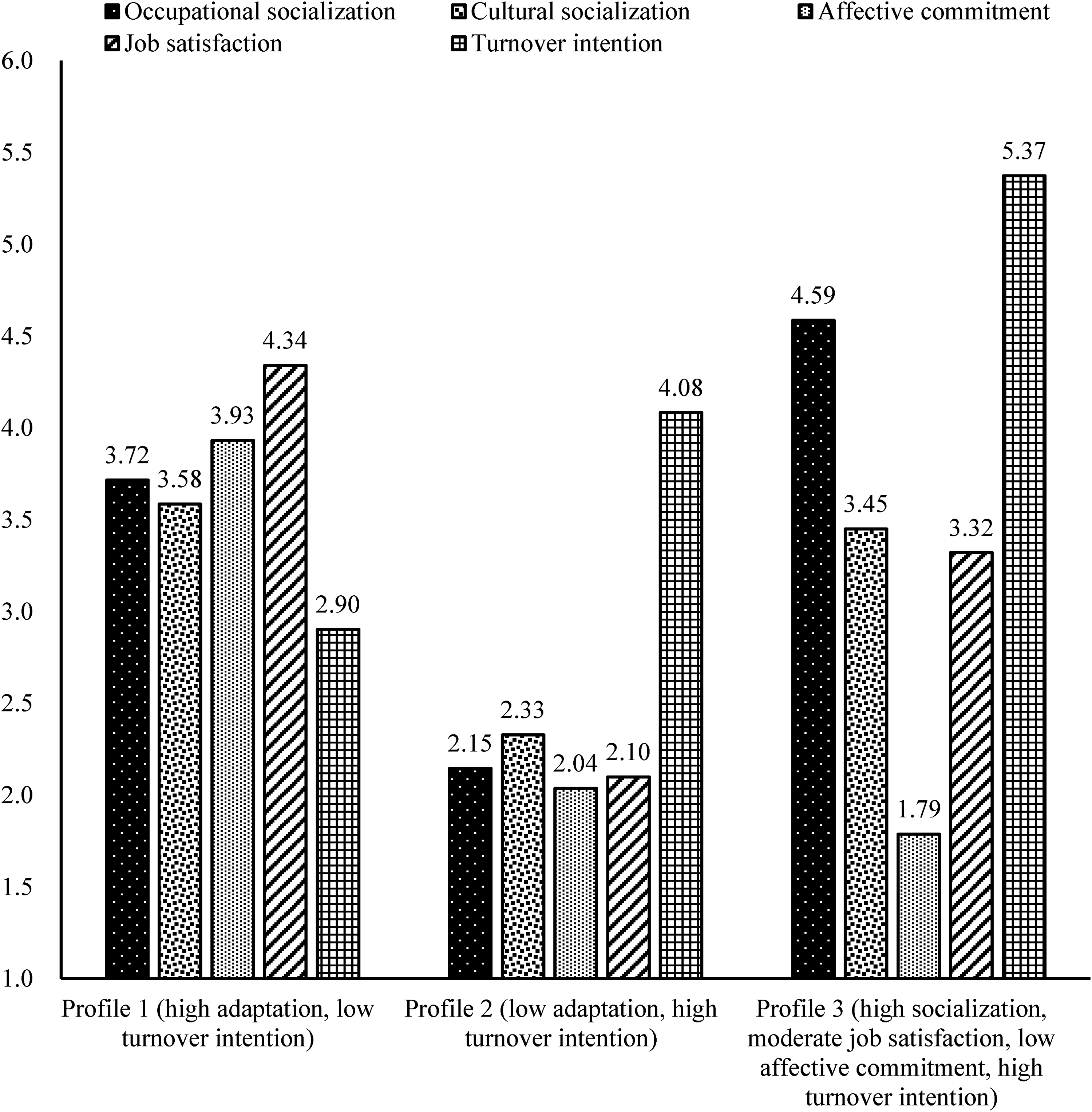
Mean scores on five workplace-adaptation indicators across three profiles (Ward's method, squared Euclidean distance; Profile 1, n = 156; Profile 2, n = 64; Profile 3, n = 25). Note. No missing values were observed. Higher scores indicate greater levels of each named construct; for turnover intention, higher scores denote a stronger intention to leave. The visual layout was adapted from the author's prior work, Fukuma 41 ; all data, statistics, axes, and labels were newly produced for the present study. See Methods 2.2 for details of the clustering procedure and preprocessing.
Cross-walk of dataset use across prior cluster-analytic studies and the present study (N = 245).

Note. OS: occupational socialization; CS: cultural socialization; AC: affective commitment; JS: job satisfaction; TI: turnover intention. This table summarizes how the same N = 245 dataset was used across two prior cluster-analytic studies by Fukuma and the present study. It provides a concise main-text cross-walk; Appendix B and Appendix Table B1 provide fuller transparency details regarding overlap and safeguards.
Final sample and analytical approach
As described in Section 2.1, the analytic sample comprised 245 employees with psychiatric disabilities working in private-sector companies or special-purpose subsidiaries in Japan, all with 1–3 years of organizational tenure. The inclusion criteria were: (a) current employment in a private-sector company or special-purpose subsidiary, (b) self-reported psychiatric disability, and (c) organizational tenure between 1 and 3 years. The only exclusion criterion was tenure outside this 1–3-year window. In the original survey (N = 1000), no respondents meeting criteria (a) and (b) were unemployed, and there were no missing values on the focal measures used in the present analyses; all models were therefore estimated using complete cases (N = 245).
Overview of analysis
All indicators were z-standardized before clustering. Exploratory factor analyses, cluster analyses, and chi-square tests were conducted using IBM SPSS Statistics 25.0 for Windows, whereas confirmatory factor analyses were conducted using IBM SPSS Amos 25.0. We conducted separate hierarchical agglomerative cluster analyses for (i) workplace adaptation and (ii) proactive behavior using Ward's method with squared Euclidean distances. For each domain, we compared solutions for k = 2–4 using the agglomeration schedule, average silhouette widths, parsimony, and interpretability.
Participant demographics
The mean age of participants was 38.75 years (SD = 10.78), and the mean total work experience was 9.89 years (SD = 8.41). The mean number of job changes was 5.02 (SD = 7.78). Participants were 39.2% male (n = 96) and 60.8% female (n = 149); most held non-managerial roles (95.9%; n = 235). Employment status was 38.4% full-time (n = 94) and 61.6% non-full-time (n = 151). Organizational tenure with the current employer was distributed as follows: first year, 38.0% (n = 93); second year, 30.2% (n = 74); and third year, 31.8% (n = 78). A majority held a psychiatric disability certificate (53.5%; n = 131), with 46.5% (n = 114) reporting non-holder status. Full distributions are presented in Table 2.
Participant demographics (N = 245).
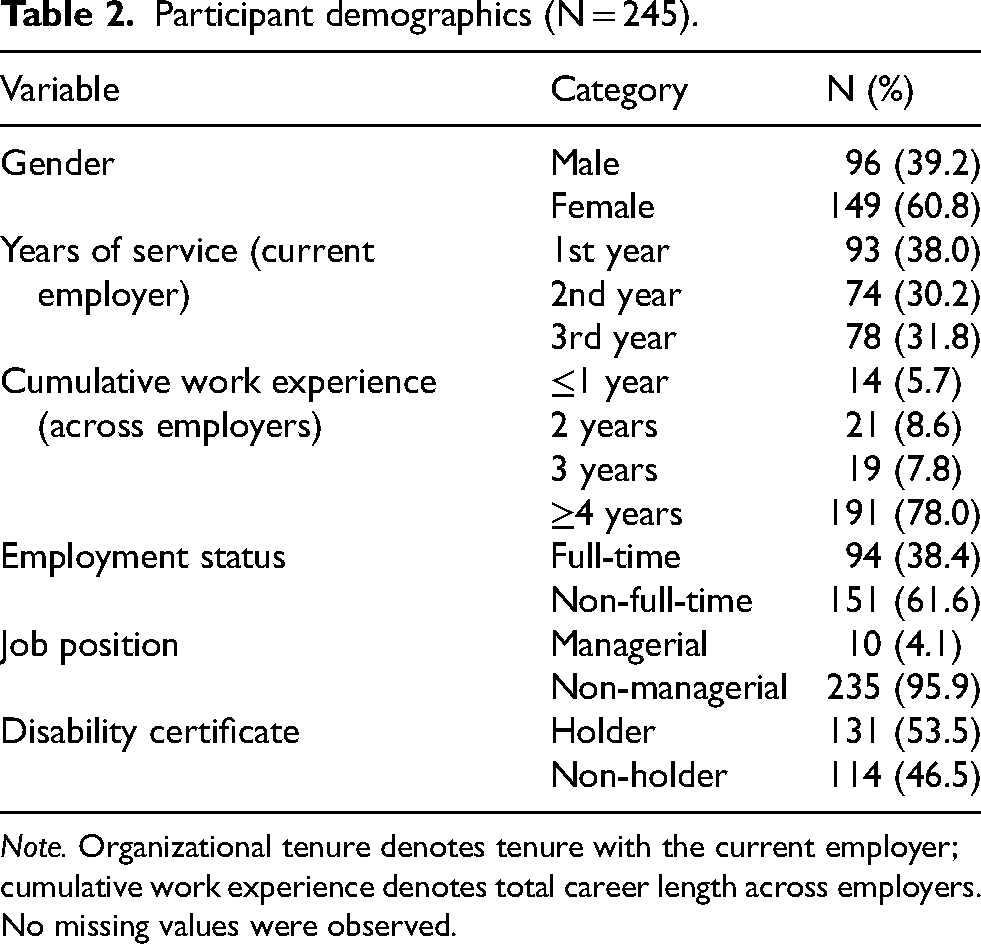
Note. Organizational tenure denotes tenure with the current employer; cumulative work experience denotes total career length across employers. No missing values were observed.
The survey did not capture granular DSM/ICD diagnostic categories or educational attainment. Instead, we recorded disability-certificate status as a standardized indicator within Japan's employment system. We note this measurement choice and its implications for generalizability in the Limitations (Section 4.5).
Measures
This study used five validated measurement scales (Appendix Table A1). Unless otherwise noted, all items were administered in Japanese and rated on a six-point Likert scale ranging from 1 (“strongly disagree”) to 6 (“strongly agree”), with higher scores indicating higher levels of the construct. Composite scores were computed as the mean of the constituent items so that each item contributed equally to the scale score. Item wording and the number of items per construct are provided in Appendix Table A1. Internal consistency was acceptable to good for all scales in the present sample (Table 3).
Summary of measurement scales and internal consistency (Cronbach's α; N = 245).
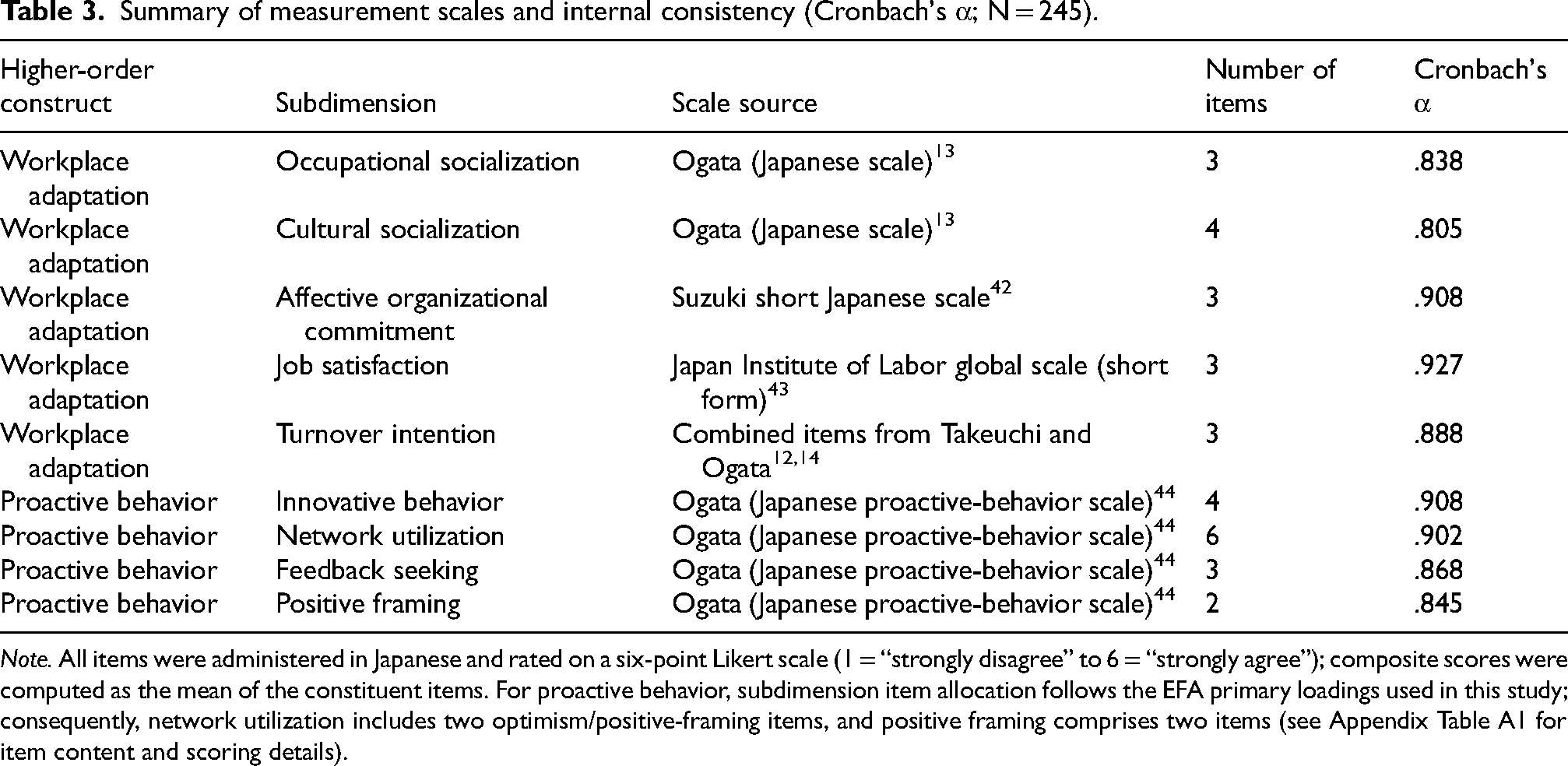
Note. All items were administered in Japanese and rated on a six-point Likert scale (1 = “strongly disagree” to 6 = “strongly agree”); composite scores were computed as the mean of the constituent items. For proactive behavior, subdimension item allocation follows the EFA primary loadings used in this study; consequently, network utilization includes two optimism/positive-framing items, and positive framing comprises two items (see Appendix Table A1 for item content and scoring details).
Occupational and cultural socialization
Occupational and cultural socialization were measured using seven items from Ogata, 13 developed based on the organizational socialization frameworks proposed by Chao et al. 45 and Haueter et al. 46 Prior studies in Japanese private-sector samples support the scale's factorial validity and internal consistency, as well as its positive associations with affective commitment. 15
Affective commitment
Affective commitment was assessed with three items from Suzuki's short Japanese scale. 42 Prior research supports its factorial validity and its negative association with turnover intention in Japanese employee samples. 15
Job satisfaction
Global job satisfaction was measured with three items from the Japan Institute of Labor's five-item scale. 43 Studies of employees with disabilities in special-purpose subsidiaries report acceptable psychometric properties for this abbreviated version in similar organizational contexts. 47
Turnover intention
Turnover intention was assessed with a three-item composite adapted from Takeuchi's two-item measure and Ogata's two-item scale.12,14 Two items captured the desire to change employers and to leave the current company. To reduce the cognitive burden of reverse wording for employees with psychiatric disabilities, we reformulated Ogata's reverse-coded item (“I intend to stay with my current company indefinitely”) into a straightforward item capturing thoughts of leaving.
The composite score was computed as the mean of the three items, with higher scores indicating stronger turnover intention. A conceptually similar three-item measure has shown acceptable reliability and a strong negative correlation with job satisfaction in samples of employees with disabilities, supporting criterion-related validity. 47
Proactive behavior
Proactive behavior was measured using 15 items adapted from Ogata's original 16-item scale, 44 which was developed based on the proactive socialization framework of Ashford and Black. 20 The original scale comprises four subdimensions: innovative behavior (4 items), network utilization (5 items), positive framing (4 items), and feedback seeking (3 items). In the present study, one network-utilization item (“I try to broaden my interpersonal relationships within the company”) was omitted because it showed substantial cross-loadings on the second (.418) and third (.329) factors in Ogata's factor analysis (difference < .20). 44 The remaining 15 items yield four subscales with 4 items for innovative behavior, 4 for network utilization, 4 for positive framing, and 3 for feedback seeking.
The measure captures information seeking, feedback seeking, networking, and positive reframing of work situations, but it does not include task-crafting items (see Section 1.2). Prior studies in Japanese private-sector samples support its reliability and criterion-related validity. 44 To ensure comparability across studies using this dataset, we harmonized measurement definitions with prior publications based on the same analytic sample.31,38–41
Results
Factor analysis of workplace adaptation
An exploratory factor analysis (EFA) using maximum likelihood estimation with Promax rotation was conducted to examine the factor structure of the workplace-adaptation indicators. The analysis supported a five-factor structure across the 16 questionnaire items. The first factor consisted of three items related to turnover intention and was labeled turnover intention. The second factor comprised four items pertaining to cultural socialization and was labeled cultural socialization. The third factor included three items related to job satisfaction and was labeled job satisfaction. The fourth factor comprised three items concerning occupational socialization and was labeled occupational socialization. The fifth factor consisted of three items measuring affective commitment and was labeled affective commitment (see Appendix Table A1 for item wording).
In the EFA, items with a primary loading ≥ .40 were retained as indicators of a given factor, whereas items showing cross-loadings > .30 (i.e., a |Δ| between the two highest loadings < .20) were flagged a priori for review. A small number of items met the cross-loading flag. However, retention was theoretically justified and supported by subsequent model fit, so no items were removed and all 16 items were retained in the five-factor solution. The Promax rotation converged in eight iterations, and the EFA model-fit statistics were χ2 = 68.054, df = 50, p < .05.
Subsequently, confirmatory factor analysis (CFA) was conducted to evaluate the EFA-derived structure. A five-factor oblique model was specified in which item–factor assignments were constrained to the EFA primary loadings, with no cross-loadings estimated, and factor correlations were freely estimated. CFA results indicated an acceptable overall fit for the five-factor workplace-adaptation model (Table 4). Internal consistency estimates for each subscale are reported in Table 3.
Confirmatory factor analysis fit indices for workplace adaptation and proactive behavior (N = 245).
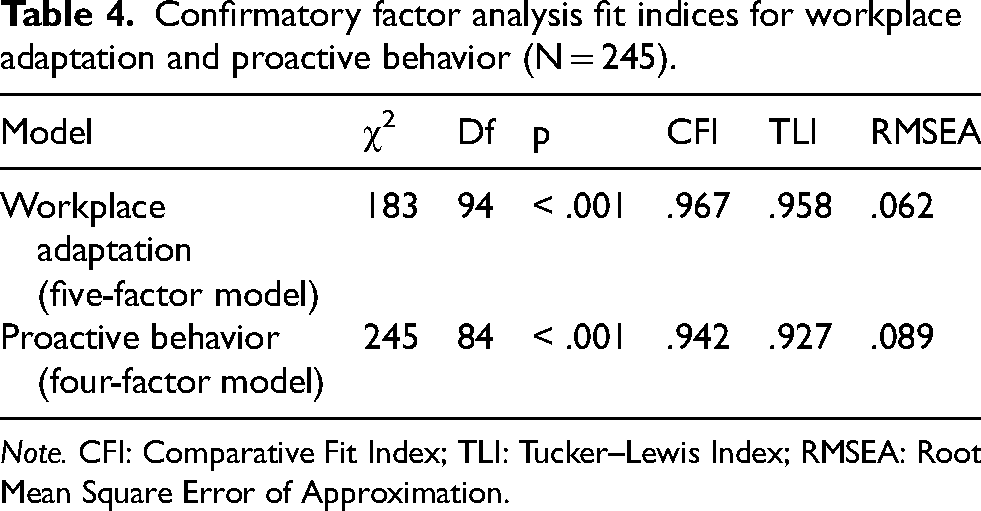
Note. CFI: Comparative Fit Index; TLI: Tucker–Lewis Index; RMSEA: Root Mean Square Error of Approximation.
Factor analysis of proactive behavior
An exploratory factor analysis (EFA) using maximum likelihood estimation with Promax rotation was conducted to examine the factor structure of proactive behavior. The results indicated that the 15 questionnaire items supported four distinct factors, which were retained based on interpretability and conceptual coherence. The first factor included four items representing innovative behavior. The second factor comprised four items related to network utilization and two optimism/positive-framing items that showed their primary loadings on this factor; it was labeled network utilization. The third factor consisted of three items related to feedback seeking. The fourth factor included two items associated with positive framing.
As in Section 3.1, items with a primary loading ≥ .40 were retained as indicators of a given factor, whereas items with cross-loadings > .30 and a primary–secondary |Δ| < .20 were flagged for review. No items violated these thresholds; therefore, no items were removed, and all 15 items were retained across the four-factor solution. The Promax rotation converged in six iterations, and the EFA maximum-likelihood goodness-of-fit was χ2 = 123.248, df = 51, p < .001.
Subsequently, CFA tested a four-factor oblique model corresponding to the EFA structure, with inter-factor correlations freely estimated and item–factor assignments fixed to the EFA primary loadings, with no cross-loadings specified. CFA results indicated an acceptable fit for the proposed four-factor structure of proactive behavior (Table 4). Because the CFA followed the EFA-based allocation, the network-utilization subscale comprises six items, whereas positive framing comprises two items. Cronbach's alpha coefficients for the four proactive-behavior subscales are summarized in Table 3.
Cluster analysis of workplace-adaptation profiles
A cluster analysis was conducted to classify workplace-adaptation profiles among employees with psychiatric disabilities employed in general private-sector companies or special-purpose subsidiaries with 1–3 years of organizational tenure. Five variables were used—occupational socialization, cultural socialization, affective commitment, job satisfaction, and turnover intention—using Ward's method with squared Euclidean distance. A two-stage procedure, consisting of exploratory identification followed by confirmation, indicated that a three-cluster solution (k = 3) provided an adequate balance of parsimony and interpretability, supported by the elbow in the agglomeration schedule and inspection of adjacent solutions.
The three clusters were subsequently labeled Profile 1, Profile 2, and Profile 3 and comprised n = 156, n = 64, and n = 25 participants, respectively. As shown in Figure 1, Profile 1 exhibited relatively higher means on occupational and cultural socialization, affective commitment, and job satisfaction, together with relatively lower turnover intention than the other profiles. Profile 2 showed the opposite pattern, with lower means on socialization, affective commitment, and job satisfaction and higher turnover intention. Profile 3 showed relatively high occupational socialization, moderate job satisfaction, the lowest affective commitment, and the highest turnover intention. This pattern suggests a mixed configuration in which some aspects of day-to-day adjustment appear relatively favorable, while organizational attachment and intended retention remain comparatively weaker.
Based on these mean-score patterns, the three clusters were labeled as follows: Profile 1 (high adaptation, low turnover intention), Profile 2 (low adaptation, high turnover intention), and Profile 3 (high socialization, moderate job satisfaction, low affective commitment, high turnover intention). These labels are descriptive summaries of the observed score configurations.
Cluster analysis of proactive-behavior types
A separate cluster analysis was conducted to classify proactive-behavior types among employees with psychiatric disabilities employed in general private-sector companies or special-purpose subsidiaries with up to three years of organizational tenure. Four proactive-behavior indicators were used—innovative behavior, network utilization, feedback seeking, and positive framing—again applying Ward's method with squared Euclidean distance. An exploratory stage suggested that a three-cluster solution (k = 3) was optimal in terms of the agglomeration schedule, parsimony, and theoretical interpretability, and this solution was retained in the final model.
The three clusters were subsequently labeled Type 1, Type 2, and Type 3 and comprised n = 99, n = 68, and n = 78 participants, respectively. As shown in Figure 2, Type 1 displayed comparatively higher mean scores on all four proactive behaviors, whereas Type 2 showed lower mean scores across all four behaviors. Type 3 exhibited a distinctive pattern with a relatively higher mean for feedback seeking and lower means on innovative behavior, network utilization, and positive framing than the other types.
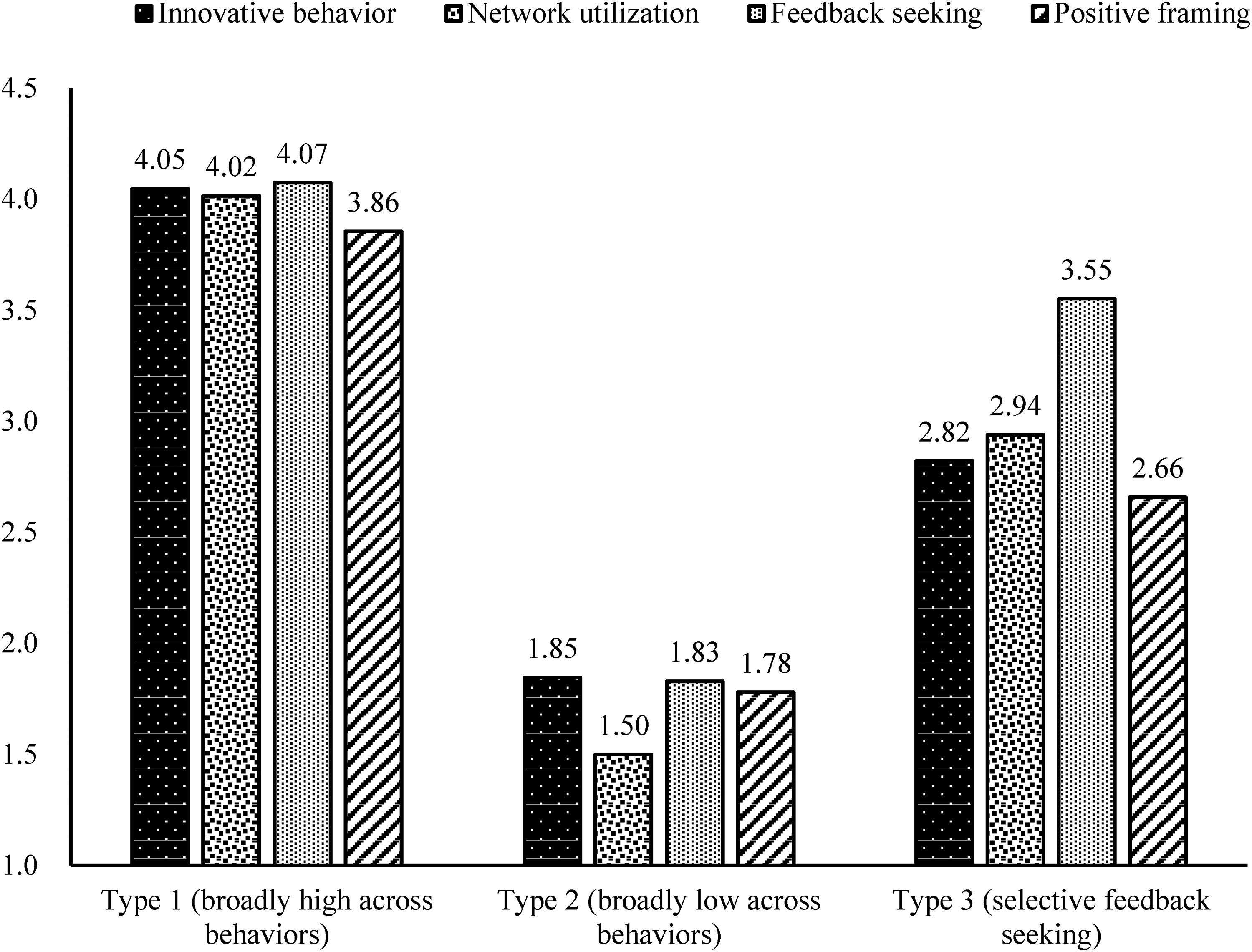
Mean scores on four proactive-behavior indicators across three types (Ward's method, squared Euclidean distance; Type 1, n = 99; Type 2, n = 68; Type 3, n = 78). Note. No missing values were observed. Scores are scale means (1–6). Higher values indicate higher levels of each named behavior.
Based on these score patterns, the three clusters were labeled Type 1 (broadly high across behaviors), Type 2 (broadly low across behaviors), and Type 3 (selective feedback seeking). For clarity, the type numbering for proactive behavior is independent of the profile numbering used for workplace adaptation in Section 3.3.
Relationship between workplace-adaptation profiles and proactive-behavior types
We tested the association between workplace-adaptation profiles and proactive-behavior types using a chi-square test of independence (Table 5). The association was statistically significant, χ2(4) = 76.403, p < .001. Expected frequencies were adequate for the χ2 approximation, with no cells having expected counts < 5 and a minimum expected count of 6.94. We also report an effect size for the association, Cramér's V = 0.396, indicating a moderate association.
Relationship between workplace-adaptation profiles and proactive-behavior types (N = 245).

Note. Cell entries are observed counts with row percentages in parentheses; row percentages sum to 100.0 within each proactive-behavior type. ASR = adjusted standardized residual; ASRs are reported descriptively (two-tailed α = .05; |ASR| ≥ 1.96), with no familywise error correction. Cramér's V = 0.396. Chi-square assumptions were met (minimum expected count = 6.94; no expected cell count < 5). No missing values were observed. Profile 1 = high adaptation, low turnover intention; Profile 2 = low adaptation, high turnover intention; Profile 3 = high socialization, moderate job satisfaction, low affective commitment, high turnover intention.
Adjusted standardized residuals indicated that proactive-behavior Type 1 (broadly high across behaviors) was overrepresented in Profile 1 (high adaptation, low turnover intention; z = 5.7, p < .001) and underrepresented in Profile 2 (low adaptation, high turnover intention; z = −5.6, p < .001). Type 2 (broadly low across behaviors) was underrepresented in Profile 1 (z = −8.4, p < .001) and overrepresented in Profile 2 (z = 7.2, p < .001) and Profile 3 (high socialization, moderate job satisfaction, low affective commitment, high turnover intention; z = 2.9, p < .01). Type 3 (selective feedback seeking) showed a modest overrepresentation in Profile 1 (z = 2.1, p < .05). This distribution is consistent with the descriptive interpretation of Profile 3 as a mixed pattern in which relatively favorable day-to-day adjustment coexists with weaker organizational attachment and elevated turnover intention.
Association between proactive-behavior types and tenure categories
We conducted a chi-square test of independence to assess the association between proactive-behavior types and tenure categories (organizational tenure; first through third year) (Table 6). The test indicated no statistically significant association, χ2(4) = 4.989, p = .288. Expected frequencies were adequate for the chi-square approximation, with no expected cell count < 5 and a minimum expected count of 20.54. For completeness, we also report the effect size: Cramér's V = 0.101, indicating a small association.
Relationship between proactive-behavior types and organizational tenure (current employer; N = 245).
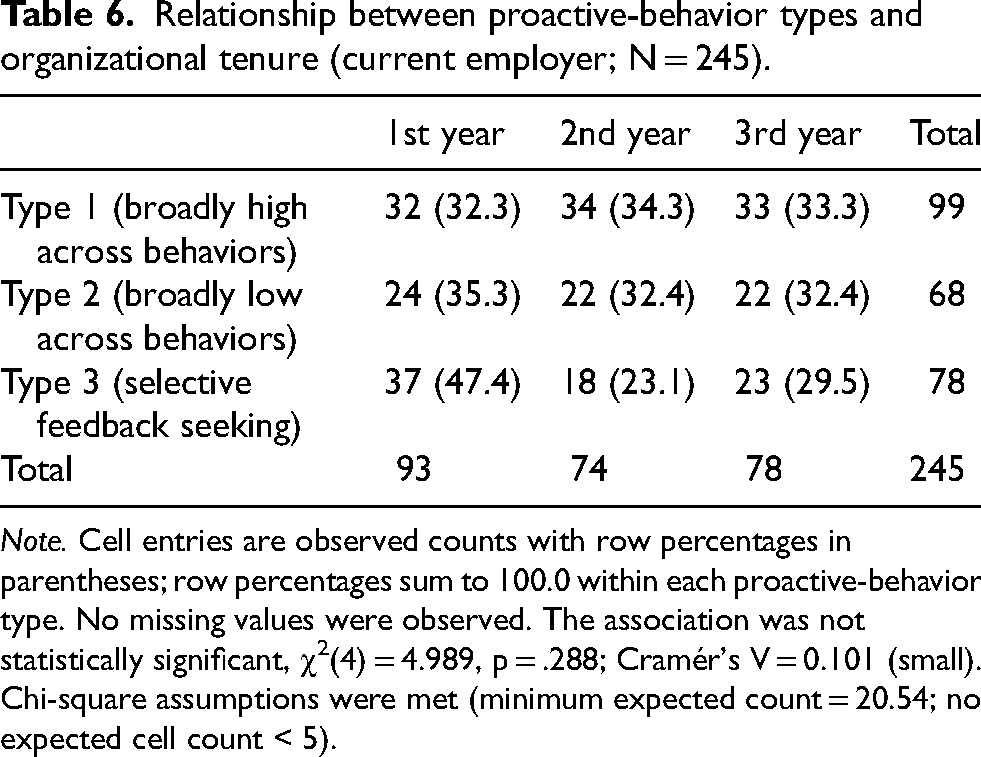
Note. Cell entries are observed counts with row percentages in parentheses; row percentages sum to 100.0 within each proactive-behavior type. No missing values were observed. The association was not statistically significant, χ2(4) = 4.989, p = .288; Cramér's V = 0.101 (small). Chi-square assumptions were met (minimum expected count = 20.54; no expected cell count < 5).
Discussion
The present study contributes a dual person-centered framework linking workplace-adaptation profiles and proactive-behavior types. This framework extends prior adaptation-only analyses by clarifying segment-specific retention-risk patterning and related practice implications. We first interpret the workplace-adaptation profiles, then discuss the profile–type association and the tenure analysis, and finally outline profile-specific practice implications and study limitations.
Interpretation of the classification of workplace-adaptation profiles
Profile 1 (high adaptation, low turnover intention) was the most prevalent workplace-adaptation profile in this sample. This prevalence may reflect features of Japan's employment-support infrastructure for persons with psychiatric disabilities, including community-based workplace visits and internships that can facilitate anticipatory socialization, that is, role and context learning prior to entry. Prior correlational studies link higher anticipatory socialization with smoother post-entry socialization and adjustment.48,49
Relationship between workplace-adaptation profiles and proactive-behavior types
Workplace-adaptation profiles were associated with proactive-behavior types, with higher proactive-behavior types more frequently observed in Profile 1 and lower proactive-behavior types more frequently observed in Profile 2 (Table 5). Interpreted descriptively, these patterns indicate that proactive behavior and workplace adaptation co-occur in patterned ways among employees with psychiatric disabilities in Japanese corporate settings.
Meta-analytic evidence in newcomer socialization indicates that proactive behaviors are positively associated with proximal socialization indicators and broader adjustment outcomes, although their predictive strength differs across outcomes.10,50 Recent evidence further suggests that positive framing is broadly related to multiple socialization indicators, whereas relationship building is especially relevant to social acceptance and social integration. 10 This broader evidence base is consistent with interpreting proactive behavior in the present study as an adjustment-relevant resource that covaries with workplace-adaptation profiles rather than as an isolated tactic.
Disability-employment research also emphasizes that organizational contexts shape whether proactive help-seeking and accommodation-related behaviors are feasible and beneficial. Supportive and fair corporate cultures are associated with more favorable attitudinal outcomes among employees with disabilities, 51 and anticipated social consequences and supervisor reactions shape workers’ willingness to request accommodations. 52
Against this backdrop, the present dual person-centered framework extends existing work by showing how proactive-behavior types cluster with workplace-adaptation profiles, thereby sharpening retention-risk interpretation beyond adaptation-only clustering. This pattern is also consistent with Japanese evidence linking multiple proactive behaviors to higher workplace adaptation. 15
At the same time, the Profile 3 pattern suggests that relatively favorable socialization does not necessarily translate into stronger organizational attachment or lower turnover intention. Prior research distinguishes more proximal aspects of newcomer adjustment, such as day-to-day socialization and work experiences, from more distal attitudinal outcomes, such as organizational commitment and turnover-related intentions.10,53 From this perspective, Profile 3 may reflect a mixed form of adaptation in which everyday adjustment appears relatively favorable, while organizational attachment and intended retention remain weaker. This finding underscores the value of a person-centered approach in identifying partially aligned or internally mixed adaptation profiles rather than assuming that favorable adjustment in one domain will automatically extend to all others.
Relationship between proactive-behavior types and tenure categories
Proactive-behavior types were not significantly associated with tenure categories within the 1–3-year organizational-tenure range (Table 6). One possible explanation is that, in this sample, the restricted tenure range, together with substantial prior work experience and multiple job changes, may have attenuated tenure-related differences in proactive behavior.
In fact, participants’ total work experience ranged from 1 to 40 years, and 78.0% had four or more years of prior work experience. In addition, among the 93 participants in their first year with their current employer, 74 had been hired mid-career. Taken together, these characteristics suggest that many participants may already have acquired work-related skills and knowledge relevant to workplace adaptation through prior employment, even if their tenure in the current organization was still short. As a result, within the restricted 1–3-year tenure range, differences in proactive-behavior types may have been less likely to emerge as differences across tenure categories.
Prior research suggests that role clarity, self-efficacy, and organizational support during work-role transitions, 54 as well as identity reconstruction during career moves, 55 may shape proactive behavior in ways that are not fully captured by tenure categories alone. Accordingly, the present finding should be interpreted as indicating that, within this restricted early-tenure range, proactive-behavior types were not clearly differentiated by tenure category. This result also cautions against assuming that proactive behavior increases automatically with tenure, at least within the early employment period examined here.
Implications
The present findings have both theoretical and practical implications. Theoretically, they extend prior research on proactive work-related behavior among people with disabilities by moving beyond variable-centered accounts to a person-centered understanding of how proactive behavior co-occurs with workplace adaptation. Previous research has shown that job crafting is associated with meaningful work among workers with disabilities, 33 that disability acceptance is an antecedent of proactive career behavior among people with disabilities, 32 and that, in the same dataset, self-efficacy, leader–member exchange (LMX), job characteristics, proactive behavior, and organizational adaptation are associated with workplace adaptation. 31 However, prior studies did not show whether distinct configurations of proactive behavior and workplace adaptation coexist within this population or how such configurations relate to retention-risk patterning. By identifying both workplace-adaptation profiles and proactive-behavior types, the present study shows that proactive behavior does not simply vary in level; rather, it clusters in patterned ways that are differentially linked to adaptation-related outcomes. The present study also complements prior qualitative evidence on workers living with common mental disorders. Nielsen and Yarker 34 highlighted the diversity of workplace challenges and the importance of self-initiated adjustments, but that heterogeneity has rarely been examined quantitatively from a person-centered perspective. The present findings address this gap by showing that employees with psychiatric disabilities do not exhibit a single pattern of workplace adaptation or proactive behavior. Instead, both vary across distinguishable profiles and types, thereby advancing a more differentiated understanding of early employment adjustment in this population.
Practically, the present findings support segment-specific HR and disability-management practices that align support with distinct retention-risk patterns. Because the results are cross-sectional, the recommendations below should be interpreted as practice-oriented options that may help create conditions under which proactive behavior and workplace adaptation co-occur in more favorable configurations.
From a practical standpoint, these profiles may also be approximated without large-scale surveys by attending to observable workplace cues, such as whether employees actively seek clarification or feedback, how comfortably they raise support needs, whether they express a sense of belonging to the organization, and whether relatively positive day-to-day functioning coexists with recurring statements about wanting to leave or uncertainty about staying. Viewed in this way, Profile 2 may be recognizable through low proactive engagement combined with difficulty using available support, Profile 1 through active use of support and relatively stable organizational attachment, and Profile 3 through a mixed pattern in which employees appear socially and task-wise adjusted but remain weakly attached to the organization or ambivalent about staying. These observation points are also broadly consistent with prior research indicating that supportive relationships with supervisors and coworkers facilitate information sharing, feedback, and help-seeking among employees with disabilities, 53 that supervisor support is linked to newcomers’ socialization outcomes, 37 and that, among employees with disabilities, relatively favorable day-to-day work experiences do not necessarily translate into lower turnover intention or stronger intention to remain. 56
Profile 2: implications for high retention risk (low adaptation, high turnover intention)
Profile 2 shows the clearest pattern of retention risk and may therefore require the most immediate and structured support. Organizations may prioritize structured onboarding, frequent scheduled check-ins that lower the threshold for feedback seeking, and rapid access to accommodation processes for this segment.
Supportive supervisory relationships may be particularly important for Profile 2. Prior research indicates that leader support, high-quality leader–member exchange, and empowering leadership are associated with proactive work behavior, whereas psychological safety is associated more specifically with voice and feedback seeking.57–60 Together, these findings suggest that, for employees in Profile 2, supervisory support may function not only as a task-related resource but also as a relational condition that enables safer proactive engagement. Disability-employment research likewise suggests that accommodation-friendly climates increase the likelihood that employees with disabilities request adjustments and report more favorable work-related attitudes.2,61 From a practical perspective, HR may monitor the delivery of support to Profile 2 through simple process indicators, such as whether check-ins occur as scheduled, whether questions receive timely responses, and whether agreed adjustments are implemented.
Profile 3: implications for mixed adaptation with elevated turnover intention (high socialization, moderate job satisfaction, low affective commitment)
Profile 3 suggests a partial-adaptation pattern in which some aspects of day-to-day adjustment appear relatively favorable, but attachment to the organization remains weak. For this segment, the central task is to strengthen future fit and organizational attachment rather than basic task mastery alone. In practice, this segment may include employees who perform adequately and report reasonable day-to-day adjustment but still express uncertainty about long-term fit, limited identification with the organization, or a readiness to leave if a better opportunity emerges.
Practices for Profile 3 may include clarifying career pathways and progression criteria, increasing opportunities for meaningful contribution, and using regular feedback routines to connect day-to-day work with longer-term goals. Where appropriate, these practices may be paired with individualized accommodations, such as predictable routines, written task summaries, brief flexible breaks, and task chunking, embedded into routine review cycles.52,54
Profile 1: implications for sustaining favorable adaptation (high adaptation, low turnover intention)
Profile 1 indicates relatively favorable adaptation and lower retention risk, but these conditions still require maintenance. For this segment, the main implication is not intensive remediation but the preservation of everyday supports, including clear role communication, psychologically safe opportunities to ask questions, and continued access to needed resources.
Where formal roles are available, disability employment counselors and in-company job coaches may provide ongoing work-focused support that helps sustain favorable adaptation over time. Supported employment research indicates that job coaching is associated with better workplace adjustment, retention, and work-related functioning among people with psychiatric disabilities. 62 Encouraging HR personnel and line managers to coordinate with these resources may strengthen internal capacity for individualized support in both general firms and special-purpose subsidiaries.
Limitations of this study
Cross-sectional design and causal inference. First, the cross-sectional design precludes causal inference regarding links among workplace-adaptation profiles, proactive-behavior types, and outcomes such as job satisfaction and turnover intention. Temporal ordering and stability of the observed associations cannot be established. Longitudinal or repeated-measures designs are needed to examine how profiles and types evolve over time and to test directional hypotheses.
Self-report data and common-method considerations. Second, all focal variables were obtained from a single self-report, internet-based survey, which may introduce self-selection, social desirability, and common-method biases. Objective or multi-informant indicators, such as supervisor reports and HR records, were not available, and formal common-method variance diagnostics, such as marker-variable approaches, were not conducted; thus, residual method bias cannot be ruled out. The use of a large opt-in online panel may also entail selection and nonresponse biases. All measures were administered in Japanese, and cross-language or cross-cultural measurement equivalence was not evaluated.
Generalizability and sample characteristics. Third, the analytic sample comprised employees with psychiatric disabilities working in Japanese private-sector firms, including special-purpose subsidiaries, with 1–3 years of organizational tenure. These characteristics constrain generalizability to other disability groups, sectors, national contexts, and broader tenure ranges. The narrow tenure window, combined with substantial prior work experience and multiple job changes in this sample, may further limit extrapolation to first-time labor-market entrants or to workers with more stable careers.
Timing of data collection and contextual specificity (April 2021). Fourth, the survey was fielded in April 2021, during a period when many workplaces were still adapting to pandemic-related changes. We did not measure detailed work-arrangement variables, such as remote or hybrid status, degree of work reconfiguration, or pandemic-specific organizational policies, so we cannot assess how such contextual factors may have shaped workplace adaptation experiences or proactive behavior. Accordingly, we cannot determine whether the magnitude or configuration of the observed patterns differs under post-pandemic work arrangements, including sustained hybrid work. The focal constructs in this study—workplace adaptation, including socialization, commitment, satisfaction, and turnover intention, and proactive behaviors such as feedback seeking and network utilization—represent enduring mechanisms through which employees secure information, support, and fit. Post-pandemic scholarship also underscores that mental health has become a central workplace concern and that organizations increasingly rely on coordinated prevention, intervention, and accommodation approaches to support employee functioning. 63 Disclosure-related supports remain salient in contemporary workplaces, with organizational support for mental health disclosure linked to disclosure willingness and work outcomes. 9 Accordingly, the present findings should be interpreted as context-bound estimates of heterogeneity and retention-risk patterning, and replication in post-pandemic samples with explicit work-arrangement measures is warranted.
Additional methodological limitations
Fifth, although we collected several demographic indicators, including gender, employment status, job position, and disability-certificate holding (Table 2), important covariates were not obtained, such as diagnostic category or symptom severity, educational attainment, and detailed job family or task complexity. We also lacked organization-level information, such as HR practices and team climate, and did not model the data hierarchically; unobserved clustering at the work-unit or firm level may therefore confound person-level associations.
A further limitation concerns the stability of the person-centered solutions
Some profile cells—particularly Profile 3 (n = 25)—were small, which may reduce the stability of residuals and the power to detect modest associations. Person-centered solutions are inherently sample- and method-dependent; although we conducted sensitivity checks on the number of clusters, replication using alternative algorithms, such as latent profile analysis and k-medoids, and validation in independent samples are warranted.
Implications for future research
Taken together, these limitations suggest that the present results should be interpreted as descriptive rather than definitive. Future studies would benefit from triangulating self-report, supervisor, and administrative data; adopting prospective, multi-wave designs spanning pre-entry through early tenure; incorporating richer background and organization-level measures; explicitly capturing work-arrangement and policy contexts; evaluating measurement equivalence across languages and cultures; and using multisite sampling across sectors and countries to assess external validity.
Conclusion
This study applied a dual person-centered framework to examine workplace adaptation and proactive behavior among employees with psychiatric disabilities in Japanese private-sector companies and special-purpose subsidiaries. Three workplace-adaptation profiles were identified, and proactive-behavior types showed patterned associations with these profiles. Higher proactive-behavior types were more frequently observed in the high-adaptation, low-turnover-intention profile, whereas lower proactive-behavior types were more common in profiles characterized by lower adaptation and higher turnover intention.
By contrast, proactive-behavior types were not significantly associated with tenure categories within the restricted 1–3-year tenure range, suggesting that proactive behavior may not increase automatically with tenure during the early employment period. Taken together, the findings indicate that workplace adaptation among employees with psychiatric disabilities is heterogeneous and that proactive behavior is linked to workplace-adaptation profiles in patterned rather than uniform ways. These findings support the value of profile-informed workplace support.
Footnotes

Ethical approval
This study was approved by the Social Welfare Ethics Review Committee at University of Kochi (Approval IDs: 17-72 and 23-42).
Informed consent
All participants were informed of the study's purpose, data usage, and publication of results. Participation was voluntary, and informed consent was obtained online before the survey.
Funding
The authors disclosed receipt of the following financial support for the research, authorship, and/or publication of this article: This study was supported by the Japan Society for the Promotion of Science [grant numbers 18K12999, 22K02010].
Data availability
The datasets generated and analyzed during the current study are not publicly available because they contain information related to employees with psychiatric disabilities and were collected under conditions of confidentiality. De-identified data may be made available from the corresponding author on reasonable request, subject to ethical and institutional restrictions.
Declaration of conflicting interests
The authors declared no potential conflicts of interest with respect to the research, authorship, and/or publication of this article.
Appendix Table A1. Items,scoring,and reliability for all measures.
Appendix B. Data Reuse and Transparency Statement
For consistency with Section 3.3 (Figure 1), we use Profile 1–3 throughout this appendix. Legacy labels that may appear in earlier drafts or quoted material (“Adaptation,” “Maladaptation,” and “Step-up”) correspond as follows:
Profile 1 (high adaptation, low turnover intention) ← formerly “Adaptation”
Profile 2 (low adaptation, high turnover intention) ← formerly “Maladaptation”
Profile 3 (high socialization, moderate job satisfaction, low affective commitment, high turnover intention) ← formerly “Step-up”