




Abstract
Background
Workers in tropical and subtropical regions are exposed not only to hot and humid weather but also to occupational stressors that can exacerbate heat stress, leading to physiological, cognitive, and psychological consequences.
Objective
This study investigated the relationship between thermal stress, mental workload, and occupational burnout among oil industry employees during summer work shifts.
Methods
A total of 234 male employees were selected through convenience sampling. Participants completed demographic questionnaires, the Maslach Burnout Inventory, and the NASA-TLX mental workload questionnaire. Heat stress and environmental variables were measured with a WBGT device in accordance with the ISO 7243:2017 standard for assessing occupational heat stress. Measurements were conducted under indoor and outdoor conditions. Data analysis included Spearman correlation, independent t-tests, ANOVA, and confirmatory factor analysis to explore direct and indirect relationships between workload, burnout, and their dimensions.
Results
The average WBGT index exceeded ISO occupational exposure limits in 80.77% of cases. Machine operators, control room engineers, firefighters, and maintenance personnel were most frequently exposed to excessive heat. A significant negative relationship was found between work experience and emotional exhaustion among employees within the ISO-recommended exposure range. Cognitive workload, particularly time pressure and mental demand, was strongly associated with occupational burnout.
Conclusion
Heat stress indirectly influenced occupational burnout through increased cognitive workload. Greater mental pressure corresponded with higher scores across other workload subscales and burnout dimensions. These findings underscore the need for preventive strategies and improved work–rest schedules in hot industrial environments.
Introduction
Climate change has led to a significant increase in the average global temperature. 1 One of the main concerns of the twenty-first century is the rising temperature of the Earth. 2 According to a report by the International Labor Organization (ILO), it is predicted that by 2030, assuming a 1.5°C increase in global temperature by the end of the twenty-first century, approximately 2.2% of total working hours and 880,000 years of work and life will be lost globally due to occupational heat stress. 3 The working population is more vulnerable to heat stress compared to the general population. Exposure to heat can put workers at risk for diseases and adverse consequences.4,5 Workers in tropical and subtropical countries are not only exposed to hot and humid weather but also to stress and strain from work, which can exacerbate the effects of heat stress and lead to physiological, cognitive, and psychological impacts. Working outdoors while wearing work clothing can lead to an increase in core temperature (Tc), cardiovascular strain, 6 increased heart rate and skin temperature, changes in blood pressure,7,8 significant alterations in repetitive mental tasks and cognitive performance, 9 and, in some cases, substantial dehydration throughout the workday. 6 Additionally, the vulnerability of individuals’ performance in tasks that rely more on cognitive functions (such as working memory, reasoning) is greater in response to temperature changes.10,11 Chronic heat stress, along with associated physical discomfort and sleep disturbances, can lead to increased stress and anxiety levels. 12 As a result, chronic exposure to occupational stress manifests as a work-related stress syndrome called burnout, which can occur in any individual. 13
Given the increasing importance of occupational burnout in industrial work environments and its connection to productivity 14 and job turnover intentions, 15 numerous studies have explored the factors influencing it. One aspect that has received less attention is the impact of temperature and heat conditions on occupational burnout. For instance, Sadeghi and colleagues assessed the causes of burnout among workers in the offshore oil company in the Sirri region. They evaluated burnout in employees as being caused by individual factors, job characteristics, organizational features, and economic and social factors, and did not consider work environment factors (such as climate and noise) as contributing to burnout. 16 However, the impact of heat stress on burnout was not assessed by Sadeghi and colleagues. It remains unclear whether heat stress affects burnout directly or indirectly. While numerous studies have examined the effect of temperature on mental health and cognition, 17 the relationship between temperature, cognitive workload, and burnout has not yet been comprehensively studied in this context.
A study by Yuman et al. showed that while heat stress negatively affects cognitive performance, not all cognitive tasks are equally sensitive to heat stress. Some cognitive tasks may be more sensitive or adaptable to the effects of heat stress. 18 In an experiment integrating measurements of cognitive workload and tasks on 15 individuals, it was found that in the same tasks, a slightly warm environment led to a relatively higher cognitive workload compared to two environments that were slightly cooler or neutral. 19 Further field research in work environments is needed to explore the impact of heat stress on cognitive workload. The oil industry is a high-risk sector that requires workers to operate in challenging environments, often exposed to extreme temperatures, which poses a significant risk of heat-related illnesses among outdoor workers in this industry. 20 Heat stress is a common concern in the oil industry because it can lead to physical and mental health issues, cognitive performance disruptions, 21 and a decline in productivity as well as increased absenteeism. 22
Examining the various aspects of heat stress and its impact on cognitive workload and occupational burnout in an industrial environment, through the development of a model, can aid in better understanding the relationships between different individual, physiological, psychological, and cognitive factors. This approach can provide a deeper insight into the health issues of employees in the oil industry. Therefore, this study investigated the environmental responses, burnout, and cognitive workload of oil industry workers during summer shifts. It was hypothesized that occupational burnout and cognitive workload would intensify with an increase in temperature.
Methods
Participants
The required sample size was determined based on the most statistically demanding objective of the study, which involved testing the relationships between heat stress, cognitive and physical workload, and job burnout using Confirmatory Factor Analysis (CFA). According to widely accepted guidelines, CFA requires a minimum ratio of 5 participants per estimated parameter to ensure model stability and adequate statistical power. Based on the number of relationships specified in the conceptual model, the minimum required sample size was estimated to be 220 participants. Therefore, at least 220 participants were recruited through convenience sampling. The inclusion criteria for the study were the absence of mental health disorders, no use of antidepressant or sedative medications, and at least one year of work experience in a hot environment. Participants with a self-reported history of mental health disorders were excluded from the study to minimize potential confounding effects on mental workload and job burnout measures and to enhance the internal validity of the findings.
Participants were selected from the operational staff of Karoun Oil and Gas Company, a subsidiary of the National Iranian Oil Company (NIOC), located in southwestern Iran. Although the Karoun Oil and Gas Company operates several industrial facilities, the present study was limited to six plants across three industrial complexes, in addition to the Firefighting, Operations Unit and the Well Services Unit. Each site included both a control room and an operational field. Data were collected during the morning shifts over a two-month period in the hottest season of the year.
A total of 234 male employees were included using a convenience sampling method. Among them, 127 were working rotating 12-h shifts, and 107 were on a fixed morning schedule. The occupational distribution of participants was as follows: station supervisors (n = 3), shift supervisors (n = 25), firefighters (n = 7), HSE officers (n = 4), operators (n = 65), control room engineers (n = 8), well patrol technicians (n = 6), maintenance staff (n = 75), service workers (n = 16), security staff (n = 20), and drivers (n = 5).
The mean age of participants was 43.49 years, with an average work experience of 19.78 years. All participants provided verbal informed consent to participate in the study and to allow publication of the results.
Procedure and actions
At the beginning of the study, participants were informed about the details of the study and gave their informed consent. They then completed demographic questionnaires that included information about age, BMI, smoking habits, marital status, hours of sleep per day, hours of exercise per week, educational level, work experience, job type and location, and shift type (fixed morning or rotating shifts). Additionally, participants completed the Maslach Burnout Inventory (MBI) and the NASA-TLX cognitive workload questionnaire.
The Maslach Burnout Inventory consists of 22 questions that measure burnout in three dimensions: emotional exhaustion, depersonalization, and reduced personal accomplishment. The questions are rated on a seven-point scale: {0 (Never), 1 (Very little), 2 (Little), 3 (Moderate), 4 (Moderately high), 5 (High), 6 (Very high)}.
The NASA-TLX is a multidimensional assessment tool in the form of a questionnaire, designed to evaluate and measure the perceived workload and pressure of a specific task or activity. For each area of activity, participants are asked to rate their experience on a scale from 0 to 100, and these ratings are then used to calculate the overall workload score in TLX, with scores ranging from 0 to 100 representing the total cognitive workload.
Measurement of WBGT Index
To measure heat stress and environmental variables (dry bulb temperature, natural wet bulb temperature, globe wet bulb temperature, radiant temperature, and relative humidity), a TENMARS-TM188 digital WBGT meter, made in Taiwan, was used. All variables were measured in both indoor and outdoor work environments. In indoor environments, measurements were taken twice, while in outdoor environments, measurements were made every two hours between 10:00 and 16:00.
The WetBulb Globe Temperature (WBGT) index value was assessed using the formula provided in ISO 7243 for both indoor and outdoor environments.23–25
For indoor environments without solar load, the equation:
WBGT = 0.7 × Tnwb + 0.3 × Tg
was used, while for outdoor environments with solar load, the following equation applied:
WBGT = 0.7 × Tnwb + 0.2 × Tg + 0.1 × Tdb
The time-weighted average (WBGT-TWA) values were calculated based on the alternating work-rest pattern of individuals during a work shift.
Depending on the job and position, all workers wore either one-piece or two-piece clothing. Taking into account the fabric's technical specifications, the WBGT correction factor was applied based on Celsius degrees according to the type of workwear. For workers wearing impermeable gas and vapor-resistant one-piece coveralls, a correction factor of 11 was added, while for those in regular workwear (long-sleeved shirts and pants), a factor of 0 was used. 25 The metabolic rate was determined based on ISO 8996 standards. 26 According to this standard, the metabolic load of individuals was calculated based on anthropometric characteristics such as weight, height, and body surface area, as well as the heart rate in both resting and working conditions. The work metabolism (physical workload) was then determined.27,28 Workload categories were assigned based on calculated metabolic rates as light (<234 W), moderate (234–360 W), heavy (360–468 W), or very heavy (>468 W). Each category was compared to its corresponding permissible WBGT limit in accordance with ISO 7243:2017 (Table 1). Airflow velocity measurements were made using a silver-coated Kata thermometer. 29
Workload categories, metabolic rates, and WBGT limits.
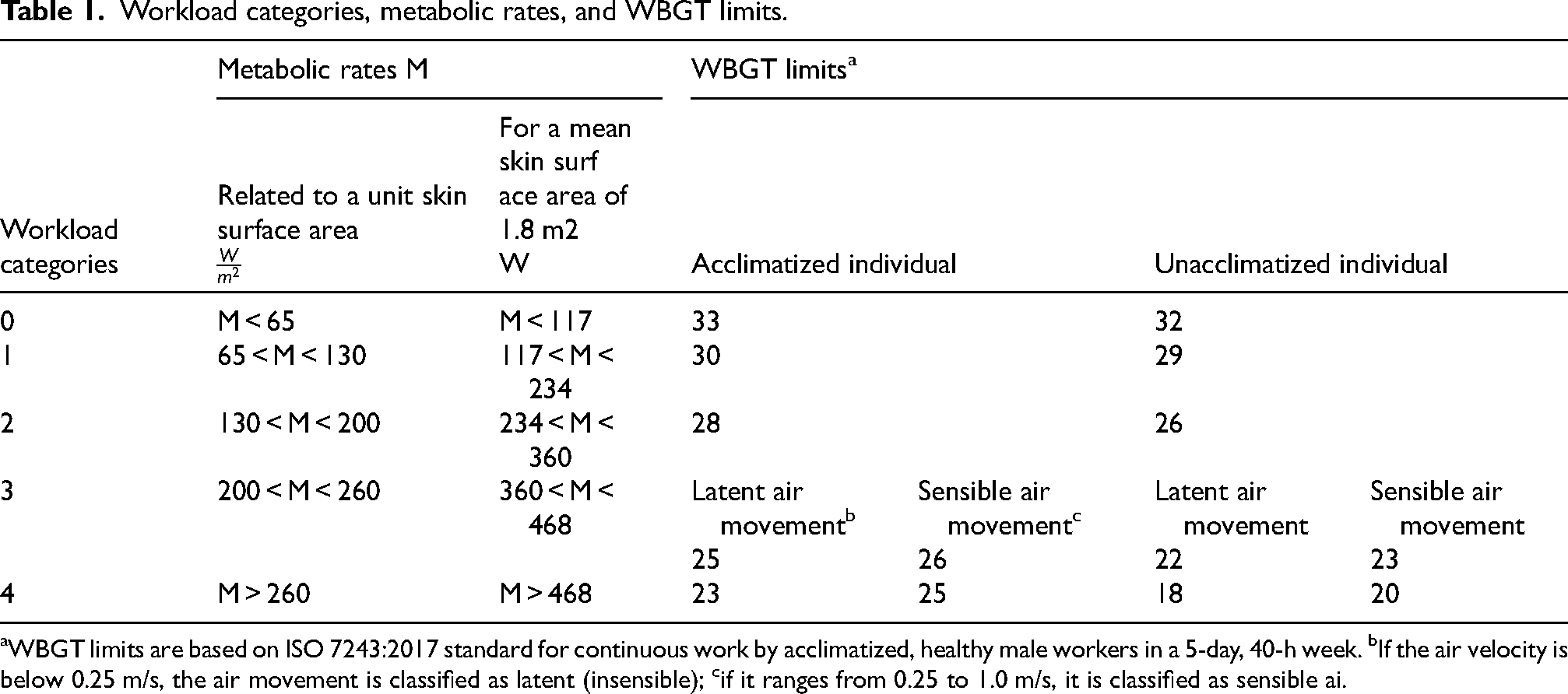
WBGT limits are based on ISO 7243:2017 standard for continuous work by acclimatized, healthy male workers in a 5-day, 40-h week. bIf the air velocity is below 0.25 m/s, the air movement is classified as latent (insensible); cif it ranges from 0.25 to 1.0 m/s, it is classified as sensible ai.
Analytical approach
After data collection and input into SPSS software (version 24), the data was filtered using the Kolmogorov-Smirnov test to assess the normality of the continuous variables. Descriptive statistical methods, including frequency distribution tables, descriptive charts, and measures of central tendency and dispersion, were used to describe the data. Non-parametric tests, such as the Spearman correlation coefficient, and parametric tests, including independent t-tests and ANOVA, were applied. To confirm the direct and indirect relationships between cognitive and physical workload, occupational burnout, and their components, confirmatory factor analysis (CFA) was used. The analysis was conducted using AMOS software (version 24) due to its capabilities in structural equation modeling (SEM) and CFA. Our model included heat stress as an independent variable, with occupational burnout and cognitive workload as dependent variables.
A priori, model fit was evaluated using multiple goodness-of-fit indices, with CMIN/df values <3, RMSEA values <0.08, and CFI and NFI values ≥0.90 considered indicative of acceptable model fit.
Various statistical methods, including regression analysis and correlation coefficients, were used to assess the strength and significance of the relationships. Model fit was evaluated using indices such as root mean square error of approximation (RMSEA) and CFI. To assess potential confounders, covariance analysis was performed. All tests were conducted at a 95% confidence level.
Results
Preliminary analysis
Table 2 presents the mean, count (for qualitative variables), standard deviation, and bivariate correlations of the study variables. On average, heat stress levels (WBGT index) exceeded the recommended occupational exposure limits set by ISO in 80.77% of cases. All machine monitoring operators, control room engineers, firefighters, fire maintenance personnel, and electrical maintenance workers were exposed to heat stress levels beyond the permissible occupational exposure limits, and their exposure was deemed non-compliant (exceeding ISO's recommended limits). The distribution of participants’ educational levels was as follows: 14 individuals had less than a high school diploma, 50 had a high school diploma, 33 held an associate degree, 83 had a bachelor's degree, 51 held a master's degree, and 3 had a PhD.This distribution shows that the majority of participants had either a bachelor's or master's degree. The average scores for emotional exhaustion, depersonalization, and personal inefficacy subscales were at a moderate level. The mean overall mental workload score on a 0 to 100 scale was 67.02. Among the subscales, insecurity had the lowest score, while mental pressure had the highest score compared to other components. A total of 32.05% of individuals rated the level of mental and cognitive activity required for their job as very high. More than half of the participants reported above-average satisfaction with their job performance in achieving occupational goals. A statistically significant correlation was observed between the WBGT index and age (p < 0.05), indicating that older individuals were more likely to work in environments with lower heat stress levels. Additionally, mental pressure was significantly lower in individuals with more work experience (p < 0.05). Moreover, physical pressure significantly decreased with increasing age and work experience(p < 0.05). Correlation analysis revealed a significant relationship between sleep time and the effort and frustration(p < 0.05). Additionally, as mental pressure increased, other dimensions of mental workload and job burnout also increased. Results from the independent t-test analyzing demographic variables in relation to mental workload and job burnout revealed that the mean score for personal performance differed significantly between married and single individuals (p < 0.05). However, no significant differences were found in the mean scores of other job burnout subscales and mental workload between fixed morning shift and rotating shift workers, or between smokers and non-smokers. Among individuals whose occupational heat exposure was within the ISO-recommended limits, a significant statistical correlation was found between work experience and emotional exhaustion subscale.
The mean, count, standard deviation, and bivariate correlations of the study variables.
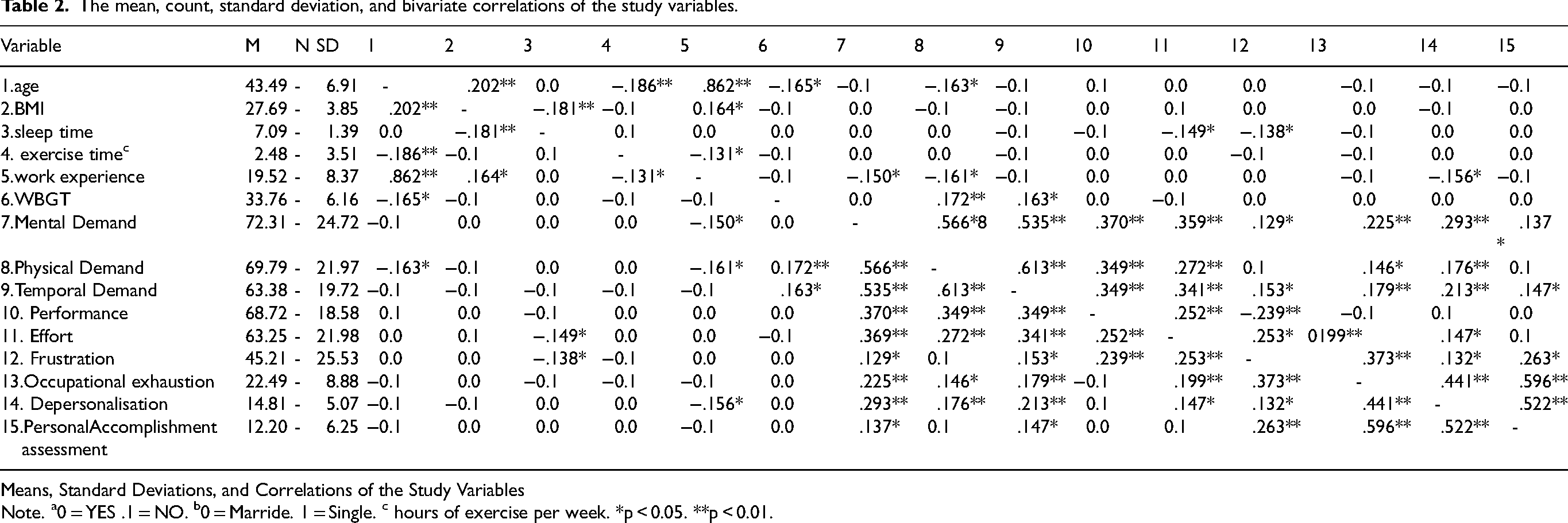
Means, Standard Deviations, and Correlations of the Study Variables
Note. a0 = YES .1 = NO. b0 = Marride. 1 = Single. c hours of exercise per week. *p < 0.05. **p < 0.01.
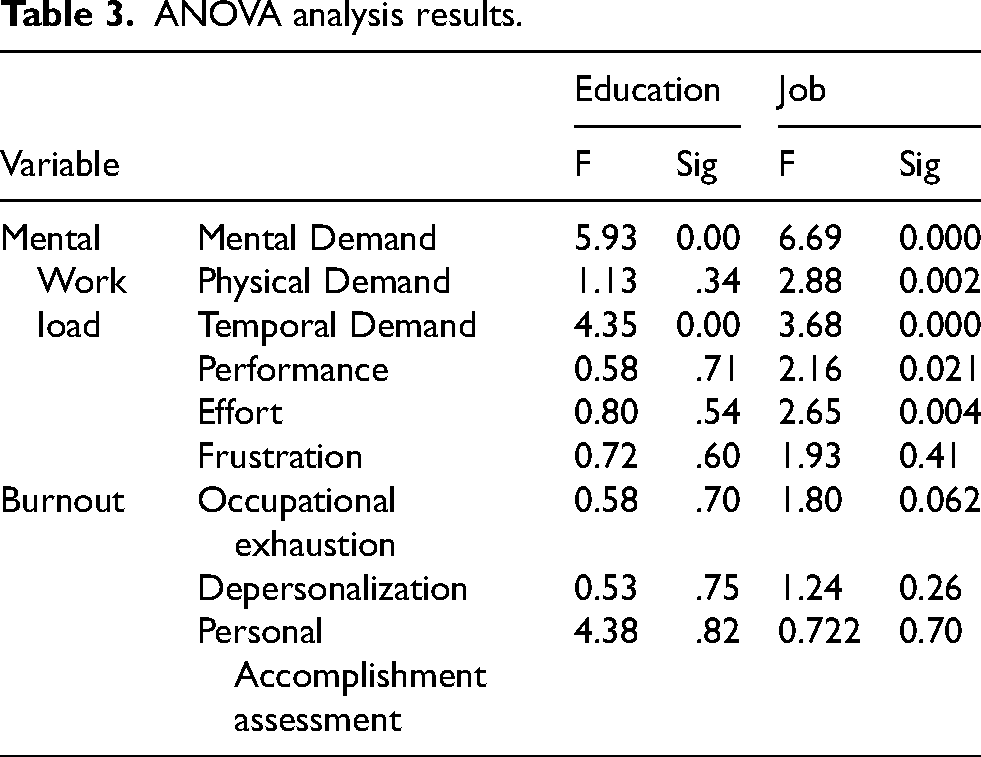
The ANOVA test showed a significant difference in the mean scores of the mental pressure and time pressure subscales among individuals with different education levels (p < 0.05). Participants with higher educational attainment exhibited higher scores on these dimensions.
Additionally, the mean scores of all mental workload subscales except for job insecurity were significantly different across various occupational groups (p < 0.05) (Table 3).
ANOVA analysis results.
However, no significant differences were found in the mean scores of any job burnout or mental workload subscales between smokers and non-smokers, married and single individuals, or fixed morning shift and rotating shift workers.
According to the results of Table 4, the fit indices of the two-factor model for the studied variables have acceptable values for model fit.
Model fit indices for the two-factor model between variables in summer.

CMIN = Chi-Square Minimum Discrepancy, Df = Degrees of Freedom,CFI = Comparative Fit Index,RMSEA = Root Mean Square Error of Approximation,GFI = Goodness of Fit Index, NFI = Normed Fit Index
According to the results from Figure 1, thermal stress had an impact on cognitive workload, and thermal stress, mediated by cognitive workload, affected occupational burnout. The highest factor loading influencing cognitive workload was the dimension of time pressure, followed by physical and mental pressure, while the lowest factor loading was the dimension of insecurity. Additionally, there was a correlation between the dimensions of effort and performance and the feeling of insecurity. In occupational burnout, the highest factor loading was related to the dimension of inefficiency levels. A significant relationship was observed between the inefficiency level in occupational burnout and the feeling of insecurity in cognitive workload. As inefficiency levels increased, individuals’ sense of insecurity also increased.
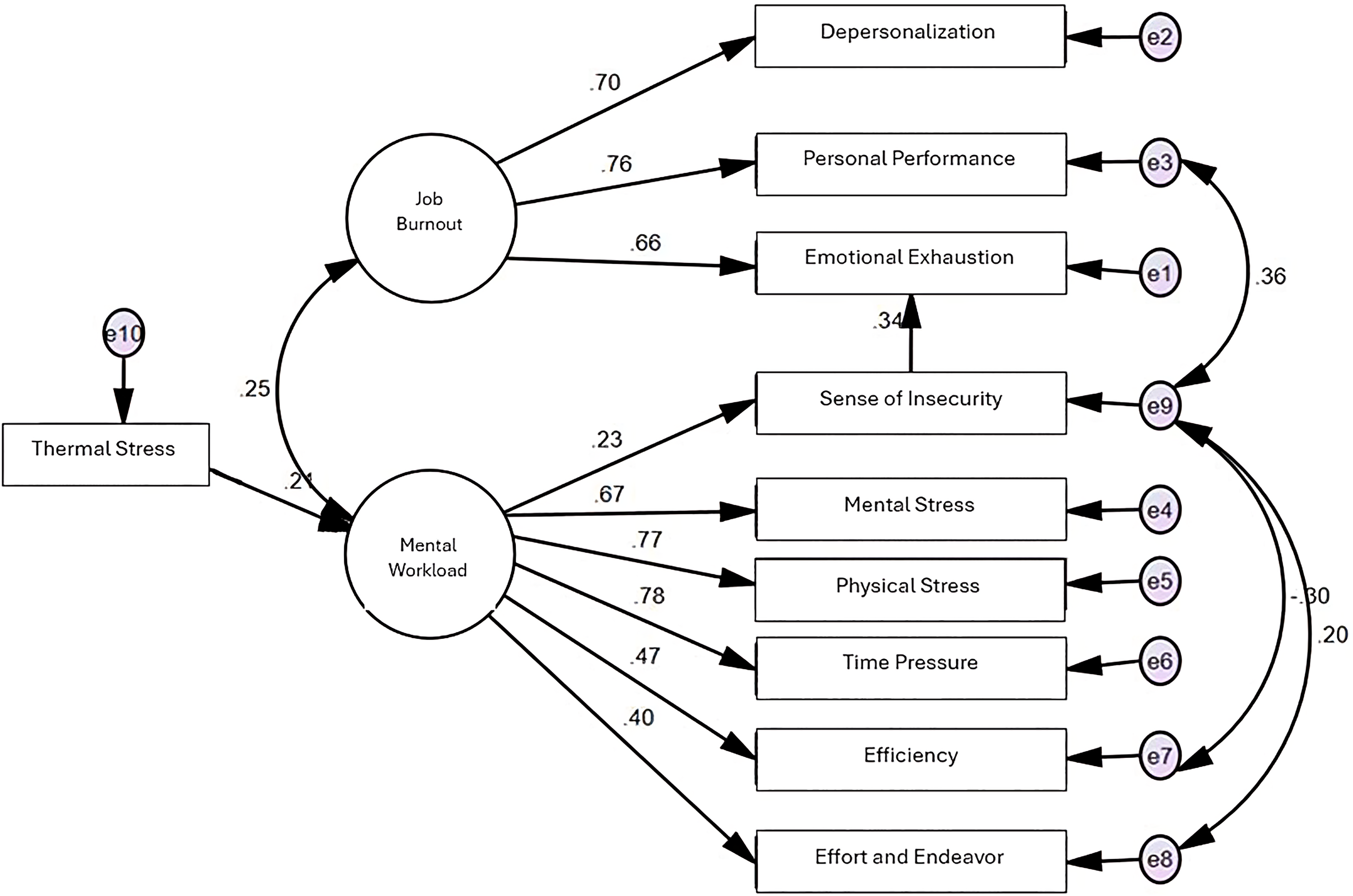
Illustrates the observe variables and their corresponding factors in the two-factor measurement model, representing the relationships between the studied variables during the summer season.
Discussion
This field study examined the impact of thermal stress on workload and occupational burnout among employees in the oil industry. The findings of this study revealed that 80.77% of employees working in the South Oilfields Company in Ahvaz were working under conditions of thermal stress during the summer. Among the various occupations, machine operators, control room engineers, firefighters, and electrical and firefighting technicians faced high levels of thermal stress. Among employees exposed to high levels of thermal stress, an inverse relationship between work experience and depersonalization was observed. Thermal stress significantly affected occupational burnout through cognitive workload. The cognitive workload was influenced by the dimensions of physical and mental pressure, while the dimension of insecurity had the least effect. Furthermore, a significant correlation was observed between the dimensions of effort and performance and the feeling of insecurity. Regarding occupational burnout, the inefficiency dimension had the highest factor loading, and a correlation was observed between this dimension and the feeling of insecurity in cognitive workload.
The results of the analysis of demographic data and the WBGT index in this study showed a statistically significant relationship between the WBGT-TWA index and the age of individuals. Younger individuals were more likely to work in stations with an unauthorized range of thermal stress compared to their older colleagues.
The data analysis indicated a statistically significant relationship between work experience and the subscale of depersonalization. In other words, as work experience increased, depersonalization scores decreased. It is possible that individuals with more work experience are less likely to experience depersonalization. This finding aligns with the studies by Aleksandra R. Vojvodic and De la Fuente Solana EI et al.. 30 In Vojvodic's study, the highest levels of occupational burnout were observed in younger personnel with less work experience. 31 Individuals with more work experience may have gained more experience and skills in managing stress and work challenges, which can help them cope better with work pressures and experience less depersonalization. Additionally, research has shown that strong social capital in the workplace serves as a protective factor against burnout. 32 Employees with higher social capital at work are likely to have stronger emotional connections, perceived commitments, and more constructive relationships with their colleagues or groups within the organization. 33
Social capital reflects the characteristics of social relationships within organizations, which can increase employees’ commitment to the organization. 34 It is also related to social networks, 35 trust, 36 colleague support, 37 and communication 38 among employees. Individuals who have been in the workplace for a longer period may have established stronger social connections. These connections can help reduce feelings of isolation and depersonalization.
The data analysis among individuals whose occupational exposure to heat was within the recommended limits by ISO showed a statistically significant relationship between work experience and the subscale of emotional exhaustion. In other words, as work experience increased, the level of emotional exhaustion in individuals decreased, which aligns with the studies by Sophia Anastasiou et al. and Schroeder et al.39,40 Research has shown that temperature and relative humidity, through their effects on thermal responses, influence emotional changes. 41 Thermal stress, through heat-sensitive physiological mechanisms, can lead to sleep disturbances, fatigue, and heat stress, 42 thereby affecting mood and reducing emotional well-being. 43 In this study, individuals with more work experience were working in more favorable conditions in terms of temperature and humidity, which is why they experienced less emotional exhaustion. Overall, the significant negative correlations between depersonalization and work experience under unauthorized heat exposure, as well as emotional exhaustion under authorized heat exposure, may indicate the differing impacts of environmental conditions on individuals’ work experience.
The analysis of demographic data and subscales of cognitive workload showed that as age and work experience increased in the study participants, physical pressure decreased. This finding was consistent with the study by Zakerian et al.. 44 This result may be due to a combination of various factors. For instance, older individuals typically have more experience in tasks and duties, and this experience can help them perform tasks more efficiently, resulting in less perceived pressure. 45 Additionally, older individuals in this study may engage in fewer physical activities due to health-related reasons or may be transferred to tasks with lower physical demands, and this change in job type could lead to a reduction in physical pressure.
The data showed that individuals with higher education levels had higher average mental and time pressure. The reason for this finding may be related to the nature of the work these individuals perform. In the research setting, which is the operational areas of the oil company, many jobs involve specialized, complex, and challenging tasks that require skilled and educated individuals. People with higher education levels are typically employed in roles that require deeper thinking, more complex analysis, and more significant decision-making. Additionally, in these roles, the need for memory recall and information processing is greater compared to other jobs. Furthermore, in some cases, these individuals may face higher expectations from employers, colleagues, and themselves, and may take on additional responsibilities, such as shift supervisors or maintenance team managers. These roles often involve pressure to meet deadlines and precise schedules, all of which can contribute to increased mental and time pressure.
The analysis and data did not confirm a relationship between the occupation of the study participants and the subscales of occupational burnout. Research suggests that burnout is a multifaceted phenomenon and can be influenced by a combination of individual, organizational, and social factors. 46 Personality traits, 47 coping skills, and previous experiences of individuals can have a significant impact on this phenomenon. Additionally, if an organization provides the necessary support to its employees, the likelihood of experiencing occupational burnout decreases. 48
The analysis of performance evaluation data and subscales of cognitive workload revealed a statistically significant relationship between the number of hours of sleep per day and the subscales of effort and performance, as well as the feeling of insecurity. This means that individuals who get more sleep may demonstrate better performance and experience less insecurity. This finding aligns with the studies by Kashani et al. and Jansen et al.30,31 Sleep quality plays a vital role in maintaining overall health and well-being. Adequate and quality sleep is essential for cognitive performance, emotional balance, and physical well-being. 49 The inverse relationship between sleep hours and the subscales of effort and performance and insecurity could be due to various factors. The feeling of insecurity involves a range of negative emotions, including discouragement, anger, stress, and resentment, in contrast to feelings of safety, contentment, happiness, calmness, and self-satisfaction. Adequate sleep helps improve mood and reduce stress. 50 Therefore, individuals who do not get enough sleep may experience fatigue and lack of concentration. This fatigue can affect their ability to perform in the workplace and lead to a decrease in performance levels and an increase in stress and insecurity.
The analysis of data showed that thermal stress affects cognitive workload, with the highest factor loadings being on the physical, mental, and time pressure dimensions. Thermal stress increases cognitive workload by inducing physiological changes,51,52 affecting the nervous system, 53 disrupting sleep and rest, and causing psychological effects, ultimately leading to a decline in cognitive performance. 54 Studies examining heat-related disorders in brain physiology, activity, and functional connectivity using various neuroimaging techniques have demonstrated that heat exposure impacts brain function and cognitive behavior by influencing the processing and transmission of information through different pathways. 55
Additionally, our findings revealed that thermal stress does not directly impact occupational burnout but rather affects it indirectly through cognitive workload. Furthermore, there was a correlation between the inefficacy dimension of occupational burnout and the feeling of insecurity in cognitive workload. Some cognitive tasks may be more sensitive or more resilient to the effects of heat stress. 18 Our findings align with the studies conducted by Altanchimeg Zanabazar et al. and Fallahi et al..56,57
Zanabazar's study demonstrated that an increase in mental workload leads to job burnout and a decrease in organizational commitment. 56 Fallahi's findings also indicate a significant statistical relationship between job burnout and mental workload, with MWL, education level, and job categories being the primary predictors of job burnout. 57
Research has shown that thermal stress is recognized as a harmful factor contributing to the decline of cognitive performance, including comprehension, memory, concentration, mathematical calculations, tracking tests, reaction time, text and numerical message reception and decoding, visual alertness, mental calculations, reading comprehension, hidden figure tests, and verbal fluency. 58 As mental workload increases, job burnout simultaneously rises. 57 In other words, the greater the sense of time pressure, stress, and cognitive demands, the more individuals experience fatigue and job burnout.59–61 Furthermore, as employees perceive a higher mental workload, their organizational commitment decreases accordingly. It is evident that the more individuals feel time pressure, stress, and cognitive demands, the greater their fatigue and job burnout, leading to a reduced willingness to apply their knowledge and skills in their work and a diminished interest in continuing their job. 57
This study has several limitations that should be considered when interpreting the findings. First, the cross-sectional design limits the ability to draw causal inferences between heat stress, cognitive workload, and job burnout. Second, the study population consisted solely of male workers from an oil and gas company in southwestern Iran, which restricts the generalizability of the results to female workers, other industries, or different geographical settings. In addition, the study relied on a convenience sampling approach, which may introduce selection bias. The sample size for certain occupational subgroups, such as station supervisors and HSE officers, was relatively small, limiting the robustness of subgroup-specific analyses. Therefore, future research should employ longitudinal designs, use probabilistic sampling methods where feasible, and include larger and more diverse populations across different occupations, industries, and demographic groups to enhance generalizability.
Conclusion
The present study examined various aspects of thermal stress and its impact on mental workload and job burnout in an industrial environment using a specific model. The results indicate that thermal stress is a significant factor contributing to mental workload and job burnout in hot work environments. Mental pressure was found to be lower in individuals with more work experience. Additionally, thermal stress does not directly cause job burnout but rather influences it through mental factors. As mental pressure increases, job burnout also rises.
Footnotes
Acknowledgments
We extend our heartfelt gratitude to the editorial board as well as reviewers of WORK: A Journal of Prevention, Assessment & Rehabilitation. Their unwavering dedication ensures the publication of highquality and valuable papers in the field of Occupational Health and Safety. We wish them continued success and excellence.
Funding
The authors received no financial support for the research, authorship, and/or publication of this article.
Declaration of conflicting interests
The authors declared no potential conflicts of interest with respect to the research, authorship, and/or publication of this article.