



Abstract
Background
Healthcare workers in psychiatric institutions are exposed to various types of occupational safety and health risks, among which job dissatisfaction represents a significant concern.
Objective
The observed aspects of occupational safety and health (OSH)contribute to the identification of “key points” that require additional attention and the development of possible solutions. Investigating the challenges faced by healthcare workers in psychiatric institutions allows for a deeper understanding of these issues and facilitates the formulation of solutions tailored to their specific needs.
Methods
The research is based on Likert-type assessment scale designed to assess the satisfaction of healthcare workers employed a specialized hospital for psychiatric disorders with regard to occupational safety and health (OSH).
Results
The results showed that the majority ofhealthcare workers are satisfied with working conditions concerning workplace communication, opportunities for professional development and clearly defined expectations. They are well-informed abouttheir rights and responsibilities, as well as the individuals responsible for occupational health and safety (OHS) matters.The key issues identified include work overload and workplace-related stress.
Conclusions
There is a need to establish special protocols or internal documents in psychiatric hospitals that clearly outlinethe procedures to be followed in cases of patient-initiated harassment or violence. The authors recommend the introduction of flexible working hours, increased number of employees, reorganization of services or a different distribution of work tasksin order to reduce the workload of healthcare workers.
Introduction
Many researchers are interested in the risks of occupational diseases/accidents to healthcare workers.1–4 A variety of occupational risks exist within healthcare institutions, with differing levels of exposure depending on the employee's professional role and category. Healthcare workers in psychiatric institutions area particularly challenging category. Psychiatry is considered one of the most stressful medical disciplines since healthcare providers are responsible for managing chronically ill or incurable patients with mental illness. 4 The analysis of the literature has pointed to some problems that these employees frequently encounter. For example, their mental health may be endangered by risks such as workplace stress, burnout syndrome, workplace dissatisfaction, lack of work motivation, workplace violence, etc.4–5 Research indicates that healthcare workers perform one of the most stressful professions, which often leads to burnout.6–9 Marković highlights specific factors contributing to job satisfaction (such as cooperation with colleagues, support from superiors, and clear work instructions) and dissatisfaction among healthcare workers (including salary, opportunities for advancement, and availability of equipment), concluding that job satisfaction is a significant predictor of the overall quality of work within the healthcare institution in which they are employed. 10 Reuben Praharsh et al. emphasize that workplace violence against healthcare professionals is a global issue that directly affects their mental health. 11 D’Ettorre and Pellicani stress the need for research to focus on the health consequences of workplace violence experienced by healthcare workers in psychiatric institutions. 12 In addition, healthcare workers may encounter additional hazards, including poor communication among team members within the institution, which affects the condition of patients. 13 Following this, hostile behavior in the workplace may occur. Such behavior can be labeled as mobbing. 14 Furthermore, the work-family conflict can have a negative impact on safety and health at work, and as a result, healthcare workers can suffer from physical and mental health problems. 15 Healthcare workers in psychiatry are also exposed to many other less common hazards. Also, they are subject to risks that are inherent to other healthcare workers,such as workplace violence, 16 long-term impact of leader-member exchange, 17 burnout, 18 second victim syndrome, 19 etc. All of these risks are amplified in times of crisis or emergency situations, such as the COVID-19 pandemic. 20
This paper focuses on satisfaction with occupational safety and health among healthcare workers in a psychiatric institution in the Republic of Serbia. It highlights that occupational accidents are still commonplace in contemporary workplaces, despite increased understanding of safety, human psychology and human-technology interaction. 21 Healthcare workers in psychiatric institutions are unequivocally encompassed by this statement.
Methods
The aim of the research is to analyze safety and health at work in psychiatric institutions from the perspective of employee satisfaction.This aim is further delineated into the following objectives: (1) to analyze the satisfaction of healthcare workers with the job type and their tasks; (2) to analyze the satisfaction of healthcare workers with their work environment; (3) to analyze the satisfaction of healthcare workers with occupational safety management and prevention.
The research included healthcare workers employed at Special Hospital for Psychiatric Diseases “Gornja Toponica”, located in Nis, Serbia, and it was conducted in 2023, with the consent of general manager of this hospital. “Gornja Toponica” is the second largest specialized hospital of its kind in the Republic of Serbia. It is the sole institution of its kind in central and southern Serbia and also the largest in this region, as determined by the number of beds specifiedby the Regulation on the plan of the network of health. 22 In addition to this facility, there are three other hospitals of the same type located in the northern region of the country.Consequently, by choosing to conduct the research within this institution, the authors believe that the criterion of sample representativeness has been met.
The main criterion for inclusion in the study was employment as a healthcare professional—either a physician or a nurse/technician—within a psychiatric hospital. Accordingly, the study population did not include patients or users of psychiatric services. At the time of the research, 280 health workers (60 doctors and 220 nurses/technicians) were employed in the institution, and 215 of them voluntarily agreed to participate in the research. This indicates a high response rate (76.8%) and, therefore, potentially reliable results.
The research is based on the descriptive research method and the scaling technique–specifically, a Likert-type scale, as one of the most fundamental 23 rating scales 24 when regarding measuring attitudes, opinions, satisfaction, behaviors, and preferences. The Likert-type assessment scale is specially constructed for research purposes. It consists of 22 statements, with the first five referring to the satisfaction of healthcare workers with the type of work and their tasks; the following six addressingsatisfaction with the work environment; and the remaining eleven focusing onsatisfaction with occupational safety management and prevention. Respondents expressed their views by selecting one of five offered responses: (1) Strongly agree; (2) Agree; (3) Neutral; (4) Disagree; (5) Strongly disagree. The questionnaire was administered in a paper-and-pencil format and took approximately 15 min to complete. The research was anonymous, which was stated in the header of the assessment scale itself.
To present and organize the research findings more concisely, the original 5-point scale was simplified into a 3-point scale by combining the two strongest agreement responses and the two strongest disagreement responses, allowing for more insightful analysis of the data. Therefore, the scale was restructured as follows: 1 - Positive perception (Agreement), 2 - Neutral perception, and 3 - Negative perception (Disagreement). This adjustment did not compromise the meaning or quality of data interpretation.
Results
Table 1 shows a sample of respondents, structured according to the following variables: gender, profession, work experience in a psychiatric institution and marital status.
Structure of respondents.

The following tables present the key findings, according to the research objectives, and the differences in the respondents’ attitudes with regard to the set variables.
The data presented in Table 2 indicate that the majority of surveyed healthcare professionals perceive working with patients as extremely stressful (77.6%), which is confirmed by theirpositive responses to the statement that patient-initiated harassment, threats and violence are frequent (65.1%). Also, healthcare workers often feel that they are overwhelmed at work and have insufficient time to complete it (78.1%), wherebymore than half of the respondents (60.4%) agree that work leaves them too little time for their family, friends and leisure activities.The attitudes of healthcare professionals regarding the statement that they would like to spend the rest of their career outside the health facility are divided - 46.5% of respondents disagrees, 37.2% of them agree, while 15.8% are neutral.
Employee satisfaction with the job type and their activities.

Starting from the fact that more than half of the surveyed healthcare workers agreed with the statements related to satisfaction with their work environment/characteristics of the work organization (Table 3), it can be concluded that they are satisfied with the communication with their superiors (79.1%), receive sufficient information for quality work performance (81.4%), and have good control over work processes and tasks (80%). Supervisors consult healthcareworkers about the manner and timing of performing work tasks (73%) and involve them in making decisions relevant to work and hospital in general (60.9%). Also, the majority of healthcare professionals believe that they have considerable opportunities for professional development and career advancement (67.4%).
Healthcare workers’ satisfaction with their work environment.

The data presented in Table 4 show that the majority of the respondents consider that their duties and responsibilities at work are clearly defined (82.3%). Although the previously presented data (Table 2) showed that most healthcare workers believe that their work leaves them insufficient time for their family, friends and leisure activities, as many as 85.6% of employees say that organisation of working hours is satisfactory.
Healthcare workers’ satisfaction with OSH management and prevention measures.
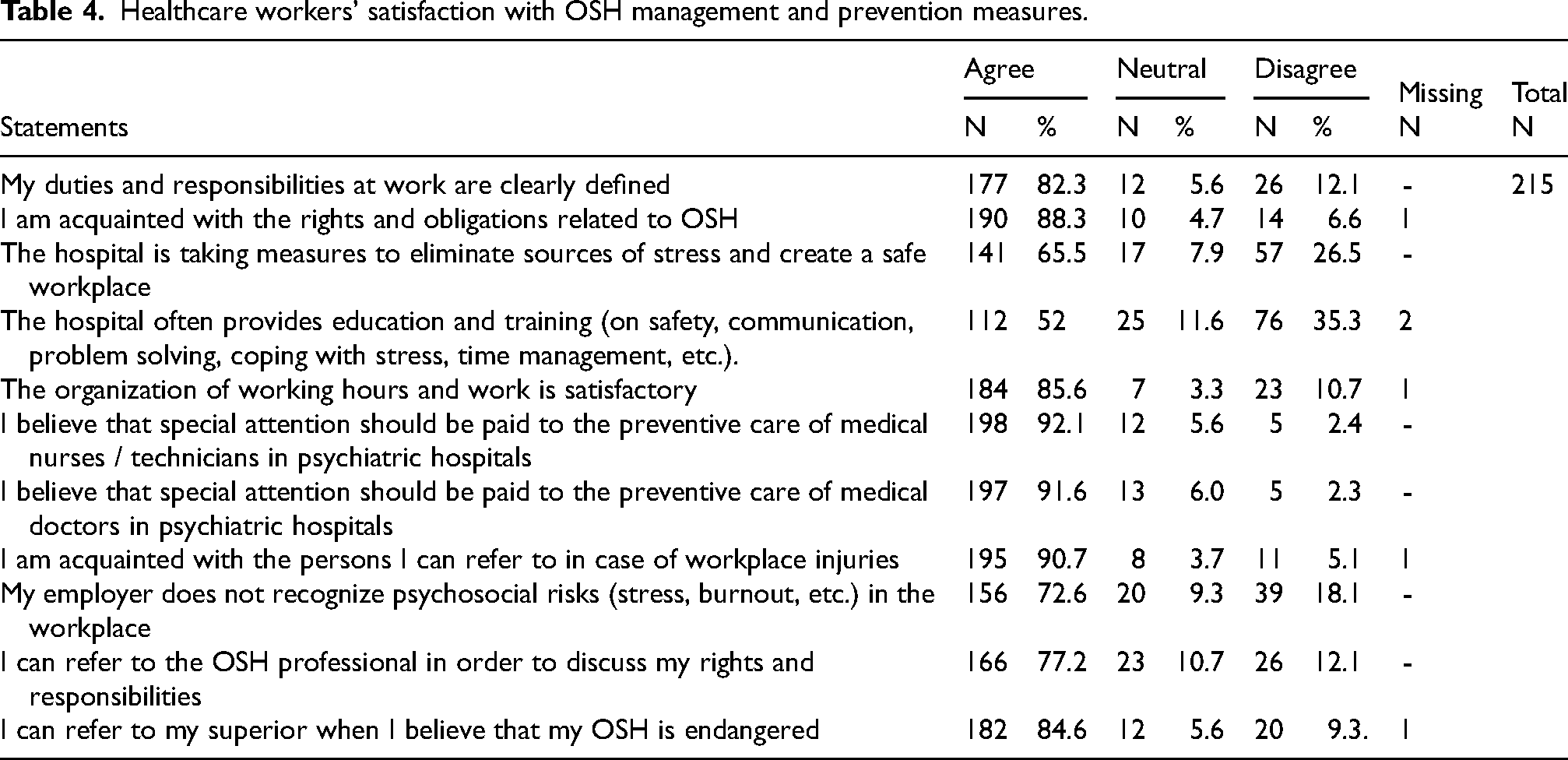
The respondents are acquainted with their rights and obligations related to OSH (88.3%), and they can always contact a person responsible for OSH (77.2%) for advice. Healthcare workers know who they can talk to in the event of an injury at work (90.7%). Also, most healthcare workers can refer to their superiors when they believe that their OHS is endangered (84.6%), and feel that special attention should be paid to the preventive protection of medical technicians (92.1%) and doctors (91.6%) working in psychiatric hospitals. However, the majority of the respondents (72.6%) stated that the employers do not recognize psychosocial risks. In spite of this, more than half of the respondents(65.5%) believe that measures are being taken to remove sources of stress and create a safe workplace in the hospital(Table 4).
Table 4 also shows that, according to 52% of healthcare workers, education and training (on safety, communication, problem solving, stress management, time management), are often provided in hospital.
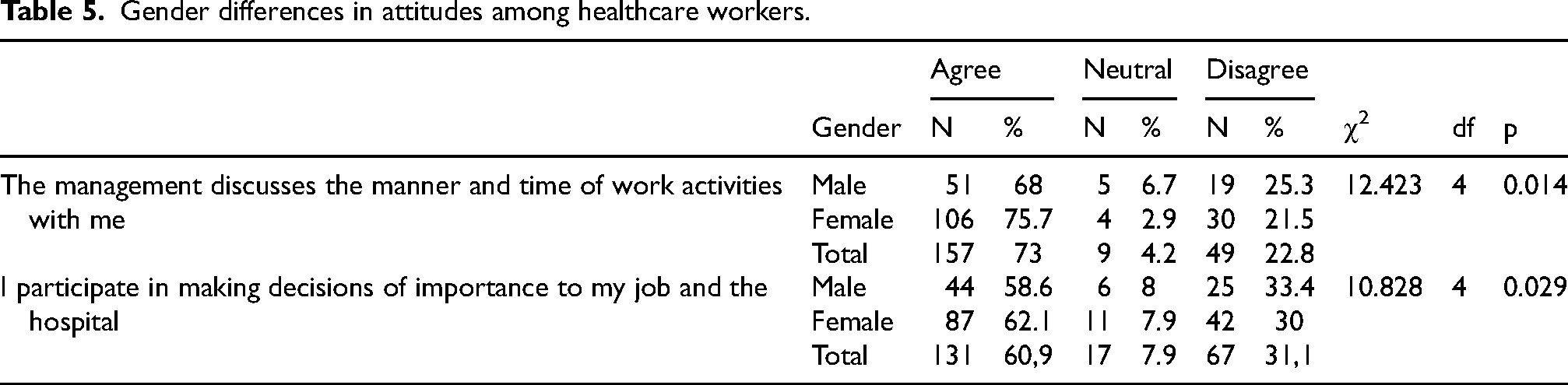
A statistically significant difference in the attitudes of healthcare workers based on gender has been established in the case of statements The management discusses the manner and time of work activities with me (χ2=12.423; df = 4; p = 0.014) and I participate in making decisions of importance to my job and the hospital (χ2=10.828; df = 4; p = 0.029).With regard to other variables, such as years of service in a psychiatric institution, profession and marital status, statistically significant differences in the attitudes of the respondents have not been found. (Table 5)
Gender differences in attitudes among healthcare workers.
Discussion
The employment in healthcare is considered a highly stressful profession, mainly due to the great responsibility for human lives, as well as various other specific stressors. 25 Moreover,the level of workplace stress directly affects employee satisfaction. 26 Therefore, it is entirely reasonable that the majority of surveyed healthcare professionals perceive working with patients as a highly stressful aspect of their profession. In addition, healthcare workers in the field of psychiatry are particularly exposed to various forms of hostility, aggression and insults, i. e. patient-initiated workplace violence. 27 Many studies confirm that nurses are particularly exposed to such hazardsin psychiatric institutions.27–31 This can be illustrated by the results of the research on the attitudes of nurses working in hospitals for mental disorders in Cairo (Egypt). Namely, most nurses pointed out that they have a feeling that they are under pressure due topatients’ requests, a feeling that patients have a negative attitude towards them, and a perception of being threatened or intimidated by certain patients. 32 However, in our research, no statistically significant difference was found in the attitudes of the respondents with regard to the profession (medical nurse/technician, senior medical nurse/technician, medical doctor).
Healthcare workers’ positive responsesto the statement that patient-initiated harassment, threats and violence are frequent confirm the negative practice that is present in psychiatric institutions around the world. Exposure of psychiatric staff to various forms of patient-related violence has been confirmed in many studies: in California, out of 323 psychiatric professionals, 69.5% experienced physical assault in the previous 12 months; 27 in the United Kingdom, out of 254 aggressive incidents in a psychiatric hospital, 57.1% of the targets were healthcare workers; 33 also in the United Kingdom (London), out of the 154 healthcare workers employed in psychiatric institutions, between 80% and 90% of nurses were exposed to verbal violence and threats over a year, 68% of employees were victims of sexual harassment, while 16% of respondents experienced severe physical violence; 34 in Slovakia, out of 223 nurses, 98.58% experienced patient aggression in the previous year; 35 in Italy, an analysis of patient data from a psychiatric hospital in Rome identified 321 patients who were violent at least once, most often to nurses. 30 Ilenia et al. in their study indicate that violence against nurses working with psychiatric patients directly reduces job satisfaction and the quality of their work. 36 Research on working conditions and workplace violence against mental health professionals in Konya city center shows that it negatively affects life satisfaction, job satisfaction, and the mental health of these professionals. 37
The obtained data also indicated that the healthcare workers often feel overwhelmed at work and have insufficient time to complete their working tasks. This finding contrasts with the results of a study conducted at the Clinic for Psychiatric Diseases ‘Dr Laza Lazarević’ in Belgrade, 38 where the majority of employees reported satisfaction with the amount of time available to complete their assigned tasks and engage with patients. In addition to the fact that healthcare workers in our research believe that they have insufficienttime to perform their tasks, they are frequently required to work overtime and during night shifts. More than half of the respondents indicated that their work commitments leave them with insufficient time for family, social interactions, and leisure activities.This is also confirmed by research conducted among mental health workers in Greece, which concludes that ambiguities in the division of work tasks, rights, and responsibilities of employees lead to their dissatisfaction. 39
Moreover, the stress and level of responsibility associated with work in psychiatric institutions likely contribute to some respondents expressing a desire to continue their professional careers outside the healthcare setting. Konstantinos and Christina 28 point to a negative association between stress and job satisfaction among nurses working in psychiatric institutions. They classified the sources of stress into four categories: problems related to interpersonal relationships (among nurses themselves or between nurses and doctors); leadership skills of department heads; stressors related to patient care (mostly violent incidents); and organizational issues such as administration, organizational structure, etc. A study investigating the intentions of psychiatric nurses to leave their jobs, conducted in Japan 40 found that significant predictors that affect the decision to leave a job are younger age, fewer previous job changes, lack of support from supervisors, lower job satisfaction and perception of increased risk of violence. Almost half of the nurses who participated in that research showed their intention to leave their job.
Given that the respondents in our study expressed satisfaction with the characteristics of work organization and the work environment, it may be concluded that interpersonal relationships within the hospital are founded on cooperation and effective communication, supported by timely feedback and mutual trust, which collectively provide a foundation for inclusive decision-making on important matters. The attitude of management towards employees, but also the quality of relations between employees themselves, are related to the occurrence of stress, i. e. job satisfaction. 28 Janković et al. 41 claim that good interpersonal relationships and cooperation with colleagues decrease emotional exhaustion of employees during and after work and enable better healthcare services. The obtained results are in line with the results on employee satisfaction at the Clinic for Psychiatric Diseases “Dr Laza Lazarevic” in Belgrade, 38 where the majority of the respondents were satisfied with the direct cooperation with their superiors, as well as with the evaluation of their work, clear instructions regarding expectations from the superiors and the possibility of presenting their ideas to them. However, most employees were dissatisfied with the possibility of professional development, i. e. continuous education. In contrast, the data obtained in our research show that the majority of healthcare professionals believe that they have considerable opportunities for professional development and career advancement.
Even though most healthcare workers believe that their work leaves them insufficient time for their family, friends and leisure activities, the majority of the respondents consider that their duties and responsibilities at work are clearly defined and that organization of working hours is satisfactory. This attitude likely arises from their awareness that the nature of their profession inherently involves confronting significant challenges, including extended working hours and the responsibility of caring for patients with highly unstable conditions. 42 Work-life balance is not just an individual priority in contemporary working life, it is also valued by organizations and societies due to its positive effects. 43
The respondents are well-informed about the designated occupational safety and health (OSH) officer and know whom to consult for guidance or in the event of a workplace injury. They can also refer to their superiors when they believe that their OSH is endangered. However, the question that remains is whether healthcare workers actually report workplace injuries to the appropriate persons. Namely, according to some studies42,44 employees in psychiatric institutions often do not report incidents with patients. A study conducted in Ghana 44 found that only 44% of 296 nurses employed in two psychiatric hospitals reported to the hospital authorities their “recent” exposure to health hazards in the workplace. Nurses justify this by stating that the issue in question was minor and manageable without assistance, that they forgot to report itfeared potential reprimands from superiors, lacked a clear channel for reporting workplace health hazards, or felt that reported incidents were often not followed by appropriate corrective measures. Authors 44 point to the possibility that healthcare workers have become accustomed to working conditions in psychiatric institutions, perceiving them as standard or inevitable, thus increasing their ability to be exposed to various hazards in the workplace. In addition, the reason for non-reporting may be that psychosocial risks, such as insults, are often not considered work-related hazards. The results obtained in our research show that this kind of risk is possibly not recognized by employers.
The obtained data also showed that education and training on different aspects of OSH are often provided in hospital. Such training needs to be intensified and supplemented with programs related to the prevention of workplace violence, as the nature of work in psychiatric institutions requires healthcare professionals to respond appropriately to any form of violent behavior. According to Guay et al. 45 these are the skills related to recognizing and responding adequately to violent situations, but also the skills that would facilitate “bearing” the consequences that such situations can produce.
Limitations
The results of this study must be considered within the context of several limitations. There are two major limitations that could be addressed in future research. Given that the research was conducted only in one psychiatric institution, the inability to generalize the research findings could be a limitation that deserves mention. This is a limitation known as “sample bias” or “selection bias”. Namely, considering that the research included a specific type of a healthcare facility - a psychiatric hospital, the authors were not able to obtain the consent of the managers of several psychiatric facilities for the implementation of the research. The research was conducted in a psychiatric institution for which the authors were able to obtain consent, thereby limiting the study sample to the employees of this particular facility. Special Hospital for Psychiatric Diseases “GornjaToponica” is one of four hospitals of this type in the Republic of Serbia, but the only one in central and southern Serbia. This limitation is evident in the fact that the results obtained cannot be compared with those from the other three healthcare institutions. Additionally, the study focused solely on healthcare workers’ satisfaction and did not address other aspects, such as the practical implementation of safety measures or the perceived risks to the safety and health of healthcare workers. Furthermore, the authors were unable to survey patients or incorporate questions that might have provided additional insight and clarification regarding the main research question. This limitation highlights the need for further research that would include additional focus groups to investigate the quality of working conditions and health protection in psychiatric institutions.
The second limitation pertains to the scarcity of relevant literature; the limited availability of prior research on occupational safety and health among employees in psychiatric institutions hindered the ability to compare findings and conduct a more comprehensive theoretical analysis related to the main research question addressed in this study. This is important in order to identify literature gaps and to present the need for further development in this area of study. Given the insufficient research and importance of this issue, the authors believe that the results of this study can raise awareness within the scientific and professional communities regarding the necessity to enhance both the quality of working conditions and the healthcare provided to employees in psychiatric institutions.
Conclusions
The observed aspects of OSH in the given psychiatric institution provided valuable insights into practical realities and facilitated the identification of critical areas requiring further attention and the exploration of potential solutions. Generally, a significant majority of the employees are satisfied with their working conditions related to communication at work, OSH, and clearly defined expectations from the management. Most of the respondents were aware of their rights and responsibilites related to OSH, they were aware of whom to contact in the event of a workplace injury and believed they could approach their superiors if their personal safety was threatened. Another encouraging fact is that the employees are being included in making important work-related decisions (i.e., how and when work tasks are performed). Nonetheless, healthcare workers frequently experience a sense of being overwhelmed, as excessive workloads—with numerous tasks and insufficient time for completion—combined with demanding patients and limited free time for family, friends, and other activities, constitute a significant challenge for employees in psychiatric institutions. In addition, the results of the study highlighted stress as a significant issue, which is widely recognized and identified as a health risk for employees.46,47 In psychiatric institutions, stress primarily results from working with patients, which can increase the risk of patient-related violence, as evidenced by some research. 27 Furhtermore, workplace stress can be regarded as a contributing factor to the desire to leave the job, which is shown by a certain number of respondents. Stress and burnout of healthcare workers has an effect on their work engagement. 48
Implications
The results obtained in this research can help in improving OSH of healthcare workers employed in psychiatric institutions. First of all, the identified problem of increased stress at work, with an increased risk of patient-related violence, underscores the need to establish specific protocols or internal guidelines within psychiatric hospitals that will define the procedures in case of patient-related violence against healthcare workers. Other solutions may be the education and training related to techniques and ways of reducing stress, recognition and response to stress situations, etc. In addition, the issue of working hours in the psychiatric institution may be mitigated through organizational restructuring aimed at reducing employee workload and workplace stress, as well as by implementing various forms of flexible scheduling. The institution may consider hiring additional staff through flexible employment arrangements (e.g., casual employment contract), introduce remote work and some of the internet platforms for specific tasks.
This research provides a valuable foundation for further analysis of various aspects of OSH of healthcare workers in general, as well as those employed in psychiatric institutions. Further research may focus on the comparison between OSH systems in different psychiatric institutions in one or more countries, and the comparison of attitudes of healthcare workers in different facilities. Finally, this research may contribute to the development and innovation of OSH measures tailored to healthcare professionals.
Footnotes
Acknowledgements
This paper is supported by the Ministry of Science, Technological Development and Innovation of the Republic of Serbia, Goal 3, Contract No 451-03-34/2026-03/200148.
Funding
The authors received no financial support for the research, authorship, and/or publication of this article.
Declaration of conflicting interests
The authors declared no potential conflicts of interest with respect to the research, authorship, and/or publication of this article.
