



Abstract
Background
Despite advances in safety management, accidents in the chemical industry remain frequent, partly due to overlooked individual-level psychological factors.
Objective
Grounded in the Job Demands-Resources (JD-R) model, this study introduces Occupational Stigma (OS) as a job demand impairing safety performance through Organizational Cynicism (OC), while identifying Perceived Organizational Support (POS) as a critical job resource for fostering high safety performance.
Methods
Utilizing a hybrid analytical approach combining Structural Equation Modeling (SEM) and Fuzzy-set Qualitative Comparative Analysis (fsQCA) on 257 Chinese frontline chemical workers, we respectively capture variable-centered and configuration-centered relationships.
Results
SEM results show that higher occupational stigma is associated with greater organizational cynicism, which in turn is negatively related to safety performance. Specifically, cynicism fully mediates stigma's impact on safety compliance and partially mediates it on safety participation. Complementarily, fsQCA identifies specific configurations sufficient for high safety performance, establishing POS as a pivotal core condition.
Conclusions
By elucidating the stigma-induced psychological cascade and highlighting the protective function of perceived organizational support, these findings provide actionable recommendations for alleviating occupational stigma and improving safety in high-risk industries.
Keywords
Introduction
The chemical industry plays a central role in many national economies, 1 yet it remains one of the most hazardous industrial sectors. 2 In China, despite the implementation of increasingly stringent safety regulations, major chemical accidents continue to occur, causing severe casualties and economic losses. 2 Official investigation reports typically attribute these incidents to employees’ inadequate skills or weak safety awareness. 3 However, accumulating evidence in safety management suggests that workers’ safety behavior is shaped by the interplay between their psychological states, occupational attitudes, and the organizational context, rather than by individual failures alone. 4 This calls for a more systematic examination of human factors that may undermine safety performance in high-risk settings. In the context of Process Safety Management, human failure is often a contributing factor to catastrophic incidents. While engineering controls are vital, the reliability of the workforce, particularly their willingness to follow Standard Operating Procedures and participate in Hazard Identification, is heavily influenced by psychosocial factors. As the largest chemical market globally, the Chinese context provides critical reference points for international peers facing similar safety challenges.
Unlike physical and technical hazards such as equipment failure or hazardous substance exposure, which can be mitigated through engineering controls, psychosocial stressors operate at a psychological level and are therefore more difficult to detect and manage. Psychosocial stressors are increasingly recognized as key antecedents of safety performance because they can trigger unsafe acts through stress, emotional exhaustion and psychological depletion. 4 Occupational stigma (OS) has been identified as a particularly salient psychosocial stressor in occupations that are perceived as “dirty” or devalued. As a socially constructed phenomenon, occupational stigma subjects workers in tainted occupations to social devaluation and disrespect, which can impair their job attitudes and performance. Occupational stigma has been extensively examined among workers in sectors such as construction and mining.5,6 Yet, in stark contrast to the strategic importance of the chemical industry, research on occupational stigma has largely overlooked chemical workers. Their experiences and the potential safety implications of being stigmatized as chemical workers remain under-examined in both organizational psychology and safety science.
Stigmatized occupations are typically viewed as disgusting or devalued along three dimensions: physical, social and moral. 7 In the Chinese chemical industry, workers’ perceived “dirtiness” appears to reflect all three forms of stigma. First, there is an inherent physical stigma: chemical production environments involve exposure to toxic substances and ever-present risks of process upsets, explosions and leaks, making the work dangerous, dirty and physically demanding. Second, chemical workers often face relatively low pay, long and irregular hours and limited career prospects, which can reinforce perceptions of low social standing and social stigma. Third, public criticism directed at the industry for environmental pollution and catastrophic accidents is frequently generalized to individual workers, who risk being morally discredited as complicit in such harms. 8 Consequently, these workers are not merely the primary bearers of chemical risks but are also frequently misconstrued as the perpetrators of such incidents.
When workers perceive negative judgments from the broader public, and even from family and friends, they must expend sustained psychological effort to manage shame, avoid social scrutiny, and reconstruct a positive occupational identity. 7 From a job demands–resources (JD-R) perspective, these stigmatizing experiences constitute job demands that consume psychological resources and heighten the likelihood of strain and disengagement.
Despite growing interest in occupational stigma, little is known about how it affects safety-critical outcomes. We argue that the impact of OS on safety performance is unlikely to be purely direct; rather, it operates through employees’ attitudes toward their organization. In stigmatized environments, workers look to their employer for recognition and protection. When they perceive that the organization does not adequately buffer them from stigma-related threats or fails to provide sufficient support, they may feel disappointed and disillusioned. 9 Over time, this disillusionment can crystallize into Organizational Cynicism (OC) —a deep-seated belief that the organization lacks integrity, accompanied by negative affect and disparaging behavior. 10 Within the high-stakes context of chemical production, cynical employees may re-interpret rigorous safety procedures as mere liability protections for the company and perceive safety inspections as symbolic rituals rather than genuine risk controls, thereby becoming less willing to comply with or actively participate in safety initiatives.
Safety performance is commonly conceptualized in terms of employees’ safety behaviors, particularly safety compliance and safety participation. 11 These behavioral indicators are considered more diagnostic for predicting and preventing accidents than lagging, outcome-based safety metrics. 12 Prior research has predominantly examined intra-organizational determinants of safety performance, such as leadership, safety climate and formal management systems, while paying relatively little attention to external social factors, including occupational reputation and stigma, that may shape individual safety behavior at the micro level.
To address these issues, this study pursues two complementary objectives. First, using structural equation modeling (SEM) on survey data from 257 frontline chemical workers in China, we test a mediation model in which OS is associated with higher OC, which in turn is expected to be negatively related to safety compliance and safety participation. Second, adopting a fuzzy-set qualitative comparative analysis (fsQCA), we explore how combinations of OS, POS and OC form equifinal configurations that are sufficient for high safety performance, with particular attention to the role of POS as a critical resource condition. By integrating occupational stigma into the JD-R framework as a novel job demand and positioning POS as a critical job resource, our study contributes to a more nuanced understanding of how stigmatized work environments can undermine safety in the chemical industry and identifies practical levers for mitigating these risks.
Theoretical background and research hypotheses
Job demands-resources (JD-R)
The JD-R theory explains how job demands and job resources shape employee health, well-being, and performance.13,14 In the JD-R framework, factors that consume an individual's psychological or physiological resources are classified as job demands, whereas those facilitating goal attainment or providing support constitute job resources. These two dimensions may operate independently or interactively to shape key outcomes. 15
In recent years, the JD-R framework has witnessed continuous evolution and refinement. Bakker & Demerouti further elucidated the interactive mechanisms of job demands and resources on employee well-being. 13 Empirical research supports these dynamics: a large-scale study in the South Korean manufacturing sector demonstrated that job demands involving physical and psychological risks significantly reduce safety compliance; however, this negative association is attenuated when organizational resources—such as effective safety management—are mobilized. 16 Similarly, research on Chinese coal miners revealed that a robust psychosocial safety climate can mitigate or even reverse the detrimental impact of job demands on safety behaviors. 17
Within the JD-R framework, occupational stigma can be understood as a job demand that drains psychological resources by exposing chemical workers to persistent negative social evaluations. In contrast, organizational support provides a job resource that helps workers cope with stigma-related shame, defensiveness, and identity threat. The combined influence of job demands and resources on safety performance may be non-linear and interactive. 13 To capture this complexity, this study adopts a mixed-methods approach integrating Structural Equation Modeling (SEM) and fsQCA. This design enables a deep investigation into how demands and resources jointly operate to shape safety performance.
Occupational stigma (OS) and safety performance
Employees in highly stigmatized occupations often seek yet rarely receive social recognition, as occupational stigma impedes external validation. Maladaptive coping strategies may further intensify their negative self-evaluations, while inadequate organizational support exacerbates feelings of isolation and helplessness. 9 Such stigma functions as a job demand: it consumes personal resources and may contribute to exhaustion, a known antecedent of unsafe behavior and accidents.18,19 Within the JD-R framework, occupational stigma represents a distinct and potent job demand. Its continuous depletion of personal resources constitutes the model's distinct “cost pathway”.
In safety performance research, the two-dimensional model advanced by Griffin et al. is widely adopted, conceptualizing the construct into two distinct dimensions: Safety Compliance (SC) and Safety Participation (SP). 11 The former, safety compliance, entails strict adherence to prescribed safety rules and procedures, thereby preventing personal injury. 11 This dimension reflects an employee's cognitive understanding of safety protocols and is typically characterized by its mandatory nature enforced by the organization. 20 In contrast, safety participation encompasses voluntary behaviors designed to enhance the broader workplace safety environment, such as attending safety meetings or proactively reporting hazards. 11 Rooted in an employee's intrinsic concern for safety, this dimension is fundamentally discretionary in nature. 20 In the chemical process industry, SC specifically translates to rigid adherence to safety protocols and operating limits to prevent Loss of Containment. SP reflects the Workforce Involvement element of Process Safety Management, such as voluntarily reporting process deviations, near-misses, and suggesting safety improvements.
Research specifically examining the impact of occupational stigma on the safety performance of production workers remains limited. In the Chinese construction sector, scholars found that perceived stigma exacerbates professional identity crises, compromising safety behavior. 5 Similarly, within the gold mining industry, prior research indicates that stigmatized groups often engage in downward social comparisons; this phenomenon undermines organizational cohesion and consequently impairs production outcomes. 6 Furthermore, extant literature indicates that occupational stigma exerts a negative influence on job performance and satisfaction, 21 while significantly amplifying technology avoidance and turnover intention—factors consistently identified as being intimately correlated with safety performance in high-risk settings.21–23
In summary, chemical workers face significant psychosocial stress due to negative public perceptions regarding pollution and safety. This external pressure acts as a cognitive burden, potentially distracting them from critical operational tasks. Integrated into the JD-R framework, occupational stigma functions as a distinct psychosocial stressor (i.e., a social or psychological factor that depletes mental resources). While it may not directly precipitate operational errors, it constitutes a sustained physiological and psychological cost.
13
By chronically depleting psychological resources, alienating work attitudes, weakening professional identity, stigma fundamentally undermines safety performance through both cognitive and motivational pathways. Therefore, we hypothesize: H1a: Occupational stigma negatively affects safety compliance among chemical workers. H1b: Occupational stigma negatively affects safety participation among chemical workers.
The mediating role of organizational cynicism (OC)
Cynicism has become a common response to job stress and psychological strain in modern workplaces. 24 Fundamentally, cynicism involves a deep-seated distrust of others’ motives, disparagement of their actions, and a tendency toward defensive avoidance. When this attitude is directed specifically toward the employing entity, it manifests as Organizational Cynicism (OC), 10 Distinct from generalized cynicism, OC stems primarily from negative workplace experiences and specifically targets the employer. 10 This cynical mindset manifests as overt dissatisfaction, inducing emotional exhaustion and passive resistance to organizational tasks, which ultimately erodes work performance. 24 Dean et al. describe OC as a multidimensional attitude involving cognitive, affective, and behavioral components: employees first form cynical beliefs, then experience negative emotions, and may eventually show withdrawal or passive resistance. 10 Once this cynical mindset solidifies, it targets not only the organization as a holistic entity but also extends to specific stakeholders, including leadership and colleagues. 10
Empirical research has identified several pivotal antecedents of organizational cynicism. At the individual level, factors such as compromised physical and mental health, low self-esteem, and limited educational attainment serve as significant predictors.
25
At the organizational level, psychological contract breach, abusive supervision, and communication barriers act as potent catalysts.
10
When employees perceive the identity threat imposed by occupational stigma, they often externalize the blame for this social devaluation to the organization—a defensive mechanism employed to safeguard their self-esteem. The resulting chronic emotional depletion renders workers unable to sustain positive regard for their employer. From a Conservation of Resources (COR) perspective, cynicism then becomes a defensive response to resource loss, helping employees distance themselves psychologically from a work environment they perceive as unsupportive.26,27 Although direct empirical evidence linking perceived occupational stigma to OC remains relatively scant, the theoretical rationale outlined above supports the following hypothesis: H2: Perceived occupational stigma positively affects organizational cynicism among chemical industry workers.
OC is principally characterized by profound distrust toward the employing organization and a perception of futility regarding work value. This mindset exacerbates the erosion of employee proactivity and exerts a significant deleterious impact on work attitudes and outcomes.10,26 Distinct from the cynicism associated with job burnout—which typically centers on the nature of the work itself—OC is specifically directed at the employing entity, rendering it potentially more pernicious. 25 Crucially, the deep-seated mistrust engendered by cynicism precipitates unsafe work behaviors. Such non-compliance is fundamentally a failure of trust, in that employees’ cynicism toward the organization leads them to doubt the very basis of its safety protocols, undermining their willingness to comply.
Unlike safety compliance, which is mandatory, safety participation is a voluntary behavior that motivates employees to proactively contribute to collective safety. 28 Substantial evidence indicates that organizational cynicism precipitates defensive silence—a withdrawal that transforms potential safety advocates into indifferent bystanders. 29 An adverse work environment predisposes employees to engage in knowledge hiding, 30 thereby effectively inhibiting the sharing of experience-based hazard warnings. Under the influence of OC, when encountering potential safety hazards, employees are prone to form the cognitive belief that reporting is futile, harbor affective reluctance to assist in organizational rectification, and ultimately exhibit the behavioral response of silence.
Synthesizing the theoretical arguments presented above, organizational cynicism is posited to exert a deleterious impact on safety performance. Consequently, we propose the following hypotheses: H3a: Organizational cynicism negatively affects safety compliance among chemical industry workers. H3b: Organizational cynicism negatively affects safety participation among chemical industry workers.
Functioning as a chronic source of health impairment, OS disrupts the positive employee-organization bond and thereby breeds OC. As trust weakens and employees become more passive toward organizational safety initiatives, their safety performance may gradually decline. Even when workers engage in perfunctory self-protective measures, their cynical mindset precludes them from becoming proactive agents in constructing a robust safety culture. Prior research has confirmed the mediating role of organizational cynicism between negative work experiences and adverse employee behaviors.
26
Thus, we propose the following mediation hypotheses: H4a: Organizational cynicism mediates the relationship between perceived occupational stigma and safety compliance among chemical industry workers. H4b: Organizational cynicism mediates the relationship between perceived occupational stigma and safety participation among chemical industry workers.
The resource value of perceived organizational support (POS)
Perceived Organizational Support refers to employees’ global beliefs regarding the extent to which the organization values their contributions and cares for their well-being. 31 Prior research shows that high levels of POS can reduce psychological strain, support work motivation, and promote safety-oriented behaviors. 32 Within the JD-R framework, POS functions as a critical job resource operating through dual pathways: it directly stimulates motivation to enhance work-related well-being, 33 and buffers the health impairment process by attenuating the detrimental effects of negative emotional states on safety outcomes. 32 As a central construct in employee-organization relationships, POS exhibits a tripartite nature—simultaneously serving as an antecedent driver, a mediating mechanism, and a buffering moderator. 33 This role suggests that POS may function not only as a linear predictor, but also as an important condition in configurations of high safety performance.
In high-stakes environments such as frontline chemical production, POS is recognized as a paramount job resource.
34
High levels of organizational support afford indispensable tangible resources—including personal protective equipment (PPE) and financial aid—alongside intangible assets like psychological counseling and health monitoring.
31
These resources can offset stigma-related strain and help employees maintain both the capacity and motivation to engage in safe behavior. Consequently, this study posits that within complex safety ecosystems, POS operates not merely as a simple linear variable, but constitutes a core condition within the configurations driving high safety performance. Therefore, we propose: P1: Perceived Organizational Support functions as a core condition within the configurations sufficient for high safety performance among chemical workers.
To bolster the systematic rigor of the configurational analysis and adhere to established fsQCA protocols, we incorporate Organizational Tenure(OT) as an antecedent condition, consistent with methodological best practices.35,36
The research model derived from this theoretical framework is illustrated in Figure 1.
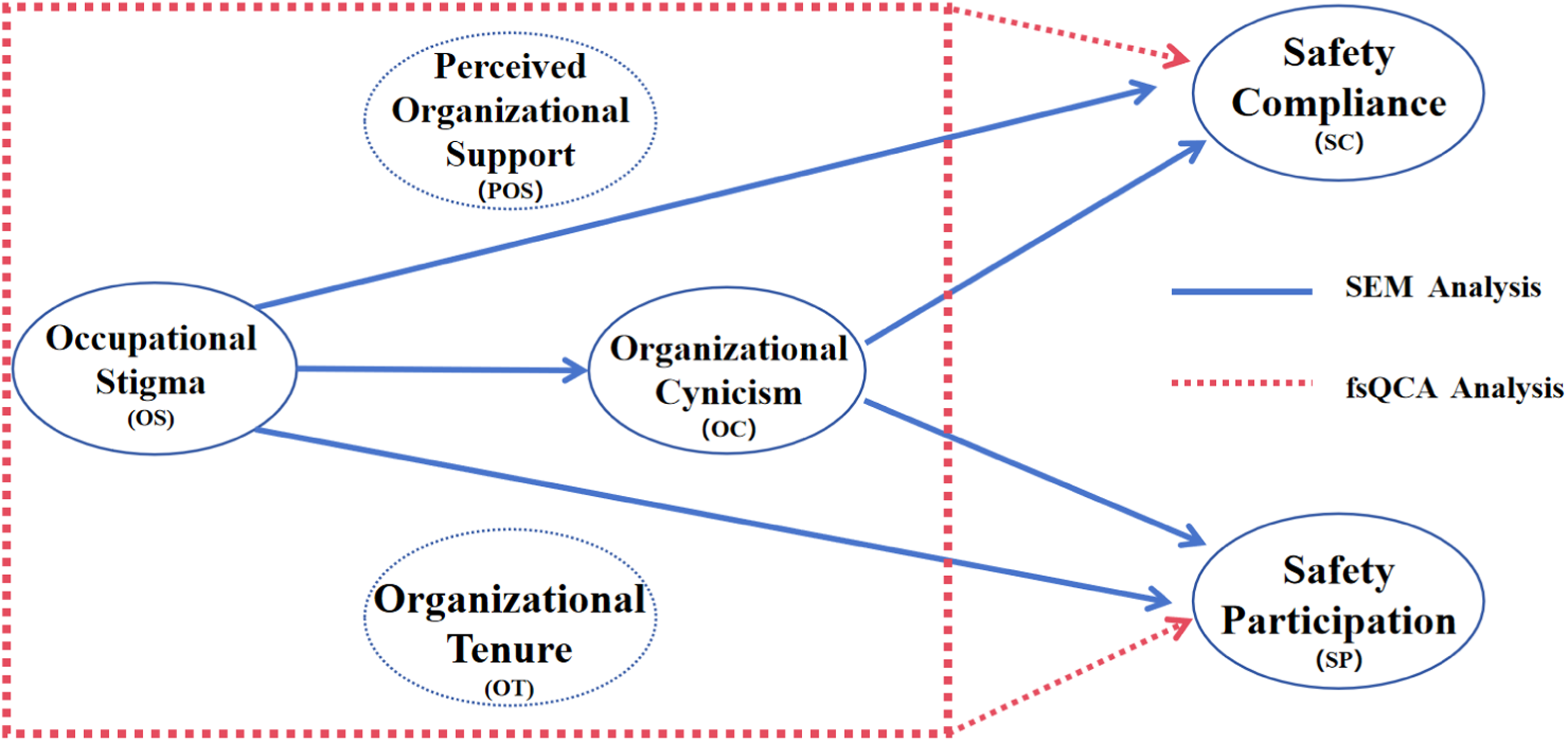
Research model.
Method
Measures
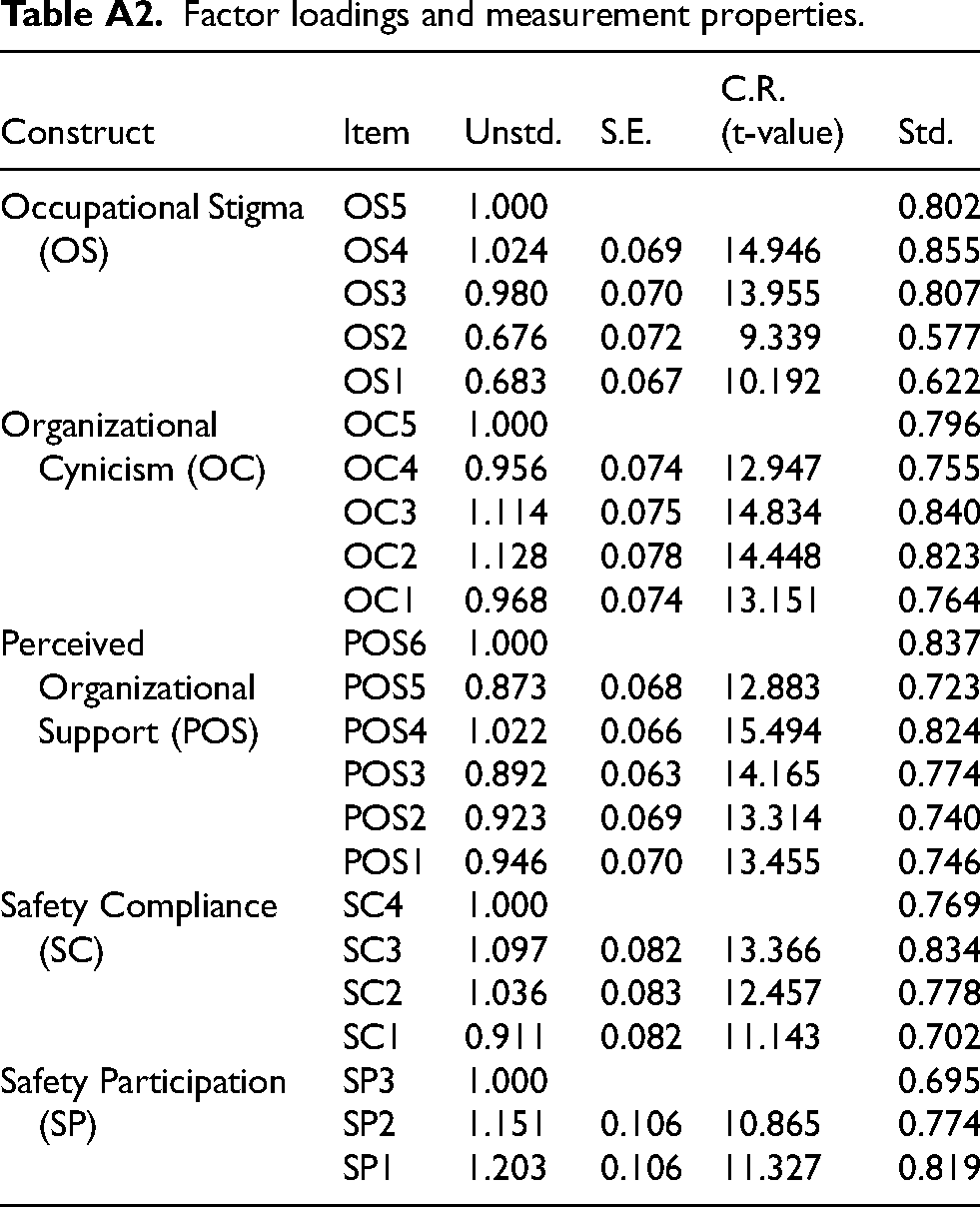
The measurement scales utilized in this study were derived from established instruments with validated reliability. Following the translation protocol outlined, all scales were translated into Chinese and back-translated to ensure linguistic equivalence. Prior to the formal survey, a pilot test was conducted with four chemical enterprise managers and three HR specialists to identify and refine any ambiguous items. Based on their feedback, the wording of specific items was adapted to use locally appropriate terminology, thereby enhancing comprehension among frontline chemical workers. All instruments employed a 5-point Likert scale, ranging from 1 (strongly disagree) to 5 (strongly agree). As presented in Tables 1 and 2, all constructs exhibited acceptable reliability and validity, with Cronbach's alpha and CR values exceeding 0.70, and AVE values surpassing 0.50.
Results of the confirmatory factor analysis.
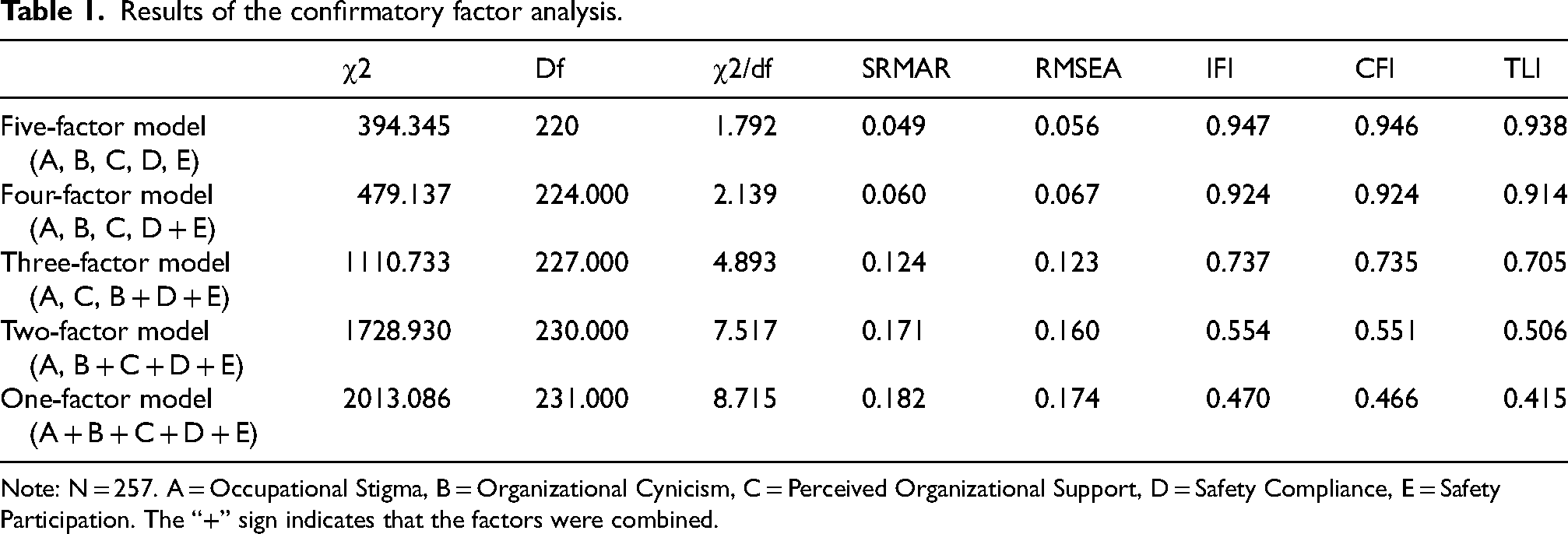
Note: N = 257. A = Occupational Stigma, B = Organizational Cynicism, C = Perceived Organizational Support, D = Safety Compliance, E = Safety Participation. The “+” sign indicates that the factors were combined.
Discriminant validity: AVE square roots and inter-construct correlations.

Note: N = 257. Diagonal elements (in bold) represent the square root of the AVE. Off-diagonal elements represent the correlations between constructs. OS = Occupational Stigma; OC = Organizational Cynicism; POS = Perceived Organizational Support; SC = Safety Compliance; SP = Safety Participation.
Occupational Stigma(OS). Occupational stigma was assessed using the 5-item scale developed by Schaubroeck et al., 37 which has been specifically validated for Chinese occupational contexts.
Organizational Cynicism(OC). A 5-item scale was synthesized from Neves et al. and Johnson and O’Leary-Kelly to assess organizational cynicism,38,39 including two reverse-scored items.
Perceived Organizational Support (POS). Based on the original 36-item scale by Eisenberger et al., 31 this study utilized the 6-item short form developed by Eisenberger et al. 40
Safety Performance. A 7-item scale was synthesized from Xia et al. and Vinodkumar and Bhasi to assess safety performance, comprising two dimensions: Safety Compliance (SC) and Safety Participation (SP).41,42 Certain items have been previously validated in the Chinese context.
Control Variables. Consistent with prior literature, gender, age, organizational tenure, and education level were included as demographic variables. Organizational tenure was categorized using cut-off points of 1, 3, and 5 years.
Data collection and sample
Data were collected from September to November 2025 across five chemical enterprises in three major chemical industrial regions in Eastern and Central China through established university-industry partnerships. All procedures received institutional ethics approval. Prior to participation, respondents were assured that: (a) no sensitive data would be collected; (b) anonymity would be preserved by matching responses via WeChat Open-IDs; and (c) participation was voluntary with a monetary incentive. With management authorization, questionnaires were distributed to frontline operators across all shifts. Following the recommendation, a combined convenience and snowball sampling strategy was employed via peer referrals to facilitate coverage across multiple shifts and work teams.
A two-wave time-lagged design was implemented with a 72-h interval between phases. This interval was determined in consultation with on-site safety managers, who advised that extended gaps would reduce response matching rates due to rotating shift cycles. The time-lagged design primarily serves to mitigate common method bias. Wave 1 assessed demographics, occupational stigma, and organizational cynicism. Wave 2 measured safety performance and perceived organizational support. Matching of longitudinal responses utilized system-logged, anonymized WeChat Open-IDs. Of the 373 questionnaires collected in the first wave, 291 were retrieved in the second wave. After data screening, 257 valid questionnaires remained, yielding an effective retention rate of 68.9%.
The sample was predominantly male (N = 204, 79.4%), consistent with the gender distribution typical of the frontline chemical workforce. Regarding education, the majority held vocational college degrees (n = 174, 67.7%). Organizational tenure was distributed as follows: less than 1 year (32.3%), 1–3 years (23.7%), 3–5 years (25.7%), and more than 5 years (18.3%). The workforce was relatively young, with the 25–35 age group constituting the largest proportion (47.9%).
Analytical strategy
A research framework was constructed based on the Job Demands-Resources (JD-R) model. SEM was employed to verify the mediation effects within the “Stressor (Occupational Stigma) → Psychological Mechanism (Organizational Cynicism) → Outcome (Safety Performance)” pathway. Furthermore, fsQCA was utilized to examine the resource role of Perceived Organizational Support (POS) and to identify the causal configurations leading to high safety performance. SEM captures the effects of individual variables and tests mediation pathways, whereas fsQCA identifies how multiple conditions combine into configurations sufficient for the outcome. Together, they provide a more comprehensive understanding of safety performance than either method alone. Data analyses were performed using R and fsQCA 4.0.
Results
Common method bias analysis
Given that all variables were self-reported, potential common method bias (CMB) was assessed using Harman's single-factor test. All measurement items were subjected to an unrotated Exploratory Factor Analysis (EFA). The analysis yielded four factors with eigenvalues exceeding 1. The first factor explained 33.90% of the total variance, falling below the critical threshold of 40%. These results suggest that CMB is not a pervasive issue in this study.
Confirmatory factor analysis
Confirmatory Factor Analysis (CFA) was conducted using AMOS 28.0. As presented in Table 1, the hypothesized five-factor model demonstrated a significantly better fit than alternative nested models, meeting established criteria (χ2/df < 3, SRMAR<0.08, RMSEA<0.08, IFI>0.9, CFI>0.9, TLI>0.9). These results confirm adequate discriminant validity among the five latent constructs: Occupational Stigma, Organizational Cynicism, Perceived Organizational Support, Safety Compliance, and Safety Participation. In conjunction with the findings from the preceding section, the measurement model demonstrates valid psychometric properties for hypothesis testing.
Discriminant validity
As presented in Table 2, the square roots of the AVEs exceeded the inter-construct correlations for all variables, with the exception of the relationship between Safety Compliance and Safety Participation. Given that these two constructs represent theoretically related sub-dimensions of safety performance, the Fornell-Larcker criterion may be overly stringent. Consequently, the analysis was supplemented with the Heterotrait-Monotrait (HTMT) ratio suggested by Henseler et al. 43 As reported in Table 3, the HTMT value between these constructs was 0.781, falling below the critical threshold of 0.85. Collectively, these results indicate adequate discriminant validity across the measurement scales.
HTMT analysis for safety compliance and safety participation.
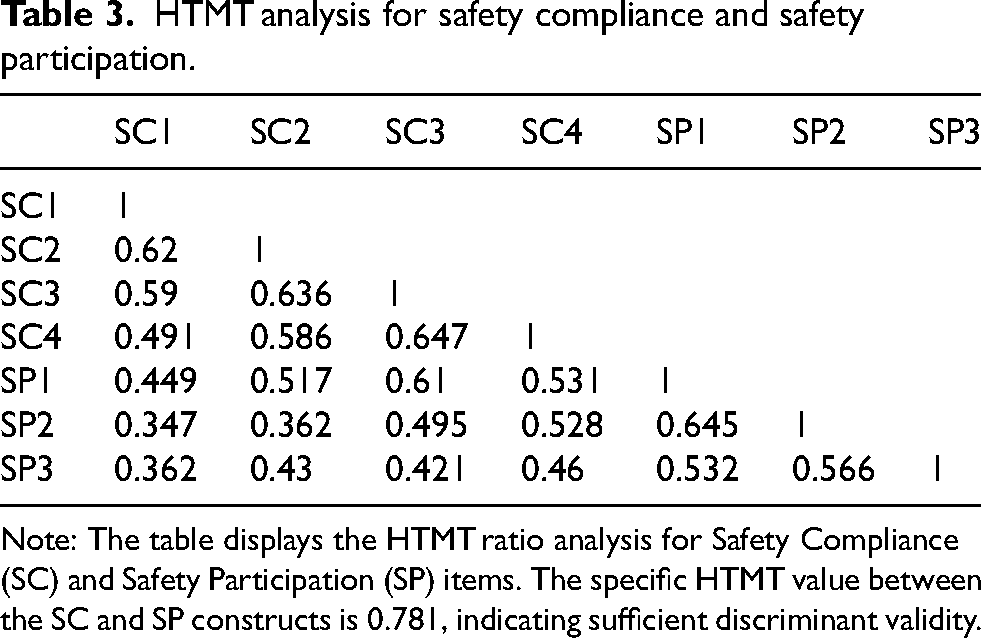
Note: The table displays the HTMT ratio analysis for Safety Compliance (SC) and Safety Participation (SP) items. The specific HTMT value between the SC and SP constructs is 0.781, indicating sufficient discriminant validity.
Descriptive statistics
Following reliability and validity assessments, descriptive statistics and bivariate correlations were computed to examine initial patterns among the study variables (Table 4). As anticipated, OS demonstrated a significant positive correlation with OC (r = 0.596,p < 0.01). Consistent with theoretical expectations, OS exhibited significant negative associations with both SC (r = −0.214,p < 0.01) and SP (r = −0.382,p < 0.01). Similarly, OC was negatively associated with SC (r = −0.250,p < 0.01) and SP (r = −0.353,p < 0.01). These patterns align with the proposed theoretical relationships, providing preliminary empirical evidence to support the subsequent structural equation modeling analysis.
Descriptive statistics and bivariate correlations among study variables.
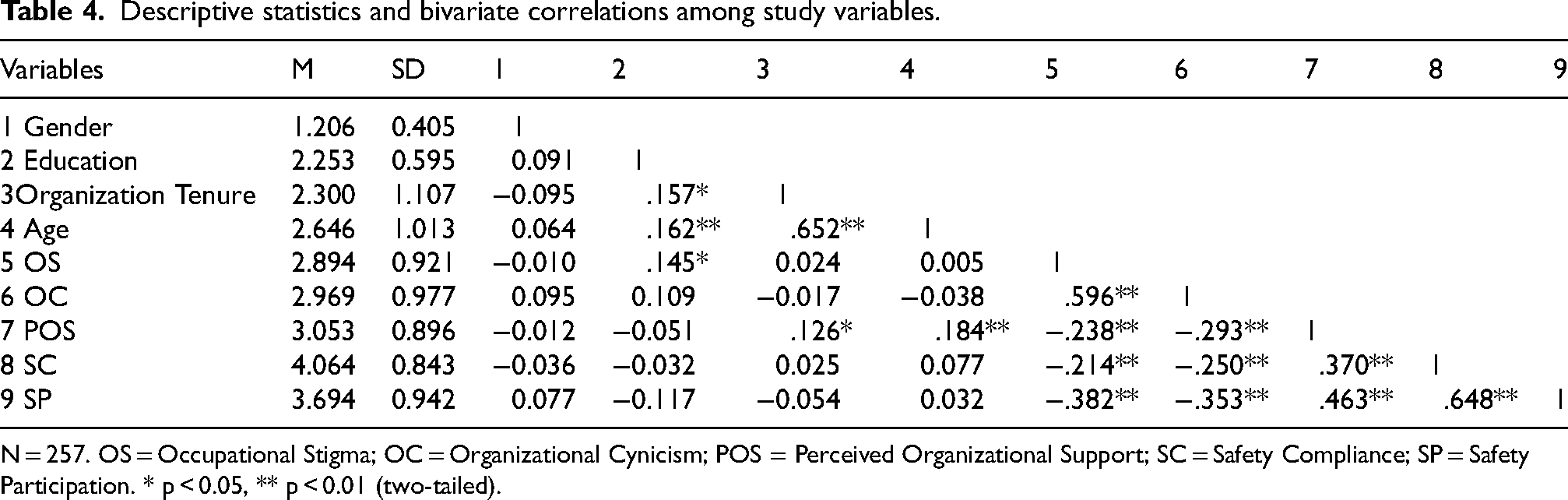
N = 257. OS = Occupational Stigma; OC = Organizational Cynicism; POS = Perceived Organizational Support; SC = Safety Compliance; SP = Safety Participation. * p < 0.05, ** p < 0.01 (two-tailed).
SEM hypothesis testing
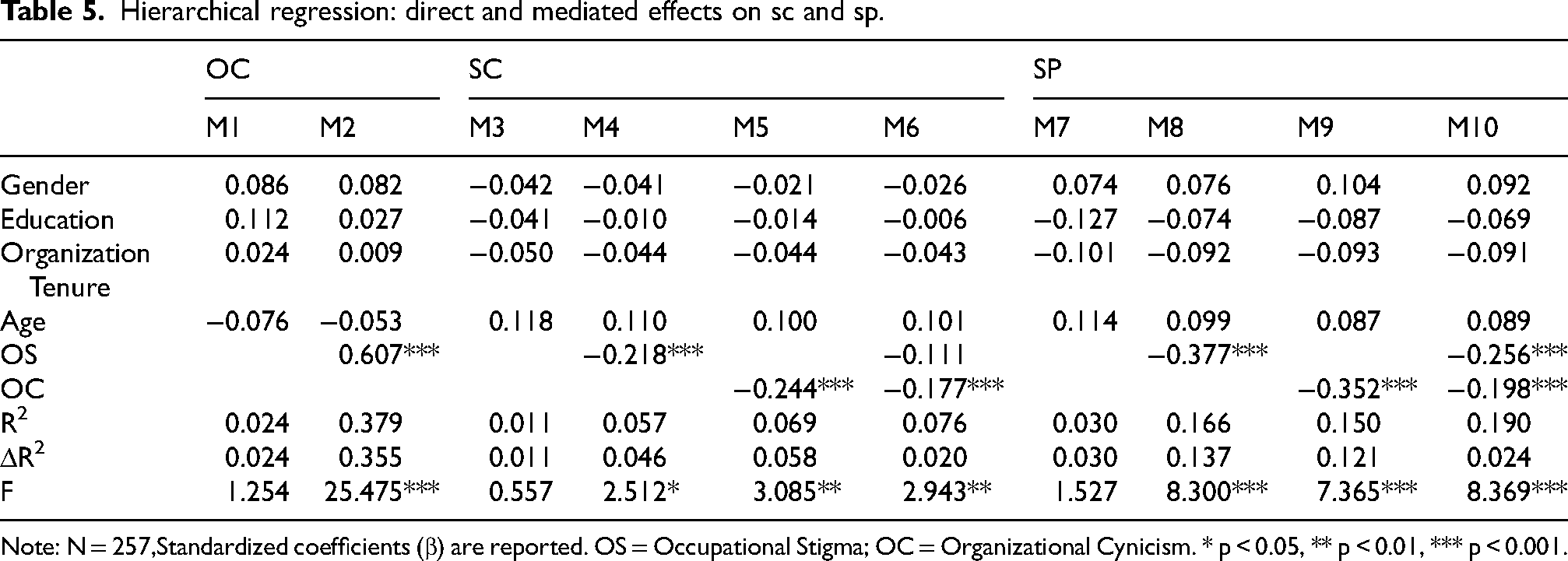
Following the causal steps approach, hierarchical regression was first conducted to preliminarily test the mediation hypotheses. The mediation effects were then formally verified using a bias-corrected bootstrapping procedure. First, the direct effects of OS were examined. In Model 2, OS significantly and positively predicted OC (β=0.607,p < 0.001). Similarly, Models 4 and 8 indicate that OS had a significant negative impact on SC (β=−0.218,p < 0.01) and SP (β=−0.377,p < 0.001). These findings support Hypotheses H1a, H1b, and H2. Furthermore, Models 5 and 9 demonstrate that OC was negatively associated with both SC (β=−0.244,p < 0.01) and SP (β=−0.325,p < 0.01), thereby supporting Hypotheses H3a and H3b.
Second, the mediating role of OC was evaluated. In Model 6, with the inclusion of the mediator, OC significantly negatively predicted SC (β=−0.177, p < 0.05), whereas the direct effect of OS on SC became non-significant (β=−0.111,p > 0.05). According to the criteria established by Baron and Kenny, 44 this suggests that OC fully mediates the relationship between OS and SC. In Model 10, both OS (β=−0.256,p < 0.01) and OC (β=−0.198,p < 0.05) exerted significant negative effects on SP. However, the regression coefficient for OS decreased in absolute value compared to Model 8, indicating that OC partially mediates the relationship between OS and SP (Table 5).
Hierarchical regression: direct and mediated effects on sc and sp.
Note: N = 257,Standardized coefficients (β) are reported. OS = Occupational Stigma; OC = Organizational Cynicism. * p < 0.05, ** p < 0.01, *** p < 0.001.
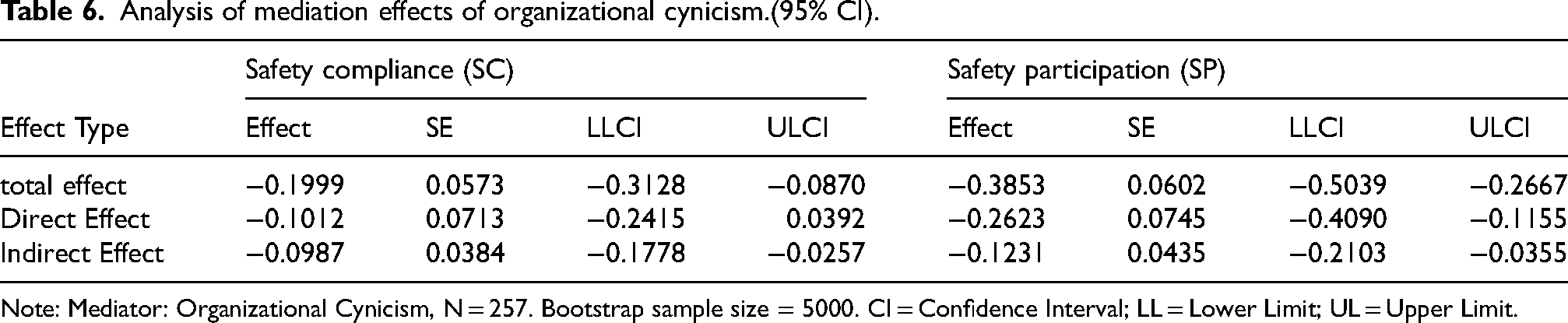
To further verify the mediating role of OC, a bootstrapping procedure was performed with 5000 resamples to estimate 95% confidence intervals (CI). Table 6 presents the total, direct, and indirect effects of OS on SC and SP through OC.
Analysis of mediation effects of organizational cynicism.(95% CI).
Note: Mediator: Organizational Cynicism, N = 257. Bootstrap sample size = 5000. CI = Confidence Interval; LL = Lower Limit; UL = Upper Limit.
Regarding SC, the indirect effect of OS on SC via OC was significant (Effect = −0.0987, SE = 0.0384), as the 95% CI excluded zero (CI = [−0.1778, −0.0257]). In contrast, the direct effect of OS on SC was non-significant (95% CI = [−0.2415, 0.0392], containing zero). These findings indicate that OC plays a full mediating role in the relationship between OS and SC, thereby supporting Hypothesis H4a.
Regarding SP, both the indirect effect (Effect = −0.1231, SE = 0.0435, 95% CI = [−0.2103, −0.0355]) and the direct effect (Effect = −0.2623, 95% CI = [−0.4090, −0.1155]) of OS on SP were significant. This pattern suggests that OC functions as a partial mediator between OS and SP, supporting Hypothesis H4b.
FSQCA
POS functions as both a resource provider and a buffering agent, often playing a non-linear role within complex organizational systems. Recognizing that safety performance is a complex dynamic process, fsQCA employs configurational thinking to examine the combinatorial effects of multiple factors and distinguish between core and peripheral conditions. 35 Therefore, this study adopts fsQCA as a complementary method to SEM to investigate the causal configurations driving safety performance and their underlying mechanisms, thereby enhancing the robustness of the research findings.
Pre-analysis preparation
In this study, OS, OC, POS and Organizational Tenure (OT) were selected as antecedent conditions, while SP and SC served as outcome variables. The fsQCA 4.0 software was utilized to calibrate the raw data. Following the protocols of Ragin and Pappas et al.,35,36 the direct method of calibration was applied. Specifically, the calibration anchors for OS, OC, and POS were established at 4 (full membership), 3 (crossover point), and 2 (full non-membership).36,45 For outcome variables SP and SC, due to skewed data distributions, anchors were adjusted upward by 0.5 and 0.25 points respectively based on sample statistical characteristics to accurately reflect actual membership degrees. 36 For Organizational Tenure, the anchors were set at 3.5 (full membership), 3 (crossover point), and 1.5 (full non-membership). Finally, a constant of 0.01 was added to all anchors during input to prevent case exclusion caused by ambiguity at the crossover threshold.
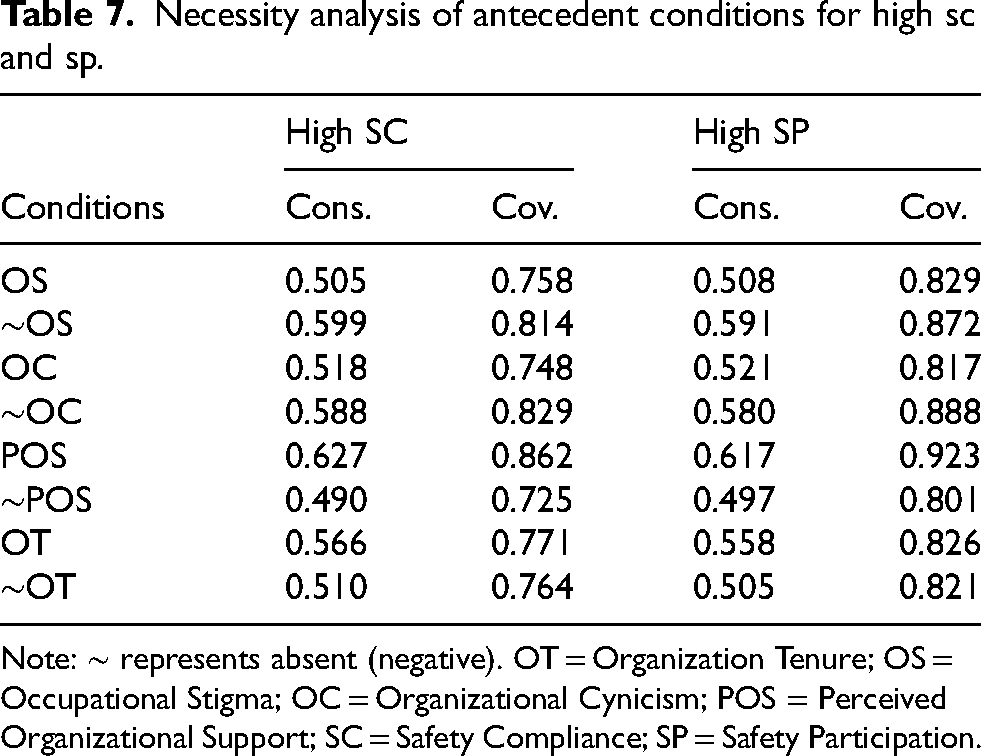
Prior to truth table construction, a necessity analysis was conducted to ascertain whether any single antecedent condition could independently explain the outcome. As presented in Table 7, the consistency values for all antecedent conditions fell below the threshold of 0.9 recommended by Ragin. 35 These results indicate that no single factor constitutes a necessary condition for either high SC or high SP. Consequently, the study proceeded to the sufficiency analysis of configurational pathways.
Necessity analysis of antecedent conditions for high sc and sp.
Note: ∼ represents absent (negative). OT = Organization Tenure; OS = Occupational Stigma; OC = Organizational Cynicism; POS = Perceived Organizational Support; SC = Safety Compliance; SP = Safety Participation.
Configuration analysis of results
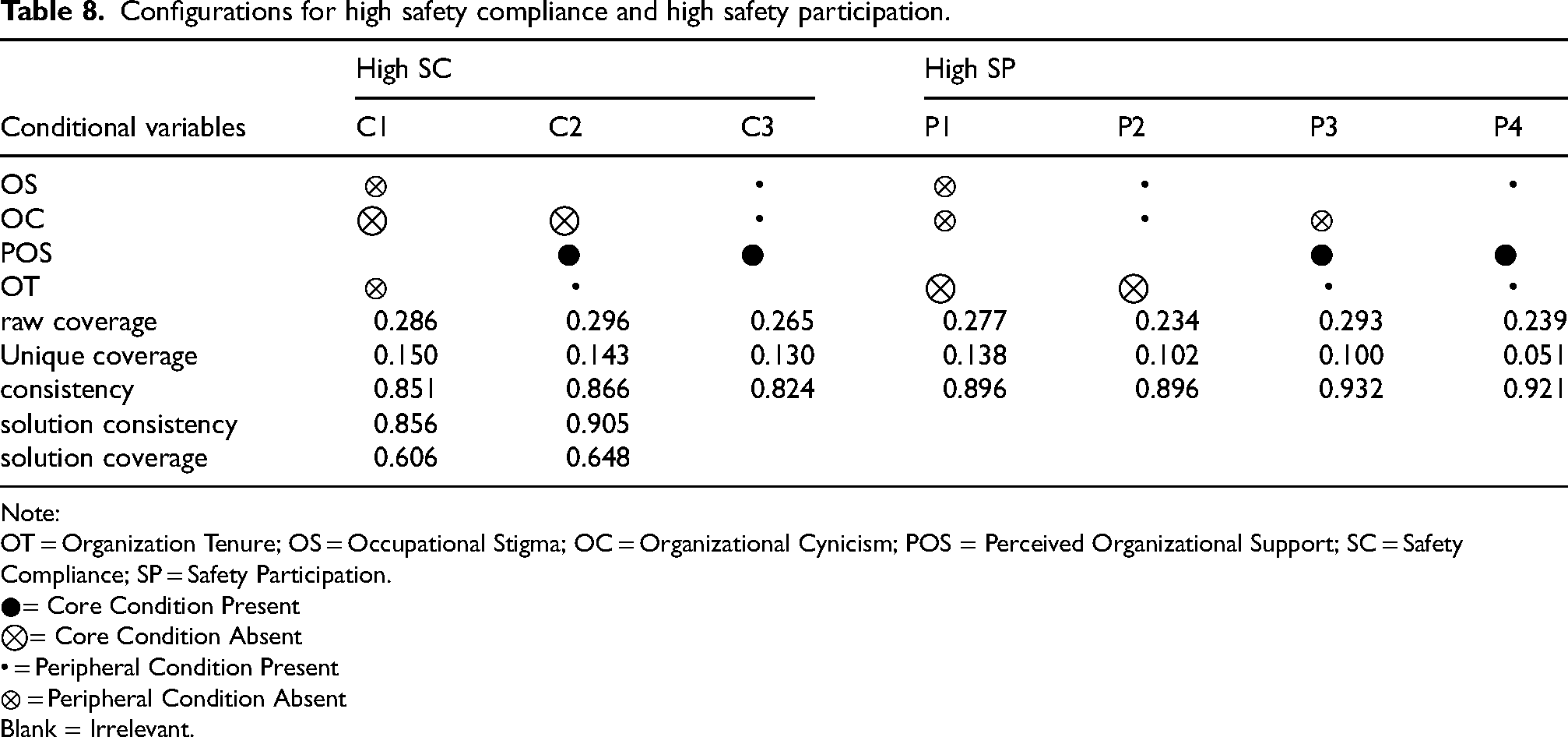
A truth table was constructed to display the logical combinations of antecedent conditions and the corresponding number of cases, thereby facilitating the analysis of configurations associated with high safety performance. Drawing on existing research,35,36 the raw consistency threshold was set to 0.80, the case frequency threshold to 5, and the PRI consistency threshold to 0.70. Table 8 presents the configurational solutions, where each column represents a distinct pathway to high SC or high SP. To verify the robustness of the results, systematic sensitivity analyses were conducted by adjusting the frequency threshold (±1 case) and shifting the calibration anchors (±0.1). The analysis revealed that the core configurations remained materially unchanged, thereby supporting the stability of the findings. The following section details the causal configurations leading to high safety performance.
Configurations for high safety compliance and high safety participation.
Note:
OT = Organization Tenure; OS = Occupational Stigma; OC = Organizational Cynicism; POS = Perceived Organizational Support; SC = Safety Compliance; SP = Safety Participation.
●= Core Condition Present
⨂= Core Condition Absent
• = Peripheral Condition Present
⊗ = Peripheral Condition Absent
Blank = Irrelevant.
POS emerges as a core condition in configurations C2 and C3 leading to high SC. This finding resonates with the JD-R framework, corroborating the role of POS. As a motivational resource, POS provides essential psychological resources that facilitate strict adherence to safety protocols; as a buffering resource, it helps counteract negative workplace influences. Specifically, Configuration C3 exemplifies this buffering capacity: despite the peripheral presence of OS and OC, the existence of POS as a core condition appears to enable employees to maintain high safety compliance. This underscores a critical intervention principle: enhancing safety compliance may rely not merely on eliminating negative factors but, more crucially, on strategically leveraging POS to counteract safety impairment processes. Furthermore, the comparison between C2 and C1 illuminates career-stage dynamics: beyond the crossover point of Organizational Tenure, relying solely on the absence of negative attitudes (as seen in C1) becomes insufficient. Instead, POS appears critical for sustaining compliance. Thus, POS functions both as a protective buffer against OS (C3) and as a developmental resource promoting compliance continuity across career trajectories.
Configurations P1 and P2, leading to high SP, identify the absence of Organizational Tenure as a core condition. This suggests a distinct newcomer advantage, wherein employees in the early career stages demonstrate heightened engagement in discretionary safety activities. In contrast, configurations P3 and P4—characterized by POS as a core condition alongside the peripheral presence of high tenure—indicate that sustained participation is closely associated with strategic resource investment. While early-career employees may exhibit spontaneous participatory tendencies, the proactive behaviors of tenured employees rely substantially on POS as a motivational resource.
Collectively, these findings indicate that the infusion of organizational resources serves as a vital strategy for enhancing safety performance, thereby supporting Proposition P1.
Discussion
Discussion of findings
First, the results indicate that OS is significantly associated with lower safety performance among chemical workers. In high-risk frontline settings, job demands extend beyond physical workload to encompass psychological stressors such as OS. To navigate this stigmatization, workers may frequently expend psychological resources on identity reconstruction and cognitive reframing, a process through which individuals reinterpret negative experiences to maintain a positive self-concept. This chronic resource depletion tends to erode the volitional resources necessary for safety compliance while substantially diminishing the motivation for proactive safety participation. By suggesting how societal evaluations may penetrate organizational boundaries and become relevant to workplace safety, our findings provide empirical support for viewing psychosocial risks as substantive occupational hazards. 46 This finding is consistent with prior research in manufacturing and construction industries, where stigma and psychosocial stressors have been shown to impair employee motivation and safety behavior.
Second, our findings shed light on the distinct pathways through which OS impairs safety performance, highlighting differential underlying mechanisms. Specifically, the analysis reveals that organizational cynicism fully mediates the relationship between stigma and safety compliance, whereas it partially mediates the stigma-safety participation link. This suggests that OS may be linked to SC largely through the development of OC. When workers perceive their occupation as socially devalued and the organization as ineffective in mitigating this stigma, they are liable to develop a cynical mindset. This cynicism may frame safety protocols as mere bureaucratic formalism, leading to passive resistance. The finding that controlling for cynicism eliminates stigma's direct effect suggests that trust erosion is a critical driver of compliance failure. Conversely, regarding safety participation, occupational stigma exerts both direct and indirect effects. This dual-pathway mechanism indicates that, even absent a complete collapse of organizational trust, the direct impairment of self-esteem caused by stigma appears sufficient to suppress safety voice and curtail voluntary safety citizenship behaviors. 47
Finally, the fsQCA results identify distinct configurations sufficient for high safety performance. POS emerges as a core condition across most pathways, lending support to the motivational and buffering roles of job resources within the JD-R framework. Specifically, Configuration C3 demonstrates that the presence of core high POS enables employees to sustain high SC despite the concurrent presence of OS and OC. This implies that fostering SC relies not merely on eliminating stressors, but crucially on leveraging POS to counteract resource depletion. Furthermore, distinct patterns emerge based on tenure. For newcomers, high SP is achieved via simpler pathways independent of complex resource matching, aligning with proactive integration strategies. Conversely, for tenured employees, sustaining high safety performance appears highly dependent on high POS (Configurations C2, P3, P4). This underscores that in high-OS industries, POS transitions from a beneficial resource to a critical requirement for preserving the safety motivation of the senior workforce.
Theoretical contributions
This study elucidates the impact of psychosocial stressors on human reliability within the chemical process industries. It suggests that analyzing process safety requires considering how external social pressures affect operator behavior—a critical human factor often neglected. Moving beyond general stress models, we identify Organizational Cynicism as a key barrier that degrades safety performance. We characterize SC as a contract-based behavior rooted in trust, whereas SP entails a resource-dependent investment necessitating individual energy reserves. This theoretical distinction implies that safety interventions cannot be generic: while restoring trust helps ensure adherence to Standard Operating Procedures, enhancing workforce involvement requires directly mitigating the cognitive depletion caused by occupational stigma.
Complementing these insights into behavioral risks, our findings underscore the function of POS as a critical organizational safeguard against human factor failures. We demonstrate that robust support systems act as a buffer, maintaining safety performance even in adverse work environments. This is confirmed by the fsQCA findings, where a configuration of high SC persists despite the coexistence of high OS and high OC, provided there is core high POS. Synthesizing these findings reveals that, although societal stigma may be immutable in the short term, organizations can construct a robust support system acting as a psychological firewall.
Managerial implications
Multi-level interventions should be implemented to mitigate the impact of occupational stigma on workforce reliability. Given that OS serves as a distal antecedent of safety hazards, enterprises must spearhead proactive measures. Internally, organizations should reduce stigma by providing specialized training programs that reinforce the importance of each worker's role in safety procedures, thereby strengthening occupational identity and professional pride. Externally, firms must actively communicate their commitment to safety and environmental stewardship to improve the industry's reputation, thereby supporting employee morale.
Furthermore, the mediating chain of OC should be disrupted by rebuilding trust within the safety culture. Regarding environmental issues or hazards, leaders should adopt transparent communication and timely corrective actions, strictly avoiding safety hypocrisy. 48 Simultaneously, organizations should establish Employee Assistance Programs to provide psychological counseling and mental health support, such as on-site counseling services and anonymous peer support groups. By intervening in both material and psychosocial domains, firms can help workers cognitively reframe their work experiences and mitigate cynical attitudes.
Finally, a high level of POS should be cultivated to function as a barrier against human failure. Regarding physical infrastructure, companies should provide state-of-the-art PPE and optimize shift scheduling to directly manage operator fatigue. In terms of institutional design, robust incentive mechanisms should be established to reward safety voice, such as monthly safety contribution awards, thereby reinforcing positive feedback for SP. Specifically for tenured employees, organizations must extend enhanced care to foster a supportive climate. Crucially, organizational resources must be leveraged to reinvigorate safety sensitivity that may have succumbed to habituation or desensitization due to long-term routine exposure.
Limitations and future directions
This study has two limitations. First, we focused primarily on POS, omitting individual human factors (e.g., risk perception) and external supports. Future research should integrate multi-level resources to better understand protective factors against psychosocial stressors in high-hazard environments, and further investigate the long-term effects of POS interventions on sustained safety performance. Second, strict site access controls constrained data collection. Due to operational difficulties in coordinating probability-based sampling across rotating shifts, convenience and snowball sampling were adopted on the recommendation of on-site management, which may introduce selection bias. Moreover, because safety performance was measured through self-reported questionnaires, the results may be affected by social desirability bias. For similar reasons, the 72-h interval between survey waves, while effective for mitigating common method bias, may not fully capture developmental trends or establish the temporal ordering among OS, OC, POS, and safety performance. Future studies should aim for broader sampling frames and extended time lags to enhance generalizability and causal depth.
Conclusion
Focusing on frontline workers in China's chemical industry, this study adopts a dual-analytical approach combining SEM and fsQCA. SEM findings suggest that organizational cynicism mediates the impact of OS on safety performance—fully for safety compliance and partially for safety participation. fsQCA further reveals that POS serves as a core buffering resource within multiple equifinal configurations for high safety performance. This perspective demonstrates that safety performance is not the product of isolated linear associations, but rather emerges from the holistic and dynamic interplay between environmental stressors and supportive organizational resources. Our results offer pivotal theoretical grounding for future inquiry into safety performance mechanisms. By identifying POS as a critical resource, this study provides practical implications for chemical industries seeking to mitigate stigma and improve safety outcomes through targeted organizational interventions.
Footnotes
Acknowledgements
The authors would like to thank all participants for their time and valuable contributions to this study.
Ethical approval
The study was conducted in accordance with the Declaration of Helsinki. The research protocol was reviewed and approved by the Ethics Committee of the School of Mechanical Engineering at Henan Polytechnic Institute (Approval Number: 25-8-20-01; Approval Date: August 20, 2025).
Author contribution(s)
Yuhao Wang: Data Curation, Visualization, Software.
Funding
The authors received no financial support for the research, authorship, and/or publication of this article.
Informed consent
Informed consent was obtained from all individual participants included in the study. Participants were informed about the academic purpose of the study, the voluntary nature of their participation, and their right to withdraw at any time. The confidentiality and anonymity of the data were assured, and the completion and submission of the online questionnaire were considered as implied consent.
Declaration of conflicting interests
The authors declared no potential conflicts of interest with respect to the research, authorship, and/or publication of this article.
Data availability statement
The data that support the findings of this study are available from the corresponding author upon reasonable request.
Appendix A
Factor loadings and measurement properties.
| Construct | Item | Unstd. | S.E. | C.R. (t-value) | Std. |
|---|---|---|---|---|---|
| Occupational Stigma (OS) | OS5 | 1.000 | 0.802 | ||
| OS4 | 1.024 | 0.069 | 14.946 | 0.855 | |
| OS3 | 0.980 | 0.070 | 13.955 | 0.807 | |
| OS2 | 0.676 | 0.072 | 9.339 | 0.577 | |
| OS1 | 0.683 | 0.067 | 10.192 | 0.622 | |
| Organizational Cynicism (OC) | OC5 | 1.000 | 0.796 | ||
| OC4 | 0.956 | 0.074 | 12.947 | 0.755 | |
| OC3 | 1.114 | 0.075 | 14.834 | 0.840 | |
| OC2 | 1.128 | 0.078 | 14.448 | 0.823 | |
| OC1 | 0.968 | 0.074 | 13.151 | 0.764 | |
| Perceived Organizational Support (POS) | POS6 | 1.000 | 0.837 | ||
| POS5 | 0.873 | 0.068 | 12.883 | 0.723 | |
| POS4 | 1.022 | 0.066 | 15.494 | 0.824 | |
| POS3 | 0.892 | 0.063 | 14.165 | 0.774 | |
| POS2 | 0.923 | 0.069 | 13.314 | 0.740 | |
| POS1 | 0.946 | 0.070 | 13.455 | 0.746 | |
| Safety Compliance (SC) | SC4 | 1.000 | 0.769 | ||
| SC3 | 1.097 | 0.082 | 13.366 | 0.834 | |
| SC2 | 1.036 | 0.083 | 12.457 | 0.778 | |
| SC1 | 0.911 | 0.082 | 11.143 | 0.702 | |
| Safety Participation (SP) | SP3 | 1.000 | 0.695 | ||
| SP2 | 1.151 | 0.106 | 10.865 | 0.774 | |
| SP1 | 1.203 | 0.106 | 11.327 | 0.819 |