



Abstract
Background
Physical and psychosocial contexts of employment and the quality of the work environments impact both physical and mental health, particularly among individuals with disabilities.
Objective
Given the relationship between health and employment and the need to understand the relationship between quality of work and COVID-19 acquisition risk, this project focused on studying the impacts of job quality following the emergence of the COVID-19 virus.
Method
GLM logistic regression to explore odds ratios of employment quality factors on our dependent variable, contracting COVID-19.
Results
The overall model was significant, indicating selection of predictor and control variables have an impact on COVID-19 risk (χ2(11) = 59.53, p < .001, N = 2325). Age and race were significant individual predictors. Finally, among the employment quality variables, only one comparison was significant. Individuals with some but not all markers of employment quality, compared to individuals who were unemployed, were 1.3 times more likely to contract COVID-19 (OR = 1.3, p = 0.03).
Conclusion
Employment, in light of COVID-19, is full of complexity and nuances. Even more so is the relationship between COVID-19, health, and employment for PWDs. The significant findings from the current study have important implications for the incorporation of employment, and specifically quality employment, as a predictor of physical health among PWDs.
Introduction
Work is a fundamental source of purpose, social connectedness, identity, financial security, and quality of life (Kober & Eggleton, 2005; Saunders & Nedelec, 2014) and there is strong theoretical and empirical support for a relationship between work, or paid employment, and both physical and psychological health (Blustein, 2008, Klumb & Lampert, 2004; Thurgood & Frank, 2007). In the United States, individuals with disabilities continue to experience a substantial gap in employment rates compared to individuals without disabilities. In 2023, 22.5% of people with a disability were employed compared to 65.8% of people without a disability (Bureau of Labor Statistics, 2024). The perennially low rate of employment participation for those with a disability has broad and lasting health consequences. Compared to persons who are employed, those who are unemployed tend to experience higher prevalence of depression and anxiety disorders, use alcohol more frequently, and report lower scores on self-esteem and quality of life measures (Dutta et al., 2008; Harvey et al., 2017). Conversely, individuals actively engaged in meaningful work experiences not only earn a livable wage but derive physical and mental health benefits as well as increased overall well-being (Strauser, 2021).
The relationship between health and employment among individuals with disabilities is increasingly well-established (Chan et al., 2017; Hall et al., 2013). Generally, work participation results in reduced negative health consequences and promotes general well-being and quality of life for individuals with disabilities. However, the relationship between work and health is complex and not entirely linear. This fact has become increasingly clear in the context of research on employment quality.
Jobs vary in their physical, psychological, social, and economic characteristics, and factors that Butterworth et al. (2011) described as having poor psychosocial conditions, such as those characterized by low decision latitude, high demands, low job security, low social support, low pay, and few benefits, may be no better, and have in some cases been found to be worse for mental health, than unemployment (Broom et al., 2006; Butterworth et al., 2011). People with disabilities are represented in a higher concentration in low-wage positions, and are almost twice as likely to work part time compared to those without disabilities (Bureau of Labor Statistics, 2024). These positions are more likely to be associated with what Butterworth et al. (2011) described as poor psychosocial conditions. Further, for many people with chronic health conditions, particularly those with mid-career onset progressive conditions, work can transition from a health-promoting activity to one associated with stress, pain, and exacerbation of symptoms such that leaving the workforce becomes a healthier option than maintaining employment.
In short, the relationship between work and health is complex and non-linear. The form and scope of available data limit the ability to understand the nature and implications of this relationship. In this complex and nuanced context there is a need for more multidimensional study of relevant employment variables (Strauser, 2021) and to examine employment as a multifaceted construct. The traditional research approach of using a dichotomous outcome of employed or unemployed, while providing important information, does not adequately address the more nuanced factors in the work experience that may directly affect or mediate the health-work relationship. Employment quality is increasingly being recognized as a critical variable (Strauser, 2021) in understanding this relationship. The physical and psychosocial contexts of employment and the quality of the work environments impact both physical and mental health (Hämmig & Bauer, 2014; Stansfeld & Candy, 2006).
Recently, there has been an increased focus on studying aspects of job quality for employed individuals with disabilities, though approaches to measurement have varied. For example, in national survey research, the concept of job quality has traditionally been measured in terms of whether an individual is employed, hours worked, and wages earned (Sevak et al., 2015). In a more refined and informative approach, Brucker and Henly (2019) operationalized a quality job in terms of whether an individual was employed, whether they were offered health insurance benefits, whether they earned wages above the median, and whether workers had an opportunity to participate in an employer retirement savings program.
In the context of seeking to understand these relationships, the COVID-19 pandemic has created additional layers of complexity. Over the past four years, COVID-19 has simultaneously affected each of the elements involved, altering the availability and level of participation in work, the nature and quality of work, and the potential health consequences and risks associated with working. The impacts of the COVID-19 pandemic on labor and the workforce in the United States have been dramatic, widespread, and complex, and this has particularly been the case for people with disabilities and chronic illnesses. Compared to those without disabilities, people with pre-existing conditions were more vulnerable to severe disease experiences (including death) during the first several waves of COVID-19 (Umucu et al., 2021), remain more likely to experience interruptions of employment and lower likelihood of returning to work (Bishop & Rumrill, 2022), and continue to have more difficulties with ongoing symptoms (e.g., cognitive impairment, respiratory and circulatory difficulties, compromised immune systems; CDC, 2024a). There is growing evidence that populations at higher risk of COVID-19 are also at increased risk for post-COVID-19 conditions (CDC, 2024b; Hall et al., 2024), and many of the risk factors associated with long COVID (or post-COVID-19 syndrome) put people with disabilities at an increased risk, including older age (>50), female sex, a more severe case of COVID-19 infection, and having multiple preexisting conditions, especially hypertension, obesity, psychiatric disabilities, and immunosuppressive conditions (Asadi-Pooya et al., 2021; Crook et al., 2021; Yong, 2021). Many physical health concerns are related to long COVID, including fatigue, dyspnea (difficulty breathing), cognitive impairment, chest and joint pain, and gastrointestinal and cardiac issues (Crook et al., 2021; Yong, 2021).
Understanding the impact of job quality can inform priorities of obtaining work and assessing the quality of work in which individuals with disabilities are engaged. Given the relationship between health and employment and the need to understand the relationship between quality of work and COVID-19 acquisition risk, this project focused on studying the impacts of job quality following the emergence of the COVID-19 virus. Furthermore, it assessed the potential protective factor of employment quality. The research question we addressed was: What is the relationship between job quality and COVID-19 risk among individuals with disabilities and chronic health conditions?
Methods
Participants
Data were obtained from the fourth wave of the National Survey on Health and Disability (NSHD; University of Kansas Institute for Health and Disability Policy Studies, n.d.). The NSHD is an ongoing national survey of adults with disabilities that provides data related to health insurance and access to health care (KU-IHDPS, 2024). The 2022 NSHD wave (which is the 4th wave of the survey) used a purposive convenience sampling approach as well as recruitment via Amazon's MTurk and comprised a total sample of 2,725 participants ages 18+. A detailed description of the sample makeup and variables is provided in Table 1.
Descriptive statistics of the sample.

Note. N = 2725. Frequencies may not equal the column total due to missing data; percentages may not total 100% due to rounding.
Measures
Participants’ disability status was self-reported and all respondents completing the full survey answered “yes” to the following screening question: “Do you have a physical or mental condition, impairment, or disability that affects your daily activities OR that requires you to use special equipment or devices such as a wheelchair, walker, TDD or communication device?” In addition to the screening question, participants were asked to categorize their primary disability in one of seven categories in randomized order, intellectual/cognitive, mental illness/psychiatric, physical/mobility disability, chronic illness/disease, sensory, developmental or neurological using the item: “Of the options listed below, which ONE category would you use to describe your main disability or health condition?”.
Several variables were relied upon to answer the research question posed in this study. First, a composite variable was created that included several markers of
Procedures
All study protocols, procedures and informed consent, including methodology, were approved by the University of Kansas IRB (Study#00147878
Analysis
NSHD data were analyzed using IBM SPSS Statistics 28. Demographic and health status variables were calculated using descriptive statistics, and comparisons between our sample across levels of job quality were made using independent samples t-tests. Using a similar measurement approach as Brucker and Henly (2019), we conceptualized job quality as employed, working at least 30 h a week, wages above the median, and access to benefits. Health outcomes for this project focused on the impact of job quality on the likelihood of contracting COVID-19. The main research question was answered using GLM logistic regression to explore odds ratios of employment quality factors on our dependent variable, contracting COVID-19. Any missing data (i.e., participants responded “I don't know” to item asking if they had contracted COVID-19) were treated with listwise deletion.
Results
Results from the logistic regression model examining associations between employment quality and contracting COVID-19 are presented in Table 2. The overall model was significant, indicating selection of predictor and control variables have an impact on COVID-19 risk (χ2(11) = 59.53, p < .001). The model was set up to predict those individuals who did contract COVID-19 so this is a measure of COVID-19 risk. Three of the individual predictors were significant. Age was an individual significant predictor that individuals 65 and older, in comparison to individuals 18–34, were less than half as likely to contract COVID-19 (OR = 0.46, p < .001). Race was also a significant individual predictor with Black participants, in comparison to white participants, being half as likely to contract COVID-19 (OR = 0.56, p = .02). Finally, among the employment quality variables, only one comparison was significant. Individuals with some but not all markers of employment quality, compared to individuals who were unemployed, were 1.3 times more likely to contract COVID-19 (OR = 1.3, p = 0.03).
Binary logistic regression predicting COVID-19 risk.
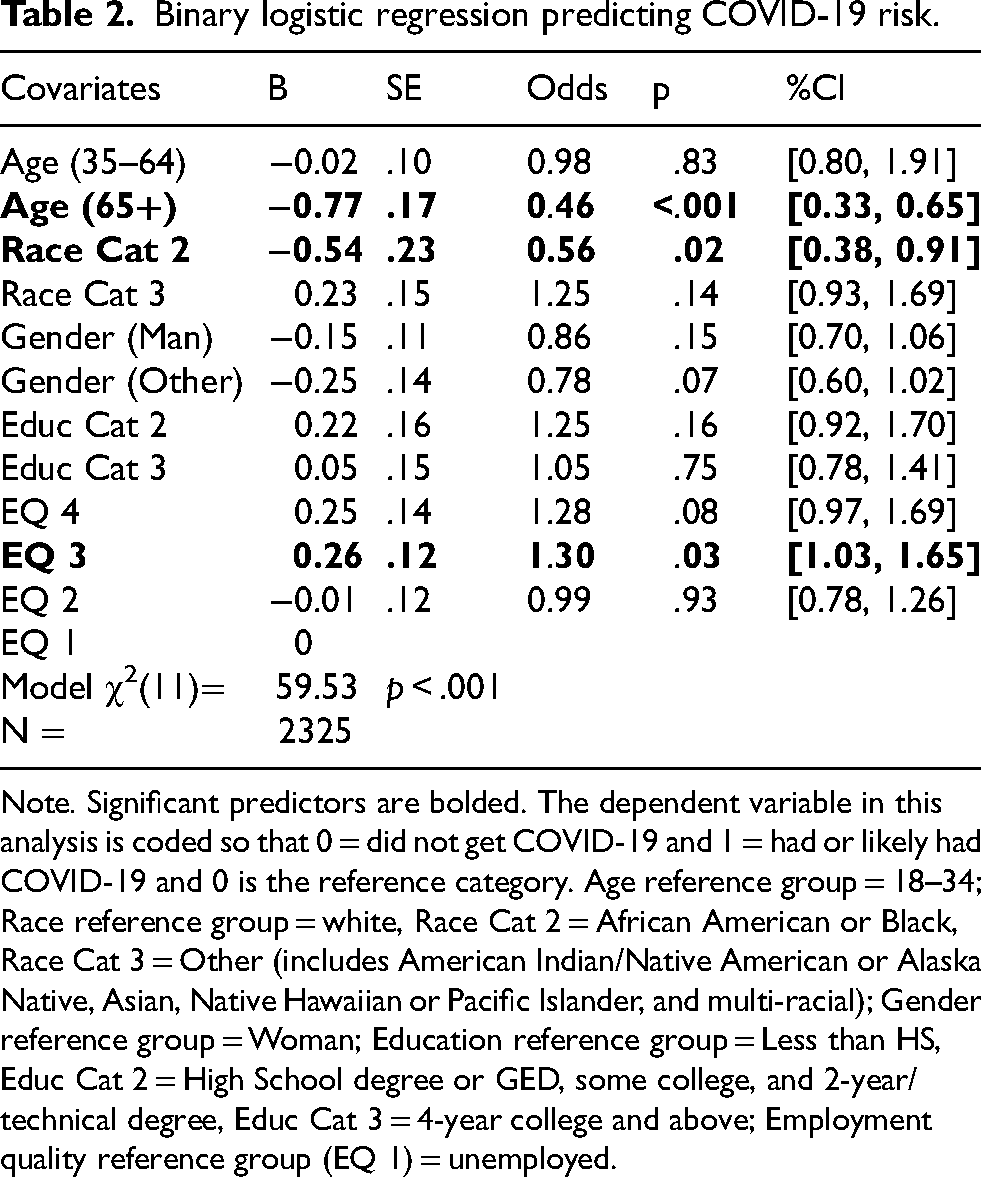
Note. Significant predictors are bolded. The dependent variable in this analysis is coded so that 0 = did not get COVID-19 and 1 = had or likely had COVID-19 and 0 is the reference category. Age reference group = 18–34; Race reference group = white, Race Cat 2 = African American or Black, Race Cat 3 = Other (includes American Indian/Native American or Alaska Native, Asian, Native Hawaiian or Pacific Islander, and multi-racial); Gender reference group = Woman; Education reference group = Less than HS, Educ Cat 2 = High School degree or GED, some college, and 2-year/technical degree, Educ Cat 3 = 4-year college and above; Employment quality reference group (EQ 1) = unemployed.
Discussion
The COVID-19 pandemic disproportionately and adversely impacted people with disabilities (PWDs) in health, quality of life, and employment (American Psychological Association, 2020; Bureau of Labor Statistics, 2022; Wong et al., 2022). However, based on analyses from the Current Population Survey, there is evidence to suggest that PWDs have disproportionately benefited in the economic recovery period, in the form of increased labor market participation (Ne’eman & Maestas, 2023). Employment, in light of COVID-19, is full of complexity and nuances. Even more so is the relationship between COVID-19, health, and employment for PWDs. The significant findings from the current study have important implications for the incorporation of employment, and specifically quality employment, as a predictor of physical health among PWDs.
Age was found to be a significant predictor. Specifically, participants who were over age 65 were less likely to contract COVID-19 compared to participants 18 to 34. One possible explanation for these findings is in age-related differences in health perceptions and behaviors. While set before the time of COVID-19, Brewer et al. (2007) found, through a meta-analysis of 34 studies, a strong relationship between risk perception and health behavior (in the form of getting vaccinated), with those who perceived themselves to be more susceptible to contracting the disease and the disease to be more severe being more likely to vaccinate themselves. There was extensive messaging about the risk for older adults’ contracting COVID-19 and for it to be severe in this sub-group of the population during the pandemic (Singhal et al., 2021). Thus, older adults may have been (and continue to be) more cautious in their social and community participation to account for this potentiality. These results may also point to a difference among work settings based on age and risk of COVID-19, where individuals 18–34 are more likely to be employed in services or direct customer jobs as opposed to more secluded office settings.
Race was also a significant predictor with Black participants being less likely to contract COVID-19. Given the increased risk of COVID-19 among BIPOC individuals throughout the U.S., this finding was surprising (Jashinsky et al., 2021). Further research is needed to uncover the relationship between race and COVID-19 risk, while controlling for the other predictors in the model.
Participants who reported one or two markers of employment quality (compared to those who were not employed) were 1.3 times more likely to contract COVID-19. This finding could be due to a number of possibilities. One possible explanation is that “good work is good for health” (Department for Work & Pensions & Department of Health, 2017, p.7). Those with fewer markers of quality employment may be in riskier places of employment and be exposed to COVID-19 more frequently, compared to someone who is unemployed and stays at home or those with all markers of quality employment who may have more freedom to take time off or work remotely. A related concept of precarious work (work that is inherently unstable and uncertain) has been found to be associated with increased risk of contracting COVID-19 (McNamara et al., 2021).
There are several limitations within this study that should be noted. The NSHD sample, while national in scope, is comprised of a majority of white women, which impacted the representativeness of the sample. Additionally, as a cross-sectional study, these relationships were studied as a point-in-time and causality cannot be determined. Participants were reporting on whether they had, at any point in time, obtained COVID-19, which may not always paint an accurate picture of the relationship between work, employment quality, and COVID-19 risk. For example, an individual may have contracted COVID-19, recovered, changed jobs and then reported on the study. There is still much to be discovered regarding the relationship between COVID-19 and employment, especially among individuals with disabilities. Even with the inherent limitations, these findings still suggest an interesting relationship warranting further exploration and study. Future studies should consider the time and context in which individuals may have contracted COVID-19 in order to better understand its relation to work.
Conclusion
A more nuanced, multifaceted understanding of how work impacts health can inform intervention development to consider aspects of employment quality in providing career and employment services to all people, especially PWDs. Work is a critical social endeavor that directly impacts health and well-being and gaining a better understanding about the elements of a quality work environment can encourage positive health outcomes among individuals with disabilities. More research is needed to understand this relationship among COVID-19, health, and employment among PWDs.
Footnotes
Acknowledgements
The authors have no acknowledgements.
Ethics statement
All study protocols, procedures and informed consent, including methodology, were approved by the University of Kansas institutional review board (Study#00147878
Informed consent
Informed consent was obtained from all participants for this study.
Funding
The authors disclosed receipt of the following financial support for the research, authorship, and/or publication of this article: Preparation of this manuscript was made possible by Grant #90AREM0005 from the Administration for Community Living (ACL), U.S. Department of Health and Human Services (HHS). The National Survey on Health and Disability (NSHD) is administered by the University of Kansas Institute for Health & Disability Policy Studies (KU-IHDPS) and funded by the National Institute on Disability, Independent Living, and Rehabilitation Research (NIDILRR project #90IFRE0050). The contents of this manuscript do not necessarily represent the policy of NIDILRR, ACL, or HHS and you should not assume endorsement by the federal government.
Declaration of conflicting interests
The authors declared no potential conflicts of interest with respect to the research, authorship, and/or publication of this article.