



Abstract
Background
Digital tools can be important in the state vocational rehabilitation (VR) system. These tools can help rehabilitation counselors improve productivity and customer experience, make it possible for counselors to work from home or across multiple devices, improve communication, help make the VR process more straightforward, and improve work-life balance leading to high level of job satisfaction. However, there are factors that influence rehabilitation counselors’ motivation to use digital tools in their clinical practice, and as a result, there is a need to develop and validate a clinical assessment instrument to assess rehabilitation counselors’ motivation to use digital tools in the workplace.
Objective
The purpose of this study was to evaluate the psychometric properties of the Motivation to Use Digital Tools at Work Scale in a sample of VR counselors.
Methods
This study included 416 state VR counselors as participants. The sample was randomly split into two samples, with 197 participants used for the exploratory factor analysis (EFA) and 219 participants used for the confirmatory factor analysis (CFA). Zero-order correlations were utilized to examine the relationships between the Motivation to Use Digital Tools at Work Scale constructs and related constructs in the nomological model.
Results
EFA identified a two-factor measurement structure that was confirmed by CFA: Intrinsic motivation and external motivation to use digital tools at work with strong internal consistency reliability for both subscales.
Conclusion
The Motivation to Use Digital Tools at Work Scale is a valid and reliable scale for assessing motivation among VR counselors and confirms the impact of intrinsic versus extrinsic motivation on technology interaction.
Keywords
Introduction
There has been a significant increase in the integration of digital tools within the workplace, driven by rapid advancements in information and communication technologies (ICT). These changes have fundamentally transformed business operations and employee tasks (Plekhanov et al., 2022). Digital tools, such as software applications, communication platforms, and automation technologies, are now prevalent across various industries, enhancing productivity, collaboration, and efficiency. In the digital transformation world of work, organizations are quickly digitizing their working processes, supporting remote work, expanding online operations, and increasing their spending on new technologies to make work simpler, faster, more efficient and more cooperative (Jaumotte et al., 2023).
State vocational rehabilitation (VR) agencies are also modernizing their digital infrastructure to help VR counselors integrate digital technologies into their practices, improving service delivery, and increase competitive integrated employment (CIE) outcomes for people with disabilities (Hartley & Bourgeois, 2020). The adoption of digital tools is shaping traditional workflows by enabling remote work, facilitating real-time communication, and automating routine tasks (Yasmin & Tanaka, 2022). For example, government approved, secure and encrypted communication platforms can allow rehabilitation counselors to conduct virtual consultations and therapy sessions, along with online VR interventions, especially for clients with appropriate levels of digital readiness to receive care from the comfort of their homes. This approach increases accessibility to services, especially for those in rural and remote areas, and enhances patient engagement and continuity of care (Cason, 2015; Dorsey & Topol, 2020).
Digital tools approved for use by state VR agencies and Community Rehabilitation Programs (CRPs) also allow counselors to use telehealth platforms to maintain regular contact with their clients, monitor progress through online assessments, and deliver individualized plans for employment (IPE) through secure and encrypted digital platforms (Cason, 2015; Dorsey & Topol, 2020; Hartley & Bourgeois, 2020). These tools also facilitate the collection and analysis of data, enabling rehabilitation counselors to make more informed decisions and track treatment outcomes over time (Yasmin & Tanaka, 2022). Moreover, collaborative platforms like Zoom Government, Microsoft Team, and Slack have revolutionized team interactions, breaking down geographical barriers, and enhancing collective problem-solving (Leonardi, 2018). These platforms with agency approval can be utilized by rehabilitation counselors to collaborate with counselors in CRPs, share insights, and coordinate care more efficiently. Using these digital tools, rehabilitation counselors can offer increasingly thorough and coordinated care, leading to better overall well-being for clients (Hartley & Bourgeois, 2020).
Additionally, there is research evidence to suggest that employees who have a sense of autonomy at work have higher rates of work engagement, organizational commitment, job performance, and job and life satisfaction, as well as a lower turnover rate (Gagné et al., 2022; Muecke & Iseke, 2019; Wu et al., 2023). As state VR agencies prepare to transition to the digital transformation world of work, it is important to assess state VR counselors’ motivation and readiness to use digital tools in clinical rehabilitation practices. Assessing these factors will allow counselors to be a more active part of this transition process, which may, in turn, increase autonomy and lead to improvements in job performance, job satisfaction, etc.
Self-determination theory (SDT) offers a useful framework to understand people's motivation. According to SDT, three psychological needs (autonomy, competence, and relatedness) must be met to optimally motivate workers, ensuring they perform outstandingly and experience well-being (Deci & Ryan, 2013; Gagné & Deci, 2005). Individuals need to feel effective and capable within their environment (need for competence), act as agents of their own behavior rather than being controlled by external pressures (need for autonomy), and experience meaningful connections with others (need for relatedness; Deci & Ryan, 2000, 2013). Meta-analytic evidence demonstrated that satisfying these needs is linked to better performance, reduced burnout, greater organizational commitment, and lower turnover intentions (Van den Broeck et al., 2016).
Self-determination theory also differentiates between types of motivation: intrinsic motivation (doing something for its own sake, out of interest and enjoyment), extrinsic motivation (doing something for an instrumental reason), and amotivation (lacking any reason to engage in an activity; Deci & Ryan, 2013). Extrinsic motivation is further divided based on how much external influences are internalized, meaning they are absorbed and turned into internal drivers that motivate activity engagement (Deci & Ryan, 2000; Howard et al., 2020). Since high levels of autonomous motivation are positively associated with job performance, organizational commitment, job satisfaction, and life satisfaction and proactivity (Van den Broeck et al., 2021), organizational psychology researchers strongly advocate for fostering self-determined motivation across various life domains, including work (Ryan & Deci, 2017). Satisfying the three psychological needs mentioned above is significantly related to more self-determined motivation (Gagné et al., 2022). However, there is a paucity of research on barriers and facilitators affecting VR counselors’ motivation to use digital tools in clinical VR practices. The scarcity of research can be partially attributed to the lack of psychometrically sound clinical assessment instruments.
The Behavioral Regulation in Exercise Questionnaire (BREQ-3), developed by Wilson et al. (2006) and refined by Markland and Tobin (2004), is a widely used instrument designed to measure different types of motivation. The BREQ-3 framework aligns with SDT, providing a nuanced understanding of the spectrum of motivation from intrinsic to extrinsic. This alignment makes the BREQ-3 a valuable tool for exploring how different types of motivation affect behaviors and outcomes in various settings, including exercise, education, and workplace environments (Markland & Tobin, 2004; Wilson et al., 2006). In the present study, we used the BREQ-3 as the foundation for the “Motivation to Use Digital Tools at Work Scale” by reviewing and modifying BREQ-3 items from exercise to digital tools at work. This modified assessment will provide valuable insights into rehabilitation counselors’ motivations to use digital tools at work. State VR agencies can then use the SDT framework to design in-service training that will increase rehabilitation counselors’ autonomous motivation to use digital tools to improve quality of VR services in the post pandemic era and the digital transformation world of work.
Purpose of the study
The purpose of the present study is to evaluate the psychometric properties of the Motivation to Use Digital Tools at Work Scale in a sample of state vocational rehabilitation counselors. The following research questions were investigated:
Method
Participants and procedures
After receiving Institutional Review Board approval from a research-intensive university located in the Mid-Atlantic region of the United States, counselors in state VR agencies and CRPs were recruited to complete an online survey via Qualtrics, a web application for building and managing online surveys and databases. Responses were kept confidential, and the participants received one CRC continuing education credit as an incentive for completing the survey. The only inclusion criterion was working as a State VR counselor. There were 665 participants who initiated the survey; 201 participants did not complete any of survey items, and another 48 were eliminated after further screening. The final sample used for analysis included 416 State VR counselors. The participant cohort was randomly split, with 197 in the Exploratory factor analysis (EFA) and 219 in the Confirmatory Factor Analysis (CFA). Detailed information on participants’ demographic characteristics is presented in Table 1.
Demographic characteristics of the study participants (N = 431).

Measures
Motivation to use digital tools at work
The Motivation to Use Digital Tools at Work scale was developed based on the BREQ-3 (Markland & Tobin, 2004; Wilson et al., 2006), adapting external regulation (pressure from others or organizations to use digital technology), integrated regulation (using digital technology as consistent with personal goals and identity), and intrinsic regulation (personal enjoyment and satisfaction from using digital technology). Each factor consists of four items; and each item is rated on a 5-point Likert-type scale ranging from 1 (strongly disagree) to 5 (strongly agree). ‘Exercise’ in the original scale was modified to ‘digital technology’ for this study. The developers reported Cronbach's alpha as .83 for external regulation, .89 for integrated regulation, and .91 for intrinsic regulation. Reliability of this measure in the current study sample will be presented in the results section.
Technology Adoption Propensity Index
The Technology Adoption Propensity Index (Ratchford & Barnhart, 2012) was used to assess individuals’ positive and negative attitudes towards technology. It consists of 14 items across four factors: optimism factor (positive views on technology's ability to enhance control, facilitate changes, improve convenience, and simplify life), proficiency factor (perceived skills in understanding, using, and advising on new technologies), dependence factor (feelings of control versus dependency on technology use), and vulnerability factor (concerns about privacy invasion, security risks, and skepticism towards technology companies’ persuasive tactics). Each item is rated on a 5-point Likert-type scale ranging from 1 (strongly disagree) to 5 (strongly agree). According to the developers, internal consistency coefficients (Cronbach's alpha) were reported to be .87 for optimism, .87 for proficiency, .78 for dependence, and .73 for vulnerability. In this study, Cronbach's alpha was .88 for Optimism, .89 for Proficiency, .82 for Dependence, and .68 for Vulnerability.
Core self-evaluations
The Core Self-Evaluations Scale (CSES; Judge et al., 2003) was used to measure CSEs, which are conceptualized as the overall, fundamental perception that people have about their worth and capability as human beings. The CSES is composed of 12 items representing higher order personality traits (self-esteem, generalized self-efficacy, neuroticism, and locus of control). Each item is rated on a 5-point scale from 1 (strongly disagree) to 5 (strongly agree). The CSES has been found to correlate significantly with job satisfaction, job performance, and life satisfaction, (Judge et al., 2003). The Cronbach's alpha was .86 in the present study.
Data analysis
Descriptive statistics, reliability analyses, and correlational analyses were performed using IBM SPSS Statistics Version 29.0 for Mac. EFA, a common statistical technique for examining the measurement structures of clinical assessment instruments (Floyd & Widaman, 1995), was used to examine the measurement structure of the Motivation to Use Digital Tools at Work Scale in this study. CFA (Byrne, 2016) was performed to cross-validate the two-factor measurement structure using AMOS Graphics statistical program. Missing values for the participants were estimated with a simple imputation method using regression to handle missing data at the item level for measures with missing values. Zero-order correlations were utilized to examine the relationships between the Motivation to Use Digital Tools at Work Scale constructs and related constructs in the nomological model.
Results
Exploratory factor analysis
The 12 × 12 correlation matrix of the Motivation to Use Digital Tools at Work Scale was subjected to a principal axis factoring analysis. The Kaiser-Meyer-Olkin measure of sampling adequacy (Kaiser, 1974) was .87, which exceeded the minimum criterion of .50. The Bartlett's test of sphericity (Bartlett, 1950), which tests the hypothesis that the correlation matrix is an identity matrix, was statistically significant χ2 (66, N = 197) = 1286.50, p < .001, indicating that correlations in the data set were appropriate for factor analysis. Both the Kaiser–Guttman's “eigenvalues greater than one” criterion (Kaiser, 1960) and Cattell's scree test (Nunnally & Bernstein, 1994) indicated a two-factor measurement structure. The two-factor solutions were rotated using promax rotation to enhance interpretation of the factors. The final solution accounted for 56.52% of the total variance, and the solution was parsimonious, interpretable, and psychologically meaningful. All items had factor loadings over .64. The two factors were labeled ‘Intrinsic Motivation to Use Digital Tools at Work’ and ‘External Motivation to Use Digital Tools at Work’, respectively. Factor loadings, eigenvalues, and percentage of variance explained are presented in Table 2.
Explanatory factor analysis using principal axis factoring with promax rotation.
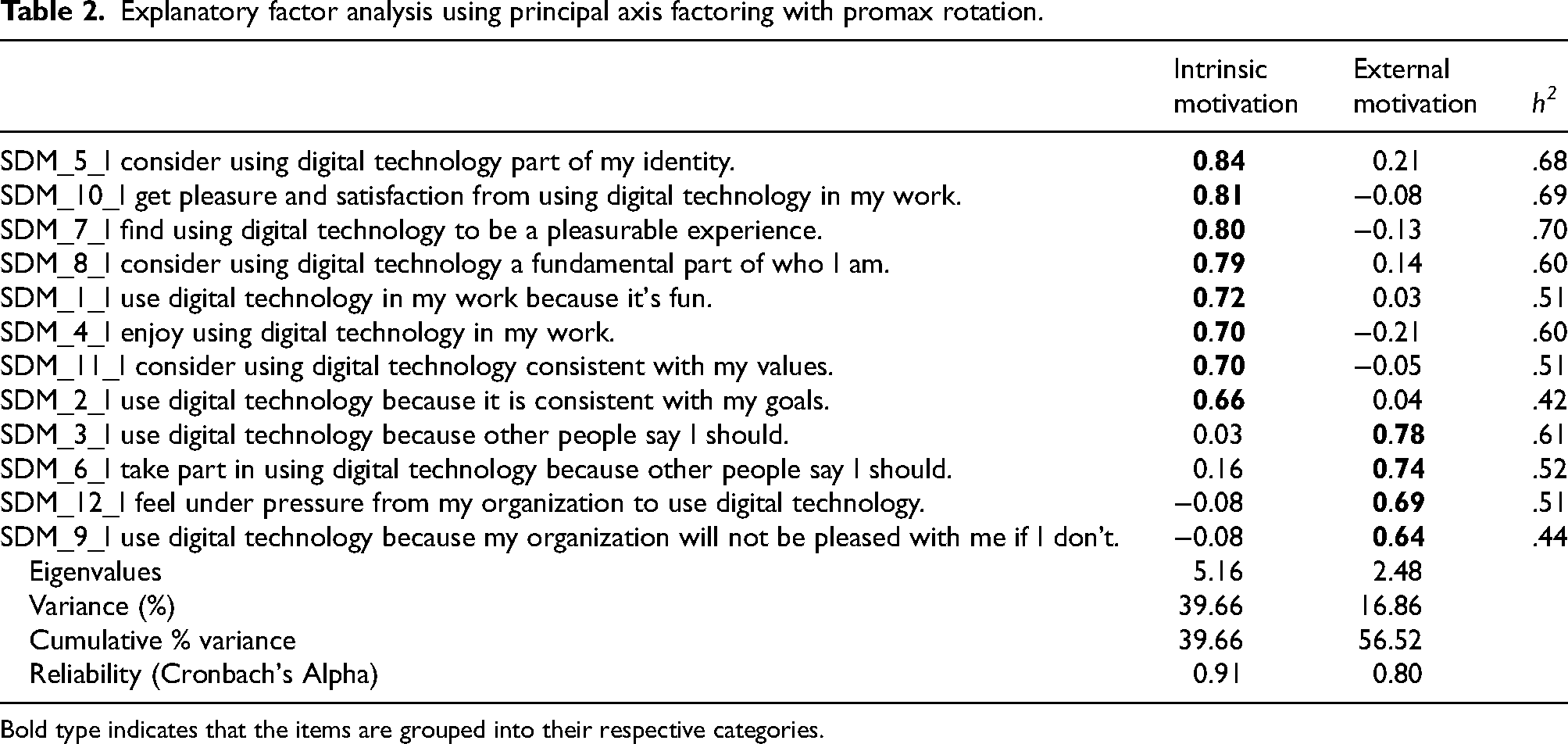
Bold type indicates that the items are grouped into their respective categories.
Factor 1 – Intrinsic motivation to use digital tools at work
This factor comprises eight items, representing the alignment of digital technology use with one's personal identity, values, and sense of satisfaction (e.g., ‘I get pleasure and satisfaction from using digital technology in my work.’). This factor accounted for 39.66% of the total variance. The mean rating for this factor was 3.47 (SD = 0.79). The reliability of this factor was .91.
Factor 2 – External motivation to use digital tools at work
The factor comprises four items, reflecting the influence of external factors, such as social expectations and organizational pressure, on the use of digital technology (e.g., ‘I use digital technology because other people say I should.’). This factor accounted for 16.86% of the total variance. The mean rating for this factor was 2.75 (SD = 0.97). The reliability of this factor was .80.
Confirmatory factor analysis
The CFA results indicated a good fit model: χ2 (53, N = 219) = 265.22, p < .001, χ2 /df = 5.00, Comparative-Fit Index (CFI) = .812, Root Mean Square Error of Approximation (RMSEA) = .136 (90% confidence interval [0.120, 0.152]), and the Standardized Root Mean Square Residual (SRMR) = 0.089. An examination of the modification indexes suggested that three pairs of error terms should be correlated: (a) e5 (“I consider using digital technology part of my identity”) and e8(“I consider using digital technology a fundamental part of who I am”); (b) e9 (“I use digital technology because my organization will not be pleased with me if I don’t”) and e12(“I feel under pressure from my organization to use digital technology”); and (c) e8 (“I consider using digital technology a fundamental part of who I am”) and e6(“I take part in using digital technology because other people say I should”).
The chi-square statistic for the re-specified two factor model was still significant: χ2 (50, N = 219) = 120.19, p < .001. However, the alternative indexes that are not sensitive to large sample size indicated a very good fit for the two-factor model after correlating the three pairs of error terms; χ2 /df = 2.40 (less than 5), CFI = .94 (higher than .90), RMSEA = 0.080 (90% confidence interval [0.062, 0.099]; less than .08), and the SRMR = .071 (less than .08). In addition, all items in the two-factor model significantly loaded on their respective factors ranging from .50 to .79 for the Intrinsic Motivation to Use Digital Tools at Work, and from .48 to .80 for the External Motivation to Use Digital Tools at Work (see Figure 1).

Confirmatory factor analysis of the two-factor measurement structure of the self-determined motivation to use digital tools at work.
Internal consistency and correlation among the subfactors
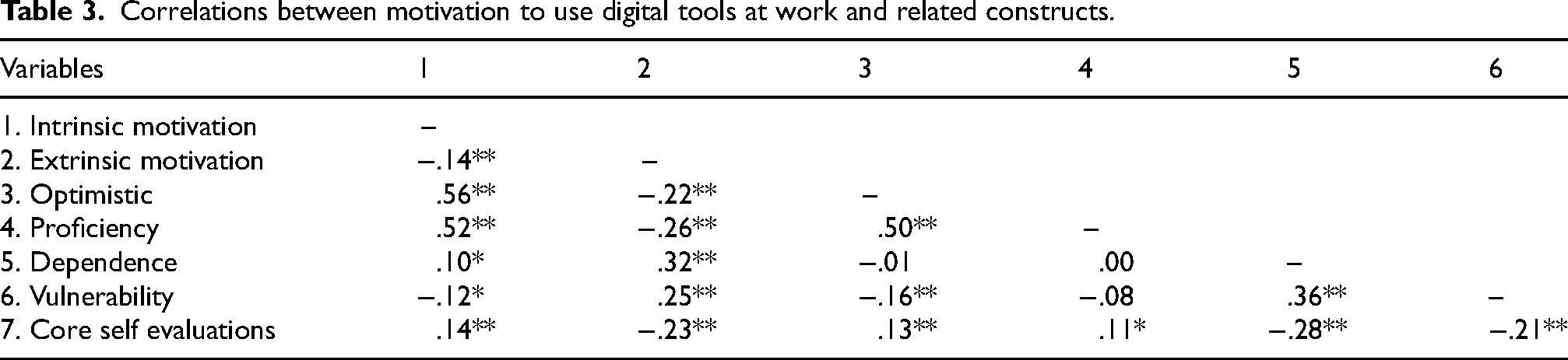
Cronbach's alpha coefficients were .91 for the Intrinsic Motivation to Use Digital Tools at Work, and .80 for the External Motivation to Use Digital Tools at Work with the total sample (N = 416). The mean rating for the Intrinsic Motivation to Use Digital Tools at Work, and the External Motivation to Use Digital Tools at Work were 3.49 (SD = 0.75) and 2.72 (SD = 0.95), respectively. The Intrinsic Motivation to Use Digital Tools at Work, and the External Motivation to Use Digital Tools at Work are negatively related to each other (r = −.14, p < .01).
External correlation
Intrinsic Motivation to Use Digital Tools at Work factor was positively associated with Optimistic (r = .56, p < .001), Proficiency (r = .52, p < .001), Dependence (r = .10, p < .01), and Core self-evaluation (r = .14, p < .001), while negatively related to Vulnerability (r = −.12, p < .01). Extrinsic Motivation to Use Digital Tools at Work was negatively related to work Proficiency (r = −.26, p < .001), Optimistic (r = −.22, p < .001), and Core self-evaluation (r = −.23, p < .001), while positively related to Dependence (r = .32, p < .001) and Vulnerability (r = .25, p < .001) Table 3.
Correlations between motivation to use digital tools at work and related constructs.
Discussion
The nature of work is evolving as advances in ICT facilitate new methods and processes across various industries. Although the idea of technology taking over jobs is striking, it does not accurately represent how people will interact with digital technology or how job requirements will shift in the future (Gagné et al., 2022). The role of motivation is frequently overlooked when designing and implementing digital technology in the workplace, despite the significant impact technological changes can have on employee motivation. Self-determination theory (SDT) provides a valuable framework for understanding motivation as a multidimensional concept (Gagné et al., 2022). According to SDT, three psychological needs—autonomy, competence, and relatedness—must be met to effectively motivate employees, ensuring they perform well and experience job satisfaction (Deci & Ryan, 2013). A meta-analytic review of 99 studies with 119 distinct samples indicated that fulfilling these needs leads to improved performance, reduced burnout, increased organizational commitment, and lower intention to leave the job (Van den Broeck et al., 2016).
The present study evaluated the psychometric properties of the Motivation to Use Digital Tools at Work Scale in a sample of State VR counselors. CFA results validated the two-factor structure: Intrinsic Motivation to Use Digital Tools at Work and External Motivation to Use Digital Tools at Work. Internal consistency reliability coefficients were strong, with values of .91 for Intrinsic Motivation and .80 for External Motivation, indicating good to excellent reliability (George & Mallery, 2003). Construct validity was established by examining associations with four factors of the Technology Adoption Propensity Index. Pearson correlations revealed small to medium effect sizes, with intrinsic motivation negatively correlated with external motivation. Additionally, intrinsic motivation was positively correlated with optimism, proficiency, and dependence factors but was negatively associated with vulnerability factor. This indicated that state vocational rehabilitation counselors who were more intrinsically motivated to use digital tools at work tended to have positive views on technology's ability to enhance control, facilitate change, improve convenience, and simplify life. They also perceived themselves as skilled in understanding, using, and advising on new technology, while managing feelings of control versus dependency on technology. However, they expressed concerns about privacy invasion, security risks, and skepticism toward the persuasive tactics of technology companies.
Conversely, extrinsic motivation showed a positive correlation with factors related to dependence and vulnerability. This suggests that state vocational rehabilitation counselors driven by external rewards or pressures might feel a stronger reliance on technology and experience greater vulnerability regarding its potential risks. In contrast, extrinsic motivation was negatively associated with optimism and proficiency factors. This indicates that those who are motivated by external incentives may have lower levels of optimism about technology's benefits and may perceive themselves as less skilled or proficient in using and managing technological tools effectively. This discrepancy highlights how intrinsic and extrinsic motivations shape attitudes and behaviors towards technology differently in the context of rehabilitation counseling.
These findings are consistent with recent meta-analytical evidence that emphasizes the importance of intrinsic motivation for employee well-being and organizational citizenship behavior. Research by Van den Broeck et al. (2021) highlights that intrinsic motivation is crucial for enhancing positive outcomes in the workplace, while extrinsic motivation can have detrimental effects. Specifically, intrinsic motivation has been linked to higher levels of job satisfaction, greater engagement, and more proactive behaviors, whereas extrinsic motivation often leads to decreased job satisfaction, increased dependence on external rewards, and heightened vulnerability to stress and dissatisfaction.
The observed correlations in this study reinforce the validity of these broader findings, demonstrating how intrinsic motivation positively influences attitudes towards technology in the context of state vocational rehabilitation counseling. Individuals with intrinsic motivation not only exhibit greater optimism and proficiency with digital tools but also manage dependency concerns more effectively. In contrast, those driven by extrinsic factors may experience increased dependence and vulnerability, with diminished optimism and perceived proficiency. These results provide strong empirical support for the construct validity of the Motivation to Use Digital Tools at Work Scale. The scale proves to be a reliable tool for assessing the levels of self-determined motivation among vocational rehabilitation counselors in state VR agencies and community rehabilitation programs. By capturing the nuances of intrinsic versus extrinsic motivation, the scale offers valuable insights into how different types of motivation affect professionals’ interactions with technology, thereby informing strategies to enhance their effectiveness.
Implications
The validation of the Motivation to Use Digital Tools at Work Scale has significant implications for rehabilitative counseling and future research. As VR counselors adapt to digital practices, enhancing intrinsic motivation is more effective than relying on extrinsic motivators for better engagement with technology (Lomäki et al., 2016). This approach supports improved perceptions of technology's benefits and overall digital competence. Effective implementation can enhance productivity and job satisfaction and begin to address issues such as diagnostic errors and high healthcare costs in the U.S. (Chu et al., 2022; Lyu et al., 2017). Understanding motivation in this context is crucial for organizations to adapt and improve service delivery.
The Motivation to Use Digital Tools at Work Scale can guide VR organizations in developing training programs to boost counselors’ confidence and skills with digital tools, aligning with Bandura's self-efficacy theory (Bandura, 1997; Bandura & Schunk, 1981). Enhanced motivation leads to greater work engagement and job satisfaction (Schaufeli & Bakker, 2004). However, challenges such as employee disengagement and difficulties integrating technology remain (Dery et al., 2017). The scale can offer assistance with certain difficulties by identifying low motivation and informing specific strategies to address these issues. Further research is still needed to explore additional methods for improving motivation and engagement in digital environments.
Limitations
The results of this study should be interpreted with attention to specific limitations. Initially, the study sample may not fully capture the diverse range of rehabilitation counselors across the field. The survey link was distributed exclusively through the VRTAC-QE email list, and as a result, the participants were limited to members of this specific group. It is important to note that members of VRTAC-QE might be more proactive in enhancing their professional skills and staying informed about the latest resources, which could suggest that they possess a higher level of motivation compared to the broader population of state vocational rehabilitation counselors. As a result, incorporating alternative sampling methods in future research could help strengthen the generalizability of the study's findings. Additionally, the sample's average of 15.27 years of experience in rehabilitation counseling indicates that most participants were senior-level counselors. Experienced professionals might have different attitudes and motivation compared to those newer to the field. Lastly, although each subfactor of the Motivation to Use Digital Tools at Work scale showed acceptable internal consistency, the items were adapted from a tool designed to measure motivation to exercise. Therefore, it is crucial to conduct further validation of the revised Motivation to Use Digital Tools at Work scale specifically within the population of rehabilitation counselors. This will ensure the scale's reliability and accuracy in measuring the motivation levels of professionals in this field.
Conclusion
The current study underscores that intrinsic motivation plays a pivotal role in shaping positive attitudes toward digital tools, leading to enhanced optimism, proficiency, and effective management of technology-related dependency. The validated Motivation to Use Digital Tools at Work Scale provides a valuable framework for assessing motivation among state vocational rehabilitation counselors. This scale not only confirms the impact of intrinsic versus extrinsic motivation on rehabilitation counselors’ interaction with technology, but it also offers practical insights for improving technology integration in the workplace.
Footnotes
Acknowledgments
The authors have no acknowledgments.
Ethics statement
The project was reviewed by the University of Wisconsin-Madison Institutional Review Board (no. 2022-0296). The activities under the VRTAC-QE are deemed a program evaluation, and as such are not considered human subjects. The study was therefore exempt from ethical approval.
Informed consent
Informed consent was obtained from all participants prior to their participation in the survey.
Funding
The authors disclosed receipt of the following financial support for the research, authorship, and/or publication of this article: The contents of this paper were developed with support from the Vocational Rehabilitation Technical Assistance Center for Quality Employment at the University of Wisconsin-Madison funded by the U.S. Department of Education (Grant number: H264K200003). However, the contents do not necessarily represent the policy of the U.S. Department of Education, and you should not assume endorsement by the Federal government.
Declaration of conflicting interests
The authors declared no potential conflicts of interest with respect to the research, authorship, and/or publication of this article.