




Abstract
Background
Earlier research has focused on the immediate impacts of the COVID-19 pandemic on persons with spinal cord injury (SCI).
Objective
The present study revisits lessons learned from the previous study and assesses the longer-term effects of the pandemic.
Methods
We used a community conversation method to inform our analysis. The themes examined include adapting to a “new normal” way of interacting with the world, employment, social isolation, and physical and mental health.
Results
We found that a person's ability to adapt to changing circumstances is a major predictor of how one will respond to the aftermath of a pandemic, and that this adaptability is heightened for persons with SCI.
Conclusion
Service providers, healthcare professionals, employers, and persons with SCI should be attuned to the impact of an individual's adaptation skills when dealing with long term societal social upheavals. This is particularly relevant for the SCI community, and continued inclusive research is necessary to understand these effects.
Introduction
Several months into the start of the COVID-19 pandemic, we assembled a research team to assess the early impacts of the pandemic on persons living with spinal cord injury (SCI) (Adams et al., 2021). We focused on the immediate “shock to the system” and examined how the pandemic impacted employment as well as other factors. Through a series of focus groups, we were able to ascertain that the pandemic affected persons with SCI in ways both similar and dissimilar to the general population. Issues related to physical and mental health were beginning to take a toll on this group, with less availability and access to resources, but also with an emerging reliance on virtual methods of support. The need for accommodations for those employed varied widely based on employee attitudes, type of work, and employer responsiveness. Maintenance of employment was a central theme, with uncertainty regarding policies around remote work and the changing workforce landscape. Social isolation and coping methods were frequently noted throughout the focus groups.
Years later, we seek to revisit the impact of the still-ongoing pandemic on persons with SCI. Looking back on our findings in the early days of the pandemic, we notice two things: the uncertainty of what the future would hold and the ability to adapt to a changing environment. In the current article, we revisit several of the same questions to assess the pandemic's medium-term effects on persons with SCI.
In particular, we focus on employment, social isolation, physical and mental health, and what the “New Normal” looks and feels like for this population. Approximately 300,000 people live with SCI in the United States (Paralysis in the U.S., 2023), and globally there are over 20 million individuals with SCI (Ding et al., 2022). Life expectancies have increased dramatically over the past decades for this population. The question is no longer limited to the acute effects of SCI or even the acute effects of a virus or pandemic on persons with SCI. The question at hand is how persons with SCI are impacted in the “Aftershock” of a global pandemic.
Method
Community convenings
To explore whether and how the initial focus group findings were still relevant a year and a half after the publication of the first article, the research team organized a community conversation. Community conversations are structured community events that are designed to promote collaborative local discussion on ways to develop job opportunities and identify strategies that reflect the priorities, culture, and available resources of a local community (Carter et al., 2020). Community conversations are small-group conversations designed to encourage the exchange of ideas, generate solutions, and foster relationships (Carter et al., 2020). The research team worked with organizers of the 10th Kentucky Congress on Spinal Cord Injury (KCSCI) and organized a group conversation. The conversation lasted for approximately 45 min and was facilitated by the lead author of this article. A total of 32 people participated in the conversation. The conversation was conducted in a hybrid format- both in person and virtual. Participants were divided into smaller groups of 3–4 individuals. Scribes were provided by a local community action organization. Each scribe was randomly assigned to a group to capture notes and key reflection points. Scribes were provided a guidance protocol before the conversations to help them capture responses and quotes from participants.
Community conversation participants
The community conversation was promoted by the Kentucky Congress on Spinal Cord Injury (KCSCI) organizers to attendees with spinal cord injuries (SCI). The conversation was conducted in a hybrid format, with 28 individuals in-person and 4 individuals participating in an online chat.
Data analysis
As mentioned previously, scribes were assigned to each of the small break-out groups. Notes from the scribes were aggregated into a single text file. A thematic analysis was conducted with the textual data. The notes were read by the researchers multiple times. Codes were assigned to the textual data and organized into themes. Finally, the themes generated by the community conversation were compared to those generated through the earlier focus groups. It should be noted that Dr. LoBianco, Principal Investigator, is a person with a spinal cord injury. His lived experience lens was critical in reviewing the themes as well as translating the implications of the findings (Beames et al., 2021)
Three months after Kentucky's “Healthy at Home” executive order was implemented, our team conducted a series of focus groups regarding how the pandemic had impacted persons with SCI. During these focus groups, four main themes were identified: adjusting to the “new normal” concerns about employment, social isolation, and concerns about physical and mental health.
Two years later, our community conversation sought to re-examine these themes. Guiding this conversation were the questions of what had changed, what had stayed the same, and what new issues had emerged over this time period.
Results
The “new normal”
Reflecting back on the two years since our initial discussions with members of the SCI community about their experiences with the COVID-19 pandemic, individuals discussed their experiences and noted diverse ways in which the post-pandemic era had impacted their lives. In some instances, these reflections mimic earlier themes, such as social isolation, adjusting to the “new normal,” and concerns over health (both directly and indirectly related to COVID-19 itself). The experiences of having lived through years of the pandemic had dramatically different effects on members of this population, with some realizing benefits to their way of life as a result and others expressing detrimental effects. It should be noted that not only did individuals not describe a universal experience as a result of the pandemic, but individual experiences varied by different domains (e.g., daily life/routine, employment, isolation, and health). Our research aim was to explore the effect of the pandemic on persons living with SCI; in the process we may have learned more about the responses of individuals to a societal traumatic event than we did about the impact of the traumatic event itself.
When we asked members of the group to discuss their “new normal” and how it had changed during the course of the pandemic, we encountered various types of responses. In many cases, the experience was positive, as reflected by mentions of greater opportunities to participate in virtual groups. Some mentioned being involved in groups that were less geographically based (national exercise communities) or more informal (virtual coffee hours). Others mentioned the intentionality of meetings – both in terms of setting times for virtual meetings and greater preparation (hygiene, masking) when going out in public. Still others appreciated the ability to utilize telehealth services, which were not as readily available before the pandemic but have remained available in many cases even after in-person healthcare returned as the norm.
Others described their “new normal” in less favorable terms. Particularly, those who valued in-person gatherings expressed frustration that recreational activities were less likely to be available now than before the pandemic. At times this appeared to be due to the shifting nature of these activities from in-person to virtual; at other times it was due to other factors such as personal fatigue, fear or anxiety of being in public, or simply the inability to convert activities to a virtual setting (e.g., bowling, tennis, camping). One respondent noted an increase in alcohol consumption as a coping mechanism, albeit an ineffective one.
A few respondents noted that there had not been any real change to their lives. In some cases, this may have been due to living a relatively solitary life prior to the pandemic and then continuing to do so during and after. Others expressed a feeling that things would return to normal after the pandemic, but that had not happened and so they were resigned to their status quo. Of course, the very term “after the pandemic” may be a bit of a misnomer, as COVID-19 and Long Covid syndrome continue to have effects on people's personal, medical, social, and vocational functioning across the globe.
Many of these findings echo what our initial focus groups told us shortly after the start of the pandemic. At that time, virtual modes of meeting were new to most, but they adapted quickly. This ability to adapt is still a major predictor of well-being more than two years later. There may be less fear and anxiety now than before, but they are still real and prevalent. Some fears have been realized (e.g., contracting the disease, loss of social networks) while others have largely abated, either due to acceptance, embracement, or resignation to the “new normal.”
Employment
A second area of focus for our conversation involved employment and how work experiences and opportunities had changed throughout the pandemic. As with the general population, our group of individuals with SCI had varied experiences with changes in employment during this period. Many of these changes involved the physical location of where their work was done: specifically whether their job was performed in-person, remote or hybrid. Although differences in work location were frequently noted, experiences of both in-person and remote work were similar. Some in-person workers indicated that their work never stopped, mainly because it could not (e.g., hospital or lab work). But similar comments were made by remote workers (e.g., lawyers do not stop working due to having to shift to remote work).
Both in-person and remote workers expressed challenges due to the pandemic. For those working in-person, conflicting messages regarding policies related to masking and vaccinations were found to be both confusing and potentially unsafe. For those working remotely, the inability to have employer-assisted accommodations as readily available at home as on-site posed challenges. The lack of personal interaction was also noted as a challenge for remote workers. Shifting policies regarding these two modes of work presented difficulties as well, as frequent shifts between being on-site and remote disrupted individuals’ routines and caused anxiety.
Some participants noted that work had become more accessible as they (and others) adjusted to the changes with more virtual settings and products. Specific products such as Zoom and DocuSign were mentioned as positively impacting worker experiences. Others noted greater opportunities for collaboration, such as virtual coffee hours and options to participate without physical travel.
When employment was tied to physical fitness or sports, the experience was more pessimistic. At the same time, the initial discontinuation of in-person physical activity and the disruption to organizations caused these opportunities to not return to pre-pandemic levels. Though adaptive virtual fitness options were noted and, in some cases, opened new opportunities, the overall experience of greater reliance on solely virtual exercise options had a negative impact on employment, especially for those who were employed in that sector.
The pandemic itself opened some new employment opportunities. Several participants noted being employed in healthcare-related fields to deal with COVID-19. Others indicated that work in human service agencies has a new opportunity to focus on serving clients and promoting advocacy for those struggling directly or indirectly with COVID-19.
Not all participants were currently employed. Several retirees were present and related either that the shifting work conditions related to the pandemic were irrelevant to them or that it made meeting others more difficult. Another respondent who was a student shared a mixed response, indicating that while both an internship and graduation were canceled the pandemic expedited other educational opportunities.
Socialization
A third area that was explored during the community conversation was the social aspects of the pandemic and post-pandemic era. Specifically, the compound question asked to the groups was, “What has the impact of the pandemic on your social network been? Has it changed the way you connect with people in your social circle?”
The prevailing theme that emerged from this question was that social interaction is not the same as it was prior to the pandemic. In some cases this involved direct in-person meetings, such as going out to eat with friends, playing cards, sports, and festivals. Some respondents noted that these events were slowly starting to come back; in other cases, the lack of social interaction was believed to be of a more lasting nature. Much of the lack of resumption in in-person gatherings stemmed from confusion and disagreement regarding safety measures (masking, vaccinations) and the self-perception of persons with SCI who believed they were at higher risk of complications related to COVID than their non-disabled peers who may have been less willing to take safety precautions.
Several respondents noted that this era has heightened social tensions with family and friends. As stated previously, differences in approaches to safety (masking and vaccines) created tension. Another respondent indicated that the time since the start of the pandemic more clearly defined who they were genuinely close with (and presumably not close with). Another respondent noted that their social group had become more politicized. One respondent reported that initially their family made an effort to connect through Zoom, but that this was no longer the case.
Others noted less adverse effects of the post-pandemic era. Respondents stated they had grown closer with their family, spouse, and pets during this period. Others found enjoyment in being alone, and picked up new online hobbies such as video games or increased use of social media. Another respondent noted that they are more conscientious about the time they do get to spend socially.
Some participants expressed optimism that life was returning to normal. One respondent noted that the pandemic caused distance but that this was temporary. Another noted previous frustration with the lack of social gatherings but pointed out that these opportunities were slowly returning. Some respondents were more matter-of-fact regarding their reliance on virtual modes of socializing; expressing a level of resignation, but not all were troubled by this. The creation of virtual social networks for personal help was recognized. One respondent reported that they were now seeing friends more. Another noted practical means to allow for more socializing, including the installation of air purifiers and intentionally planning outdoor gatherings.
Others disclosed specific and troublesome issues. General loneliness still seemed prevalent. Many respondents expressed frustration with social activities not returning to pre-pandemic levels. Others noted difficulties in traveling. Juggling increased responsibilities and challenges in maintaining a healthy work-life balance were reported. One respondent expressed isolation as contributing to a drinking problem.
Physical and mental health
A final question posed to the group during our community conversation asked about changes in physical and mental health since the start of the pandemic. Specifically, we asked, “How has your physical health changed since the start of the pandemic (exercise, nutrition, energy levels, illness, access to care)? How about your mental health (feelings of well-being, interactions with others, coping mechanisms, and support systems)?”
As with other questions, answers to this prompt varied widely. Many respondents noted positive changes in their physical health, both due to changes related to the pandemic itself and to changes related to coming out of the pandemic. Although Americans rarely describe the global pandemic as having a positive impact on their individual health (Umucu, 2021), the different modes of managing health for this population were seen as positive at times.
Some respondents noted that they were able to take more time to receive medical treatment. Others identified new modalities for exercise or a greater awareness and the need to adopt healthier lifestyles. Other issues presented challenges. The scheduling of personal caregivers was revealed as a concern. This may have multiple reasons, including health concerns, the ability to pay for good care, and a changing job market for potential aides. Others who relied on more traditional forms of in-person exercise had not seen those opportunities return to normal and had experienced negative consequences.
Some respondents mentioned continuing feelings of isolation, which at times led to depression. Anxiety was expressed by some respondents regarding a return to more ‘normal times,’ but others noted that anxiety had lessened as conditions improved. As physical and mental health cannot truly be separated, the anxiety produced by the lack of access to providers for physical health caused anxiety for those with routine or exacerbated health conditions.
Other findings were likely due to factors unrelated directly to the pandemic. These included the process of aging with a disability and tighter restrictions on public assistance for quality medical equipment. One respondent communicated that wheelchairs improve quality of life, but new Medicaid restrictions have made wheelchairs primarily available for home use only. To the extent that the pandemic has taught us that we can survive, although perhaps not thrive, in a socially isolated situation, the prospects are worrisome that public policy will deem survival as sufficient for this population.
Table 1 displays the prevalence of comments related to the four identified themes mentioned in each group during our community conversation.
Prevalence of comments related to the four identified themes mentioned in each group during our community conversation. a
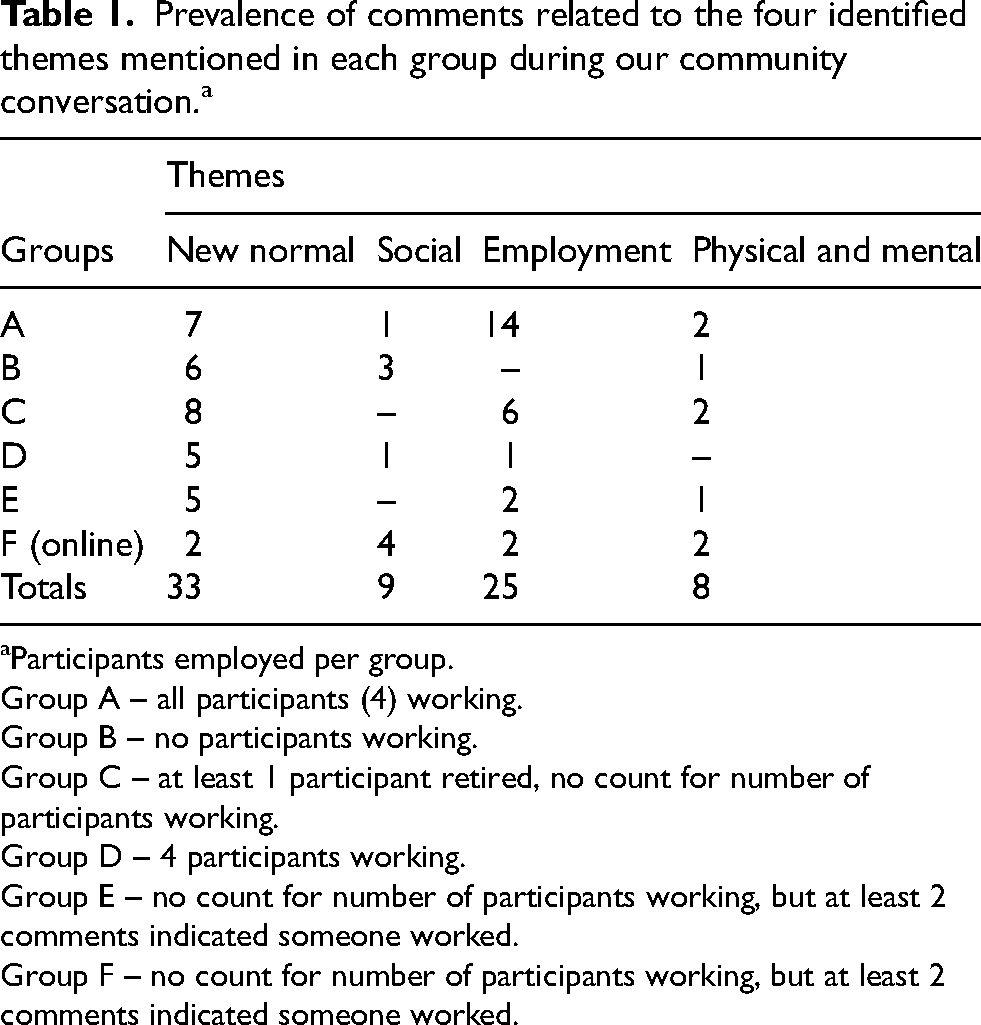
Participants employed per group.
Group A – all participants (4) working.
Group B – no participants working.
Group C – at least 1 participant retired, no count for number of participants working.
Group D – 4 participants working.
Group E – no count for number of participants working, but at least 2 comments indicated someone worked.
Group F – no count for number of participants working, but at least 2 comments indicated someone worked.
Discussion
Persons with SCI are far from a monolithic group. Like the rest of society, they have different means of coping, adapting, experiencing the world, and living their lives. This is what we found as we revisited a group of persons with SCI two and a half years after the start of the pandemic. Given that the effects of the pandemic on persons with SCI were relatively consistent with the impact on the larger society, one might reasonably ask why this is a question worth pursuing. In short, our answer is this: because the stakes are higher.
We discovered that the ability to adapt to changing conditions was a significant factor in the degree to which persons with SCI successfully navigated the aftermath of the pandemic. Persons with SCI are uniquely positioned to adapt to new life circumstances, having acquired a life-changing disability at least once already (Barone & Waters, 2012). However, there is still a significant degree of variability in how those adaptive skills carry forward in the aftershock of a global pandemic. Those who were able to shift employment situations, to embrace virtual modes of communication, and to adapt to new means of socializing and accessing health and wellness services fared reasonably well, whereas those who could not expressed frustration and disappointment. For those without SCI, these factors are likely inconvenient – individuals may have to alter their lives to accommodate new situations. For persons with SCI who lack adaptive skills, they may be detrimental – changes in work environment may lead to a lack of accommodations and eventual unemployment; social isolation may be heightened by lack of accessible transportation; an overburdened healthcare system may lead to delaying or not receiving needed medical care (Umucu, 2021).
Addressing the disparate impacts of such an ‘aftershock’ creates several opportunities for service providers, policymakers, and advocates. Rehabilitation professionals are, by definition, positioned to enable adaptation to new life circumstances (Rubin et al., 2016). They should also note that adaptation to acute injury is not a one-time adjustment. Adaptation is a lifelong skill that should be taught and encouraged in rehabilitation settings (Smart, 2020). Unfortunately, the average duration in acute rehabilitation post-injury has dramatically shortened in recent decades (National Spinal Cord Injury Statistical Center, 2015). Our findings from this study underscore the necessity of a more comprehensive approach to rehabilitation for persons with SCI. It is possible that some of this may be well suited for outpatient settings, mainly as new technologies and modalities are discovered. This also opens opportunities for peer mentoring, as individuals may learn adaptive strategies from drawing on the experiences of peers while at the same time decreasing the likelihood of social isolation (O’Hare & Murphy, 2017). Employment specialists must be aware that clients differ in the critical area of adaptability to changing environments.
Customized employment has been a popular method of finding jobs for persons with various disabilities (Ottomanelli et al. 2023). Customizing supports around a client's skills of adaptation may need to be taken into greater consideration. The ability to utilize technology and transportation are major predictors in maintaining employment in “normal” times, but they take on heightened importance in the aftermath of a global catastrophe. The willingness of persons with SCI to ask for needed accommodations was a prevalent theme in our research. While employers may be willing to provide supports, persons with disabilities must feel comfortable enough to ask for what they need without the fear of being seen as expendable.
Limitations
The authors acknowledge several limitations of the current study. The respondents were not randomly selected and not necessarily representative of the more general SCI population. They were more likely to be active in their community, and more likely to be employed. Some social desirability bias may have been present during conversations, particularly since scribes were not persons with SCI.
Conclusion
Our research speaks to the need for self-advocacy and inclusion of persons with SCI in obtaining what is needed. This research has been led by a person with over thirty years of lived experience with SCI and informed by dozens of others with SCI. We are a large community and at times, a vocal community. But often we let isolation get in the way of our community integration and fail to be as vocal as we need to be. The SCI community holds vast expertise in what is required to enhance our lives in a globally changing environment. As with all groups, the rallying cry of “nothing about us without us” must be emphasized (Smart, 2020). Our research demonstrates that persons with SCI often get what we ask for. But too often, we do not ask for it. We need to make our needs known regarding accommodations to employment, social, and healthcare settings. We need to recognize that change is a constant and adaptability is a skill, and we need our systems to be responsive to those realities as we prepare for the future.
This article is offered as an example of inclusive research in the Participatory Action Research tradition. Shocks and aftershocks are part of the human condition. The degree to which communities at risk for disparate impacts are engaged in research and advocacy can help determine the long-lasting effects of such events.
Footnotes
Acknowledgements
The authors have no further acknowledgments.
Ethics statement
This study complied with all ethical requirements of the National Research Act of 1974 and the University of Kentucky's policies regarding field research. All participant data were kept confidential and anonymous by the research team. The study was determined to be exempt from Institutional Review Board approval.
Informed consent
The data reported in this study represented secondary analyses from interviews conducted with members of a disability advocacy organization in Kentucky. Participants confirmed their consent to participate in the interviews via written (e-mail) correspondence with interviewers.
Funding
The authors received no financial support for the research, authorship, and/or publication of this article.
Declaration of conflicting interests
The authors declared no potential conflicts of interest with respect to the research, authorship, and/or publication of this article.