



Abstract
Background
There has been a rising push to mainstream disability concerns in human resources research to enhance the inclusion of persons with disabilities in the workforce.
Objective
The study evaluated the familiarity and comfort of assistive technology and workplace accommodations (AT-WAs) of human resources professionals of small organizations and companies.
Methods
A cross-section survey was used for the study. Participants were members of one of two chapters of the Michigan Council of the Society for Human Resource Management (MISHRM), a human resources professional organization.
Results
The study revealed the necessity of training human resources workers in AT-WAs. In particular, most questions about AT-WAs showed high levels of comfort and familiarity overall. However, service sector professionals stated they needed to feel more at ease with their understanding of ADA compliance and reasonable accommodations. Additionally, the manufacturing sector reports feeling extremely uncomfortable or uneasy about altering recruiting videos to ensure accessibility.
Conclusions
The knowledge and training of HR professionals in organizations about AT-WA is limited. Yet, it is crucial for good employment outcomes for persons with disabilities who need access to appropriate workplace interventions and systems.
Introduction
Globally, approximately one billion people (or 15% of the population) live with some form of disability (World Health Organization, 2024), and 61 million adults (or more than 25% of adults in the United States) have a disability
In an effort to improve the inclusion of people with disabilities in the workforce, there has been a growing effort to mainstream disability issues in human resources research (Johnson et al., 2020; Procknow & Rocco, 2016). However, little work has been done with a clear focus on the professional development of hiring managers or human resources professionals. Moreover, given the heterogeneous nature of disability groups (physical, sensory, cognitive, etc.), researchers are increasingly acknowledging the need for further ‘research on particular disability types’ (Baldridge & Kulkarni, 2017) to gain a more comprehensive understanding of disability experiences within the context of professional development.
Reasonable Accommodations
Reasonable accommodations in the workplace are vital in making employment for persons with disabilities (PwD) possible. The term “reasonable accommodations” defined in the Americans Disabilities Act (ADA) is any modification or adjustment to a job or the work environment that will enable an applicant or employee with a disability to participate in the application process or to perform essential job functions (ADA National Network, 2021). Examining barriers to employment for PwD invariably points to various factors of employers’ knowledge and training in providing accommodations for PwD. Furthermore, with the advancement and technological development of assistive technology (AT) and workplace accommodation (WA) (AT-WA), there is a need for continued educational opportunities such as AT-WA courses, AT-WA certificate programs, and AT-WA specialist mentors. These opportunities can significantly strengthen the future workforce's ability to effectively support people with disabilities, leading to improved employment outcomes through AT-WA services (Ward-Sutton et al., 2022). Additionally, the AT-WA training and resources for employers will further bolster the workforce's capacity to hire people with disabilities and enhance their job prospects.
Bhaskar et al. (2023) conducted a qualitative research study to explore factors that lead to career success and career sustainability of visually impaired individuals. Bhaskar et al. (2023) found that adopting diversity policies and practices improves profitability and financial success for organizations. To gain a competitive advantage, organizations need to use human resources optimally. Applying talent management to benefit from unutilized or under-utilized resources can optimize overall performance (Collings et al., 2019). By providing a fair opportunity to visually impaired individuals by developing a robust inclusive culture and a conducive environment where employees both accommodate and maintain positive attitudes with a right to work with a dignity mindset.
Additionally, hiring managers should make efforts to assist visually impaired candidates in accessing job postings on companies’ and directories’ websites and enable them to fill out job applications quickly. Moreover, suggested accommodations for individuals with a disability in the post-Covid world for in-person and online meetings and presentations include print materials and large-print materials upon request in advance, designating accessible space up front at a 3:1 ratio for each participant requiring an accommodation, ensuring custom keyboards, descriptions of all images with alternate text captions, incorporate breaks into videoconferencing, enable use of reader software and organize screen content from left to right/ top to bottom, read aloud whiteboard content, use mic to enhance audio quality/reduce background noise, hyperlinked descriptive text in place of URLs and digital color contrast analyzers to name a few (McNamara & Stanch, 2021). Accommodations should be simple, user-friendly, if wearable, lightweight, cost-effective, and perform well in real-time (Manjari et al., 2020).
Numerous tools and educational opportunities exist to help employers understand disability and how visually impaired people perform job tasks. A variety of brochures, videos, scholarly journal articles, and websites describe how visually impaired people gain access to and retain printed information, use computer technology, and handle routine office procedures (American Foundation for the Blind [AFB], n.d.; Halbach et al., 2022; Lindsay & Lam, 2018; Lund & Cmar, 2020). This information notwithstanding, employers continue to express concerns about the complexity and expense of providing accommodations, worries about inordinate delays in newly hired visually impaired employees reaching total productivity, and expectations that it will be difficult to terminate a visually impaired employee whose productivity does not reach the desired level (Basu & Sambath Rani, 2023; Papakonstantinou & Papadopoulos, 2020).
While there are several workplace accommodations for persons with disabilities, employers seeking new employees should understand the employee's job well, including the essential tasks that must be accomplished. It is important to realize that most jobs can be accommodated, and having this information can change workplace attitudes about the productivity of employees with disabilities, their retention rates, and the employer's intent to hire more people. Such information is relevant to the employment cycle and addresses managers’ concerns, – beginning with the pre-employment recruitment process, selection, social integration, and performance management. Another way to address reasonable workplace accommodations is through vocational rehabilitation professionals who can educate about general AT accommodations and further help businesses address their hiring needs (McDonnall & Cmar, 2022).
Another potential solution is to create an accessible and accommodating environment and to provide training specifically for persons with blindness or low vision (Crudden & McKnight, 2022). To effectively support the hiring of individuals with visual impairments, employers should create an accessible and accommodating environment and offer targeted training for those who are blind or have low vision (Crudden & McKnight, 2022; Gupta et al., 2021). Additionally, educating employers about effective hiring practices and relevant public policies for individuals with blindness or low vision (BLV) can further enhance their hiring strategies (Chan et al., 2021; McDonnall & Cmar, 2022). These strategies can also be applied to hiring individuals with various disabilities. For instance, the Workforce Innovation and Opportunity Act of 2014 (WIOA) supports persons with disabilities (PwD) in securing and advancing in jobs that offer “family-sustaining wages” and “economic self-sufficiency,” ultimately enhancing workforce quality by increasing the credentials of individuals with disabilities (Crudden & Steverson, 2021). To reinforce these efforts, the disability literature and mandates highlight several key suggestions: employers should clearly define essential job tasks, collaborate with vocational rehabilitation professionals, create accessible environments, provide specialized training for employees with blindness or low vision, and educate themselves on best hiring practices and relevant public policies. For example, the Workforce Innovation and Opportunity Act of 2014 (WIOA) supports persons with disabilities (PwD) in their efforts to secure and advance in jobs that provide “family-sustaining wages” and “economic self-sufficiency” to increase prosperity among workers and to improve the quality of the workforce by increasing the credentials of persons with disabilities (Crudden & Steverson, 2021). To effectively support the hiring of individuals with visual impairments, the following suggestions are also emphasized throughout the disability literature and mandates: employers should clearly define essential job tasks, collaborate with vocational rehabilitation professionals, create an accessible environment, provide specialized training for employees with blindness or low vision, and educate themselves on best hiring practices and relevant public policies.
Assistive Technology in the Workplace
Assistive technology (AT) can be defined as an item that is used to improve the quality of functioning among persons with disabilities in their daily lives, at school, and at work (Research and Training Center on Independent Living [RTCIL], 2021). There are different levels of ATs, “low tech” is typically inexpensive and accessible, “mid-tech” is usually digital and may require batteries or another power source and “high tech” is costly and specialized (World Health Organization, 2024). Examples of assistive technology in the workplace include screen readers, smart hearing aids, and voice recognition software, all of which have become reliable and affordable for employers in recent years (Kulow & Thomas, 2019).
The U.S. Department of Labor Statistics reported that in 2021, a mere 5.7% of employed individuals with disabilities aged 16 and older received career assistance in the previous five years. This statistic highlights a significant gap in support for this population, as career assistance programs are crucial for job training and providing access to assistive technology. Such resources can empower individuals with disabilities by equipping them with the skills and tools necessary to succeed in the workforce, ultimately improving their employment outcomes and job satisfaction. The low percentage suggests that many individuals with disabilities may be missing out on valuable opportunities for professional development and advancement, which can contribute to broader issues of economic disparity and underemployment within this community. This appears to underscore the urgent need for heightened awareness and investment in career assistance programs provided by vocational rehabilitation counselors, blind and visual impairment rehabilitation services, and assistive technology specialists, ensuring all individuals with disabilities receive the comprehensive support necessary to excel in their careers. (Bureau of Labor Statistics, 2021).
Current Study
This study aims to survey and evaluate the knowledge and training of AT-WAs received by human resources professionals and technology support professionals of organizations and companies. Specifically, the following research questions were addressed:
Is there a relationship between the years of experience, level of education, industry type and knowledge of human resource managers and HR support professionals who provide Assistive Technology (AT) and Workplace Accommodations (WA) for (AT-WA) of Persons with Disabilities (PwD)? Do human resource managers know where to seek help from Persons with Disabilities (PwD)?
Methods
A cross-section survey design was used for the present study. Institutional Review Board (IRB) approval for this study was obtained from [de-identify]. A cross-sectional study is a type of research design in which data is collected from many individuals at a single time. In cross-sectional research, variables are observed without influencing them (Setia, 2016).
Participants
Participants in this study included human resource professionals who made hiring decisions within their companies. Participants were members of one of two chapters of the Michigan Council of the Society for Human Resource Management (MISHRM), a human resources professional organization. The two chapters included the Kalamazoo Human Resources Management Association (KHRMA) and the Lakeshore Human Resources Management Association (LHRMA). The MISHRM provides professional development and networking opportunities to Human Resource professionals and business leaders throughout Michigan (MISHRM, 2023). All participants were above 18 years old and were in the United States at the time of the study.
Recruitment
Participants were recruited by obtaining permission from each chapter's president and distributing the survey at monthly meetings. The survey was distributed via a QR code shown during the meetings. At the time of survey distribution, the KHRMA had a total of 360 members and the LHRMA had a total of 160 members. A second recruitment was conducted at the 2023 MISHRM conference during a presentation addressing ATWA by the PI and GRA of the study.
Inclusion/Exclusion Criteria
The recruitment email sent out to participants included the inclusion and exclusion criteria. The criteria to determine which subjects were included and which were excluded were any members of the AHRM group who are human resource professionals of an organization or company located within the United States. The PI and GRA incentivized participants to help increase the response rate to enhance the generalizability of the study's results. Ten gift cards worth $25 each were provided.
Frequency and Time Involvement
The frequency and length of time subjects were involved in the study was a one-time Qualtrics survey. The survey was posted on June 1st, 2023, and the data was collected until July 27th, 2023. The second recruitment during a conference occurred on October 17th and was a one-time opportunity to complete the survey.
Survey Design
A cross-sectional survey evaluated the knowledge and training of AT-WAs received by human resources professionals of organizations and companies. The survey was developed using the codebook from the 2015 Kessler Foundation National Employment and Disability Survey (KFNEDS), created by the Kessler Foundation, to help fulfill their organizational goal of improving the lives of persons with disabilities (Kessler Foundation, n.d.). The survey contains information on Americans’ experiences with disabilities in finding and maintaining employment from October 17, 2014, through April 23, 2014. The survey also used the Job Accommodation Network (JAN) Toolkit checklist for Recruiters, Hiring Managers, Supervisors, and Managers. The Job Accommodation Network is a resource developed by the U.S. Department of Labor's Office of Disability Employment Policy, which offers aid in job accommodations and issues surrounding disability employment (Job Accommodation Network, n.d.). Combining these two surveys (KFNEDS and the JAN) created a draft survey of roughly 50 questions.
A focus group of eight human resource professionals provided feedback to ensure that questions were relevant to the field, readable for individuals in the human resource management field, and had consistent wording and terminology throughout the survey. Throughout the survey, focus group participants suggested using the term “organization or company” to describe the entity in which they work to create consistency (Ward-Sutton et al., 2022). After receiving feedback, the PI and Graduate Research Assistant (GRA) collaborated on editing the survey and added it to Qualtrics. The final survey consisted of 30 questions in both multiple choice and 5-point Likert scale formats addressing demographics (i.e., years of experience, education level), accessible and inclusive applications and interviews, accommodations for applications and interviews, and assistive technology and accommodations for retaining and returning employees.
Once the survey was finalized, a pilot test was conducted, and questions were adjusted as needed before distribution to the sample at large.
Data Analysis Strategy
At the close of the study, information or data will be exported from Qualtrics and imported into the Statistical Analysis Software (SAS). Descriptive statistics will be generated to characterize the sample. One-way frequency tables were conducted to show categorical data. Cross tabulations were conducted between the years of experience and comfort level of human resource professionals and years of experience and familiarity with AT-WA of PwD.
Results
The findings of this study revealed that 78 individuals in the field of human resources started the survey addressing the awareness and knowledge of assistive technology and workplace accommodations of human resource professionals. Of the 78, 13 (20.31%) indicated that their job role was that of a human resource generalist whereas 20 (31.25%) stated that they were a human resources manager. Human resource professionals were also asked to provide the number of years of experience. Of the 78 who responded, 23 (32.86%) listed as having six to ten years of experience, followed by 22 (31.43%) as having zero to five years of experience. Regarding age, 23 (33.82%) of the respondents listed as being between the ages of 35–44.
Table 1 summarizes the demographic characteristics collected from the survey.
Demographic Profile of Respondents.
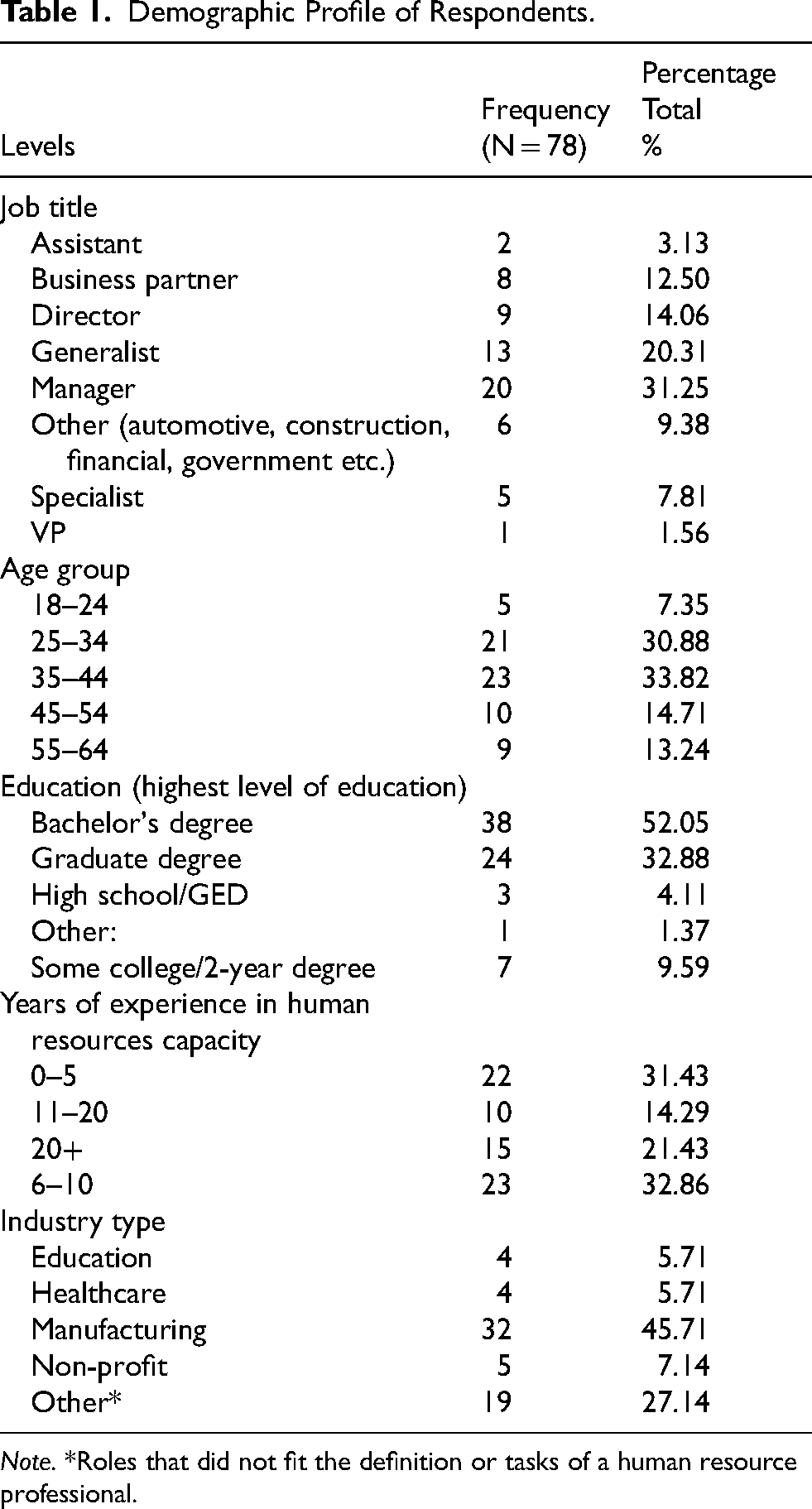
Note. *Roles that did not fit the definition or tasks of a human resource professional.
Overall Familiarity
Overall, of the 78 human resource professionals that participated, the majority (73.3%) indicated that they were either moderately familiar (MF) or extremely familiar (EF) with the accessibility of their organization's application and interview portals, 76.7% of the participants reported being MF or EF with their organization's digital pre-employment testing process, 91.7% reported being MF or EF with their organization's protocol for inviting applicants for an interview, 73.3% reported being MF or EF with their organization's reasonable accommodation request and follow-up process, 73.3% reported being MF or EF with the protocols for implementing any requested accommodations within their organization, and 70% reported being MF or EF with the accessibility of required hiring documents within their organization. Inversely, 65% reported being not at all familiar or slightly familiar with tax credits for accommodations made to comply with the ADA, and 60% reported being not at all familiar or slightly familiar with a local department of rehabilitation agency. High levels of comfort were seen overall, and most participants reported being comfortable or very comfortable with all questions regarding comfort in assistive technology and reasonable accommodations.
Familiarity Level by Industry
Individuals who indicated that they work in education reported the highest level of familiarity [10 of the 17 questions rated at MF or EF equaling 100%] followed by healthcare [6 of the 17 questions rated at MF or EF equaling 100%], nonprofit [3 of the 17 questions rated at MF or EF equaling 100%], professional service workers [1 of the 17 questions rated at MF or EF equaling 100%], manufacturing [0 of the 17 questions rated at MF or EF equaling 100%], and other [0 of the 17 questions rated at MF or EF equaling 100%]. Low levels were observed across all industries for familiarity with tax credits for accommodations made to comply with the ADA and familiarity with a local department of rehabilitation agency. Those in the healthcare (75%), manufacturing (70%), non-profit (75%), professional service (75%) and other (64.3%) industries had the highest proportion of respondents who reported being not familiar or slightly familiar with tax credits for accommodations while among those in the education industry, no respondents reported being not familiar with tax credits. A similar pattern was observed for participants’ familiarity with a local department of rehabilitation industry.
Familiarity Level by Years of Experience
Levels of familiarity also differed by years of experience the participants had in the field of human resources. Individuals who indicated that they had 11–20 years of experience reported the highest level of familiarity [7 of the 17 questions rated at MF or EF equaling 75% or higher] followed by those with 20+ years of experience [4 of the 17 questions rated at MF or EF equaling 75% or higher], those with 0–5 years of experience [4 of the 17 questions rated at MF or EF equaling 75% or higher], and those with 6–10 years of experience [1 of the 17 questions rated at MF or EF equaling 75% or higher]. All experience groups reported deficits in familiarity with tax credits for accommodations. Those with 0–5 years of experience (60%), 6–10 years (73.7%), and 11–20 years (75%) had the highest percentage of respondents who reported not familiar or slightly familiar with tax credits for accommodations while among those with 20+ years of experience 53.9% reported low familiarity. The same pattern was found for familiarity with a local department of rehabilitation industry, unfamiliarity decreased as years of experience increased. Those with 11–20 years of experience showed low levels of familiarity with community resources for training for assistive technology and workplace accommodations, 57.1% reported being not or slightly familiar. A large proportion of the 11–20 years group also reported being not familiar with vision assistive technology (28.6%), upper mobility assistive technology (28.6%), and no participants reported being moderately or extremely familiar with cognitive assistive technology. Table 2 summarizes the familiarity level of HR professionals using assistive technology and making workplace accommodations.
HR Professionals AT and Reasonable Accommodations Familiarity Percentages.

Comfort by Years of Experience
Among the respondents with 0–5 years of experience as a human resource professional, 55.6% reported being very comfortable with providing reasonable accommodations, if requested, for a person with a disability, and 66.7% reported being very comfortable asking only job-related interview questions as they relate to the essential job functions. Among those with 6–10 years of experience, 68.4% reported being very comfortable asking only job-related interview questions as they relate to the essential job functions, 52.6% reported being very comfortable ensuring the accessibility of pre-hire tests and informing candidates of the process for pre-hire tests in advance, and 52.6% reported being very comfortable informing candidates of the entire hiring process so they can decide if an accommodation is needed. Among those with 11–20 years of experience, 100% reported being comfortable or very comfortable with asking only job-related interview questions as they relate to the essential job functions however, a large proportion (42.9%) reported being uncomfortable or very uncomfortable with modifying (caption and audio description) recruiting videos or multimedia to ensure accessibility. Among those with more than 20 years of experience in the industry, 100% of the participants reported being comfortable or very comfortable with advocating at all levels of the organization or company for reasonable accommodations, and providing reasonable accommodations, if requested, for a person with a disability while 92.3% reported being comfortable or very comfortable with asking only job-related interview questions as they relate to the essential job functions.
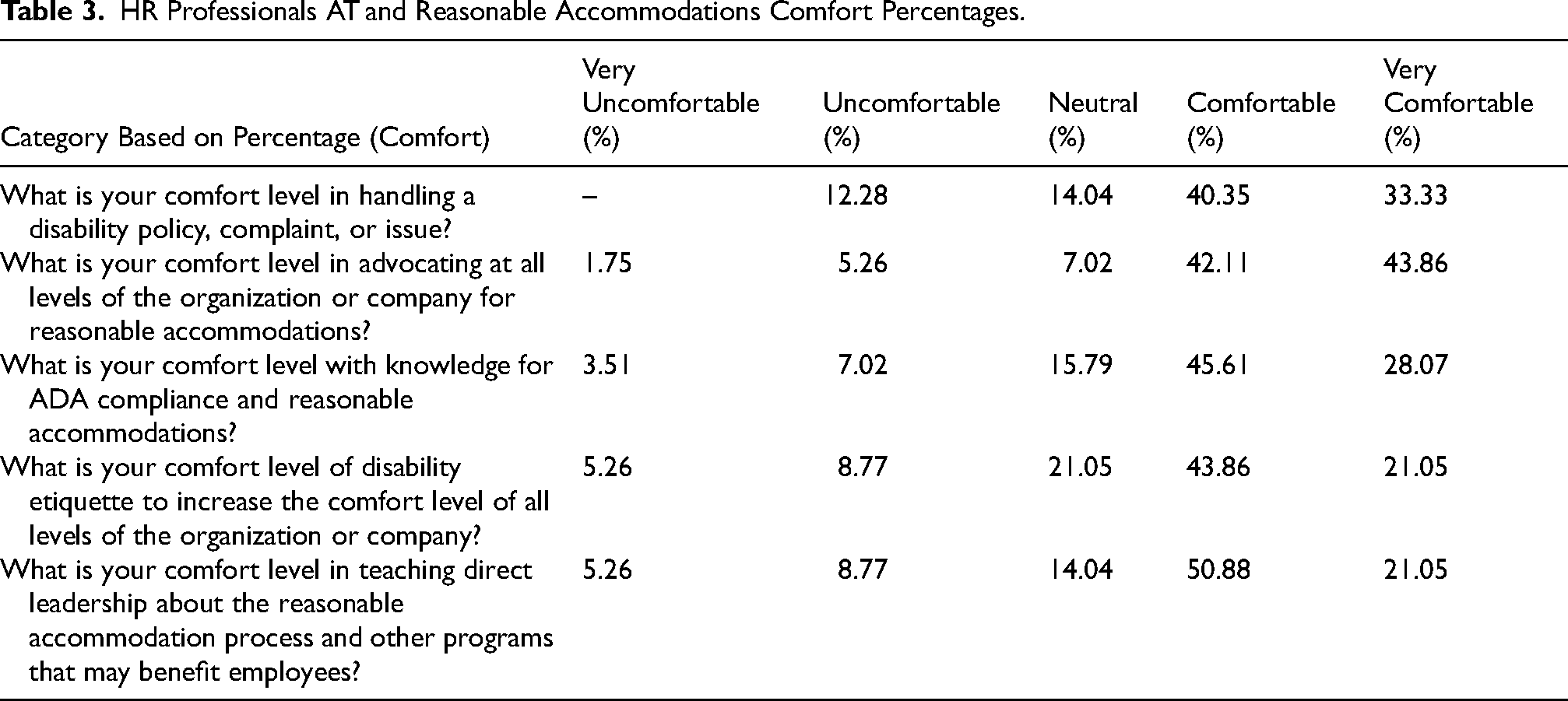
Participants in the education industry showed the highest levels of comfort, 100% of participants reported being comfortable or very comfortable for 13 of the questions out of 15. Those who reported being in the nonprofit industry had 100% comfortable or very comfortable for 11/15 questions; however 50% of participants reported feeling neutral comfort about modifying recruiting videos to ensure accessibility. Among those in the healthcare industry, 100% reported being comfortable or very comfortable for 5/13 questions however 50% reported being very uncomfortable modifying recruiting videos or multimedia to ensure accessibility and 50% reported being uncomfortable providing accommodations during the onboarding process. Among those in the professional service industry 100% reported being comfortable or very comfortable for 4/13 questions however, 25% reported being very uncomfortable with their knowledge for ADA compliance and reasonable accommodations. Among those in the manufacturing industry, comfort was not reported at 100% for any questions and 44.4% of the participants reported being very uncomfortable or uncomfortable modifying recruiting videos or multimedia to ensure accessibility. In the other industry group, no questions had a 100% response rate of comfortable or very comfortable. Table 3 summarizes the comfort level of HR professionals using assistive technology and making workplace accommodations.
HR Professionals AT and Reasonable Accommodations Comfort Percentages.
Discussion
The purpose of this study is to assess the knowledge and training that AT-WAs have received from human resources and technology support professionals in businesses and organizations. The following research questions were specifically addressed through a survey: is there a correlation between the years of experience, educational attainment, industry type, and knowledge of technology support professionals and human resource managers who provide workplace accommodations (WA) and assistive technology (AT) for people with disabilities (PwD) and are HR managers aware of where to look for assistance to accommodate people with disabilities? Based on our findings, the following recommendations should be considered: First, HRMs need to foster reasonable accommodations to promote a work environment that supports the success and retention of employees with disabilities. Second, HRMs need to familiarize themselves with public policy tax credits for accommodations made to comply with the ADA. Third, HRMs must connect with State Vocational Rehabilitation Agencies (SVRAs) to provide broader employment opportunities and disability education.
There are significant barriers to employment for people with a disability. However, our findings indicate HRMs are highly familiar with providing reasonable accommodations but lack knowing where to seek help accommodating persons with a disability. Therefore, a multifaceted approach is needed to help promote different organizational settings where visually impaired individuals can work effectively through inclusion by cultivating a network of resources to streamline the accommodation process. An example of what this may look like encompasses HRPs, equal employment offices, facilities management, information technology, SVRAs, and the health and safety department assisting with the reasonable accommodations process for new employees or accommodating current employees with a disability.
Furthermore, the individual with a disability should be the expert in knowing what their capabilities and limitations consist of with open communication to identify the best type of accommodation. This brings us to our next recommendation of public policy tax credits for accommodations that comply with the ADA. If an organization provides an accommodation early on, the chances of that cost being lower increases significantly. Resources such as the Job Accommodation Network (JAN) can be vital for HRMs in helping their employees with a disability find the right accommodation for their job tasks and responsibilities. However, as our study results indicate, many HRMs fail to go a step further in finding tax incentives and credits provided by ADA public policies and the IRS for reasonable accommodations. These benefits can be used to cover a variety of expenditures that include and are not limited to the purchase of adaptive equipment, fees for consulting services, removal of architectural barriers, and production of accessible formats. HRMs are encouraged to read about tax credit sections 44 and tax deductions under section 190, established under the Internal Revenue Code. For more helpful tax tips, look for the following forms 8826 Disabled Access Credit, 5884 Work Opportunity Credit, and 3800 General Business Credit.
State Vocational Rehabilitation Agencies (SVRAs) could further support the above recommendations. These agencies are not just resources but experts in the disability field, providing services for all individuals with all types of disabilities. Among SVRAs, dedicated Vocational Rehabilitation (VR) agencies serve individuals who are blind or with visual impairments, referred to as Blind VR agencies. These agencies have rehabilitation counselors readily available to assist individuals with a disability with employment training, skill development, on the job support, coaching, accommodations, and can even meet with employers or hiring managers to offer additional support on workplace accommodations, AT, public policies, disability education, training, and development. Their expertise and support can be invaluable to HRMs in creating a supportive and inclusive work environment.
Limitations
No study is without limitations. This study required the PI to complete four additional amendments to the IRB, as it was challenging to get HR professionals to complete the survey. Three organizations were contacted and agreed to send the survey out to members but then indicated a lack of time to send it out to members, or there was a change in leadership and the leadership opted not to support the study. This left for a small sample size.
Conclusions
The present study has several implications for human resource research and practice. More research has become available in recent years on workplace reasonable accommodations by disability types. However, they have yet to specifically explore the knowledge and training of AT-WAs received by HRMs within an organization. This novel research will help HRMs better understand accessibility for all and recommendations for organizations to deploy. HRMs were found in this study to have high percentages of familiarity and comfort with AT-WAs but lack general knowledge and training on AT public policy tax credits and deductions for organizations, as well as information about their local SVRAs who provide employment support for individuals with a disability and employers. These findings are very timely as more employers move to hybrid work environments, COVID-19 has produced a new population of disabled workers, and increased access to AT could improve equity in the workplace by removing several barriers among individuals with a disability if properly supported by HRMs for an effective hiring talent management practice in the global labor market.
We set out to explore the knowledge and training of AT-WA received by HRMs, which has provided us with a more significant opportunity for deeper insights into AT-WA knowledge and training content. Our findings suggest that ongoing knowledge translation and training are needed to provide reasonable accommodations for AT-WA public policy tax credits, deductions, and SVRAs, for which there is a disconnect. Researchers provided recommendations and additional resources to address these concerns and provide a starting point for filling this AT-WA knowledge and training gap for individuals with a disability, given that this specific workforce has not been fully potentialized by HRMs.
Footnotes
Acknowledgements
The authors would like to thank the Michigan Council of the Society for Human Resource Management (MISHRM), a human resources professional organization, the Kalamazoo Human Resources Management Association (KHRMA) and the Lakeshore Human Resources Management Association (LHRMA), without whom this project would not have been possible.
Ethics Statement
The Institutional Review Board (IRB) at the Grand Valley State University approved the pilot study described in this article (23-264-H-GVSU).
Informed Consent
The participants signed an IRB approved consent form through the Qualtrics survey.
Funding
The authors received no financial support for the research, authorship, and/or publication of this article.
Declaration of Conflicting Interests
The authors declared no potential conflicts of interest with respect to the research, authorship, and/or publication of this article.