




Abstract
Background
Finding employment is a complex task and traditional means of job seeking such as submitting a traditional resume may be ineffective and inaccessible for some people with disabilities.
Objective
Identify the scope of literature related to documenting any outcomes associated with using alternatives to traditional resumes for people with disabilities.
Results
Seven studies identified in the scoping met full inclusion criteria. Most studies were non-experimental, focused on the use of video resumes or video CVs, and did not meet American Psychological Association's journal article reporting standards. Results also suggest there are benefits for people with intellectual disability to participate in the process of creating a video resume.
Conclusion
Challenges securing adequate employment persists for people with disabilities. Research on any benefits of using a resume alternative for people with disabilities is in its infancy. Findings from this scoping review cannot, in conglomeration, confirm that there are benefits when implementing these alternatives, however, findings from this review suggest the use of resume alternatives warrant further investigation.
Introduction
People with disabilities have a right to work and having a job can enhance one's social networks, self-determination, and overall quality of life (e.g., Blustein, 2019; Voermans et al., 2021). However, obtaining employment remains a significant barrier for many people with disabilities and this disparity is evident across the lifespan. According to the U.S. Bureau of Labor Statistics (2024), youth with disabilities, aged 16–19, are less likely than their peers without disabilities to participate in the labor force (i.e., 27.6% versus 37.4%); and participation rate and discrepancy further drops into adulthood with only 24.2% of adults with disabilities employed compared to 68% for those without disabilities. Recent US policy efforts, such as Employment First, emphasize that all individuals, regardless of disability, should have opportunities to pursue competitive, integrated employment (Association of People Supporting Employment First, n.d.). In line with this vision, educators and the Rehabilitation Services Administration provide pre-employment transition services to prepare youth with disabilities for the workforce. These services include: (a) job exploration counseling, (b) work-based learning experiences, (c) postsecondary education counseling, (d) workplace readiness training, and (e) instruction in self-advocacy (Workforce Innovation Opportunity Act, 2014).
Despite policy and practice efforts, barriers to employment exist and persist across the job seeking landscape. The traditional job-seeking process often includes applying to the job, often with an electronically submitted resume, which may serve as a barrier for people with disabilities. Biases rooted in misunderstandings regarding the abilities of individuals with disabilities may perpetuate continued exclusion as resumes may highlight factors such as lack of employment history, employment gaps, or difficulties to communicate one's skills in written form in addition to concerns about written disclosure of disability, and (e.g., Bonaccio et al., 2020; Dean et al., 2022; Glazko et al., 2024). In response, some jobseekers are pursuing alternative methods to better communicate their skills and abilities than a traditional written resume (e.g., video resumes, portfolios, visual resumes). Video resumes, for instance, allow applicants to present themselves to employers and share their job specific competencies, qualifications, and previous work experiences (Gissel et al., 2013). Non-traditional formats may offer advantages over traditional resumes, both in terms of showcasing specific skills and helping employers better match applicants to job tasks (Moore & Fris, 2014; Richter, 2007).
Educators, vocational rehabilitation counselors, and employment specialists continue seek evidence-informed tools and strategies to improve hiring outcomes for people with disabilities, and a clearer understanding of one critical component of the employment process—the resume—is needed. In addition, as accessibility practices evolve in the recruitment process, synthesizing research on resume alternatives is both novel and timely. This study aims to examine the existing peer-reviewed research on alternatives to traditional resumes for jobseekers with disabilities through a scoping review. Our research questions are:
What are the characteristics of peer-reviewed research on resume alternatives for people with disabilities? What types of alternatives to traditional resumes are currently being studied? What outcomes are documented when a person with a disability uses a resume alternative, and do outcomes vary based on type of disability?
Method
To address our broad research questions, a scoping review framework (i.e., Hadie, 2024) was implemented after a preliminary search did not identify any reviews of this topic. A scoping review, in this instance, is an appropriate framework to “examine the extent, range and nature of research activity” in a targeted area (Arksey & O'malley, 2005, p. 21).
Search terms (see Table 1) for this scoping review were designed to be less restrictive than a traditional systematic review (Munn et al., 2018). To be included in this review, studies met five criteria: (1) include an alternative to a traditional resume as a component of investigation, (2) include individuals with disabilities in the sample, (3) was peer-reviewed, (4) are written in English, and (5) report results that inform one or more of the research questions. Due to the exploratory nature of this review, no studies were excluded because of research design or certainty of evidence associated with the results. There was no requirement related to publication date.
Scoping Review Search Terms.

Note. For this scoping review Deaf was considered a linguistic minority, not a disability (Charrow & Wilbur, 1975; Manning et al., 2022).
Search Procedures
First, we conducted an initial search to confirm a similar review was not available. Then, we used two primary concepts to identify the keywords to implement in the searches: (1) alternatives to traditional text-based resumes, and (2) participants with disabilities. Our search was conducted in January 2025 across four electronic databases: ERIC, PsychINFO, Academic Search Premier, and Google Scholar. Each cluster of terms (see Table 1) was each searched by two authors. In addition, an ancestral search was conducted by reviewing the references for articles that met inclusion criteria.
A total of 15 articles were identified and reviewed for full inclusion criteria. Any disagreements for meeting full inclusion were resolved by a third author which led to seven articles included in the review. Articles were excluded for reasons such as (a) resume alternative was not developed for employment purposes (e.g., Wood, 2021), (b) participants with disabilities were not part of the sample (e.g., Waung et al., 2014), or (c) focused on Deaf individuals and was excluded due to Deaf identification as linguistic group, not a disabled group of people (e.g., Kelly & O'Brien, 1992).
Results
Included studies were coded and data was extracted on the following: (a) participant demographics, (b) research context, (c) resume alternative, (d) research design, (e) results, and (f) design quality based on American Psychological Association's (APA) Journal Article Reporting Standards (JARS) for qualitative and quantitative research (APA, 2020). A summary of findings is provided in Table 2.
Summary of Results.
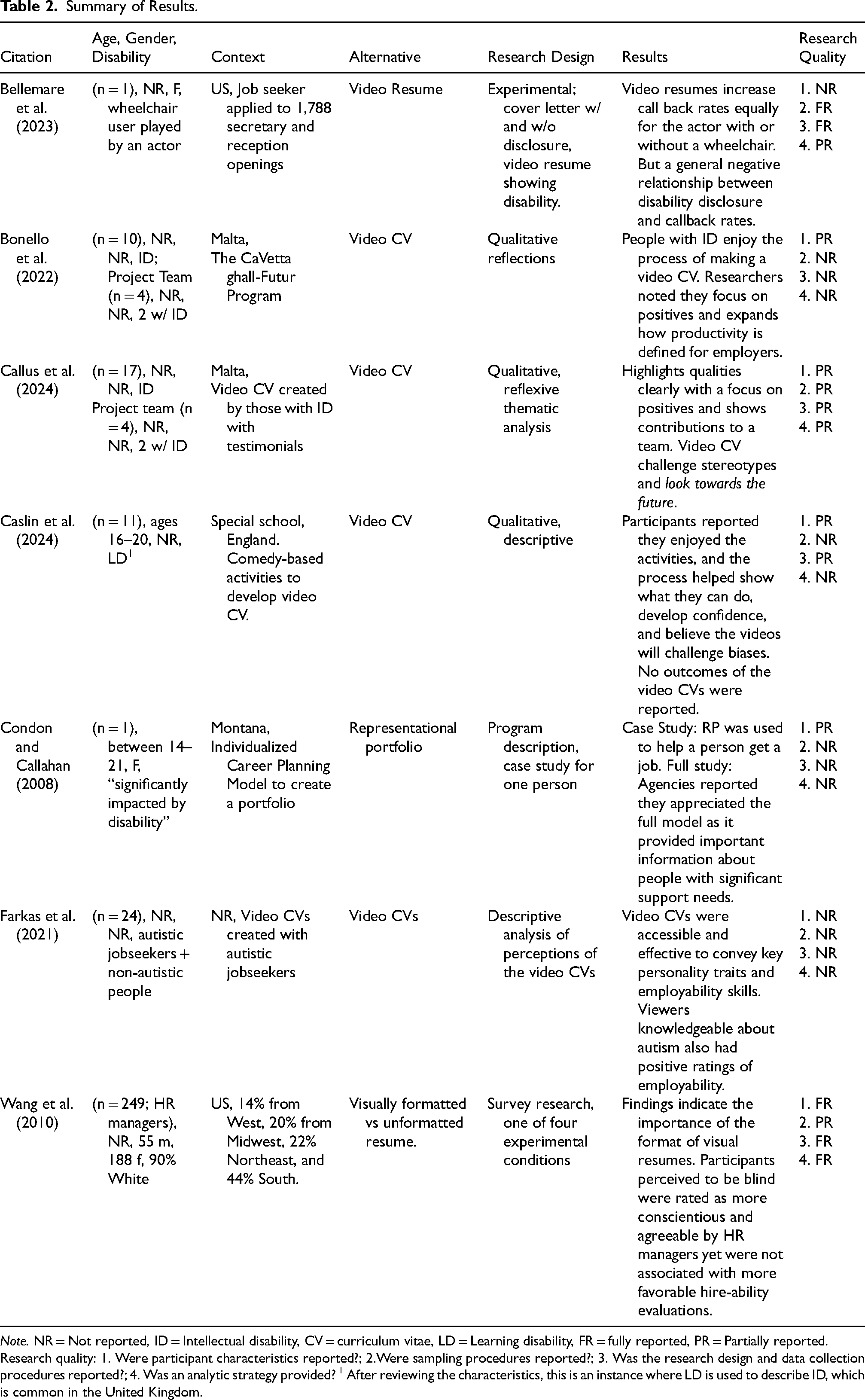
Note. NR = Not reported, ID = Intellectual disability, CV = curriculum vitae, LD = Learning disability, FR = fully reported, PR = Partially reported. Research quality: 1. Were participant characteristics reported?; 2.Were sampling procedures reported?; 3. Was the research design and data collection procedures reported?; 4. Was an analytic strategy provided? 1 After reviewing the characteristics, this is an instance where LD is used to describe ID, which is common in the United Kingdom.
Characteristics of Research
Publication date ranged from 2008–2024 with most studies (n = 5) published between 2021–2024. Three studies were published by researchers from the US. Four studies focused on alternatives for individuals with I/DD, one focused on wheelchair users, one on blind jobseekers, and one study focused on jobseekers with autism. Most studies did not implement an experimental design (n = 5). The two studies that implemented an experimental design focused on jobseekers who are in a wheelchair or blind.
Resume Alternatives
Resume alternatives identified in the review predominately included a video resume or video CV (n = 5). The specific details about the components of the video CV or resume varied across studies, however, studies did not report the components of the alternative with replicable precision. One study investigated if representational portfolios (an analogue version of a video resume) improve chances of getting hired, and another study focused on visual formatting (i.e., headings, indentation, text alignment across content) of a written resume and association with human resource manager ratings of the applicant.
Documented Outcomes
Included studies documented a variety of outcomes including increased callback rates, increased perceptions of employability or reduced stereotypes and two studies documented benefits for individuals simply by engaging in the development process of creating a video resume. Based on the limited number of studies and types of studies identified in our review, we cannot definitively document any major themes related to employment outcomes. In addition, due to limited demographic reporting of included studies, we were also unable to answer if outcomes varied based on disability status. Furthermore, when reviewing each article for APA JARS research quality indicators, characteristics of participants were only partially reported across five studies, sampling procedures were only fully reported across three studies, and research design and data collection procedures were only reported with precision across two studies. Finally, sufficient description of the analytic strategy, based on research methodology, was fully reported for one study. In summary, most studies did not report on the research context, procedures, and analysis with replicable precision, which impedes on any generalization of findings.
Discussion
While the current evidence base for using resume alternatives for people with disabilities remains thin and limited by methodological quality, this scoping review serves as a starting point to identify a gap in inclusive employment research. As vocational rehabilitation and education professionals continue to search for strategies to support more equitable employment outcomes for individuals with disabilities, these findings signal an opportunity for increased research and improved rigor when exploring alternative ways to apply for a job.
Implications for Research
First, future research should provide comprehensive demographic information on participants and details about the employment context. The lack of detailed information across studies hampers the ability to assess how resume alternatives perform across different groups and settings. Next, findings demonstrate the need for increased methodological rigor of future research including (a) listing research questions, (b) improving the precision of reported procedures and analysis, and (c) designing the study with attention to rigorous design standards to ensure validity and generalizability of findings. In addition, future research should implement experimental designs to explore if alternatives to traditional resumes are positively associated with improved employment or job-seeking outcomes for people with disabilities (i.e., invitation for interviews, offers of employment). In addition, barriers to implementing an alternative should also be identified (e.g., compatibility for non-traditional formats with online application systems). Third, future research should prioritize a replicable description of the resume alternative so that others can reproduce the alternative and, if applicable, replicate the process to develop the alternative. This would include information about any required technology and software, the role of support personnel to guide jobseekers with disabilities through the process, and duration, content, and other descriptors of the final product. Future research could also explore other innovative resume alternatives, including online portfolios or social media-based resumes. Finally, future research should seek to determine any indirect benefits in the process of creating an alternative resume may have on employment outcomes. For example, does building an alternative resume build workplace readiness skills or self-advocacy in people with disabilities?
Conclusion
In summary, this scoping review identified that more research is needed to fully understand any benefits of creating and using alternative resumes during the job-seeking process. As people with disabilities continue to experience lower employment compared to non-disabled peers, creative alternatives to traditional resumes have the potential to offer some benefits that could ameliorate these persistently discrepant outcomes.
Footnotes
Acknowledgement
N/A

Ethics Statement
N/A, not human subjects research
Informed Content
N/A, not human subjects research
Funding
The authors received no financial support for the research, authorship, and/or publication of this article.
Declaration of Conflicting Interests
The authors declared no potential conflicts of interest with respect to the research, authorship, and/or publication of this article.