



Abstract
Background
Workers with disabilities are more likely to have lower earnings, work part time or in service occupations compared with adults without disabilities. Studies typically examine disability as a dichotomy (with or without severe functioning difficulties).
Objective
This article extends the literature by describing differences in work conditions not often examined (work schedule inflexibility, job security and benefits) among U.S. workers ages 18–64 with varying severity of functioning difficulties.
Method
Using the 2021 National Health Interview Survey (NHIS), logistic regression models predicted associations between functioning and work conditions for workers ages 18–64, controlling for individual characteristics, geography, full time work status, and occupation.
Results
Adults reporting any functioning difficulties had higher odds of experiencing work schedule inflexibility and perceived job insecurity, and lower odds of access to paid sick leave than those reporting no difficulties. Workers with the most severe functioning difficulties received less advance notice of work schedule than other workers.
Conclusion
Work conditions differ for workers by level of functioning difficulties. Studies comparing only those with and without severe functioning difficulties may understate associations between functioning difficulties and work conditions. Understanding differences in work conditions by severity of functioning difficulties may inform efforts to improve outcomes for workers with disabilities.
Introduction
Fifty years ago, the first federal law addressing equal employment opportunities for people with disabilities – the Rehabilitation Act of 1973 (1973), was signed into law. In 1990, the Americans with Disabilities Act (1990) was enacted, with changes made by the ADA Amendments Act of 2008 (2008), further strengthening the prohibition of discrimination based on disability, defined in part by the experience of substantial limitations in functioning and major life activities, in the workplace. However, in 2024 the percentage of adults ages 16–64 with disabilities who were employed (37.4%) was approximately half that of adults ages 16–64 without disabilities (74.9%) (U.S. Department of Labor, 2025).
Earlier research has shown that workers with disabilities are more likely to work part time and in service occupations, as well as have lower average earnings compared with those without disabilities (Kruse et al., 2018; Schur et al., 2009; Schur et al., 2017; U.S. Department of Labor, 2025). Yet, there has been less emphasis on how specific work conditions – such as work schedule inflexibility, short advance notice of work schedule, perceived job insecurity, and access to paid sick leave – differ for workers with and without disabilities. Similarly, less research has been conducted that examines work among adults with varying levels of limitations or severity of functioning difficulties.
This analysis uses the 2021 National Health Interview Survey (NHIS) to examine differences in work conditions (work schedule inflexibility, short advance notice of work schedule, perceived job insecurity, and access to paid sick leave) by functioning difficulties (no difficulties, some difficulties, a lot of difficulties or cannot do at all) among working adults ages 18–64 in the U.S. This paper contributes to the literature on work and disability by: 1) examining differences in work conditions not frequently included in analyses that reflect control over work conditions (work schedule inflexibility and short advance notice of work schedule) and economic dimensions (perceived job insecurity and access to paid sick leave), and 2) expanding the operationalization of disability to acknowledge the full continuum of functioning.
Background
Prior Research on Work and Disability status
Prior research has established differences in employment status, work hours, and earnings among individuals by disability status (Kruse et al., 2018; Schur et al., 2009; Schur et al., 2017; U.S. Department of Labor, 2025). Yet such measures do not capture differences in other dimensions of employment that have become increasingly prevalent in the labor market. These dimensions, such as non-standard work arrangements (including temporary or contingent employment, and irregular work schedules), control over schedule and work autonomy, and changes in access to employment benefits including health insurance, retirement benefits and paid sick leave, may also reflect job precarity and job quality (Congdon et al., 2020; Kalleberg, 2011, 2018; National Academies of Science, Engineering and Medicine, 2020).
Some studies have examined differences in job quality by disability status (Brucker & Henly, 2019; Henly & Brucker, 2020; LaMontagne et al., 2016; Luca & Sevak, 2020; Shahidi et al., 2023), although it is worth noting that the literature uses inconsistent definitions of non-standard work arrangements and other measures of job quality. For example, using the 2014–2016 Current Population Survey, Brucker and Henly (2019) found no differences in the likelihood of having a “good” job – defined as a job with higher than median earnings and access to health insurance coverage and retirement benefits – between workers with and without disabilities after accounting for sociodemographic characteristics and health status.
Brucker and Henly (2019) only considered economic dimensions of job quality, such as earnings and benefits. Other studies have found differences in job quality by disability status using measures of work conditions such as perceived insecurity, unpredictable hours, or multidimensional measures of job quality (Henly & Brucker, 2020; LaMontagne et al., 2016; Luca & Sevak, 2020; Schur et al., 2009; Shahidi et al., 2023). For example, Shahidi et al. (2023) found that workers with disabilities more likely to be employed in jobs that were perceived to be less secure or offered fewer benefits than workers without disabilities. The likelihood of precarious employment, defined as having little or no job control, and/or having part time or temporary employment, was higher among workers with disabilities than among those without disabilities, although these results were moderated by age (Jetha et al., 2020). Among young adults, workers with disabilities were more likely to work irregular work schedules and experience more volatility in work hours than those without disabilities (Luca & Sevak, 2020). Workers with disabilities were also more likely to perceive job and income insecurity, report higher rates of temporary, part time or gig work, and have less schedule flexibility than workers without disabilities (LaMontagne et al., 2016; Schur et al., 2017; Shahidi et al., 2023). However, Shahidi et al. (2023) found no differences in pension benefits, working long hours, or irregular and unpredictable schedules between Canadian workers by disability status.
Differences in employment outcomes may reflect differences between those with and without disabilities. If adults with disabilities are less healthy or have lower levels of educational attainment on average than adults without disabilities, then they may be more likely to be employed in jobs that have lower earnings and less likely to be employed in jobs that offer employment benefits (Kruse et al., 2018; Schur et al., 2017). Prior research suggests that differences in employment status and work hours by disability status are largest among individuals at midlife, males, non-Hispanic people, unmarried workers, and those with lower levels of education (Jetha et al., 2020; Sevak et al., 2015), and lower among those with higher educational attainment (Sevak et al., 2015). However, among college graduates working full time, those with disabilities were employed in jobs lower in intrinsic quality – defined as job autonomy, responsibility and intellectual challenge – than those without disabilities (Henly & Brucker, 2020).
Functioning and Disability Measurement in Prior Research
Just as the studies cited above use varying measures of work conditions, most of these studies rely on varying measures of disability. Several studies use dichotomous measures of disability status based on the six-question set adopted for use in the American Community Survey in 2008 (Brucker & Henly, 2019; Kruse et al., 2018; Luca & Sevak, 2020; Sevak et al., 2015; U.S. Department of Labor, 2025), or the Disability Screening Questions (DSQ), or its shortened version, developed by Statistics Canada (Jetha et al., 2020; LaMontagne et al., 2016). Other studies use a dichotomous measure based on different disability question sets or on questions which ask about work limitations. However, such measures cannot capture differences between working adults with disabilities who may not experience such limitations and adults without disabilities (LaMontagne et al., 2016; Schur et al., 2017). Some studies use measures which include a focus on long-term limitations (lasting at least 6 months) or adopt a medical approach by asking about the certain diagnosed conditions that may give rise to functional limitations (Henly & Brucker, 2020; LaMontagne et al., 2016; Schur et al., 2017).
Yet, all these studies examine disability status or disability type as a dichotomy (categorizing people as with or without disabilities), rather than considering the continuum of severity of functioning difficulties as in the present analysis. Despite varying measures of both work conditions and disability status, the literature on work and disability does suggest an association between disability and work conditions.
This study uses the 2021 NHIS to examine differences among adult workers ages 18–64 in the United States in work conditions (work schedule inflexibility, short advance notice of work schedule, perceived job insecurity, and access to paid sick leave) by differences in level or severity of functioning difficulties (no difficulties, some difficulties, a lot of difficulties or cannot do at all). These four work conditions highlight intrinsic dimensions of job quality, specifically control over work conditions (work schedule inflexibility and short advance notice of work schedule) as well as economic dimensions of job quality (perceived job insecurity and access to paid sick leave).
Method
This study uses data from the 2021 NHIS, a nationally representative household survey of the U.S. civilian noninstitutionalized population. The NHIS is an annual survey conducted continuously throughout the year and collects information on respondent health status, health-related behaviors, and healthcare access and use. One sample adult ages 18 and older is randomly selected from each household to answer detailed questions about their health. In 2021, the NHIS also included questions about work conditions (National Center for Health Statistics, 2022). Interviews are typically conducted in respondents’ homes, but follow-ups to complete interviews may be conducted over the telephone. Due to data collection difficulties posed by the COVID-19 pandemic, interviewing procedures were disrupted, and 62.8% of Sample Adult interviews were conducted at least partially by telephone during 2021 (National Center for Health Statistics, 2022).
The analytic sample for this study includes sample adults ages 18–64 who reported that they worked for pay in the week before interview, performed seasonal or contract work in the last 12 months, or were working at a family job or business not for pay. Working adults with missing data or unknown information on work conditions and the other covariates were generally excluded from the analysis unless specifically noted. Overall, 2.8% of working adults ages 18–64 were missing data or unknown information on functioning and other covariates. Working adults ages 18–64 with missing or invalid responses on the work conditions outcomes ranged from 0.5% for work schedule inflexibility to 1.2% for perceived job insecurity. For this reason, the unweighted sample size differs for each outcome: work schedule inflexibility (n = 14,524); short advanced notice of work schedule (n = 14,434); perceived job insecurity (n = 14,430); and access to paid sick leave (n = 14,474).
Outcome Variables: Defining Work Conditions
Four work conditions highlighting both economic dimensions of job quality (access to paid sick leave and perceived job insecurity) as well as intrinsic dimensions of job quality (specifically control over scheduling via work schedule inflexibility and short advance notice of work schedule) are defined as follows.
Work schedule inflexibility – Respondents were asked “How easy or difficult is/was it for you to change your work schedule to do things that are important to you or your family? Would you say very easy, somewhat easy, somewhat difficult, or very difficult?” Responses were recoded dichotomously as, 1) very easy or somewhat easy to change work schedule, and 2) difficult or somewhat difficult to change work schedule.
Perceived job insecurity – Respondents were asked “Thinking about the next 12 months, how likely do you think it is that you will lose your job or be laid off? Would you say very likely, fairly likely, somewhat likely, or not at all likely?” Responses were recoded dichotomously as, 1) not at all likely to lose job in next 12 months, and 2) at least somewhat likely to lose job in next 12 months.
Employer provides access to paid sick leave – Respondents were asked “Was/is paid sick leave available if you need it?” Working adults who responded “Yes” were considered to have paid sick leave available through their employer.
Short advance notice of work schedule – Respondents were asked two questions, “Did your work schedule at your main job change on a regular basis?” and if yes, “Approximately how far in advance does your employer usually tell you the hours that you will need to work on any given day?” Short advance notice of work schedule was dichotomized as: 1) work schedule did not vary (responses of “No” to the first question) or received 2 weeks or more advance notice of work schedule (responses of “Yes” to the first question and responses of “2–4 weeks” or “More than a month” to the second question), and 2) received less than 2 weeks advance notice of work schedule (responses of “Yes” to the first question and responses of less than 2 weeks to the second question about advance notice of work schedule). A cutoff of two weeks (or 14 days) is consistent with predictive scheduling policies in several jurisdictions which specify that employers provide at least 14 days advance notice of work schedules.
Key Independent Variables: Defining Functioning Difficulties
Functioning difficulties is defined by the level of difficulty reported in the six-question Washington Group Short Set on Functioning (WG-SS), an internationally validated measure of disability recommended by both the United Nations (UN) Statistical Division and the UN Economic Commission for Europe's Conference of European Statisticians as the preferred method for collecting information on disability. The question set has also been endorsed as the international standard for disaggregating the 2030 Agenda for Sustainable Development Goals by disability status and has been added to censuses and health surveys in more than 120 countries, including the U.S. (Washington Group on Disability Statistics, 2020, 2024; Weeks et al., 2021).
The six domains of functioning include: seeing (even if wearing glasses), hearing (even if wearing hearing aids), mobility (walking or climbing stairs), communication (understanding or being understood by others), cognition (remembering or concentrating), and self-care (such as washing all over or dressing). Response choices for each of the six questions are “no difficulty”, “some difficulty”, “a lot of difficulty”, and “cannot do at all”.
The measure of functioning difficulties is defined using three categories based on severity of difficulties reported in the WG-SS questions. Adults who responded “no difficulty” to all six questions are defined as having “no difficulties” with functioning; adults who responded “some difficulty” to at least one question but did not answer “a lot of difficulty” or “cannot do at all” to any of the six questions are defined as having “some difficulties” with functioning; and adults who respondents “a lot of difficulty” or “cannot do at all” to at least one of the six questions are considered to have “a lot of difficulties” with functioning. Adults who respond “a lot of difficulty” or “cannot do at all” to at least one of the six WG-SS questions are considered to have disabilities according to the recommended international threshold for defining disability (Washington Group on Disability Statistics, 2020; Weeks et al., 2021).
Analytic Plan
This analysis uses the 2021 NHIS to explore associations between functioning difficulties and work conditions. First, the percent distribution of sociodemographic, health, geographic and work characteristics for working adults ages 18–64, and by level of functioning difficulties is described. Wald tests were used to assess the statistical significance of differences in characteristics across categories for each level of functioning. Next, unadjusted differences in work conditions among working adults by level of functioning difficulties are reported. Two-tailed significance tests were used to identify significant differences in work conditions by functioning difficulties. Logistic regression models were estimated to predict associations between functioning difficulties and the four work conditions outcomes. Bivariate models and fully-adjusted models controlling for sociodemographic and health characteristics (ages 18–44 and 45–64, sex, race and Hispanic origin, educational attainment, fair or poor health), geography (rural residence, residence in South), and work characteristics (full time employment status and major occupation group) are presented for all workers.
All estimates reported in this analysis meet National Center for Health Statistics standards of reliability (Parker et al., 2017). The 95% confidence intervals were generated using the Korn–Graubard method for complex surveys (Korn & Graubard, 1998). Estimates are weighted to account for the NHIS complex survey deign and are representative of the U.S. civilian noninstitutionalized population. Analyses were conducted using SAS-callable SUDAAN version 11.0.3 software (RTI International, 2018) within SAS version 9.4 software (SAS Institute Inc., 2023).
Results
Table 1 presents the percent distribution of selected sociodemographic, health, geographic, and work characteristics for all working adults ages 18–64 and by functioning difficulties. Overall, 3.2% of working adults ages 18–64 years reported having a lot of difficulties or cannot do at all to one of the six WG-SS questions, while 29.8% reported some difficulties, and 67.0% reported having no difficulties in any of the six functioning domains. Table 1 also reveals differences in sociodemographic composition by functioning difficulties. Compared to working adults reporting no functioning difficulties, those reporting some difficulties or a lot of difficulties were more likely to be ages 45–64, female, in fair or poor health, to reside in a rural area, and to be employed in service occupations, including health care support; and were less likely to hold a Bachelor's degree, work full time or in business and financial operations, professional, or health care practitioners and technicians occupations. Compared to working adults with some or no functioning difficulties, those reporting a lot of difficulties were more likely to live in the South and be employed in transportation and material moving occupations.
Percent Distribution of Working Adults Ages 18–64 by Selected Characteristics and Functioning Difficulties: United States, 2021.
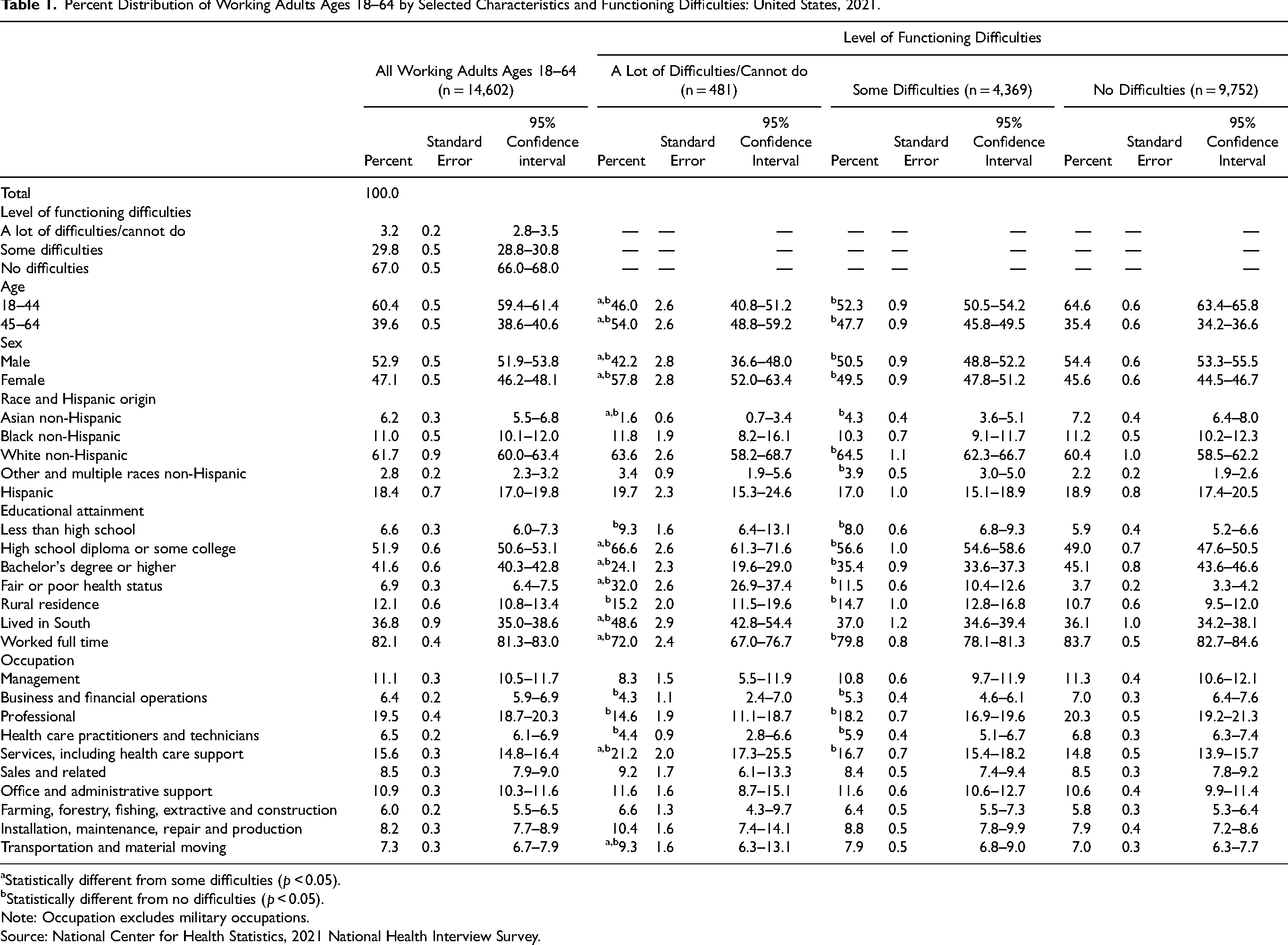
Statistically different from some difficulties (p < 0.05).
Statistically different from no difficulties (p < 0.05).
Note: Occupation excludes military occupations.
Source: National Center for Health Statistics, 2021 National Health Interview Survey.
Table 2 reports the unadjusted percentages of working adults ages 18–64 by selected work conditions and functioning difficulties. Overall, 22.2% of workers reported that it was somewhat or very difficult to change their work schedule, 15.3% reported receiving less than two weeks advance notice of their work schedule, 14.4% reported that they were likely to lose their job in the next 12 months, and 70.1% reported that their employers provided paid sick leave.
Unadjusted Percentage of Selected Work Conditions among Working Adults Ages 18–64, by Functioning Difficulties: United States, 2021.
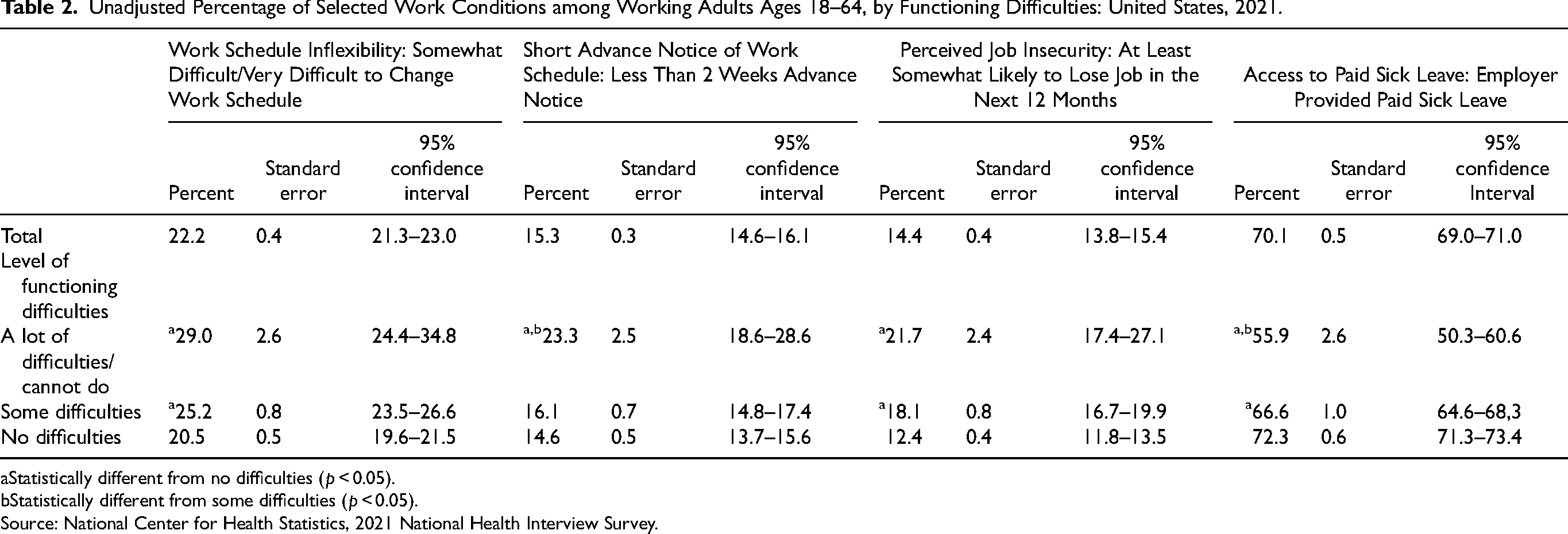
Statistically different from no difficulties (p < 0.05).
Statistically different from some difficulties (p < 0.05).
Source: National Center for Health Statistics, 2021 National Health Interview Survey.
Table 2 also shows unadjusted differences in work conditions by functioning difficulties. Working adults reporting a lot of difficulties in functioning (29.0%) and those reporting some difficulties (25.2%) were more likely to report work schedule inflexibility than working adults reporting no difficulties (20.5%). Workers with a lot of functioning difficulties were more likely to report receiving less than two weeks advance notice of work schedule (23.3%) compared to those with some difficulties (16.1%) and those with no difficulties (14.6%). Working adults with a lot of difficulties in functioning (21.7%) and those with some difficulties (18.1%) were more likely to perceive job insecurity than those with no difficulties (12.4%). The percentage of workers reporting access to paid sick leave was lower among workers with a lot of difficulties (55.9%), compared to those with some difficulties (66.6%) and those with no functioning difficulties (72.3%).
Table 3 presents odds ratios for functioning difficulties from logistic regression models predicting work conditions (full model results are reported in Appendix Table A1). In fully-adjusted models, working adults with a lot of difficulties (AOR 1.49, CI 1.14–1.96), as well as those with some difficulties (AOR 1.29, CI 1.16–1.42), had significantly higher odds of reporting that it was very difficult or somewhat difficult to change their work schedule compared to those with no functioning difficulties. Working adults with a lot of difficulties had higher odds of receiving less than two weeks advance notice of work schedule (AOR 1.51, CI 1.12–2.02) than working adults with no functioning difficulties. Working adults with any functioning difficulties also had higher odds of perceiving that they were likely to lose their job in the next 12 months (a lot of difficulties: AOR 1.68, CI 1.26–2.24; some difficulties: AOR 1.50, CI 1.32–1.70) than adults with no difficulties in any of the six functioning domains. Working adults with a lot of difficulties (AOR 0.73, CI 0.58–0.94) or some difficulties (AOR 0.88, 0.79–0.98) had lower odds of having access to paid sick leave through their employer than those with no difficulties.
Odds Ratios for Level of Functioning from Logistic Regression Models Predicting Selected Work Conditions among Working Adults Ages 18–64.
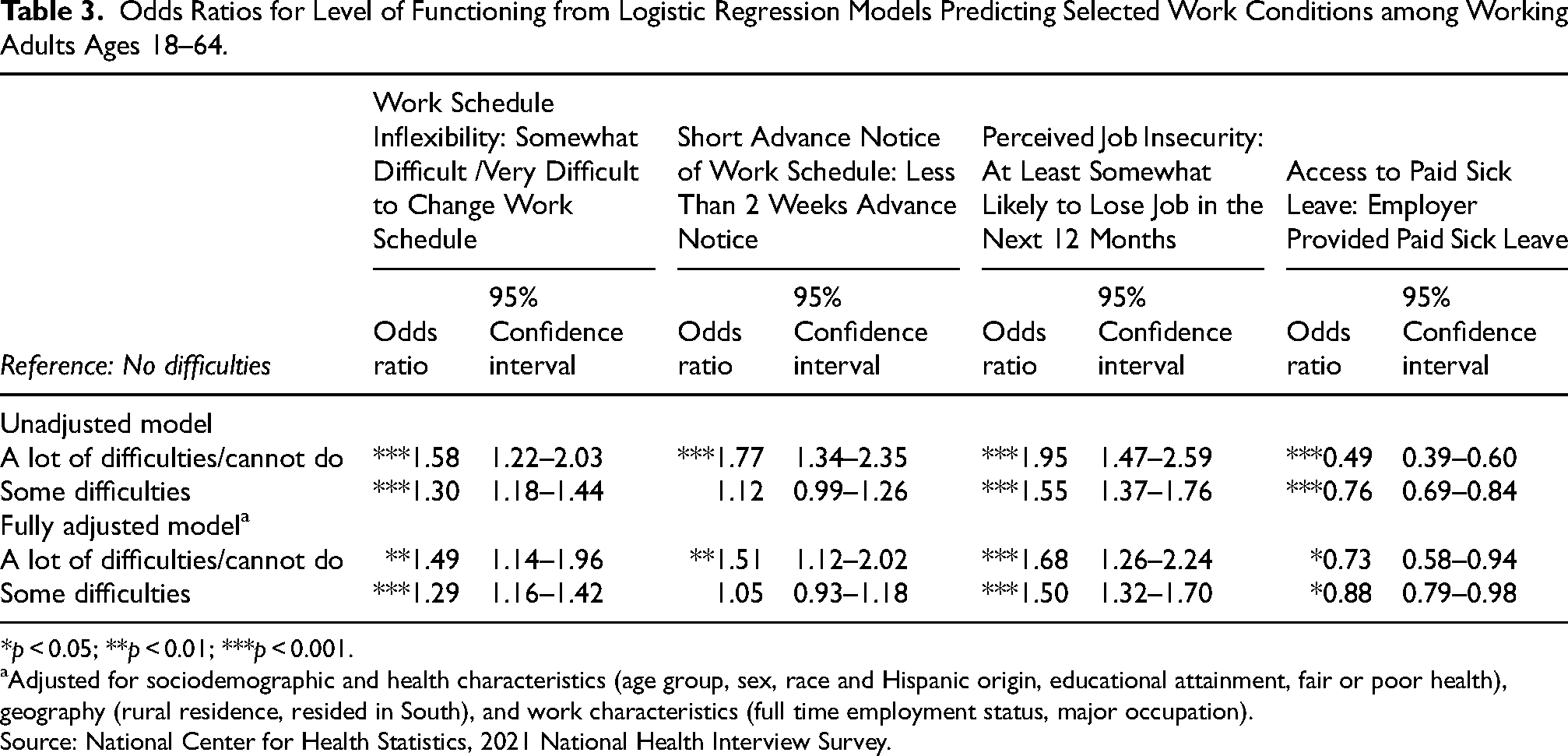
*p < 0.05; **p < 0.01; ***p < 0.001.
Adjusted for sociodemographic and health characteristics (age group, sex, race and Hispanic origin, educational attainment, fair or poor health), geography (rural residence, resided in South), and work characteristics (full time employment status, major occupation).
Source: National Center for Health Statistics, 2021 National Health Interview Survey.
Discussion
This paper examines differences in work conditions by functioning difficulties among U.S. working adults ages 18–64, controlling for differences in socioeconomic characteristics, health, and geography, as well as full time employment status and occupation. This paper also contributes to the existing literature that expands the focus on work beyond employment and earnings alone to consider important characteristics of work that impact participation in, and satisfaction with, work (Ray et al., 2017, 2021). It also expands the examination of disability beyond a simple dichotomy. Using nationally representative data to examine unique work conditions that reflect both intrinsic dimensions of job quality and economic dimensions, the analyses fill gaps in understanding the relationship between work and functioning by exploring associations between these work conditions among adults with varying severity in functioning difficulties.
Results suggest that differences in several work conditions examined exist for workers with varying levels of functioning difficulties even in models controlling for sociodemographic, health, geographic and other employment factors. Specifically, work conditions such as difficulty changing work schedule, perceived job insecurity and access to paid sick leave differ for workers with any functioning difficulties – those with either lot of difficulties or those with some difficulties – compared to workers with no functioning difficulties, although there was no significant difference in advance notice of work schedule among workers reporting some difficulties and no difficulties. The presence of differences in most of the work conditions examined between adults with any functioning difficulties (including those with some difficulties) and no functioning difficulties highlights the importance of examining outcomes along the continuum of functioning, rather than focusing on a dichotomous measure of disability or solely on those with the most severe functioning difficulties.
There are several considerations for future work. Although severity of functioning difficulties is examined, associations between the specific domains of functioning difficulties and work conditions were not explored. Yet, there may be differences in employment outcomes by functioning domain (seeing, hearing, mobility, communication, cognition and self-care). This analysis included four work conditions – work schedule flexibility, short advance notice of work schedule, perceived job insecurity and access to paid sick leave. But these are not the only conditions that workers may experience. Job quality is a multi-dimensional concept. Other work conditions could not be examined due to a lack of data availability or the decision in this analysis to focus primarily on work arrangements that reflect control over schedule and job precarity. Future analyses will further explore these associations by functioning type and may extend the focus of work conditions.
There are also limitations to consider. As a household survey, NHIS relies on self-reported responses. Reports of perceived job insecurity and work schedule inflexibility may reflect respondents’ subjective interpretations rather than objective measures of work conditions.
Income, which may be associated with functioning difficulties and work conditions, is not included in the model because earnings are an outcome of employment and account for a substantial proportion of most adults’ income. Similarly, industry is a separate concept from occupation that may also reflect work conditions, but models reported here do not include industry as a control. Results not shown indicate that including industry did not change the magnitude or the statistical significance of the model-adjusted estimates reported here (results available upon request). For this reason and to preserve model power, the final model did not include industry.
The NHIS definition of employment includes consideration of adults who were employed in the last week for pay, as well as seasonal or contract workers who were not working in the past week but who had worked in the last 12 months and adults working at a family business not for pay. Some work conditions examined – such as access to paid sick leave – may be less relevant for those in seasonal/contract or unpaid family work. However, seasonal/contract workers who were not working in the past week but who had worked in the past 12 months and unpaid family workers accounted for less than 1 percent of the analytic sample of working adults aged 18–64. Models were estimated to evaluate the impact of excluding those in unpaid family work or in seasonal or contract positions who would not be eligible for paid sick leave; results did not vary from those presented here (results available upon request). Finally, this analysis is based on data from 2021, as that was the most recent time the NHIS included these questions. Thus, these results may reflect transitory changes in the labor market and work arrangements during the COVID-19 pandemic and may not reflect current conditions.
Conclusion
Despite these limitations, workers with a lot of functioning difficulties as well as those with some functioning difficulties were more likely to experience work schedule inflexibility and perceived job insecurity and less likely to have access to paid sick leave than their counterparts with no functioning difficulties. As shown, examining work conditions by level of functioning elucidates differences in work arrangements and work conditions for workers having some functioning difficulties relative to those with no difficulties, as well as those who would be considered to have disabilities (a lot of difficulties with or cannot do in at least one functioning domain). Further, workers with a lot of functioning difficulties continued to experience less control over work arrangements than workers with no functioning difficulties. Understanding differences in work conditions by level of functioning may inform targeted policies to improve employment and health outcomes for workers at all levels of functioning.
Footnotes
Acknowledgment
The authors would like to thank reviewers at the National Center for Health Statistics and CDC National Institute for Occupational Safety and Health (NIOSH), as well as anonymous peer reviewers, for the helpful feedback on this manuscript.

Ethics Statement
This study used public-use data from National Center for Health Statistics National Health Interview Survey and ethics approval was not required.
Informed Consent
This analysis used public-use data from National Center for Health Statistics National Health Interview Survey and informed consent was not required.
Funding
The authors received no financial support for the research, authorship, and/or publication of this article.
Declaration of Conflicting Interests
The authors declared no potential conflicts of interest with respect to the research, authorship, and/or publication of this article.