



Abstract
Getting students to network with one another can be one of the biggest challenges in college courses, despite being a highly important function of higher education. Networking can, in fact, lead to that first job or to professional advancement, and technology can improve the success of individual and institutional efforts. This article describes how one instructor moved from a systemwide “Meet the Classmates” assignment nested within the learning management system to the use of a free social networking system, LinkedIn®, and how one icebreaker assignment evolved to three larger, more comprehensive assignments that better leveraged certain social networking system characteristics for greater career preparedness. Exploratory data from 154 respondents from undergraduate capstone strategy courses provides insights into some possible advantages and limitations of the free social networking system to offset networking challenges as well as to enhance those professional and career-based advantages associated with effective network management.
Keywords
Introduction
Networking is a complex skill requiring explicit training and practice for all but the few naturally talented (de Janasz & Forret, 2008). With a wide range of social networking system (SNS) websites many students today receive much in the way of practice but little in the way of training, especially from a professional perspective. Now available online, professional networking has expanded beyond traditional in-person “meet ‘n greet” events and requires an additional set of skills to take full advantage of those networks. Throughout this article, I examine the role of general and professional SNSs as instructional tools and examine their strengths and weaknesses as potential assets for business school student networking and career building.
I follow Boyd and Ellison (2007) and Coyle and Vaughn (2008), and formally identify an SNS as a web-based service that allows its users to (a) construct a public profile, (b) identify a list of users with whom they share a common connection, and (c) view and traverse their and others’ connection lists within the system.
Social networking websites such as Facebook®, LinkedIn®, and Orkut® allow users to create a personal profile based on personal information, professional experience, and educational history. According to the Pew Internet and American Life Project, fully one third of online adults have a profile or summary on an online SNS (Lenhart, 2009). Fourteen percent of that one third maintain their profile on Linkedin (my SNS of choice) and use it for self-promotion and the maintenance of business and professional contacts (Lenhart, Purcell, Smith, & Zickuhr, 2010). A Business Week report that looked at various professional SNSs also showed LinkedIn to be the most popular, with Xing®, a German site, to be a distant second (McConnon, 2007).
The professional SNS users are not concerned with friendship lists, emphasized by personal SNSs; rather, the important question is how to actively manage their professional networks and use them for career building (S. Baker, 2009). Professional networks purportedly accomplish this far better than personal networks. To more clearly use and focus efforts harnessing the power of increasingly complex professional networks, I provide exercises that gradually introduce students to the professional SNS environment and, assumedly, accomplish career building at the same time.
I consider the key to an SNS tool’s proper use comes from understanding what it is designed to do—its affordances (Norman, 1990)—coupled with students’ professional goals. In this case, one of those professional goals includes the construction of career enhancing networks. Although I see plenty of evidence, both anecdotal and research based, of the popularity of SNSs, I have not seen studies that focus on using the unique affordances of SNSs to build career-enhancing networks. Rather than SNS popularity and importance, therefore, I focus on the SNS network affordances and students’ career-based activities and provide preliminary evidence that SNSs do support and enhance many of those activities while failing to support others.
In the paragraphs that follow, I will introduce LinkedIn and some of the core SNS characteristics that are presumed to promote student career enhancement. Then I describe two exercises flexible enough to tailor for use in any class incorporating career goals as learning outcomes, whatever the profession may be. I follow this by providing exploratory research on student professional network usage to better understand both the general SNS and the professionally focused SNS and pros and cons of their use to boost students’ professional goals. Previous research has dealt with topics such as impression management, friendship performance, networks and network structure, and policy issues, yet scholars still have limited understanding of who is and who is not using these sites, why, and for what purposes (Boyd & Ellison, 2007). I examine some of these purposes. Finally, I offer conclusions specific to my findings to better leverage the LinkedIn/professional SNS in capstone business classes, nonbusiness courses, or career services offerings that support career development.
The SNS Functionality
As I mentioned in my definition of the SNS, users identify themselves, supply their own connection lists, and then may explore lists they and others have created. A list is initially populated when a user adds professional contacts within LinkedIn. The list then serves as a compilation of persons that, maintained, comprise each user’s professional network. These various lists permit users to actively engage in career building. As users identify themselves and their profiles develop, they must create a viable and cohesive online identity, begin to flesh out their own professional lists, share those lists, and connect those lists to other individuals and lists accessible on the SNS. These lists can facilitate communication and information sharing and help establish a sense of place as users are introduced to informal and formal groups and organizations (Goodings, Locke, & Brown, 2007). According to Boyd (2004), Garone (2009), and Donath and Boyd (2004), users navigate the networked social world as they learn to present themselves and connect with others. Both of these skills are central to traditional college career centers that focus on well-known resume construction and interview skills. Not every SNS, however, is suited to career building.
SNSs take many forms and generally focus on a few key objectives (Boyd & Ellison, 2007). For example, LinkedIn classifies itself as a professional SNS and, as such, is concerned principally with providing a social networking platform that is beneficial to members in a professional sense. Other examples of SNSs include the general SNS (e.g., craigslist, Facebook), the business SNS (e.g., APSense, Blink, EntrepreneurConnect, and FastPitch), and the job SNS (e.g., CareerBuilder, Monster, and HotJobs). The professional SNS blends aspects of the personal and job SNSs, providing things such as resume building, education and career networking, the ability to publish and read unique content, write and ask for recommendations, and search for jobs, people, and companies—actions more suited to network and career building.
Among my own motivations for using the LinkedIn SNS was the desire to better understand how students might or might not use this free resource. First, it is widely assumed that the newer or Gen Y students (Eisner, 2005) find such technology both familiar and comfortable. If such is the case, then less front-end training would be necessary for or desired by the students. Second, the Gen Y students should more capably adopt and use the technology, meaning that the leveraging of this technology should be that much more powerful. Third, a key goal of my strategy course includes a professional development component. Using the free resource, students on the cusp of graduation sign in to the LinkedIn site, explore and experiment with the site, report on that activity, and provide an introspective assessment of their professional networking activities and LinkedIn experiences. My assumption has been that students will come away with a richer understanding of SNSs and how they may help in career advancement. To help assess this goal, I have asked a series of exploratory and reflective questions to better understand how students are using SNSs in general and LinkedIn in particular. For example, what do students look for in an SNS? What motivates them to use such a tool and what features do they use? What does the LinkedIn SNS do for students? How do they evaluate it? And how does it aid in their career development through features such as its job search, management of professional information, introductions to others, collaboration on projects, and joining private groups?
From Discussion Forum Posts to SNS
As a business school professor, I was loosely charged with creating and maintaining a sense of community such as it existed within our College of Business. Originally, this task was managed by most professors through a standardized “Meet Your Classmates” exercise within our Lotus-based learning management system (LMS) for in-person and online students. The assignment was simple: using the Lotus-based LMS, go into the online course, post a personal profile, and read your classmates’ profiles to “meet” each other. This format bore no similarity to a social networking site, by any stretch of the imagination, except that the posting of an unstructured, introductory “profile” was created and was available for classmates to peruse. This format lacked the tools to identify a personal network or to research other networks as recommended by Boyd and Ellison (2007). Beyond definitional differences, the “Meet Your Classmates” profile students submitted within the LMS was simplistic, nonstandard, and difficult for students to manage. For example, if the student was enrolled in three courses and each course assigned the LMS profile assignment, students posted a separate profile in each of the three courses; there was no way to submit the assignment once and share it across multiple courses. Students did not use the folder space provided, and the LMS interface was likely a large factor in students’ failure to review many of the other student profiles. Just as the student was required to create separate profiles in every class, reading other students’ profiles required each folder be opened one by one—there was no option to view everyone all at once and skim through the material. As implemented within the Lotus-based LMS, this assignment was less help and more hindrance in achieving institutional and course objectives.
The University replaced the Lotus-based LMS with another LMS, ANGEL®, which required each instructor to redesign instructional materials and fit assignments to the newer format. While redesigning my courses, I considered deleting the College of Business “Meet Your Classmates” profile assignment in the orientation modules entirely, but I did see potential value in the assignment. The assignment supported the College of Business mission and, in theory, the idea of connecting with others was sound. I had minimal experience with social networking on Facebook and LinkedIn, but I knew that they offered, at a minimum, an interface superior to the commonly used structure in learning management systems—of documents nested in a folder buried within a course module. Therefore, to improve navigation, or ease of use, for the “Meet Your Classmates” assignment, I removed it from the LMS. Instead, I experimented with the more public, open-source, professional social network system, LinkedIn in my undergraduate capstone strategy courses.
Three LinkedIn Assignments
Using the old Lotus LMS, students did very little to expand their personal and professional networks beyond the initial discussion forum postings, and no clear evidence was found for the improvement of their networking skills in general. In fact, once the initial assignment was completed, it was the unusual student who revisited the profiles.
Initially, I changed only one aspect of the assignment by removing it from the confines of the learning management system and relocating it within the publicly available LinkedIn website. I viewed the first semester under the LinkedIn SNS as a pilot assignment to (a) see if the move would work for College of Business community-building purposes and (b) observe what changes, if any, occurred. My goal was not to compare characteristics of the abandoned older LMS system with the very different SNS system but, rather, to compare the student achievement of course goals with the technical change. For many students simply signing on and completing their profiles, the bare minimum requirements, sufficed. This outcome suggested that no real change took place by relocating from within the learning management system to the LinkedIn website.
However, for a few students in each class something remarkable appeared to take place. Not only did they finish the initial assignment, these students appeared to voluntarily adopt their use of the SNS for professional purposes by exploring other profiles, expanding their networks, using their network as a means for communication, and actively developing advanced personal profiles that included resumes and comprehensive histories. This behavior motivated me to do two things. First, it made me rethink all aspects of the assignment such that a greater use of the LinkedIn network could be factored into the courses to improve learning outcomes related to strategic professional development. This goal led to a change in Assignment 1 and the addition of Assignments 2 and 3 (discussed below) in hopes that they would extend student learning. Second, it caused me to consider what drove certain students to use the network and which specific functional aspects dominated their experiences. Who actively used the network? And which functions were used least? To better understand these experiences, I surveyed all students who completed the social networking exercises. Below, I outline all three new exercises, which I designed to provide students with the more strategic, or long term, perspective on their professional development and career goals. I then discuss descriptive and exploratory statistics driving the LinkedIn networking experience generated by the third exercise.
Assignment 1: Initial Acquaintance With Professional Networking
Students’ initial introduction to professional social networking in my strategy courses (see Assignment 1, Table 1) was repurposed from the former “Meet Your Classmates” exercise, which was supposed to accomplish online what in-class introductions previously accomplished. Typical student postings would report how far they had progressed in their academic programs and state where they worked. Sometimes students would include future professional goals or specific career objectives. Wording and instructions for the LinkedIn introduction assignment was identical to the original “Meet Your Classmates” assignment. Students navigated to the LinkedIn website. Once there, students followed the website’s instructions to sign on: entering their name, general location, password, and basic professional information (Figure 1). For the course assignment the website’s sign-on process served the assignment’s bare-bones objective of entering a professional thumbnail sketch. Developing an advanced, comprehensive, profile was optional and obliged students to list professional goals, a description of their current place of employment, professional works in progress, and other relevant professional details. After signing up on LinkedIn, my hope was that students would begin to think about and explore their professional persona (Goodings et al., 2007; Haythornthwaite, 2005). Setting up the initial profile usually has the effect of beginning a rudimentary resume and initiating many of the employment and educational group memberships that comprise the basic components of a professional social network.
Assignment 1: Acquaintance With SNS

NOTE: SNS = social networking system.

LinkedIn introduction and sign-on page
From an active learning perspective, during setup I ask for minimum reading and writing and only discuss this assignment as issues come up with the hope that students will more likely personalize the experience or adopt those aspects of the SNS that are most important to them rather than focus on those few items preselected by me. I know that a few students will adopt LinkedIn and will begin using the tool in earnest while others will only meet the assignment’s basic requirements—signing up on and contacting me through the site. Acquaintanceship with one another meets one learning goal, but beyond that I look for evidence of the assignment’s benefit and success with my more advanced active learning goal of reflection. No extra credit is awarded for this but, rather, is driven by intrinsic motivation or interest in the SNS. In this manner, I again avoid interposing myself between the student and the technology during their early use of the SNS. I look for student adoption, personalization, and internalization of job and career goals and their formulation of a professional “self” (later on in Assignment 3). This is something we also discuss in class on an ongoing basis.
Instructors adopting and adapting these assignments should have at least signed on to LinkedIn themselves and must do so in order for students to contact them on LinkedIn. This would meet the minimum required of the students. However, I recommend that instructors begin to develop a fairly complete profile as a model for students interested in developing one of their own. This may take some time as it involves supplying resume information, signing up for groups, listing education, and asking for recommendations. The site tracks the progress of each profile and lists the profile as only partially completed until a wide variety of professional information has been entered. The process can be lengthy.
Assignment 2: Exploration of the SNS
I introduce the second assignment (see Table 2) just after the semester midpoint, when most students are finally comfortable with course structure and expectations. The learning goal for Assignment 2 is to explore others’ professional selves to better understand, evaluate, and improve on their own professional selves, including the identification of professional goals, longer-term career objectives, and relevant network referents. At this stage some students have already explored the LinkedIn system, whereas most others possess only the basic account created when they signed up. Many have chosen not to engage in the SNSs more complex profile completion process, which is quite extensive, and many have provided only the basics required in Assignment 1. Both levels of experience are important however, as the more inquisitive students were able to explore on their own and the technologically nervous students overcame the first barrier, establishing a LinkedIn membership. This is a perfect time to guide that exploration in a modest manner. I ask that students consider expanding their networks (giving various examples of viable professional network growth), begin reviewing other profiles for ideas, engage in collecting exemplar social network practices, begin targeting job leads or organizational interests, and continue refining their professional selves. I also recommend contacting current connections as a possible “safe” first step, taking the exploration in some more personally relevant directions, and finally reflecting on the process and providing a very brief summary.
Assignment 2: SNS Exploration

NOTE: SNS = social networking system.
Students who opt out of the exploration because of lack of interest or distrust of the sharing of personal information online perform the minimum sign on without penalty. However, they must still complete the reflective summary and do receive credit even for opting out of a more advanced profile provided they offer an explanation. Although some students voice their concerns to me personally, their cautions usually take the following form:
On LinkedIn you would not want to post pictures or content that may be harmful to your image or regarded as unacceptable behavior by potential employers or colleagues. My personal advice would be to use LinkedIn as a strictly professional site, with the benefit of social networking, and to use another site such as Facebook and MySpace for more personal networking. However keep in mind that more than ever employers are researching people on Facebook. If you are worried about potential career threats keep your privacy setting up on Facebook and make sure that there are no risky pictures.
LinkedIn supports site exploration through a variety of automated processes. For example, LinkedIn feeds a list of individuals’ names that are in some way connected to the user’s network, called “People You May Know” (Figure 2). This list holds high network potential for the professional networker. LinkedIn provides group updates on recent activities of those members within the user’s network so they know what others like them are doing in their careers or as members of a special interest group. LinkedIn also provides the member with network updates on new group memberships, connection updates, and even provides a box for each member to update others on any current activities. These various tools relate to the basic learning goals for the second exercise. Students reflect on this process to solidify their own self-understanding. Again, how they explore is driven by their own interests and, therefore, unique to each student rather than standardized through Assignment 2.
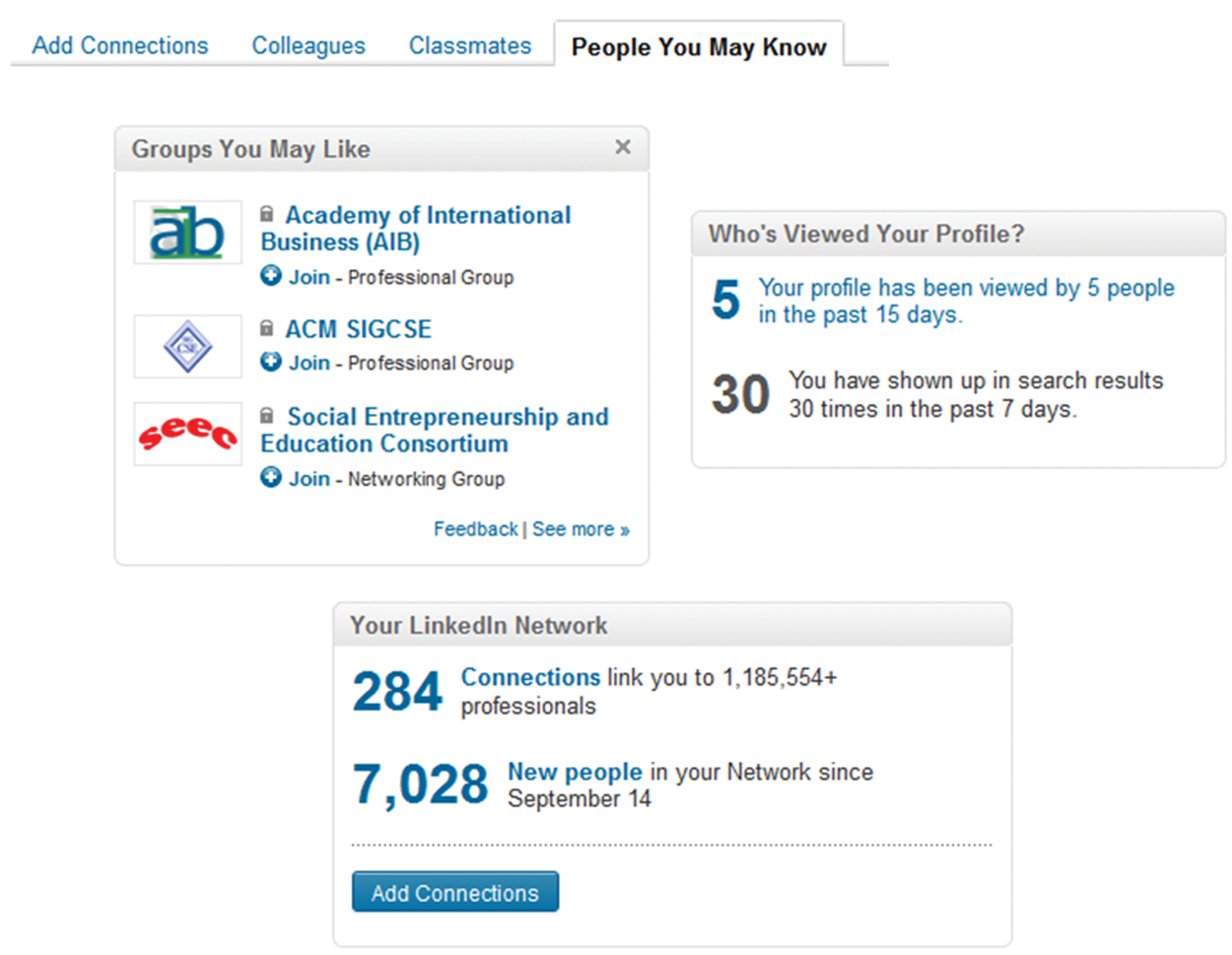
LinkedIn exploration and network advancement mechanisms
Assignment 3: SNS Introspection and Career Building
The third assignment (see Table 3) is an end-of-semester assignment primarily designed to encourage student introspection while collecting data relevant to that introspection. Assignment 3 is completed via an instrument that contains both a survey and a set of semistructured reflection questions. The survey asks about student professional networking activities and SNS preferences as well as experiences specific to LinkedIn. While questions examine current practices, and these are revealing in themselves, the activity also spurs additional networking on the part of most students as they rigorously examine the professional SNS one last time before graduation.
Assignment 3: SNS Introspection and Survey

NOTE: SNS = social networking system.
Assignment 3 also requires an understanding of the professional networking site’s basic functionality. This includes a personalized outline that includes a “Who’s Viewed My Profile” feature that lists how many people from which professional groups viewed the member’s profile within the last 30 days, and an invitation to “Job Search,” which many students accept even when not actively seeking employment. As students answer questions about SNS functionality, they are better able to assess the utility of that functionality to their own experience and may revisit the LinkedIn site with that new perspective (Figure 3).

LinkedIn introspection, career management, and job search
The main learning goal of the end-of-course survey is introspection and reflection, which I assume leads to more comprehensive use of job resources. However, the survey also asks students to consider and share various experiences listed above. The students’ responses to Assignment 3 facilitate their own synthesis of highly related topics—networking, job search, career building, online tools, preferences, motives, experiences—that should, at this point, be very clear when they discuss which SNS activities were most useful to them. The survey includes an examination specific to the LinkedIn SNS introduced and used throughout the semester. So introspection and the reporting of experiences are designed to reciprocally support one another.
Exploratory Data Collection and Analysis
Qualitative and quantitative data were collected online for all sections of the capstone strategy courses in which the LinkedIn exercises were given from 2009 to 2010. This provided 154 individual responses with a 100% response rate. Students were asked to complete the survey voluntarily but were also provided with an extra credit incentive. Demographically, 52% were female, 48% male—between the ages of 20 and 52 years with 86% White, 2.7% Hispanic, 5.3% Black, 1.3% Asian or Pacific Islander, 1.3% American Indian or Alaskan Native, and 3.3% other. All were business majors taking the capstone business strategy course at my university.
One set of questions was designed to better understand student SNS activities in general, features found to be most important, and the extent to which students engaged in relevant SNS activities. Another set of questions asked about LinkedIn experiences, job features used, and the level of importance of certain key LinkedIn features. All questions used former SNS studies, especially the Pew Internet and American Life Project (Boase, Horrigan, Wellman, & Rainie, 2006; Lenhart, 2009; Lenhart et al., 2010) as a model. However, specific survey items were crafted to represent current SNS and LinkedIn capabilities since it was their use that I sought to better understand. As functionality increases or changes, or as instructional goals change, so too should specific survey items to better reflect the measurement of key objectives and key SNS functions.
Desirable General SNS and Professional Networking Characteristics
My first two questions were open-ended short response designed to better understand the importance of certain SNS and LinkedIn characteristics and to better understand potential motivation for their usage. In response to Question 1—“What key things would you look for in a social networking site?”—a number of students responded that security and privacy (33), ease of use (31), linking to people they know (20), and job information (15) were among their top desired characteristics. In response to Question 2—“What things would you look for most on a professional networking site? What features would you expect to see?”—a number of students responded that job listings (41), company profiles and contacts (20), professionalism (18), and networking capabilities (18) listed among their top features. A full set of coded responses and counts above five can be found in Table 4. Perhaps not surprisingly, students prioritized very different characteristics for each question. Looking at Table 4, several items stand out for their apparent importance and potential influence on other items that were examined by this study. For example, safety, ease of use, and site popularity show up in the lists of both Questions 1 and 2. All can be hypothesized to affect general SNS usage as well as usage of LinkedIn in particular, but any conclusions were beyond the scope of this study. I was more interested in understanding actual student use of these newly adopted tools. However, these responses, and others in Table 4, point to important factors worthy of examination in future studies.
Desired General and Professional SNS Characteristic Counts

NOTE: SNS = social networking system; N/A = not applicable.
Student Engagement in General SNS Activities
Question 3 asks students the extent to which they engaged in various general SNS activities. Again, these were developed using Pew Internet and American Life questions and informed by the functionality of various SNSs. Table 5 contains the summary activities and results, measured from Very Seldom to Very Often, with a N/A option for students who never engaged in those online activities. The data reveal that students most frequently—from Occasionally to Very Often—search for individuals they know (82.7%), connect with others (79.9%), search for information (77.9%), and create a profile (63%). Students least frequently—from N/A (or not online at all) to Seldom—publish articles (79.9%), publish opinions (67.3%), publish their own commentary (65.4%), and join local groups (62.3%). Therefore, students appear accustomed to engaging in searches, connecting with others, and creating some form of profile. They are not accustomed to publishing articles, opinions, or even commentary that may help establish dialogues that can aid in connecting with persons interested in similar topics. They also engage least in joining local groups that may help establish or grow local community links and opportunities. This is somewhat surprising because Gen Y students are viewed as being among the most connected students in history. Yet, according to my findings, they prefer very individualistic activities rather than tending toward the group or communal opportunities available through the SNS. Similar results are found in the next section.
Student Engagement in General SNS Activities

NOTE: SNS = social networking system; N/A = not applicable.
Student Engagement in SNS Career Building Activities
Question 4 asks students the extent to which they engaged in various professional development or career-building activities online. This set of questions was developed using SNS features and was also influenced by typical career services activities such as those found in career service centers. Table 6 contains the summary activities and results measured from Very Seldom to Very Often, with a N/A option when those online activities were not engaged in at all. The data reveal that students most frequently—from Occasionally to Very Often—look for jobs (80.1%), look for persons they know (73.7%), research job or employment types (73.0%), and research companies (72.4%). Students least frequently—from N/A (or not online at all) to Seldom—register with groups for job search reasons (60.4%), register with groups for career-building reasons (59.9%), research internships (55.6%), and look for internships (55.0%). Students therefore engage in many activities familiar to general SNS activities (compare with the previous section) but forego registration with established groups that could help build their networks in meaningful ways and do not take advantage of potentially meaningful internship searches. Again, this is contrary to assumptions made about Gen Y students.
Online Professional Development Activities

NOTE: SNS = social networking system; N/A = not applicable.
LinkedIn Job Search Features
Question 5 asks students to select all LinkedIn job search features they have used or currently use. Students were to “click all that applied” so responses were cumulative. This set of questions was developed using features specific to LinkedIn. Table 7 contains a list of these cumulative responses. Of all respondents, 90.4% created a profile (which goes beyond the basic first assignment of simply signing on to LinkedIn), 80.7% updated their profile, 79.3% looked for people they know, 55.6% used the job keyword search, 44.4% looked at people who looked at them, and 39.3% looked at companies in their network. These top percentage social network activities suggest that beyond completing the basic assignment, signing in, and establishing contact, students were using the LinkedIn tool to create, revisit, and refine their own profiles. They were using job, person, and network searches, which better connected them to their most relevant network resources. Students were also interested in who was looking at their profiles. This had the effect of providing students with an external perspective on the types of individuals drawn to their current profiles through various means such as a search, for example, and is consistent with past research (Backstrom, Huttenlocher, Kleinberg, & Lan, 2006; de Janasz & Forret, 2008; Ellison, Steinfield, & Lampe, 2007).
LinkedIn Job Search Features

NOTE: SNS = social networking system; N/A = not applicable.
Other equated to N/A in all cases.
Students used a variety of other LinkedIn search activities to a slightly lesser degree; these included looking for people in a network of interest (40.0%), looking up companies in their network (39.3%), and using the regional job search (36.3%). Some even joined groups (35.7%). Even less frequently used were the more involved activities of asking for a recommendation (23.7%), using the advanced job search (23.7%), looking at the number of times they appeared in a search (23.0%), giving recommendations (17.0%), and creating a group (5.2%). All these activities require greater energy expended in personal commitment, reflection, or exploration of the site and this may have accounted for the decreased percentages. A small percentage (4.4%) found all these activities inapplicable to them. This could have been related to their limited use of site functionality beyond signing in, or to trust and security issues mentioned by many respondents in Table 4 (the “Desired Characteristics” response). A few students expressed discomfort in using SNSs and the LinkedIn SNS. But most found their exploration to be a positive experience.
One student described her ongoing experience as follows:
My first impression of LinkedIn was a bit skeptical. I assumed it would be the typical MySpace or Facebook networking website. However, I realized that LinkedIn could be a portal into extensive networking and job research. I networked with more than 6 classmates who shared the same interests as me. However, I also networked with people who I hadn’t communicated with before. I came across some profiles that showed educational and employment development. For instance, I visited [one student’s] profile and it represented his management abilities and leadership qualities within the retail business. I admired this because this type of quality is very useful when working in a business. In addition, I also took it on myself to research companies within human resource services as well as financial industries in order to get a feel for the current job market.
Another student described the development process as follows:
I tried to improve my profile by sampling other professionals and classmates. I have found many different tools to enhance and modify my profile and improved it along the way. For example, I saw that one of my classmates had a recommendation from another classmate on her profile, so I then in return sent out a recommendation for another classmate to evaluate myself. I think positive recommendations from classmates or coworkers are a great way to improve your profile.
LinkedIn and Career Building
Question 6 focuses on career-building objectives and the extent to which LinkedIn helped students to achieve those objectives. These are listed from Strongly disagree (1) to Strongly agree (5), including a N/A option for those not engaged in LinkedIn and the online SNS tools. Table 8 contains a list of possible objectives and their ratings, many of which emphasize the introspective goals of Assignment 3. That is, it was expected that working within the networked LinkedIn environment would naturally cause many students to think about their professional “self” and to behave in more proactive ways. In general, this was a passive approach in that I expected that mere contact with and use of the tool might result in increased professional awareness (Whiting & de Janasz, 2004). This approach had mixed results. Students found LinkedIn most helpful (Agree to Strongly Agree) in thinking more about their careers (68.6%), thinking more about their professional images (67.3%), valuing people as an important career asset (66.0%), and taking greater advantage of available resources (65.8%). In summary, members thought more about how their professions related to them personally; thought more about what they wanted from their careers, professions, and future jobs; and thought more about resources available to accomplish their goals.
LinkedIn and Career Building

The following are a few examples:
For my LinkedIn profile I have updated it to match what it is I am looking for in a job, listed my previous jobs, and described who I was. I plan to find other people that match my interests for some help and guidance with my future job choice. I have also asked for recommendations. I have been exploring LinkedIn more, and looking through other contacts’ profiles, both professional and nonprofessional. Doing this has helped me get a general idea of where I stand, and what kind of information is important to my success, and the direction I want to take. I am starting to learn that people quickly respond to the military background, so I decided to use my military experience to my advantage, and make that a significant aspect of my profile.
LinkedIn was least helpful (Strongly disagree to Neither disagree nor agree) in aiding students to view themselves as important resources for others (35.9%), be more competitive (35.3%), better express their areas of expertise (33.3%), and develop their professional networks (32.7%). These last figures are somewhat surprising since one of the implicit goals of the exercise was to better enable students to express their areas of expertise and build a better network based on that understanding. These were, in fact, a couple of the main goals of developing a professional profile. Additionally, one explicit aim of professional SNSs is the development of a professional network, yet nearly one third of the students sampled felt that LinkedIn was least helpful in achieving this particular goal. My recommendation is to provide a more active introduction of the LinkedIn SNS combining more discussion surrounding the effective use of a professional SNS and the clear identification and development of a listing of professional capabilities. In fact, combining a more active introduction of the SNS with a skills inventory or personal skills assessment that would serve as a student introduction to their professional self—so they view themselves as contributing professionals—might be highly effective.
Importance of LinkedIn Features
A final set of questions was designed to better understand which SNS activities users valued the most from the LinkedIn system. This list of activities was developed from the LinkedIn website descriptions prior to the introduction of their new Learning Center multimedia videos (see Table 9). In terms of LinkedIn features students ranked “most important”—from Important to Very important—getting introduced to others (76.5%), being found for professional opportunities (77.0%), finding a job (76.7%), managing professional information (73.5%), and managing publicly available information about themselves (72.1%). In terms of LinkedIn features students ranked least important—from Very unimportant to Neutral—joining private groups (59.1%), closing a deal (57.0%), collaborating on projects (54.9%), sharing files (52.6%), and solving problems (48.5%). Finally, students found posting job listings (23.8%), finding the best talent for their company (22.8%), closing a deal (16.4%), and gathering data (15.4%) as Not applicable.
Importance of LinkedIn Activities

In summary, a large percentage of students cared about searching for or otherwise availing themselves of professional opportunities and managing publicly available professional information. The largest percentage of respondents found activities such as collaboration, sharing, and solving problems to be least important. A large number of respondents found features such as posting job listing for their companies (19.2%), finding the best talent for their companies (18.5%), closing a deal (14.0%), and gathering data (13.2%) as simply not applicable. Therefore, students seemed to leverage LinkedIn affordances of communication and identity management but took least advantage of information sharing and community building mentioned in prior research (Boyd & Ellison, 2007; Haythornthwaite, 2005). This indicates that the student experience, when left to independent exploration, may not use the technology to its fullest advantage or may opt out for a number of reasons, including unfamiliarity, discomfort with the technology, fear, low self-esteem, or distrust (W. E. Baker, 2000; de Janasz & Forret, 2008). It also indicates that certain barriers exist between the Gen Y student and the technology that, contrary to commonly accepted wisdom, remain to be overcome.
One student described his information management effort as follows:
I have added some classmates from [the business school] as well as some coworkers that I have worked with in a previous job. After looking at some other classmates profiles, mine seems pretty bare and I have realized to take full use of this site I should add some more information about both myself and previous employment. I also have added some people from a network that I wish to speak to, to get some inside information about a current job opportunity I am looking at for after graduation.
Conclusions
The main goals of this article were twofold: first, share the evolution of three assignments designed to more closely connect students with their professional selves and their peers; and second, share actual use data surrounding general SNS and professional SNS needs, student engagement in general SNS use, student career-building activities, LinkedIn job search features, LinkedIn and career building, and the importance of LinkedIn features. Although I met both these goals—and I believe doing so helps other instructors’ ability to generalize to their own courses—my assignments are currently constrained by the confines of capstone strategy courses and SNS functionality.
I offer two recommendations. First, careful examination should be given to the assignment instructions and goals to more closely customize these to any course where the adoption of these assignments is under consideration. For example, I used a very passive approach to encourage self-guided exploration. Students were asked to engage in SNS use unguided by me, so they could encounter personally relevant experiences and SNS functionality. My assumption in doing this included greater personal relevance and greater learning. Research also suggests that technology is often helpful for those who are introverted or uncomfortable with face-to-face networking (Whiting & de Janasz, 2004). But there were obvious deficits in SNS understanding because of this approach. For example, in career building students did not possess, after exploration, a greater sense of their own worth in a network, a greater sense of their own competency, nor better express their areas of expertise. This was a disappointment since I was certain that engaging in various career-building activities would lead naturally to these outcomes, especially given research on the Gen Y demographic. I would, in future assignments, provide additional instructional support for these areas so that a more active approach to networking was employed (de Janasz & Forret, 2008; Friar & Eddleston, 2007). I would also include a skills inventory or discussion on professional worth such that students were “primed” to see themselves as useful contributors to the professional arena.
Second, I would reexamine SNS and LinkedIn functionality since this changes in subtle ways over time. That is, although their general functionality remains the same and SNS professional goals are fairly constant, features do change which may address weaknesses or create others. For example, in December 2010, I examined the LinkedIn site again to observe that some of the textual instructions had been replaced with more professionally designed multimedia tutorials. Such tutorials may, as I said, address some of the weaknesses of the LinkedIn tool described in this study. In fact, a multimedia approach is more likely to address multiple learning modalities, meeting the needs of a diverse audience. This is just hypothesis, however. Whatever the case, I recommend that future surveys incorporate either additional functionality or focus only on functionality specific to the course assignments and learning goals. My surveys contained some items that were functionally relevant but less relevant from an instructional perspective. I therefore recommend that any potential adopter begin with a survey that asks semistructured and open-ended questions that will help assess general social networking, specific social network (e.g., LinkedIn), as well as job- and career-based course objectives.
In my school, the career services center serves many functions but has a limited budget, is short of personnel, and, as my research revealed, students typically avail themselves of resume and interview workshops only—despite the presence of other products developed by the center. I found that part of this problem appears to stem from great student uncertainty about who they are as professionals and, thus, an inability to conceive of the advantage these services could provide them professionally. I firmly believe that the identification of a professional self is a key element in job-search and career-building success. But I also suspect that much is going on here from an identity, career services, and psychological perspective that I did not investigate. Future pedagogical, social network, or professional studies would help greatly in a practical and research sense by adding key variables to this study. I found that the use of a free social networking site dedicated to professional issues significantly helped my resource-poor situation, while the structure of these assignments aided students’ sense of professional self in some ways (but not in others). Greater advantages are undoubtedly possible with a greater understanding of the fine details underlying these tools and student experiences and greater inclusion of active networking exercises (de Janasz & Forret, 2008; Friar & Eddleston, 2007; Whiting & de Janasz, 2004).
Finally, regarding future research, my study was exploratory in nature and was designed to test whether or not I was meeting certain course goals given the adoption of the professional SNS as an instructional resource and tool and to see exactly who was using the LinkedIn tool and for what purposes. Although it was beyond the scope of my research, I became quite interested in how this appeared to affect key consequents of SNS use, namely, benefits to communication, information, community, and identity (Boyd & Ellison, 2007; Haythornthwaite, 2005). Though much of my quantitative and qualitative data supports previous research, I did not examine in-depth details specific to students’ communication learning outcomes or sense of community. For instance, I did not measure whether or not students felt a greater sense of community with their class and professional peers after using the SNS. Interestingly, though, evidence seems to suggest that my Gen Y students were more comfortable with individualistic activities and avoided the more community-based options when left to their own devices.
Past research suggests that SNS appeal is based, in part, on perceived benefits in terms of communication, information, community, and identity (Boyd & Ellison, 2007; Haythornthwaite, 2005). I believe these would make for interesting and useful advances in better understanding SNSs, including how their characteristics help advance important learning goals. For communication, SNSs provide an environment for various exchanges to take place. They facilitate and encourage such exchanges. However, they do not, according to this current study, guarantee communication across all SNS functions. For information and its management, SNSs can make information more accessible as well as provide unique, superior, and often reciprocal information sharing (Acquisti & Gross, 2006; Skog, 2005). Yet students are often uncomfortable sharing certain information, thus impeding information flow and stunting SNS function use.
SNSs create a sense of community (Boyd & Ellison, 2007) by providing and maintaining place- and professional-sense (Backstrom et al., 2006; Ellison et al., 2007) and connected presence (Licoppe & Smoreda, 2005). For example, a professional SNS includes items of interest to the professional, such as groups, events, meetings, and unique content creating niche communities and transforming “traditional neighborhood- and village-based groups to geographically dispersed social networks” (Boase et al., 2006 p. i; see also Hampton, Sessions, Her, & Rainie, 2009). Such a site with identifiable content and a tangible identity therefore creates a feeling of place. However, a feeling of community is likely affected by the active use of certain SNS functions and, again, is likely affected by the extent of information sharing just mentioned. Additionally, contrary to popular belief, Gen Y students do not appear to tend naturally toward easily available community-based activities. Although they may do so more than past generations (an assumption untested in this article), they do not appear to do so easily or naturally.
Finally, such community requires that users at least establish an elementary professional identity and, after its establishment, that users promote that identity while it evolves and members’ awareness of their identities increases (Sunden, 2003). The student exercises I describe were repurposed to increasingly support better communication, information sharing, involvement in professional communities, and especially to establish a sense of professional identity. I especially recommend examining these constructs in conjunction with SNSs to better understand how they affect SNS use. For example, students did not appear to possess a strong sense of professional self such that certain functionality within the SNS was essentially ignored or underutilized. They simply did not make a connection between their own professional worth and professional community-building activities. It may be that a lack of professional self inhibits such expression by the students, a question that future research may unravel.
Footnotes
Acknowledgements
My thanks to Reena E. Lederman Gerard, instructional designer, and two anonymous reviewers for recommendations to this and earlier drafts.
Declaration of Conflicting Interests
The author(s) declared no potential conflicts of interest with respect to the research, authorship, and/or publication of this article.
Funding
The author(s) received no financial support for the research, authorship, and/or publication of this article.