




Abstract
A Model of Authentic Becoming that conceptualizes learning as a continuous and ongoing embodied and relational process, and uses social constructionism assumptions as well as Kolb’s experiential learning model as its point of departure, is presented. Through a focus on the subjective, embodied, and relational nature of organizational life, the assignment presented in this article provides a structure to facilitate students becoming more effective and authentic organizational members and self-authors. Learning outcomes also include the development of self-understanding, empathy, and the ability to engage in practical reflexivity and self-reflection. Students incorporate organizational behavior concepts and theories meaningfully into their writing and lives. Additional learning and the improvement of the classroom learning environment are facilitated through students verbally sharing their assignments in class with one another.
Keywords
We only divorce “theory” from the world and practice when our ideas have begun to mask rather than enhance life. It is only when we have lost touch with the world that our minds seem to operate in an “ideal” sphere of their own. For this reason . . . If our ideas are tied to life and action, then can we always ask of any idea: What type of life does it serve?
As we think and act, so our world becomes.
Contemporary managers face the daunting task of effectively coordinating the actions of organizational members whose background, language, culture, and skill levels vary widely. This must be accomplished in a world of increasing flux, complexity, and contingency. In this environment, the ability to continuously learn from lived experiences, one’s own and others’, is key to being effective managers and organizational members (Bushe, 2009). Because of this, decontextualized and disembodied organizational behavior theories are becoming less meaningful in helping organizational members effectively navigate their organizational lives and improve their organizations.
That is, effective organizational behaviors depend not only on the goals of the organization but also on its context, including the individual organizational members’ relationships that guide their decisions about who to be and how to act when interacting with others. The behaviors of setting goals, monitoring progress toward those goals, and assessing reasons for falling short are needed before corrective action can be taken (Hitt, Black, & Porter, in press). Thus, management educators need to help students learn how to learn from their experiences—particularly from those that had a less-than-satisfactory outcome.
Authentic becoming is conceived as a proactive process in which one continuously develops one’s self-awareness of and movement toward one’s ideal self. This ideal self is not fixed. It continuously develops based on one’s experience. Authentic becoming requires a continuous conscious development of one’s ideal self by creating and adhering to self-disciplines (Sterner, 2005). Thus, authenticity is understood not as a destination to be achieved but as a continuously evolving process of becoming (Bergson, 2007).
The assignment presented below facilitates students’ self-development and the improvement of their organizational behavior, as well as their understanding of organizational behavior concepts and theories. It puts the learner’s experience at the center of his/her learning. The assignment provides each student with a personalized, vivid, and relevant “case” illustrating both textbook organization behavior theories (Gutiérrez, 2002; Litvin & Betters-Reed, 2005) and the ways in which one’s own thoughts, feelings, wants, perspectives, actions, and words co-construct his/her organizational reality within his/her unfolding relationships with others (Bushe, 2009). Engaging in the assignment, students become self-authors who create meaningful knowledge and a new conception of themselves that will help them make a difference in their organizations (Baxter Magolda, 1999; Baxter Magolda & King, 2004; Kegan, 1994).
Model of Authentic Becoming
The Model of Authentic Becoming builds on previous management classroom uses of reflection in two ways. First, it asks students not only to recall an experience cognitively, making sense of what happened to them by objectifying it (Miller, 2004; Waddock, 1999), but also to pay attention to what it felt like to move through and within (Cunliffe, 2004) the experience. What the cognitive approaches to reflection emphasize is the process of detaching oneself from one’s experience in order to see more objectively what happened and how the outcomes might be improved. The Model of Authentic Becoming does this as well. However, by including practical reflexivity, it also asks the students to step into an experience and relive it from their own thoughts, feelings, wants, and sensory experiences and from an imagined inner perspective of another person (Dugal & Eriksen, 2004).
Because the Model of Authentic Becoming employs social constructionism suppositions, the level of analysis shifts to the relationship between actors rather than at the individual level. The ultimate focus of Model of Authentic Becoming is to facilitate the conscious development of who one wants to continuously develop to be within one’s relationships with others. The model facilitates one’s relational, authentic becoming. Thus, rather than searching for knowledge (Scott, 2010), learners develop new ways of being in relationships with themselves and others through making decisions and taking actions to influence their continuous process of becoming.
This assignment used Kolb’s (1971, 1984) widely known model of adult learning (Figure 1) as its point of departure. The topic of reflection, one of the four steps in Kolb’s learning model, has primarily been addressed in the literature as a practice to deepen student learning by making it more personal and thus more engaging. Following Schön (1983), the desired outcome of student learning through reflection is to build the skills needed by a reflective practitioner.
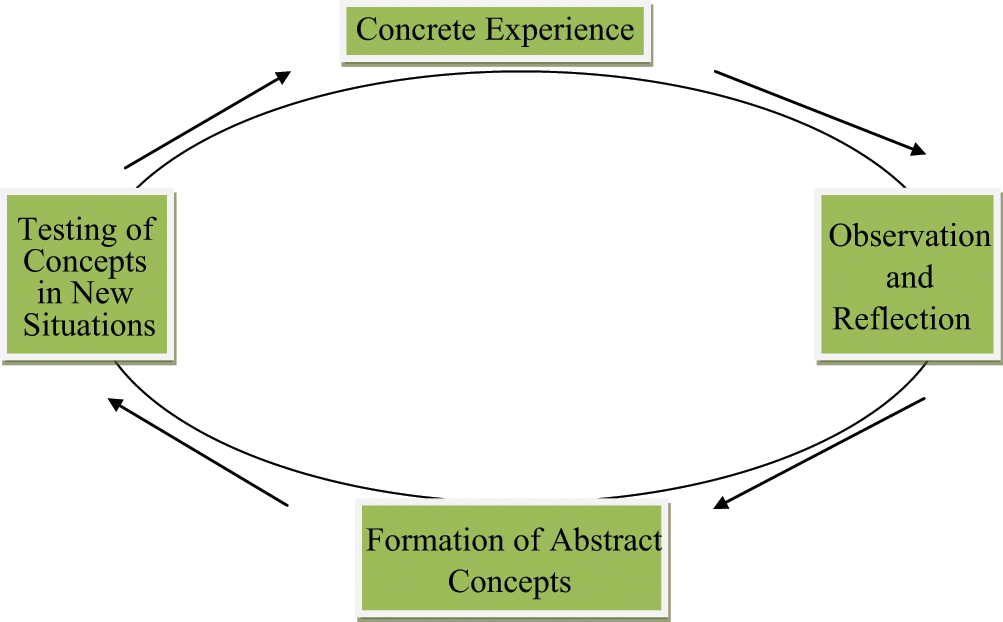
Kolb’s experiential learning model
Specific classroom uses of reflection vary. Hedberg (2009) maps out some differences, including differences in what students are asked to reflect on: the subject matter of the course, what one learns about oneself, and broader societal implications such as of the use of power and inequality. Other choices for engaging in reflection include the level of analysis (individual, group, organizational), method of discovery (private or collective), and timing (before, during, or after the experience). In addition to examinations of student learning, reflection articles in the teaching literature also include ways that the teachers themselves reflect on their teaching practices (Reynolds, 1999).
Kolb’s model tells a never-ending story of learning in which a particular experience takes place that presents a learning opportunity, indicated by the box designated Concrete Experience. Interpretations are made regarding whether this experience is routine or unexpected. It is particularly the unexpected within our experience that requires sense making (Bruner, 1990). In this model, Reflective Observation leads to the Abstract Conceptualization part of the learning cycle, in which ideas, concepts, and theories help the learner to make sense of his/her experience and identify opportunities for intervention and change. Then, as new approaches are imagined, drafted, and planned, the model turns attention to Active Experimentation, which gives rise to new concrete, lived experiences to be interpreted as expected or unexpected, thus renewing the cycle of learning. With Kolb’s model, the ultimate goal is the creation of instrumental cognitive knowledge.
Of course, any model is a simplification of what it represents. Although learning from experience does not often occur in a neatly cyclical fashion (Jeffs & Smith, 2005), it still requires reflection on what happened and one’s part in what happened. As Schutz (1967) points out, the ongoing stream of lived experience has no meaning until it is looked back on. Learning when engaging in reflection on experience occurs when individuals “are able to disengage themselves from a situation and analyze it in a rational and objective way. Essentially, this means thinking about experience and then applying our ideas and models to practice” (Cunliffe & Easterby-Smith, 2004, p. 33). Reflection allows us to “see things in a way they have not been understood before” (Scott, 2010, p. 433).
Keeping the focus on the ways that individuals collectively cocreate knowledge, identities, and appropriate behaviors, social constructionism assumes a unity of being and knowing, a collapsing of ontology and epistemology (Shotter, 1993). The process of learning is still from experience, but the outcome shifts from learning about and from one’s circumstances to becoming someone different. Such learning involves looking at ourselves as active participants in the construction of the world we experience as outside of ourselves. Cunliffe and Easterby-Smith (2004) refer to this self-referential complex of attention to one’s thoughts, wants, emotions, body, and role in creating one’s self and circumstances as practical reflexivity. How we think, want, feel, and observe affects how we behave in our relationships with others and others’ responses to us and thus how an experience unfolds (Brothers, 2005; Bushe, 2009). Learning from others’ responses to our own behaviors, we come to realize that we can anticipate possible problems and so plan our own behavior accordingly. In this way, insofar as behaviors are carefully considered and planned, rather than reactive to external stimuli, they can be considered to be strategic. Ben Franklin, for instance, created a daily checklist of the specific behaviors in which he needed to engage so as to embody his key virtues (Haidt, 2006).
The essence of an individual’s organizational life is a continuous movement through experience in relationships with others. On a practical level, organizational members can learn when their embodied, relational experiences are examined, together and separately (Bushe, 2009). “Whereas reflection encompasses learning by reflecting on experience, reflexive approaches embrace learning in experience” (Cunliffe & Easterby-Smith, 2004, p. 31). Practical reflexivity deepens reflection by “interrogating the taken-for-granted by questioning our relationship with our social world and the ways in which we account for our experience” (Cunliffe, 2009, p. 45).
Practical reflexivity is a form of existential questioning, a self-questioning. Like reflection (Schön, 1983), it can take place in the moment of action or retrospectively. Practical reflexivity allows us to understand ourselves and our ways of relating to others in order to best participate in our social world (Cunliffe & Easterby-Smith, 2004). It allows us to choose who to be and how to act and speak. Through the questioning of our beliefs, assumptions, emotions, and wants, we are challenged to consciously take into account how these affect how we relate with others and construct our experienced reality in our day-to-day life.
In the Model of Authentic Becoming, learning requires an active exploration of one’s self in relation to others (Chia, 1996; Cunliffe, 2002). Rather than assuming that there exists an objective reality from which we are separate, social constructionism assumes that realties are socially co-constructed within our relationships with others (Cunliffe, 2004; Hacking, 1999). Relationships enable and constrain behaviors and actions (Shotter, 1993). Knowledge is created and sustained in our daily interactions with others (Berger & Luckmann, 1966), as are our identities and experienced reality (Shotter, 1993). To incorporate practical reflexivity, Kolb’s model was therefore adapted into a Model of Authentic Becoming (Figure 2) to account for the change in one’s being that accompanies learning (Cunliffe, 2004; Hacking, 1999; Shotter, 1993). The resulting model includes practical reflexivity, which pays attention to the embodied, relational, subjective, and intersubjective nature of the organizational experiences that its members co-construct (Cunliffe, 2002).
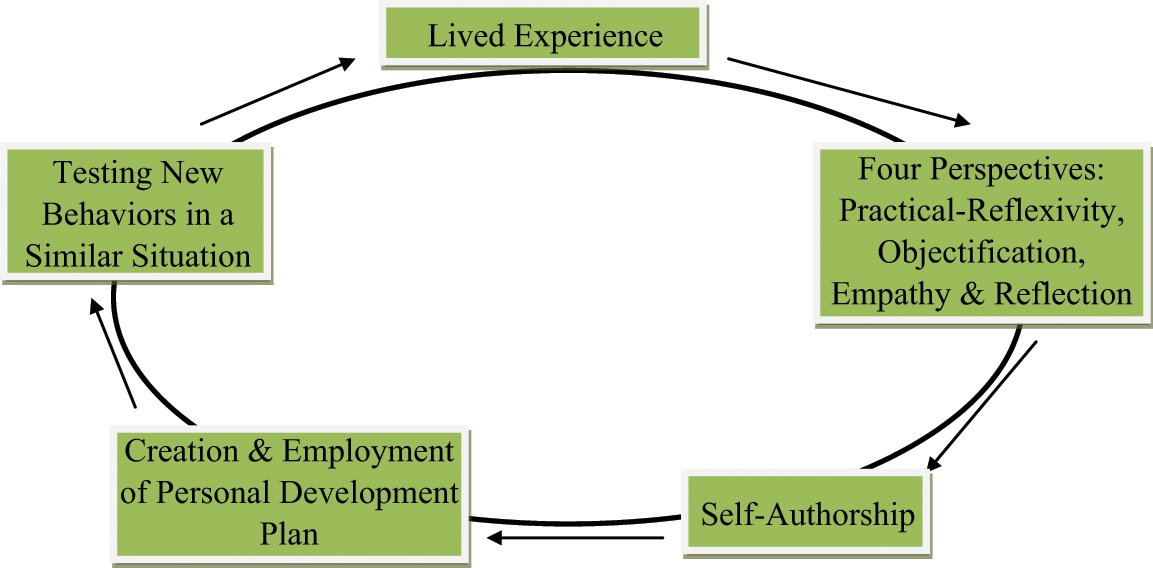
Model of Authentic Becoming
The Model of Authentic Becoming focuses on a relational understanding of organizational experience rather than on the solitary understanding of self-reflection (Gergen, 2009). The unit of analysis is the quality of interactions among people rather than the individual’s experience of the interaction. In this way, the model takes learning beyond a purely cognitive and conceptual activity to one that facilitates learners being different and engaging in different behaviors in their relationships with others; it facilitates learners’ becoming.
The Model of Authentic Becoming requires that an experience be viewed from multiple perspectives: practical reflexivity, objective, empathetic, and reflection. Practical reflexivity facilitates one’s awareness of what it was like to live the experience rather than simply developing one’s cognitive understanding of the experience (Cunliffe, 2004). As learners articulate their understanding of the situation, others, and themselves, they learn how to script future words and actions—they become self-authors (Baxter Magolda, 1999; Baxter Magolda & King, 2004; Kegan, 1994). A brief rationale for each component of the model is offered below.
Lived experience
This is an experience that unfolded in an unsatisfactory way and from which the learner believes he/she can learn how to behave in a way that will lead to more positive outcomes in future situations. Self-directed change is provoked by dissatisfaction with one’s current situation (Higgins, 1987), based on which one partakes in autonomous and purposeful action to change (Boyatzis, 1994, 1995; Kolb, 1970; Rhee, 2003).
Self-awareness is a state of awareness of a discrepancy between one’s ideal self and one’s current self (Duval & Wicklund, 1972). The mere act of identifying such a situation is a first step in overcoming the hypocrisy and judgment that damages relationships (Haidt, 2006). In the context of the organizational behavior course, these lived experiences are closely related to what McNeely calls management incidents, articulation of which increase students’ reading of assigned materials, class attendance, and interest in the course (McNeely, 2000). To more broadly and deeply understand the lived experience, the learner examines and writes about it from four different perspectives: practical reflexivity, objective perspective, empathetic perspective, and notion of reflection.
The four perspectives
As outlined above, practical reflexivity examines the consequences to others of one’s thoughts, feelings, and wants in order to build the awareness of what it was like to live in the experience. With the objective perspective, learning is arrived at through an objectification of experience in which “there is a reality to be discovered and concrete objects we can think about measure, categorize, and develop theory to explain” (Cunliffe, 2009, p. 44). Thus, an objective description consists of identifying the actions taken, the words spoken, and the objects in the space where the experience unfolded.
Because we are beings whose lives unfold in relation to one another (Gergen, 2009), the empathetic perspective asks the learner to become aware of how others are subjectively experiencing and co-constructing the experience with us. The fourth perspective, reflection, draws on Kolb’s notion of reflection to ask the learner to use ideas, concepts, models, perspectives, and theories to make sense of his/her experience. In the context of an organizational behavior class, reflection is the process of seeing how the experience both is supported by and challenges the theories and concepts presented in the textbook.
Self-authorship
Self-authorship is a movement from an external to internal self-definition that occurs in relationships to experience, others, and oneself (Baxter Magolda, 1999). Based on what they have learnt from taking multiple perspectives, learners become self-authors by selecting beliefs and determining who to become in relationships with others (Baxter Magolda, 1999, 2001; Kegan, 1994), in the context of, but separate from, the thoughts and feeling of others. A self-author makes up his/her own mind (Baxter Magolda, 2001).
Personal development plan
Once the learners examine their lived experiences from the four perspectives and engage in self-authorship, they articulate in their personal development plan how they want to behave differently in similar situations in the future. Simply possessing a cognitive understanding that one needs to change one’s behavior is usually not enough to change one’s behavior, even in cases when not changing one’s behavior is life threatening (Prochaska & Velicer, 1997). Changing one’s behavior takes awareness and practice. The Model of Authentic Becoming asks the learner to plan how he/she will be different and engage in new behaviors in his/her relationship with others and the self-disciplines he/she will engage in to master these new behaviors.
Testing new behaviors in a similar situation
Similar to Kolb’s model’s phase of active experimentation, the learners test out these new behaviors. This new lived experience will allow the learner to assess the efficacy of his/her new behaviors. If the behavior leads to a desirable outcome, the learner can continue these newly acquired behaviors. If not, the learner may repeat the Model of Authentic Becoming cycle.
The Assignment: Applying the Model of Authentic Becoming in an Organizational Behavior Classroom
The assignment presented in this article, titled Facilitating Authentic Becoming (also available online at http://jme.sagepub.com/supplemental), was developed and based on an assignment in Osland, Kolb, Rubin, and Turner’s (2007) Organizational Behavior: An Experiential Approach, Eighth Edition, titled “Personal Application Assignment,” which was based on Kolb’s (1971) model of an adult learning cycle. The assignment was designed to deepen students’ learning by having them go through the steps and write up their responses to each of the steps in the Model of Authentic Becoming. It has been developed over six semesters in an undergraduate organizational behavior course at a liberal arts college in the northeast United States and recently successfully employed in an MBA Self-Leadership course. Because the Organizational Behavior course has become a requirement for all business majors, the students are predominantly second- and third-year students, with some students outside the business school taking the course in their final year of undergraduate study. Over the last three semesters, each course section size averaged 23 students. The assignment is detailed below and in the appendices. It is assigned two or three times over the semester.
Learning Objectives
Supportive of the goal of facilitating student’s becoming and consistent with the Model of Authentic Becoming, the assignment’s learning objectives are the following:
Better understanding of organizational behavior concept and theories
Increased self-understanding
Improved ability to make sense of the lived experience
Improved ability to learn from lived experience
Improved ability to empathize with others
Development of ways to improve their future organizational behavior
The learning objectives will be revisited during the upcoming discussion of student perceptions of their learning in the class.
Preparation by the Instructor
To prepare to use this assignment, instructors can read Cunliffe and Easterby-Smith’s (2004) chapter in Organizing Reflection titled “From Reflection to Practical Reflexivity: Experiential Learning as Lived Experience.” To deepen their understanding of the assignment, anticipate students’ questions about the assignment, and provide meaningful feedback to students, instructors benefit from completing this assignment themselves before using it in class. Doing so helps the instructor learn with and from students. Guidelines for sharing in class are provided below (see Appendix G) to help the professor and the students anticipate their roles in such a discussion and to create an environment of safety.
Preparation by the Students
Some students find it difficult to both to engage in and to write up a practical reflexivity essay. They have anxiety around engaging in practical reflexivity because of the uncertainty of their proficiency and, thus, their ability to earn a good grade. Therefore, it is important to create a supportive environment in which they can learn how to engage in practical reflexivity and practice, doing so with clear and supportive feedback from the instructor. Students are also provided with examples of the 14-page Facilitating Authentic Becoming assignments completed by previous students. The assignment is first given near the fifth week of class, and so in the first 4 weeks the students are required to submit paragraphs about their own lived experiences related to the concepts in chapters of the organizational behavior text. When writing these paragraphs, students employ practical reflexivity on which they receive feedback to help them understand and improve their ability to describe their thoughts, feelings, and wants and to articulate how it affected their behavior and how others respond to their behavior.
Students are reminded to make sure to read and understand the assignment and to set aside enough time to meaningfully complete it; this point cannot be emphasized enough. Prior to the due date, the first time they complete the assignment, they work during class time on the assignment, providing them with the opportunity to ask questions and come to understand how much time will be required to complete it. Even though the assignment’s sections are all due at the same time, students are strongly encouraged to write the practical reflexivity, objective, and empathetic descriptions in different sittings. Doing so helps them to clear their head of the previous perspective before moving on to writing up the next perspective on their experience and to writing their reinterpretation of the experience.
The assignment begins with an introduction (see Appendix A), which is followed by the five parts of the assignment: Practical Reflexivity, Objective Description of Experience, Empathetic Description of Experience, Reflection, and Behavioral Adaptations and Personal Development Plan (Appendices B -F, respectively). Finally, “Guidelines for the Sharing of Facilitating Authentic Becoming Assignments in Class” (see Appendix G) and a Grading Rubric for the assignment (Appendix H) are provided for the students. These sections of the Model of Authentic Becoming are described below.
In the first part, Practical Reflexivity (Appendix B), students identify an experience with another person or other persons that did not turn out the way they wanted or expected because of the way they behaved. In other words, it should be an experience that (a) had a negative outcome to which their interactions with another contributed and (b) pertains to the course concepts and theories. Students write in the present tense and first person (“I”) to describe their experience subjectively as it was unfolding from within their bodies and relationships with others. This requires that they articulate what they were thinking, feeling, and wanting during the experience and how these thoughts, feelings, and wants influenced how the experience unfolded, attempting to separate it from how they currently understand the experience.
The second part of the assignment, Objective Description of Experience (Appendix C), requires that the students objectively describe the identified experience by describing the “who, what, when, and where” of the situation. In other words, meanings, judgments, feelings, or intentions are not included. As Dragnet’s Joe Friday was parodied as saying, “Just the facts, ma’am,” this part of the paper should include just the facts.
The third part of the assignment, Empathetic Description of Experience (Appendix D), requires that students, to the best of their ability, describe how the other significant person(s) subjectively experienced the situation. As in the practical reflexivity part of the assignment, this description is to be written in the present tense and first person (“I”). Since most students tend to initially write the empathetic description from their own self-oriented subjective perspective, it is meaningful for them to ask a friend to give feedback on this section. At times, students have approached the person about whom they are writing the empathetic description and asked that person to describe the experience from his or her perspective.
For the fourth part of the assignment, Reflection (Appendix E), students use the concepts, ideas, and theories from the relevant chapters of the course text to reframe and reinterpret their experience in a way different than they subjectively experienced it. Then, based on their four different types of description, they articulate what they learned about themselves and the situation.
In the final section of the paper, Behavioral Adaptations and Personal Development Plan (Appendix F), students identify alternative behaviors in which they will engage when they experience similar situations in the future to create a more desirable outcome than originally occurred. Then they create a personal development plan to identify action steps that they can take to increase the probability that they will behave as they say they will behave in similar situations in the future.
After students complete the assignment, they spend a class period voluntarily sharing their assignments with one another (see the Guidelines in Appendix G). As one student stated, Through hearing everyone else’s experiences I feel it made us closer as a class. Being closer to a class, it was easier to work well with my partner for leading a class discussion and also easy to participate in class discussions because I felt like I was talking to my friends.
The Completed Assignments
Generally speaking, the amount of effort most students put into the assignment is impressive, judged by the on-average 14-page papers submitted two to three times and the number of hours that students report having worked on it. Asked to describe a situation that did not turn out as planned, students write about a broad range of experiences. Some experiences seem relatively mundane, such as disagreements and misunderstandings at work, interactions with significant others at home, or issues around balancing the multiple demands of school, work, and social life. Others describe major life-changing events, such as finding out a parent has cancer, a serious car accident, parents getting divorced, a parent losing his or her job, or getting oneself into legal trouble. Mundane or transformative, these experiences provide the material through which students reflect, empathize, analyze, critique, strategize, and ultimately increase their self-understanding and ability to determine who they want to become.
Based on their comfort level, students vary on the depth to which they express their thoughts, feelings, and wants. Especially on the first assignment, their level of self-criticalness varies. But the second time that they complete the assignment, the students increase the depth to which they examine themselves and their experience. After the mutual sharing of their first papers, students become more willing to accept their failings when they realize others are willing to do so too.
It is exhilarating to read the students’ articulation of what they learned about themselves after examining their experience from the multiple perspectives. After creating their developmental plan, students are challenged to employ it to transform their behaviors in the specific ways that they identified. After completing this assignment, and engaging in self-reflexivity postings and class discussions, students become individuals who think about themselves as their experiences unfold, increase their awareness of their choices about how to behave, and behave more consciously and strategically.
In effect, students are becoming different, particularly in their interactions with others. They undergo an ontological transformation, evidenced by changes in the language they use to make sense of and articulate their experiences: “I plan on continually working on who I am and who I am going to try to be” and “I am now taking accountability for my emotions and actions.” They become more aware of others: “Through the practical reflexivity assignments I have been much more aware of my behavior toward others.” They become more aware of themselves: “I am more in tune with my feelings and behavioral actions” and “I understand who I am and who I want to become.” They change their behaviors: In his paper, one student had written about how he had once in frustration and anger kicked over the garbage can in his apartment, denied that he had done so to his roommate, and gotten into a fight. The next time he aimed his foot at that same garbage can, he told the class later in the term, he cursed, “D . . . it, Professor!” because he was conscious of what he was doing and so had to stop. The student’s courage in becoming self-conscious and accountable to himself and others brings me great joy. I am happy to be able to facilitate an experience that helps students learn to continuously improve the quality of their lives, their relationships with others, and the world they co-construct.
Student Feedback
To systematically assess the value of this assignment and its efficacy in achieving its stated learning goals, student surveys were administered at the end of the 2009 and 2010 fall semesters. The students had completed the assignment three times in the fall of 2009 and two times in the fall of 2010 before taking the survey. It was administered at the beginning of one of their class meetings, and participation was voluntary and anonymous. All students in attendance filled out the survey. In the fall semester of 2009, out of the 38 students enrolled in the course, 36 responded to the survey, for a response rate of 95%. In the fall semester of 2010, out of the 47 students registered in the course, 42 responded to the survey, for a response rate of 89%. Appendix I is a listing of the survey questions and student responses to the close-ended questions. In this appendix, I have compiled the data for each semester and the two semesters combined. The closed-ended questions employed a scale of strongly agree, agree, disagree, or strongly disagree. When students completed the survey, the assignment was titled Practical Reflexivity, Reflection, Empathy, and Personal Development Plan rather than its present title—Facilitating Authentic Becoming.
In both semesters, students reported that the assignment met the course objectives; was meaningful to the development of their understanding of organizational behavior; helped them better understand organizational behavior concepts and theories; was an effective use of their time; increased their self-understanding, empathy, and ability to make sense of and learn from their lived experience; and allowed them to develop ways in which to improve their future organizational behavior. Responses to the open-ended question also reflected positively on the course assignment. Below, I highlight the questions that address achievement of the assignment’s six learning goals (in italics below) and include some sample student comments.
Nearly all students agreed that the assignment helped them better understand organizational behavior concepts and theories: Through this assignment I learned that the textbook terms really can relate to my everyday life. In many classes, I dread reading the textbook, but because of the way we related the terms to our lived experience I was better able to appreciate the textbook terms. [The most meaningful thing I learned was] how to properly implement the organizational behavior concepts into my daily life, and how I could change my course of action in the future so that this mistake doesn’t happen again.
All the students agreed that through completing this assignment they increased their self-understanding: I learned a lot of the real causes of my actions, and they were different than what I thought they were. The most meaningful thing I learned from these assignments was the actual effect of my actions on others. I can now see that my attitudes and actions toward others have a lot greater impact than I previously thought. The most meaningful thing I learned from the assignment is what my personality is like and how situations are affected by it. Mostly I learned about dealing with my emotions.
All the students agreed that this assignment improved their ability to make sense of their lived experience: It was interesting that events that I thought I knew everything about the situations, I was only seeing the tip of the iceberg and there was plenty more to learn. [I was] able to analyze life events that may not seem too meaningful and discover meaningful life lessons behind them.
Nearly all students agreed that the assignment improved their ability to learn from their lived experience: It improved my ability to learn from my lived-experiences. I have had many conflicts in my life that I have just put behind me and almost forgot about. This was an opportunity for me to learn from my past experiences so that I can do better in other similar situations throughout my life.
Nearly all the students agreed that the assignment improved their ability to empathize with others: What I found most interesting was the part when you put yourself in another person’s position. The empathetic part was what made me think about my actions in a different perspective which was very helpful in my understanding. The most interesting part of the assignment for me was looking at the event through the other person’s eyes. Being able to understand how they feel showed my errors during the event. Writing the empathetic perspective because it forced me to evaluate my behavior through someone else’s eyes and give me a greater understanding of the consequences of my behavior.
Nearly all the students agreed that they were able to develop ways to improve their future organizational behavior: I enjoyed reflecting upon my decisions and actions. I found ways to change my behavior that I will be able to use in the future. It helped me think critically about my behavior. I have the knowledge to make changes in my behavior. By altering just a few things, I can make smarter choices and feel more confident about myself. I learned how to improve as a person through self-reflection and how to act if situations similar to the ones I dealt with happen again.
Many of the students expressed the value in looking at their experiences from different perspectives. Most had never before taken into consideration how others with whom they were interacting with during their chosen situation might have experienced the situation as it unfolded. They had been operating from a “naïve realism” in which they believed that they understood the world as it really was (Haidt, 2006). These comments point to their increased ability to make sense of their experiences; they can now make sense of them from multiple perspectives rather than just their own subjective perspective. A number of students talked about increasing their emotional intelligence. Also, students realized the need to take responsibility for their actions.
It is easier to blame others for my mistakes and failures rather than myself. I learned that I need to take responsibility for my actions. When I go into an experience I need to worry about my actions and not blame others.
Student Performance
In informal conversations, students have reported how valuable they found doing the assignment more than once. The first time students do the assignment they are often worried about “getting it right” rather than growing through it. Since they are not used to expressing their feeling and wants, let alone their thoughts, in their subjective and empathic descriptions, some students struggle to express their own and others’ feeling and wants as they describe how the experience unfolded. Also, their “objective” description tends be more subjective; it is hard to “see” their perceptions and interpretations. Finally, some students struggle with the creation of a meaningful developmental plan. Rather than expressing what activities they will engage in to be able to change their behavior, they merely reiterate what behaviors they would change.
After receiving feedback and sharing the assignment, the students realize its benefit to their self-development. The next time they do the assignment, they welcome this aspect. Students’ performance improves the second time they complete the assignment, particularly in terms of their ability to describe the first three perspectives: practical reflexivity, objective perspective, and empathetic perspective. Therefore, even though I grade the assignments more rigorously the second time, students’ grades still improve about 6%. This improvement is most dramatic among students who did not do so well on their first attempt. After completing the assignment the second time, its value begins to sink in more deeply. Students realize that they can consciously change who they become and understand how they affect those with whom they are relating. They come to see how organizational reality is co-constructed.
Based on the criteria in the grading rubric (see Appendix H), students become more articulate in their description of their subjective perspective—they are more aware of how their own thoughts, feelings, emotions, and wants have affected their behavior. Students’ empathetic descriptions similarly reveal more about how they imagine the other’s thoughts, feelings, emotions, and wants affected the other’s own actions. In the objective description, students show improvement in their ability to describe the “who, what, where, and when” of an event, with way fewer editorial comments. Although students’ ability to include discussion of the relevant Organizational Behavior concepts stays relatively consistent, their identification of action steps to change their future behaviors improves dramatically!
Adaptations
As well as being assigned in undergraduate organizational behavior courses, this assignment can be meaningfully adapted and effectively used in any undergraduate and graduate management course that is fundamentally concerned with facilitating the students becoming more effective organizational members or leaders.
Instructors may choose to use only parts of the assignment. For example, they might use only the first three parts of the assignment to facilitate students’ development of their self-awareness, or the first four parts to make the course material meaningful through relating it to the students’ lived experiences. For the next semester, I plan to ask the students to complete the assignment early enough to have time to employ their developmental plan and test out new behaviors. Then, they will be asked to complete a second iteration of their assignment based on how that worked out for them.
If the professor feels that there exists an inherent lack of trust among students, it would be beneficial to have the students engage in a trust-building activity before they share this assignment with one another. A number of team-building exercises that facilitate the development of trust can be found in Peragine (2007). Having students complete a ropes course can also be used to facilitate the development of trust among students. Finally, another trust-building exercise can be found in Goltz and Hietapelto (2006).
Typically, students have not developed the ability to look at shared experiences from another’s perspective (Morgan & Dennehy, 2004). Using class time for students to pair up to look over each other’s empathetic description and provide feedback can help them with their empathetic descriptions.
Students, and the instructor, might have some initial hesitations in sharing their assignments with the class because of the personally revealing nature of the assignment. If this sharing does not take place, students’ learning and the development of the learning community is hindered. In my classes, there have always been students who share their assignments without hesitation. It is important to applaud these students’ courage and to thank them for the “gift” of their experience. Hearing it, their classmates begin to understand how others’ subjective experience affects their own ability to effectively organize their behavior with others. They realize that each person’s experience is unique. Students can envision who they are through their similarities and differences with the student sharing his or her experience. Based on these initial students sharing their assignments, inevitably more and more students volunteer to share their experience.
Although some may be hesitant and need some encouragement to share their assignment, almost all have a desire to share. There is something powerful and self-transformational in the sharing of this assignment. In sharing, the students take responsibility for themselves and who they are in their relationships with others. It is empowering. The students realize that they and their classmates are all fallible and human. This is liberating and helps the students to step up and take responsibility for themselves and their effect on others. It is also of great benefit to the learning community if the instructor shares an experience in which his or her behavior was responsible for an ineffective or immoral organizational situation.
If students are uncomfortable sharing their assignment with the whole class, they can team up and share them one-on-one. Allowing them to choose with whom they want to share would provide the safest space.
Summary
Self-Reflection and Practical Reflexivity Allow Students Become Life-Long Learners
This assignment and the Model of Authentic Becoming were created to address students’ ability to become effective and authentic organizational members rather than simply allowing them to develop an abstracted and disembodied understanding of organizational behavior. This impetus initially led to Kolb’s (1971) adult learning cycle model of experiential learning and then to its application in the “Personal Application Assignment” in Osland et al.’s (2007) Organizational Behavior: An Experiential Approach, Eighth Edition, in which students reflect on their experience. I wanted to facilitate learning that was as relevant and meaningful as possible to the learner’s lived experience and to his or her becoming. Thus, in addition to encouraging students to reflect on their experience, I wanted to facilitate students’ engagement in practical reflexivity. Practical reflexivity focuses on the lived, embodied, and relational nature of organizational life. So with the inclusion of practical reflexivity, objective and empathetic description, and a developmental plan, I created the Model of Authentic Becoming and the assignment presented in this article.
We are relational beings, who become within our relationship with others. As students engage in the assignment based on the Model of Authentic Becoming, they explore not only on their own experiences but also those of others. Through taking multiple perspectives, they learn that both their and other’s experiences and selves are always co-constructed within their relationships. Given that power is the conscious and deliberate ability to co-construct reality, self, and one another, doing the assignment is empowering. In the future, as students come to understand the source of their power to influence positive feelings in themselves and one another, they can choose to be different. As they recognize their contribution to how events unfold and who others become, they can begin to take a more active role in crafting their thoughts, feelings, and actions toward themselves and others.
Therefore, in addition to facilitating students’ meaningful understanding of organizational behavior concepts, ideas, and theories, this assignment helps students become more effective and authentic organizational members. Through practical reflexivity, empathy, and reflection, students improve their understanding of their own and of organizational behavior, allowing them to learn from their lived experience. Based on this learning, students craft specific actions to become more effective and authentic organizational members. They become self-authors. Additional learning and a deeper classroom learning environment are facilitated through the students verbally sharing their assignments with one another. Students learn about others, the uniqueness of each individual’s subjective experience, and through difference and similarities about themselves.
Managing is an embodied, relational activity, and as such, one can only become an effective manager by learning through and from one’s lived experience. This exercise allows Don Schön’s (1983) “reflective practitioner” not only to learn to become a more effective manager through reflection on his experience but to also to become a “practical reflexive practitioner” and, thereby, an even more effective and authentic manager. The ability to learn from one’s experience is paramount to being an effective manager (Bushe, 2009). Although none of the students in my undergraduate Organizational Behavior courses were practicing managers, in the MBA Self-Leadership course that I have just finished teaching, all the students were employed full-time, some as managers. All these graduate students agreed that this assignment helped them improve their effectiveness and authenticity at work. In his final paper, one student stated, I also am significantly more productive at work. I have begun to regain a focus on what I can control and that has allowed me to become less reactionary throughout the course of a day. Also, I am less emotional with regard to events that occur outside of my control and am more easily able to respond without the unnecessary emotional reactions.
Footnotes
Appendix A
Appendix B
Appendix C
Appendix D
Appendix E
Appendix F
Appendix G
Appendix H
Appendix I
Author’s Note
I would like to thank Rita Durant for her editorial guidance that helped me develop and explicate the ideas in this article and my editor, Debra Comer, and anonymous reviewers for their comments and suggestions that greatly improved the quality of this article.
Declaration of Conflicting Interests
The author(s) declared no potential conflicts of interest with respect to the research, authorship, and/or publication of this article.
Funding
The author(s) received no financial support for the research, authorship, and/or publication of this article.
References
Supplementary Material
Please find the following supplemental material available below.
For Open Access articles published under a Creative Commons License, all supplemental material carries the same license as the article it is associated with.
For non-Open Access articles published, all supplemental material carries a non-exclusive license, and permission requests for re-use of supplemental material or any part of supplemental material shall be sent directly to the copyright owner as specified in the copyright notice associated with the article.
