




Abstract
This article develops and presents a model of the relationships among emotional intelligence, self-leadership, and stress coping among management students. In short, the authors’ model suggests that effective emotion regulation and self-leadership, as mediated through positive affect and self-efficacy, has the potential to facilitate stress coping among students. A primary implication of the model is that basic emotion regulation and self-leadership strategies could be included in introductory management courses to potentially increase management students’ abilities to cope with stress. Furthermore, because the model has the potential to generalize to the workplace, management students exposed to emotion regulation and self-leadership strategies may be better equipped to effectively manage stress in their future careers.
Keywords
A sizeable body of empirical research has addressed the impacts of stress on individuals in various work and educational contexts (e.g., Brougham, Zail, Mendoza, & Miller, 2009; Hunter & Thatcher, 2007; Rafferty & Griffin, 2006). One estimate suggests that the annual cost of stress in the workplace is approximately $300 billion (Cynkar, 2007). As the above-mentioned statements demonstrate, college students comprise a group that is particularly prone to stress (e.g., Darling, McWey, Howard, & Olmstead, 2007). Indeed, the link between student stress and illness is well documented (e.g., Roddenberry & Renk, 2010). Given the serious consequences of stress in both business and higher education contexts, the purpose of this article is to develop and present a model of the relationships among emotional intelligence, self-leadership, and stress in students. In short, our model suggests that effective emotion regulation and self-leadership, as mediated through positive affect and self-efficacy, has the potential to facilitate effective stress coping among students and therefore should be integrated in college curricula. We begin with a brief overview of the concepts of stress and emotions before developing and presenting our model along with supporting evidence based on our experiences in applying the model in our classes. Specifically, we integrate a number of examples of how our students have applied various aspects of the model to increase their stress coping and overall personal effectiveness. We conclude by addressing some practical implications of our model and by making some suggestions for future research.
Stress and Emotions
We base our framework on the understanding of stress as presented in the work of Lazarus and colleagues (e.g., Lazarus & Folkman, 1984). Within this perspective, stress is “defined as a relationship between the person and the environment that is appraised by the person as relevant to his or her well-being and in which the person’s resources are taxed or exceeded” (Folkman & Lazarus, 1985, p. 152). Early research (e.g., Duffy, 1962) viewed stress as a unidimensional concept analogous to arousal or activation. Later, Selye (1974) advanced two types of stress: distress and eustress. The former represents the destructive kind of stress, as illustrated by anger and aggression, while the latter depicts the constructive type of stress, as illustrated by empathic concerns for others. In a similar vein, Lazarus (2000) drew a distinction among three types of psychological stress: threat, challenge, and harm/loss. A “threat” assessment denotes the perception of probable harm that may create a loss. A “challenge” assessment is made when an individual perceives the situation as an opportunity for growth or achievement. A “harm/loss” appraisal occurs when one believes that injury has previously happened (Folkman & Lazarus, 1985).
The study of stress is largely interdependent with the field of emotions (Lazarus, 2000). Salovey and Mayer (1990, p. 186) defined emotions as “organized responses, crossing the boundaries of . . . physiological, cognitive, motivational, and experiential systems.” This definition suggests that emotion is experienced physically as well as mentally. In other words, emotion often involves thoughts as well as the physical sensations of discomfort or pleasure (Manz, 2003). Indeed, the field of neuroscience is extending the connections between emotions on one hand and behavioral and physiological responses to information-processing mechanisms and their neural substrates on the other (Ochsner & Gross, 2008). For instance, Green and Malhi (2006, p. 149) have suggested that “the ability to generate alternative explanations for emotional events, and keeping these alternative appraisals in mind for the duration of the eliciting stimulus, is required for effective reframing of the emotional stimulus.” Building on this perspective, we suggest that effective emotion regulation and self-leadership have the potential to provide the means for the “alternative appraisals” needed for “effective reframing.”
Scientists (e.g., Lewis, Haviland-Jones, & Barrett, 2008; Zautra, 2003) have often proposed a close association among emotions, health, and life quality. For example, recent research (e.g., Smith, Glazer, Ruiz, & Gallo, 2004) suggests that negative emotions such as hostility, anger, and aggressiveness are risk factors for heart disease. Indeed, a large number of researchers have argued in favor of the benefits of positive emotions relative to general health and well-being (e.g., Fredrickson, 1998; Richman et al., 2005; Witvliet, Ludwig, & Laan, 2001). Based on this conceptual foundation, our model suggests that effective emotion regulation within the context of emotional intelligence coupled with the effective use of behavioral and cognitive strategies within the context of self-leadership leads to more positive emotions (positive affect) and higher levels of self-efficacy, ultimately resulting in more effective student stress coping. After a brief overview of the concepts of emotional intelligence and self-leadership, we develop and present our model.
Emotional Intelligence and Emotion Regulation
Emotional intelligence (EI) may be defined as the ability to perceive, understand, and regulate our own or another person’s emotions (Mayer, Salovey, & Caruso, 2000; Salovey & Mayer, 1990). EI is often divided into four basic dimensions: (1) perceiving emotions, (2) using emotions, (3) understanding emotions, and (4) managing emotions (Mayer & Salovey, 1997). The ability to perceive and understand the emotions of oneself and those of others is a necessary prerequisite for managing one’s emotional processes. Likewise, the ability to interpret the meaning of one’s emotions and those of others is another important component of EI. Finally, EI suggests that one’s emotions can be managed or regulated through a process of diminishing the impact of negative emotions while enhancing the effects of more positive ones (Mayer & Salovey, 1997).
Because our model focuses primarily on the EI concept of emotion regulation, we now expand our discussion of this particular dimension. Over the past two decades, scholars have paid increasing attention to the concept of emotion regulation (e.g., Cole, Martin, & Dennis, 2004; Gross, 1998, 2002; Thompson, 1994). Emotion regulation may be defined as a heterogeneous set of processes through which individuals influence their own emotions and the ways in which those emotions are experienced and expressed (Gross & Thompson, 2007). Emotion regulation processes may be conscious or unconscious, automatic or intentional, and may serve to diminish, intensify, or merely maintain an individual’s emotions (Gross & Thompson, 2007).
Emotion regulation strategies may be divided into two broad categories: antecedent-focused strategies, which occur before an emotional response is generated, and response-focused strategies, which are applied after an emotional response has already been triggered (Gross, 2002). Antecedent-focused strategies include situation selection, situation modification, attention deployment, and cognitive change (Gross, 1998). Situation selection involves choosing or avoiding situations based on the emotional responses the situation is likely to elicit. Individuals using this strategy will avoid situations that result in negative emotions and seek out situations that result in more positive reactions. Situation modification entails changing the structure of the situation in which one finds oneself to produce more positive emotional responses. Attention deployment consists of refocusing one’s attention on a different aspect of the situation that has a more positive emotional impact. Cognitive change involves reinterpreting the meaning of an event or situation in a way that results in a more positive emotional reaction. In contrast, the two primary response-focused strategies are reappraisal and suppression (Gross, 2002). Reappraisal involves a process of recasting a potentially emotional situation in more neutral and nonemotional terms. Suppression occurs when an individual hides or masks emotional reactions with more positive or at least neutral behavioral responses.
Self-Leadership
Self-leadership is the process of influencing oneself to establish the self-direction and self-motivation needed for effective performance (Manz, 1986; Neck & Houghton, 2006; Neck & Manz, 2010). More specifically, the self-leadership process involves the use of specific behavior-focused and cognitive-focused strategies designed to enhance individual effectiveness. Self-leadership is therefore a normative and prescriptive model that operates within theoretical contexts of social cognitive theory and self-regulation theory (Neck & Houghton, 2006). Self-leadership’s behavior-focused strategies include self-observation, self-goal setting, self-reward, and self-correcting feedback. Self-observation involves the process of assessing one’s own behaviors to identify behaviors that should be changed, enhanced, or eliminated (Mahoney & Arnkoff, 1978, 1979; Neck & Manz, 2010). Next, individuals can engage in self-goal setting to develop and adopt the specific goals on which to focus their energies. Goal setting research suggests that specific, challenging, and realistic performance goals can have a positive impact on task-related performance (e.g., Locke & Latham, 1990). The strategy of self-reward involves creating reward contingencies linked to the self-set goals in order to energize and direct the effort necessary for goal attainment (Mahoney & Arnkoff, 1978, 1979). Self-rewards may be quite simple, such as mentally praising oneself for a job well done, or they may involve something much more tangible, such as treating oneself to dinner at a favorite restaurant. Self-correcting feedback consists of a constructive self-evaluation of failures and unproductive behavior to refocus effort in more positive directions (Manz & Sims, 2001). It should be noted, however, that the excessive use of self-punishment, including unrealistic self-criticisms leading to feelings of guilt, may be counterproductive and should generally be avoided (Neck & Houghton, 2006).
Self-leadership’s cognitive-focused strategies, on the other hand, are designed to help reshape certain key mental processes in order to facilitate more positive and optimistic thought patterns that can have a significant impact on individual performance (Neck & Houghton, 2006; Neck & Manz, 1992, 1996). The cognitive-focused strategies include engaging in positive self-talk, constructive mental imagery, and eliminating dysfunctional beliefs and assumptions. Taken together these strategies may contribute to the creation of constructive thought patterns or habitual ways of thinking and thereby enhance individual cognitive processes, behavior, and affective states (Neck & Manz, 2010). Self-talk may be defined as what individuals covertly tell themselves in their internal dialogues (Ellis, 1962; Neck & Manz, 1992). Pessimistic self-talk often corresponds with negative emotional states and dysfunctional cognitive processes (Ellis, 1977; Neck & Manz, 1992). This strategy suggests that individuals should heighten their awareness of the content of their internal dialogues to reduce or eliminate negative, irrational, or pessimistic self-talk while encouraging more optimistic self-dialogues (Seligman, 1991). Constructive mental imagery involves visualizing successful performance prior to actual performance (Neck & Manz, 1992). People who engage in positive visualization and mental rehearsal in advance of engaging in a task are more likely to experience success in performing the actual task relative to those who visualize failure (Finke, 1989). Indeed, a meta-analysis of 35 empirical studies reported a significant positive effect for mental imagery on individual performance (Driskell, Copper, & Moran, 1994). Finally, by identifying and eliminating dysfunctional beliefs and assumptions individuals can minimize dysfunctional thinking processes that can often lead to depression, unhappiness, and personal ineffectiveness (Burns, 1980; Ellis, 1975).
A Model of Emotional Intelligence, Self-Leadership, and Student Stress Coping
Our model of emotional intelligence, self-leadership, and student stress coping is presented in Figure 1. In the following paragraphs, we present the model along with evidence from our teaching experiences that demonstrates how our students have been able to apply the strategies contained in the model for more effective stress coping. More specifically, we take a balanced approach by first discussing the potential impact of EI and emotion regulation on student stress coping before discussing the potential effect of self-leadership’s behavioral and cognitive strategies on student stress coping. Finally, we integrate specific examples of how we incorporate the strategies contained in the model into our classes, along with evidence in the form of qualitative student feedback that supports the effectiveness of the strategies prescribed by our model.
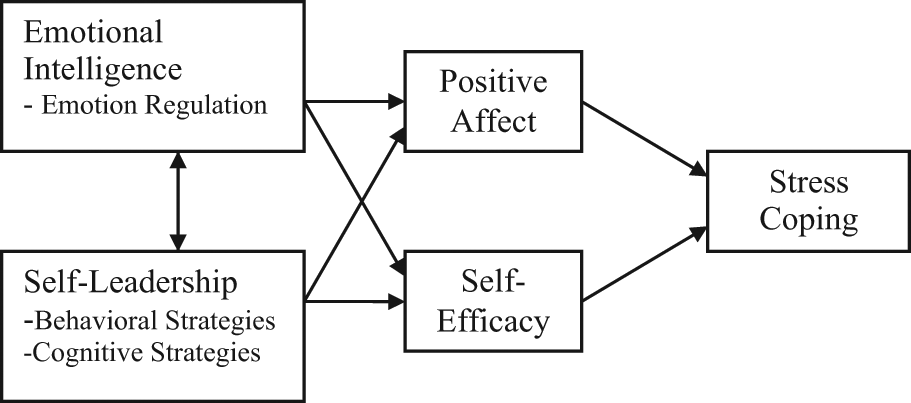
A model of emotional intelligence, self-leadership, and stress coping
Our model is particularly applicable to students because exposure to emotion regulation and self-leadership strategies may help students not only to more effectively manage their current stressors but also to develop coping skills that can help them to effectively endure the stresses of their future jobs. College students are a primary source of future organization members, and teaching students how to successfully deal with stress during their academic careers can better prepare them to cope with stressful situations in their future workplaces. College students face a number of stressors ranging from the demands of their academic coursework to challenges in managing interpersonal relationships. These stressors are often exacerbated by ineffective emotion regulation and self-leadership.
Before examining the model more closely, it is important to note that EI and self-leadership focus on similar processes of self-influence. As Boss and Sims (2008) have noted, emotion regulation and self-leadership “are two peas in the same self-regulating pod” (p. 142). Nevertheless, EI and self-leadership are generally regarded as distinct concepts within the self-regulation domain (e.g., Boss & Sims, 2008; D’Intino, Goldsby, Houghton, & Neck, 2007). EI is primarily concerned with the ability to self-regulate emotions, while self-leadership focuses on the self-regulation of behaviors and thought processes. However, because emotions are likely to have a powerful influence on both behavior and cognition, the concepts of EI and self-leadership are very likely to interact with one another (D’Intino et al., 2007). Individuals who are high in EI and can regulate their emotions using the strategies outlined above will likely be more effective in leading themselves. Likewise, the effective use of self-leadership strategies may help people to become more emotionally intelligent. Hence, in our model we assume that EI and self-leadership are distinct yet reciprocally related concepts.
Emotion Regulation Strategies and Student Stress Coping
As outlined above, a primary objective of the emotion regulation strategies within EI is the increase of positive emotional outcomes. In our model, we adopt the commonly used term positive affect (e.g., Lyubomirsky, King, & Diener, 2005) to reflect the idea of positive emotional outcomes. Our model suggests that effective emotional regulation results in greater positive affect and existing empirical research provides support for such a linkage (e.g., Kafetsios & Zampetakis, 2008; Palomera & Brackett, 2006). Our model also suggests that effective emotion regulation leads to greater self-efficacy. Self-efficacy refers to an individual’s assessment of personal capability to perform a given task or behavior (Bandura, 1986, 1991; Gist, 1987). Self-efficacy is a central concept within social cognitive theory, which emphasizes self-awareness and self-regulation as primary factors in the development of self-efficacy beliefs (Bandura, 1997). As noted above, EI also focuses on self-awareness and the self-regulation of emotion, processes that are likely to influence individual self-efficacy perceptions. Furthermore, as George (2000) has suggested, EI processes may also have an impact on causal attributions. Thus, effective emotion regulation may help individuals to generate causal attributions resulting in emotional reactions that either enhance or minimize the damage to their self-efficacy beliefs (Gundlach, Martinko, & Douglas, 2003). Recent research has provided some empirical evidence in support of this relationship (e.g., Moafian & Ghanizadeh, 2009).
Our model further suggests that positive affect and self-efficacy both facilitate student stress coping. A number of stress researchers have identified positive affect as a key component for effective appraisal of and coping with stressful situations (e.g., Folkman & Moskowitz, 2000, 2007). For example, two longitudinal studies (e.g., Folkman, Moskowitz, Ozer, & Park, 1997; Moskowitz, Folkman, Collette, & Vittinghoff, 1996) involving AIDS caregivers identified three kinds of stress coping related to positive affect including positive reappraisal, goal-directed problem-focused coping, and infusion of ordinary events with positive meaning. In addition, two recent experimental studies involving students subjected to academic stress found that positive affect was related to effective stress coping as evidenced by more complete poststress cardiovascular recovery (Dowd, Zautra, & Hogan, 2010; Papousek et al., 2010). Similarly, recent research has suggested a relationship between self-efficacy perceptions and effective stress coping (e.g., Shen, 2009). For example, a recent study involving athletes showed a significant relationship between self-efficacy for coping with stressful situations and actual coping effectiveness (Nicholls, Polman, Levy, & Borkoles, 2010). Furthermore, Schaubroeck and Merritt’s (1997) findings in an empirical study involving health care professionals and employees of a large contracting firm suggested that job self-efficacy may be an important factor for coping with work stressors. Another recent study suggests that people with high self-efficacy in stressful job situations behave more proactively using problem-centered coping than people with low self-efficacy in similarly stressful job contexts (Salanova, Grau, & Martínez, 2006).
Self-Leadership Strategies and Student Stress Coping
Positive affect has also been advanced as one of several key predictable outcomes of self-leadership (Neck & Houghton, 2006). Preliminary research evidence has tended to support this assertion. For example, in a field study involving a group of America West airline employees, Neck and Manz (1996) reported significantly enhanced positive affect among employees involved in a self-leadership training intervention relative to those employees in a no-training control group. More recently, Houghton and Jinkerson (2007) reported a significant relationship between self-leadership strategies and subjective well-being (a concept closely related to positive affect), as mediated by the absence of dysfunctional thinking processes. In addition, Neck and Houghton (2006) suggest that a major objective of self-leadership strategies is the enhancement of individual self-efficacy perceptions, calling it the single most common outcome variable proposed in the self-leadership literature (e.g., Manz, 1986; Neck & Manz, 1992, 1996; Prussia, Anderson, & Manz, 1998). Empirical evidence tends to support the effectiveness of self-leadership strategies in the enhancement of self-efficacy perceptions. For instance, Neck and Manz (1996) showed a significant difference in self-efficacy levels between a self-leadership training group and a no-training control group. Similarly, Prussia et al. (1998) reported significant relationships between self-leadership strategies, self-efficacy perceptions, and task performance.
Applying the Model in the Context of Management Education
We have taught emotion regulation and self-leadership strategies in our management classes for many years. Our class sizes have ranged from fewer than 10 students to classes of more than 1,000 students, and students have responded very favorably to the strategies contained in our model regardless of class size. Our courses include dedicated lectures on the topics of self-leadership and EI, while the concepts of positive affect and self-efficacy are integrated in various other parts of the course. Continuing with our balanced approach, we now provide two specific examples of how we facilitate the use of both EI and self-leadership strategies as a means for increasing positive affect and self-efficacy and ultimately stress coping among our students.
After presenting the basic concepts of EI and emotion regulation in a class lecture, we use an EI self-assessment and application exercise adapted from Nahavandi (2012, pp. 134-135), which first requires students to rate themselves on the various dimensions of EI, including emotion regulation. The exercise then asks students to consider some specific approaches for applying EI and emotion regulation in their personal, work, and school environments. These approaches include keeping a journal to track behavior and progress, seeking help from friends, coworkers, and mentors, and working on controlling one’s temper and moods to stay composed and positive when facing difficult and stressful situations.
Similarly, after presenting the self-leadership strategies in class, we have our students complete a self-leadership exercise adapted from Neck and Manz (2010, pp. 66-67) that helps them to analyze their thought processes relative to times when they have felt stress. The exercise requires students to think carefully about a recent time when they were feeling a negative emotion (such as stress, anxiety, or depression) along with the problem or task that accompanied these negative emotions (such as a job interview, relationship problem, or a test). Students are then instructed to make a list of the things they were telling themselves before identifying any mental distortions inherent in their self-talk processes. Finally, students are required to reword their self-talk in more positive ways in order to eliminate dysfunctional thought processes. Through this exercise, students are able to better understand how they can reframe their inner dialogues and thought processes toward a more positive mode that may enhance their positive affect, their self-efficacy for dealing with the stressors they are facing, and ultimately their stress coping skills.
In a variation of this in-class exercise, students are instructed to keep a journal record of times that they feel stress or an emotional response to situations. This exercise covers an extended period of time (i.e., for the semester) as opposed to an exercise completed in a single class period. A possible format for the journal entries is as follows: (1) How would you describe the stressful situation? (2) What were your thoughts? What did you tell yourself? (3) What feelings did you have regarding this situation? (4) What did you do in response to this situation? (5) What might have you done differently?
As indicated above, we often use journaling to facilitate the application of both EI and self-leadership strategies. Journaling is helpful from at least three perspectives: (1) it enables the capturing of thoughts, feelings, and behaviors close to the time of the event; (2) journaling provides opportunities for the individual to reflect on the experience and learn; and (3) this exercise provides more actuate capturing of the event and the response for later group discussions. As noted by Hughes, Ginnett, and Curphy (1999, p. 79), “Experiential learning theorists, such as Kolb (1983), believe people learn more from their experiences when they spend time thinking about them.”
Qualitative Evidence in Support of the Model
Although we have not yet tested the linkages suggested by our model through empirical data analysis, we have gathered and examined some preliminary qualitative data from two primary sources: written comments on our class evaluations and a comprehensive written application assignment. First, a thematic analysis of student comments on our teaching evaluations for the classes in which we have applied our model using the techniques described above revealed a clear theme involving the effectiveness of emotion relation and self-leadership strategies for facilitating student stress coping. Thematic analysis (e.g., Aronson, 1994) is a technique designed to identify patterns or themes within informants’ statements or comments. The following statements are representative of the comments that comprised the theme identified in our analysis:
I have been using the tools we discussed in class and I feel like a completely different person! I am very hard on myself and have difficulty in relaxing. I think very negatively and worry A LOT about everything! Now, when I catch myself thinking negatively, I stop myself and change my way of thinking and I feel less stressed. I picture myself doing well in anything I want to do. I imagine myself succeeding. I just wanted to give you my two cents about mental imagery and self talk. I normally try to use both of these in stressful situations but have been trying to use it more since we discussed it in class. I think it has helped with my stress level. I use positive self talk as a test taking strategy. In high school, I had really bad testing anxiety and would get sick virtually before every major test. My performance was definitely affected by it. However, by improving my self-talk, my scores got better and my stress was much reduced.
Second, we require a five-page written individual leadership development project in which students are asked to apply emotion regulation and/or self-leadership strategies to a specific challenge in their lives (e.g., losing weight, making better grades, etc.). Students often write about how they have used emotion regulation or self-leadership to improve their stress management. Once again applying thematic analysis (Aronson, 1994), we analyzed these assignments from several of our classes over several semesters and found an identifiable theme regarding the effectiveness of emotion relation and self-leadership strategies for facilitating student stress coping. Below we present a brief sample of student responses to these projects:
Before engaging in this project, I did not have any sort of plan for managing my negative emotions. I would just accept that I had them and would try my best to not let them show. Now I feel I have a system in place where I can gauge my level of negativity and take the steps to find a way to at least stop these emotions from snowballing into other aspects of my life. After conducting this leadership change project, I learned about the power of my emotions and mental processes. Most of the time I am unaware how detrimental my negative thought patterns are to my individual performance. I have to work on maintaining a positive and encouraging tone to prevent deconstructive thoughts from entering my head. I took the first step in achieving my goal of becoming a mentally stronger individual. Continuous practice and learning from my mistake is how I will grow into the leader I want to become. I used to always freak out and become super stressed over every detail. To become an effective leader or self-leader, I must get over the issue of getting too stressed out or letting my emotions get to me because I need to be able to show the ones following me that I can handle the situation. By doing this individual leadership development project, I have learned that managing stress is something that is very capable of being learned. I now know how to manage my time efficiently, plan ahead, work well with group members, and even learn how to lead others while they are stressed out as well. As a result of all the effort that I have focused on over the last 5 to 6 weeks, I have found that the number of times that I have found myself being stressed out has been dramatically reduced. Equipped with the techniques to more effectively manage my own time and stress level, I think that with continued implementation I am prepared to become a better manager and leader of other people.
Practical Implications, Limitations, and Future Research Directions
Although the model presented here has been applied primarily to college students, we believe that our framework may generalize to other groups of people in a variety of contexts. Given the potential generalizability of our model, we recommend that emotion regulation and self-leadership strategies be included in general college curricula so that tomorrow’s organizational members may be better prepared to cope with their own stressors and to help facilitate effective coping behaviors among other organizational members. Another practical implication of the model’s potential generalizability is that organizations should consider providing training interventions designed to arm organizational members with the emotion regulation and self-leadership strategies outlined here. A training intervention along the lines of that described by Neck and Manz (1996) could have great potential for increasing the positive affect and self-efficacy for dealing with stressors among organizational members, ultimately leading to increased abilities to effectively cope with job-related stress.
A primary limitation of our article is the lack of empirical data to test the linkages suggested by the model, especially the potential role of positive affect and self-efficacy as mediators of the relationships between EI and student stress coping and self-leadership and student stress coping. Although our thematic analysis of student comments on our class evaluations and of the content of the comprehensive written application assignment revealed definite themes involving the relationship between the use of EI and self-leadership strategies and stress coping among students, our thematic analyses did not reveal any evidence in support of the potential mediating role for positive affect and self-efficacy. This finding is likely explained by the fact that students making unprompted and unstructured comments on course evaluations and in a written assignment would be unlikely to think in terms of potential mediators, but would more likely focus on the direct effects of the EI and self-leadership strategies on their stress coping capabilities.
Nevertheless, future research should empirically examine the various linkages in our model, especially the potential mediating role of positive affect and self-efficacy. The model should first be empirically tested in the context of higher education, with students as the focal subjects, before being examined in other samples of interest. Published scales exist for each component of our model (e.g., Brief, Burke, George, Robinson, & Webster, 1988; Chen, Gulley, & Eden, 2001; Edwards & Baglioni, 1993; Houghton & Neck, 2002; Mayer, Salovey, & Caruso, 2002), which should facilitate the testing process. In addition, the model lends itself well to analyses using structural equations modeling techniques. Although we have presented some evidence in preliminary support of our model in the form of the qualitative data provided by student comments, the model presented here may only be validated through empirical testing.
Conclusion
A famous adage reads, “You can’t control the wind, but you can certainly adjust the sails.” With this in mind, we posit in this article that emotion regulation and self-leadership are mechanisms by which individuals can “adjust the sails” in their lives to more effectively cope with the stressors (the wind) that may present themselves. In summary, this article has presented a comprehensive framework of the relationships between emotional intelligence, self-leadership, and stress coping among students. The model suggests that the effects of emotion regulation and self-leadership strategies on stress coping are mediated through positive affect and self-efficacy. Our model makes an important contribution to the literature by being among the first to examine the role of self-regulatory strategies in the context of student stress coping behaviors. By equipping students with a better understanding of and effective tools for the process of coping with stress, management education can help create future managers and organizational members who can effectively cope with the many stressful situations encountered in the workplace.
Footnotes
The author(s) declared no potential conflicts of interest with respect to the research, authorship, and/or publication of this article.
The author(s) received no financial support for the research, authorship, and/or publication of this article.