




Abstract
The Mock Trial is an experiential exercise adapted from a law school process that encourages students to think critically about theories, topics, and the practice of management in an innovative classroom experience. Playing the role of attorneys and witnesses, learners ask questions and challenge assumptions by playing roles in a trial with testimony and cross-examination. Once a theory or topic has been chosen to be “put on trial,” one team of petitioners (challengers) and their witnesses make arguments to a jury. Another team acts as the respondents (defenders) for the opposing side and presents their case in a mock courtroom setting. The jury renders a verdict using a fishbowl format for their deliberations. Then feedback and classroom debriefing, which immediately follow the trial, and later reflection papers help solidify the learning experience. All materials required to create, run, and assess a Mock Trial are provided in this article.
The Mock Trial is an experiential exercise drawn from law school pedagogy that provides a dynamic platform for participants to think critically about management theories and practices in an interactive role-play. At a recent teaching conference, the authors presented the Mock Trial as a way to evaluate the Myer–Briggs Type Indicator. Participants asked for a detailed article so that management and organizational behavior instructors could use the exercise in their classrooms. Its appeal is rooted in courtroom dramas that have long been popular in film and television. Building on the success it has yielded in educating lawyers, nurses, counselors, and students in other disciplines, and exploiting the popularity of this genre, we present the Mock Trial as a novel management pedagogical tool to challenge learners to think more critically and to engage in cooperative, problem-based learning (PBL).
In a Mock Trial, the students are assigned to two different teams, the petitioner (or challenger) and the respondent (or advocate), and then are assigned a topic that is typically a management theory (e.g., expectancy theory or path goal leadership) or a practice that allows the learners to examine the subject from different points of view. The teams prepare for the day of the Mock Trial by research, discussion, and preparation of pretrial statements. Students who are not assigned a role in that particular subject become jurors. The trial proceeds with arguments presented and students as expert witnesses testifying for each side. Then the jury discussion and verdict are conducted in a fishbowl format so that the participants can discover the effectiveness of their arguments.
To appreciate the solid pedagogical foundation of the Mock Trial more fully, it is important to briefly review how it has been used in other disciplines as well as its utility based on theories of management education.
Mock Trials in Other Disciplines
The pedagogical usefulness of Mock Trials in other disciplines is well established. The exercise has a rich tradition on college campuses. The American Mock Trial Association publishes rulebooks and practice guides for annual intercollegiate competitions (American Mock Trial Association, 2010). Mock Trials have also been used effectively in undergraduate and graduate courses across myriad disciplines. They have been a staple in business law classes to introduce learners to the trial process as well as to teach substantive legal concepts (McDevitt, 1998). A criminology instructor had her class reenact a famous murder trial (Shepelak, 1996), whereas a nursing instructor selected an actual patient record for a malpractice trial (Alverzo, 1997). In a course on counselor training, students researched both an issue to be tried and compiled handbooks containing statutes, cases, and evidence, which were then turned over to real judges, counselors, and attorneys who conducted the trial (Colby & Long, 1994). Expert opinions delivered and defended at trial have been used in economics, philosophy, and geosciences courses (Bair, 2000; Beck, 1999; Beck & Czerniak, 2005; Hersch & Viscusi, 1998; Siegel & McKenzie, 2004; Walker, 2005). The diverse ways in which the Mock Trial has been used shows that it has the depth and flexibility to make it useful for management, organizational behavior, and leadership instructors as they devise teaching tools to enable critical thinking about the theories, concepts, and practices presented in their courses.
The importance of critical thinking
Critical thinking provides a framework for developing analytical skills and is defined as reflective thinking that focuses on deciding what to believe or do (Ennis, 1989). The role of critical thinking in management education has been addressed numerous times (Cunliffe, 2004; Dehler, 2009; French & Grey, 1996, Smith, 2003). The core of critical thinking is a combination of cognitive skills and affective dispositions. Cognitive skills encompass interpretation, analysis, evaluation, inference, explanation, and self-regulation. Affective dispositions include inquisitiveness, concern over becoming informed, confidence in one’s reasoning abilities, open-mindedness regarding divergent world views, honesty in facing one’s own biases, as well as a willingness to reconsider and revise views (Facione, 2004). When participants in a Mock Trial examine a theory, topic, or practice, they must interpret, analyze, and evaluate incomplete or conflicting information. Both the cognitive and affective components of critical thinking are engaged when students are playing their Mock Trial roles. Two approaches to the role of critical thinking in management education are relevant to the Mock Trial.
The first approach values critical thinking as a necessary component of good decision making (Smith, 2003) as well as a prerequisite to becoming a wiser student of management knowledge (Caproni, 2000). The objectives of the Mock Trial are to foster the students’ ability to evaluate the body of knowledge in the field and to make good decisions based on that evaluation—to value the process of learning in conjunction with the acquisition of information (Elder & Paul, 2007; Karraker, 1993). These objectives are consistent with the idea that an appreciation of deeper, hidden issues is an important goal of critical thinking (Stepanovich, 2009).
A second approach, the Critical Management Studies approach, is also consistent with the learning outcomes of a Mock Trial. Here, an educated advocate of a theory, topic, or practice needs to be aware of the subjectively constructed realities of that theory or practice (Cunliffe, 2004). Critical Management Studies aim to challenge the passive acceptance of reality as presented (Fournier & Grey, 2000) by examining the legitimacy of the values and assumptions presented in any course content (Akella, 2008). A Mock Trial is not a search for “truth” because that term connotes only one acceptable way of viewing people and their environment. The versatility of the Mock Trial is supported by its applicability to any paradigm an instructor wishes to emphasize as well as for its ability to contrast approaches based on their ontology, epistemology, or assumptions about human nature. For example, one trial team could attempt to prove that Expectancy Theory is effective because motivation is an objective, measurable phenomenon while the other side contends that a nominal, subjectivist approach better describes the reasons why people act as they do. The use of dramatic scripts based on case studies or actual organizational practices has been found to effectively introduce undergraduates to critical management education (Prichard, 2009).
Spending less time lecturing, instructors in thinking-skills courses should spend more time guiding learner-centered learning activities. They should create in-class experiences that vividly exemplify core concepts and principles. They should direct debates, lead discussions, and guide analyses, always modeling effective thinking practices and habits of mind. (Smith, 2003, pp. 45-46)
Most important, the Mock Trial elevates the process of thinking over the product of thought. Weick (1979) long ago shattered the lexicon of management research by shifting the focus from studying organizations to questioning the organizing process.
If students of organization become stingy in their use of nouns, generous in their use of verbs and extravagant in their use of gerunds, then more attention would be paid to process, and we’d learn more about how to see and manage it. (Weick, 1979, p. 44)
Participants in Mock Trials are thinking when they
consider, in depth, the theory, topic, or practice to be tried,
engage in text and database research to learn more about the strengths and weaknesses of their subject,
divide their responsibilities in trial teams,
act as attorneys to prepare their questions for witnesses,
act as an expert witness to research and prepare their answers, and
make objections to the judge and arguments to a jury.
And, finally, critical thinking is occurring when the jury deliberates a verdict, and the entire class evaluates the jury’s effort. There are no textbooks, PowerPoint slides, or study aids available to provide readymade answers in a Mock Trial. Therefore, putting a subject on trial is synonymous with thinking critically about it and all its ramifications.
Pedagogical foundation in the management literature
Two streams of research on experiential education in management pedagogy converge to make the Mock Trial an effective tool to challenge learners and prompt them to think more critically. These two streams describe the dividends active learning techniques (i.e., problem based and cooperative) yield and explain the advantages of transitioning from a static sense of critical thinking to a more process-oriented mode of thinking critically.
First, active learning encourages thought through experience. Learners talk, listen, read, write, and reflect (Meyers & Jones, 1993) as they wrestle with course content. Active learning invokes higher order cognition: analysis of components, synthesis of those parts to form a new structure, and, finally evaluation of the result using complex criteria (Page & Mukherjee, 2007). Role-playing provides an engaging learning environment for controversial subjects (Comer & Vega, 2006). Students are able to try theories, topics, and practices that have been covered by readings and lectures (Auster & Wylie, 2006; Marcic, Seltzer, & Vaill, 2001). By combining critical thinking with active learning, “the value of questioning and challenging existing structures and practices” as well as each learner’s own beliefs and experiences increases the depth and breadth of learning (Reynolds & Vince, 2004, p. 444). Learners are then poised to understand what a “theory” is—precise outlines in a specific domain that explain why and how relationships are formed in order to predict future outcomes (Wacker, 1998, pp. 363-364).
More particularly, Mock Trials evoke two models of active learning: PBL and cooperative learning. The problem-based model is a design in which the problem is posed (e.g., how to challenge or defend the theory or practice) so that the learners discover that they need to acquire knowledge before they can solve a problem (Smith, 2005; Woods, 1996). This approach has great potential in helping learners integrate theory and practice (Duch, Allen, & White, 1997; Sherwood, 2004) by putting students in an unstructured, prototypical, real-world problem (Bigelow, 2004). PBL exercises are well suited to self-directed efforts that span an entire term (Eriksen, 2007).
Cooperative learning reflects a commitment to interactive activities by encouraging learners to communicate with each other in the pursuit of a deeper, more nuanced appreciation of a subject (Ballantine & Larres, 2007; Holubec, 1992). The interactive nature of the process allows students to actively learn while becoming completely engaged. Cooperative learning encompasses important aspects of the Mock Trial: collaboration, leadership, and effective interpersonal skills. Learners must work within their team to present the most persuasive case they can while each team must cooperate with the other to conform to the Mock Trial format and generally give the appearance of professionalism. Cooperative learning lends itself to reflexive self-assessment that enables learners to develop in their own way. An exercise that combines problem-solving skills with effective teamwork has been shown to better prepare learners to solve everyday organizational problems (Goltz, Hietapelto, Reinsch, & Tyrell, 2008).
Learning Objectives
The Mock Trial allows substantive learning when learners gain a deeper, more nuanced appreciation for the subject of their trial as a result of their research, trial preparation, and the trial itself. This type of learning also embodies Bloom’s (1956) taxonomy of learning objectives: comprehension, analysis, and synthesis. The two primary learning objectives of the exercise are,
Learning Objective 1: To allow students to gain a deeper understanding of the management theory, topic, or practice on trial by moving from the passive learning of a traditional class setting to active learning.
As previously stated, engaging in a Mock Trial encourages students to find the relevant aspects that their role demands. If a student is assigned the role of defense attorney, he or she will have to research the strengths and weaknesses of the theory, topic, or practice as well as the relevant literature that will be used to attack the “client.”
Learning Objective 2: To engage learners in thinking critically about management theories or practices.
In general, student comments (see Evidence for Learning section below) reflected awareness that they had to work harder to understand the topics of discussion. However, they were also motivated to do so as result of either preparing for their trial roles or to be impartial judges in the Mock Trial.
Two secondary learning objectives also may be achieved using a Mock Trial:
Learning Objective 3: To practice effective teamwork as students work collaboratively to build the case for or against the theory, topic or practice and to prepare for the various roles in the trial.
Preparing a defense or attack on a particular theory, topic, or practice requires teamwork. Although the roles seem individual (e.g., Petitioner’s Counsel or Prosecuting Attorney, Respondent or Defense Attorney, Expert Witnesses, Judge and Jury members), the successful prosecution or defense cannot be conducted without integration of each individual’s work. Students come together to plan their “attack” or defense and leaders quickly emerge to get the work completed or, occasionally, to lead the team into dysfunctional plans and behaviors. The outcomes of these dynamics are clearly seen in the trial. A good debrief of the activity includes questions about effective leadership and team behaviors.
Learning Objective 4: To enhance the students’ public speaking skills as well as the skill of extemporaneous thought and debate.
Most business schools include communication skills as a one of their learning goals, such as “Students will be able to make oral presentations effectively in a professional business context” with measurement stated as “evidence of organization and clarity in making an oral presentation.” To these ends, most business school students have experience with group and individual presentations but almost always in the form of an informational report. As a distinct difference, the Mock Trial asks for an advocacy approach to problem solving. Students may be asked to advocate for or against a theory, topic, or practice that they may not agree with or even like. We believe that this exercise increases conceptual versatility and sharpens communication skills by requiring a presentation that includes a judging audience and also by using a learning design that allows students to be questioned by their peers regarding the quality and truth of their research and presentation.
The Exercise
In this section, we position the Mock Trial, detail its preparation, describe its in-class execution, and discuss assessment.
Target Learners
The Mock Trial would be most appropriate for upper-division undergraduate students, graduate students, and executive learners. We have found that more mature learners are inclined to get into the spirit of the trial and the role-play and have the discipline to do the in-depth research the trial requires. The subject chosen for the trial will in large part dictate the appropriate learner level. Historical figures and those in the current press tend to be popular for undergraduates. Graduate students enjoy examining the abstract nature of theories. Executive learners are drawn to explore well-known management and leadership topics and practices. However, instructors need to be wary about stereotyping learners. Almost any learner can effectively place a theory, topic, or practice on trial with support and encouragement.
Optimal Course Positioning
The Mock Trial can be a time-consuming exercise, depending on how it is used in a course. In the longer form, it can require several weeks for learners to research their subject, prepare witness testimony, and develop arguments. Scheduling trials at the end of the semester or quarter is usually best. It can be considered as a capstone exercise that not only exhibits the preparation learners invest in the Mock Trial but also allows them to practice the team and research skills required to try their cases. Since only about 10 learners have active roles, it is likely that several trials will be needed in a class. Although the Mock Trial can be a significant component of a course, the exercise is not intended to dominate a class. Rather, we find that its preparation develops on a track that parallels topics and teaching methods an instructor traditionally uses. Instructors can experiment with it without substantially revising their syllabi.
Mock Trials can also be used in a more short-term manner. The topic can be chosen or given in the second or third week of class and the trials can take place 2 to 3 weeks later. Obviously, the depth of the arguments and research would be less, but some topics can lend themselves to a shorter time period, such as the BP oil spill, managing for shareholder value, or going green.
Introduction of the Exercise
The Mock Trial should be described in the very first class of the term. In our experience, the first class gives learners time because they are often synthesizing the syllabus and tend to be most receptive to new approaches. An outline that instructors can use for PowerPoint slides or a handout that gives an overview of the Mock Trial is contained in Appendix A.
Trial teams are best formed early in the semester. We recommend randomly assigning teams of four or five learners (Jones, 1997). Less than that leads to overload while more fails to equitably distribute the load. Alternatively, instructors could use an assignment method based on their demographic background or interest in the topic, or teams can be encouraged to self-form. The team can select which members have the roles of witnesses (2) and “attorneys” (2-3). The team decides what role their witnesses will take (i.e., their identities, backgrounds, a general summary of their expected testimony, and questions and answers). The attorneys prepare opening and closing statements and for cross-examination of the other side’s witnesses.
The topics or issues can be assigned or chosen by teams from a list determined by the instructor. A nonexclusive list of management theories and practices that lend themselves to Mock Trials is contained in Table 1. Another source of topics is the McGraw-Hill series, titled “Taking Sides,” in Management, Business & Society, and Human Resource Management, among other disciplines, which frame controversial issues.
Theories and Practices Suitable for Mock Trials.

The instructor gives the attorneys (Petitioners for one team and Respondents for the other) a statement of the issue to be tried to frame the issue the jury will vote on. For example: (a) “Affirmative Action is nothing more than reverse discrimination,” (b) “The Myers–Briggs Type Indicator is a useful tool in the recruiting and selection process,” (c) “Random drug testing is a minimally invasive means of guaranteeing a drug-free workplace,” or (d) “Phillip Knight is guilty of building his fortune by exploiting third world workers in sweatshops.” The instructor creates a verdict form to hand out to the jury prior to its deliberations. Instructors who wish to add a writing component to the trial can require each team to prepare and exchange pretrial briefs that sets forth each side’s key arguments, a summary of its witnesses’ testimony, and supporting documentary evidence for the benefit of the Judge, jury, and audience.
Early in the term, the class can be given a tutorial on the resources of the university’s library in general and the databases it subscribes to in particular. Often, a research librarian will give a tutorial in class or at an assigned time for the class in the library. A research tutorial is an essential building block for the Mock Trial and ultimately to becoming a skilled critical thinker.
Keeping Tabs on the Trial Teams
We have found that short, regular meetings between the instructor and the teams go a long way to keeping trials on track. Some teams will need more coaching than others. Teams that are struggling with who will do which role or how to prepare may need more individual help from the instructor. Other teams will grasp the role-play easily and will need periodic check-ins. Perhaps most important, the check-ins let learners know that the instructor cares about their learning, well-being, and performance—an important facet of effective teaching (Hawk & Lyons, 2008).
Conducting the Trial
Mock trials resemble the actual courtroom counterparts, but unlike their law school counterparts, Mock Trials in management classes invite experimentation and innovation. Therefore, the points that follow are guidelines, not requirements.
The Petitioner’s attorney makes an opening statement that tries to explain the management theory, topic, or practice in such a way that the jury and audience understand the topic. The Respondent’s attorney then makes an opening statement that attempts to refute the management theory, topic, or practice. The attorneys for each side can use witnesses to express opinions based on personal knowledge or describe what they have learned from their research.
Attorneys and witnesses prepare by conducting research. We cannot overstate the importance that learner preparation plays in the success of the simulation (hence the value of clear guidelines, a research tutorial at the outset of the course, and periodic meetings thereafter).
Witnesses are asked open-ended questions that allow them to explain their role in the case. Counsel might ask questions such as: (a) “Would you explain Theory A in layperson’s terms?” (b) “How do you feel about your job on an assembly line?” (c) “Ms. Consultant, how effective have you found this practice to be in your clients’ ability to hire the best and brightest candidates?” Exhibits, such as charts, photos, or videos may be presented that help to convey the essence of a theory or practice (e.g., an excerpt from “The Big One” showing Michael Moore’s encounter with Phillip Knight, Chairman of Nike, or footage of the effect of the Gulf Oil Spill presided over by Tony Hayward, former CEO of BP Group). The Petitioner is allowed up to two witnesses.
Once each Petitioner’s witness completes his or her testimony, he or she is subject to cross-examination by the Respondent’s attorneys. During cross-examination, leading questions are used that “put into the witness’ mouth the words that are to be echoed back” in the form of a “yes” or “no” answer (Prince, 1973, p. 469). The object of the simulation is to critically examine the subject and have some fun doing so. A leading question might be, “While it is popular to criticize Mr. Hayward and BP, how would you suggest we meet the public’s insatiable hunger for oil without incurring risk?”
Cross-examination could be a bit intimidating, but its creativity presents opportunities for learners to challenge themselves. Learners can be encouraged to give it their best effort but not to expect the polished product a real attorney can deliver. To warm up their classes a week or so before trials commence, instructors can show clips from films where cross-examination is highlighted. Film clips provide exceptional visual presentations of the topics to be learned (Champoux, 2006) and are particularly helpful to enhance a learner’s critical thinking (Meisel & Fearon, 2006).
Once the Petitioner’s witnesses have completed their testimony, the Respondent’s attorney has the opportunity to call up to witnesses. Because cross-examination of Petitioner’s witnesses is limited to what they previously testified to on direct examination, Respondents need the opportunity to call witnesses who can testify to flaws or weaknesses in the theory, topic, or practice that were not covered by Petitioner’s witnesses. Since all witnesses are subject to cross-examination, each side has the chance to examine the others’ witnesses.
An additional role of Bailiff is possible. If included, the Bailiff helps the Judge, administers an oath to witnesses, and handles documents. The instructor can serve as Judge or assign the role to a class member. The Judge controls the trial by ruling on attorneys’ objections, directing witnesses to answer, and asking if the jury has a verdict.
Finally, the last role is that of the juror: 8, 10, or 12 jurors can be picked from the remainder of the class or members of the class can volunteer. The jurors listen to the testimony and then deliberate in a fishbowl format for all to hear. The nonparticipating members of the class should listen but not interrupt.
Feedback is an essential ingredient in Mock Trials. Initial verbal feedback comes from the jury discussion. After the verdict is reached, the remaining learners in the class can then be invited to join in a debriefing with the trial participants. Not only will role players want the chance to see how well they fared, the interactive exchange enables all learners to modify their opinions based on comments shared by others. The interaction also reinforces the importance of active listening—a vital skill (Helms & Haynes, 1992) that can be overlooked in many management courses. Then the audience fills out an anonymous form that gives the trial participants feedback on their preparedness, execution of their parts, and substantive merit of their cases. A form we have successfully used is contained in Appendix B. We have found that when the audience knows it must evaluate the trial, learners are more engaged. And since they will also be conducting their own trial, we stress that the evaluations should be as accurate and complete as possible to provide feedback. Peer evaluations can also be used at this time, which encourages team members’ performance; an example is presented in Appendix C.
Time Allotment
The Mock Trial will require a 75-minute or longer class. If less time is available, the Mock Trial can be shortened to 50 minutes by allowing only one witness per side and conducting the debrief in the following class. The instructor should be a strict time keeper, or that job can be given to the Bailiff, if the instructor is acting as Judge. The sequence of events is shown in Table 2.
Sequence of Events.
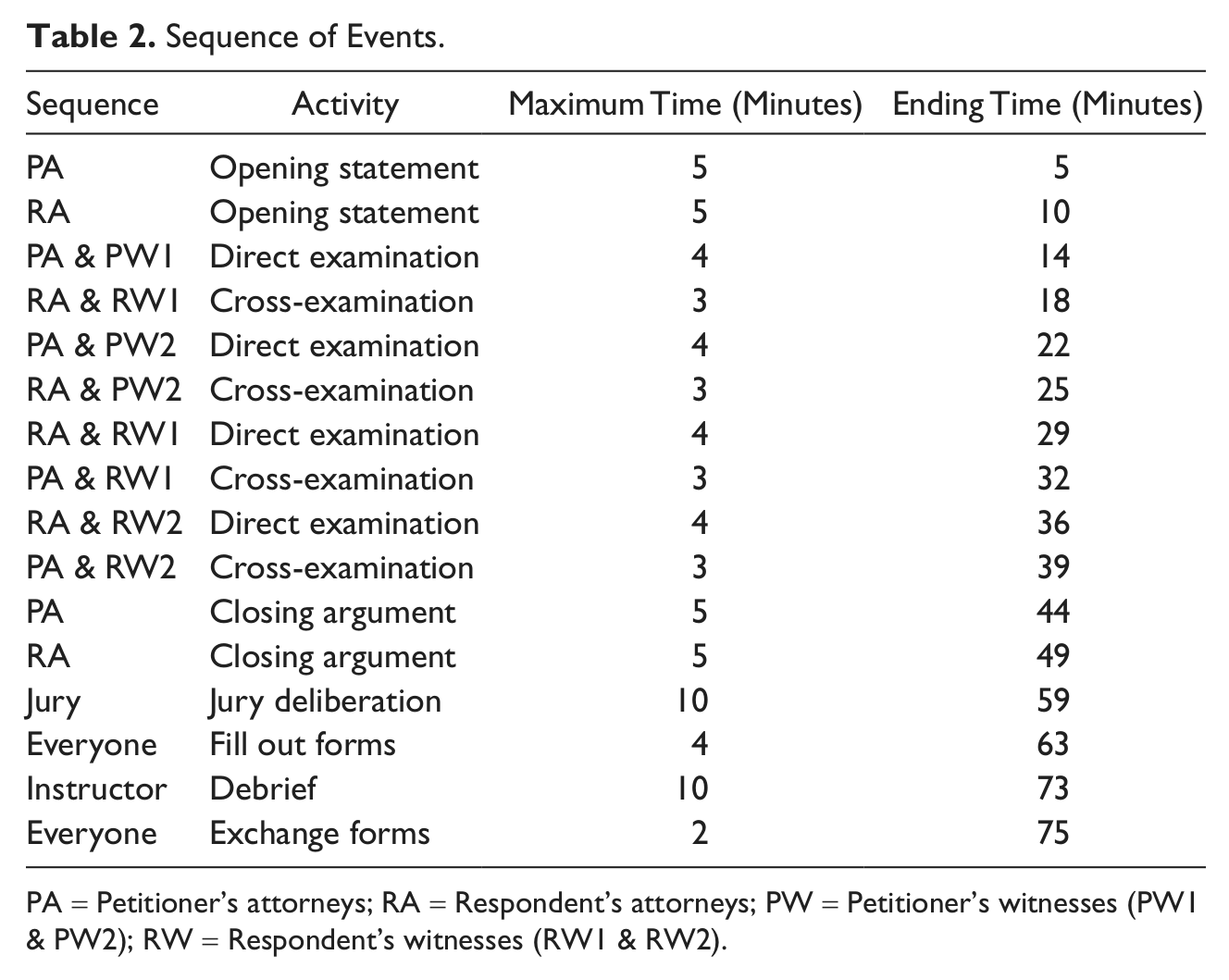
PA = Petitioner’s attorneys; RA = Respondent’s attorneys; PW = Petitioner’s witnesses (PW1 & PW2); RW = Respondent’s witnesses (RW1 & RW2).
Any classroom with movable seats can be used by arranging 10 to 12 chairs in two rows for the jury; set off desks, and chairs for the Judge, Bailiff, and counsel for each side; and place a centrally located seat for witnesses to give testimony. The remaining seats should be organized so that the audience can easily see and hear the action. A black robe and gavel for the Judge adds a realistic touch to the trial.
Students can be encouraged to be prepared for any role in their team, if someone cannot make it to class the day of the trial. The Mock Trial works best if each team member takes some portion of the trial (opening, direct, cross, closing) to make sure that the work is evenly spread throughout the team.
Each instructor will have to decide if this exercise is worth the time needed for development and delivery. We have found that the exercise generates a positive return on its substantial investment. The outcomes include heightened learner interest in an active learning process and positive development of their thought process. We have found that the novelty of the exercise in business classes has enhanced its appeal to participants accustomed to presenting research reports or business plans.
Assessment
Even though many rubrics have been developed to assess Mock Trials (Bengston & Sifferd, 2010), we have discovered that in a management course the Mock Trial can be best assessed through oral debriefing, posttrial Reflection papers, or the instructor’s observation of the trial itself (or any combination of these approaches).
Debriefing
Initially, the instructor can assess the power of the experience during an oral debriefing period directly following the exercise or in the following class. There are two areas for discussion: the personal experiences of participants and the expansion of each individual’s ability to critically think about a theory, topic, or practice. Some personal questions that the instructor may pose to start the dialogue are
What role did you assume on your trial team and why?
How effective were you in your role?
How effective was your team overall?
What did you learn about the trial subject?
What surprised you about the outcome of the trial?
At the level of thinking critically, the instructor can ask questions such as:
How did your thinking change about the subject during the preparation phase?
How has your thinking changed over the course of the trial?
Would you do anything differently now that you have experienced the trial?
Would this experience make you choose different behavior in a real-world setting?
For instructors who employ a “contribution” or “participation” portion of a learner’s final grade, the quality of his or her contribution to the debriefing can be subjectively assessed.
Reflection paper
Learning from the Mock Trial has a critical thinking component enhanced by the active participation in the trial experience including, but not limited to, formulating new ideas, opinions, values, and decisions about the subject; assessing the group dynamics issues of problem solving; and testing the currency of an idea (McDevitt, 1998; Ponte, 2006). Other potential learning is of presenting and listening skills as well as being part of a cohesive team. The Reflection paper can be both fuel for an aspect of critical thinking and a metric for measuring learning in the Mock Trial experience. Reflection papers describing learners’ trial roles and their opinions on the trial subject have been successfully used in other disciplines (Hersch & Viscusi, 1998; Randolph-Prince, 1990; Werth et al., 2002). Reflection leads to deeper learning about the learner as well as the subject (Hedberg, 2009).
We suggest a two-stage, semistructured paper. Once learners are assigned to a trial team and topic, they are assigned Part 1: A short essay to report what they have learned about the subject of their trial from textbooks, database research, and lectures and to express what the trial will demand from them. This essay is an interim assignment (i.e., to be completed in the first month or so of the term) to help students assess their learning as the preparation progresses.
We suggest that instructors review the essays, make comments if justified (e.g., keep teams on track, express encouragement) but refrain from entering a grade. The essays are then returned to learners so that they are assured that the instructor is mindful of their efforts. The purpose of the first essay is to prompt learners to think about the subject as well as the trial process. In effect, it serves as a benchmark against which they and the instructor can gauge the depth and breadth of their thinking by the time a verdict is rendered.
Following the trial, the interim essays are augmented with Part 2: Questions that prompt learners to express their thoughts or opinions on the subject of their trial, to consider what skills have been affected, and to synthesize their overall growth. We suggest combining both Part 1 and Part 2 as a final paper to be reviewed and graded as any other term paper. Guidelines for the Reflection paper are contained in Appendix D.
Trial observation
A short rubric may be used by instructors to grade the team performance during the trial itself and can be augmented by qualitative comments. A sample is contained in Appendix E.
Evidence Connected to Learning Objectives
The Mock Trial affects learning goals in several ways. In a survey of 100 students taking part in an undergraduate appellate simulation, Keyes and Whincop (1997) concluded that students benefited from performing legal research. Among the benefits were that they learned how to apply principles to a factual situation, to formulate written arguments, and to run a case. They also developed persuasion and group coordination skills. Knerr, Sommerman, and Rogers (2001) make the point that although empirical evidence is lacking, there appear to be several specific benefits to using a courtroom simulation in the classroom (judging by instructors’ perceptions and students’ responses):
First, such exercises help make the material seem more “alive” to the students. They take an active role in a dispute, rather than just passively ingest information via their textbook or the instructor’s lecture, which also appears to help facilitate critical thinking. On a somewhat related note, the “hearings” give all concerned a break from the monotony of the lecture discussion format most often used in undergraduate business law courses . . . [The experience] also tends to give students a healthy respect for ambiguity. Students often discover that what they first perceived as a black and white issue may actually be shades of gray. (p. 4)
Foster and Carboni (2009), writing in the Journal of Management Education, make the case that assessing student learning in case study exercises entails “a close engagement with students during class time and a thorough reading of their journals” (p. 691). The Mock Trial has a learning arc similar to a case study and requires a similar attention to student learning.
Taking all the outcomes assessment ideas into consideration, in this article we will look at four different approaches to better understand the students’ learning outcomes.
1. Evaluation through the posttrial reflective assignment
Students are asked to respond, in a Mock Trial Reflection Paper, to a set of questions that are designed to engage their thinking in what occurred prior to and during the mock trial (see Appendix D). In addition, they are asked to reflect on how they approached the assignment, what they were thinking as the Mock Trial occurred, and what they learned from the experience. Learning from the Mock Trial meets the primary- and secondary-learning goals. Primary learning occurs with mastering the content of the trial—theory, topic, or practice—comes from the preparation and active participation in the trial experience. Secondary learning takes place with group dynamic issues of problem solving, leadership, and self-directed learning; collaborative teamwork and presentation and listening skills are built (McDevitt, 1998; Ponte, 2006). As Kessler, Simpson, and Fry (2009) suggest,
Entire sides may need to work together to develop themes. Lawyers may need to work with their witnesses to develop questions. Opening and closing lawyers may want to coordinate their speeches. Witnesses on each side may want to listen to each other and help prepare for cross-examination. (p. 144)
The postexperience assignment helps generate and summarize what is learned through reflection.
2. Evaluation through understanding the Mock Trial as a form of PBL
The Mock Trial format can be placed squarely in the tradition of PBL, creating a classroom environment in which the problem drives the learning. A Mock Trial fits the PBL model as a design in which the problem is posed (how to attack or defend the theory, topic or practice) so that the students discover that they need to learn some new knowledge before they can solve the problem (Woods, 1996). This learning environment is active, cooperative, can be self-assessed, provides prompt feedback, and allows a better opportunity to account for personal learning preferences.
The value of PBL as in a Mock Trial is in creating active involvement in the study of the subject. Empirical evidence for the efficacy of PBL has been studied in the areas of collaboration and trust, team leadership, the acquisition and refinement of interpersonal, small group, and communication skills, enhancement of research skills and problem-solving abilities as well as enhanced consideration, evaluation, and respect for different perspectives (Bauer, 2003). These results support the learning objectives listed above and suggest the efficacy of the Mock Trial as a powerful learning design.
3. Evaluation to measure understanding of the theory under examination
A pre- and posttest to measure understanding of the theory being examined in the Mock Trial would be appropriate but has not been done. However, there is considerable anecdotal evidence from student comments and the posttrial reflective assignment that the Mock Trial format creates learning for most of the participants. Reflection papers we have collected shows that learners are benefiting from the exercise because they are thinking more deeply about their subjects and themselves.
4. Evaluation via instructor’s observations
A fourth form of evaluation is the instructor’s own observation of the exercise and the impact it has on learners. Our experience has paralleled learners’ reflections. We have witnessed clear evidence of learning in our trial participants: heightened research prowess, improved problem-solving abilities, and enhanced appreciation of different perspectives (Bauer, 2003). In sum, we have found that the Mock Trial has been an interesting and different way to end the term.
Evidence From Our Experiences With The Mock Trial
We have used Mock Trials in undergraduate as well as MBA courses at four universities, both private and public, including in programs with JD-MBA students, although no legal background is necessary for students to engage in this activity. We have found that students have access to so many legal dramas that they take to the role-play very easily.
The exercise has also been used across many subjects: organizational behavior, ethics, groups and teams, labor relations, leadership, and employee benefits. The issues that have been tried have been equally varied. Should corporations have their contributions to PACs capped? Should American corporations extend U.S. labor conditions to their subsidiaries abroad? Should the Defense of Marriage Act be repealed? Should the Employee Non-Discrimination Act be enacted? Should new state employees participate in defined contribution plans instead of defined benefits plans?
The quotes that follow are from Reflection papers we have received and provide evidence of attainment of the learning objectives previously described.
I think the mock trial is a great learning technique because it forces the teams to really study each topic. No team wants to go up in front of the class and get embarrassed because they were unprepared. Students had the ability to be creative with their witnesses and questioning. The mock trial encourages critical thinking, creativity and teamwork in a realistic environment which pushes students to excel. I feel that the simulation format was easy to understand and implement. I liked researching the topic of the trial as well as finding other similar trials. Overall the mock trial was a pleasant experience and it was unique and entertaining because it was simply different than anything I had ever done in a class before.
The fact that learners had to gain a deeper understanding of their subject by conducting research and generating facts for witnesses to testify to Learning Objective 1 (To allow students to gain a deeper understanding of the management theory, topic or practice on trial by moving from the passive learning of a traditional class setting to active learning) and Learning Objective 2 (To engage learners in thinking critically about management theories or practices), clearly opened up creative opportunities that many relished.
Everyone can read a book and study for a test but after the test the material disappears from our memory banks. In Human Resource Management, the amount of information that we need to recall on a day-to-day basis is huge and anything that can help us retain the information is good. With the mock trial we were given a situation that we could very readily find ourselves in and we had to defend our given side. This type of teaching technique is helpful because it gives us the chance to see the situation from both sides and either find a way to defend the action or be able to have our decisions stand up in a court of law. So as students graduate and find jobs in HR it makes them stop and think, “Can I defend the position/action I have taken in a court of law?” because that is where we could find ourselves. [Sic] The mock trial was a fun experience because we got to participate and see what could happen in certain situations from all the different sides: lawyer, defendant, juror or observer. Mock Trials develop a better understanding and allows students to better retain the information. Due to the fact that one was engaged in the process of delivering information to the class, students are in a way teaching the class; so students have to make sure that they are ready and know what they are talking about. Mock Trials also allow students to look at situations with different perspectives. Oftentimes, if not all times situations always have two sides of the stories. As a professional, we have to take the time to analyze the different perspectives. During the preparation of our Mock Trial, when deciding our arguments we had to do this, we had to analyze our strong points, and at the same time the other side’s arguments. Mock Trials required students to be prepared. Students know that people are going to be watching them; so therefore, they have the pressure of sounding good, looking good and most important being knowledgeable of the material.
Learners developed a healthy appreciation for multiple points of view in Learning Objective 2 and also learned to express themselves with clarity and confidence (Learning Objective 4: To enhance the students’ public speaking skills as well as the skill of extemporaneous thought and debate).
Being in a group trying to put a case together was a great learning experience. For me personally, I learned something from every one of my group members. There were some people in the group that were more experienced with giving Mock Trials, and others like me were first timers. The ones who were more experienced really taught us how we could present information, what information to look up and what the other side might come up with. During the actual Mock Trials, no matter what part you were playing, you really had to know your position and the law behind it. It forced you to prepare and understand the law so you could defend it and know you were right. Also, from the opposing side, you learned quickly new laws and information about the case that they researched. . . . Another positive experience that I had with the trials was that even though it was group work, everybody was responsible for their own individual parts, so it was difficult for anybody to leech off of another member of the group. Everybody had to know their part and present it in front of the class. There is always a problem having to do work for other people in the group, and here it was much more difficult for that to happen, which is nice. Also, because everybody had their own work, you only really needed to pair up with one other person to prepare, so even though everybody in my group had completely different busy schedules, we were able to get all our work done without any problems.
Mock Trials manifest PBL as well as cooperative thinking that serve to improve learners’ teamwork skills while instilling a sense of individual accountability (Learning Objective 3: To practice effective teamwork as students work collaboratively to build the case for or against the theory and to prepare for the various roles in the trial):
[This] was my first experience with participating and even witnessing a mock trial and the experience was one in a million. I say this because first you are able to role-play for a mock trial as well as watch your fellow students around you role play. I love mock trials because it gives you a chance to take on a role that you can either be for or against, but by taking on that role you are able to understand the importance of the laws and regulations more deeply. I did not feel that I would learn as much from watching a mock trial then from doing one because I would not have to conduct the research to justify my team’s side, but I was in fact able to learn something. I was able to see what the mock trial teams came up as a defense and how they got into character in order to win their side. Mock trials are a spectacular way of getting students involved in their learning. I thought it was a great chance to learn the information presented to me in my regular lecture and tests in a new and creative way. Through this way of learning the mock trials helped me understand the material much more clearly which made it easier to remember and use in my everyday life. I’ve never had such a simulation in class that helped boost my confidence level and allowed me to have a greater understanding of the trial process. The mock trials felt so real. Since I’ve never been to a real trial before, this class experience gave me a feel of what to expect if I ever have to participate in a future trial. I also enjoyed listening in on the different perspectives the jury expressed. The opinions and comments everyone shared was so dynamic and real. The whole mock trial process felt authentic and everyone’s show of respect in class made the process less intimidating.
Audience members as well as those engaged in the trial are prompted to begin critical thinking about a subject while gaining confidence in their understanding of the learning process (Learning Objectives 1 and 2). Although the primary role players may seem to be most engaged in the Mock Trial, in practice the entire class is actively involved. By using teams for role development, virtually everyone becomes an active participant (e.g., each lawyer and witness role had a team who helped prepare the role) while the jury decides the case and the audience critiques the players. Thus the entire class has a stake in the process.
Furthermore, since the Mock Trial is envisaged as a capstone exercise, all learners participate by observing other trials and completing evaluation forms for the trial teams. We have found that this approach tends to minimize audience members’ daydreaming. Observers seem to enjoy the drama generated by their peers.
Learners are occasionally annoyed by the cross-examination techniques of the attorneys and have complained that they are made to look unprepared in the eyes of the instructor. To forestall a problem, it is important that at the outset the instructor stress the need for both preparation and courtesy in asking questions. We stress that no person can ever be convinced of a position if he or she is under attack. Accordingly, Mock Trial instructions emphasize the importance of courtesy and professionalism: “Always act professionally and treat others with courtesy.” Furthermore, the audience is required to critique the courtesy of trial teams in their evaluation (“The team was courteous to the other side”) as is the instructor (“Extent to which the team was courteous to the other side”). When participants are aware of their obligations and know that they will be held accountable we have found that personal attacks are minimized.
As in any complex experiential exercise, a few participants are overwhelmed by the pressure of preparation of both Mock Trial techniques and novelty of the concept. This problem can be handled by providing sufficient time to prepare for the exercise, some guidance on developing appropriate expertise on the theory (e.g., “We don’t have to know everything, just what is reasonable for a classroom discussion”), frequently checking in with the teams, and constant reassurance that frustration and a measure of anxiety are normal. We are confident stating that participants at several levels of education and experience will be receptive to and benefit from the Mock Trial experience. They have reported a positive response in terms of interest and in the critical assessment of management theories and practices. A frequent response has been to report a “challenging but fun and interesting” experience.
A Final Thought
Mock trials provide exciting challenges for both instructors and learners. They call on instructors to be deliberate in planning, patient in execution, and reflective in assessment. Participants engage in hard, probing work that can encourage them to take chances while having some fun in the process. Learners are invited to gain a healthy sense of skepticism that can be manifested in a lifelong orientation to logic rather than faith, and to evidence, rather than assumptions. Mock trials demonstrate that asking tough questions yields greater long-term dividends than accepting matters at face value. In the never-ending obligation of educated people to challenge perceived management wisdom, the defense never rests.
Footnotes
Appendix A
Appendix B
Appendix C
Appendix D
Appendix E
Declaration of Conflicting Interests
The author(s) declared no potential conflicts of interest with respect to the research, authorship, and/or publication of this article.
Funding
The author(s) received no financial support for the research, authorship, and/or publication of this article.