




Abstract
In this article, we present a proposal for fostering learning in the management classroom through the use of student-produced video assignments. We describe the potential for video technology to create active learning environments focused on problem solving, authentic and direct experiences, and interaction and collaboration to promote student learning. We argue for the use of a student-produced video assignment as a way to achieve these outcomes and present an adaptation of a project known as the Newsroom Assignment. We present details on how instructors can implement the assignment, with suggestions for future research on the use of student-produced video projects in management courses.
Instructors in management courses have often found video materials to be a useful instructional tool. However, the interest in video often involves how to learn “from” video (Jonassen, Howland, Moore, & Marra, 2003), that is, learning primarily by watching video programming. We propose that instructors increasingly consider how to encourage students to learn “with” video, by using the technology to create their own video projects that demonstrate their understanding of course concepts. This article presents details about how to implement and use a form of student-produced video assignments known as the Newsroom Assignment in management and business courses.
Viewing video materials in the classroom has a number of benefits (for a recent review, see Billsberry, Leonard, & Charlesworth, 2012), such as operating through multiple sensory inputs (Champoux, 1999; Madden, 1983; O’Connell, McCarthy, & Hall, 2004), promoting skills that go beyond writing competencies (Liedtka, 2001), creating a focus for student attention (Marx & Frost, 1998), and supplementing the lack of diverse business experience of many undergraduate students (Bumpus, 2005; Roth, 2001). However, using video materials in this manner also presents a number of challenges that instructors should consider when incorporating video into their course plans. Some of the video materials available to instructors, such as the materials provided by textbook publishers, may lack a level of quality that produces optimal learning outcomes (Hunt, 2001). Other materials, such as motion pictures and documentaries produced by the entertainment industry, feature high-quality production but may lack strong theoretical content (Champoux, 1999). Problems also arise with simply watching and reflecting on video programs for learning. Researchers in the field of educational technology have noted that video can induce a passive response, making it difficult to use video to instill critical thinking skills—the capacity to evaluate and judge information, identify causal patterns, and apply theory to specific practices—in students (Jonassen et al., 2003; Jonassen, Peck, & Wilson, 1999).
We propose that using a student-produced video assignment like the Newsroom Assignment addresses these concerns, and this article presents the requirements for designing such an assignment. The requirements of effective management in modern organizations call for students to develop a better grasp of the diversity and complications of organizational environments and management problems (Cunha, Cunha, & Cabral-Cardoso, 2004). Learning is enhanced when students can be more actively involved in the process and when that process involves social interaction and problem solving (Proserpio & Gioia, 2007). We argue that a student-produced video assignment will accomplish this by creating authentic experiences for students, presenting problem-solving situations that call for the application of course concepts, promoting interaction and collaboration among students, and fostering the development of experience that can be generalized to new situations (Jonassen et al., 2003).
Video in Management Education
The use of video and film has a long history in management education. Champoux (1999) highlighted the extent of video use and described the use of feature movies as an effective learning tool in the management and organizational behavior classroom. Many researchers have reported using theatrically released feature films as a teaching tool (e.g., Comer, 2001; Holbrook, 2009; Roth, 2001). Going further, Smith (2009) described how to use motion pictures as a replacement for textbooks and lectures. Video programming produced for television broadcast has also been used (e.g., Hunt, 2001; Kenworthy-U’Ren & Erickson, 2009). Other researchers have reported using video recordings in other ways that have proved productive in management education (e.g., Marx, Jick, & Frost, 1991), such as video case studies (Liedtka, 2001), recordings of speeches (O’Connell et al., 2004), news reports (Marx & Frost, 1998), and documentaries (Scherer & Baker, 1999). With a rich set of content available on the Internet, the sources of video material for the classroom are likely to expand in the future.
There are many explanations for the use of video in management education, but they seem to indicate learning benefits in three areas: multichannel learning, seeing management concepts in action, and enhancing student engagement. First, multichannel learning refers to using multiple sensory channels to enhance student learning. For instance, it has been argued that using video emphasizes verbal and auditory learning rather than just text-based skills (e.g., Liedtka, 2001; Madden, 1983). Second, seeing management concepts in action allows students access to experiences and situations that they may not otherwise be able to witness (Roth, 2001), providing an opportunity for them to make more connections between course concepts and management practice (Huczynski & Buchanan, 2004). Finally, video enhances engagement because students are drawn into the narrative of video programming where the visual and auditory stimulus it provides causes them to reflect on and respond to what they see (Marx & Frost, 1998).
Moving Beyond Watching Video
Although researchers have increasingly seen the value of video, others have explored more generally how learning should be enhanced in the classroom. For instance, it is believed that students will learn better when they actively approach the solution of problems, become involved in authentic experiences, and cooperate with others in the learning process (Cunha et al., 2004; Jonassen et al., 2003; Proserpio & Gioia, 2007). Learning will be stimulated when students are required to utilize important concepts in the solution of problems, especially those that reflect the complexity and uncertainty they will likely find in their future occupations. Furthermore, working in combination with others helps students see a variety of ways of interpreting situations and provides feedback on their experience. Ultimately, when incorporating technology and media in the classroom, instructors should consider how to use them to create social learning environments that allow students to use knowledge to produce new solutions.
Recent work has shown how these features can be produced with novel uses of video technology. Tyler, Anderson, and Tyler (2009) provided a description of an exercise in which students play a more active role in how video is used in the learning environment. The authors claimed that although there is a great deal of empirical support in the broader social science literature for the effective use of film clips and learning, the instructor typically provides the film clips for the classroom. In contrast, the authors describe and recommend an assignment that calls on students to work in groups to identify media clips that illustrate management concepts. In this assignment, students search and evaluate rather than simply observe. They engage in brainstorming, problem solving, critical thinking, and collaboration to complete the assignment, aiding students in achieving both an understanding of course concepts and critical managerial skills.
Applications of video technology that have the potential to create the most active learning experiences for students are those with the capability of getting students to use course-related concepts and problems in situations where they have a stake in resolving those situations. One way that management educators can exploit video technology is to use it to record student performance as they execute managerial activities. This can be coupled with postperformance reviews to evaluate the effectiveness of student efforts, reinforce desired behaviors, and bring awareness to problematic behaviors. Mumford (2009) reported on an exercise that featured a simulation assignment using video as part of the feedback process to help students learn appropriate job skills. Mumford distinguished between being knowledgeable versus being competent and argued that students must exhibit both characteristics. Being competent was described as having the capacity to act appropriately given managerial situations a student will ultimately encounter on the job. As part of the proposed assignment, students record themselves as they engage in management role-plays, and use these recordings as feedback on their performance. Mumford argued that students benefit from seeing their own behaviors recorded on video, modeling effective behaviors, and correcting ineffective ones. The learning in this situation is highly active because it exposes students to direct and authentic real-world experiences and focuses their efforts on problem solving, particularly in improving performance in areas related to their future careers. Depending on the structure of the learning activities, cooperation and social engagement may also be applied.
The uses of video technology that may produce the most active learning situations are those that require students to use the technology in combination with theory to produce a tangible intellectual product. Students benefit from not simply passively watching videos but also actively producing their own videos. Such assignments can produce the most active learning efforts by students as they collaborate with each other to plan, create, edit, and present a video production that applies theory. Examples of these kinds of applications appear in the education literature and other fields (Jonassen et al., 2003). For instance, Goldman (2004) reported on the use of digital video technology to create an active learning culture among high school students. Students became deeply engaged in the medium and with the subject as they created and shared their own videos and watched the videos of others. Video was effective in creating a learning community because of its ability to get students to evaluate the video they watched and to formulate their own response to it. Swain, Sharpe, and Dawson (2003) described the use of digital video projects to teach history in middle schools. The examples they discussed suggested that students gained a better sense of the complexity of the concepts and situations they studied using the technology and that they used it to enhance communication and problem-solving skills. These sorts of applications of video media and technology should be examined more extensively in management education.
Jonassen et al. (2003) described what they felt were the most effective applications of the technology as learning “with” video as opposed to learning “from” video. Rather than focusing attention on learning from prerecorded or commercially produced video, instructors of management should look at developing assignments that get students to use course concepts in the production of their own video programs. By producing their own video works, not only are students encouraged to use course concepts to understand managerial and organizational situations, the task can also focus on the essential learning features mentioned earlier: emphasizing problem solving, creating active and meaningful experiences, and fostering collaboration among learners. Student-produced video assignments present students with a complex problem-solving situation, both in the subject under study and in the creation of the video project. The scope of the task develops their skills in critical thinking, research and data gathering, organization and management of teams in an active and collaborative problem-solving process, and visualization and interpretation of situations and potential solutions.
Student-Produced Video Projects: An Example
The Newsroom Assignment
Instructors can choose from a wide variety of options to implement student-produced video projects in a course. The types of assignments in which students create videos are as varied as more traditional written assignments. Examples include the creation of video cases for class presentation and discussion, the design of video role-plays for use in class, or the creation of video training materials. One specific assignment with the potential for producing the benefits discussed earlier is the Newsroom Assignment (Jonassen et al., 2003). In the Newsroom Assignment, students work in groups to identify, research, write, and produce a news story; in effect, student teams create a short video documentary about a particular subject. Students can use the assignment to develop an understanding of a variety of course concepts, because stories can encompass a wide array of topics. These topics can range from current events to investigative exposés to debates of hot topics. News reports, video footage, and commentary can be used to tell the story, so students are required to assemble and process many pieces of information to create a coherent final product. Students become more actively engaged in the learning process as they both analyze realistic managerial and organizational situations and craft a video report that communicates their ideas effectively to others.
The Newsroom Assignment also has the potential to develop valuable skills in students. The assignment draws on multiple communication skills including reading, writing, presenting, and editing. Students have to write and edit scripts for their on-camera performances. They may also have to build interviewing and data-gathering skills if they must engage with employees, managers, and business owners to conduct their research. Students also have the opportunity to extend their managerial and team-building skills as they take on varying roles as researchers, writers, camera operators, and newscasters.
Connecting the Newsroom Assignment to Learning Objectives
The overarching purpose of this assignment in a management classroom setting is for students to gain insight into managerial and organizational phenomena by using course theories and concepts to analyze, interpret, and shape a narrative about a specific organization being studied. The students document the activities and problems of an organization and its employees and management and then use their knowledge of management theory to make sense of what they witness. Depending on the nature of the course and the inclination of the instructor, students may also suggest recommendations through their video presentation. Figure 1 shows a prototype assignment description based on our use of the Newsroom Assignment in an undergraduate Organization Theory course. The description indicates to students that the broad learning objectives involve accurately using theory as well as developing and demonstrating communication skills. This description could be customized for use in a number of different management and business courses.

A prototype assignment description for students.
The Newsroom Assignment is sufficiently versatile to accommodate many forms of course learning objectives. It works by presenting a problem-solving situation that requires students to use course theories and concepts in an active way. Students must not only identify and assess the problems of the organization they are studying but also tackle the problem of organizing themselves as a team and producing the final video documentary product that represents their results. Along the way, students will also develop skills in speaking and writing, working in teams, and using presentation and video-editing software as they work with members of the subject organization and produce the video documentary. The assignment creates an authentic and direct experience for students by getting them to confront the challenges of real-world organizations. Students develop their newsroom documentaries by conducting interviews with managers and staff of the subject organization, and they also confront their own challenges of making sense of the situation and completing a product that will communicate their findings about the organization. The assignment also promotes cooperation as students work together in teams, with members of the subject organization, and with their entire class and instructor to understand the situation that they are confronted with, gain feedback about their observations, and complete the assignment.
Conducting the Newsroom Assignment
The successful implementation of the assignment is dependent on some unique preparatory and production steps. These include developing a basic understanding of the course concepts and drafting scripts for the dialogue, creation of the video itself (consisting of filming and editing of video materials), and screening of the video in class.
Scripting, Filming, and Producing
Writing the script for the video documentary, filming the video footage, and editing that footage into a final product include much of the active component of learning from this assignment. Students can draft questions for the organization members based on the theories and concepts being studied in the course and conduct interviews with the management and staff. It is important for the student who conducts the interviews to be taught to remain neutral while building rapport (Patton, 2002). It is equally important that students develop a sense for writing questions that are clear and solicit the actual information desired (Patton, 2002; Rubin & Babbie, 2008). Ultimately, the student interviewer must be able to develop a sense of how the interview is flowing and how the interviewee(s) is/are reacting to the questions, and be able to provide useful and helpful reflections in such a manner that the flow of conversation can be maintained.
With permission, these interviews can be filmed for use in the actual video. Additional scripted material must be developed for narrated and discussion portions of the video. From the background research and the interview, the students can develop the script’s content. During script development, group members will take on specific roles such as news anchor, person-on-the-street interviewer, and reporters debating the pros and cons of the chosen metaphor. On completion of the script, the instructor can examine it for presentation of ideas, cohesiveness, and appropriate application of theory.
Once the student team writes the script, and with the instructor’s approval, the students can start filming. A variety of digital video cameras are available that can effectively record the video needed for the Newsroom Assignment, although ones that use digital video cassettes are recommended as they often have the fewest compatibility problems. Often times, students can work with computer labs or departments to check out the necessary equipment. Training can be provided by students within the class who have had experience using the equipment or from the IT staff that supports the department, college, or university. Classrooms can be reserved ahead of time so that students have a location in which they can film. Students should be encouraged to film more than they will use as some scenes will be left out of the final product. Although the final product of the assignment is a video, other multimedia forms can also be used in the project. Still photos of individuals or documents from digital cameras, audio recordings of interviews using digital voice recorders, music files produced using audio software or purchased from music services, text from transcripts or documents, and graphics and illustrations from drawing programs or presentation software (e.g., Microsoft PowerPoint) can all be used in addition to video produced using camcorders.
The next step in developing a product is to compile all the information into a coherent video. Today, computer software such as Apple iMovie and Windows Movie Maker provide an easy-to-use interface that allows students to seamlessly create videos. The instructor should allow for scheduled training on the software. Training could involve the entire class, or alternately, each team might select one or two members to attend the training and learn the software. These students may then be selected as the producers and develop the final project. Students should plan on developing between 10 and 20 minutes worth of video for the Newsroom Assignment.
Viewing the Video
Working in teams gives students the benefit of sharing ideas with and gaining understanding from a few of their classmates. However, additional insight can be gained if interaction and cooperation occur within the entire class as well. Consequently, the assignment includes a component in which the students’ videos are shown to the entire class to discuss. In this way, instructors can use the video documentaries in a more conventional manner as video cases. By displaying the videos from each of the teams in a class, the whole class has an opportunity to see how course concepts are used in the hands of other students to more comprehensively explain the situation within the subject organization. The insights gained from viewing and discussing the videos will resonate more with students because they are tied directly to the content of the course, a tangible product of the students’ own efforts to study an organization with which they worked directly, and presented in the engaging medium of video. Additional benefits can result if managers at the subject organization view videos in class, sharing further insights and answering questions from the class or providing feedback by reviewing the videos outside of class. This has the added benefit of assisting the instructor in detecting inaccuracies in how students portray the organizations they study. However, in practice, members of participating organizations often find it difficult to provide this level of involvement in the project. If desired and with permission of the subject organization, videos can also be put online for archiving, permitting managers and students virtually unlimited viewing opportunities, although this option raises some additional concerns discussed later.
Issues in Carrying Out the Newsroom Assignment
Although the previous section highlighted the activities involved in the assignment, there are several important tasks and responsibilities that need to be addressed by instructors implementing the Newsroom Assignment. These steps include choosing the subject organization, establishing a time line, gaining access to the hardware needed to produce the video, and understanding the ethical issues related to conducting this type of research within organizations.
Choosing the Subject Organization(s)
Prior to the start of the semester, the instructor should choose the organization(s) that will be the research subject for students. The instructor should provide the students with enough background about the organization to give them a start on the project. This information can include the organization’s mission, organizational chart, services provided, bylaws, and any other supporting documentation. Most important, the instructor needs to explain the assignment and secure permission from the organization so that students can complete their work. It can make a large difference in the student experience if an organization has open doors and a willing staff versus members who are too busy to engage with the students or provide any information. It may be helpful for instructors to arrange a specific contact person within the organization for students to go to for information and to have someone from the organization come speak to the class prior to the video project being assigned. Other issues may arise depending on the nature of the organization. For instance, if the organization is a nonprofit social service agency and clients are to be interviewed, the institutional review board (IRB) must be notified and informed consent needs to be obtained, or alternately, rules should be devised for students about who can and cannot be interviewed. Figure 2 depicts a prototype description of the assignment, similar to the one shown in Figure 1 but targeted specifically at informing a prospective organization about the Newsroom Assignment, the benefits that students should get out of the experience, and what might be required of managers and employees who agree to participate.
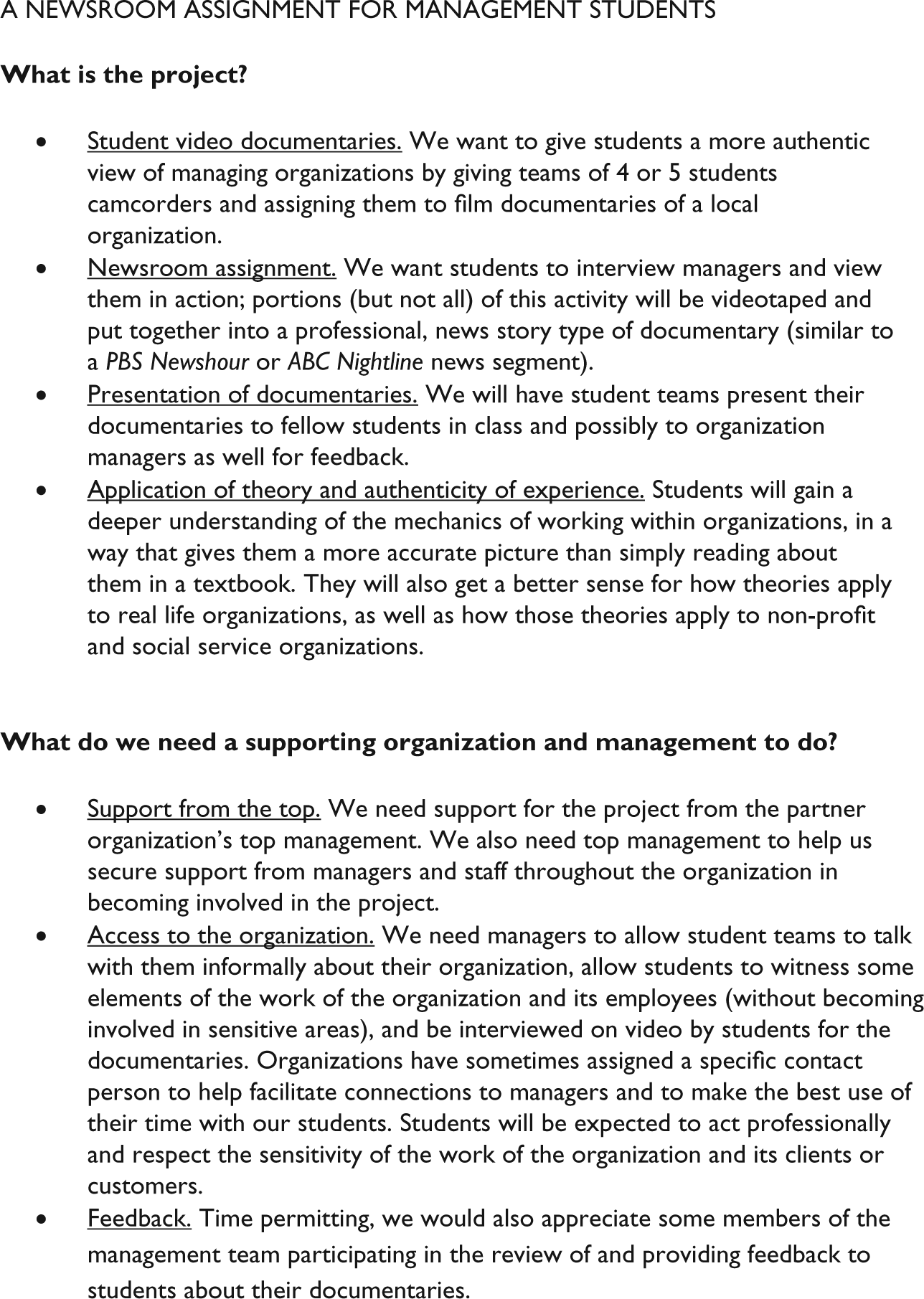
A prototype assignment description for managers of participating organizations.
The Newsroom Assignment is flexible regarding the number of organizations used in a single class environment, so instructors have a choice about the number of organizations they wish to use with each class. The alternative that we used in the past is to use only one organization for the entire class section. This requires that all student teams conduct research on the same organization. This reduces the load on the instructor in finding organizations to support his or her efforts and helps in detecting inaccuracies and biases by teams in their portrayal of the subject organization. In this format, teams can be assigned to analyze the organization from specific theoretical perspectives so that each will provide a distinct examination of the organization’s situation. For instance, in an organization theory course, one team could examine a subject organization from a structural perspective whereas another could use a cultural perspective. This can maximize the value of shared sense making that can occur by allowing each team to develop their own analyses and interpretations of the organization and then sharing them with other teams as they discuss their video documentaries.
When a team presents their project in class, they build on the work of other teams that focused on other theories and issues facing the organization and can actively involve them in discussing the differences and similarities of their findings. The downside is that there will be a higher burden on the subject organization that has to endure multiple teams of students seeking interviews and information from managers and employees.
Another alternative that instructors can consider is using multiple organizations as subjects for the assignment. In this format, each team looks at a different organization. This choice will increase the burden on the instructor to find organizations willing to participate in the project. However, each organization will be confronted with fewer students asking for valuable time. The value of shared sense making over a variety of observations and perspectives on an organization can be preserved by specifying that each team cover particular theoretical approaches in their analysis of the company, perhaps by assigning to each team member a different theory or concept as his or her focus. This approach to the Newsroom Assignment does not allow teams to develop a deep collective understanding of the workings of an organization, but it does allow students to see how management theory works in a wider variety of organizations, which can be brought out in class discussion of the videos. Instructors must balance these competing factors in making their instructional choices.
Establishing a Time Line
The instructor needs to develop a time line for the project in order to give students guidance on the expected pace of the work for the class. The time line needs to include due dates for completing interviews, developing the script, filming, and producing the final product. One basic recommendation for a 16-week semester is to ask students to familiarize themselves and conduct interviews with the organization within the first 4 weeks. The script could be finished in an additional 4 weeks. The filming and the producing could be completed around the 12th week of the semester. The final 4 weeks of the semester can be allocated to presentation and discussion of videos in class.
Additional considerations might call for alterations of this proposed schedule. First, the schedule must accommodate coverage of the course topics. Teams that make use of course concepts and theories covered later in the semester may find that they are unable to generate proper interview questions or an adequate script for the documentary early in the semester. In this case, coverage of course concepts could be done in the first third of the semester, with field research on the organization, filming, and editing taking up a few additional weeks. In any case, time at the end of the semester should be reserved to screen the final videos in order to provide students with a comprehensive look at the subject organization from all the perspectives covered in class. Depending on the length of the video documentaries, the organization of the postscreening discussion, and the number of videos screened in one class period, presentation of the videos in class could take as little as 2 weeks in a typical class schedule. Instructors can also consider posting videos on Internet-based video services or to online course management systems (after securing permissions from the subject organization and considering issues related to the Family Educational Rights and Privacy Act discussed later) so that they can be reviewed outside of class, potentially freeing up class time.
Second, instructors should consider allocating time in class for training with the video-editing software. Given the popularity of Internet video-sharing sites such as Google’s YouTube service, the widespread availability of digital video devices like digital cameras and camera-equipped mobile phones, and the video-editing software built into Microsoft Windows and Apple Macintosh operating systems, some students will already be familiar with the process of recording and editing video presentations. However, most will not be experienced in working with video, even at the novice levels required for this assignment. Instructors should consider devoting at least 2 days to familiarizing students with (a) operating digital camcorders, using lighting, and recording sound; and (b) editing video using either Microsoft’s Movie Maker or Apple’s iMovie software (or other available software packages). As mentioned above, training can be structured in different ways. Depending on the availability of equipment and lab space, the entire class could go through training workshops or a few individuals from each team could attend with the responsibility of imparting the skills gained to the rest of their team members.
Third, instructors should consider allocating class time for students to work on the projects. Although class time often seems severely limited when considering all the topics that need to be covered in a course, students will find the class time devoted to working on the project valuable for working in the field with the subject organization’s managers, collaborating with team members on writing interview questions, and editing footage into the final video. Allowing students to work on the project in class helps them complete the project and also helps avoid potential complaints that not enough time was available during the semester to adequately complete it.
An additional activity that instructors may consider is having students prepare team journals or reflection papers that document the process they used over the course of the semester to complete the project. These assignments can demonstrate how students solved the problem of organizing their teams and managing the time line for completion of all the required activities for the Newsroom Assignment. Journals allow team members, the instructor, and other students in the class further interaction that can enhance feedback and sense making in the classroom, especially if these journals can be shared through blogs, wikis, or other course management tools on an ongoing basis during the semester. Students can report project management and scheduling information, notes on interviews and research on the organization, reflections on the process of interacting with organization members as well as recording and editing experiences, and other information that informs the instructor and the class about the experience of completing the project.
Accessibility of Hardware and Software
Access to and training with the digital video cameras and movie-making software is another important aspect that is necessary in the successful implementation of the student-produced video. For instance, camcorders may have to be acquired for use in the project, as well as other equipment, and it is likely that the computers available in typical general use computer labs will not be equipped for capturing video from camcorders. Although the hardware requirements for video editing for this type of project are generally not very restrictive (almost all computers equipped with Microsoft Windows XP or later versions and Apple’s Mac OS X are powerful enough), some additional equipment may need to be acquired. A basic list is provided in Table 1.
Video Project Equipment List.

Students also need guidelines for use of the equipment. For example, if students share access to cameras, a checkout policy needs to be established. Policies need to be developed for handling the loss or damage of equipment owned by the university. Students also need to be aware of computer lab hours if they depend on the lab for video-making software and/or for equipment. As mentioned in the previous section, students (along with instructors) may need training on the use of cameras and software. At many universities, multimedia specialists or educational technologists can assist faculty in designing and teaching workshops to students, and may already schedule such workshops in support of the general university community. The instructor should be able to recruit IT staff or computer lab managers to provide technical support for students.
Ethical Issues
Another responsibility of the instructor is to make the students aware of the ethical concerns that arise when conducting interviews and showing videos. These concerns arise both from the use of an organization as the subject of their project and their own participation in the assignment. Generally speaking, a university’s IRB must approve projects that directly involve human subjects, even if that research is led by students. However, for this particular assignment, the necessity of IRB involvement is unclear for a variety of reasons. The video documentary assignment does involve the collection of data on human subjects in the form of audio and video recordings, but it is also an activity intended for educational rather than scientific purposes. The IRB process is unique to each institution, so instructors are advised to consult with their university’s board to determine the appropriate course of action.
The organization and its members should be made aware of how their images and comments will be used. Regardless of the formal IRB requirements at any specific university, students should seek consent from anyone they interview. Such consent could be sought informally by simply stating the purpose of the project and the intended uses of the video footage during the initial interaction between students and the members of the subject organization. Alternately, consent from participants could be secured formally through signed release forms that indicate their level of participation, explicitly describe the assignment and how the video will be used in the classroom, and highlight any future use of the video. At a practical level, instructors will likely find that an approach in the middle of these two extremes will suffice in their own situation, and getting individuals to sign hefty legal documents agreeing to participate is not necessarily required. A basic release form, based on examples and feedback from other institutions and individuals and created in consultation with our institution’s legal office, is provided in Figure 3. Instructors can use or modify it for their own class use.
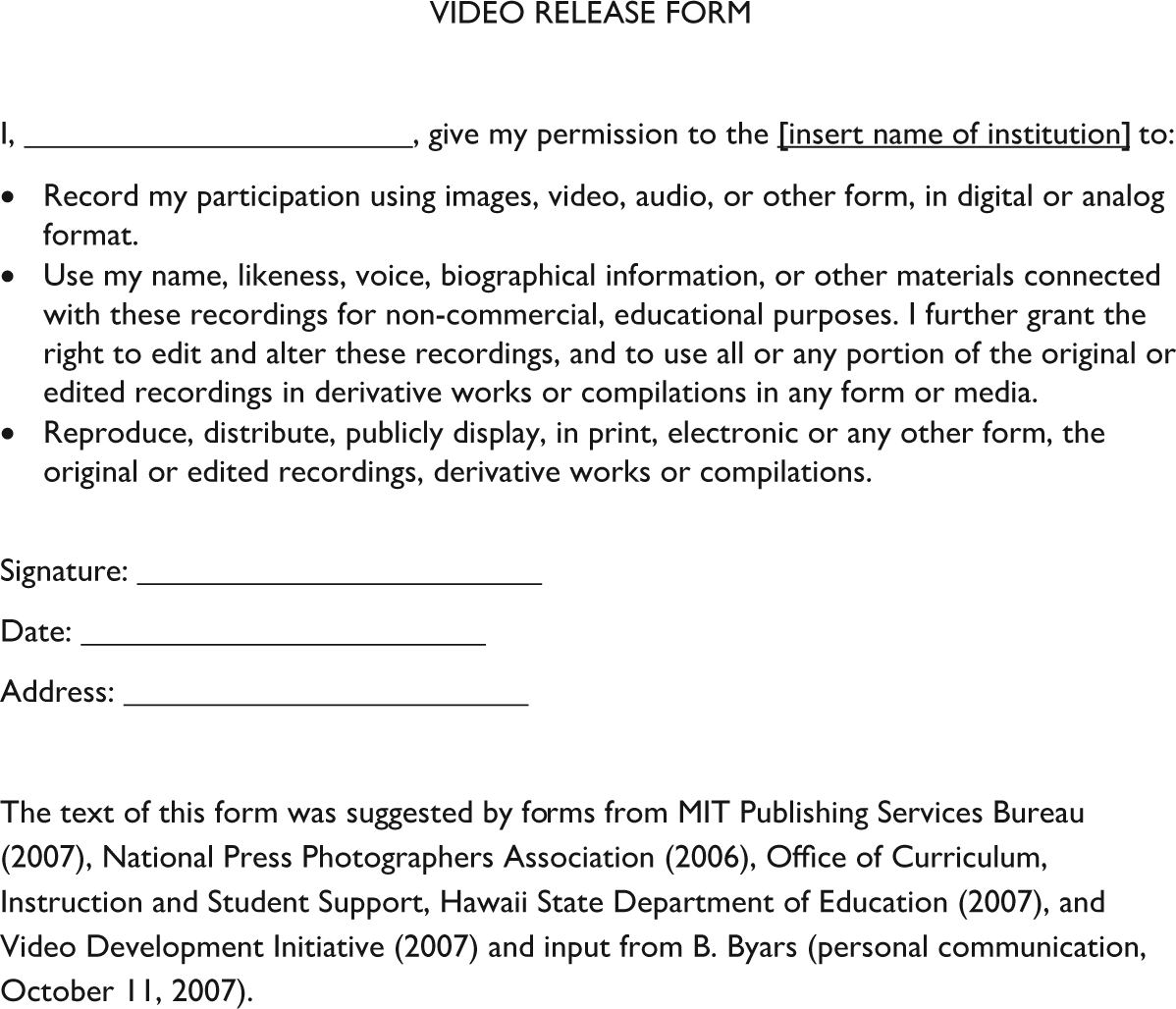
Sample video release form.
As students work on their projects, they should be flexible in response to the needs of the managers and employees with whom they interact. For instance, if organization members are uncomfortable with being filmed but still want to participate, students should provide them with options that more closely match their comfort levels yet yield valuable information for the project. Students may find that members will participate but also wish to remain anonymous. Appearing in front of a camera may create discomfort in some individuals, and those participants may only allow the use of still photos, audio voice recordings, or interview transcripts, all of which can still be effectively used for the video assignment. In such cases, the release forms could be modified based on the organization member’s level of participation.
Because of the public nature of viewing and discussing the videos in the classroom, instructors must also contend with the issue of student privacy and how the videos are used if distributed online. Screening the videos in class should present little concern, but problems may arise if an instructor wants to allow members of the subject organization to view the videos or wishes to distribute the videos across digital networks where individuals outside of the class can view them. Because of concerns arising from the Family Educational Rights and Privacy Act, instructors should also have students sign releases if they appear on camera as part of the assignment; the sample release form in Figure 3 can be used for students as well as members of the subject organization. Just as students should be flexible with members of the subject organization on how they appear in the final cut of the video assignment, instructors should also allow some flexibility for students who may not wish to have their image shown. As detailed earlier, students will find many ways to be actively involved in the project beyond simply appearing on camera.
If the video projects are posted to online web services for distribution, additional concerns emerge. As mentioned earlier, instructors may wish to do this in order to store video projects and allow managers at subject organizations to view the videos whenever they wish. Video files may be uploaded to services fully accessible by the public such as Google’s YouTube service described earlier or to services that place more limits on accessibility like a university’s Blackboard system (http://www.blackboard.com). However, instructors, students, and managers should be aware that once the videos become available on any of these types of services, they lose much of their control over who can access and use the videos. For classroom purposes, there may be few negative consequences to permitting more public access to video content. As the size of the audience increases, the possibility that video content will be viewed—and even reedited and reused—for other (and sometimes potentially malicious) purposes increases even without the explicit intention of students. Instructors may also want to consider that organization members may be reluctant to cooperate with students on the project if video footage will be posted on online networks. In any case, although there are benefits to making video projects available online, all parties—instructors, students, and managers and employees in the organizations being studied—should be aware of the consequences of choosing to use this technology.
Student Reactions
In tests of the Newsroom video assignment in our own classes, students expressed a variety of concerns and impressions that helped form our recommendations discussed in this article. Typically, students were initially apprehensive when the assignment was described to them. This was not surprising as the assignment is quite different from other course work and often requires them to learn new technical skills. However, this early anxiety lessened over the course of a semester as students became familiar with the project requirements, received instruction on using the software and hardware, and received briefings on the availability of equipment from technical support staff. After the first semester using the Newsroom Assignment, we were able to show students examples of past projects, which helped a great deal in acquainting students with the project. We also had students produce a quick video early on in the semester on the members of each team; this “dress rehearsal” allowed students to get comfortable with the technology before working on the “real” project. As might be expected, video quality varied across teams but did not seem to affect student reactions to them; problems with shooting and editing videos were discussed in class and helped students understand the process of working together as small groups to solve problems. The quality of videos based on the effective use of management concepts also varied, much as might be expected of any other class assignment. However, we believe that the production of the videos coupled with the discussion of them after viewing them in class provided students with an enhanced understanding of course concepts.
Qualitative comments solicited from students demonstrated that overall students seemed to like the assignment and found it beneficial in terms of meeting the learning objectives of a management course. For example, several students reported enjoying the real-world nature of the project, including the opportunity to interview managers and employees in the field. They also enjoyed doing the project in lieu of a paper; several claimed that the Newsroom project was unique and forced them to think creatively in order to complete the assignment. In addition, students enjoyed learning about using the technology and appreciated having the opportunity to edit mistakes out while working toward a final product. However, some frustration was reported around doing a technology-driven assignment. These frustrations included students’ perceptions of working with team members less skilled with technology, restricted availability of equipment, and lack of technical support. Ultimately, based on feedback, it appears that the project was an effective way to tie the real-world content into a novel and enjoyable learning experience.
Future Research
There are a number of areas for future research on the use of student-produced video in the management classroom. These areas include assessment, specific course applications, and alternatives to the Newsroom Assignment.
Assessment
Instructors can handle assessment of student-produced video projects in the same fashion as they handle assessment with written papers, oral presentations, and exams. When considering assessment for the video project, instructors should align the assessment process with the learning objectives established for the course, major, or program (see AACSB International, 2007). However, some issues are different in the Newsroom Assignment compared with more traditional assignments and may require different approaches. For instance, should the cinematic style of the students’ videos be part of their evaluation? One could argue that this is very important, just as the speaking style of a student presentation or the editing and revision of a written paper may be considered important. Rappaport and Cawelti (1998) argued that instructors should consider the cinematic style of videos chosen for screening in the classroom; this may imply that the quality of the photography, the production design, lighting, and special visual effects should be assessed in student-produced video. Alternately, an emphasis on production quality may also promote a heightened focus on the technology rather than the course concepts, analogous to having students focus on expensive covers, font choices, heading styles, and color printing instead of quality writing and conceptual clarity in a traditional written paper.
Specific Management Course Applications
The Newsroom Assignment is flexible in its application in different courses. However, implementation and assessment issues may be specific to particular course applications. Investigation of specific applications in various management courses can illustrate how student-produced video projects can solve unique course learning objectives. Furthermore, much of the study of student-produced video projects has occurred in the educational technology literature, and does not look specifically at management student populations (e.g., Goldman, 2004; Swain et al., 2003). Given these questions, future research can add significantly to the effective use of video technology in the management classroom by studying its impact in management courses and by identifying course-specific assessment issues.
Alternative Assignments
Although the Newsroom Assignment described above offers a great deal of flexibility in terms of how students execute their final project, there are other models that instructors can use in designing a student-produced video project. The Newsroom Assignment leans toward a traditional, newscaster-based style. However, instructors may adjust that approach so that students create a more “talk show” type of project, with a host and several discussants on camera simultaneously. Another alternative might include projects that emphasize a documentary or ethnographic approach, where students produce a video that involves more of a storytelling style. Future research can explore more fully this array of possible applications for creating video technology with management students.
Conclusion
Video teaching materials and technologies have an established place in management and business education. Instructors use video in a variety of ways to address the learning needs of their students. Video contributes tremendously to the learning experience of students by focusing their attention on critical concepts, tapping into multiple sensory channels and developing skills beyond written competencies, and enabling students to visualize a diverse array of managerial situations and problems. However, instructors must also consider the potential challenges of using video in their courses: the lack of appropriate video materials, the consequent lack of materials that have both high production quality and enough useful conceptual content, and the tendency of video viewing to reduce student attentiveness and motivation for learning.
To combat these challenges, we suggest the use of student-produced videos. Having students produce their own video materials promotes active learning. Students get involved with researching the materials, working on and developing the project with others, and producing the final project. Interacting with the management content necessary to produce the video gives students a greater chance of understanding and synthesizing the material. Active learning is also present when asking students to produce videos set in authentic situations. These situations require students to interact with the types of scenarios that they are likely to encounter outside the classroom.
We suggest the use of the Newsroom Assignment as a mechanism to facilitate active learning through student-produced video. The Newsroom Assignment requires students to work in groups to identify, research, write, and produce a news story; in effect, student teams create a short video documentary about a particular subject. Working together on developing a script, interacting with organizations, using the technology, and sharing the end result with others requires students to interact with the information in a very hands-on way. The instructor needs to be aware of several considerations when using the Newsroom Assignment, such as finding organizations willing to be subjects for the students, securing equipment and technical support, developing a time line conducive to the course schedule, creating a mechanism for assessing student projects, accessing the required equipment and training for students, and managing various ethical issues. In conclusion, student-produced video can be a successful mechanism for facilitating a learning environment that is active in nature. The ultimate benefit to the Newsroom Assignment is that students get the opportunity to learn about management using a novel approach and finish with a product they can own and share.
Footnotes
Acknowledgements
The authors wish to express their thanks to Lori Swinney and Chad Bushy at the University of North Dakota’s Center for Instructional & Learning Technologies for assistance with the video technologies discussed in the article. Dr. Duane Helleloid, Joshua Jones, and Steve Vogel at the University of North Dakota’s College of Business & Public Administration also provided important assistance in completing the project. The authors also recognize the contribution of the editor and the anonymous reviewers; their suggestions and expertise significantly helped improve the article.
Authors’ Note
The authors presented an early version of this article at the Texas Computer Education Association Educational Technology Research Symposium, February 6, 2007. Readers may contact the first author for additional information related to the article.
Declaration of Conflicting Interests
The author(s) declared no potential conflicts of interest with respect to the research, authorship, and/or publication of this article.
Funding
The author(s) received no financial support for the research, authorship, and/or publication of this article.