




Abstract
This review presents a synthesis of the state of arts-based management education scholarship, with teaching and research recommendations. To begin, the lack of creativity and empathy development in management students is presented. Next, literature-based descriptions of arts-based management exercises focus on how to use improvisational theatre, visual arts (film, collage, drawing, sculpture, and photo-captioning), poetry, narrative writing and storytelling, and music in the management classroom. Then, each art form is analyzed in terms of its capacity to develop creativity (the ability to produce new, useful, and high-quality ideas and products) and empathy (the ability to understand another person’s feelings and want justice for him or her), as conceptualized in recent psychological research. Based on these descriptions and analysis, three arts-based teaching challenges are proposed for advancing practice in this area: confronting the shifting role of instructor and learner; forging collaborations with professional artists, art faculty, and students; and promoting active arts-participation in students. Finally, research recommendations are offered for extending the field with a table of eight design elements.
And if liberal learning is not intentionally connected with students’ central concerns it may be decorative or entertaining but will not be deeply informative. (p. 165) Studies of innovative design and creativity more generally have shown that an exploratory, playful, intrinsically fascinated orientation underlies the creative process in any domain. Given this understanding of what is needed for creative thinking in business, it makes sense to try to give business students a more exploratory and intellectually vibrant stance toward their studies and their work. (p. 168)
In these quotes from the Carnegie report, Colby et al. (2011) point toward the importance of creativity as a beneficial outcome of integrating the humanities and the liberal arts into undergraduate business education. The report also emphasizes that this new interdisciplinary teaching and curricular approach should go beyond “decorative” integration by addressing student learning and workplace experiences. Emotion and empathy are suggested as ways to deepen learning and understand business as a humanistic pursuit situated in cultural contexts that involve an ethical dimension (Colby et al., 2011). Parallel to this trend of integrating liberal arts into business education is the use of a particular type of liberal arts—the visual and performing arts—for example, theatre, drawing, poetry, and music 1 —in business and leadership courses, executive institutes, and corporate professional development to help promote creativity in professionals and students. For example, management and leadership programs across the globe, like The Banff Centre in Banff, Canada; the Center for Creative Leadership in Greensboro, North Carolina, U.S.A.; and the Center for Art and Leadership in Copenhagen, Denmark, have pioneered ways to use the arts, creating a rich interest area for faculty, students, and practitioners. Special interest groups and conferences have formed among scholars such as the 1995 Academy of Management National Conference on jazz as an organizational metaphor (Meyer, Frost, & Weick, 1998) and the Art and Management Conference in York, England. Concomitantly, the small field of organizational aesthetics and aesthetic leadership developed in the late 1980s and early 1990s (Duke, 1986; Guillet de Monthoux, Gustafsson, & Sjostrand, 2007; Palus & Horth, 1996, 2002; Samier & Bates, 2006; Smith, 1996; Strati, 1992; Taylor, 2002; Taylor & Hansen, 2005; Weggeman, Lammers, & Akkermans, 2007; Welsch, 1996) helped set a theoretical precedent to further develop the studio arts in management and leadership in courses, and a substantial amount of articles on this topic debuted in the Journal of Management Education (e.g., Corsun, Young, McManus, & Erdem, 2006; Gagnon, Vough, & Nickerson, 2012; Huczynski, & Buchanan, 2004; Morris, Urbanski, & Fuller, 2005; Van Buskirk & London, 2008). Thus, while scholarship and the teaching practice of using the studio arts in business and leadership education is not new, it is not explicitly articulated as an area of liberal arts learning in the Carnegie Report.
The purpose of this article, therefore, is to address the gap by explicating the ways that arts-based experiences are designed, taught, and researched, with teaching and research recommendations to help this emergent field go beyond the value of “decorative” integration and consumption implied as a pitfall of liberal arts integration in the Carnegie Report to develop creativity in management students. First, the lack of creativity and empathy development is presented. Next, each type of arts-based management exercises is described, with an explication of how these exercises can help promote creativity and empathy in management students. Three arts-based teaching challenges are then teased out as well as recommendations for future research in this area focusing on eight course and research design elements.
Statement of the Problem: Lack of Empathy and Creativity Development
Three interrelated problems in the Carnegie Report frame the impetus for synthesizing and critically reviewing studio arts-based management education: (a) the lack of empathy and creativity development in business students as suggested by the Carnegie Report, which can be supplemented by liberal arts integration; (b) an insufficient inclusion of the arts as one of the key liberal arts in the Report; and (c) no explication of teaching methods in the area of arts integration (compared, e.g., with the inclusion of the disciplines of political science and philosophy). The paradox of promoting empathy and creativity in college students, particularly in business majors, is an issue that professors face in the classroom and advising context: Empathy and creativity are generally discouraged in the workplace and society even though they are widely considered to be key aspects of childhood and student development in the early years, across cultures. If one considers the development of the college students that management and leadership professors currently teach, advice, and do research with, it is important to think about how college students receive mixed messages about whether it is beneficial to be empathetic and to be creative. While there are many definitions and models of creativity, it generally refers to the ability to produce excellent, relevant, and novel ideas and products (Plucker, Beghetto, & Dow, 2004; Sternberg, Jarvin, & Grigorenko, 2009). Empathy is considered to be the ability to care about another person’s feelings and want justice for that person (Zhou, Valiente, & Eisenberg, 2003), a basis for positive behavior and relationships (Spinrad & Eisenberg, 2007).
Empathy and creativity are valued generally as essential parts of children’s cognitive development (Cropley, 2003) and “optimal” growth (Huebner, Gilman, & Furlong, 2007) that can be fostered in schools (Kaufman & Beghetto, 2007). Very young children are encouraged to be empathetic and care about other people’s feelings as they learn socialization processes intrinsic to family life and school success (empathy; Spinrad & Eisenberg, 2007). Likewise, very young children are encouraged to explore and express themselves in a variety of ways, namely through artistic media like music, song, dance, and painting (creativity; Dewey, 1934). Yet as children grow into their teen years (high school), being empathetic might be considered virtuous yet uncool. And artistic, creative pursuits are viewed generally as way to round out future academic achievements (Hall & Thomson, 2005) to help teens differentiate themselves from other college applicants as a competitive advantage. But, in young adulthood (college), students are encouraged to be practical and chose a profession wherein empathy and creativity can be perceived as “soft” skills not entirely relevant to the type of learning and majors that will help students be academically successful and make a good living. For business students, the pressure to be practical and hard-nosed competitors—thus de-emphasizing “soft” skills that involve interpretation (Ambrosini, Billsberry, & Collier, 2009) and subjectivity—like empathy and creativity—might be even more prominent than for other college majors. As business professor Michael London articulated (Van Buskirk & London, 2008):
I was a purveyor of all things soft . . . in the finance-driven world of the school, professors of organizational behavior, management, leadership and group dynamics had to deal with the tendency to see their discipline as soft, fuzzy and vague by colleagues and students alike . . . soft was considered weak; hard was real and bottom line. (pp. 305-306)
This excerpt identifies how the actual process of learning, which can draw on meta-skills like empathy and creativity (Sternberg et al., 2009), is not considered to be particularly important for excelling financially and socially. Dr. London’s quote corroborates with an accumulating stream of scholarship decrying a workplace-curricular gap between corporate and MBA-related skills (especially the ability to manage people), and the proliferation of atheoretical curricula and coursework that fails to account for student assumptions, beliefs, and concerns (see Rubin & Dierdorff, 2013). Views on empathy and creativity, though, might be changing. In addition to content knowledge, noncognitive outcomes like creativity are increasingly considered to be successful components of college success and retention, lifelong learning, and workforce preparedness. For example, College Board Vice President Wayne Camara contended that creativity, empathy, and intellectual curiosity are intrinsic to promoting engagement in learning for college and workforce success (Educational Testing Services, 2009). The Association to Advance Collegiate Schools of Business (AACSB; 2007), which accredits business schools, provides conferences and seminars to help shape the role of business schools in society, stressed the importance of creativity as critical to innovation in management practices. Creativity is also described as a skill that is emphasized at the expense of analytics in business schools (AACSB, 2009), which can be remedied by fostering integrative learning and active alumni networks. Problem solving—a part of the creativity research tradition in cognitive and social psychology (Pretz, Naples, & Sternberg, 2003)—is also cited as an example of a learning objective used in management programs (AACSB, 2007). Problem solving is associated with being able to produce ethical solutions to complicated management problems. This skill includes empathy or the ability to understand another person’s feelings and want that person to be treated well (Zhou et al., 2003).
More recently, in the Rethinking Undergraduate Business Education: Liberal Learning for the Profession, Carnegie Foundation scholars Colby et al. (2011) proposed that empathy and global learning and emotional ties to creative work are important characteristics of liberal learning relevant to business education, which harkens back to Dewey’s (1934) emphasis on everyday life as heightened aesthetic experience. Creativity is cited as intrinsic to the definition of entrepreneurship, and business education is criticized for not fully developing this area in students whereas as liberal education has focused on the humanistic qualities of empathy and creativity:
At this point, however, entrepreneurship education as we observed it does not fully recognize and take advantage of larger themes such as innovation and creative thinking, the development of fresh but grounded visions of future directions, and responsiveness to a constantly changing environment. . . . Their education is too narrow to support the creativity and flexibility they will need to be innovative business leaders. (Colby et al., 2011, p. 163, italics added)
In this conception of liberal learning for business education, creativity is positioned as relative to both individual and group success in business education. Working in teams to generate ideas, and not judging these ideas prematurely are associated with new business design, services, and products (Lubart & Mouchiroud, 2003). Depending on how individual creativity is defined and fostered in practice, it can be perceived as resisting the logic of rationality that underpins the efficiency and formal procedures of businesses and organizations (Schipper, 2009). Thus, creativity is usually circumscribed by “rational” organizational goals (Schipper, 2009). The Carnegie Report, though, does not address the nuances of creativity and empathy development and does not describe which disciplines are included under the general description of the “arts and sciences,” with no mention of the arts in particular. This gap is important to reconcile with because novel arts-based teaching approaches can help the field of management education address the criticism of disintegrated business learning experiences, which can be disconnected from fast-paced, real-world changes.
To summarize, there is a pronounced paradox concerning how to promote empathy, the ability to care about another person’s feelings (Spinrad & Eisenberg, 2007; Zhou et al., 2003), and creativity, the ability to produce excellent, relevant, and novel ideas and products (Plucker et al., 2004; Sternberg et al., 2009), in the trajectory of business student development. Higher education programs, and specifically applied fields like management, leadership, and human resource development education, have been critiqued twofold: for the lag time between the actual skills needed in the workplace and representing those skills in programs, syllabi, and coursework (Nesbit, 2012), and second, for the lack of innovative ways of teaching beyond passive listening with PowerPoint presentations (Johnson, 2011) where the instructor controls the flow of communication between instructor and students (Sawyer, 2006). This critique reifies the argument for integrating liberal learning into business curriculum that includes the deliberate cultivation of creativity modeled after psychological research on creative individuals, and for problem solving based on ethical considerations, which is conceptually tied to empathy. In light of this repositioning of empathy and creativity, the question of how to promote empathy and creativity in management courses persists, especially when the arts are integrated purposefully into the curriculum. To address this question, this article endeavors (a) to synthesize the state of studio-arts based integration into management education for professors who wish to consider using arts activities in their courses and (b) to explore how arts-based experiences can go beyond decorative integration and consumption implied as a pitfall of liberal arts integration in the Carnegie Report to develop creativity and empathy in management students.
Method
To produce a synthesis on the topic of arts integration into management and leadership education, a search was conducted using the descriptors “arts,” “aesthetics,” “studio arts,” “theatre,” “improvisational theatre,” “poetry,” “storytelling,” “visual arts,” “film,” “music,” or “jazz,” combined with “manage*ment*,” “lead*er/ing/ship,” “organization*al,” “edu*cation,” “learn*,” or “develop*/ment” in business, art, psychology, education, and social science databases including Business Source Complete, PsycInfo, ERIC, Academic Search Premier, JSTOR, and Arts and Humanities Index. The inclusion criterion for this review was an article or book that combined both art and leadership concepts. The database search yielded more than 1,000 articles from 1977 to 2013 and was narrowed down to focus on arts-based management education. Articles that focused on the metaphor of the arts such as the “art of leadership” without explanation of arts activities were excluded. Arts were included that spanned both the genres of “fine art” such as sculpture and poetry and popular culture such as film and music.
Ethnographer Harry Wolcott’s (1994) D-A-I (D(escription), A(nalysis), and I(nterpretation)) method was used to structure this review to provide a cohesive and focused examination of the topic. In the Description phase, articles were categorized according to the type of arts. Research was summarized to describe how the arts are actually used in management or leadership courses, in the order in which they have been most frequently used in the field: improvisational theatre, poetry/narrative writing and storytelling, visual arts (both two and three dimensions), and music. An overview of the history of arts-based management education orients the reader to these descriptions. Next, the Analysis phase attempted to analyze how each art form helps stimulate empathy and creativity in management students. The art forms were synthesized, compared, and analyzed in order to draw out the expressive qualities unique to each art form as well as the complexities of implementing each art form. Finally, the Interpretation phase attempted to interpret the description and analysis by comparing the different art forms. Based on this interpretation, three challenges emerged for advancing teaching practice in this area and in the context of designing future research.
An Overview Arts-Based Management Education
This overview provides a short history of how management professionals started using the arts: In the late 1980s, consultants applied the arts to improve organizations. For example, Marjorie Parker of the Norwegian Center for Leadership Development used music, poetry, and visual arts with the Hydro Aluminum Karmoy Fabrikker Company from 1996 to 1998 (De Ciantis, 1995). Similarly, Suzanne Merritt created the Polaroid Creativity Lab in 1992 to help the Polaroid Corporation break through growth barriers using the visual arts as one form of communication to enhance creativity (De Ciantis, 1995). Merritt’s work expanded to scholarship on aesthetic leadership principles (Merritt & DeGraff, 1996) as well as working with the Center for Creative Leadership in Greensboro, North Carolina, to develop arts-based leadership development exercises.
Other European and American leadership training programs adapted the arts like improvisational theatre to better meet the needs of their clients. Arts-based leadership and management training programs or certificates have been or are currently offered at The European Graduate School in Switzerland; The Banff Centre in Banff, Canada; The Center for Creative Leadership in Greensboro, North Carolina; and Center for Art and Leadership, in Copenhagen, Denmark. Universities who have offered specific arts-based leadership courses include Oxford University, U.K.; MIT’s Sloan Leadership courses; the University of Chicago’s MBA program (Adler, 2006); and Northwestern University’s Kellogg School of Management (Kuehner-Hebert, 2013).
These programs generally fall into one of two ways to promote management learning: a manager attends the program alone or accompanied by his or her colleagues. Attending the arts-based programs by oneself enables a manager to leave existing group dynamics at work to concentrate deeply on complex problems and personal challenges in his or her job role. This departure and isolation from workplace dynamics can foster a sense of risk-taking and a willingness to experiment with artistic media, which is believed to foster deep(er) learning than attending the program with colleagues. On the other hand, intact groups who attend workshops or programs can codevelop their problem-solving skills together. As a result, these groups might transfer new ideas and solutions generated through arts-based learning more effectively than the solitary participant back into their workplace. In addition to accredited arts-based management programs, it is no longer uncommon to stumble across consultants who use the arts like sculpture and photography to coach professionals in the areas of vision setting, career-goal development, and communication improvement. This practice fuses the tradition of business consultation with arts education and even the arts therapy field, which attempts to develop and improve individual- and group-based interaction based on insights fostered through the art making process (Robbins, 1994). Often, such insights reflect a critical pedagogical approach used in experiential management education (Strati, 2007; Welsh, Dehler, & Murray, 2007). How then, does each art form help management students help to stimulate creativity and empathy related to their work? The next section presents each art form, synthesizes prevalent exercises in extant scholarship, and describes how they relate to the development of creativity and empathy.
Improvisational Theatre
Innovative theatre curricula have been developed for management courses, with special names like “Arts-Based Training” (Corsun et al., 2006), “Organization Theatre” (Meisiek, 2004), “Change as Theater” (Mirvis, 2005), or “Psychodrama” (Catani & Lambri, 2009). As these titles suggest, theatre is one of the most common art form for engaging managers and leaders, both in the workplace as a form of organization-wide development and in management courses.
Examples of Improv Theatre Exercises
Theatre includes a wide variety of approaches ranging from classical acting techniques and methods based on memorized scripts, sets, and music to spontaneous unscripted role-playing. A variety of improv approaches exist; this section is neither exhaustive nor proscriptive but gives a general sense of typical exercises used in workshops and classes. Initial improv exercises attempt to get management students’ attention, with the idea of refining their perception (Springborg, 2012) through auditory, visual, and sensory cues (Gagnon et al., 2012). These skills are isolated in each exercise and then used in combination. For example, “apples and oranges” requires students to walk around an inner circle of chairs and to listen to the word “apple” or “orange.” Additional chairs are added until each person has a chair, but students generally do not recognize that all the chairs have been added because they are focused on listening to the auditory cues of “apple” or “orange” being shouted (Gagnon et al., 2012).
In another improv exercise, students pair up to “take care of your partner” (Gagnon et al., 2012). They move from the individual perception honed in “apples and oranges” to perception when communicating with another person (Barrett, 1998). The student pays full attention to his or her partner, developing a story. One student starts, and another student builds on his or her story in a supportive manner that “takes care” of him or her so that she does not stop talking and continues developing a basic storyline. In a similar exercise called “yes and . . .,” students stand in pairs directly across from each other. One student starts a sentence, and her partner continues her story by saying “And—.” This helps build trust between partners so that no one controls what is said (Moshavi, 2001). Pruetipibultham and Mclean (2010, p. 13) cited an example of “yes and” from 3M that was used to develop the Post-It note (based on Fry, 1987, cited in Vera & Crossan, 2005): Apparently, through the process of “yes and,” 3M researchers transformed the outcome of a failed adhesive and applied it to other ways of keeping impermanent notes of paper attached to books.
Building on individual and pair exercises, “word-at-a-time” includes a small group exercise (Gagnon et al., 2012). Similar to the childhood “telephone” game, each person states a word and then builds successively on that word. These small groups of students might play several rounds of “word-at-a-time” to become familiar with the process and to build group collaboration advantageous to leadership situations (Crossan, 1998). “Story line/pop-up” expands the four-person collaboration with six to eight students in a group (Gagnon et al., 2012). This time, students take turns being the storyteller. The storyteller steps forward to kick off the story with a theme given to them by an instructor/leader, and each student builds on the story in a round robin manner—either by stepping forward or “popping up.”
Developing Empathy and Creativity Through Improvisational Theatre
Empathetic communication and cognitive problem solving can be stimulated through the somatic expressiveness unique to improvisational theatre. Of the four arts most commonly used in management education (i.e., improv, visual arts, music, poetry), improv arguably most emphasizes the aspect of making sense of experience through the body and mind via acting, also referred to as bodily cognition (Springborg, 2012). Bodily cognition is a term used for recognizing the instrumental role of the body in constructing meaning of everyday experience, which can be heightened through the senses and tactile sensations when making art (Johnson, 2007). This form of understanding is a largely untapped area of sense-making identified in critical organization studies (Chandler, 2011, for example) and critical management pedagogy (Strati, 2007; Welsh et al., 2007), which questions rationalistic approaches to learning about and managing organizations. This area of aesthetics has been applied, too, to leadership (Duke, 1986; Katz-Buonincontro & Phillips, 2011; Samier & Bates, 2006; Smith, 1996), organizational theory and management studies (Guillet de Monthoux, 2007; Strati, 1992; Taylor, 2002; Taylor & Hansen, 2005; Weggeman et al., 2007; Welsch, 1996), and human resource development (Gibb, 2004).
Conjuring spontaneous thinking in management students through improvisational role-playing is believed to help students think on the “fly” much as they would when encountering a new or problematic situation in the workplace but in a setting free from workplace responses. Typically, there is no single director in improv, resulting in role-plays that are unscripted, emergent, and spontaneous. This requires management students to literally think “on their feet” by speaking and using their bodies in the moment during a role-play. Using improvisational theatre techniques is relevant to theories of management and leadership development grounded in situated cognition (Brown, Collins, & Duguid, 1989; Scardamalia & Bereitier, 2006). Improv theatre can also change the dynamic of the management professor–student relationship that is oft criticized as static and mono-directional with the professor as transmitter of knowledge (Johnson, 2011; Sawyer, 2006). This shifting of the professor-student role is arguably rooted in Augusto Boal’s (1985) Theatre of the Oppressed techniques that questioned the traditional theatrical approach of separating the actor from audience. In Theatre of the Oppressed, “spec-actors” were invited to participate in the acting process and thus question the status quo of societal norms and values.
In addition to cognitive approaches to problem solving, the aforementioned improv exercises can successively build perceptual awareness at the individual and then group level. More complex role-plays of workplace scenarios in which larger groups of students interact can also be used. In improv role-playing that emphasizes acting out complex workplace experiences, students collaborate with each other even further and with improv actors as they cocreate content (Katz-Buonincontro, in press). A student would begin the collaboration by describing a role-playing theme such as a hotly contested exchange between a manager and a business client, or a special project that requires new teams to overcome past experiences of workplace incivility to work effectively together. The management students would act out a conflict with improv actors, identify the problems more closely, and generate solutions to these problems. Meisiek (2004) used a similar approach in a home care organization, as opposed to a classroom, to surface discussions and engage employees emotionally around the difficult organizational climate.
In summary, improvisational theatre in management education can include strengthened empathetic responses among students (Katz-Buonincontro, in press), airing difficult discussions (Meisiek, 2007), and enhanced group cognition in the area of creative thinking (Pruetipibultham & Mclean, 2013). Improv theatre can help build creative problem solving and empathy individually and collectively in the classroom: For example, when students watch other students act out these workplace problems, they can build “second-order observation,” a concept that refers to an observation of an observation (Luhmann, 1997 in Meisiek, 2004). This helps develop students’ perceptual shortcomings—a limited categorization or interpretation of information based on past experience (Corsun et al., 2006). Thus, management students can refine their perceptual acuity of organizational occurrences and build empathy for others’ perspectives about workplace problems. This kind of interaction can help students to think and act with spontaneity and to understand the nature of complex emotional reactions in the workplace (Feinstein, Mann, & Corsun, 2002), which can result in the desire to act in new ways (Meisiek, 2004; Mirvis, 2005).
Poetry, Narrative Writing, and Storytelling
Poetry, writing, and storytelling are the art forms that most closely mirror traditional teaching techniques of developing written and oral language mastery in management students. Because the written language is the most widely used form of academic communication in coursework through writing papers, research reports, exam essays, and emails, the act of composing poetry and creative writing builds on the purpose of mastering reading, writing, and speaking through the articulation and communication of ideas. Articulating, recording, and communicating these ideas is fundamental to the development of creative ideation. However, the medium of poetry, writing, and storytelling differ in important and significant ways for new idea generation and building empathetic responses to human situations and explored in this section.
Examples of Poetry, Narrative Writing, and Storytelling Exercises
Poetry can be employed as an art form in the field of management in four different ways: (a) poets serve as organizational consultants to businesses (Buswick, Morgan, & Lange, 2005; Essez & Mainemelis, 2002); (b) business professionals actively write and publish poems about business life and their workplace experience (Windle, 2006); (c) researchers explore their own, or management students’ aesthetic experiences in organizations through the writing process (Darmer, 2006; Hiley, 2006; Kirby, 2011); and (d) management professors share poems they have written about their professional identity with students and/or have students write and share their own poems (Van Buskirk & London, 2008).
With regard to poets as organizational consultants to businesses, poet David Whyte has visited many corporations to promote discussions about difficult issues (Essez & Mainemelis, 2002), and consultant Ted Buswick uses poems in strategy retreats. This format usually involves investigating into the nature of organizational problems to be discussed, then carefully selecting the poem and finally, introducing the poem to organizational members. Poem selection rests on subject matter, accessibility, beauty, and emotional tension so that organizational members can effectively connect with the poem’s meaning, connect that meaning to workplace problems, and derive different ideas to solve those problems (Buswick et al., 2005).
As a form of inquiry with management students, Hiley (2006) and Phillips (Katz-Buonincontro, Phillips, & Arnold, 2013) used writing as an extension of the research process in which field notes are commonly taken. Students are asked to keep a journal to reflect on their workplace experiences, to develop a research voice, and document their development as management students through poetry. For example, Hiley (2006) used writing with students to relate, reflect, and retell experience. These students’ poems examined issues of “paradox,” “feelings of loss,” “vulnerability,” “struggle,” and “searching.” Phillips (Katz-Buonincontro et al., 2013) also used reflective writing with doctoral educational leadership students, but it was to consider the nature of artistry more deeply after visiting professional artists’ studios. Here, this student discussed her realization that artists use a high level of skill that is undermined in American school systems: “I am always intrigued by the artist’s mindset and ability to “see” things that I cannot. . . . Also, the skills that are needed to be an artist are underappreciated . . .”
Similar to Hiley (2006) and Phillips (Katz-Buonincontro et al., 2013), Palus and Horth (2002) developed a journal-writing technique called visual–verbal journal, or VVJ, that explicitly incorporates visual elements with writing. The pictures can serve as visual cues for remembering key details. Palus and Horth (2002) have also adapted the Japanese poetic form of haiku with leadership participants, which can be used to recount work troubles and successes.
Van Buskirk and London (2008) developed different poetry exercises to help themselves as well as their students bridge the dichotomy between their work and personal identities. Based on Bill Van Buskirk’s experience of writing a poem about his role as a management professor, they designed a workshop called the Poetry Gallery. Workshop participants circulate around a room individually reading 75 to 100 poems, followed by a process where they select a poem and then share the poem with others (Van Buskirk & London, 2008). Next, participants compose their own poems and share them. Lastly, published poems like James Autry’s From “On Firing a Salesman” have been used to explore topics such as “human resources,” that is, what means to experience stress in corporate life while also being a student (Van Buskirk & London, 2004).
Developing Empathy and Creativity Through Poetry, Narrative Writing, and Storytelling
In these writing exercises, the act of narration focuses on the recollection of lived experience through the construction and telling of stories. This touches on the idea that management students can develop a meaningful understanding of their professional identity as potential managers and their workplace experience through telling stories, writing, and composing poetry. In turn, this process serves to help develop empathy for others and care about the problems that they face which precipitates the desire for sustained creative problem solving. Social scientists like Polkinghorne, Ricoeur, and Carr have emphasized the act of meaning making through storytelling, which, in the context of management education, can influence and shape leadership identity. David Whyte, one of the most widely known poets used in arts-based organizational development, discussed the rationale for including poetry to develop organizational members’ identity with management researcher Elizabeth Essex (Essex & Mainemelis, 2002):
We have no language around most of the dynamics of identity in the workplace. We spend most of our time there, or society spends most of its energies and news emphasis on work, and there’s almost nothing on the identities that we form around our work. (p. 149; italics added)
In addition to developing management identity, poetry has been used to develop meaning in business life and to bridge workplace and personal experience. For example, Ted Kooser, former Vice president of the Lincoln Benefit Life Company, who is a poet, wrote (Windle, 2006):
I wish I could steal into corporate headquarters all across the country and replace every one of those pop-management books with collections like this one. It would greatly humanize American business. Poetry has a way of making life and work meaningful-something that the management “gurus” have not yet stumbled upon. (p. 461)
Poetry departs from social science principles of third-person voice, because it relies on establishing a first person relationship with the audience (Brown, 2006). For the management student writing and sharing poetry, the poetry-writing process highlights his or her subjective experience and can elicit a feeling of vulnerability for making relationships with others more personal or authentic. Arguably, this vulnerability can lay a foundation for empathy. Because poems are individual, subjective portraits of organizational reality, writing and discussing published poems or poems written by students and faculty members in group settings with management students can foster dialogue in which organizational realities are examined, analyzed, and compared across different perceptions. In summary, writing and reading poetry in management education can help foster empathy and creativity by engaging deeply about the purpose and meaning of work (Buswick et al., 2005; Hiley, 2006) and deepening an appreciation of artistic skills (Phillips, 2011) to divergent thinking around organizational problems (Buswick et al., 2005) as well as enhanced awareness of affective aspects of organizational life in general (Pruetipibultham & Mclean, 2010).
Visual Arts: Film, Collage, Drawing, Sculpture, and Photo-Captioning
The visual arts are used in a number of ways in arts-based management education, including traditional forms like film, collage, drawing, analysis of photographic imagery (two-dimensional exercises), and sculpture and clay (three-dimensional exercises) as well as less common forms like photo-captioning. While film is traditionally grouped with theatre and performance as an art form, it has been used in management courses as a visual experience, which resonates with the purpose of using visual symbols to analyze themes prevalent in management theory and experience. The visual arts can overlap with poetry, reflective writing, and storytelling when pictures are combined with words to help develop a story or to relate an experience.
Examples of Visual Arts Exercises: Collage, Drawing, and Photo-Captioning
Two-dimensional visual arts are employed as an art form in management in three main ways: (a) to communicate existing information in new ways in the workplace through visual charts, sketches, and collages (Palus & Horth, 2002); (b) to create drawings to foster perceptual acuity and spawn new forms of group interaction (Palus & Horth, 2002); and (c) to project and then analyze workplace challenges onto photographs (visual-verbal explorer, Palus and Horth, 2002).
Collage, charts, and pictorial representations of strategy, mission, and vision can be used in the workplace to communicate in a more direct and immediate way than words (Palus & Horth, 2002). Visual representations of organizational goals represent a denotative way to employ the arts in the workplace with no training. Additionally, visual charts have helped to group information in one single area that people can easily view together. Even the arrangement of organizational charts in terms of the way that shapes hierarchically communicate truth has been examined (King, 2003).
One drawing exercise used at the Center for Creative Leadership is called “seeing with new eyes” (Palus & Horth, 2002). In this drawing exercise, leadership participants attempt to draw their hand, which can be challenging and even frustrating. Through multiple drawings, the leaders learn to slow down their perception by examining their hand closely as well as noticing positive and negative space. Leadership participants practice patience while trying out this new type of artistic skill to refine how they perceive challenges in the workplace. Drawing has also been used with leadership students to develop new perceptions of one’s leadership practice, which began with visits to the university’s School of Art and Design and culminated in drawing at a separate Art and Craft Center (Katz-Buonincontro et al., 2013). In a similar drawing exercise, leadership students made a “logo” and then wrote a moniker for the logo with a caption stating how they perceived their school leadership role. Students then discussed their own leadership identity in terms of how they grapple with accountability, and how they see the future of their professional identity in terms of an evolving aspect of the self (Arnold, 2012).
Projecting one’s leadership or management challenges onto existing photographs is also another way to extend and deepen the meaning of professional identity. In Visual Explorer (Palus & Horth, 2002), the student would identify a topic or challenge and write about that issue. Then, they would select a photograph that evokes their interest. Next, the student would analyze the photo with denotative meaning by noticing interesting visual details and then expand this analysis to include connotative meanings that can include personal, social, or industry-specific associations. These connotative meanings would be discussed in pairs or small groups, so that others can also discuss the meaning of the associations. Analyzing emotion in paintings can be used to help students recognize emotion in nonthreatening way, to build their emotional awareness (for the exact exercise, see Morris et al., 2005).
In the popular application of film to the management classroom, management students deconstruct the connotative meaning of messages and their legal, economic, and political consequences (Hobbs, 1998) and illicit emotional engagement in learning (Kearney, Krumm, Hughes & Satterfield, 2013; Stratton, Kass, & Rotenberry, 2011). The format of film provides a portrayal of a situation that involves complex process theories (Huczynski & Buchanan, 2004) that can be analyzed in the classroom context. Different genres of film are used in different ways. Because the use of film is diverse with extensive scholarship particularly in the Journal of Management Education (Billsberry, 2013), this review does not include a comparison of different film applications. Documentaries, dramas, and animated films can be used in conjunction with questions grouped around themes like strategic planning, stereotyping, and leadership behavior, and then analyzed with group discussions (Ambrosini et al., 2009; Champoux, 2001; Forbes & Smith, 2007). Specific visual arts resources like film and television may pose copyright concerns depending on the country and type of use (Ambrosini et al., 2009). Even the process of directing large film projects in movie-director careers can be applicable to management students (Alvarez, Miller, & Svejenova, 2004).
Examples of Three-Dimensional (3-D) Visual Arts Exercises: Sculpture
Three-dimensional visual arts exercises include “touchstone” sculptures (De Ciantis, 1995) or making 3-D metaphors from found objects (Katz-Buonincontro et al., 2013). In the touchstone project, past participants have focused on choosing materials to represent their own leadership goals as part of other learning activities like obtaining 360 degree feedback and writing a life biography. The qualities of each particular material were carefully considered before selecting and using them in conjunction with other objects. After the individual touchstone sculptures are created, participants introduced the sculptures to each other and interpreted the connotative meanings with each other. For example, one participant explained (De Ciantis, 1995):
This piece of plywood is me. See, it’s right-angled at one end-that’s where I’m coming from, very analytic and hard-edged. This big, open shell is my analytic side. No problem with that, it’s well-developed and I rely on it a lot. But here, next to it is my emotional side. It’s a lot smaller, only open a little way, and it’s pretty well covered up. The other end of the base is not right-angled, it’s irregular. These other two shells here at this end are more equal in size. They represent my analytic side and my emotional side. (p. 8)
In this description, the participant imbued the materials with his own attributes. He drew parallels between the inherent quality of the material and his own qualities as a leader. For example, the quality of “right-angled” in the plywood is perceived as being similar to “hard-edged.” The scale of the objects in relation to each other are also emphasized: the participant identifies the “big” shell as the more developed side of himself, whereas the “smaller” shell that is “open a little way” represents his lesser-developed “emotional side.” As conveyed in the aforementioned example, the ability to represent oneself in another material makes the three-dimensional visual arts unique from the rest of the arts for management education. Because sculpture is three-dimensional, it contains form, texture, shape, and color that can represent humanistic qualities like no other art form. The materiality and visceral qualities help to stimulate students to consider their experiences and goals in a different way than poetry, improv, writing, and music.
Developing Empathy and Creativity Through the Visual Arts
The act of creating, discussing and comprehending visual representations of experience, objects, or other concepts using pictorial symbols can help promote empathy and creativity. Generating, appreciating, and deconstructing the meaning of visual symbols can be traced to art theory and criticism and visual sociology where cognitive thought and feeling are associated with visual images. These images can help produce insight and understanding that is different than verbal analysis alone. In turn, this enriched insight and understanding can be associated with increased fluency of ideas, which is a hallmark of creativity (Sawyer, 2011).
For example, Weber (2004) used Barthes’ (1981, 1983 in Weber, 2004) definition of two types of meaning in images: denotative meaning, the initial description of what is seen; and connotative meaning, the broader description of what is seen in terms of personal, social, cultural, and historical meanings. Denotative and connotative meanings are used in conjunction with a variety of visual arts in the aforementioned visual arts exercises. These denotative and connotative meanings can help clarify goals and vision and promote emotional engagement with work (De Ciantis, 1995; Katz-Buonincontro et al., 2013). Other benefits can include increased communication within organizational departments through visual cues and reminders as well as slowing down individual perception to promote reflection on workplace goal-setting (Palus & Horth, 2002).
Music
Music, and especially the genre of jazz, has been used increasingly as a metaphor for improvisation deemed beneficial for organizational adaptation and success (Barrett, 1998; Boughon, Weick, & Binkhorst, 1977; John, Grove, & Fisk, 2006; Meyer et al., 1998). Music is probably the most prevalent and popularly consumed art form, but it has been the least developed for workplace settings. Musical activities have been developed to promote communication and risk-taking within group settings.
Examples of Music Exercises
Management scholarship has focused mainly on the effects of songs on work culture as a way to shape or control organizational culture and values through creating prerecorded or live songs that advertise new products and motivate and engage employees, used mainly during the pre–World War II period (El-Sawad & Korczynski, 2007; Nissley, Taylor, & Butler, 2002; Prichard, Korczynski, & Elmes, 2007; Pruetipibultham & Mclean, 2010). Music exercises adapted for use in the management classroom, however, are not as extensive as the other art forms of improv theatre, poetry, film, and visual arts.
One notable approach is to situate literally managers in a musical performance. For example, Caulkin (1999) described 100 managers from eight companies sitting among professional musicians in a British concert hall. In this 2-hour management-meets-musicianship experience, the symphony conductor created a “music paradigm” where managers could experience directly the synchronized performance of professional musicians (Caulkin, 1999). Some of the purported benefits for the managers included witnessing the complex mixture of self-reliance and collaboration, and commitment required to produce a work of Brahms as well as the responsibility of the conductor as reliable leader for the musicians.
A second music integration approach is to bring music into the management classroom. Wheatley (1998, 1999), for example, integrated music into student games in the classroom with musical chairs and music bingo, which was used to discuss the fairness of human resource decisions like pay increases, job promotions, and down-sizing. In “musical bingo,” the instructor plays music for approximately 30 seconds and teams of five management students attempt to correctly identify the songs on their bingo cards (Wheatley, 1999). This game is used to identify principles of good communication and teamwork (Wheatley, 1999). In a game that is similar to the childhood game of red light, green light, Wheatley has used “musical stop and go” to help instill accountability in the learning process among management students. To begin, management students move from one end of a room to another end of the room to music. When the instructor stops the music, that is, “the red light,” the students are required to stop, too. If a student is still moving, then the instructor asks him or her a question from a previous lecture. In addition to listening to music, management students have also been instructed on dancing the tango to learn and practice communication and coaching skills (Kuehner-Hebert, 2013). Jazz has also been applied to leadership learning: jazz performers perform songs with leadership students as audience members. The performers demonstrate how to improvise with other musicians as accompaniment, and then leadership students are invited into groups, and they used their own instruments to join the band (Keuhner-Hebert, 2013).
Developing Empathy and Creativity Through Music
Music can be used to enhance the aesthetic qualities of the learning or work environment, stimulated through the aural experience of sound. This aural experience is thought to influence how a student thinks and feels, which is the basis for creative action. In particular, lyrics in songs can be used as examples of individual stories and experience to evoke empathy and passion as ways to re-engage with work. Music can be applied purposefully to affect the learning climate (in leadership institutes) or the workplace climate (in corporations) strategically positioned before, during, or after significant learning or work projects. It is thought that music can cognitively prime an individual to understand significant concepts better or perceive experiences and situations in new ways as well as a way to relax the mind in between stressful events, thus leading to enhanced student creativity.
Jazz has been used as a metaphor for how people can improvise in workplace settings, much in the same way that improvisational theatre is lauded for assisting managers and leaders to think spontaneously on their feet (bodily cognition)—the argument included in the improvisational theatre section. Being able to react spontaneously is theoretically connected to creative and innovative thinking, which is advantageous for problem solving and responding proactively versus reactively to a fast-paced, changing work environment. For example, John et al. (2006) suggested that 10 different aspects of musical improvisation are connected to enhancing the ways that services can be delivered, for example, “improvisation” is linked to the inherent variation in customer interactions. Jazz musicians and ensembles have been examined as organizations (Boughon et al., 1977) with implications for aesthetic understanding (Elliott, 1986) and organizational learning (Barrett, 1998), but the metaphor has also been criticized for not extending to important organizational acculturation processes (Eisenhart, 1995).
Teaching Beyond “Decorative Integration:” Arts-Based Challenges and Opportunities
For management professors interested in trying some of the art exercises described in this review, there are several psychological, materialistic, facility-based, and institutional considerations that, at first blush, might not be completely intuitive. Confronting these teaching challenges is necessary for going beyond the decorative integration and consumption of the humanities, outlined in the Carnegie Report (Colby et al., 2011). This section further interprets the descriptions of the art-based management exercises and analysis of each of these arts to develop empathy and creativity, by identifying three central teaching challenges: confronting shifting professor–student roles, collaborating with art faculty/professional and student artists, and promoting active participation among management students with no arts background.
All these teaching challenges are rooted in the question of how to effectively elicit the authentic creative expression of phenomenological lived experience through the arts, and then balance that creative expression within the context of the classroom dynamic so that feeling and empathy are respectfully developed without devolving into therapeutic sessions that have little relevance to workplace learning and transfer, and do not overwhelm students (Welsh et al., 2007). These arts-based teaching challenges may run counter to the bounded rationality of business procedures (Schipper, 2009) and depart from traditional higher education courses and professor–student interactions where the real or authentic self is often expected to be “checked,” or abandoned, before entering the classroom door thus failing to account for student assumptions, beliefs, and concerns (see Rubin & Dierdorff, 2013).
Confronting the Shifting of Professor–Student Roles
The relationship between the management professor and student can change from more authoritarian to democratic and constructivist, which can pose a challenge to established and perhaps more comfortable teaching and learning roles in the traditional management classroom. This reflects a critical pedagogical approach used in experiential management education (Welsh et al., 2007). For example, when role-playing, the professor is not the sole gatekeeper of knowledge, and the management student is not just a consumer of knowledge receptive to the professor’s implied power. This role shift can be awkward or uncomfortable at first, especially because it goes against the grain of professors’ doctoral preparation based on lectures, group seminars, and individual advising meetings. Therefore, professors might need to adjust their own professional norms and learn alongside students in role-play situations.
When considering how to incorporate improv theatre, the main teaching challenge is creating the right types of constraints for improvisational theatre exercises, so that management student can freely express themselves within the boundaries of the exercises. Thus, supporting students who are reticent to speak in public needs to be balanced with students who tend to dominate small group discussions. Improv theatre can be beneficial for encouraging students who might be good at generating novel ideas, but are hesitant about discussing them in groups and implementing and monitoring those ideas in the workplace, which is an essential aspect of group creativity and effective creative problem solving (Isaksen, Dorval, & Treffinger, 2011).
With regard to poetry and journaling, the relationship between the professor and student can change to include vulnerability, self-disclosure, and more humanistic representations of the self in the classroom. The main teaching challenge is identifying a good fit between the course goal and type of poem as well as the degree and type of emotion used in the poem, so that the professor can anticipate the range of reactions in students, and make the poem relevant to course material. Consultants using poems as a form of organizational development are careful about matching the type of poem with the type of organizational problem being discussed among organizational members (Buswick et al., 2005).
The “crit” format used in traditional visual arts courses can be adapted to management development because it is considered beneficial to spawning deep discussion of ideas and workplace problems represented in a work of art. In a crit, each student takes a turn presenting a work of art and then gets feedback from the instructor and/or his or her peers. This group setting can help students to expose, discuss, and debate their thoughts, assumptions, and feelings regarding a work of art, thus aiding them in generating connotative meanings of a single work of art. The process of a group crit helps students to assess themselves and their peers, which is a direct, immediate—albeit challenging—form of feedback that can be beneficial for enhancing group creativity in the classroom and refraining from premature judgment of ideas. For the instructor, this requires stimulating sufficient and supportive dialogue where students do not feel judged about the quality of their artwork, especially because differences between drawings and sculptures can easily be spotted. Thus, the crit can be a daunting assessment experience for students at first, but ultimately support group creativity modeled for students to transfer to their managerial skills when supervising teams.
Of the art forms reviewed for this article, music is the least explored art form for management education. And dance remains a largely untapped arts resource. Stimulating perception aurally though sound (Springborg, 2012) and through replicating the experience of jazz improvisation (Kuehner-Hebert, 2013) appear to present the greatest teaching challenge in this review because it requires the expertise of professional musicians. Thus, the main teaching challenge is providing a truly authentic musical experience with professional musicians, which can be pricey and involve a high degree of coordination with existing professional performances—either through the student-immersed-in-a-professional-setting- approach (Caulkin, 1999) or through the music immersed in the classroom approach (Kuehner-Hebert, 2013). Lastly, students might be reticent to play musical instruments, requiring support from the instructor.
Collaborating With Art Faculty, Student-Artists, and Professional Artists
An issue that is touched on with little detail in the arts-based management literature is the importance of adopting the role of the professional artist and forging close collaborations with art faculty and/or artists. Cultivating strong collaborations and partnerships with art faculty, student-artists, and professional artists in the community (through museums and organizations) is paramount to garnering effective resource allocation, space, and institutional support. Developing smaller workshops or institutes within or across academic units requires obtaining institutional support from department chairs, deans, and other academic leaders. Opportunities for interdepartmental collaborations can be supported through course releases, professional development funds, and institutional grants, or through swapping guest lectures. For example, theatre-art students interested in developing their improv skills, for example, could be invited to management courses to demonstrate exercises and coach management students. And management faculty or students could give an overview of financial and accounting principles for those students interested in starting a theatre or theatre-education company.
Such exchanges of expertise within universities can help dispel false myths regarding the hard work, persistence, and motivation underlying most creative endeavors (Sawyer, 2011). One of the false myths regarding the arts is that art can be easy to make, stemming from the notion that artists do not make a good living for their work and thus are not as valued like other professionals. This false myth implies that little skill is involved in the artistic process, or that artistic creativity rests on whimsy, chance, or muse-like inspiration. Other assumptions are that artists do not have other scientific- or business-related skills like business operations and managing teams, due to their autonomous nature and emphasis on individuality. In fact, artists need to be one-person entrepreneurs to establish, promote, and sustain interest and sales in their works of art, which are relatable concepts to business students. As one student commented in the aforementioned section on poetry and writing exercises after she visited artist studios, “the skills that are needed to be an artist are underappreciated” (Phillips, 2011). Thus, effective teaching collaborations require promulgating mutual respect for each faculty member’s and artist’s traditions, training, and knowledge. To do so, considerable planning and preparation is required. Typically, this requires management faculty to experiment with the art form him or herself, as in the example of management professor Bill Van Buskirk (Van Buskirk & London, 2004).
The psychological process of adopting the role of artist involves experimenting with the medium directly and extensively before integrating it into courses with students. For poetry, this might include initiating a consistent and authentic journal-writing practice, writing multiple drafts of poems that disclose authentic parts of one’s identity and experience, and pouring over various published poems, for example, the works of “business-poets” like Ted Kooser, Vice president of the Lincoln Benefit Life Company (Windle, 2006). Disclosing personal experience means questioning how much of oneself might be considered appropriate to write about in a poem, knowing that the poem would be shared with students and other colleagues. The process of self-disclosure is common for art faculty and professional artists who typically exhibit and/or perform their work in a public venue, but for management faculty, using the arts requires significant time and energy.
Special space and facilities are needed to use the arts that might not be obvious. For example, improv theatre works well in large open spaces, not in a traditional theatre or auditorium where a stage separates actors from students. Rather, ballroom halls or open rooms allow students can easily rearrange chairs and tables as they see fit. Campus or local art museums work well for helping management students to immerse themselves in settings that focus on examining the aesthetics in works of art as in the example of Morris et al.’s (2005) exercise for promoting emotional recognition by viewing paintings. Studios in art departments or craft centers can be effective for promoting reflection away from work, giving ample space to explore materials and hold the type of communal “crits.”
Promoting Active Participation in Students With No Art Experience
The review of arts-based management education also points toward designing and implementing effective learning conditions for students who might be hesitant or unwilling to use the arts, mostly because they have minimal or no recent art experience. For many adult learners, the last time they had art class was when they were in elementary school; and for older MBA and PhD students, their most recent art experience might have been assisting their children with a craft at home or a school-based art project. More common art-related experiences for adults are related to popular culture and are largely consumptive, for example, watching a movie, film, or theatrical performance; listening to music; or occasionally visiting an art museum. Thus, for adults, there is a significant gap between what it means to appreciate the arts versus learning through the arts. For example, consuming arts experiences for entertainment and leisure purposes to escape work and relax is completely valid, yet this is a different orientation than the reflexive practice of actively learning through the arts to clarify, question, and improve one’s workplace identity and abilities.
This active participation is implied in the aesthetic learning experience noted by several organizational scholars (Strati, 2007; Welsh et al., 2007), which was proffered by Dewey (1934), who noted the participatory disposition of learning unique to the arts. Thus, to make the learning experience less about consumption (Hobbs, 1998) and more about management learning based on the generation of ideas where the self is projected and critically examined through an artistic object, it is important to fully consider how to help students make this transition. The importance of this transition is implied one leadership participant’s remarks (De Ciantis, 1995):
You know when the staff introduced themselves the first day and here was this “artist” who was going to be working with us-I sat there and though, “Geez, I need this garbage?” Now I think it might have been the most powerful part of the whole program for me. (p. 8)
This comment highlights another false myth about the arts—not only that they are easy and thus require little skill as discussed in the prior section, but also that they can be touchy-feely—a colloquialism for being overly sentimental, silly, or irrelevant to real work. As one arts-based leadership program director said, “the arts are not necessarily valued . . . it’s that thing you do when you’re a kid, or if you’re one of those ‘artsy-fartsy’ kind of people” (Personal communication, 2004). The “arts-fartsy” stereotype can be damaging to creating effective learning conditions for students.
This stereotype also points toward the importance of consciously setting the emotional tenor for effective arts exploration that delves into complex identity issues. This tenor should focus on deriving authentic emotions rooted in student concerns and workplace experiences. Providing psychological safety without purporting to offer extensive psychoanalytic interpretations of workplace problems is important. This kind of safety includes “emotional scaffolding” (Kearney et al., 2013) to set up conditions for deep reflection, respect, and good communication, making these groups into microcosms for practicing team building.
To dissolve the “artsy-fartsy” stereotype and approach the subject of emotional engagement in learning in the arts, management faculty can directly explain the rich history of each art form, include literature reviews and web resources on arts-based research findings. For example, Morris et al. (2005) provided students with a definition of emotion as well as specific emotions such as anger, sadness, and love as well as ways to recognize emotions in others. Similarly, sharing research from the field of creativity studies can also be useful to help legitimize creativity as a real, as opposed to “soft” psychological construct that has deep roots in the arts. Scholars like Csikszentmihalyi (1990, 2003), for instance, started his career by researching artists and eventually widened his studies to include business leaders exhibiting creative behavior, attitudes, and dispositions.
Directions for Arts-Based Management Research
The strength of scholarship on arts-based integration has been the focus on connecting management students’ workplace identity, problems, and other types of experiences to a new form of creative expression and empathy development through the arts. To round out the descriptions, analysis, and interpretations about teaching in the arts beyond the value of decorative integration: this section proposes new directions for conducting research in this area.
Documenting the arts-based learning process during courses has relied almost exclusively on qualitative data collection and analysis techniques that are used in the field of arts-based research (see Barone & Eisner, 2012; Klenke, 2008; Leavy, 2009; Sullivan, 2005). Arts-based research has been defined as research that “exploits the capacities of expressive form to capture qualities of life that impact what we know and how we live” (Barone & Eisner, 2012, p. 5). This definition could be extended to “how we think” (critical and creative thinking) and “how we feel” (empathy), and “how we work.” Notably, artistic performances emphasize the questioning of identity explored in critical theory and postmodernism (Leavy, 2009). In this review, for example, scholars explored their role as professors through performance (Van Buskirk & London, 2008) to break down perceived barriers between students and professors. The following eight questions will aid professors in advanced planning and preparation for participating in research on arts-based teaching (see Table 1):
Designing Research on Arts-Based Management Teaching.
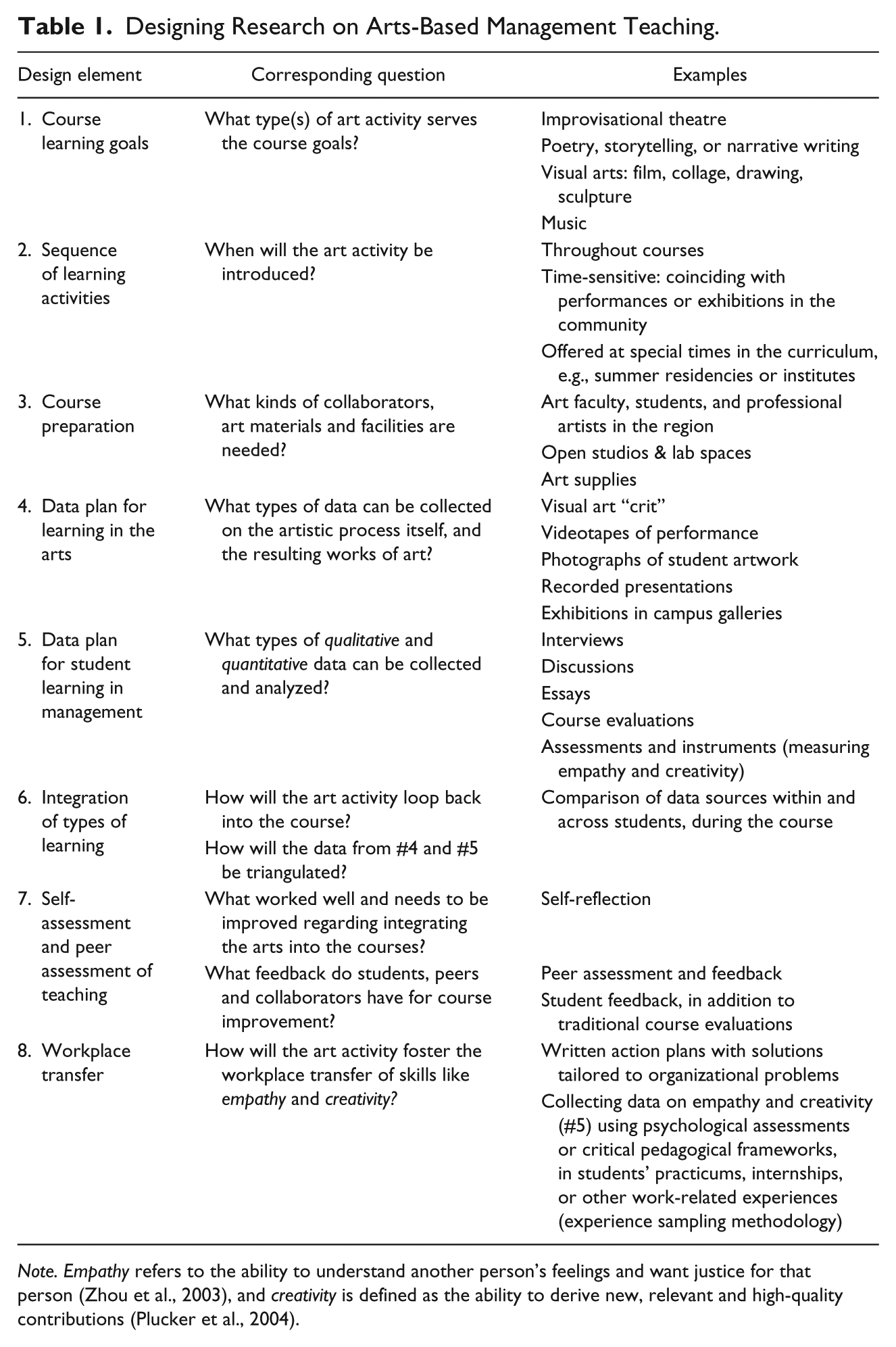
Note. Empathy refers to the ability to understand another person’s feelings and want justice for that person (Zhou et al., 2003), and creativity is defined as the ability to derive new, relevant and high-quality contributions (Plucker et al., 2004).
Which art activities serve the course goal(s) (course learning goals)?
When will the art activity be introduced (sequence of course activities)?
What kinds of collaborators, art materials, and facilities are needed (course preparation)?
What kinds of data can be collected on the artistic process itself, and the resulting works of art (data plan for learning in the arts)?
What kind/s of qualitative for example, interviews, discussions, and essays, and quantitative data for example, assessments and course evaluations, can be collected, analyzed (data analysis plan for student learning)?
How will the art activity loop back into the course and be triangulated (integration of types of learning)?
What worked well and needs to be improved regarding integrating the arts into the courses (self-assessment)? What feedback do students, peers, and collaborators have for course improvement (student and peer assessment)?
How will the art activity help foster workplace transfer of skills like empathy and creativity (workplace transfer)?
The last question points toward the importance of considering the application of learning to students’ practicums, internships, and workplaces. Studies on the transfer of arts-based learning into other management situations and contexts using mixed methods or quantitative methodology were almost nonexistent and thus pose a new research frontier. For example, psychological inventories and assessments focusing on empathy (Zhou et al., 2003) and creativity self-assessment and peer ratings (see Kaufman, Plucker, & Baer, 2008; Kerr & Gagliardi, 2003), can be carefully designed to compliment qualitative representations of arts-based learning in the pre-during-post phases of learning.
With regard to studying creativity, the particular model needs to be carefully chosen based on a preference for investigating sociocultural features, groups/teams, a developmental approach, or personality studied in mainstream psychology (see Hennessy & Amabile, 2010), or even the phenomenological or more postmodern frameworks used by scholars in this review (e.g., Van Buskirk & London, 2008). Each model points toward different ontological beliefs about the nature of creativity and how it might be fostered, assessed, and studied, especially considering the unique constraints of the management classroom and the affordances of the arts as an expressive form of communication (Barone & Eisner, 2012).
One of the paradoxical issues in studying creativity in management students’ learning, however, is capturing the actual moments when creativity or flow is experienced (Barrett, 1998; Csikszentmihalyi, 1990, 2003; Sawyer, 2000) and being able to attribute that creativity to arts-based learning, as opposed to idea generation and implementation developed through other means. Thus, newer methodologies like experience sampling methodology (Hektner, Schmidt, & Csikszentmihalyi, 2007) that attempts to collect multiple instances of thought, and feeling throughout a day, for example, might generate insight into the arts-learning process. The phenomenon of improvisation is also a challenge to research. Because improvisation is characterized through spontaneity and serious play (Sawyer, 2000), it remains to be seen if this can be cultivated through the arts in management students who have no arts background when a strong basis of skill is required to achieve a professional level of artistic improvisation. For example, a student’s minimal arts experience or resistance to learning in the arts might affect his or her interest in the arts and the quality of his or her artwork. Finally, future research might consider how some art forms might promote more creativity in particular students than other types of arts by using quasi-experimental designs with different types of arts instruction, or comparing arts instruction to stimulate a skill like “creative thinking” to non-arts instruction around that same skill. Threats to valid arts instruction would need to be developed when designing and implementing such instruction in a classic experimental design to allow for scrutiny of quality teaching practices for adult learners.
To conclude, this review showed the robust practice of integrating the visual and performing arts that was missing from the Carnegie Report, thus broadening the notion of “liberal arts learning.” The field of the arts-based management includes a diverse representation of the arts: improvisational theatre, poetry/narrative writing and storytelling, visual arts (two and three-dimensional), and music. While the review attempted to include works across a variety of publications and scholars, a limitation is that it is probably not exhaustive as new applications of the arts are being developed, piloted, refined, and written about. This review demonstrated explicit links between arts-based management education and empathy and creativity development as articulated in the Carnegie Report (Colby et al., 2011). Three teaching challenges were presented to help management educators confront the challenge to go beyond “decorative” integration and consumption, alleged in humanities-based integration: confronting the shifting role of instructor–learner; collaborating with art faculty, student artists, and professional artists in the community; and promoting active participation in the arts in students. Eight design elements were also proposed to help management faculty consider the quality, utility, and effectiveness when integrating the arts into their courses and conducting research in this area. Because the scope of arts-based management education is increasing, it is important to consider research designs and methodologies such as newer psychological measurements in empathy and creativity and experience sampling methodology. With new advances in the arts and technology, even, arts-based management education has a legitimate and compelling future ripe for innovation and new research.
Footnotes
Declaration of Conflicting Interests
The author(s) declared no potential conflicts of interest with respect to the research, authorship, and/or publication of this article.
Funding
The author(s) received no financial support for the research, authorship, and/or publication of this article.