




Abstract
Some curricular elements are threshold concepts that involve “troublesome knowledge,” not because they are difficult for students to comprehend per se, but because they are challenging for students to fully appreciate. In this article, we suggest that entrepreneurial failure is a threshold concept in entrepreneurship courses because students may get so fixated on failure’s economic costs that they neither fully appreciate the social and emotional costs nor recognize the potential benefits of failure to entrepreneurs. In a multiphase empirical study, we explore the effects of entrepreneurial experiences on how students categorize and conceptualize entrepreneurial failure. We find that students with entrepreneurial experiences provide more complex, multicategorical descriptions of failure and are more likely to represent the useful aspects of failure in their descriptions. Our findings highlight the role of experiences in facilitating students’ understanding of the threshold concept of entrepreneurial failure and suggest that entrepreneurship educators can leverage student experiences to promote more complex representations that account for both the costs and benefits of failure.
Keywords
Tell me and I will forget; show me and I may remember; involve me and I will understand.
Failure is a harsh reality for many entrepreneurs. From the U.S. Bureau of Labor Statistics, more than a fifth (21.2%) of the 11.4 million private sector firms established between 1994 and 2012 in the United States had failed within the first year. More than half (51.5%) of the nine million U.S. firms established between 1994 and 2007 had failed within 5 years (U.S. Bureau of Labor Statistics, 2014). In spite of the pain associated with failure, entrepreneurs such as Henry Ford, who failed in his first two automotive ventures (the Detroit Automobile Company and the Henry Ford Company) suggested that “failure is the opportunity to begin again more intelligently” (quoted in Maxwell, 2001, p. 42). Walt Disney also reflected on the utility of failure, saying, “I think it’s important to have a good, hard failure when you’re young. I learned a lot out of that” (quoted in Greene & Greene, 1998, p. 37). Similarly, a growing number of researchers have emphasized the potentially productive aspects of failure, such as the opportunities for learning and growth that it can engender (Cope, 2011; McGrath, 1999; Ucbasaran, Shepherd, Lockett, & Lyon, 2013).
Teaching students about entrepreneurial failure offers a particular challenge for management educators, who sit on the horns of a dilemma. On one hand, some students have difficulty appreciating the full impact of entrepreneurial failure, including its socioemotional and financial costs (Shepherd, 2004). On the other hand, educators who emphasize the costs without also representing failure as a “real option” (McGrath, 1999) with potential benefits for learning (Minniti & Bygrave, 2001) and opportunity identification (Alvarez & Barney, 2007) risk prematurely discouraging the aspirations of promising entrepreneurs (Piperopoulos & Dimov, 2014).
We suggest that entrepreneurial failure constitutes a threshold concept in entrepreneurship education. A threshold concept refers to a course concept that is critical to students’ understanding of a discipline (Meyer & Land, 2003) with implications for transforming students’ understanding to see the world in a new way (Trafford, 2008). Threshold concepts are “troublesome knowledge” because they are topics in a course where students are likely to get “stuck” (R. McCormick, 2008; Perkins, 2006). For instance, depreciation in accounting, deconstruction of textual analysis in English literature, or entropy in physics are all examples of topics that often present special difficulties for students to comprehend (Meyer & Land, 2005).
However, threshold concepts need not be difficult to comprehend to make learning troublesome (Cousin, 2006). The concept of entrepreneurial failure is not difficult to understand on its face—certain indicators of failure (e.g., depletion of financial and operational resources or bankruptcy) are almost self-evident (Thornhill & Amit, 2003). However, the full range of nonpecuniary costs and consequences of entrepreneurial failure, including its emotional consequences (Shepherd, 2003; Shepherd, Wiklund, & Haynie, 2009) and the risk of social stigmatization of the entrepreneur (S. Lee, Peng, & Barney, 2007), are often overlooked. In particular, entrepreneurship students “cross the threshold” and gain a more integrative understanding of their discipline (Meyer & Land, 2005) when they are able to appreciate that failure can be simultaneously painful and productive for entrepreneurs (Shepherd, 2004).
Although we are the first, to our knowledge, to formally identify entrepreneurial failure as a threshold concept in entrepreneurship education, this identification reflects ongoing inquiry among practitioners, academics, and students to make sense of a persistent societal puzzle: Society lauds the risks taken by entrepreneurial ventures that succeed but quickly condemns and stigmatizes those who fail (Cardon, Stevens, & Potter, 2011; March & Shapira, 1987). The seeming inconsistencies of society’s tendency to simultaneously praise entrepreneurship for unleashing the “gales of creative destruction” (Schumpeter, 1950, p. 83) and to harshly penalize failure legally and socially (S. Lee et al., 2007) begins to makes sense when students reach a more nuanced, balanced view of the simultaneously painful and productive aspects of failure.
In this article, we suggest that instructors may leverage even minimal experiences that students have had with entrepreneurship to motivate more thoughtful, complex representations that conceptualize both the burdens and benefits of failure. Drawing on motivated information processing theory (De Dreu, Nijstad, & van Knippenberg, 2008), we empirically explore how experiences with entrepreneurship can motivate students to talk about failure more complexly, representing both failure’s costs and potential benefits. This article contributes to the growing research interest within management education in the challenges associated with teaching entrepreneurship (Florin, Karri, & Rossiter, 2007; Kuratko, 2005; B. McCormick & Gray, 2011). Our research also contributes to the threshold concepts literature by demonstrating one approach to addressing the problem of how to identify variation in students’ acquisition of threshold concepts (Meyer & Land, 2005, 2006). Our methodology illustrates an inductive, indirect method of assessing students’ understanding and appreciation of a threshold concept by analyzing their free-response representations of the concept.
Entrepreneurial Failure as a Threshold Concept in Entrepreneurship Education
Entrepreneurship education involves formal programs and training intended to develop the knowledge and skills of prospective entrepreneurs and to encourage students to consider entrepreneurship as a potential career path (Katz, 2007; Pittaway & Cope, 2007). The growth in entrepreneurship education in universities and colleges reflects the belief that entrepreneurial activity plays a critical role in economic growth and employment opportunities (Kuratko, 2005). Although developing entrepreneurship-relevant knowledge and skills is one goal of entrepreneurship education (e.g., DeTienne & Chandler, 2004), many researchers have suggested that facilitating positive perceptions of entrepreneurship (Athayde, 2009), improving human capital formation in entrepreneurial endeavors (Martin, McNally, & Kay, 2013), and inspiring social entrepreneurship (McCrea, 2010) are also important educational outcomes.
One critique of entrepreneurial education is that educators often fail to adequately discuss entrepreneurial failure, especially the emotional toll it can take on individuals and how students can learn from failure (Shepherd, 2004). The tendency to overlook failure in entrepreneurship education is consistent with McGrath’s (1999) argument that there is an antifailure bias in entrepreneurship theory and research. However, ignoring failure as a real possibility leaves individuals ill-equipped to make sense of failure when it occurs (Shepherd, 2003) and neglects the potential utility of failure as a vivid form of feedback that can facilitate an entrepreneur’s learning and the success of future ventures (Hayward, Forster, Sarasvathy, & Fredrickson, 2010; Ucbasaran et al., 2013).
We propose that entrepreneurial failure is an example of the “troublesome knowledge” that characterizes a threshold concept in a disciplinary curriculum (Meyer & Land, 2003). Some students may approach failure too casually and dismiss the nonpecuniary impact of failure (Shepherd, 2004). Conversely, other students may be so fearful of the costs of failure that they become reluctant to consider entrepreneurship as a “real option” (McGrath, 1999). Students who invest the cognitive energy to carefully interrogate their own beliefs about entrepreneurship and reassess their attitudes toward risk, however, can reach a balanced understanding of the benefits with the costs of failure that may facilitate a responsible, cautious yet confident approach to entrepreneurial endeavors. To illustrate the role of failure as a threshold concept in entrepreneurship education, we compare failure to a parallel example of a threshold concept in the field of physiology: pain.
Pain and Entrepreneurial Failure as Examples of Threshold Concepts
The threshold concept of pain in physiology parallels the topic of failure in entrepreneurship. For instance, the concept of pain constitutes “troublesome knowledge” (Cousin, 2006) in physiology because pain is often perceived by students as something negative that must be alleviated, without appreciating its usefulness as a vivid source of feedback (Meyer & Land, 2005). Similarly, as our findings below suggest, students’ negative perceptions of failure reflect a belief that entrepreneurial failure is destructive and simply undesirable without fully appreciating that failure can be a powerful source of feedback and opportunity for learning (Shepherd, 2004; Yamakawa, Peng, & Deeds, 2013).
Returning to the example of pain as a threshold concept in physiology, pain is “transformative” because understanding it involves a radical conceptual shift in how students perceive the world (Meyer & Land, 2005). In particular, in distinguishing the aversive aspects of pain from the productive aspects, students are invited to inhabit a “liminal space” of uncertainty, in which existing, simplified representations of the world (i.e., pain is bad) are shaken and more nuanced conceptualizations of the discipline (i.e., pain is a tool) can emerge (Meyer & Land, 2005). Similarly, grasping the complexities of entrepreneurial failure can transform individuals’ understanding of failure such that it is perceived not only as a “real option,” with real costs but also as an opportunity for learning and growth (McGrath, 1999). Appreciating a more balanced role for entrepreneurial failure is, along with other threshold concepts, likely to trigger an ontological as well as a conceptual shift (Cousin, 2006). That is, reconceptualizing failure as a real option requires a change in students’ understanding where they shift away from the mind-set of preventing failure at all costs without moving to the other extreme of dismissing the consequences of failure. 1 Thus, entrepreneurship educators face a set of challenges in teaching students about entrepreneurial failure that resemble those confronted by physiology educators in instructing students about the role of pain.
Crossing the Threshold: Motivated Information Processing
In teaching about entrepreneurial failure, business educators face a dilemma shared by other disciplines where the threshold concept is readily comprehensible in abstract but difficult for students to appreciate in practice. In particular, students’ common sense, intuitive understandings of the concept, reinforced by societal norms, may interfere with their learning (Cousin, 2006). Thus, entrepreneurship educators face at least two challenges in teaching students about failure. First, educators face the challenge of assessing when students have moved toward a more complex, balanced appreciation of entrepreneurial failure. Researchers have called for more innovative methods to adequately capture variation in students’ acquisition of many threshold concepts (e.g., Meyer & Land, 2005, 2006). To address this concern, we have incorporated a concept mapping methodology (described in detail in the “Method” section) that has been used in the classroom and in management research (e.g., Hay, Kinchin, & Lygo-Baker, 2008; Peterson & Behfar, 2003) for the evaluation of entrepreneurial failure as a threshold concept. We suggest that concept mapping provides a promising method for evaluating threshold concepts by showing variance in the complexity with which students represent concepts such as entrepreneurial failure.
A second challenge is to motivate students to go beyond simplistic, culturally ingrained beliefs to conceptualize failure more complexly and to appreciate its positive, as well as negative, aspects. In this section, we draw on motivated information processing theory (De Dreu et al., 2008) to explain the potential effects of experiences with entrepreneurship on students’ representations of entrepreneurial failure. Dual-processing models of cognition and learning (e.g., Evans, 2008; Sherry & Schacter, 1987) suggest that individuals ordinarily process information quickly and heuristically unless they are motivated to focus their attention more deliberately and systematically (Smith & DeCoster, 2000). The extent to which individuals devote greater effort to thinking more systematically about information from their environment hinges on their epistemic motivation to develop a rich and accurate understanding of the stimuli around them (De Dreu & Carnevale, 2003; Van Kleef, De Dreu, & Manstead, 2004).
The epistemic motivation to engage in deeper, more complex information processing that facilitates the sort of transformative learning associated with threshold concepts can be increased or decreased by situational factors. In particular, individuals are more likely to engage in systematic, complex information processing when a topic is personally involving such that individuals see the personal relevance of the issues associated with a concept (De Dreu, Koole, & Steinel, 2000).
We suggest that experiences with entrepreneurship enable individuals to be personally involved in ways that may motivate deeper, more complex information processing about failure. In keeping with the logic of motivated information processing theory, we propose that the pedagogical benefits are not necessarily a function of the characteristics of the experiences themselves (e.g., their length or “quality”), but rather the extent to which the experiences motivate individuals to reflect more carefully about failure and its consequences.
One way in which experiences with entrepreneurship may motivate more systematic information processing is through increasing personal involvement with entrepreneurial activities and the potential for failure among students. For instance, direct experiences with entrepreneurial activities can influence issue involvement, or the extent to which individuals perceive information to be personally involving (H. Lee, Herr, Kardes, & Kim, 1999). Research suggests that individuals who perceive an issue to be personally involving and relevant to them are motivated to more carefully process and scrutinize the information (Petty & Brinol, 2010). As students are able to “see, touch, and feel” entrepreneurship firsthand (Cooper, Bottomley, & Gordon, 2004), the issues that entrepreneurs face, including failure, are likely to become more vivid and personally relevant. Perceptions of the personal relevance of an activity, in turn, are associated with greater cognitive elaboration, which is characterized by a more thoughtful, complex consideration of the issues surrounding the topic (O’Keefe, 2013; Petty, Cacioppo, & Schumann, 1983). Students, then, may enter the classroom with preliminal variations in the perceived personal relevance of entrepreneurship, which may contribute to explaining “why some students productively negotiate the liminal space of understanding . . . and others find difficulty in doing so” (Land, Cousin, Meyer, & Davies, 2005, p. 60). Thus, we suggest that participating in entrepreneurship, even in a limited capacity, will increase the personal relevance to students of key entrepreneurship issues such as failure, motivating them to think about failure more complexly (i.e., in terms of multiple cognitive categories that go beyond the immediate pecuniary costs of failure).
We also suggest that individuals with entrepreneurial experiences will be motivated to rate failure more positively. Cope (2011) describes how individuals who are exposed to entrepreneurial activity come to appreciate the numerous benefits to their own development associated with entrepreneurial failure, even as they seek to come to terms with what they or others have lost. Experiences with entrepreneurship can motivate students to understand how entrepreneurs largely appreciate the benefits of failure at the same time that society stigmatizes failure (Cardon et al., 2011). An indicator that students have moved beyond the “troublesome knowledge” where individuals frequently get “stuck” (Meyer & Land, 2003) on the negative outcomes of failure may be found in how individuals assess the consequences of entrepreneurial failure. Thus, we suggest that individuals with entrepreneurial experiences will rate failure more positively than those who do not.
Several researchers have suggested that failure provides a valuable opportunity for learning and future growth (Cope, 2005; Sitkin, 1992). Whereas discussing negative aspects of failure may reduce individuals’ incentives to take action and lead them to embrace defensive stances in response to failure (McGrath, 1999), discussing the learning benefits of failure should be associated with a more balanced, future-focused attitude in response to failure (Cope, 2011). Thus, the ways in which individuals discuss failure are likely to be closely associated with their cognitive representations of failure (Corbett, Neck, & DeTienne, 2007). We predict that individuals who discuss entrepreneurial failure in terms of learning, growth, and change are more likely to perceive the positive aspects of failure and rank the consequences of failure more positively. The extent to which there are differences in cognitive representations of failure, in turn, may provide a fruitful approach to assessing when students have reached postliminal states, a vexing issue in the literature to this point (Meyer & Land, 2006):
Overview of Method
Figure 1 visually depicts the steps in our research method. Our research approach involved data gathering and two phases of analysis: An inductive phase and a deductive phase. The inductive phase (Phase 1) incorporated the principles of concept mapping (Hay et al., 2008; Jackson & Trochim, 2002) to map participants’ representations of failure from their open-ended descriptions of failure. The deductive phase (Phase 2) then examined the association between self-reported experiences with entrepreneurship and participants’ representations and ratings of failure and its consequences.

Overview of data source and phases of analysis.
Method
Participants
A total of 233 undergraduate students at a large university in the western United States participated in this study in partial fulfillment of the requirements of a course in Organizational Behavior. The mean age of respondents was 23.6 years (SD = 4.1) with a mean of 6.9 years of work experience (SD = 4.6). Among the respondents, 35% were female and 16% reported that they had previous experiences with entrepreneurship, with an average of 3.1 years of reported entrepreneurial experience (SD = 2.9).
Procedure
Participants were asked to complete questionnaires about entrepreneurship and their interest in and experiences with entrepreneurship. In addition to demographic questions for statistical purposes, participants were asked to define and describe entrepreneurial failure using bullet-point, free-response statements. Participants were also asked to rate the consequences of failure on a Likert-type scale and then to provide an open-ended explanation of why they rated as they did.
Analysis: Phase 1
Phase 1 of our study used elements of the concept mapping process described by Jackson and Trochim (2002) and related qualitative methods designed to assess the multidimensionality of participants’ cognitive representations of entrepreneurial failure (e.g., Cacioppo, von Hippel, & Ernst, 1997). Concept mapping and qualitative sorting techniques to categorize unstructured data have been used in psychology (e.g., Goodyear, Tracey, Claiborn, Lichtenberg, & Wampold, 2005), in the classroom (e.g., Kinchin, Hay, & Adams, 2000), and in management research (e.g., Fehr & Gelfand, 2010). The purpose of these methods is to facilitate visual representations of conceptual similarities in open-ended survey response data.
The questionnaire yielded a total of 1,482 free-response statements defining and describing entrepreneurial failure. Consistent with recommendations in the literature (Mason, 2002), we selected a subset of 69 of the statements that represented a broad range of responses that avoided redundancy. We then recruited a separate group of 90 respondents (26% female) with a mean age of 24.1 years (SD = 3.5) and 7.3 years of work experience (SD = 4.3) to engage in a modified Q-sort (Kolb, Boyatzis, & Mainemelis, 2001) of the 69 selected statements. This process is consistent with the goal of minimizing researcher influence on the initial stages of analyzing the data (Jackson & Trochim, 2002). Q-sort procedures, in particular, are well suited for inductively deriving categories from individual responses to build theory (Kerlinger, 1964) and have been successfully used in previous management education research (e.g., Mainemelis, Boyatzis, & Kolb, 2002).
Participants were instructed to group statements that they perceived to be most similar into “piles” and to place statements that were less similar into different piles. The criteria used to group statements into piles was at participants’ discretion, with the only restrictions that each statement could only be placed into one pile, each statement had to be included in a pile, and there could not be a “miscellaneous” pile (Jackson & Trochim, 2002).
Participants’ Q-sort responses were then aggregated and summed to create a symmetrical dissimilarities matrix, based on the frequency with which any two statements were placed in the same pile by respondents. We then analyzed these data using multidimensional scaling (Kruskal, 1964) to construct a Euclidean distance model illustrating respondents’ perceptions of how similar (or different) the statements were from one another. The statements that the respondents interpreted to be most similar as a result of being frequently grouped together in the same piles resulted in a lower number that represented closer proximity to one another. The groupings of each participant were aggregated into clustered categories, which are depicted in the Euclidean distance model in Figure 2. Statements that respondents interpreted as less similar resulted in a higher number that represented a greater Euclidean distance.
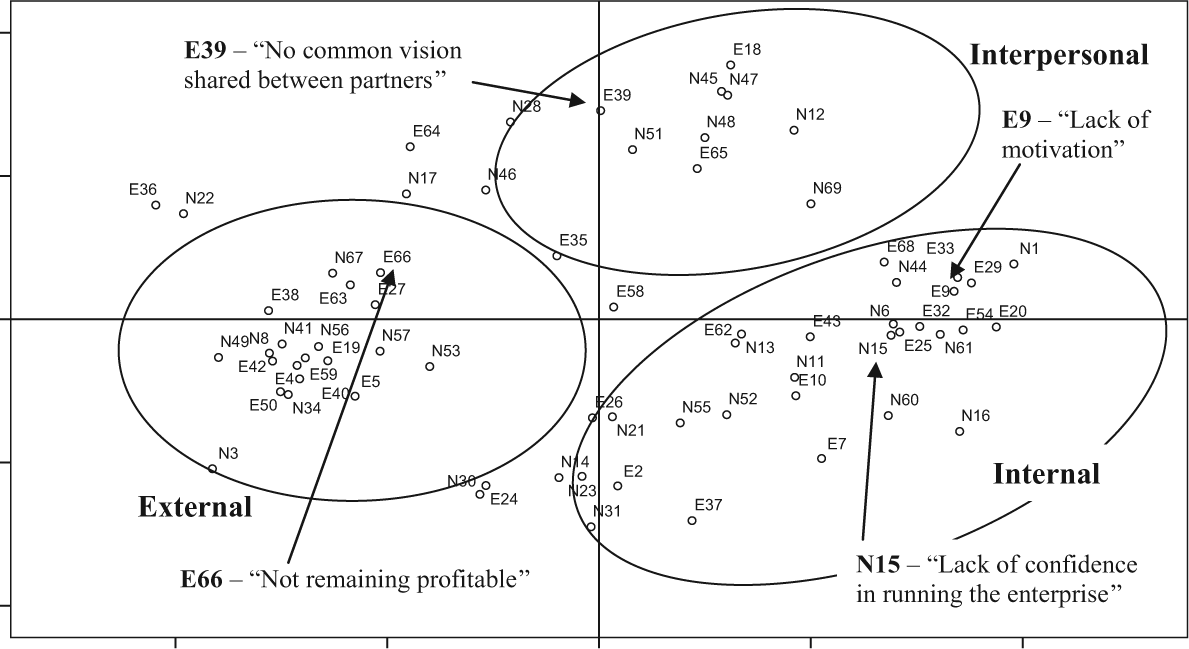
Inductively derived Euclidean distance model from participants’ categorizations.
To illustrate an example of how the responses shared by participants are reflected in the Euclidean distance model, data points E9 (“lack of motivation”), N15 (“lack of confidence in running the enterprise”), E39 (“no common vision shared between partners”), and E66 (“not remaining profitable”) are labeled in Figure 2. The close proximity of statements E9 and N15 to each other reflect similarity in how participants categorized these statements, whereas the greater Euclidean distance from these data points to statements E39 or E66 highlight categorization divergence. Category labels are described in more detail in the “Findings” section.
To determine the optimum number of categories in the Euclidean distance model, we used two criteria. The first criterion is based on Kruskal’s (1964) stress index, or goodness-of-fit measurement, which provides an elbow test to determine the number of categories that best represent the stimulus space. After reaching an optimal number of categories, adding additional categories no longer appears to substantially reduce the stress of fit, thereby creating an elbow that pinpoints a more parsimonious solution. The second criterion is based on the extent to which each category that emerges can be interpreted and validated (Pinkley, 1990). Using these criteria, we derived a solution with three distinct categories.
Findings: Phase 1
Up to this point in the research process, we emphasized the emic (Lindlof & Taylor, 2010) by foregrounding participants’ categorization of the statements in an effort to not impose our own, external categorizations in the initial analysis of the data. Once participants’ inductively derived categories were in place, we transitioned to the etic (Zhu & Bargiela-Chiappini, 2013) by introducing our judgment as researchers in labeling the categories. Specifically, we engaged in an iterative process involving constant comparison between the specific statements included in the categories and our impressions of the underlying thematic content of the categories (Locke & Golden-Biddle, 1997).
Category Labels
The first of the three conceptual categories of statements describe entrepreneurial failure in terms of its external factors. The external categories discuss entrepreneurial failure in financial terms (e.g., “negative ROI [return on investment],” and “failure to properly capitalize the business”). Others talk about failure in terms of shortcomings in planning, operational, and marketing strategies (e.g., “[venture] creates a product or service consumers don’t want” and “too little planning”) and account for economic and political factors beyond the entrepreneur’s immediate control. The second category includes statements that describe failure as a function of the internal factors. The statements include descriptions of failure in psychological and emotional terms (e.g., “lack of motivation” and “loss of interest”). They also discuss failure in terms of an individual’s lack of skills, education, or experience (e.g., “you don’t know how to start [the venture]” and “failure to understand the business in which they have endeavored”).
The third category represents the interpersonal factors associated with failure, particularly with respect to relationships with employees and partners in the venture. Many of the failures described in this cluster of statements derive from the poor management of relationships in starting and maintaining entrepreneurial endeavors. Interpersonal factors can refer to relationships with employees (e.g., “failure to properly reward people whom they employ”) as well as partners, customers, or other outside stakeholders.
Analysis: Phase 2
The second phase in our analysis involved empirically examining whether individuals with entrepreneurial experiences describe failure more complexly and rate the consequences of failure differently than those without experiences. Hypothesis 1 predicts that students with entrepreneurial experiences will represent failure in more complex ways by using a greater number of the inductively derived categories from Phase 1 than students without such experiences. To evaluate this question, two independent raters who were blind to the purposes of the study separately coded the 1,482 statements from the participants based on the extent to which they fell into external, internal, and interpersonal categories. Reliability was good (Cronbach’s α = .96) and disagreements were resolved by consensus. The results of our analyses for all three hypotheses are reported in the “Findings” section.
Hypothesis 2 predicts that individuals with entrepreneurial experiences will rate the consequences of entrepreneurial failure more positively than those without experiences. To address this hypothesis, participants were also asked to rate the consequences of failure on a 7-point Likert-type scale (1 = very bad; 7 = very good) and then to explain their rating using short, open-ended statements. The 233 participants in our study generated a total of 519 statements explaining their ratings of failure.
Hypothesis 3 predicts that ratings of failure by individuals will be mediated by the extent to which they describe failure in terms of learning, growth, and change. To assess this hypothesis, the two authors independently coded each of the 519 statements to examine what proportion of each participant’s statements described learning, growth, or change in their descriptions of the consequences of entrepreneurial failure. Intercoder reliability was good (Cronbach’s α = .90). To control for differences in the number of statements by each participant, we divided the number of statements that described learning, growth, or change by the total number of statements to derive a percentage of statements with learning, growth, or change terms for each participant.
Findings: Phase 2
For Hypothesis 1, we assessed the number of categories used in descriptions by students with entrepreneurial experiences and those without. Using the Brown–Forsythe t test, which is designed for comparing differences between groups with unequal variances (Tabachnick & Fidell, 2007), we found that the descriptions of individuals who reported entrepreneurial experiences incorporated significantly more categories (M = 2.29 categories) than individuals without entrepreneurial experiences (M = 1.97 categories), F(1, 224) = 5.94, p < .05, providing support for Hypothesis 1.
Hypothesis 2 predicts that individuals with entrepreneurial experiences will rate the consequences of entrepreneurial failure more positively than individuals without entrepreneurial experiences. A one-way analysis of variance indicates that individuals with entrepreneurial experiences rated the consequences of entrepreneurial failure significantly more positively (M = 4.10, SD = 0.22) than individuals without entrepreneurial experiences (M = 3.38, SD = 0.10), F(1, 232) = 8.64, p < .01, providing support for Hypothesis 2.
Hypothesis 3 predicts that more positive ratings of failure by individuals will be mediated by the extent to which they describe failure in terms of learning, growth, and change. There are several ways in which mediation can be determined. We used the bootstrapping method 2 for estimating the direct and indirect effects of mediating variables (Preacher & Hayes, 2008). A model was constructed in which entrepreneurial experiences was entered as the predictor variable, rating of the consequences of entrepreneurial failure was entered as the dependent variable, and the percentage of statements that discussed learning, growth, and change was entered as the mediator. The indirect effect of the mediator did not include zero in its 95% confidence interval and therefore showed evidence of mediation: the percentage of learning, change, and growth terms had a 95% (bias-corrected and accelerated) bootstrap confidence interval of [.058, .527], p < .05. Additionally, we conducted a Sobel test (Preacher & Hayes, 2004) of the mediator, which also indicated that the percentage of learning, growth, and change frames used by participants mediated the relationship between entrepreneurial experiences and ratings of the consequences of failure (Z = 2.245, p < .05) and provides support for Hypothesis 3.
General Discussion
Entrepreneurship education continues to play a prominent role in business schools (Edelman, Manolova, & Brush, 2008; Kuratko, 2005) and instructors have been called to address entrepreneurial failure as a critical issue for prospective entrepreneurs (Shepherd, 2004). In this article, we assert that entrepreneurial failure is a threshold concept that represents troublesome knowledge in entrepreneurial education. Drawing on motivated information processing theory, we mapped students’ representations of entrepreneurial failure and found that students with entrepreneurial experiences use a greater number of conceptual categories to discuss failure (i.e., greater cognitive complexity) and represent the consequences of failure more positively than students who have not had entrepreneurial experiences. Thus, this research contributes to the literature on teaching about entrepreneurship in management education by suggesting that even minimal experiences with entrepreneurship among students can be leveraged by instructors to motivate more thoughtful, complex representations that conceptualize both the burdens and benefits of entrepreneurial failure.
Our research also contributes to the threshold concepts literature by using concept mapping as a method for addressing the persistent problem of assessment. In addition to identifying threshold concepts in management education, designing “assessment and feedback strategies that expose where an individual student is located on their journey toward, through and beyond the portal of a threshold concept” (Wright & Hibbert, 2013, p. 2) is a pressing concern for educators in all disciplines (Land et al., 2005). Our findings demonstrate an indirect and flexible approach to identifying variation in students’ acquisition of threshold concepts (Meyer & Land, 2005).
We suggest that student motivation is particularly important for threshold concepts, such as entrepreneurial failure, where students may have to overcome existing intuitive, “common-sense” beliefs (Cousin, 2006) that are reinforced by dominant societal discourses (e.g., failure equals bankruptcy, failure is bad, failure is something to be avoided at all costs). Experiences with entrepreneurship can be personally involving such that they increase the relevance of entrepreneurship-related issues and capture students’ attention such that they are motivated to think more complexly about failure and its consequences. Our analysis emphasizes the value of entrepreneurship as a phenomenon that is experienced, with implications for individuals’ appreciation of the personal and socioemotional aspects of engaging in entrepreneurship (Shepherd, 2004).
How, then, do academic institutions meet the challenge of creating entrepreneurial experiences that capitalize on the benefits realized in our findings? Beyond traditional business plan competitions, multiple models exist, including the three briefly described below. Foundry Utah is a business accelerator educational program at the University of Utah (http://foundry.utah.edu) where entrepreneurs work as a cohort in a 12-week program on their own business ideas while receiving practical training as they grow their business in conditions of uncertainty and resource scarcity. Stanford University, through the Stanford Technology Ventures Program (http://stvp.stanford.edu), organizes Startup Weekends (startupweekend.org) to stimulate experiential learning. Following the lead of the sciences, the Polsky Center at the University of Chicago (http://research.chicagobooth.edu/polsky/) offers a variety of “labs” aimed at providing students hands-on experiences.
Foundries, labs, and start-up weekends may represent powerful (but potentially costly) academic interventions to enable greater appreciation of entrepreneurial failure as a threshold concept. However, there are also options within basic course design which may facilitate students’ personal involvement. As described earlier, the motivation to engage in deeper, more complex information processing that is key to more fully comprehending threshold concepts is dependent on factors such as students’ personal involvement and their perceptions of the personal relevance of the issues associated with entrepreneurship. How then does one design an entrepreneurship course to facilitate personal involvement and increase understanding of entrepreneurial failure? We share some suggestions derived primarily from observation and practice.
Many entrepreneurship courses expect the development of a business plan as a key deliverable for the course where the primary outcome is an assessment by the instructor and a grade assigned. Some programs extend this deliverable to the actual execution of the business plan on a small scale, which introduces some degree of personal involvement. However, in the spirit of economizing, many of these business plans turn into t-shirt or food resale activities where personal consequences may be less important and accountability may again be limited to the grade assigned. To overcome these shortcomings, the authors have observed courses where student teams executing the business plans introduce their own money into the start-up funds required and compete for the highest positive cash flow with the winning team earning the right to take all excess cash flow from all the teams and donate to a local charity of their choice. This type of entrepreneurial experience powerfully encapsulates situational factors of motivated information processing as students are more personally involved with both time and money, personal consequences are enhanced as students are now working for more than the grade (competing for a charity), and accountability increases as decisions affect the success of the student, team, and charity.
Another suggestion for how instructors may foster motivated information processing in their courses involves leveraging business simulation software that emphasizes the risk and uncertainty of new ventures. These kinds of pedagogical tools incorporate competition within the course and may provide an accelerated proxy for the entrepreneurial experiences discussed in this article. Additionally, instructors can capitalize on the experiences of early-to midcareer professionals in MBA and executive education graduate business programs by requiring live consulting projects working with local entrepreneurs. Community entrepreneurs benefit from the wealth of experiences these students bring to the consulting activity and graduate students become personally involved with current, real issues faced by entrepreneurs in the region, increasing their awareness and potential igniting (or reigniting) their interest in entrepreneurial pursuits.
Considerations and Challenges
The motivational potential of using student experiences to aid in transformational learning may apply to prospective threshold concepts in other areas of business. Reflecting on troublesome areas of knowledge across business disciplines, we speculate that experience may motivate the deeper, more complex information processing that is necessary to overcome troublesome knowledge associated with three potential threshold concepts: power and political dynamics in organizations, the impact of extreme poverty on the marketing mix, and the felt responsibility associated with investing other people’s money.
First, Management students may have difficulty appreciating how power and political dynamics in organizations create the conditions for behaviors that may appear irrational and otherwise inexplicable. Without experiencing the force of political behavior in organizations, students may be tempted to dismiss political behaviors and power plays in other organizations (e.g., “That will never happen to me”) or to simplistically label such behaviors as good or bad. However, actually experiencing the complexities of organizational dynamics may lead to a more nuanced, postliminal understanding of power and political dynamics.
Second, Marketing students may have difficulty appreciating how serving customers in extreme poverty (i.e., “bottom of the pyramid” markets, Prahalad, 2012) may radically affect the marketing mix of price, promotion, place, and product. For example, the Gillette razor case highlights how it was not until 20 executives visited more than 300 homes in rural India to observe and inquire about the shaving and purchasing habits of the residents that the company appreciated and responded to the dramatically different marketing mix that was required in that market (Byron, 2010). Similarly, immersive experiences in areas of extreme poverty can transform students’ understandings of how the fundamental marketing mix can be altered.
As a third example, the felt responsibility (Fuller, Marler, & Hester, 2006; Morrison & Phelps, 1999) associated with investing (and risking) other people’s money in the face of market uncertainties may be difficult for Finance students to appreciate. Through lecture, in-class exercises, and even simulated investment portfolios, students learn the tools of investing. However, it may only be through experiencing the stress, guilt, and anxiety associated with managing another person’s money that students are motivated to come to terms with how to personally cope with the emotional risks of their profession.
Another consideration of our research suggests a valuable role for inductive methodologies, such as concept mapping, in exposing the liminality of students in relation to their understanding of threshold concepts. In particular, our research speaks to the persistent question of how to evaluate when students have moved from a limited or superficial understanding of a threshold concept to a postliminal state, where they grasp the nuances and complexities of the concept (Meyer & Land, 2006). The challenge is in distinguishing students who have a sophisticated understanding of a threshold concept from those who merely engage in “mimicry” but whose understanding is actually limited and superficial (Land et al., 2005). By tapping into the organization of participants’ underlying belief structures, concept mapping can expose whether students grasp the connections among concepts and thereby offer a more holistic avenue for evaluation (i.e., serving as “windows into the minds” of students; Shavelson, Ruiz-Primo, & Wiley, 2005).
Similarly, concept mapping can be adapted to address questions of preliminal variation among students (Meyer & Land, 2006). The issue is that some students appear to readily negotiate the liminal space of understanding a threshold concept whereas others struggle mightily (Meyer & Land, 2005). Variation in the tacit knowledge about a threshold concept that students bring to the classroom is likely to affect their negotiation of the liminal space, which in turn has implications for student retention and progression (Meyer & Shanahan, 2003). Our research approach, in which we used concept mapping to evaluate students’ existing beliefs about entrepreneurial failure in relation to their prior experiences, could be adapted and scaled as an inductive, relatively unobtrusive means of assessing students’ tacit knowledge about threshold concepts at the beginning of a class. The responses from concept mapping, which tap into participants’ perceptions and belief structures, could be used by educators as input for customizing the sequencing and structure of the course (Land et al., 2005).
One of the challenges in teaching entrepreneurial failure as a threshold concept is to develop resources that devote significant attention to both the costs and the benefits of failure. Entrepreneurship textbooks, case discussions, and course design frequently remain in the preliminal state of avoiding failure at all costs with limited consideration of a more complex, nuanced discussion of entrepreneurial failure. Until students “cross the threshold” by coming to terms with entrepreneurial failure, their understanding of entrepreneurship will be incomplete. Conversely, including a discussion early in the curriculum that enables students to appreciate the complexities of failure increases the relevance of the rest of the course material. In the meantime, entrepreneurship instructors have an opportunity to include in their curricula out-of-class, entrepreneurial experiences that encourage more complex representations of the costs and benefits of failure.
Finally, as educators seek to carry the concept of entrepreneurial failure over the threshold of understanding in entrepreneurship education and into the public square, we suggest that entrepreneurship educators should take the lead in frankly discussing with their students the societal stigmatization that is so often attached to entrepreneurial failure. A frustrating aspect of new venture development is that failure is penalized heavily (e.g., existing bankruptcy laws, S. Lee et al., 2007) and some of the heaviest penalties are associated with widespread social stigmas associated with failure (Cardon et al., 2011). We suggest that directly addressing the threshold concept of entrepreneurial failure in entrepreneurship education is an important step toward reducing the stigma attached to failure and opening students’ eyes to the possibilities of pursuing entrepreneurial opportunities. Rather than treating entrepreneurial failure as the proverbial “elephant in the room,” we encourage entrepreneurship educators to cultivate opportunities for students to experience entrepreneurship, which our findings suggest can motivate them to reexamine their beliefs about entrepreneurial failure. Whereas previous research has suggested that threshold concepts are where individuals are likely to find the greatest difficulty in learning from experience (e.g., A. Lee, 2007), our findings turn this formulation around to suggest that experiences themselves may provide the motivation for individuals to learn threshold concepts such as entrepreneurial failure.
Footnotes
Declaration of Conflicting Interests
The author(s) declared no potential conflicts of interest with respect to the research, authorship, and/or publication of this article.
Funding
The author(s) received no financial support for the research, authorship, and/or publication of this article.
This article is part of the Special Issue, “Threshold Concepts in Management Education: Research, Teaching and Learning.”
Notes
References
Supplementary Material
Please find the following supplemental material available below.
For Open Access articles published under a Creative Commons License, all supplemental material carries the same license as the article it is associated with.
For non-Open Access articles published, all supplemental material carries a non-exclusive license, and permission requests for re-use of supplemental material or any part of supplemental material shall be sent directly to the copyright owner as specified in the copyright notice associated with the article.
