



Abstract
Trends in extant literature suggest that more relational and identity-based leadership approaches are necessary for leadership that can harness the benefits of the diverse and globalized workforces of today and the future. In this study, we compared general leadership development programs (GLDPs) and women’s leadership development programs (WLDPs) to understand to what extent program descriptions addressed inclusive leadership—leadership that draws on relational skills to value both the uniqueness and belonging needs of diverse identities to create business effectiveness for the long term. GLDPs predominantly reflected pedagogical assumptions of separate knowing, development of the autonomous self, and masculine leadership approaches of agentic and transactional leadership. In contrast, pedagogical assumptions of connected knowing, development of the relational self, and relational and identity-based leadership approaches were more prevalent in WLDPs. These findings suggest that WLDPs continue to offer significant value to supporting women leaders in their advancement, yet both WLDPs and GLDPs can do more to be inclusive of additional diverse identities to better develop leaders of the future who can lead with inclusive behaviors. We suggest a pedagogical framework for inclusive leadership development that may better balance and promote synergies between achieving business priorities and relating to others and their diverse identities.
Keywords
Advancement to leadership is both an exciting and overwhelming transition in which new provisional leadership identities are experimented with and explored (Ibarra, 1999). From the wealth of leadership development programs that are available and the variety of interventions used, there is no doubt that these transitions require a substantial amount of support to maneuver (Day, 2000). As technological, globally competitive, demographic, and other powerful factors change the very nature of work and organizing, understandings of effective leadership is itself in flux. Recent descriptions of relational leadership (Cunliffe & Eriksen, 2011), authentic leadership (Avolio & Gardner, 2005), and identity-based leadership (Day & Harrison, 2007) all suggest that being a leader who can engage today’s global workforce means leading and building relationships through an awareness of and skill in managing self and others. Yet it is not clear whether and how leadership development programs align pedagogical choices to facilitate the leadership shifts (e.g., Lord & Hall, 2005), transformational learning (e.g., Debebe, 2011), and necessary disruptions (e.g., Stead & Elliott, 2012) that are needed to gain awareness of self and others in relating across interpersonal differences of a diverse, global workforce. In the present study, we examine and contrast how pedagogies of women’s leadership development programs (WLDPs) and general leadership development programs (GLDPs) are aligned to facilitate participants through deep shifts in knowing oneself and relating to others to deliver sustained business results.
Pedagogy in today’s digital age has evolved from the perspective of teaching knowledge where students are passive participants to creating social learning opportunities in which students are actively engaged in their learning process (Beetham & Sharpe, 2013). In this postmodern way of learning about the world, there is an intentional shift away from, “realities of order, reason, totality, absoluteness, linearity, domination, hierarchy, and competitiveness,” to world views that are rooted in social awareness and connectedness that can be found in feminist and more humanistic pedagogies (Bilimoria, 1995, p. 441). This shift is captured in the tensions between the debate as to whether pedagogy is teaching for knowledge or creating learning through experience (Beetham & Sharpe, 2013). In feminist pedagogy, the role of educators is not to provide expert knowledge, but to provide an environment where knowledge can be socially constructed, drawing out what students already know (Maher & Tetreault, 1996). Thus the way in which learning is created in feminist methods may better align with developing leaders for a postmodern world of interconnectedness in which leadership is understood through a “relational, social, and situated perspective through a process of becoming” (Edwards, Elliott, Iszatt-White, & Schedlitzki, 2013, p. 5). Becoming a leader—or developing a leadership identity—then cannot be considered in isolation from the social connections and relationships that foster it.
In WLDPs, addressing the ascent to leadership naturally lends itself to developing self-awareness and relating to others. Women often face contradictory expectations of their social role and the more masculine leadership attributes expected of leadership roles (Eagly & Karau, 2002). In their advancement to leadership, women often negotiate gender identity and the pressures to “fix” themselves to fit into a new leadership identity (Ely & Meyerson, 2000). To support these challenges in the leadership transition, WLDPs address women’s identity work (Ely, Ibarra, & Kolb, 2011) by providing a safe environment for transformation developed in the interactions between participants (Debebe, 2011), by integrating challenging organizational contexts, work–life integration, and career/life stage concerns with developing women’s leadership presence (Hopkins, O’Neil, Passarelli, & Bilimoria, 2008; O’Neil, Hopkins, & Bilimoria, 2015), and by providing opportunity for reflection on attitudes, feelings, and conceptualizations of self and leadership that have been socialized over the course of women’s personal and career development (Vinnicombe & Singh, 2002). This identity work that is involved with women’s leadership transitions inherently involves understanding self through relating with others. Additionally, a study of undergraduate business majors suggests that women-only education provides a supportive environment that promotes personal character development (Davis, Ruhe, Lee, & Rajadhyaksha, 2011).
Despite gender role based challenges, previous literature also suggests that there may be a female advantage for leadership (Eagly, 2007; Helgesen, 1990; Helgesen & Johnson, 2010; Rosener, 1990) by showing that women are more likely to engage a transformational leadership style focused on mentoring and empowering followers—for example, nurturing others and building trust (Eagly, 2007; Eagly, Johannesen-Schmidt, & van Engen, 2003). WLDP’s explicit focus on identity work may also foster an awareness of others’ identities that is part of the relational work of leadership. Relational leadership is understood to occur in a social construction of leadership or “leadership as a way of being-in-relation-to-other” (Cunliffe & Eriksen, 2011, p. 1430). In this definition of relational leadership, understanding of self is inherently tied to awareness of others and engaging in relational activities (Cunliffe & Eriksen, 2011). Fletcher (1998, 1999) found that women often engage in relational practice that includes empowering oneself through relational activities (achieving) as well as mutual empowerment to enable and to empower others to achieve and contribute. Thus in the ascent to leadership, women may naturally use these relational strengths in order to enable leadership development and high performance (Buttner, 2002).
Given what we know of women and WLDPs, we might propose that WLDPs are uniquely positioned to develop leaders who can handle the complex identities of today’s global workforce; however, there is evidence that suggests that leadership development programs as a whole are shifting toward addressing both identity and relational approaches to leadership. For example, Ibarra, Snook, and Guillén (2010) suggest that the general development of leadership skills and the development of self-concept as a leader are inextricably tied together (see also INSEAD, 2015). Thus an approach that integrates the development of skills with self-concept may lend itself to enhancing the relational self-awareness necessary to consider multiple identities and perhaps even intersectionality of identities in meeting belonging and uniqueness needs of inclusion. Additionally, experiential approaches to leadership development offer opportunities not only to learn from self but also to learn from others through the use of techniques such as 360-degree feedback, coaching, mentoring, creating networks, stretch assignments, and action learning in project-based team assignments (Day, 2000; Hopkins et al., 2008).
In the present study, we compare descriptions of WLDPs and GLDPs to better understand if there are patterns that would indicate differences in how leadership is understood and developed. We divide this overarching question into three research questions in order to examine the pedagogical assumptions underlying how these programs define leadership, how they address relational and identity-based approaches to leadership development, and how they foster understanding oneself and others in the development of leadership, as follows.
We conduct a qualitative analysis of WLDP and GLDP program descriptions to answer these questions and to develop a pedagogical framework for inclusive leadership development—programs that support leaders to create inclusion in their organizations and sustain long-term business results from diversity. To capture the shift to value more relational and identity-based approaches to leadership and why this shift is relevant to more inclusive leadership development, we briefly expand on the growing literature on the importance of inclusion and suggest pedagogy that can support leaders to create inclusion in organizations.
Pedagogy for Inclusive Leadership
Employees perceive that they are included when they experience both high belongingness and high value in the uniqueness of their identities (Shore et al., 2011). In a study of diversity perspectives, the integration-and-learning perspective—an understanding of diversity as a resource for “learning and adaptive change”—sustained the long-term benefits of diversity (Ely & Thomas, 2001, p. 240). Thus inclusive leadership simultaneously creates uniqueness and belonging (Prime & Salib, 2014) to develop relationships at all levels of the organization so that tasks can be accomplished for mutual benefit (Hollander, 2012) and deliver long-term results. In other words, achieving effective inclusive leadership means “doing things with people, rather than to people” (Hollander, 2012, p. 3).
In an example of positive outcomes of inclusive leadership, a leader’s inclusive treatment of and high-quality relationships with diverse team members reduced turnover (Nishii & Mayer, 2009). Inclusive leadership plays an important role in ensuring that differences that may create conflict and negative outcomes are mitigated through positive relationships and valuing of diverse identities. The value proposition of inclusive leadership is carried out through the work of relating to others in a way that makes them feel valued for their unique talents and backgrounds as well as perceive that they belong and matter to the team. This understanding of inclusive leadership aligns with the approach to learning in feminist pedagogy. In feminist pedagogy, “leadership is a special form of empowerment that empowers others” (Shrewsbury, 1993, p. 14). Feminist pedagogy recognizes identity politics and power differentials, and seeks to empower students in a community where the instructor is a role model and facilitator rather than a figure of authority (Shrewsbury, 1993). Feminist pedagogy suggests that women may have different “ways of knowing”—acquiring and transforming knowledge differently than men—due to their socialization and self-concept (Belenky, Clinchy McVicker, Goldberger, & Tarule, 1986; Gallos, 1989).
As feminist pedagogy comes from the experiences of women in learning environments, the undervaluing of relational work and challenges with identity from women’s experiences in organizations may be useful for understanding why relational and identity-based leadership approaches may not be fully incorporated into leadership development program practices. Engaging with work through relational activities can empower both self and others, yet in Fletcher’s (1998, 1999) study, this work done by women was also underappreciated due to gender bias and power differences associated this work, which caused women’s contributions to disappear or remain invisible. Although Fletcher’s finding indicates a disadvantage for women in engaging with relational work, the movement toward inclusive leadership may provide unique advantages to women.
Feminist poststructuralist approaches to learning suggest that by gaining self-awareness in relation to their gender identity, women may be able to use experiences of invisibility and visibility as a skill in which they intentionally deploy (in)visibility—both visibility and invisibility used at times when one or the other will have the most social impact—to counter gender stereotypes (Stead, 2013). Deploying (in)visibility in this way engages women in knowing when to fit into a social context to “play the game” (Stead, 2013, p. 73) potentially making their gender identity invisible, and when to make their gender identity visible to create appropriate disruption of the norm and opportunity for learning (Stead, 2013). Thus in this feminist pedagogy of shifting between fitting the norm and disrupting the norm, leadership identity is constructed through gaining a sense of self that is acutely aware of how one is perceived by others and how to relate to fit and relate to disrupt in order to change prevailing assumptions of leadership.
Based on feminist pedagogy literature, we might anticipate that WLDPs are more likely to inherently address relational and identity-based leadership approaches because these are the challenges that women face in their ongoing experiences in organizations. If this is the case, we might recommend that leadership development as a whole should forsake the traditional masculine based leadership development of old and ring in the new age of feminist pedagogy for inclusive leadership! Yet we also consider what inclusive leadership is not, which is to say that inclusive leadership is not about abdicating leadership responsibility or jeopardizing the business bottom line by giving complete primacy to relational connection and identity work. Instead, what we suggest is that leadership development needs to balance and to find synergies between relating to others and their identities with achieving business priorities and needs. We also anticipate that relational and identity work is likely undervalued given the experience of women in organizations, thus pedagogy that supports this kind of work may need more expansion in order to achieve balance.
Given this background and framing, we delve into the methods and findings of our study below. Using an inductive approach to comparing program descriptions of WLDPs and GLDPs, we reveal and infer how the learning process is constructed in both types of programs, including assumptions around the leader’s role in today’s organizations, how the program experience is described to support the development of leaders, and how identity challenges will be addressed. Based on the findings, we develop a theoretical framework of inclusive leadership development that may be used to inform the design of future leadership education programs.
Method
Sample and Data Collection
For the present study, the 2014 Financial Times’ ranking of the top open enrollment executive education programs was used to generate a population of universities/business schools from which to identify our sample. From an initial review of program descriptions available on institutional websites, it was determined that this publicly available data could provide meaningful insights into our research questions and the opportunity for exploratory analysis of the text. This initial review was conducted from July to August of 2014.
In order to do a thorough analysis of the themes present in WLDP and GLDP descriptions, we decided that only institutions with both a GLDP offering and a WLDP offering would be included in the sample. This procedure allowed us to eliminate confounding thematic differences that may have been found among institutions with only a GLDP offering. Programs were included as a GLDP for purposes of our analyses if the university identified the program as their flagship LDP or if it targeted a general leadership audience that was not divided by gender. WLDPs were included if the target audience of the program was only or primarily women or if the curriculum was explicitly geared toward understanding the leadership challenges and issues for women in the workplace. If multiple GLDPs and WLDPs were offered, the flagship program was identified and included in the sample. Programs were identified as “flagship” through independent examination of website pages and consensus among the researchers.
Once WLDP and GLDP programs were matched, program descriptions were pulled from their institutional websites for inductive coding. An inductive process was utilized in order to (a) identify specific text that was related to our research questions, (b) label the text to create subcategories, (c) reduce redundancy, and (d) expand on the most important categories discovered though the process (Creswell, 2002). Extraneous data (such as contact and payment information) were removed from the descriptions. In total, of the 70 universities/business schools on the Financial Times open enrollment executive education program rankings that offered GLDPs, 26 had a corresponding WLDP. 1 Out of these 26, five had program descriptions in languages other than English (Instituto de Estudios Superiores de la Empresa [IESE], École Supérieure des Sciences Économiques et Commerciales [ESSEC], École supérieure de commerce de Paris [ESCP], Católica Lisbon School of Business and Economics, and Kedge Business School), and one had no active course dates listed (Escuela Superior de Administración y Dirección de Empresas [ESADE]). We excluded these six programs from our study given concerns that subtle nuances may be lost in translation and that without an active program date there was no way to determine how current the WLDP offering was. Thus, the final sample consisted of 40 program descriptions (20 WLDPs and 20 GLDPs) from 20 universities/business schools as listed in Table 1. Program descriptions were reviewed and extracted from websites during September and October 2014.
Open Enrollment Executive Education Programs Included in Analysis a .
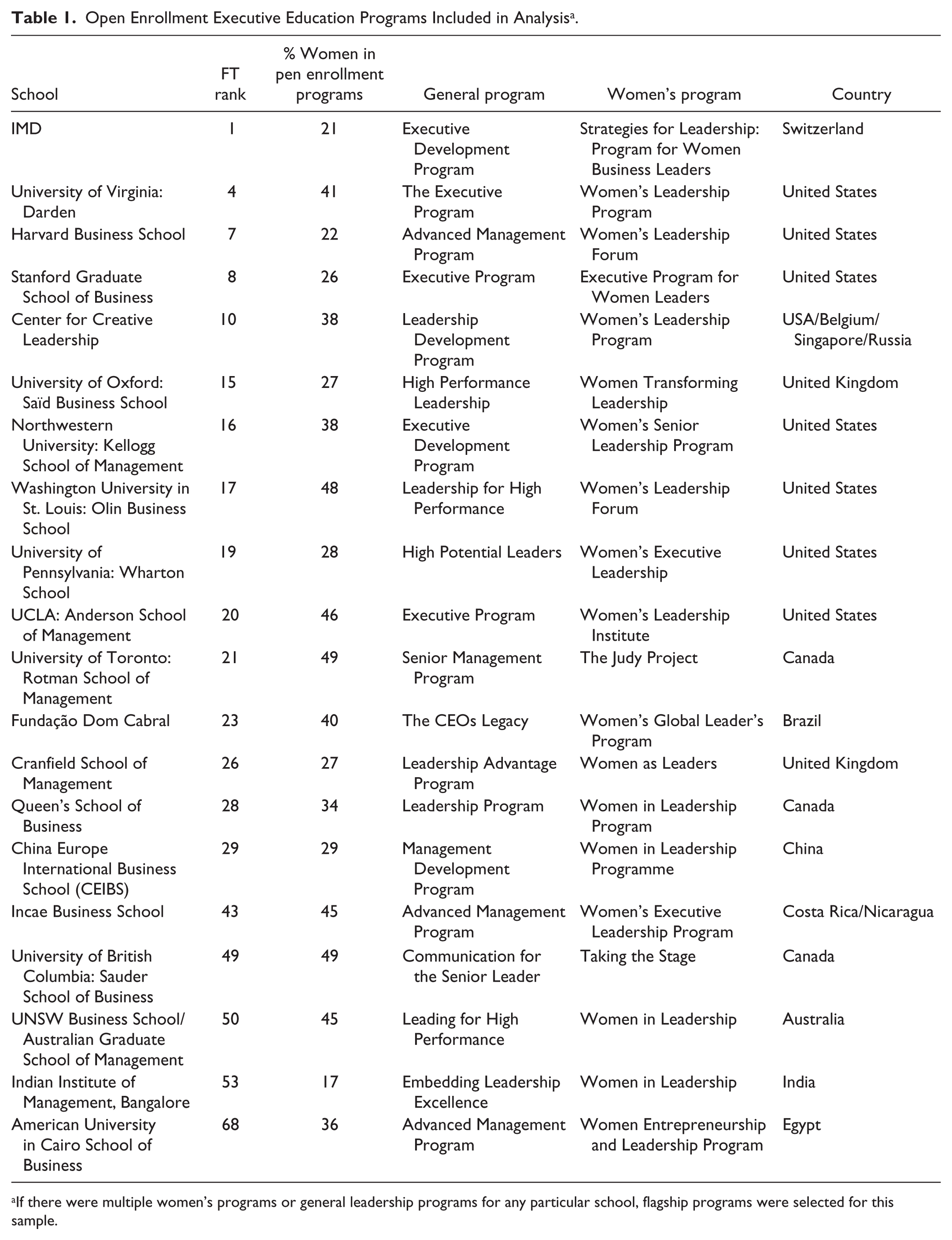
If there were multiple women’s programs or general leadership programs for any particular school, flagship programs were selected for this sample.
In general, Research Question 1 (What pedagogical assumptions about leadership are made in WLDPs and GLDPs?) was addressed in the first few paragraphs of each program description in the way the program described itself and its purpose. Most descriptions offered a value proposition for leadership, which allowed us to understand how each type of program defined leadership. Research Question 2 (What pedagogical assumptions about how relating to others enables leadership development are made in WLDPs and GLDPs?) focused more on the experiences participants would have in the program. This tended to manifest itself in the following ways: (a) in testimonials from previous participants reflecting on their experience in the program, (b) in descriptions of what kind of information or learning would be delivered (e.g., practical business knowledge vs. an experience to gain role models), and (c) in descriptions of what would be gained (e.g., a network of contacts for business advantage vs. a network of relationships for ongoing support). Finally, Research Question 3 (What pedagogical assumptions are made about understanding self and others for the development of leadership capabilities?) was typically addressed through analysis of descriptions of the benefits of coaching, team exercises/peer feedback, class discussions (particularly with guest speakers/mentors for WLDPs), and leadership assessments such as self-assessments and 360-degree surveys and feedback. The challenges of leadership in today’s global and complex world was addressed in nearly every program as a way to build value to the importance of the program, thus drawing on the same value proposition for inclusive leadership that we suggest earlier.
Coding Procedure and Analysis
We took a grounded approach (Charmaz, 2006) to our qualitative analysis of program descriptions to make their underlying assumptions transparent (Martin, 2000). Three of the coauthors independently coded the data by allocating open-codes to the program descriptions. These three coauthors created a list of open-codes to discuss patterns found in the data. They then met in order to begin to group codes into generic concept categories. The researchers used the information from this first meeting to begin the construction of a codebook (Patton, 1980). This would allow each to contribute to the definition of each concept using examples from the program descriptions to guide exemplar items. Thus the coding unit consisted of text (a phrase, sentence or grouping of sentences) in an LDP description that provided a meaningful representation of a code. At the completion of this process, 10 themes were agreed on and conceptually defined.
Two of these three coauthors then used the codebook to undertake another round of coding. This was done to rigorously examine the definitions of the themes and to ensure that themes did not need to be further collapsed and that other concepts did not exist in the data that were missed during the first round of coding. After the program descriptions had been coded for a second time, these two coauthors again met to discuss the themes. The coauthors went through 10 programs (5 GLDPs, 5 WLDPs) and compared the applied codes. Anytime the two researchers disagreed, they discussed the discrepancy until one concept was agreed on. Discrepancies often resulted from confusion with codebook terminology. As such, the researchers continued to update and refine the codebook. It was also during this stage of analysis that the coauthors talked about the creation of new concepts in the data. It was determined that two additional concepts needed to be added to the codebook. At the end of this process, the researchers agreed on 13 concepts or codes. Last, a final round of coding was conducted between these two coauthors on all LDPs in the sample in order to obtain the final results.
It was at this time that the two other coauthors were brought into the coding process to establish interrater reliability, since consistency among created concepts is essential. These two coauthors, who were not involved in the earlier code development or application process, were given the completed codebook and 49 exemplar items from the GLDP and WLDP program descriptions. Each code was represented approximately three to four times among these exemplars. These two coauthors who were blind to the codebook were also not informed about the type of program (WLDP or GLDP) to which the exemplar items belonged as this may have biased their responses. To examine interrater reliability, Cohen’s kappa was chosen over other coefficients because there were two external coders (unfamiliar with the codebook) and the data were nominal (Cohen, 1968; Dewey, 1983). The reliability coding produced a kappa of 0.73. The initial two researchers who applied the codebook then met with the two interrater reliability coders to review the results and discuss and reconcile discrepancies. In general, the discrepancies came from different perceptions of codebook terminology. On reconciling differences, a highly acceptable interrater reliability coefficient (kappa of 0.95) was obtained.
Findings
Inductive coding revealed useful insights about what is emphasized in WLDPs versus GLDPs. The frequency comparison that can be found in Figure 1 and Table 2 shows that although WLDPs and GLDPs drew on similar themes of leadership and pedagogy, the extent to which these codes were present in the program descriptions varied by program type.

Frequency summary.
Frequencies.
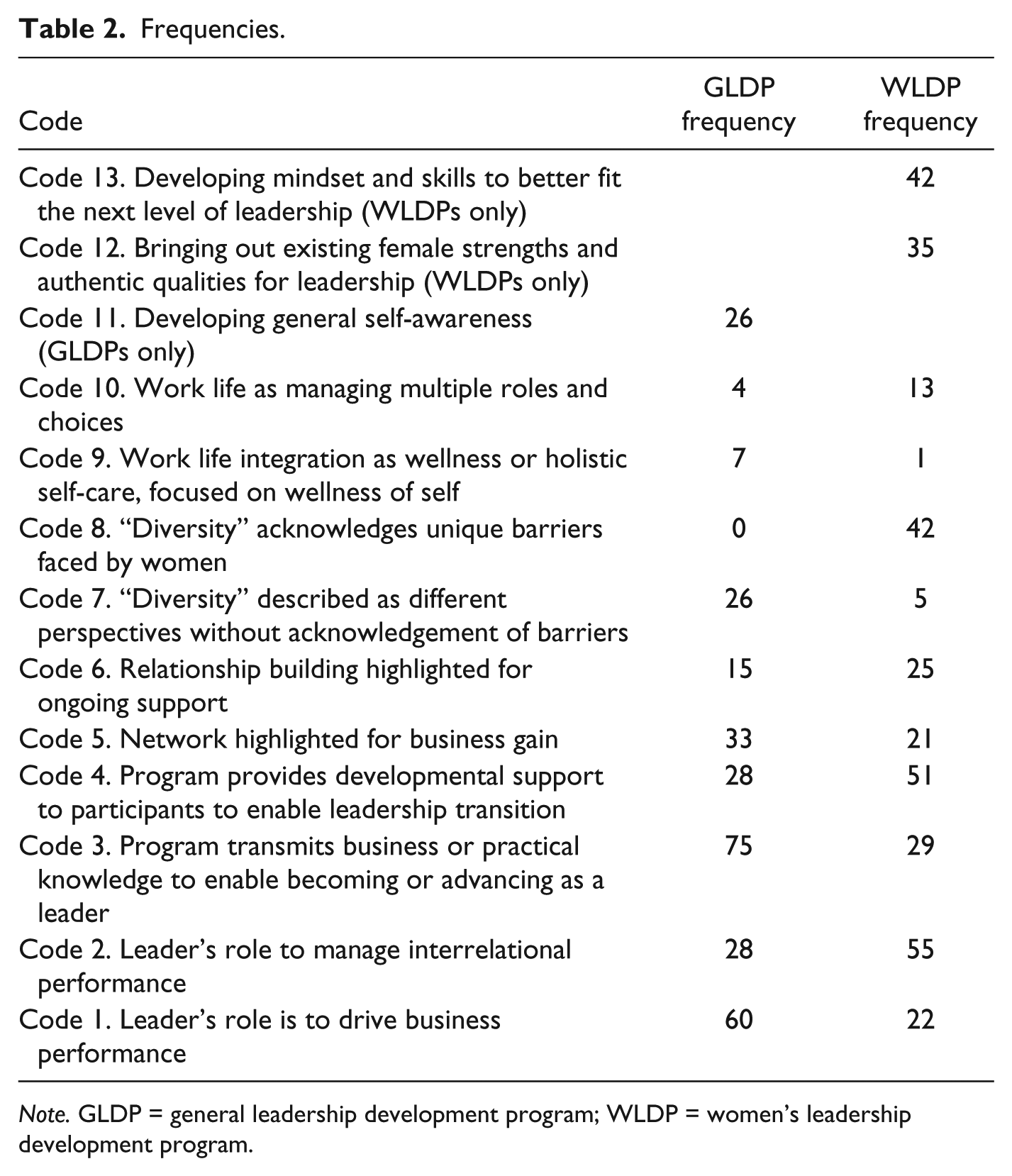
Note. GLDP = general leadership development program; WLDP = women’s leadership development program.
The codes resulting from analyses of our research questions, along with their description and an exemplary quotation, are provided in Table 3 for codes that had higher frequencies in GLDPs and in Table 4 for codes that had higher frequencies in WLDPs. We provide a summary of our findings by research question below.
Codes That Were More Prevalent in GLDPs.
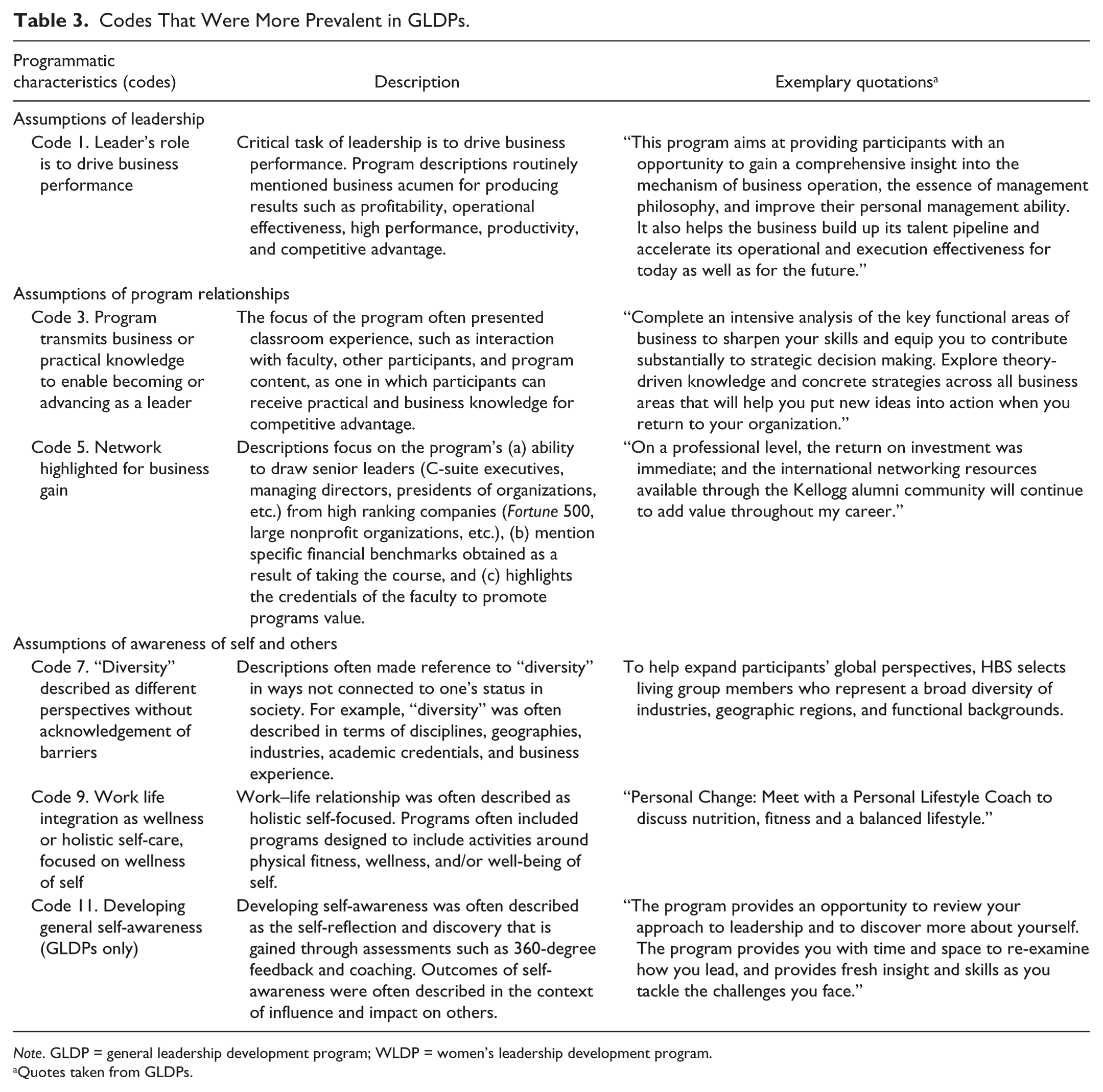
Note. GLDP = general leadership development program; WLDP = women’s leadership development program.
Quotes taken from GLDPs.
Codes That Were More Prevalent in WLDPs.
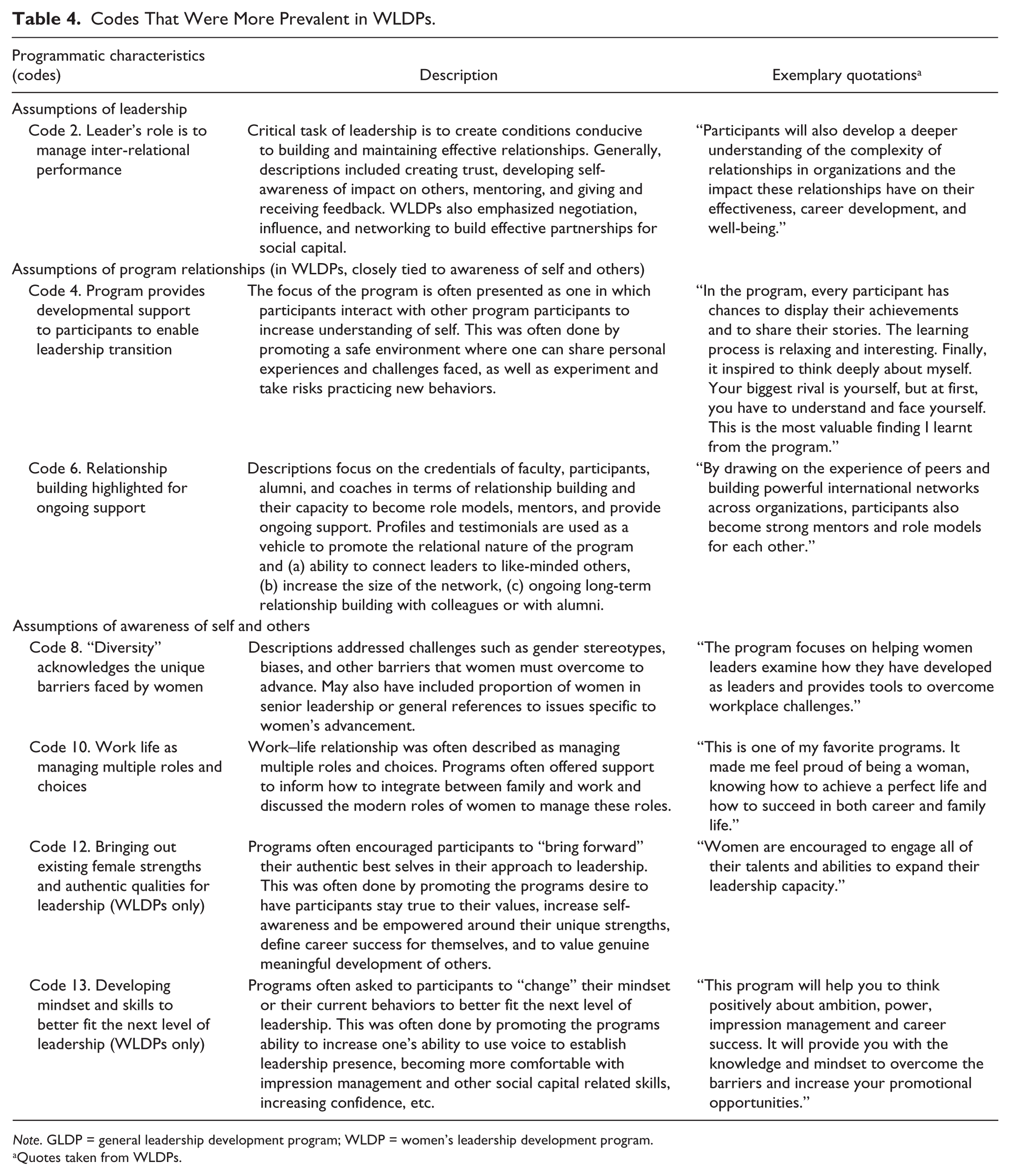
Note. GLDP = general leadership development program; WLDP = women’s leadership development program.
Quotes taken from WLDPs.
Research Question 1: What Pedagogical Assumptions About Leadership are Made in GLDPs and WLDPs?
Our analysis revealed that GLDPs tended to emphasize leadership for business performance whereas WLDPs tended to emphasize leadership for relational performance. This finding suggests that although both programs draw from newer conceptualizations of relational approaches to leadership, WLDPs may providing more opportunity to work through challenges and advantages of leading through relating. We expand on each code below.
Code 1. Leader’s Role is to Drive Business Performance
Program descriptions for this code focused on increasing profitability, effectiveness, performance, and productivity to garner a competitive edge as ways to obtain business performance. For example, one GLDP program claimed,
As global competition intensifies, companies are turning to business executives with the leadership skills and global vision to create and sustain a strategic advantage. The Advanced Management Program (AMP) enhances your ability to build and manage a high-performing organization that drives change and innovation. By exploring the financial factors shaping the world economy, you’ll gain new strategies for driving profitability in any global climate.
Thus establishing the criteria for leadership as focused on financial factors for a high-performing organization. GLDPs mentioned this view of leadership 60 times compared with 22 mentions in WLDPs.
Code 2. Leader’s Role is to Manage Interrelational Performance
WLDPs on the other hand were more likely to emphasize leadership for interrelational performance (frequency of 55 compared with 28 in GLDPs descriptions). This code applied to descriptions in both GLDPs and WLDPs around motivating and impacting team members through trust, providing mentoring, collaboration, giving and receiving feedback, and so on, but in WLDPs performing through relationships also meant gaining social capital, influence, and becoming adept at negotiating. One WLDP program indicated that good leaders focus much of their time on relating to enable others:
Good leaders spend much of their time enabling, energizing, directing, and motivating others to perform at their best and for the best of the company. Motivation is ultimately about how to get people to do what you want them to and to feel good about doing that. This session focuses on how to create conditions so that employees create value for the organization and find that process rewarding and enjoyable.
Thus leaders create value for the organization through others, and leadership does not exist without those she or he influences.
The above two sets of codes—explicating how leadership is conceptualized—are consistent with previous research highlighting different roles for leaders such as transactional styles focused on task completion and transformational styles focused on relationships and community (Eagly et al., 2003). The finding that WLDPs are more relationally focused is also consistent with the finding that women are more likely to engage in transformational styles of leadership, as men were more likely to engage in transactional styles of leadership (Eagly et al., 2003). Thus this study suggests that GLDPs are still drawing on more masculine ways of leading and may benefit from becoming even more balanced to include other styles of leadership if attempting to reach a broader leadership audience.
Research Question 2: What Pedagogical Assumptions Are Made in GLDPs and WLDPs That Address How Relating to Others Enables Leadership Development?
Our analysis revealed that both GLDPs and WLDPs reflect pedagogical choices from the tradition of transmitting knowledge as well as postmodern approaches of creating an experience through cocreating the learning environment. However, GLDP descriptions revealed a greater emphasis on participants receiving necessary knowledge (reflecting a view that instructors are experts and participants are passive recipients) whereas WLDP descriptions revealed a greater pedagogical emphasis on learning through relationships and active engagement in and cocreation of learning. More explanation on these codes can be found below.
Code 3. Program Transmits Business or Practical Knowledge to Enable Becoming or Advancing as a Leader
Text that fell under this code often presented the role of faculty and even engagement with other participants as transmitting knowledge and gaining competitive advantage. Even in team assignments of social interaction, the emphasis is on coming up with strategic solutions using the knowledge of team members. For example, in one GLDP the experience of engaging with a case is not about the experience of the case but rather the testing of fact-based knowledge:
A case competition closes out the program, drawing upon the application of all your acquired knowledge and enhanced leadership abilities. Your team skills will be put to the test as your group takes on a real business, marshals fact-based decision-making and devises a unique, practical solution to its challenges for review by an elite panel of judges.
Although on its surface the social interaction described above is experiential, the learning is not co-constructed and instead knowledge is gained through pitting participants against each other toward a “better” solution. Overall, based on our coding, GLDP descriptions emphasized transmission of knowledge as a pedagogical choice twice as much as a program experience of developmental support (see Figure 1 and Table 2).
Code 4. Program Provides Developmental Support to Participants to Enable Leadership Transition
In contrast to the GLDPs’ focus on transmitting knowledge, WLDPs were much more likely to describe their programs as providing a safe environment for understanding self through connecting with others (i.e., WLDPs frequency for this code was 51 in contrast to 28 for GLDPs). In feminist pedagogy, the sharing of experience is critical for trust and connection that helps to uncover knowledge, particularly knowledge of self (Belenky et al., 1986). In the WLDP example below, we see how the collective context of shared experience creates a safe space that is an alternative to the less connected environment of organizations:
Women are able to focus on their own development and challenges in a room full of people with similar issues and experiences. They can explore their leadership identity, strengths and weaknesses well apart from their usual context. And, importantly, the content is tailored to women.
In this description, the understanding of self and of a new leadership identity is inextricably tied to the co-construction of the shared learning experience. Thus the pedagogical assumption around what women need to support their leadership identity transition and gain awareness of self is closely tied to relating with others.
Code 5. Network Highlighted for Business Gain
Although an emphasis on developing networks on its surface may seem to provide social learning and interconnection, program descriptions emphasized the importance of acquiring a rich network for business gain. A network was described as something participants develop from attending the program that could provide them a distinctive business advantage. Statements associated with this code were offered factually, typically providing objective data such as participants’ organizational revenues and credentials (e.g., being included in the Fortune 500 list of companies) as the example below from a GLDP illustrates:
Typically, participants come from organizations with annual revenues in excess of $250 million and have approximately 20 to 25 years of work experience, including a significant amount of time as a senior manager or an officer of the company.
Again, although the context of interacting and building relationships with others suggests a pedagogical choice in creating an environment and opportunity for relating, the outcome described from these networks is about knowledge or business advantage gained versus a relationship that is fostered. GLDPs were more likely than WLDPs to describe program networks for business gain, and did so twice as much in their program descriptions as the contrasting code around relationship building for ongoing support.
Code 6. Relationship Building Highlighted for Ongoing Support
In contrast to GLDPs that were more than two times more likely to emphasize program networks for business gain than for relational support (i.e., 33 to 15), WLDPs were much more balanced. Program networks were described as providing business gain (frequency of 21) but almost as likely to describe relationship building in the program for ongoing support (frequency of 25). For example, faculty members were often described as role models, mentors, and coaches for personal and career development. Testimonials from previous participants reiterated the WLDP’s capacity for continuing relationships during and after the program. One testimonial described a WLDP in the following way:
Through this program, many participants develop lasting relationships and are able to draw on a valuable network of peers who can offer ongoing advice and support.
Another WLDP description offered extended career planning through mentors:
The program will feature a group of mentors, entrepreneurs and senior executives from the region, who will accompany the participants in their career plans after completing the program.
Statements such as those given above reflect underlying narratives of the importance of relationships to women and allude to understandings of sex differences in learning and the development of moral reasoning as reflected in the “different voice” work of Gilligan (1982) and the “connected knowing” insights offered by Belenky et al. (1986).
The pedagogical assumption that informs a relational emphasis in WLDPs seems to be around what motivates leadership learners to engage with the course and with each other. In GLDPs, the prevailing assumption that business knowledge is to be transmitted and contacts are to be gained for competitive advantage seems to inform a learning environment of separate knowing, in which knowledge is gained through separation of self from others (Belenky et al., 1986). WLDPs on the other hand show a more balanced approach consistent with feminist pedagogy in drawing from connected knowing or learning that comes from relationships and interactions with others (Belenky et al., 1986).
Research Question 3: What Pedagogical Assumptions Are Made About Understanding Self and Others for Leadership Development?
To address Research Question 3, we more specifically looked at issues of understanding self and identity management in the context of diverse others and across work life domains (Ramarajan & Reid, 2013). The following codes emerged.
Code 7. “Diversity” Described as Different Perspectives Without Acknowledgement of Barriers
These descriptions, primarily employed by GLDPs, reflect “diversity” as a business advantage without acknowledging the unique challenges of specific minority identities. In descriptions under this code, diversity was not referenced in terms of demographic or social minority identities, but rather as constituting differences in perspectives arising from experiences of different industries, careers, jobs, functions or geographical locations, the knowledge of and exposure to which could yield business advantage to participants. These are certainly important aspects of diversity and can be identity informing; however, without substantiating the challenges often faced by those with minority identities, these descriptions of diversity are somewhat narrow. For example, one GLDP described their diverse participants as follows.
Participants represent a rich diversity of disciplines, geographies and career experiences. They come from a wide variety of industries, including high-tech, manufacturing, financial services, healthcare, not-for-profit and government.
Even when GLDPs addressed diverse identities from multicultural backgrounds, this type of diversity description was more about leveraging local knowledge for competitive advantage, as illustrated in the following quote:
Our participant groups are truly global to allow discussion of strategy with peers from differing cultures, contexts and countries in the economic cycle.
Although the business case for diversity certainly has been important in increasing representation across diverse identity groups, this framing of diversity, described as the access-and-legitimacy perspective, was not found to enable sustained benefits from a diverse workforce (Ely & Thomas, 2001).
Code 8. “Diversity” Acknowledges the Unique Barriers Faced by Women
WLDPs employed descriptions of diversity to indicate differences in status, power, and privilege usually as a way to emphasize the opportunity to gain increased understanding of social identity-based diversity, biases, and stereotypes particularly those related to gender. Predictably, WLDPs often specifically brought up the unique challenges women face in organizations today, as well as the importance of retaining women leaders in workplaces as illustrated below:
Corporations and governments worldwide are increasingly concerned about the under-representation of women in executive management and leadership roles. Some have attempted to address the issue by introducing positive discrimination policies. At the same time, the business benefits of “Diversity and Inclusion” are becoming more and more well-established. As of October 2014, 4.6% of Fortune 1,000 companies had a female CEO.
While statements such as the one above are not unexpected given the targeted focus of WLDPs, what was more surprising was the contrast in the usage of the word “diversity” in WLDP and GLDP descriptions. It is no secret that women’s advancement and retention in the workplace is a popular topic today; while WLDPs often brought this issue to the forefront, GLDPs seemed to frame the concept of diversity to be more about globalization and the strategic knowledge of diversity needed by leaders to succeed in today’s global economy.
We conducted a separate secondary analysis to explore multiple identities, not just gender. From an intersectionality lens, it would make sense for program descriptions to discuss additional social identities that may face barriers in advancing to leadership also, such as race, ethnicity, social class, sexual orientation, and the intersectionality of these and other social and demographic identities. One of the members of our research team went back and reanalyzed our sample data. It was surprising to find in this reanalysis that none of the program descriptions in either sample of WLDPs or GLDPs referenced identity in these others ways. While we realize that program descriptions do not cover the full depth of content covered in a course, both WLDPs and GLDPs failed to highlight in their descriptions a consideration of multiple diverse identities and issues of intersectionality, a critical topic in more fully understanding others. Instead, what we found was that in the broader context of a university’s executive education programs, two universities within our sample offered specialized programs to separately explore other minority identities, including the Advanced Leadership Program for Asian-American Executives at the Stanford University Executive Education Programs and the Multidimensional Leaders’ Institute at the UCLA Anderson Executive Education Programs. Thus it appears that there exists opportunity to address multiple identities and intersectionalities in a more central way within both WLDPs and GLDPs in order to understand self and others for inclusive leadership.
Code 9. Work Life Integration as Wellness or Holistic Self-Care, Focused on Wellness of Self
Work life as an issue of identity came up much more frequently in descriptions of WLDPs than in GLDPs. In GLDPs, work–life balance was not so much about managing multiple different work life roles and identities, but instead about the wellness of self in terms of physical wellness and mental wellness. For example, one GLDP described its included fitness program as follows:
Wellness is an important part of the executive whole. You will take a course on cognitive fitness and will receive a [personal wellness profile]. The program offers a variety of fitness sessions.
Code 10. Work–Life Integration as Managing Multiple Roles and Choices
WLDPs also emphasized the importance of the wellness of self but in terms of identity management. For example, WLDP descriptions addressed how leaders manage roles as parent/life partner and leader at work. In one WLDP testimonial, a participant described how the program helped her navigate the multiple identities and choices that impacted others:
The Women’s Leadership Program showed me how I could gain some much needed balance between my job and my personal life and at the same time give my staff new opportunities to stand up and take charge and shine. I come to work now and know I’m making a difference to them.
Although both the above work–life integration codes (9 and 10) have lower frequencies across both sets of programs, the contrasting emphases we observed continue the pattern found in earlier codes. GLDPs emphasize expert knowledge on topics such as fitness and encourage a focus on self, while WLDPs emphasize better knowing oneself in order to make informed choices around work–life role dilemmas and encourage a focus on self in relation to others. Although this contrast is implied in earlier codes, the emphasis on the autonomous self versus the emphasis on the relational self is particularly transparent in these work–life codes.
Taken together, the contrast in how diversity and work–life integration issues are presented in GLDPs and WLDPs provide insight into how these identity-related issues may be handled in each type of program. GLDPs again tended to focus their descriptions more on what leaders can individually gain in terms of business gain—that is, knowledge from different industries/careers/jobs/functions or locale or knowledge of how to manage personal wellness—versus WLDPs that also addressed what others (e.g., organizations, teams, family) have to gain when women can overcome barriers and when women have improved work–life integration. In these descriptions, WLDPs were more likely to present work–life and diversity in relational terms of connection to others.
Finally, we sought to understand how self-awareness as a leadership skill was presented when directly mentioned in program descriptions. We expand on the self-awareness related descriptions of GLDPs and WLDPs through the codes below.
Code 11. Developing General Self-Awareness (GLDPs Only)
GLDPs described self-awareness skills in general terms often around the opportunity for self-reflection and discovery that is gained through assessments such as 360-degree surveys and executive coaching. For example,
The Program takes you through an intensive five days of self-discovery, one-on-one coaching, classroom discussions and team exercises. You will leave the Program with a better understanding of yourself and a powerful personal development agenda.
GLDPs did not highlight strengths or unique qualities of any particular group identity. However, GLDPs often did tie in the importance of self-awareness as a relational skill to increase one’s impact on others (e.g., team or organization) as illustrated below:
Designed to prompt deep introspection, AMP equips you with powerful insights about yourself and your leadership capabilities to bring about a full-scale transformation—at both the individual and organizational levels.
This code was used specifically for GLDPs in order to draw out the nuanced differences between GLDP and WLDP descriptions. Although WLDPs also addressed self-awareness, Codes 12 and 13 below were developed to apply specifically to WLDPs in order to draw out the contrasting expectations (drawing on women’s strengths and fitting the extant mindset of leadership) that inform self-awareness. These social expectations were not present in GLDPs. Next we present findings on WLDP-specific codes.
Code 12. Bringing Out Existing Female Strengths and Authentic Qualities (WLDPs Only)
Gaining awareness in WLDPs includes connecting to a broader gender identity of women and strengths of that identity. In the examples below, there is also an implicit message that drawing on these strengths individually also elevates women as a whole (e.g., women as “agents for change”):
[The program] introduces powerful experiential techniques to identify and navigate through organizational challenges or bias, and builds strengths in leadership enhanced by natural tendencies women bring to the role. [The program] also examines game changing approaches female role models have used to resolve complex situations on both a commercial and humanitarian scale, and considers how gender attributes enhanced these opportunities to become successful agents of change. Jump right in and get out of the course as much as you put in—and don’t underestimate the power of women!
Each of these examples implies that there are innate tendencies, attributes or characteristics of being a woman that can be brought out to enhance their positive leadership impact, improve their organizations and serve the greater good. These empowering strengths provide the opportunity for both a change in self-concept as well as for managing others’ identity expectations of women as leaders.
Code 13. Developing Mindset and Skills to Better Fit the Next Level of Leadership (WLDPs Only)
Statements falling under this code suggested that women, “develop a strategic mindset to promote growth and innovation,” and come to terms with issues such as the following:
[The program] addresses some fundamental behaviors that have traditionally reduced women’s ability to come across as strong, confident leaders. . . . Too often women tend to do the work, but not bring their vision to the table. . . . We teach businesswomen to bring their ideas forward, and communicate them in an effective way where their ideas are taken seriously. Participants will have an opportunity to increase their self-awareness while understanding how to build influence, leverage collaboration and lead change. Integrated program sessions promote the mindset and competencies necessary to transform participants from effective colleagues and bosses to successful and valuable leaders—who return to their organizations ready to lead at the next level.
Although only in the context of WLDPs, this code shares a commonality with the earlier concepts emphasized in GLDPs—that of expert knowledge that can be used for business gain. The previous Code 12 (bringing out existing female strengths and authentic qualities) presents descriptions that draw on the female advantage for leadership, yet through Code 13, WLDPs appear to also address the reality that often women leaders have to operate in male dominated contexts in which leadership is still tied to more agentic, masculine behaviors (Heilman, 2001). Thus, taking on a leadership mindset for women often involves a shift toward the prevailing perceptions of leadership behaviors, as pragmatically acknowledged in several WLDP descriptions.
Discussion
In today’s business environment, no leader can ignore the increasingly globalized workforce and issues of inclusion (Brannen & Thomas, 2010; Fitzsimmons, Miska, & Stahl, 2011). As leaders must respond to these workforce dynamics so must leadership development programs. Our research questions guided the exploration of WLDP and GLDP website descriptions to determine what assumptions around leadership were espoused by these programs, what pedagogical assumptions were made around teaching knowledge or co-constructing learning, and how awareness of self and others was addressed.
The coding of WLDP and GLDP descriptions in the present study revealed that the pedagogical assumptions underlying WLDPs tended to align more with the development of self-awareness and leadership identity through forming relational connections and identifying strengths that emerge from navigating the challenges of conflicting expectations between women’s and leadership roles. WLDP descriptions were more likely to address self-awareness and individual leadership identity transition through relationally connecting with a collective gender identity. In contrast, the pedagogical assumptions underlying GLDPs tended to align more with traditional masculine views of leadership where the outcomes sought are competitive (e.g., business advantage gained). We note, however, that both WLDPs and GLDPs drew on these contrasting assumptions, but to different extents. These findings suggest that merging these two paths of leadership development and providing an integrated approach may enhance the opportunity for more inclusive leadership development to occur.
In Table 5, we organize our inductive codes according to whether they were more prevalent in GLDPs or WLDPs, and then map these codes to various styles of leadership mentioned in the literature: agentic or achievement oriented leadership (Heilman, 2001), transactional or task and exchange oriented leadership (Eagly et al., 2003), relational leadership (Cunliffe & Eriksen, 2011), and identity-based leadership (Day & Harrison, 2007; DeRue & Ashford, 2010; Ely et al., 2011; Lord & Hall, 2005). Stereotypical characterization of the male gender identity includes a more agentic achievement-orientation that is characterized as aggressive, forceful, independent, and decisive (Heilman, 2001). Gender role characterizations of women are more communal and associated with being kind, helpful, sympathetic, and concerned about others (Heilman, 2001). What becomes clear through Table 5 is that the more prevalent codes in GLDPs align with masculine leadership approaches, with the exception of developing general self-awareness. WLDPs are somewhat more balanced than GLDPs across different approaches to leadership, particularly when considering the self-awareness related codes and relationship building for ongoing support; however, other codes around leadership and pedagogical assumptions that were more prevalent in WLDPs align primarily to relational and identity-based leadership approaches.
Mapping of Codes to Leadership Approach.
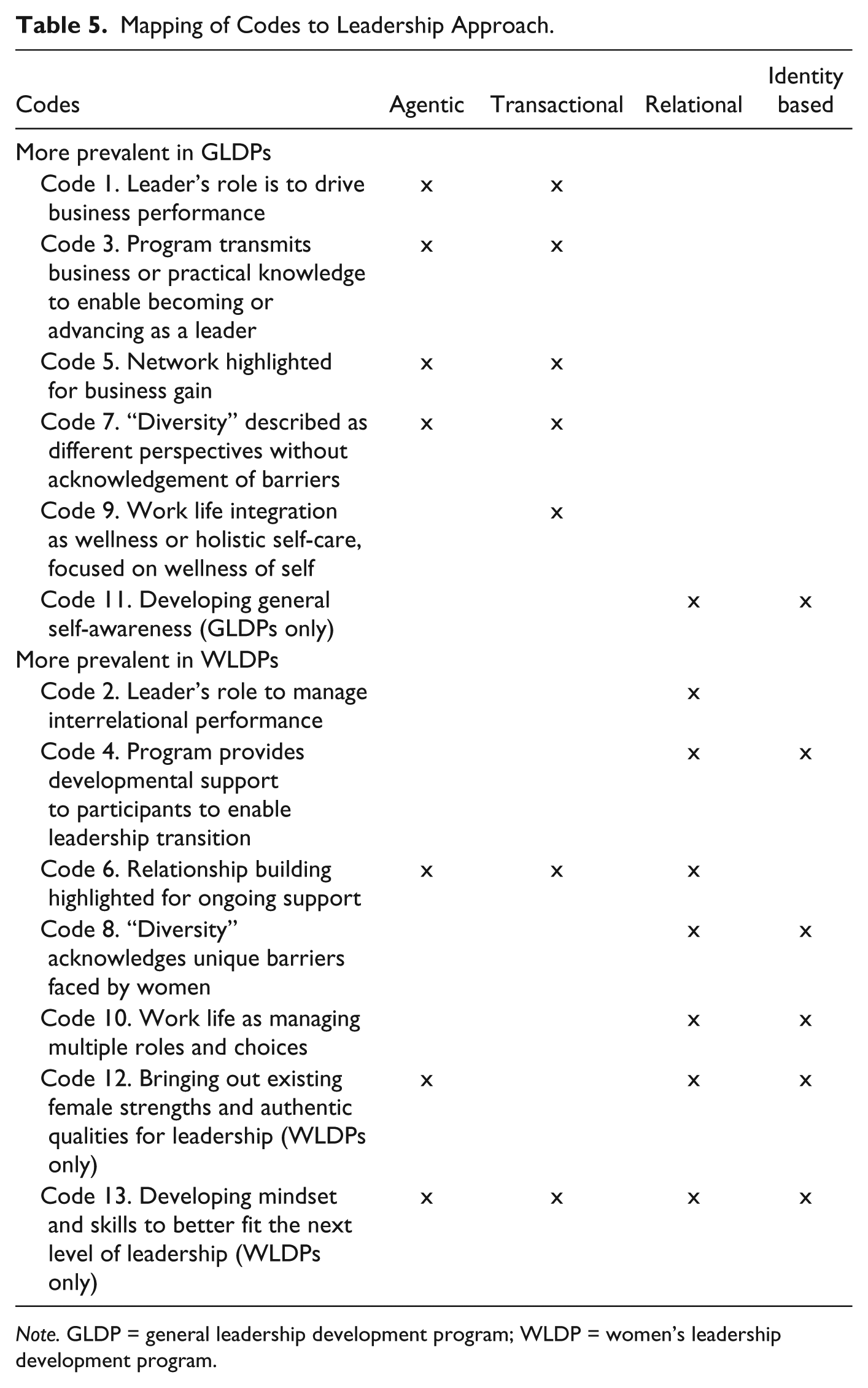
Note. GLDP = general leadership development program; WLDP = women’s leadership development program.
From our synthesis of codes, we develop a model for inclusive leadership development shown in Figure 2. This model incorporates findings from our analysis of both GLDPs and WLDPs, proposing a balanced approach to leadership development. Boxes in the model represent a summative code from our analysis, and circles represent our interpretation of the underlying pedagogical assumption or outcome. Using a reflexive process (Stead & Elliott, 2012) to bring visibility to how we teach and to understand what students learn (pedagogy), we display the two overarching paths that emerged from our data—one that leads to more transactional and agentic leadership (primarily GLDPs) and one that leads to more relational and identity-based leadership (primarily WLDPs). We are not suggesting that relational/identity-based leadership be taught exclusively either in WLDPs or GLDPs. Indeed, the two contrasting paths highlighted in Figure 2 tend to be somewhat integrated in WLDPs already. Rather we suggest that relational and identity based leadership approaches may need further integration in GLDPs in order to create effective synergies between the two paths for inclusive leadership development.
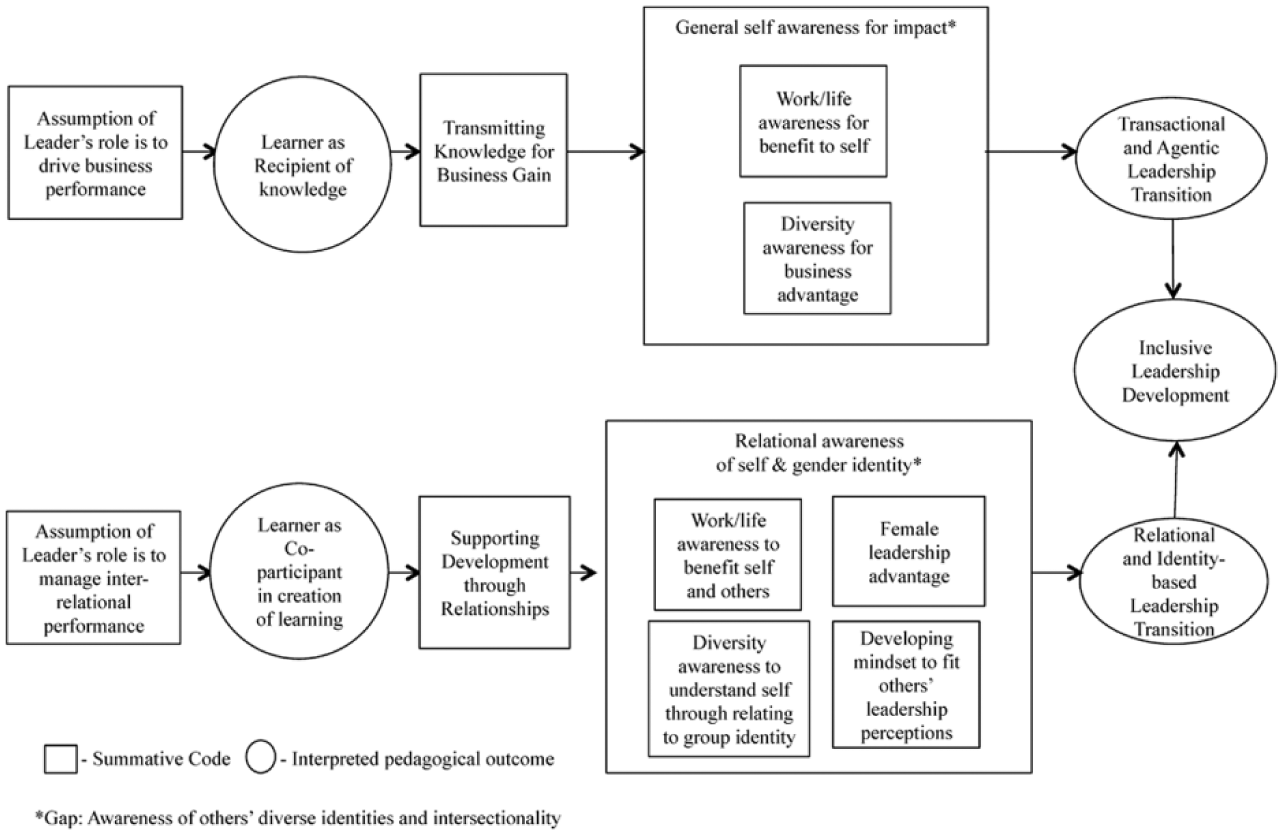
Pedagogical framework for inclusive leadership development.
Drawing on feminist pedagogical understandings of the difference between the development of knowledge as separate knowing (more masculine based approaches to gaining knowledge) and connected knowing (more feminine based approaches to collective learning) (Belenky et al., 1986), we discuss this more integrated model through these contrasts as well as differences in sources of identity formation across genders.
Separate and Connected Knowing
The top path of the model links codes predominantly found in GLDPs and the bottom path links codes that were more prevalent in WLDPs. We link assumptions about the leader’s role and the pedagogy of leadership development programs through Belenky et al.’s (1986) concepts of separate and connected knowing. Separate knowing is the development of objective knowledge that is separate from emotion and rooted in a separation of self from others (Belenky, et al., 1986). Self is separated in order to competitively determine some absolute knowledge that is to be gained, not cocreated (Belenky et al., 1986). In contrast, connected knowing develops in the sharing of experience. Relationships formed through trust and connection help to uncover knowledge, particularly knowledge of self (Belenky et al., 1986).
In linking from descriptions of leader’s role for business performance to program pedagogy, we induce that an underlying context of competition informs the codes more prevalent in GLDPs around the transmission of knowledge and networks for business gain. Thus, the value proposition of the program is to create differentiation and competitive edge through separate knowing. Participants in the program primarily are recipients of knowledge, as relating to others and sharing experience may reduce the ability for differentiation. In contrast the codes for leader’s role for interrelational performance more prevalent in WLDPs inform an underlying context of relationship building not just for business gain but also for ongoing relating to others to support the leadership transition and cocreation of learning. Participants in programs are part of creating the learning experience and engage with connected knowing—participants know more about themselves by gaining a sense of belonging to a collective identity and connecting across shared experience. Thus, for inclusive leadership development, the presence of both separate and connected knowing increases the potential for individuals to both differentiate but also gain the relational connections that support and enable necessary leadership shifts.
Development of Self-Concept and Leadership Identity
In terms of leadership identity there are three levels of self-concept—personal, relational, and collective (Brewer & Gardner, 1996). The development of leadership identity integrates these three levels of self-construal, such that this identity is individually internalized, relationally recognized, and collectively endorsed (DeRue & Ashford, 2010). Considering these levels from the perspective of gender identity, relational recognition and collective endorsement of leadership identity generally occurs without much disruption to the normative perceptions of men as leaders. Thus, working through these levels to form leadership identity is not intentionally addressed in a path to more masculine leadership approaches of agentic and transactional, as can be seen in our model. Forming masculine leadership identity is not dependent on relating to others; however, getting business impact is, thus the code prevalent in GLDPs around diversity awareness for business advantage—diversity of others is not necessary for forming mutual understanding of identity but needed for competitive gain. In the context of work life, self-awareness is literally for the self—that is, personal wellness. In the path of separate knowing, we see that identity is not typically addressed in the path leading to agentic and transactional leadership styles because these masculine approaches are implicit in general perceptions of leadership.
In our model, codes that linked more to relational and identity-based leadership approaches (more prevalent in WLDPs) included descriptions that address all three levels—individual internalization, relational recognition, and collective endorsement. Integrating across these three levels poses a challenge for women given conflicting expectations of their gender identity and leadership identity (Eagly & Karau, 2002; Heilman, 2001). Women who fulfill leadership expectations are often assessed less favorably than their male counterparts because their behavior violates gender-role expectations (Eagly & Karau, 2002; Eagly, Makhijani, & Klonsky, 1992; Heilman, Wallen, Fuchs, & Tamkins, 2004; Lämsä & Sintonen, 2001). Management and leadership behaviors are typically associated more with men (Schein, 1973, 1975), whereas communal, domestic, and subordinate sex-typical and family role expectations are stereotypically incorporated into the female gender role (Eagly, Wood, & Diekman, 2000). Thus, the identity transition to leadership for women requires intentional engagement with gaining relational recognition and collective endorsement.
In terms of individual internalization, the more positive a woman’s view is of her gender and leadership identities, the more she is able to cope with identity experiences and manage identity conflict (Karelaia & Guillén, 2014). Thus, it may be suggested to women to attempt to fit into the prevailing norms and expected behaviors (masculine styles) of leadership. Yet, in experimenting with provisional leadership identities, women were more likely to use true-to-self strategies which favor existing routines, familiar elements, and own style (Ibarra, 1999) due to a lack of role models to follow as well as a preference to emphasize substance over form and a distaste for “faking it” (Ibarra, 1999). Even if women attempt to fit the traditional more masculine norms of leadership, their efforts still unsettle the status quo (Stead & Elliott, 2012). Thus, women who display competence in leadership may experience backlash (Heilman, 2001), may be stereotyped as lacking warmth, and elicit responses of envy (Fiske, Cuddy, Glick, & Xu, 2002). If women experience this identity conflict within themselves, then being a woman threatens both her self-concept as a leader, and being a leader threatens her identity as a woman (Cross & Madson, 1997).
Although these complexities involved with women’s identity work pose challenges, it also means that intentionally addressing these multiple levels creates more links to relational and identity-based leadership transition. Although both paths have a gap in terms of awareness toward others’ diverse identities and intersectionalities, we propose that bringing together the two paths inform possibilities for a more inclusive pedagogical framework for inclusive leadership development. Although we suggest that feminist pedagogy lends to the expansion of relational and identity based leadership transitions, feminist pedagogy can also facilitate the ongoing reflexivity (Stead & Elliott, 2012) necessary to make this integration possible.
Optimal distinctiveness theory suggests that in forming the self-concept, individuals manage tensions across the need for differentiation and the need for belonging (Brewer, 1991). Drawing on optimal distinctiveness, conceptualizations of work team inclusion suggest that inclusion is perceived when individuals are able to both maintain uniqueness and have a sense of belonging (Shore et al., 2011). By engaging both separate and connected knowing, leadership development programs may provide opportunities to integrate both the need for distinctiveness and the need to belong. Additionally, GLDPs will likely benefit from the intentional identity work that WLDPs engage with in order to expand learning of self-awareness toward relational awareness of others, and understanding self through others.
Limitations of the Study
The study has certain methodological limitations. First, our sample only included universities that had WLDPs. In total, 40 leadership development programs were matched and analyzed (20 GLDPs and 20 WLDPs), which is not an exhaustive coverage of the leadership development opportunities offered by Financial Times’ ranked executive education programs. We matched only the flagship or the most general LDP available in each university/school with their WLDP, rather than all their open leadership development programs. Future research may analyze the programs of universities not included in our study as new women’s programs are added to the curriculum.
Another limitation is that only university/business school leadership development programs were included in the current analysis. It is unclear if themes found in university/school sponsored leadership development programs would be similar or different to those offered by private organizations such as Pearson, which offers a 24-month rotational program. A thorough examination of privately sponsored leadership development programs was beyond the scope of the present study. A final limitation is that the present study only relied on website descriptions. These descriptions provided overviews of program curriculum but may not have been as thorough and detailed as information found in syllabi or lesson plans, or obtained via interviews with program designers and instructors. Thus we present our model as a framework rather than a theory of inclusive leadership development.
Implications for Research
Not all of the universities/business schools on the 2014 Financial Times list had WLDPs. It may be interesting to know why the world’s leading management education institutions do or do not have WLDPs to provide insight into contextual factors surrounding what is and is not offered. Further research on contexts should also look to differences in the level and types of programs. For example, are open enrollment WLDPs based on different assumptions than in-company or industry-specific programs, and how does women’s leadership development occur differently at the graduate (specifically MBA) and undergraduate levels than in executive education?
Future research could measure and test the impact that these assumptions have on the way the programs are run, as well as on participants’ experiences and outcomes. Additional research could also delve into the gender of faculty and directors in WLDPs and GLDPs—do differing assumptions lead to female faculty being solely responsible for WLDPs, and what is the role of female faculty in the conduct of GLDPs? Interviews with faculty would likely yield richer and deeper insights into the pedagogical and content choices made in these programs. Expanding the understanding of context as well as testing impact may unearth additional elements on more inclusive leadership development approaches that were not found in this study.
Practical Implications
This study provides an initial bridge between the separate conversations occurring in the women’s leadership development literature and the general leadership development literature and opens up the possibility that pedagogical approaches used in WLDPs may enhance GLDPs. Yet both GLDPs and WLDPs could do more to intentionally address multiple identities, inclusive leadership behaviors toward diverse identities, and the intersectionality of identities. That the challenges of additional diverse identities are not explored in LDPs as a whole provides a great opportunity for expanded programming to become even more inclusive and to better harness the long-term benefits of diversity.
Conclusion
The overall proportion of women participants in open enrollment executive education programs ranges from 16% to 59% (Financial Times Ltd., 2014). The importance of leadership development programming that is inclusive of women’s identities is clear, and yet not all top-ranked executive education programs offer a women’s program. Review of the GLDP descriptions in our sample uncovered that specific support for women may not be centrally incorporated in general leadership development, thus WLDPs continue to offer a significant value proposition for organizations seeking to be more inclusive of women. Yet both WLDPs and GLDPs can do more to be inclusive of additional diverse identities and better develop leaders of the future who can lead with inclusive behaviors to sustain the benefits of diversity. Even WLDPs that focused more on relational and identity-based leadership transitions did not fully highlight the management of intersectionality and multiple identities as a critical aspect of creating full inclusion in our organizations today and in the future. This gap is a clear opportunity for WLDPs to further expand and to pave the way for expanding the relational and identity-based leadership transition support offered in leadership development programs.
The overarching problem that we posed in this study was whether leadership development programs support the identity transition and relational leadership needed for leading the increasingly global workforces of today and the future. The larger leadership and leadership development literatures suggest movement in this direction, yet empirically the pedagogical choices of GLDPs and WLDPs to actualize inclusive leadership development has not been previously explored. The findings of this study suggest that contrasts exist between GLDPs and WLDPs in how pedagogical assumptions come to light in program descriptions. Descriptions of GLDPs predominantly reflected pedagogical assumptions of separate knowing, development of the autonomous self, and masculine leadership approaches of agentic and transactional leadership. In contrast, pedagogical assumptions of connected knowing, development of the relational self, and relational and identity-based leadership approaches were more prevalent in WLDPs. Based on these findings, we linked coding structures prevalent in each type of program to propose a more balanced approach to inclusive leadership development.
Footnotes
Acknowledgements
The authors would like to thank our editor Gelaye Debebe and our anonymous reviewers for their very helpful feedback in shaping this article. We would also like to thank our anonymous Academy of Management conference reviewers who provided feedback on an earlier version of this article, and Emma Duerk who assisted with data collection.
Authors’ Note
A previous version of this article was presented and included in the Proceedings for the 2015 Academy of Management Conference in Vancouver, Canada.
Declaration of Conflicting Interests
The author(s) declared no potential conflicts of interest with respect to the research, authorship, and/or publication of this article.
Funding
The author(s) received no financial support for the research, authorship, and/or publication of this article.