



Abstract
The Kobayashi Maru is a training simulation that has its roots in the Star Trek series notable for its defining characteristic as a no-win scenario with no “correct” resolution and where the solution actually involves redefining the problem. Drawing upon these characteristics, we designed a board meeting simulation for an experiential course in nonprofit governance, which places students in a high-stakes decision-making situation closely modeled on real events. To do so, we uniquely integrated principles from acting literature with theory and research in training and development. The Kobayashi Maru Meeting is a simulation with high physical and psychological fidelity—that is, one that closely resembles the “look and feel” of real-world board governance. The topics are deliberately sensitive to personal, organizational, and societal values to create high engagement and deep learning and to highlight the importance of good governance for organizational leadership. Results from multisource, multimethod data suggest that the simulation enhanced students’ decision making, critical thinking, and communication skills, as well as their ability to deal with their own and others’ reactions in intense circumstances. Beyond board governance, the simulation creates an authentic learning experience that can be adapted to multiple learning contexts including leadership, ethics, decision making, and communication.
The Kobayashi Maru is a training simulation that has its roots in the television series Star Trek and is also featured in the more recent movie Star Trek (Abrams, 2009). In the storyline, a young cadet named James T. Kirk is faced with a no-win scenario as part of his training to command a starship. The simulation forces the cadet to deal with psychological and emotional reactions to failure. A key part of the story is that Kirk recognizes the no-win scenario, so he secretly reprograms the computer the night before so he can win. Thus, his success is contingent on redefining the problem (and, some would argue, pushing ethical boundaries while weighing the act of cheating against the opportunity to save his crew at all costs). This event shapes the foundation of Captain Kirk’s character: He believes that no situation is impossible to conquer and there is no such thing as a “no-win” scenario.
The spirit of the Kobayashi Maru, however, is that facing such a scenario is an effective way to train future leaders to deal with the complexity, dynamics, and reactions that arise in difficult situations. It is ultimately about leadership and character in the guise of navigating tactical strategy (Cassidy, Brozik, & Brozik, 2005). In the 2009 film, another officer of the starship, Mr. Spock, challenges Kirk’s actions as violating the process and social norms around cheating and dishonesty. Kirk’s counterargument—and the principle demonstrated by his actions—is that by cheating the system he saved the lives of his crew as a good leader should do. Thus, part of what defines a Kobayashi Maru (a no-win scenario) is the tension between individual, organizational, and societal values, such that these forces are not always aligned and, like Captain Kirk, respecting one set of values may come at the cost of the others.
How Do Leaders Learn to Be Leaders?
Much like having to choose between following the rules versus saving the crew, there are many concepts and competencies that can be difficult to fully grasp without actually experiencing them in practice. For instance, management education scholars have argued that textbooks and lectures are largely ineffective approaches for developing leadership, decision making, and critical thinking abilities (Madsen & Turnbull, 2006). These are precisely the types of competencies that students require to be effective in the workplace, where they will deal with complex environments, multiple stakeholders, and high-stakes contexts. Thus, our primary motivation was to assist learners in developing essential and transferrable competencies that support the practice of effective governance and leadership. Put simply, how can we really teach someone to be a leader, manager, or board director?
We target board governance in this exercise as one of those critical leadership skillsets that can be challenging for learners to understand in the abstract, without application or practice. Governance, like leadership and management, involves competencies that are essential for individuals in nearly all organizational contexts, regardless of industry or sector. Understanding governance is particularly relevant for graduates of business and management education programs, and therefore, we focused on developing an active and experiential approach for teaching these principles.
Experiential learning is a process of knowledge creation that occurs through the “transformation of experience” (Kolb, 1984, p. 41)—or simply “learning by doing” (Schmidt, 2004)—through exercises such as games, model building, internships, service learning, and simulations (Gwenna Moss Centre for Teaching Effectiveness, 2015 1 ). Learners actively practice and apply the usually more theoretical knowledge they acquire during classroom instruction (Association to Advance Collegiate Schools of Business, 2016; Kolb, 1984). Research has demonstrated that active learning is advantageous for students’ comprehension, retention, and ability to apply the information to new situations, versus passive learning techniques such as lectures and note taking (DeNeve & Heppner, 1997). Studies have also reported that students enjoy experiential learning and perceive that it helps them learn course concepts (e.g., Chavan, 2011). Role-playing, one particularly interactive form of learning, is also more student centered and more like “real life” than are tests and lectures (Teed, 2014). Role-playing (and simulations more broadly) are among the methods recommended for management education as a means to stretch beyond simply retaining information and to help learners develop procedural knowledge and an understanding of interpersonal and decisional roles (Hsu, 1989). Simulations can enhance skill development and knowledge transfer, as well as motivate students and encourage them to engage in “deep learning” (Hertel & Millis, 2002).
We incorporated these principles to design a board meeting simulation for an experiential course in nonprofit governance. The premise of the exercise is a group decision-making scenario with high physical and psychological fidelity—that is, one that resembles the look and feel of real-world board governance. The simulation is closely modeled on real events, and like its namesake the Kobayashi Maru, the scenario is one for which there is no easy resolution.
Learning Objectives
There are four main learning objectives for the Kobayashi Maru Meeting:
Enhance and apply essential leadership competencies including communication (e.g., active listening, emotion regulation, and constructive feedback), critical thinking, and decision making.
Enhance and apply governance knowledge and skills. 2
Develop awareness of how values, emotions, and perceptions influence decision-making process and outcomes.
Develop awareness of how organizational complexity and constraints affect decision-making process and outcomes.
To create the conditions within which these objectives could be achieved, we drew upon theory and literature in training and development, and we uniquely integrated classic literature on acting and theatre. As we describe next, these literatures provided the foundational principles for creating a simulation with high realism and engagement.
Fidelity in Learning Environments
Fidelity is a concept from the literature on training transfer, which refers to how closely a training context like a simulation models the real thing (Lane & Alluisi, 1992). The implication is that greater correspondence between simulation and reality increases the likelihood that the skills learned in training will be transferred to the actual context in which they will be used (e.g., on the job). In his seminal book on managerial work, Mintzberg (1973) argues that “learning is most effective when the student actually performs the skill in as realistic a situation as possible and then analyzes his performance explicitly” (p. 188). Broadly speaking, experiential learning increases the fidelity of the learning environment because of the focus on active practice and “learning by doing.”
There are two main forms of fidelity: physical and psychological. Physical fidelity (also referred to as equipment and environmental fidelity in DeMaria et al., 2010) enhances the physical realism of the training context by reproducing the actual performance environment (Kozlowski & DeShon, 2004), including the setting, equipment, or motions that the trainee performs. An example might be a flight simulator that includes a pilot’s instrument panel, a headset with real-time communications, and visual displays that depict movement in response to the trainee’s interactions with the controls.
Psychological fidelity involves creating the conditions in which the simulation evokes underlying psychological processes that are responsible for “real-world” performance of the skills being trained (Kozlowski & DeShon, 2004). In the pilot example, psychological fidelity might be enhanced by having multiple prompts on the instrument panel lighting up, urgent commands coming through the headset, and background noise or distractions that may draw the trainee’s attention away from critical tasks at hand.
Psychological fidelity mimics elements of job performance that are dynamic, emergent, and unpredictable, with ill-defined problems and incompatible goals (Kozlowski & DeShon, 2004). Trainees engage in active learning to develop adaptive, responsive, and controlled performance skills, but they do so in a safe environment that allows them to make mistakes, receive coaching and feedback, and develop a greater understanding of the “real-life” context in which they will be using the skills. In medical education, simulations with high psychological fidelity have been used to help trainees handle the emotional aspects of dealing with patient complications (Yardley, 2011) that do not arise when performing only the cognitive or kinesthetic components of a medical procedure. Learners also show enhanced performance after such experiences (DeMaria et al., 2010). Learning environments with psychological fidelity can be challenging to create but are very valuable.
These are precisely the conditions that our Kobayashi Maru Meeting is designed to produce. To create physical fidelity, learners’ surroundings should mimic the key features of a professional meeting, such as sitting at a boardroom-style table (not individual desks) with a whiteboard and flipchart at the front of the room. They can be required to raise their hands to speak and to practice using Robert’s Rules of Order (e.g., making a motion, voting). For psychological fidelity—as we alluded to earlier and describe in greater detail later—the scenario that participants must resolve is layered and complex, and the decision criteria are not clearly defined. Moreover, the values, opinions, and reactions of others involved in the simulation are unknown and unpredictable, so learners must leverage skills such as active listening, constructive communication, emotion regulation, and perception.
Characters and the Art of Acting
In framing our simulation, we drew upon acting literature that suggests that finding truth in a character occurs by stripping masks away to understand the essences of a human being. Uta Hagen (1991), a world famous acting teacher, asserts that an actor should be more sound in mind and body than other people, since he learns to understand the psychological problems of human beings when putting his own passions, his loves, fears, and rages to work in the service of the characters he plays. He will learn to face himself, to hide nothing from himself. (prologue xiii)
Constantin Stanislavski (1964), a Russian acting teacher considered by many to be the greatest acting teacher of all time and credited with founding modern “method acting” used in present-day films, also asserts that acting is not about putting on masks or a façade but rather to “experience feelings” and “play truly.” According to Stanislavski, the actor uses the conscious mind to prepare a safe place for the subconscious to surface and express emotions. The actor and the character hence become one, and the emotions of the actor are expressed through the character.
We follow this same philosophy in our simulation, such that playing characters is a way for people to express authentic human emotions while maintaining a greater level of comfort and safety in the role because the emotions or reactions ostensibly belong to the character rather than the actor. In fact, the emotions and reactions are intrinsically linked to the lived experience of the person playing the role. We suggest that learners actively practice and develop their leadership, management, or governance skills in the same way an actor develops awareness of emotions and psychological responses to situations. As in acting, the key ingredients are correct preparation, a scenario heightened enough to ignite people’s emotions, and the opportunity to discuss and reflect on what has been learned.
The Simulation
The overall frame of the exercise is that participants play the role of board members for a nonprofit organization and they are presented with a problem they must solve in order for the organization to continue to function effectively. The decision process requires board members to fulfill their fiduciary duty of providing oversight to the organization. However, the values, vision, and mission of the organization are integral to the decision and may collide with the values of society (and often with the values of the individual) about what constitutes a just action. Ultimately, it is this collision of values that creates a Kobayashi Maru situation: Respecting one set of values may mean compromising another. To enhance fidelity, the decision scenarios and the organizational profile used in the simulation are closely based on real events involving the board of an actual nonprofit organization (some details have been altered to protect confidentiality). In the sections that follow, we provide context for the board’s decision process, character and role descriptions, instructions for implementing the simulation, and key takeaways from our own experience with conducting the Kobayashi Maru Meeting.
The Organization
Lakeview Addiction Center (LAC) is a not-for-profit organization that provides addiction services and counseling. Their mandate is empowering individuals to overcome addictions. LAC’s philosophy focuses on assisting clients to restore balance and harmony by providing counseling, education, detox programs, and after-care programs. LAC has two centers, each providing inpatient and outpatient services. The organization’s mission, vision, and values are provided in Figure 1, which can also be used as a participant handout.
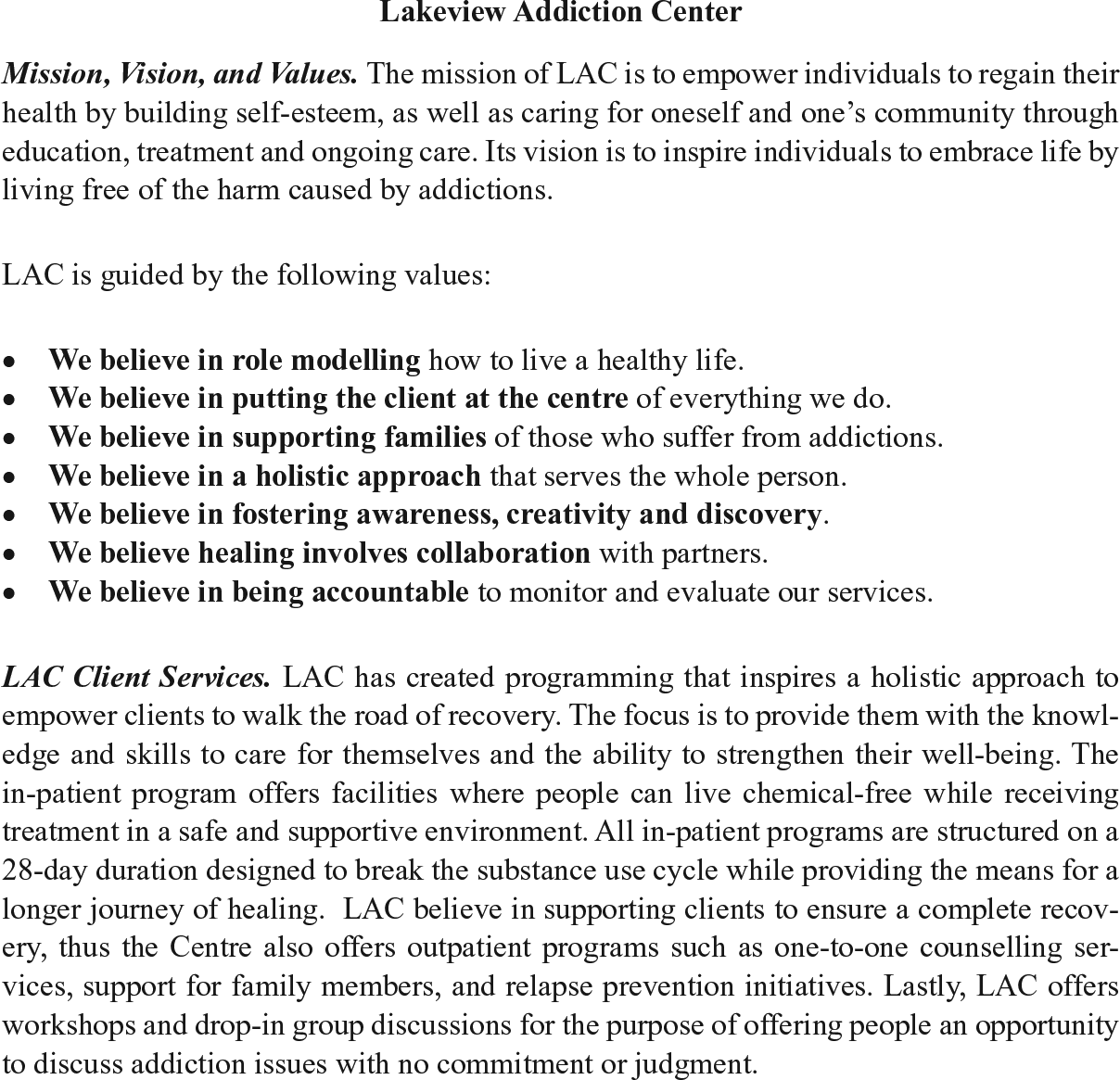
Lakeview Addiction Center’s mission, vision, and values statements.
The Current Situation
LAC suffers from chronic understaffing of social workers. They work extended hours and must often provide extra services like home visits at odd hours or on weekends. Each center recruits its own employees with little concern for the operations of the other center. Although programs in both centers meet the standards required by government agencies, there are many differences in how the programs are implemented, and there has been competition between the managers of each center. Both believe that they are implementing the organization’s values more effectively than the other. The Executive Director (ED) has been integral for ensuring balance by reminding the managers of the values and mission. Still, each manager is unwilling to share or collaborate with the other unless requested by the ED. The result is a culture of political tension that is currently being well managed by the ED. She has been exceptional in her role and has overcome many issues in the organization, including this tension between managers. Many believe that without this ED the organization will fail. In the external environment, the government recently rescinded funding from a similar organization because it lost thousands of dollars in a fraud scandal. The auditor’s report on the fraud accused the government of adopting a “hear no evil, see no evil” approach. In reaction, the government has made it clear to all government-funded organizations that there is low tolerance for poor management and governing practices and therefore a higher risk of funding retractions going forward.
Scenarios
We offer two scenario options depending on the instructor and participants’ comfort level with the topic(s). In each scenario, the outcome is not clear, there is no obvious winning solution, and the discussion process may be challenging. Instructors can use these scenarios as presented or adapt them to other topics. To arrive at a decision that is in the best interest of the organization and its constituents, the board must understand the impacts of possible decisions, and there are at least three consequential options for each scenario (Figure 2). 3 One important role for the instructor—particularly as the neutral chair that we describe later—is to highlight the implications of particular decision options and criteria as they are raised.

Decision options and considerations for each scenario.
The Characters
As noted above, we draw on principles from acting and theatre to create conditions where learners feel safe enough to participate in these high-fidelity scenarios. One key way to do this is by allowing participants to play a character, because they may feel at risk sharing their own personal opinions, beliefs, and values during the simulation. That said, the intensity of the topic combined with the limited exposure to the scenario and characters will induce participants to bring their own ideas and emotions to the roles. This is part of what enhances the extent of fidelity in each scenario and creates a highly realistic and authentic experience for learners.
We provide character descriptions for eight board members—a sufficiently-sized group to mimic a board meeting. However, the simulation is designed to be flexible enough that the instructor may elect to have fewer than eight or perhaps add additional characters of their own depending on the particular group of learners or the learning context (e.g., governance course, leadership training, ethical dilemmas). For each character, we offer information in five categories that explain their relationship to the topic, context from their personal history, and typical mannerisms (Figure 3). In keeping with our no-win scenario, the characters were created to be somewhat in opposition regarding stance, position, and personality. However, the characters are not meant to “script” participants and their interactions; the highlights provided are only a frame of reference for their position on the issue(s). Participants should have significant leeway in terms of how and the extent to which they adopt the position of the character, or enact his or her traits.

Characters in the Kobayashi Maru Meeting.
Implementing the Simulation
The simulation is ideally suited for six to eight participants in the role of board directors plus a neutral chair (typically the course instructor or session facilitator). Additional individuals can be engaged as audience members, who can observe the simulation and take part in the feedback/debrief discussions, but they should be encouraged not to speak during times that the simulation is “active” (i.e., while board members are playing out the simulation). The room should be set up with a boardroom-style table (pushing desks together works fine) and enough seats for the number of board members taking part in the active role-play portion of the simulation. In terms of preparation of materials, we recommend that the character descriptions are printed on separate pages or cards (one character per card).
First, the organization and scenario information should be distributed in printed form and/or narrated by the instructor to ensure that all participants understand the information. Next, the instructor can request the number of volunteers required for the number of board seats. As we discuss in the next section, students who do not feel comfortable with the topic or with role-play can opt to be audience members instead, assuming that the group is large enough to accommodate choice. The character cards can then be distributed randomly (we turned the cards face down and had volunteers pick from the pile without seeing the information on the cards), and the board members can proceed to their seats and review their character information. The participants should not be allowed to see each other’s character cards, but the organization and scenario information is common to everyone and may be shared or discussed as needed. This setup process takes about 10 to 15 minutes.
Once everyone has reviewed their characters, the simulation can begin by having the instructor briefly restate the issue at hand (e.g., “We have a motion on the table from our Executive Director requesting that we change our policy, and we must come to a decision today”). As the Kobayashi Maru Meeting plays out, we recommend adopting a “stop/start” approach whereby the simulation is active for a certain amount of time and then interrupted from time to time by the instructor to check in with participants and/or allow audience members to offer input. The timing is at the instructor’s discretion, and we have found it effective to “go with the flow” and respond to the direction or needs of each particular group. The stop/start approach is also effective for diffusing tension or reengaging participants, capitalizing on key learning moments, and monitoring participants’ experience in the simulation. Participants can be informed ahead of time that the instructor may interrupt for educational purposes, and we have found that this approach is very well accepted and does not disrupt participants’ engagement in the scenario, the characters, or the decision process overall (Willness & Bruni-Bossio, 2016).
Timelines
The simulation is ideally suited for approximately 1 to 3 hours, including introductions and explanation of the issues, although it could feasibly be adapted for a shorter or longer session as needed. The rationale for the time frame is that it is roughly consistent with that of a real board discussion and also ensures enough time to discuss the context and conduct risk analysis on possible options while still imposing a time constraint on the participants. We recommend that participants be informed of the time frames at the outset of the simulation to create a sense of urgency and to add to the fidelity of the experience.
Psychological Safety and Risk Mitigation
We acknowledge the unavoidable risk of the material being uncomfortable or sensitive to some individuals, and this is part of the psychological fidelity of the simulation—the decision contexts are not meant to be easy. As such, we offer several mechanisms for mitigating risk. Aside from adding interest and engagement, the primary motivation for the use of characters is to provide a buffer zone between the participants and the issues; that is, learners will understand that the stance and reactions of their colleagues are reflective of their role-play characters rather than personal positions. Moreover, in keeping with theatre training, participants should volunteer to play the role of board members and know that an “audience” role is also an option (see above). To make it easy for those who wish to step back quietly, the instructor can ask the participants in advance to choose between the two roles.
The Chair
As noted above, the setup will involve an impartial/nonvoting chair played by the course instructor. The instructor/chair will play the role without driving toward a particular outcome but with attention on the process. The chair should highlight the implications and considerations outlined in Figure 2, when certain decisions or options are being considered; that is, if these issues are not already raised by participants, the information can be introduced as a means of prompting a full discussion of the issues. If using the simulation for governance training, the neutral chair can demonstrate the governance process for students and steward their conduct (e.g., Robert’s Rules of Order or similar protocols) as this provides an excellent skill development opportunity and further enhances the physical fidelity of the simulation. If using the simulation for other topics such as leadership or management development, the chair role is still essential as a neutral moderator. The neutral chair can protect the learners’ experience, ensure that all points of view are considered, keep the discussion focused, and intervene as needed. The role is critical regardless of the focal topic, as it allows the instructor to interact with participants without disrupting the fidelity or realism of the simulation.
Concluding the Simulation and Participant Debrief
After the active simulation has played out, the instructor should facilitate a debriefing discussion so that participants (and audience members, if applicable) can discuss their observations and key takeaways. Suggested discussion questions are provided in Figure 4, which can also be used as a handout.
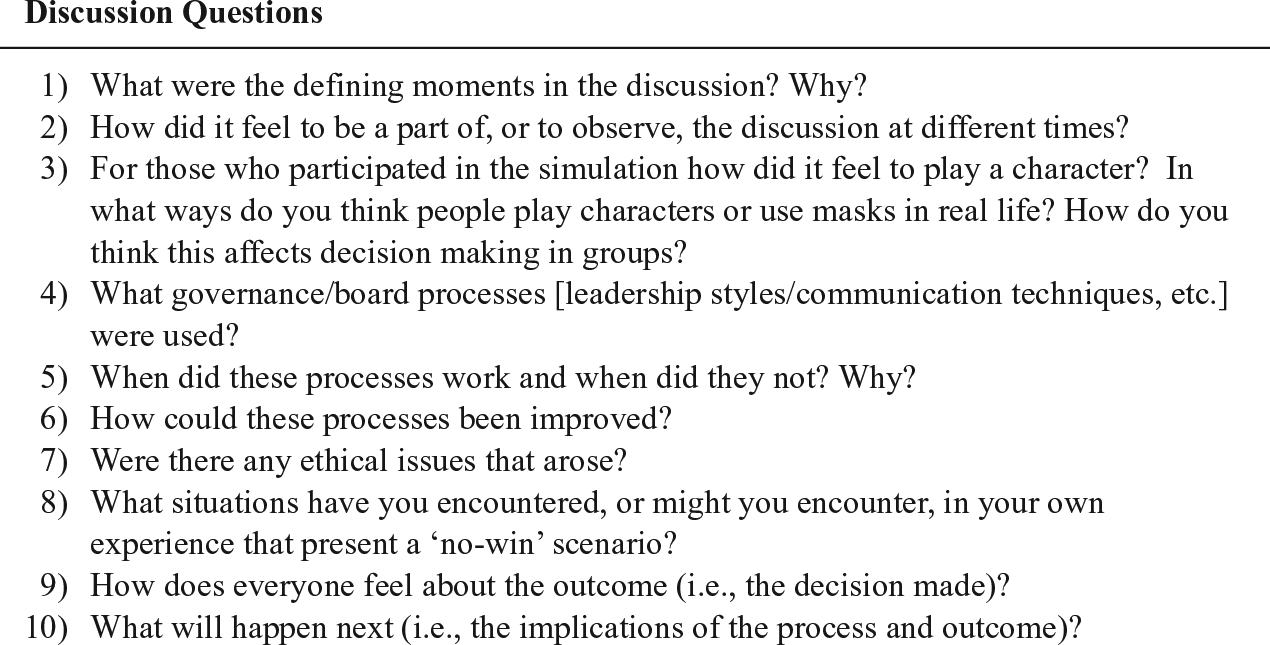
Discussion questions for debriefing the Kobayashi Maru Meeting.
Our Experiences in the Kobayashi Maru Meeting
In this section, we provide a brief account of our experiences with implementing the Kobayashi Maru Meeting with different groups. We describe some of our observations of learners’ behaviors and interactions, the effectiveness of the various roles, successes and challenges of the simulation, and some improvements we made along the way.
During the Simulation
We witnessed variance in how people approach participation. For instance, some use quotes (emphatically recited!) from the character cards, causing smiles as other participants recognize he or she is acting a character. More often than not, the character’s general stance is retained, but the participant approaches the issues and interactions as themselves. In the undergraduate governance course, the students exhibited sophistication by incorporating governance principles into the process (excellent for applied learning) yet still struggled to deal with their colleagues’ unpredictable, emotional, and contradictory responses. They indicated that they learned a lot about how emotions, values, and opinions can disrupt the decision-making process, even among trained groups. The MBA groups exhibited a willingness to play and to express contrary points of view. The characters were effective in protecting emotional responses, such that people confronted each other without it becoming personal.
Reactions to the Roles
The first time we ran this simulation, we had not developed the character cards—participants were themselves in the no-win scenario. Although this experience was transformative for the class, we felt that it was too risky to replicate without additional safeguards (we had not anticipated the level of emotional investment and engagement). This inspired the creation of characters, which we have used ever since. We feel that the characters have effectively fulfilled their purpose of providing a buffer zone and ensuring that key issues are brought forward without dampening participants’ engagement or reducing the frustrations, conflicts, and challenges of the no-win scenario.
The initial run of the simulation also inspired the creation of the audience role. In our experience with undergraduate groups, the audience consistently provided objective feedback on what they were witnessing and brought a fresh perspective. In the MBA groups, the audience noted the pitfalls in the board’s decision process—in fact, the observers became “audience as coach” by pointing out challenges and offering strategies that the board members could try. The audience drew on course content more than board members did, likely because their role allowed for greater detachment and objectivity (and was less emotional) and they advocated for board members to be more open to other people’s positions and to develop decision criteria. In both the undergraduate and the MBA groups, the audience took their role seriously and were engaged with the exercise, rather than simply being passive observers. We did note, however, that there were differences with the experience of board members versus audience members in terms of the perceived opportunity to actively practice their skills and knowledge. In particular, audience members may feel that they have less of a chance to use their communication skills and so on, given the nature of their role in the simulation.
Perhaps the greatest difficulty was experienced with the neutral chair role. We, as instructors, found it very difficult to play this role and not provide help or guidance—to simply let the students struggle and get frustrated or to let them carry out actions that we knew from experience would not get the results they wanted. The very neutral chair also frustrated the students because they wanted to lean on the instructor/chair but were forced to solve the problem(s) themselves. However, we believe that the frustration and discomfort was worthwhile as the students felt more accountable for their own process and outcomes, and it indirectly showed the importance of a chair—students recognized firsthand the need for leadership in such discussions, and this generalizes to any type of meeting (boards, management, teams, etc.).
Conclusion and Debrief
Typical strategies used by participants to try and solve the Kobayashi Maru Meeting include straw polls (rarely productive due to polarized positions, but this does offer a teachable moment regarding the drawbacks of using straw polls), examining the pros and cons of various actions (it often takes a long time to arrive here as participants are initially mired in their personal stances, but this approach helps the group progress), and eventually, under time pressure, calling a vote of some kind (rarely successful). We have yet to witness a group that arrives at a workable solution.
As such, students are always very eager to learn how the scenario could be “won.” Even after we close the simulation and transition into the debrief, they continue to discuss possible solutions as if the meeting was still in play. It is consistently evident that they become invested in discovering mechanisms that could be used to navigate a real no-win scenario, and many students cite examples from their own experiences where such situations have occurred (e.g., on boards, in work teams) and speculate on what types of approaches could be used.
Over time, we introduced an important improvement as a result of feedback from the debriefing process. We realized that students feel dissatisfied because of the no-win issue—even when they arrive at a vote, invariably some portion of the class is unhappy with the outcome. We therefore introduced the option for a Round 2, where students are given time (e.g., 30 minutes) to work off-line as a group to brainstorm ideas, do some research, discuss options, and then return to the room and then either “play it out” within the simulation or simply have a group discussion about how they would do things differently or navigate such a scenario in the future.
Instructor’s Role
We have implemented this simulation together each time (rather than one individual instructor). We feel that it would certainly be feasible to do individually, but we found that having two people was useful as one could be the neutral chair and one could be the “narrator.” Some level of storytelling ability is an asset, but the contextual information about the organization and scenarios (see Figures 1-3) could assist instructors to create a script if desired.
Evidence of Effectiveness
We assessed the effectiveness of the Kobayashi Maru Meeting using multisource, multimethod data collection. We examined qualitative accounts of students’ experiences in the simulation via personal reflection papers, and we administered a survey of perceived learning and overall reactions to another group of students who completed the simulation.
Student Reflections on Their Learning and Development
As we noted at the outset, this simulation was originally implemented in a senior undergraduate course in nonprofit governance. The students were all fourth-year undergraduate business students (N = 11) from varying academic majors including human resources, operations management, marketing, finance, and general management. After participating in the simulation as part of the course, the students completed a short personal reflection assignment that asked them four open-ended questions about (1) what effect the exercise had on them, (2) how the exercise helped them understand the decision-making context of a board, (3) their most important “takeaways” from the experience, and (4) whether/how the experience will affect their perspective with their board. The questions were intentionally general to allow the students to self-identify the most salient aspects of their experience and learning process. Although the learning objectives for the course overall were known to the students, we did not provide them with the specific learning objectives for the simulation in advance. In other words, the students were not primed to think about those particular learning objectives when they wrote about their experiences, nor did the assignment questions directly ask about the learning objectives.
Both authors examined the content of the assignments and coded individual statements (i.e., sentences or parts of sentences) if they were indicative of the learning objectives for the Kobayashi Maru Meeting. Table 1 displays whether the content of the students’ papers provided evidence that the learning objectives were achieved, as well as representative quotes. Because the sample size was small, we do not report demographic descriptors for individual participants to protect their confidentiality.
Student Reflections Pertaining to Learning Objectives.
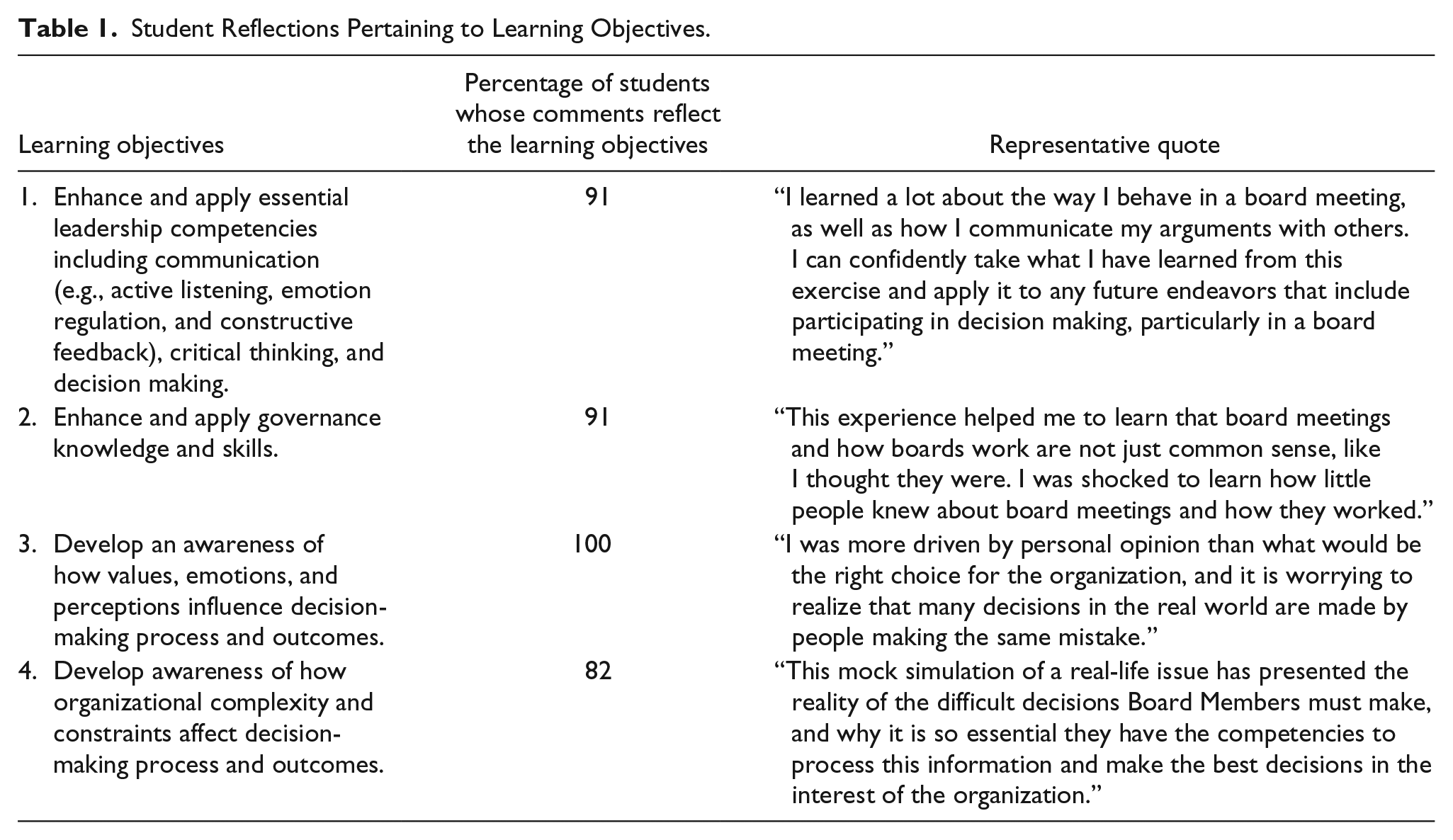
In sum, the students’ open-ended reflection papers provided convincing evidence that the desired learning objectives were achieved. Their reflections indicated that the simulation helped them understand other people’s emotional investment in a given issue and how this can manifest in reactions and behaviors. They learned how to engage in constructive communication even when ideologies and opinions differed, and they demonstrated an understanding of how boards face high stakes and potentially contentious decisions. There was ample evidence that the simulation enhanced students’ decision-making skills.
Beyond formal learning objectives, we noticed two additional themes in our examination of the students’ papers that support the overall effectiveness of the Kobayashi Maru Meeting. First, students made unprompted statements indicating their general enjoyment of the experience and the extent to which they liked taking part. Examples include “The simulation board meeting was unlike anything I have ever done in class before. I especially enjoy applied types of learning when you get to use your skills,” and “I can truly say that it was one of the most fun, intense, and memorable activities I have done throughout my four years in university. Everything about the mock Board Meeting was exceptional”. The second theme relates to the level of engagement and realism of the simulation, which also speaks to whether we were able to create the high-fidelity experiential learning environment that we hoped to provide. Students wrote, “I have never been as emotionally involved in class like I was in this seminar,” “This experience will prepare me for all future meetings and encounters regardless of board or organization,” and “I found it easy to get into the character of a board member and treat the exercise as if it was a real situation.”
Student Reactions and Perceived Learning
Our second sample comprised students in an MBA course (N = 43) who also completed the simulation as part of their curriculum—this time in a strategy course of which governance was one small component (further illustrating that it can be used in a variety of learning contexts). After they completed the simulation, we administered a brief survey that asked six questions directly relevant to the learning objectives and four general items about their reactions to the experience. The items were rated using a 5-point scale from 1 (strongly disagree) to 5 (strongly agree). Like the undergraduate students in Sample 1, the MBA students were not informed of the specific learning objectives in advance of their participation. The feedback survey was voluntary and confidential, and no identifying information was collected so that the students felt more comfortable answering honestly. A total of 31 students completed the survey for a response rate of 72%, after removing participants with missing data and those who either had to leave the class early or chose not to complete the survey. Table 2 displays the survey items with the associated means and standard deviations.
Student Reactions and Perceived Learning.

Note. N = 31. Items were rated on a scale of 1 (strongly disagree) to 5 (strongly agree).
In sum, the results show that all learning objectives achieved a score of greater than 4.0, indicating that, on average, students either agreed or strongly agreed with each item. The general items were also rated above 4.0, addressing the extent to which students enjoyed the simulation, felt they learned something valuable from the experience, thought the use of characters was effective, and would recommend that the simulation be used in the future.
Discussion
Competencies involved in leadership, management, and governance can be effectively developed through active and experiential learning. We drew upon theory and literature in training and development, as well as core principles of acting and theatre, to create a board meeting simulation with high realism and engagement that can assist with this process. Our Kobayashi Maru Meeting places participants in a challenging scenario with no “correct” resolution and illustrates the tension between individual, organizational, and societal values that can arise in governance contexts. The exercise requires that participants apply multiple skills such as communication, active listening, emotion regulation, and critical thinking to navigate the decision-making process. These essential skills make the Kobayashi Maru Meeting well suited not only for board governance but also for other training contexts such as leadership, management, and ethical dilemmas more broadly.
We collected qualitative and quantitative data from different sources to evaluate the effectiveness of the Kobayashi Maru Meeting in achieving its learning objectives and engaging learners. Results suggest that the simulation achieved the desired outcomes. Nonetheless, it would be valuable to test the effectiveness of the simulation with different groups and in different contexts. For instance, future research might examine whether the learner’s experience differs by demographic factors (e.g., gender, culture, past work experience) or by simulation role (board or audience). Combining responses from board members and audience members in our dataset provided a “hard test” of achievement of the learning objectives for all students, but it would be valuable to further explore possible differences in impact.
Although we “set the stage” for the Kobayashi Maru Meeting in the context of board governance, the core concept of a no-win scenario is certainly not limited to governance. The simulation—and the principles it teaches—can be applied to situations where individuals must solve complex problems in group settings, particularly where tensions between individual, organizational, and/or societal values are concerned. We encourage a discussion with students about situations they have experienced, or can relate to, and we provided a sample debriefing question that can be used to start that conversation. At the undergraduate level, there may be no-win scenarios that arise in the process of completing group projects for a class, or with a team at work. Beyond the debriefing questions, the instructor may choose to focus the simulation on such a scenario in order to highlight ethical and values-related situations that are self-relevant for students. We have been careful to create archetypal characters that can be adapted to any context to allow flexibility for instructors who seek to apply this simulation to other real-life settings.
The Kobayashi Maru Meeting can also be adapted for leadership and management training. For example, the simulation can apply to leadership roles by transferring the decision in Scenario 1 to management level. In Scenario 2, the decision could be adapted to apply to a leader of one of the centers instead of the ED. In this case, the ED and other managers would decide the fate of the divisional leader. Last, both scenarios could be used in an ethics or decision-making class by having a group debate on the most ethical decision in each scenario.
The essence of this exercise is best understood by reflecting on its original intent in the Star Trek series. Managing the complex emotions, reactions, and interactions that manifest in leadership and governance is difficult enough to learn in the field and almost impossible to teach in the classroom. We see value in the challenge given to Captain Kirk and have incorporated this intent in our simulation as well. Our experience has shown that the exercise is effective and engaging—but not necessarily comfortable. One student remarked that that the hardest part of this scenario was the “no-win” aspect. She said, “We are usually taught how to win.” This, of course, is at the heart of the Kobayashi Maru Meeting.
Footnotes
Declaration of Conflicting Interests
The author(s) declared no potential conflicts of interest with respect to the research, authorship, and/or publication of this article.
Funding
The author(s) received no financial support for the research, authorship, and/or publication of this article.