




Abstract
This experiential exercise enables undergraduate students to demonstrate their ability to rapidly and intentionally integrate marketing and finance concepts in a real-world context. The participants must analyze a business proposition, determine how to address identified customer needs, develop effective strategies to maximize financial returns, and document and present their proposed consumer offering in a way that secures lucrative financing for their start-up firm. With limited instruction, learners engage in simultaneous challenges including conducting consumer research, design innovation, rational decision making, team-building, and managing for optimal results. The experience is further solidified through evaluative feedback provided at exercise conclusion.
Keywords
Introduction
Experiential classroom pedagogy allows learners to gain experience in making real-world decisions under controlled circumstances that incorporate uncertainty. It can also aid in breaking down the conceptual “silos” students have, because of receiving management subject instruction without having to iteratively apply that knowledge in actual turbulent business environments (Senge, Scharmer, Jaworski, & Flower, 2005). Across sectors, employers have indicated they need employees who can rapidly “pivot,” collaborate effectively with others in the workplace, and contribute in meaningful ways to sound institutional decisions.
Engagement in these types of synthesis experiences is particularly important for students interested in entrepreneurship as they may not otherwise have a chance to understand there are no “right answers” when an entity begins to operate. Bain (2004) notes that “even when learners have acquired some conceptual understanding of the discipline or field, they are often unable to link that knowledge to real-word situations or problem-solving contexts” (p. 24). Entrepreneurial experiential exercises can allow for the practical consideration of how to effectively reframe an idea, negotiate and resolve conflict, work effectively or ineffectively with teams, engage in creative decision making under conditions of stress, and understand their own or others’ entrepreneurial mindsets (Kane & Goldgehn, 2011).
Drawing from a real-world experience, the Basket Pitch 90 exercise can be completed in a relatively short period of time (90-105 minutes), while it concurrently provides material that can be drawn upon and integrated throughout subsequent accounting, marketing, operations, and business plan development classes within either a high school or undergraduate context. As a member of a team, students are given 60 minutes to identify the costs and value proposition associated with producing high-end corporate gift baskets. They must concurrently develop a start-up budget, identify how they will use potential initial investment funds as well as effectively develop an oral and graphic representation of their concept for potential selection. At the end of the allotted time, the teams make a 90-second oral presentation (with an appropriate visual aid) to an evaluation panel with the intent of being awarded the performance contract. The learning goals for this exercise include demonstrating information synthesis, oral communication, decision making under stress, creativity and innovation, and the application of business concepts under entrepreneurial circumstances common to many new, product-based enterprises.
Experiential Learning
The Basket Pitch 90 exercise intentionally takes an experiential learning approach to the integration of marketing and finance concepts. Experiential learning flows from home-based instruction and craft apprenticeship; its earliest roots can be traced to Aristotelian Greece.
Experiential learning leverages constructivism and assumes “knowledge cannot simply be given to students: students must construct their own meanings” (Stage, Muller, Kinzie, & Simmons, 1998, p. 35). Constructivism arises from the research of a variety of theorists including Piaget, Bruner, van Glaserfeld, and Vygotsky (Weimer, 2013) and regularly forms the basis of learner-centered approaches to instruction, since it encourages individuals to connect new information to what they currently know in ways that are personally, cognitively, affectively, and behaviorally meaningful. Kolb (1984) noted that, to gain genuine knowledge rather than simply participate in instructional experiences, learners needed to be actively involved, able to reflect on what occurred, possess and use analytical skills to conceptualize what happened, and engage their decision-making and problem-solving skills to use the new ideas gained (Merriam, Caffarella, & Baumgartner, 2007). This latter factor is a crucial element of the Basket Pitch 90 exercise since it allows for a direct transfer of information after students have grappled with instructional materials and, subsequently, have a better sense of what they already know as well as what they might need to learn. Weimer (2013) points out that there are specific benefits associated with instructors waiting to provide resolution instruction: Once students realize they need to know something, “they listen attentively for the answers” (p. 23).
This “positioning” of information transfer falls in line with the experiential practice of shaping instruction to the way that learners think. When students, particularly those examining business subjects, believe they have arrived at a decision, challenging that conclusion should be the next step in the process. Understanding that business is an art, not a science, means that, as in the real world, teachers should be questioning and designing activities that require learners to explain and defend their propositions. Only then can students begin to understand that there may be quality variations among business solutions, depending on the situational context. Given a tendency to reach for more obvious solutions, this type of challenge process provides business students with some of the supports needed to complete a deeper analysis as to appropriate next steps for a budding enterprise.
Bain (2004) indicates that “deep” as opposed to “surface” learning only occurs (a) when subjects face situations where their previous mental pictures do not work, (b) where they subsequently care enough to grapple with the issue at hand, and (c) where they are able to handle the emotional trauma that may accompany challenges to ideas they previously held. Experiential exercises, such as the Basket Pitch 90 exercise, have the power to address all three of these issues in a relatively rapid period and in an environment where the consequences of failure are relatively minor in comparison to those that would be faced in an actual business setting.
Exercise Overview
The Basket Pitch 90 exercise is relatively simple. Neither the instructor nor the students need to do much by way of preparation other than have either a photo of an executive gift basket or a physical prototype for students to reference along with the exercise instructions. While having a photo or prototype “prop” available appears to allow the exercise to be completed within a 60-minute period, instructors can also experiment with simply using the words “corporate gift basket” and encouraging students to conduct an internet search to discover examples of the same. Whether or not a scaffolding prop is displayed, students are asked to make use of available technology in the form of their personal smartphones or tablets to research the prices of the various items they plan to include as part of their product offering.
Faculty can approach the Basket Pitch 90 exercise in either a formative or summative manner. Instructors can have students engage in the experiential activity after discussing general market research and implementation strategies but before they receive extensive financial instruction. The exercise can also be used to evaluate how skilled learners are at integrating various marketing and finance concepts either before or after having received formal instruction in both contextual areas. Thus, this lesson can be used both as an instructional as well as assessment tool.
The Basket Pitch 90 exercise arose from what Bain (2004) refers to as “metacognition”—the instructor’s understanding that there was a need to translate intuitive business experience in a way that allowed teenagers and emerging adults to more easily grasp the level of integrative creativity routinely required of effective entrepreneurs. The author developed the exercise after searching for experientials, appropriate for business students, that concurrently targeted marketing and finance knowledge integration. Over time, the exercise has evolved to inherently provide the instruction and physical experience needed to permit participants to manage the pressures associated with the routine assimilation of finance and market research in an environment of uncertainty, where decision-based information is always relatively incomplete. From instruction, it became clear that business learners were having difficulty developing their own comprehension about how these concurrently abstract but concrete issues intersected.
Learning Objectives
The Basket Pitch 90 exercise allows learners to begin to gain a more nuanced appreciation for the activities required to get a business started including identifying the benefits sought by the target market, selecting products and associated low-cost suppliers, and determining effective marketing and pricing strategies to use in a competitive environment. This type of learning also embodies the comprehension, analysis, and synthesis levels of Bloom’s (1956) taxonomy. The two primary learning objectives of the exercise are the following:
Engaging in the Basket Pitch 90 exercise encourages students to define and enact the relevant work aspects of a business start-up. For example, a marketing student team member might be asked to identify the best gift basket features that would appeal to both male and female bank clients and to identify potential product suppliers. Concurrently, a more finance or accounting-oriented student team member might be asked to tally up the associated product costs of goods and determine an appropriate per unit and aggregate proposal retail selling price.
In general, students are aware they need to integrate marketing and financial information to have a successful entrepreneurial start-up. However, the Basket Pitch 90 exercise supports their motivation in doing so by exploiting their desire to successfully perform in front of each other and one or two external evaluators and to concurrently do so in a manner that exceeds that of other competing teams. In this case, competition is evoked as a means to support an integrative consideration of the two contextual areas.
Two secondary learning objectives may also be achieved using this exercise.
Putting an effective proposal together in a short period of time requires teamwork. Given the magnitude of the request (identify the wholesale and retail price points, develop a start-up budget, and identify how a $100,000 initial seed investment will be used), a successful presentation cannot be created without integration of everyone’s work. Students must come together to review their proposals and practice their short pitches, and leadership must emerge on the part of each individual if the task is to be completed within the allotted time. The outcomes of planning, organizing, managing, and leading activities are on display during the final presentation and question and answer period. In addition to discussing the marketing and financial aspects of the exercise, a comprehensive debrief of the activity should include questions about effective leadership and work management behaviors.
Given that business schools’ overall curriculum includes communication skills as one of the key learning outcomes, most students of entrepreneurship have some experience with group and individual oral presentations. This usually takes the form of an informational report. However, this experiential exercise asks students to take a promotional approach to problem solving by requiring a presentation in front of an evaluative audience, while concurrently incorporating a learning design that allows for an examination of the quality of their research in a compressed time-period and without extensive rehearsal. Teams’ communication and flexibility capacities are not only on display vis-à-vis their visual aid and brief presentation but also their ability to successfully handle these tasks under time constraints as is frequently required of actual entrepreneurs is also demonstrated.
The Exercise
In this section, the exercise is positioned, its preparation detailed, and its in-class execution and assessment discussed.
Target Learners
This simulation has primarily been used as an informal, formative assessment instrument within a required entrepreneurship-focused capstone course taken by final semester undergraduates from all business disciplines. Within the institution where the exercise has been used, the capstone class is designed to provide an overall integrative experience, where graduating seniors are expected to demonstrate mastery of business administration program outcomes related to self and team leadership, oral communications, marketing, finance, operations, and associated business-related concepts. The simulation allows for students to illustrate some range of these skills.
The Basket Pitch 90 exercise is very appropriate for this level of undergraduate business students. The rationale is that these learners have previously been exposed to marketing, accounting, economic, finance, and management concepts and the exercise provides a format for considering how to draw on previously learned factors from many of these content areas. However, the exercise has also been used with high school students enrolled in summer entrepreneurship training, where no previous formal entrepreneurial education had been supplied. It appears various student age groups can effectively engage in the type of integrative thinking called for in the exercise, if they are provided with appropriate scaffolding and encouragement.
Optimal Course Positioning
The Basket Pitch 90 exercise is deliberately designed as a single 90- to 105-minute session simulation, although it can easily be carried out in a longer two-class session format, where the instructions are provided, and research is conducted in one class, while team presentations and exercise debriefing occurs in another. Students appear to be able to complete the exercise in the time given, no matter whether only 1 hour is allowed for preparation or a longer period is provided.
The exercise has primarily been used about 45 days into the semester of an entrepreneurship-focused capstone course, where it has surfaced areas of knowledge weakness for review and continued emphasis. It has also served as a summative mid-course culminating simulation after discussions about entrepreneurial marketing and financial content have concluded. The exercise is not intended to dominate a course but rather to be used to parallel topics and teaching methods an instructor may traditionally consider. Instructors are encouraged to experiment with the exercise without substantially revising their syllabi.
Introduction of the Exercise
Since the Basket Pitch 90 exercise requires the use of teams, instructors want to leverage any previously formed student teams embedded within their course. The exercise should be introduced with very little explanation other than an overhead comprised of four slides that detail the scenario and the required deliverables. A sample slide deck is provided in the appendix.
Any questions should be answered and then the instructor should declare that the exercise has begun. The instructor should not intervene during the exercise but should take notes to remind participants of critical incidents that occurred during the presentation preparation phase. While it may be somewhat chaotic at the beginning, the teams usually quickly self-organize to get the work completed in a timely manner.
Running the Exercise (Instructor Explaining Purpose to Students)
In addition to the speaking to the issues raised on the four slides, the instructor may want to emphasize that the simulation will enhance students’ awareness of how they are applying various entrepreneurial skills within an ambiguous but realistic start-up setting. Instructors can also indicate that the exercise should allow learners to see how entrepreneurial teams make decisions, innovate and move forward once a strategic initiative is seized upon and accepted by the group.
Procedures
As a team, students should be advised they will have 45 to 60 minutes to develop a proposal that responds to the requirements set forth by the bank’s (instructors should insert the name of a local, recognizable financial institution) Executive Assistant. Their 90-second pitch is to be designed to address the issues raised in the proposal including a post-award action plan and to do so in a manner that assures that their team is awarded the performance contract.
Situation as Presented to Learners
You and your partners have been making 10 to 20 corporate gift baskets per month for about 18 months. Through a family connection, your baskets have caught the eye of the Executive Assistant to the President of Bank! Your company has now been asked to submit a proposal, including anticipated start-up costs, for your team to ship 200 gift baskets per month to various Bank corporate clients. With this major order as your base, you and your team may be able to quit your day jobs and concentrate on this business full-time!
The assistant needs to present your proposal to the president in 45 to 60 minutes. She needs to understand what your prices and associated costs of goods sold will be for a regular monthly order of 200 gift baskets, comprised of similar high-quality ingredients to those you have previously provided. She has said that, after reviewing your proposal and understanding how you are budgeting for your start-up costs, the bank may be willing to provide you with access to a line of credit for up to $100,000 at 5% interest to allow you to regularly produce the 200 baskets. But your 90-second proposal pitch must be convincing enough to persuade both the president as well as the assistant that you and your team have the capacity to make this project work.
The Pitch
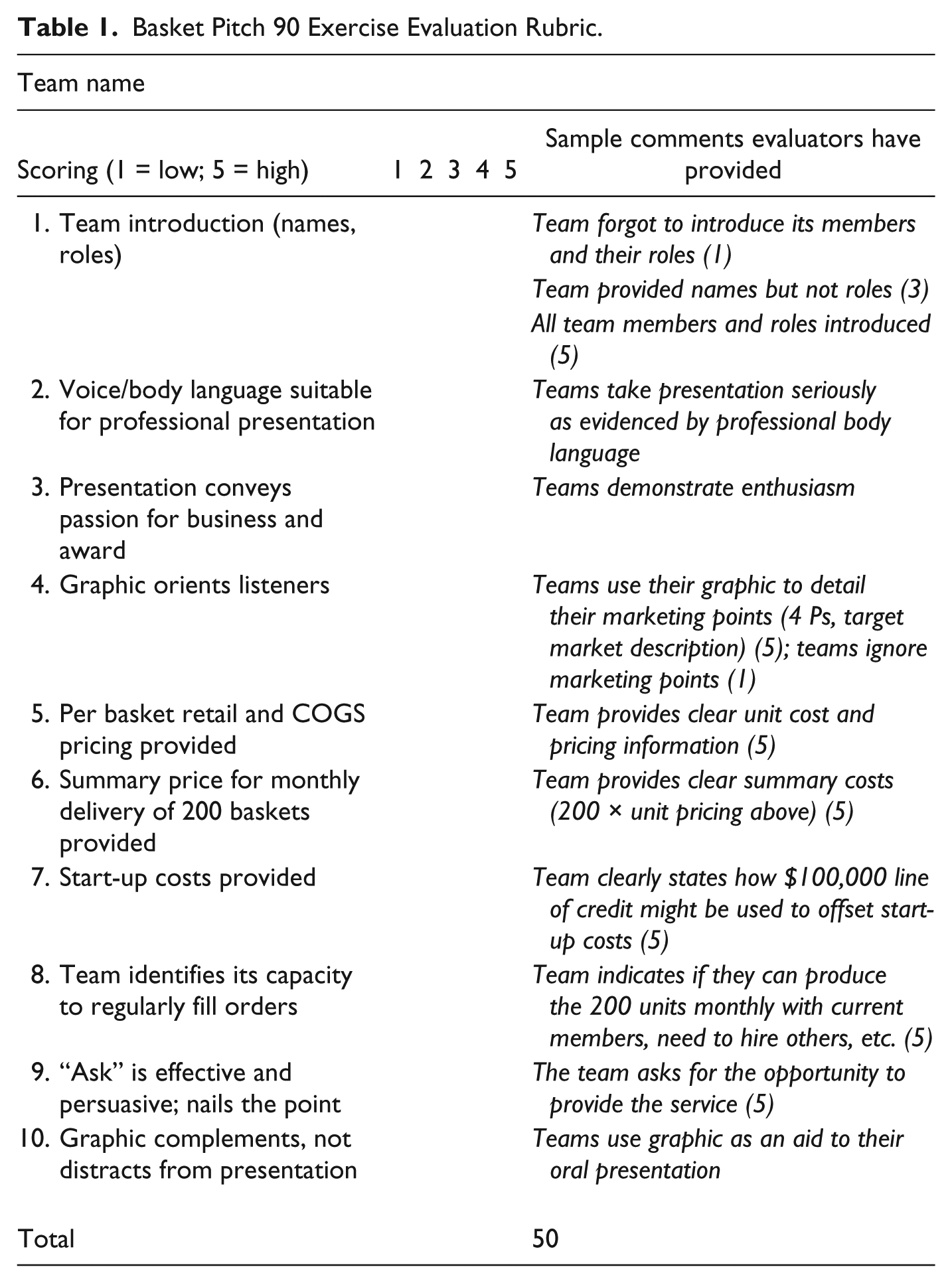
At the end of the allotted time, the instructor along with a pre-selected colleague should sit and evaluate the 90-second pitches; a sample evaluative rubric is provided (see Table 1). The evaluation team can ask questions and realistically act in the role of the bank. Once all the presentations have been made, the evaluators can begin a debriefing session; the presentation scoring results can be provided along with feedback in a subsequent class.
Basket Pitch 90 Exercise Evaluation Rubric.
Instructor Step-by-Step Procedures
The instructor should present four overhead slides to the class and assure that everyone understands the assignment (see the appendix).
The instructor should distribute a paper copy of the instructions and evaluative rubric for reference.
The instructor should ask teams to begin work. The instructor can walk the room taking notes on the various planning conversations.
After approximately 45 minutes, the instructor should give a 15-minute warning advising students they will be presenting their 90-second pitches shortly. At the end of the 60-minute preparation period, the instructor and cohort should call time and ask the student teams to make their 90-second pitches. If the exercise is being conducted over two sessions, students should be dismissed at the end of the 60-minute preparation period and asked to return to the next class with their 90-second pitches.
Whenever the presentations are made, the instructor and cohort should evaluate each team’s presentation and ask questions of clarification as necessary. Teams’ as well as individuals’ performance on each of the evaluation rubric features should be noted along with appropriate written comments. If the team pitches are presented in a subsequent class session, instructors should expect the oral presentation arguments and visual aid to be more developed, given the additional preparation time available. As a result, evaluators may want to set a higher standard for what might constitute a more complete response to the rubric segments.
On the conclusion of the class presentations, the instructor and cohort (if available) can provide overall simulation comments and indicate which team was “selected” to receive the commission. While a general rationale for the selection should be announced, given that this exercise is being used for assessment purposes, typically, group rankings may or may not be provided and detailed “scores” are not shared. However, if the instructor believes it may enhance subsequent instruction, teams can be provided with an overall or specific set of aggregate rubric scores and comments.
The Debrief
There are a multitude of ways to conduct the debriefing session to assure that the type of critical thinking about the various simulation elements comes to the fore. The following segment describes one way of handling the myriad of issues that can be addressed through this conversation.
Students should be asked to sit with their teams for the debrief session with sufficient copies of the Basket Pitch 90 evaluation rubric in front of them. The teams should be encouraged to do an initial self-evaluation, comparing their visual aid documentation and thinking to the key evaluative issues listed on the rubric. Teams should then be asked to provide a team debrief response, with an eye toward having multiple teams providing their analysis of their team’s answers to each of the evaluation rubric’s segments.
The instructor should serve in the role of facilitator, leading students through an intentional discussion of each of the 10 evaluation items. Initially, the instructor should allow the dialogue to flow without intervention and listen for key instructional elements to come to the surface. If students appear to not be critically evaluating the simulation and/or the role they took during the simulation, the instructor can intervene with specific questions and detailed observations, using the format outlined on Table 2.
Debriefing Notes—Instructors May Select Which Discussion Topics Are Most Appropriate for Their Courses.
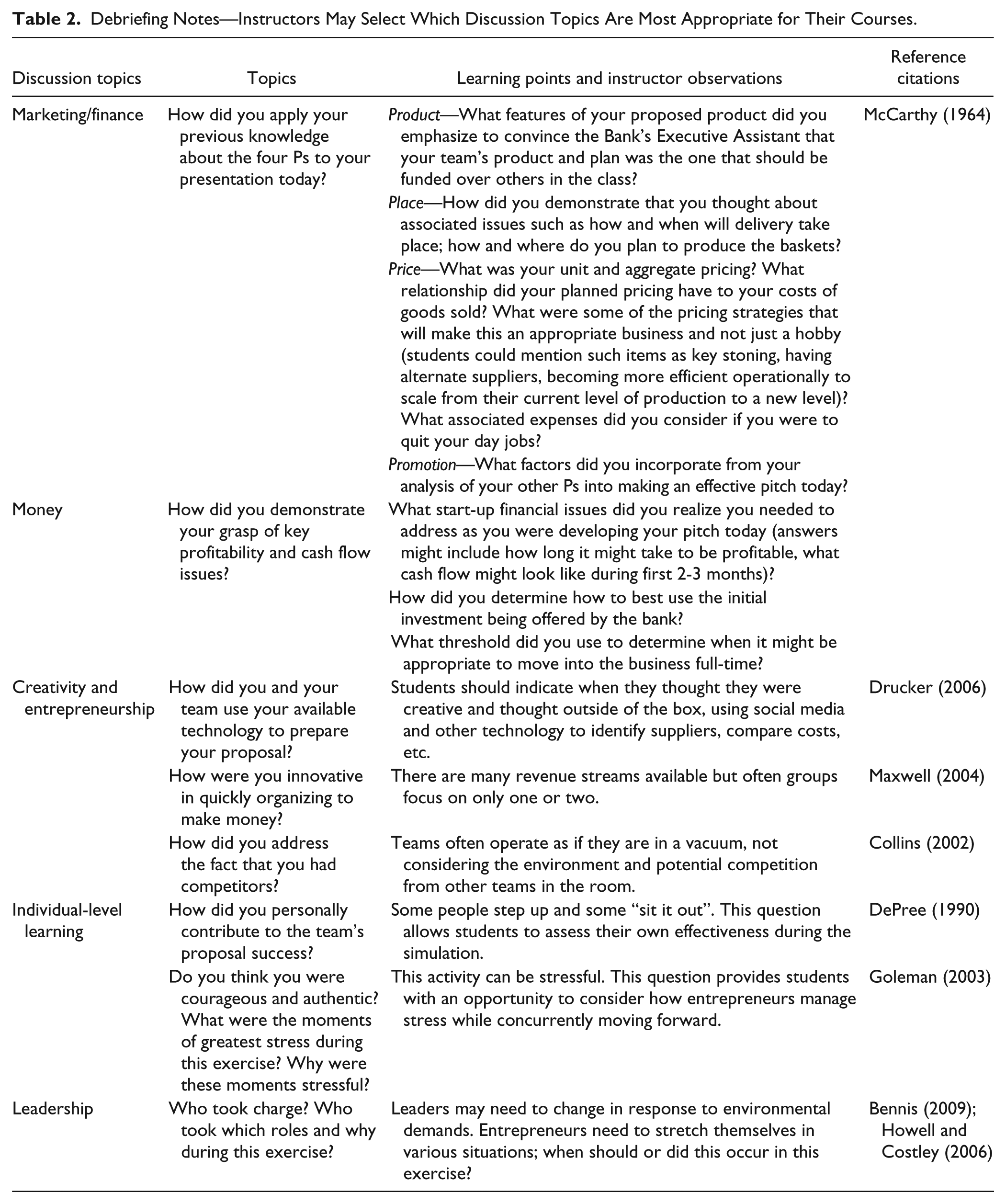
There are many critical elements that can be evaluated and discussed during the debrief session. First, teams can be asked to determine if there were any key milestones and turning points that occurred during the exercise, particularly as they identified product item costs, developed their unit and aggregate pricing, figured out their start-up costs, and decided how they might use the bank loan in their early months of production. Identifying this transition might be particularly helpful if individuals, with instructor assistance, can recall what occurred at the beginning of the simulation as the groups moved from chaos into effectively functioning teams. If the exercise is conducted over two class sessions, students can be asked to discuss how they used the intervening period to augment their in-class work and how they might similarly leverage out-of-class time for on-going team course assignments.
Next, students can be requested to reflectively document identified milestones and related issues from the exercise, with the intent of incorporating them into a written description of the strengths and weaknesses of their team. The team essays can be submitted for subsequent review.
Instructors can suggest that these narratives be incorporated into the team description and risk analysis segments of students’ business plans, if the same are required course deliverables. Instructors can also review the team essays and use them as a basis for augmenting their planned discussion of key marketing and finance issues subsequently reviewed during the remainder of the course. Use of students’ self-analysis helps make subsequent instructional references more pertinent, because learners can recall the simulation, continue to reflect on ways they could have enhanced their previous performance, and apply new or reviewed marketing and finance-related concepts to the development of their emerging business plans, if business plans or feasibility studies are one of the course deliverables.
Evaluative Findings Related to Assessment of Learning
The Basket Pitch 90 exercise has been carried out over 30 times with traditional undergraduate business students as part of a capstone course, where a business plan was one of the class’s outcome deliverables. It has also been used as an illustrative exercise embedded within three summer university business classes comprised of high school students. In all cases, it was implemented in a 60-minute performance segment, followed by a 30- to 45-minute debrief session. For the university courses, formal oral presentation feedback was provided in a subsequent instructional session.
Even though each run of the simulation has occurred within a unique context, the following critical participant omissions have typically occurred. As it relates to marketing, university student teams frequently forget to identify the key consumer benefits that are related to their product offering. They are also often confused about who the customer is. In this case, it is the bank, which is not the same as the consumer, who is the recipient of the corporate gift basket. Thus, undergraduate student teams tend to focus on product design elements that potential gift basket consumers might enjoy, as opposed to the corporate branding that is of greater interest to the bank. This provides an excellent opportunity for the instructor to discuss the different foci of target market customers versus consumers and the necessity for both defining the “pain” their product addresses in each client category as well as identifying appropriate marketing strategies that must be employed to address the needs of both sets of clients.
As it relates to the range of financial issues, undergraduate business students tended to incorporate balance sheet language into their presentations and often did not appear to understand that, as a start-up, they needed to focus on profitability and cash flow issues, not balance sheet ones. This misunderstanding appears to arise because traditional undergraduate accounting classes emphasize the financial flow from the balance sheet to the profit and loss statement to the statement of free cash flows. As a result, many undergraduate business students fail to recognize, given limited real-world experience, that start-ups have no balance sheet since they have no historical data on which to base one! Rather, through post-exercise discussion, participants learn that entrepreneurs must deal with profit- and loss-related issues and cash flow to stay alive long enough to be able to develop a prior year’s balance sheet.
Repeated conduct of this simulation reveals that high school students actually do better as it relates to responding to the associated exercise’s financial aspects than their undergraduate counterparts. This appears to be because high school students usually have not had much formal accounting exposure; as a result, they tend to treat the entrepreneurial challenge as a simple purchasing problem—buy for the lowest costs of goods sold and sell for the highest retail price possible.
However, there are some evaluative limitations that are common to both traditional undergraduates and high school student groups. Both often fail to fully consider how they will personally survive financially until they reach their anticipated break-even points—basically, neither group tends to give much detailed thought as to how they will use any start-up funds the bank might provide. Furthermore, both groups of learners tend to concentrate on selling their products as cheaply as possible without understanding that the bank, as a customer, may not be as price sensitive as they imagine. Since this is often the first time they have had to practically consider issues associated with price sensitivity, a further discussion of the same yields interesting results.
Exercise Modifications
Despite repeated use, the Basket Pitch 90 exercise itself intentionally has not been modified: Learners appear to easily understand and follow the directions and the results indicate the simulation is meeting its designed purposes of surfacing elements of students’ knowledge weaknesses as well as rekindling learners’ interest in addressing the same. Evaluative rubric feedback has become increasingly more sophisticated, considering common marketing or financial omissions found each time the exercise is completed. This information is reflected in the learning points and instructor observation questions now embedded in the rubric.
Conclusion
The Basket Pitch 90 exercise provides students with a quick opportunity to experience some of real angst involved in operational start-ups. Students typically develop creative responses to the challenge involved in getting a product business going. They have a chance to discover how they collectively and individually react to entrepreneurial situations that involve ambiguity. The simulation also provides students with a rationale for further integrative marketing and financial conversations since they can better understand what they and their peers still do not know about entrepreneurship in a competitive, yet collaborative learning environment. As such, it can serve as a foundation for participants to honestly consider what they currently understand about entrepreneurship and relate many of the subsequent course concepts to the simulation and the real world. Depending on the individual, the exercise can assist with sorting through some of the complexities associated with business start-ups and develop an enhanced self-concept about its application to their lives. Finally, experiencing the simulation can allow students to better connect entrepreneurial theory and real-world experiences on a cognitive, behavioral, and affective basis.
Footnotes
Appendix
Acknowledgements
The author would like to acknowledge the students who assisted in refining this experiential exercise over the last 5 years as well as three anonymous reviewers whose comments served to enhance this article.
Declaration of Conflicting Interests
The author declared no potential conflicts of interest with respect to the research, authorship, and/or publication of this article.
Funding
The author received no financial support for the research, authorship, and/or publication of this article.
