



Abstract
Business schools face a dilemma of promoting prosocial values while maintaining the principles of self-interest and profit maximization. In response to recent research suggesting that emotions may be the key to ethical decision making, we ask two basic questions: Do emotions make business students more ethical? Is business school education inhibiting ethical decision making? Drawing on theories on moral emotions and ethical decision making, we hypothesize that moral emotions will enhance ethical decision making, whereas hedonic emotions will diminish ethical decision making. Furthermore, we predict that a higher level of business school education will strengthen the negative relationship between hedonic emotions and ethical decision making while weakening the positive relationship between moral emotions and ethical decision making. Using a scenario-based repeated-measure design, we tested our hypotheses with 217 students from secondary schools, undergraduate business majors, and MBA programs in Hong Kong. Multilevel modeling results supported our hypotheses, suggesting that business school students may benefit from education on the unique roles of moral and hedonic emotions in the ethical decision-making process. We conclude with a summary of the theoretical and practical implications of our findings.
Responding to the growing public attention to social responsibility, business schools have incorporated business ethics and corporate social responsibility (CSR) into their curricula (e.g., Jamali & Abdallah, 2015; Moosmayer, 2012; Rasche, Gilbert, & Schedel, 2013). The increased pressure to obtain and maintain “sustainability legitimacy” (Snelson-Powell, Grosvold, & Millington, 2016) has placed an added challenge on business schools as they attempt to emphasize two seemingly competing values: profit and social responsibility. This is a challenge for business schools, especially since much of business education has historically focused on economic principles, stressing maximization of self-interest, profit, and shareholder interest (Walker, 1992).
An initial response to this challenge has been implementing courses such as “Business Ethics” and “Corporate Social Responsibility” in the curricula or adding similarly titled chapters to existing textbooks (e.g., Robbins, Coulter, Martocchio, & Long, 2018). However, current business ethics training focuses on ethical reasoning. These courses train students on how to best recognize, analyze, and address ethical issues while optimizing stakeholder interests. In a sense, business ethics has been integrated into business education’s larger underlying theme of business principles.
Research has shown that such overreliance on business principles may produce an adverse effect on students’ ethical decision making. Accumulated evidence continues to reveal that exposure to economics or business principles, which emphasizes how to maximize self-interest or profit, orients individuals toward being more selfish and less prosocial (Kasser, Cohn, Kanner, & Ryan, 2007; Kay, Wheeler, Bargh, & Ross, 2004; Liberman, Samuels, & Ross, 2004). It has also been argued that management education that emphasizes economic gain and power may engender misinformed students’ engaging in unethical judgments or behaviors (Giacalone & Promislo, 2019). Exacerbating the challenge is the fact that business schools tend to attract and select individuals who value high achievement (Arieli, Sagiv, & Cohen-Shalem, 2016). Given that business schools generally aspire to educate current and future leaders and managers, training business students to make ethical judgments when faced with ethical dilemmas continues to be a significant concern.
Some researchers have suggested that emotions may be the key to solving this dilemma. Certain studies have shown that when emotions are involved, business students tend to make more ethical decisions or display more ethical behaviors. For example, Zhong (2011) found that students can be primed to be more ethical by framing a decision as an emotional rather than a rational one. In another study, calculative tasks increased students’ self-interest by suppressing emotional reactions and increasing utilitarian judgment (Wang, Zhong, & Mumighan, 2014). Both studies point to emotions as playing a role in business students’ ethical decision making.
While several recent management textbooks, especially those on organizational behavior, dedicate a portion of their content to understanding affect and emotions (e.g., McShane & Von Glinow, 2018; Robbins & Judge, 2017), the role emotions play in business ethical decision making has been largely neglected. As of 2019, 45% of the top 50 ranked Master of Business Administration (MBA) programs by Financial Times have a course specifically dedicated to business ethics or CSR. Of the 45%, none of the course descriptions mention emotions or related keywords (e.g., emotions, affect, mood). This does not suggest a complete absence of attention to the role of emotions in business ethics, and there are anecdotal examples of business educators making efforts to include emotions in their teaching of ethical decision making, but these statistics do suggest that at the program and systematic level, the role of emotions in business ethics has not received the necessary attention. It also implies that inclusion of emotions in the topic of business ethics is left to the discretion of individual instructors rather than a collective, systematic educational effort.
In this research, we ask the question: How does business education stunt ethical decision making? In answering this question, we examine the role business education plays in the emotional processes of ethical decision making. Emotions often guide individuals’ decision making (Mellers & McGraw, 2001; Mellers, Schwartz, Ho, & Ritov, 1997; Mellers, Schwartz, & Ritov, 1999), and emotions experienced during an ethical dilemma are also likely to affect ethical decision making. Building on the research on emotions in decision making and business ethics (Graham et al., 2013; Haidt, 2003; Mellers et al., 1997; Mellers et al., 1999; Mellers & McGraw, 2001; Wang, Malhotra, & Murnighan, 2011), our research focuses on two types of emotions, moral versus hedonic emotions, that guide business students’ ethical decision making.
Moral emotions trigger strong affectively laden responses and prosocial action tendencies (Graham et al., 2011; Graham et al., 2013; Graham, Haidt, & Nosek, 2009; Haidt & Joseph, 2004). Theory suggests that this tendency toward prosocial actions operates under affective primacy; that is, the link between moral emotions and behavior precludes cognitive processes (Haidt, 2003). In contrast, hedonic emotions capture the pleasantness–unpleasantness axis of affect (Watson & Tellegen, 1985), representing the affective state that is relevant to the welfare of the self. Experienced or anticipated hedonic emotions provide signals to individuals about which option or situation is preferable and can guide them toward motives and goals that promote self-interests (Baumeister, Vohs, Nathan, & Zhang, 2007; Lang, 1995; Mellers et al., 1997; Mellers et al., 1999; Mellers & McGraw, 2001).
We posit that business school education undermines ethical decision making by weakening the positive role of moral emotions, while exacerbating the negative role of hedonic emotions in ethical decision making. We test our hypotheses with students from secondary schools, undergraduate business majors, and MBA programs in Hong Kong. The results support our hypotheses and illustrate the unique roles that moral and hedonic emotions play in ethical decision making among business school students. They also highlight how business school education can have a detrimental effect in the association between emotions and ethical decision making.
Theoretical Framework and Hypotheses
Business Education on Ethical Decision Making
Business ethics and social responsibility have become an important component of business education. Leading business schools discuss these topics as major challenges for businesses and managers. These topics have also become an overarching theme in many management textbooks, often with a separate section in each chapter dedicated to business ethics (e.g., Robbins, DeCenzo, & Coulter, 2015; Robbins & Judge, 2017).
The management education literature has also recognized the importance of educating leaders on ethical decision making and ethical behavior, and thus has focused on the philosophy and methodology of business ethics education. Major topics covered in this line of research include the worldview of business ethics and CSR education (Giacalone & Thompson, 2006), factors that influence ethics curricula (Rutherford, Parks, Cavazos, & White, 2012), ethics education approaches, and the effects of this type of education on students (Baden, 2014).
Emotions in Business Ethics Education
With the recent development of research on emotions (Ashkanasy & Dorris, 2017), many textbooks now have separate sections on emotions and their roles in organizational behavior and leadership (e.g., McShane & Von Glinow, 2018; Robbins & Judge, 2017). Although management researchers have acknowledged the role of emotions in organizations, educators of business ethics have only recently incorporated emotions into business education, such as in training on leadership, decision making, and stress management (Bowen, 2014).
In the management education literature, only a few studies have discussed emotions in teaching business ethics. For example, Jagger and Volkman (2014) recommended a holistic approach in teaching business ethics, by integrating reasoning, emotions, intuition, and social influence. Similarly, Hedberg (2017) identified a reflective learning practice that recognizes the emotional, intuitive, and social moral influences based on recent ethics research on moral intuition, as a useful approach to train students to act morally. Finally, Baker (2017) focused directly on one emotion—empathy—and developed two learning activities to train students to increase empathy and consider the role of empathy in ethical decision making.
Moral Emotions and Ethical Decision Making
The literature examining antecedents to ethical decisions at work has mainly focused on cognitive processes, moral identity, and contextual factors such as the organization’s ethical climate and reward/punishment systems (Jennings, Mitchell, & Hannah, 2015; Lehnert, Park, & Singh, 2015; Treviño, Weaver, & Reynolds, 2006). In contrast to these approaches, however, the social intuitionist approach has emphasized the role of emotions surrounding morality and ethical decision making (Haidt, 2001; Haidt & Joseph, 2007; Hauser, 2006; Reynolds, 2006; Reynolds, Leavitt, & DeCelles, 2010; Sonenshein, 2007).
Researchers in social psychology have shown that specific moral emotions drive individuals toward engaging in prosocial and ethical action (Spence, Brown, Keeping, & Lian, 2014; Tangney, Stuewig, & Mashek, 2007). For example, guilt has been associated with fair resource allocation (Oc, Bashshur, & Moore, 2015) and helping behavior (Ilies, Peng, Savani, & Dimotakis, 2013). Third-party anger has also been associated with victim-directed support (Hershcovis & Bhatnagar, 2017) and changing harmful organizational practices (Lindebaum & Geddes, 2016). More recently, management scholars have also identified moral emotions as relevant antecedents to organizational behavior (Greenbaum, Bonner, Gray, & Mawritz, 2019).
While these studies point to the association between specific moral emotions and ethical decisions, (e.g., sympathy, guilt, shame; Tangney et al., 2007; Greenbaum et al., 2019), a systematic approach to understanding the role of moral emotions and managerial ethical decision making is yet to be developed. For example, when do moral emotions become relevant, and what is the underlying psychological process for moral emotions? Moral foundations theory (MFT; Graham et al., 2009; Graham et al., 2011; Graham et al., 2013; Haidt & Joseph, 2004) offers a useful framework to understand when moral emotions are triggered and how students’ emotional reactions to ethical dilemmas may lead to more ethical decisions.
MFT (Graham et al., 2013), originating from the moral psychology literature, offers a theoretical framework to examine the role moral emotions play in business ethics (e.g., Fehr, Yam, & Dang, 2015). According to the theory, moral emotions trigger affectively laden responses that operate under affective primacy (Haidt, 2003). That is, moral emotions trigger a process that bypasses cognitive processing (Zajonc, 1980) and leads to strong action tendencies toward prosocial behavior (Haidt, 2003). This perspective stands in stark contrast to traditional ethical decision-making approaches that rely on models involving cognitive stages and rational judgments (Jones, 1991; Kohlberg, 1963; Rest, 1986). In today’s business context, it provides a rationale for business educators to incorporate emotions as essential content into the teaching of business ethics.
MFT suggests that individuals are equipped with moral intuition that is associated with an emotional reaction to situations where fundamental moral norms are violated or threatened (Graham et al., 2009; Graham et al., 2011; Graham et al., 2013; Haidt & Joseph, 2004). According to MFT (Graham et al., 2013), individuals use feelings to guide their judgments about ethical decisions. Examples of moral emotions include guilt, shame, anger, and disgust. MFT (Graham et al., 2013) posits that this process of moral intuition—an affectively charged moral judgment in reaction to threats to a fundamental moral norm—is an automatic and subconscious process. Haidt (2001) describes this process as “the emotional dog and the rational tail,” where the ethical judgment based on moral emotions is made before the rationalization, which is merely a post hoc justification for the evaluation, rather than the basis of their judgment.
Ethical dilemmas in business contexts often involve a threat to fundamental moral norms such as fairness, honesty, or care, where those values conflict with self-interest or profit-maximizing norms. Because an ethical dilemma involves a threat to fundamental moral norms, when business students experience moral emotions, their emotions will tend to result in prosocial actions (Haidt, 2003). Thus, students who experience moral emotions when facing an ethical dilemma will be motivated to engage in decisions that promote others’ welfare or uphold moral norms, that is, an ethical decision. Therefore, we hypothesize the following:
Competing Feelings: Hedonic Emotions
While moral emotions may provide a strong motivational drive to behave ethically, human emotions are complex and nuanced, such that individuals often experience “mixed feelings” (Rick & Loewenstein, 2008). Because ethical decisions in business settings involve a conflict of interest, reliance on emotions in ethical decision making may trigger other emotions that have competing action tendencies. Although moral emotions may lead to strong motivational action toward ethical behavior, other emotions may surface concurrently and pull the individual away from making an ethical decision.
Many known affective antecedents to decision making rely on the degree of experienced or anticipated pleasure or displeasure to explain the process. This pleasantness–unpleasantness axis, referred to as a “hedonic tone” (H. M. Weiss & Cropanzano, 1996), represents the affective state that is relevant to the welfare of the self, and it is the main axis of the circumplex model of affect (Watson & Tellegen, 1985). Emotions represented in the circumplex model, such as being happy, content, excited, upset, sad, or fearful, involve reactions to situations or events that are either preferable or nonpreferable to the self. In other words, the hedonic tone has traditionally been associated with behavioral tendencies directing individuals toward motives and goals that promote their self-interests (Lang, 1995).
Traditionally, hedonic motives have been an important explanatory mechanism for both proself and prosocial behaviors. For instance, when given different options, people tend to choose one that maximizes their own self-interest and that is associated with enhanced pleasurable feelings (Kahneman & Thaler, 2006). Researchers have also found that individuals engage in prosocial behavior such as helping because of the anticipated pleasure (R. F. Weiss, Buchanan, Altstatt, & Lombardo, 1971), or relief of negative states (Baumann, Cialdini, & Kendrick, 1981). These mechanisms based on hedonic motives help us understand basic human decision-making processes (e.g., Noval, 2016), as well as why individuals engage in behaviors that benefit others, even at a personal cost (e.g., Yue, Wang, & Groth, 2017).
In the context of ethical dilemmas in business settings, managers often face a choice between options that are associated with outcomes with conflicting interests (Rest, 1986). For example, they may need to make a decision to engage in an unethical action (accounting fraud, cheating, bribing, harming the environment) to maximize profits or to uphold fundamental moral values; or to advance their own self-interest or uphold moral values. While the threat to moral values and the desire to uphold them may trigger moral emotions, the prospect of maximizing their self-interest is also likely to evoke hedonic emotions. For example, the prospect of landing a dream job by presenting fraudulent information may trigger guilt, but also trigger hedonic emotions based on the anticipated pleasure of the dream job.
Likewise, when students experience hedonic emotions such as happiness and excitement with the opportunity for self-enhancement, the emotions may be due to their anticipated pleasure (Mellers et al., 1999; Mellers & McGraw, 2001). Individuals tend to choose an option that provides greater anticipated pleasure (Kahneman & Thaler, 2006; Mellers et al., 1999; Mellers & McGraw, 2001; Noval, 2016). For example, in five gambling experiments, the correlations between predicted choices based on the anticipated pleasure and actual choices ranged from .66 to .86 with an average of .74 (Mellers & McGraw, 2001). Similar findings have been reported for ethical decision making, where the anticipated pleasure of the expected outcome led the participants to choose unethical behavior (Noval, 2016). Therefore, we predict that the extent to which business students report hedonic emotions in response to an ethical dilemma will be negatively associated with ethical decision making. Thus, we hypothesize the following:
Business Education and Emotions
The previous two hypotheses predict that moral emotions and hedonic emotions, each associated with opposing action tendencies, will lead to different decisions when business students are presented with an ethical dilemma. That is, in an ethical dilemma where moral values and self-interest conflict, moral emotions will drive students to make an ethical decision, while hedonic emotions will motivate students to maximize self-interest at the cost of compromising moral values. Thus, the students will tend to engage in unethical decisions.
We posit that business school education will affect the association between emotions and ethical decision making. Business school education orients students to rely on business principles in decision making (i.e., profit and self-interest maximization). For example, some studies have found that students majoring in economics make decisions that are more selfish (Kasser et al., 2007; Kay et al., 2004; Liberman et al., 2004). Additionally, the more exposure they have to business school, the more likely that they will approach an ethical decision from the perspective of the business principles of self-interest and profit maximization by calculating the expected outcomes and the utility of different options (Wang et al., 2011).
We propose that when business school students are trained to emphasize self-interest and profit maximization, the association between moral emotions and ethical decision making will be weaker. According to MFT (Graham et al., 2013), moral emotions lead to strong action tendencies toward prosociality, bypassing cognitive processing. The positive association between moral emotions and ethical decision making, therefore, is predicated on the condition of the lack of a utility evaluation involving the goal of maximizing self-interest. However, as students are exposed to business school education and business principles, they can be trained to approach ethical dilemmas as any other business decision, weighing the cost and benefits of options and choosing the option that maximizes self-interest. This tendency will emphasize self-interest in business students’ ethical decision-making processes, which, in turn, will disrupt the affective primacy of moral emotions to behave prosocially, weakening the positive association between moral emotions and ethical behaviors.
Unlike moral emotions, hedonic emotions are closely associated with self-interest. Research has shown that hedonic emotions can provide meaningful information when evaluating and choosing an optimal option (Mellers et al., 1999; Mellers & McGraw, 2001). The hedonic emotions that students experience in an ethical dilemma may be pleasant feelings that reflect the expected gains associated with an unethical behavioral option (Mellers et al., 1997). Such pleasantness of hedonic emotions will increase the weight put on the benefits of an unethical decision, and, in turn, make it a more attractive option (Mellers & McGraw, 2001).
Students who are exposed to business education that emphasizes self-interest are more likely to use hedonic emotions as meaningful information and place more weight on these emotions when evaluating their options. They are also more likely to justify the action tendency of hedonic emotions based on business principles of self-interest and profit maximization. Therefore, the attractiveness of an unethical decision, prompted by hedonic emotions, will become greater for business students who have been trained to rely on profit-maximizing values when faced with an ethical dilemma. Therefore, we hypothesize as follows:
Our theoretical model is presented in Figure 1.
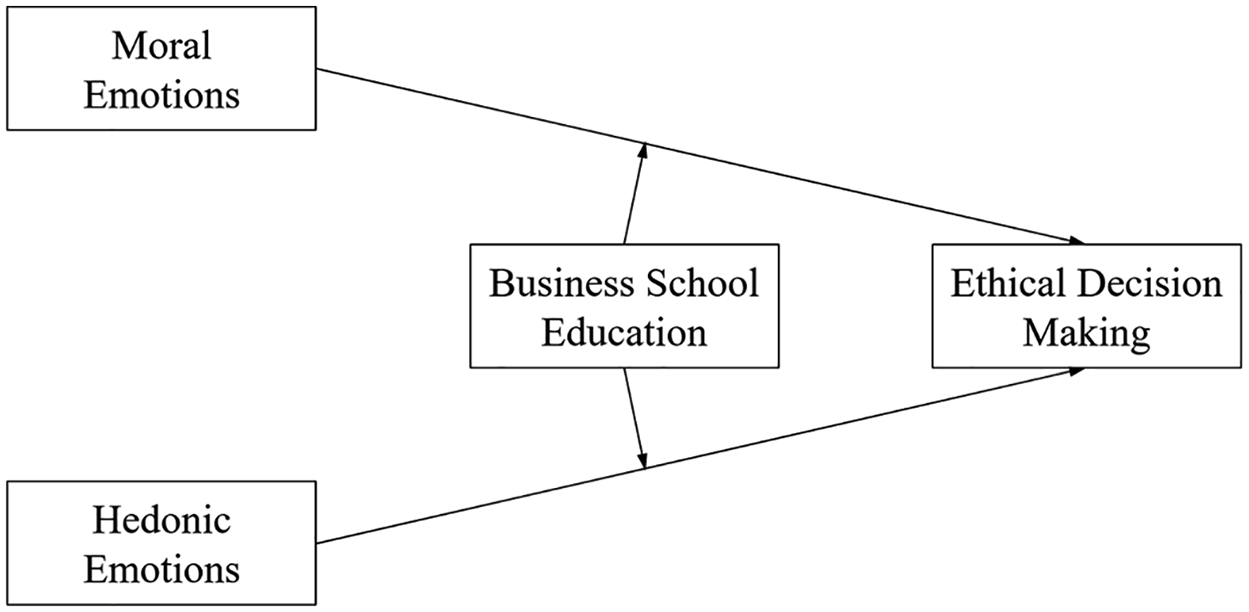
Research model.
Method
Participants
Our sample consisted of students from secondary school, undergraduate business majors, and MBA programs in Hong Kong. We collected data from students with different levels of education to maximize the variance in their exposure to business school education.
We recruited secondary school students through an elite educational organization providing training and development programs exclusively for selected local secondary school student leaders in Hong Kong. Program attendees were in the midstage of their secondary school studies. Secondary school students in Hong Kong are required to take Chinese, English, Mathematics, and General Education courses, with an option to choose other subjects. Business subjects are popular choices, including Principles of Accounting, Commerce, and Economics. Business and commercial studies have been the most popular choices for postsecondary education in Hong Kong for many years (Hong Kong Government, 2016), making business subjects highly desirable for secondary school students. In other words, Hong Kong secondary school students, especially those who are in leadership programs, are exposed to business education even at this early age. Given that business schools tend to attract top students from secondary schools in Hong Kong, student leaders who were top students with excellent academic performance and leadership potential were an appropriate group of prospective business students for this study.
We recruited undergraduate business major students from an AACSB-accredited business school at a publicly funded university in Hong Kong. The students were recruited from major courses required for the business major including Management Accounting and Business Policy and Strategy. We retained only students who were business majors in programs such as Integrated Bachelor of Business Administration, Professional Accountancy, and Global Economics and Finance. Business schools in Hong Kong generally require all undergraduate students to complete several fundamental courses, such as Micro- and Macro-Economics, Principles of Management, Principles of Accounting, Financial Management, and Introduction to Information Systems. Courses on legal and ethical issues in business are offered to undergraduate students in Hong Kong, but whether they are required to take these courses varies across programs.
MBA students were recruited from the same institution and were all close to completing their coursework. This MBA program has the longest history in Hong Kong and has been ranked among the top 50 programs globally. MBA education is popular in Hong Kong with coursework including Business Modeling, Digital Marketing, and Business Sustainability.
Out of the 227 students who agreed to participate in the study, 217 provided complete data for analyses. The final sample consisted of 44 secondary school students, 71 undergraduate business major students, and 102 MBA students. Overall, 45% of the participants were female, and 87% were Chinese, with an average age of 24.47 years (SD = 7.07). Among the secondary school participants, 61% were female, they were all Chinese, and their average age was 16.05 years (SD = 0.78); among the undergraduate business participants, 51% were female, 94% were Chinese, and their average age was 20.15 years (SD = 1.12); among the MBA participants, 34% were female, 75% were Chinese, and their average age was 31.11 years (SD = 4.20).
Design and Procedures 1
To test our hypotheses, we adopted a scenario-based, repeated-measure design building on prior work (Becker & Fritzsche, 1987; Zhong, 2011; Zhong, Ku, Lount, & Murnighan, 2010). A vignette methodology was adopted because the socially undesirable nature of unethical behaviors makes them less observable (Aguinis & Bradley, 2014). Participants were provided with three ethical dilemma scenarios in which self-advancement or profit maximization and moral values collided. The scenarios (available in the appendix) were adapted from existing studies (Becker & Fritzsche, 1987; Zhong et al., 2010). They involved fundamental moral values of care, honesty, and fairness, which are key workplace values and guide decision making in organizations (Ravlin & Meglino, 1987). In each scenario, each value was pitted against self-interest.
In the first scenario, the manager faced a choice whether to use a milling process at night to maximize profit, even though it would release more dust into the environment (Becker & Fritzsche, 1987). Therefore, the fundamental moral norm of care was in conflict with the maximization of shareholders’ interests. In the second scenario, a student in the job market was given an attractive job offer, only because the recruiter mistakenly believed that she or he had an exceptional academic record (Zhong et al., 2010). Therefore, the student faced the choice between accepting the offer without saying anything or correcting the recruiter and possibly having the offer rescinded. The fundamental moral norm of honesty was thus in conflict with maximizing the job seeker’s self-interest. Finally, the third scenario involved a choice of bribery, a prevalent dilemma in the Chinese business context (Gao, 2014), in which fairness was threatened. The manager in the scenario faced a choice to pay a big price or not to the person who could smooth the way for the company to penetrate an emerging market (Becker & Fritzsche, 1987). In this scenario, self-interest was at odds with upholding the norm of fairness.
Because we employed a within-person vignette design (Atzmüller & Steiner, 2010), the participants were presented with the same sequence of three scenarios, so that “order” is held constant at the between-person level, so as not to affect within-person relationships. After reading each scenario, participants were asked to indicate to what extent they would make the respective decisions. Participants rated their moral and hedonic emotions immediately after making the respective decisions. This measurement sequence was implemented to allow their subconscious and automatic process of moral emotions to occur without introducing priming or demand characteristics (Graham et al., 2013; Haidt, 2001). Data on demographic attributes and social desirability as control variables were collected in a separate survey, which was administrated before they participated in the main study.
Measures
Because our sample consisted mainly of Cantonese-speaking students, all items were translated and back-translated between English and Chinese (Brislin, 1970) by two bilingual speakers. When necessary, a third party assisted in resolving differences in the translations. We further invited two local Hong Kong scholars in the management field to help ensure that the expressions were appropriate for the writing practice of traditional Chinese characters used by people in Hong Kong. All items were presented simultaneously using both English and traditional Chinese characters to address the culturally diverse nature of students in Hong Kong.
Ethical Decision Making
Following each ethical dilemma scenario, participants were asked to rate the extent to which they would actually make an unethical decision presented as a behavioral option. We used a single-item measure because the construct was unambiguous (Wanous, Reichers, & Hudy, 1997). Participants rated their decision making using a 6-point Likert-type scale ranging from 1 (not at all) to 6 (to a very great extent). The scores were later reverse coded to capture ethical decision making.
Moral and Hedonic Emotions
To effectively capture naturally occurring mixed emotions of moral versus hedonic emotions in each scenario, we used a checklist approach (Ekkekakis, 2012; e.g., Multiple Affect Adjective Check List; Zuckerman, Lubin, & Rinck, 1983), to measure the students’ emotions. We presented participants with a list of 33 emotion words and asked them to choose at least three that best represented their affective state while making their decisions. Regarding moral emotions, we included five expressions capturing self-conscious moral emotions, including ashamed, bad, guilty, remorseful, and sorry (Carlo, Eisenberg, Troyer, Switzer, & Speer, 1991; Lindsey, 2005; van Kleef et al., 2008). Expressions of hedonic emotions included active, cheerful, delighted, enthusiastic, excited, happy, interested, and joyful (Watson, Clark, & Tellegen, 1988). We also included other emotion items so as not to constrain participants’ responses to only moral and hedonic emotions. These items included negative (e.g., afraid) or neutral (e.g., alert) emotions. After choosing three emotions, participants were asked to rate the intensity of the selected emotions, using a 6-point Likert-type scale ranging from 0 (not at all) to 5 (extremely). Items that were not selected were coded as zero. We averaged the reported levels of moral and hedonic emotions, respectively, to capture the experience of each type of emotion. Across the three scenarios, the ratings of moral emotions ranged from 0 to 3.60, with an average of 0.36 (SD = 0.58), while hedonic emotions ranged from 0 to 4.75, with an average of 0.50 (SD = 0.67).
Control Variables
We included nationality (dummy coded: 0 = not Chinese, 1 = Chinese), gender (dummy coded: 0 = female, 1 = male), and age (years) as controls for participants’ demographic background since previous studies have found that gender and age are associated with generosity and benevolence (Davis, 1994; Lennon & Eisenberg, 1987). We also controlled for self-reported social desirability using the 10-item true/false measure from Crowne and Marlowe (1960).
Results
Analytical Strategy and Descriptive Statistics
We adopted a scenario-based, repeated-measure design, wherein every participant reported their decisions and emotions after reading each of the three scenarios. As a result, the data had a nested structure, in which repeated observations were nested within individuals. Therefore, we tested the hypotheses using a series of two-level hierarchical linear modeling (Bryk & Raudenbush, 1992). Specifically, we conducted a series of multilevel analyses using Mplus 7.4 software (Muthén & Muthén, 2012) to test the hypothesized main and interaction effects.
Our moderator, business school education, was operationalized as a categorical variable (i.e., secondary school, undergraduate, and MBA students); therefore, to test the moderating effects, two dummy coded variables were included as follows: D1 (0 = nonsecondary school students, 1 = secondary school students) and D2 (0 = nonundergraduate students, 1 = undergraduate students), to jointly represent the three categories of business school education. We group-mean centered all within-person predictors (i.e., moral and hedonic emotions) and grand-mean centered all between-person predictors (i.e., business school education and control variables; Aguinis, Gottfredson, & Culpepper, 2013; Hofmann & Gavin, 1998).
Table 1 presents the means, standard deviations, and intercorrelations among the variables. As for the bivariate correlations at the within-person level, ethical decision making was positively associated with moral emotions (rwithin = .20, p < .01), but negatively associated with hedonic emotions (rwithin = −.45, p < .01), providing preliminary support for Hypotheses 1 and 2.
Means, Standard Deviations, and Correlations Among Study Variables.

Note. n (within-person) = 651, n (between-person) = 217. D1 coded as 0 = nonsecondary school students, 1 = secondary school students. D2 coded as 0 = nonundergraduate students, 1 = undergraduate students. Nationality coded as 0 = not Chinese, 1 = Chinese. Gender coded as 0 = female, 1 = male. Correlations below the diagonal represent between-person correlations. To calculate the between-person correlations, we averaged the within-person variables (i.e., ethical decision making, moral emotions, and hedonic emotions) across the scenarios. Correlations above the diagonal represent within-person correlations.
p < .1. *p < .05. **p < .01 (two-tailed tests).
Hypothesis Testing
Hypotheses 1 and 2 predicted that moral emotions would be positively associated with ethical decision making, while hedonic emotions would be negatively associated with ethical decision making. As shown in Table 2 (Model 2), moral emotions were positively associated with ethical decision making (γ = .21, p < .05), while hedonic emotions were negatively associated with ethical decision making (γ = −.99, p < .01). Thus, Hypotheses 1 and 2 were supported.
HLM Results Predicting Ethical Decision Making From Emotions and Business School Education.
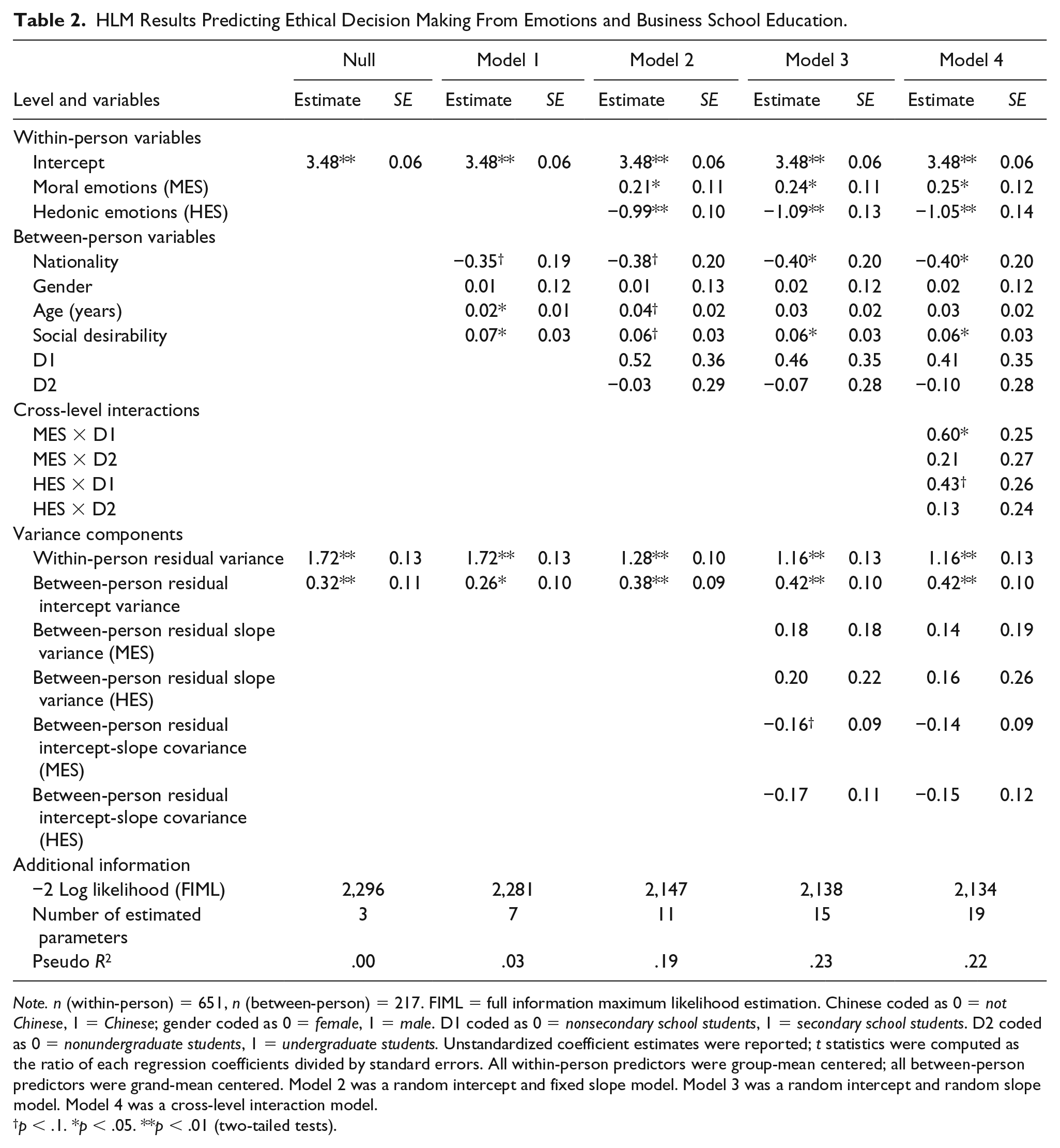
Note. n (within-person) = 651, n (between-person) = 217. FIML = full information maximum likelihood estimation. Chinese coded as 0 = not Chinese, 1 = Chinese; gender coded as 0 = female, 1 = male. D1 coded as 0 = nonsecondary school students, 1 = secondary school students. D2 coded as 0 = nonundergraduate students, 1 = undergraduate students. Unstandardized coefficient estimates were reported; t statistics were computed as the ratio of each regression coefficients divided by standard errors. All within-person predictors were group-mean centered; all between-person predictors were grand-mean centered. Model 2 was a random intercept and fixed slope model. Model 3 was a random intercept and random slope model. Model 4 was a cross-level interaction model.
p < .1. *p < .05. **p < .01 (two-tailed tests).
Hypothesis 3 predicted that the level of business school education would weaken the positive relationship between moral emotions and ethical decision making. As shown in Table 2 (Model 4), the interaction between D1 and moral emotions was significant (γ = .60, p < .05), while the interaction between D2 and moral emotions was not significant (γ = .21, ns). The pseudo R2 at the between-person level for the slope of moral emotions showed that business school education (D1 and D2) accounted for 22% of the total variance of the slope across individuals (Aguinis et al., 2013). A simple slope analysis (Preacher, Curran, & Bauer, 2006), as plotted in Figure 2, indicated that the positive association between moral emotions and ethical decision making was strongest for secondary school students (β = 0.71, p < .01), weaker for undergraduate students (β = 0.26, ns), and weakest for MBA students (β = 0.01, ns). Thus, Hypothesis 3 was supported.

Interaction between moral emotions and business school education on ethical decision making.
Hypothesis 4 predicted that business school education would strengthen the negative relationship between hedonic emotions and ethical decision making. As shown in Table 2 (Model 4), the interaction between D1 and hedonic emotions was marginally significant (γ = .43, p < .10), while the interaction between D2 and hedonic emotions was not significant (γ = .13, ns). The pseudo R2 at the between-person level for the slope of hedonic emotions showed that business school education (D1, D2) accounted for 20% of the total variance of the slope across individuals (Aguinis et al., 2013). As depicted in Figure 3, a simple slope analysis (Preacher et al., 2006) indicated that the negative association between hedonic emotions and ethical decision making was strongest for MBA students (β = −1.08, p < .01), whereas it was weaker for undergraduate students (β = −0.96, p < .01) and secondary school students (β = −0.61, p < .05). Thus, Hypothesis 4 was supported.

Interaction between hedonic emotions and business school education on ethical decision making.
Discussion
Our research investigated the association between two types of emotions—moral and hedonic emotions—and business students’ ethical decision making, and the role business education plays in these relationships. We predicted that moral emotions would be positively associated with ethical decision making, whereas hedonic emotions would be negatively associated with ethical decision making. We further hypothesized and tested the moderating role of business school education.
We tested our hypotheses by assessing students’ emotional responses to ethical dilemmas in which individuals face opportunities to maximize self-interest at the expense of others’ welfare and moral norms. The results from our sample of secondary school, undergraduate business major, and MBA students in Hong Kong provided support for our hypotheses. In general, moral emotions were associated with more ethical decision making, whereas hedonic emotions were associated with less ethical decision making. However, the relationship between emotions and ethical decision making was moderated by the level of business school education, such that the higher the level of business education, the less it was associated with moral emotions, and the more with hedonic emotions.
Together, our findings suggest that emotional responses to ethical dilemmas may be more nuanced than previously suggested and that they create competing motivational orientations within students. Importantly, the results confirmed that the relationship between emotions and ethical decision making was affected by business school education. While moral versus hedonic emotions may elicit an internal dilemma, our results show that business school education can play an important role in regulating the potential effects of emotions.
Theoretical Contributions
This research contributes to the business ethics education, emotions, and ethical decision-making literature. First, by introducing a model of moral and hedonic emotions, we have extended the literature on business education and ethics (Birtch & Chiang, 2014; McCabe, Dukerich, & Dutton, 1994; Walker, 1992; Wang et al., 2011). While caution associated with the relationship between an economic mind-set and selfishness is not new (Krishnan, 2008; Walker, 1992; Wang et al., 2011), to date, the explanation for it has been mostly cognition-based (e.g., Wang et al., 2011) or value-based (e.g., Krishnan, 2008). We add to this conversation by specifying the complexities of the emotions involved in business ethical dilemmas. Our study illustrates that the different types of emotions students feel when presented with an ethical dilemma leads to varying levels of unethical decision making, and that business education plays a significant situational role in strengthening or weakening the association between emotions and unethical decision making. Thus, we provide a new lens through which business ethics education can be framed.
Second, this research adds to the literature on emotions. While several researchers have suggested that emotions can help individuals who want to make their decision making more ethical (Wang et al., 2014; Zhong, 2011), few studies have examined the role of moral emotions in conjunction with hedonic emotions. Studies examining moral emotions have tended to use a single moral emotion and a single hedonic emotion (e.g., guilt vs. anger, Motro, Ordóñez, Pittarello, & Welsh, 2018), or taken a families approach to understanding moral emotions (see Greenbaum et al., 2019; Tangney et al., 2007, for review). Our study draws on MFT (Graham et al., 2013) and theories on anticipated pleasure (Mellers et al., 1999) to demonstrate the internal conflict created by mixed emotions. Delineating moral emotions from hedonic emotions adds precision and specificity to prior research pointing to emotions as an antecedent to decision making. Furthermore, the moderating role of business school education suggests that the process triggered by moral emotions is different from that of hedonic emotions. While these findings are based on business student samples, they add to the emotions literature by describing a fundamental psychological process where self-interest can impede or strengthen emotions-based ethical decision making.
Finally, this research contributes to the ethical decision-making literature. This literature has typically examined individual (e.g., moral identity; O’Fallon & Butterfield, 2012) or external factors (e.g., ethical climate; Birtch & Chiang, 2014) to explain their role in the ethical decision-making process. These studies use cognition-based models (Kohlberg, 1969; Rest, 1986) to explain how these individual or external factors strengthen or weaken the process of ethical decision making. We add to this literature by examining the association between two types of emotions and ethical decision making, as well as pointing to a moderating process that may strengthen or weaken the emotional process of ethical decision making. The moderation effect of business education suggests that outside of the education context, there may be other potential moderators. For example, a corporate or group climate that encourages self-interest (e.g., Birtch & Chiang, 2014) or a competitive reward structure that encourages self-enhancement motives (e.g., Ashkanasy, Windsor, & Treviño, 2006) may also impede ethical decision making by orienting individuals to be more self-interested, and therefore directing the association between emotions and decision making toward decisions that focus more on self-interest. Future studies may expand the findings from this study to examine if the relationship holds in the field context.
Practical Implications
Although management literature has experienced an affective revolution (Barsade & Gibson, 2007), there is still a heavy reliance on cognitive models when teaching business and business ethics. Our study sheds light not only on the importance of emotions in business ethics but also on how business instructors may frame emotions when teaching future business leaders. In the past, the disciplines of economics and business have treated emotions merely as a source of bias that disrupts rational judgment (Tenbrunsel & Smith-Crowe, 2008). The work reported in this article expands our understanding of the benefits and potential risks of introducing affect and emotions into an organization. Our findings suggest that while it may be dangerous to encourage managers to make emotional decisions, drawing their attention to moral emotions can provide a powerful boost to ethical decision making. We acknowledge, however, that teaching business students about incorporating emotions into ethical decision making may be an uphill battle. To help stimulate business educators and encourage innovation in teaching moral emotions in the context of ethics, we offer some suggestions to apply our findings to teaching.
Recognizing and Utilizing Emotions in Ethical Decision Making
In general, traditional economics and business training based on the underlying assumption of rationality and utility maximization (Frank, Gilovich, & Regan, 1993) tends to treat emotions as a type of bias (Tenbrunsel & Smith-Crowe, 2008). Students’ reflections in our poststudy discussions provided insights about what they were thinking when they read the scenarios and how they made decisions. Many of our participants mentioned “cost-benefit analyses” multiple times. For example, for the third scenario that involves bribery, an undergraduate participant said, “I want to know more information about the businessperson, so that I can do cost-benefit analyses. Then I will do it if the benefit exceeds the cost.”
In contrast to the rationality and utility maximization approach, decades of research has shown that our emotions play a significant role in the decision making process, especially when faced with ethical dilemmas (Dane & Pratt, 2007). As educators, we have the obligation to inform students of the scientific advancements in understanding emotions in ethical decision making. We should help students recognize the fact that emotions are not always a source of bias, but rather that they may reflect decision-makers’ intuitive judgment, which they should not just brush aside, especially when it comes to ethical decision making.
On a practical level, in-class ethical decision-making exercises using cases or video clips will help students realize the importance of emotions in decision making and the limitations of logical reasoning. For example, in some scenarios, rational calculation, which involves suppression of emotions, and moral emotions such as guilt may lead students in opposite decisions. Collective reflections in class will help students identify the role that emotions play in making ethical decisions. As educators, we should train students to acknowledge and understand the strong feelings when faced with ethical dilemmas, and to use emotion-based decision making to supplement but not replace rational decision making.
Discerning Moral From Hedonic Emotions
Once students are ready to pay attention to emotions as sources for their ethical decision making, it would be critical to warn students that they may experience different types of emotions with opposing action tendencies. Educating them about the implications and the motivational tendencies of moral versus hedonic emotions will help students in two ways. First, they will learn that the option that produces the highest expected value (including anticipated pleasure), may not necessarily be the right choice; and second, the moral emotions that may make them feel bad (e.g., guilt, shame, third-party anger) are actually an internal moral compass that they can utilize in their ethical decision making.
To achieve this, educators may introduce an in-class exercise or a case study on an ethical dilemma, for which half of the class is directed to rely on “doing what feels best for me” and the other half on “doing what feels right.” For example, in our poststudy discussion, students expressed different feelings when faced with the second scenario. One student said, “I felt worried more than happy, and to some extent, I felt guilty as if I did something really bad.” This kind of training will highlight how being guided by moral emotions will lead to different business decisions, which, in the long run, is often the most profitable thing to do given the price of ethical scandals.
Teaching the “When” and “How” of Moral and Hedonic Emotions
Moral emotions are triggered when one’s fundamental moral values are threatened. As educators, we can train students to notice the strong signals of moral emotions and utilize them to identify which fundamental moral values are being threatened. In doing so, we can point to the fundamental moral values that commonly trigger moral emotions, such as care, fairness, loyalty, authority, and sanctity. In-class training on “when” moral emotions are experienced can help the students reframe an ethical dilemma to examine it from a more abstract level. For example, nondisclosure of certain information to secure a dream job may be reframed as “self-interest vs. fairness/honesty,” where the moral emotions of guilt might be pointing to the value being threatened by self-interest. The practice of abstraction of ethical dilemmas guided by moral emotions will help students evaluate the decision at a higher level, guiding them to do what is the right thing when faced with an ethical dilemma.
It is also important to educate the students on the “how” of the moral emotions process. According to MFT (Graham et al., 2013), moral emotions work at a subconscious and automatic level, which means that students may often find it difficult to justify why they made an ethical decision. Perhaps it is this very nature of moral emotions that makes it difficult to incorporate moral emotions into business decision making. We teach our students to justify their decisions based on expected utility since we are preparing them to withstand the scrutiny of such a question from their supervisors, executives, clients, and shareholders. However, as educators, we should also teach our students that it is okay, and sometimes best, for the business to say “it’s just the right thing to do” rather than financially justifying their decisions based on business principles.
Finally, students should be warned about hedonic emotions when facing an ethical dilemma. In our poststudy discussion with students, many mentioned the experience of hedonic emotions. For example, one student said, “I felt really excited and happy to have this ideal offer.” It should be noted that anticipated pleasure is an important force that guides our decisions (Mellers et al., 1999; Mellers & McGraw, 2001), and suppressing emotions is effortful and may come at a cost of emotional exhaustion and burnout (Hülsheger & Schewe, 2011). Educators may bring to light what anticipated pleasure means in the context of an ethical dilemma, and how it may direct students to choose a decision that looks ethically questionable. Being trained to be cognizant of the process of hedonic emotions may help students refrain from making their decisions solely based on self-interest.
Providing Disclaimer on Business School Education
Our results also suggest that even if emotions are introduced to business students as an important factor in ethical decision making, the content of business school education may nullify the benefits of moral emotions and exacerbate the danger of hedonic emotions. Educating business school students on the perils of overreliance on profit maximization while teaching them to discern moral emotions may send a more consistent message that would encourage future managers and leaders to become more attuned to moral intuition. However, this requires a commitment from business schools to focus on socially responsible education, which means that business schools should acknowledge the history of focusing on profit-maximization and promoting self-interest (Giacalone & Promislo, 2013; Wang et al., 2011) and inform the students of the downfalls it may produce (Giacalone & Promislo, 2019).
Limitations and Suggestions for Future Research
This study has several limitations that should be considered, particularly by future researchers. First, all variables were evaluated based on a common source, raising the possibility of correlation inflation from common method variance (Podsakoff, MacKenzie, Lee, & Podsakoff, 2003). Future research may consider employing non-self-report measures (see Mauss & Robinson, 2009, for a review) to capture moral and hedonic emotions, such as measuring emotions through brain states using advanced techniques including electroencephalography (EEG), functional magnetic resonance imaging (fMRI), or positron emission tomography (PET).
Second, we operationalized business school education by collecting information from students in secondary schools, undergraduate business majors, and MBA programs. As it is not a longitudinal design, our findings could be attributed to other individual characteristics, such as students’ achievement-orientation, which has been shown to play a role in the self-selection process of enrollment in business education (Arieli et al., 2016). To address this issue, we ran supplementary analyses, controlling for participants’ achievement values measured by the Comparative Emphasis Scale (Ravlin & Meglino, 1987), and the results still supported our analyses. Further studies are suggested to adopt a longitudinal design to improve the robustness of findings.
Third, in the design of our study, the independent variables (i.e., hedonic and moral emotions) were measured after the dependent variable (i.e., ethical decision making). While we did ask the participants to recall the emotions that they experienced immediately after they made the decision, this undermines the ability to make a causal inference due to lack of temporal precedence of the measurement of the independent variables. It is important to note, however, that this measurement procedure was implemented to ensure that theory guided our methodology (Bono & McNamara, 2011) and that the measurement did not interfere with the psychological processes that are proposed by the theory. Specifically, MFT (Graham et al., 2013) posits that the process of moral intuition (i.e., an affectively charged reaction and judgment of morality in reaction to violation of a moral norm) is an automatic and subconscious process. If we had asked the participants to deliberate on their emotions prior to making their ethical judgment, we would have interfered with such an automatic, subconscious process. To truly capture this process, similar to suggestions on the first limitation, future studies may employ neuroscience methodologies to measure emotions without interfering with the moral intuition process.
Fourth, our findings may be limited to students in one geographical region. Students in other countries or cultures with different norms as to what is considered morally right or wrong may display different emotional reactions to the scenarios we adopted. Furthermore, while the relationships tested in our study represent fundamental psychological processes, adult managers and employees may demonstrate a different pattern of reactions. Future research could assess the generalizability of our findings and thus deepen the understanding of the role of culture, norms, and occupations in the emotional underpinnings of unethical behaviors.
Finally, the scenarios we used for our business ethical dilemma context limits our ability to generalize the results to contexts that include general helping behavior involving victims who are suffering. In our attempt to create scenarios that could elicit the focal moral emotions of interest (i.e., ashamed, bad, guilty, remorseful, and sorry), we did not include scenarios where an ethical decision may be a result of hedonic motives related to helping other individuals. Specifically, we did not include scenarios involving witnessing other individuals suffer. In such cases, other explanatory mechanisms may predict ethical decision making, such as anticipated pleasure (R. F. Weiss et al., 1971), relief of negative states (Baumann et al., 1981), and other-suffering emotions such as compassion, empathy, and sympathy (Batson & Powell, 2003; Greenbaum et al., 2019). While helping behavior and ethical behaviors are distinct constructs, the emotional processes involved in where they overlap may inspire future researchers to further explore the complexities of motives for ethical decision making. For example, future research could explore whether our findings can be generalized to other-suffering emotions in the context of business education.
Conclusion
Business educators have the responsibility to inform and guide students to make better decisions (Giacalone & Promislo, 2019). However, it has taken business schools a long time to recognize the role of emotions in business decision making, especially emotions related to business ethics. Since recent research has suggested that emotions may be the key to more ethical managerial decisions (Wang et al., 2014; Zhong, 2011), we directly addressed the question of the relationship between emotions and ethicality for business students. We started from a fundamental and puzzling question: Do emotions make business students more ethical or not? If so, what role is business school education playing? Our data demonstrate that encouraging students to approach ethical dilemmas emotionally may be risky since ethical dilemmas elicit moral and hedonic emotions with conflicting action tendencies. These tendencies could be steered toward unethical decisions with an increasing level of business education. We hope that our findings will highlight the critical role emotions play in ethical decision making and encourage future researchers to further explore the connection between business education and ethical decision making. More important, we encourage business educators to incorporate moral emotions in their teaching of business ethics such that the students are equipped with the ability to use them in making critical business decisions.
Footnotes
Appendix
Acknowledgements
We thank associate editor Debra R. Comer and two anonymous reviewers for their valuable feedback and constructive comments throughout the review process.
Declaration of Conflicting Interests
The author(s) declared no potential conflicts of interest with respect to the research, authorship, and/or publication of this article.
Funding
The author(s) disclosed receipt of the following financial support for the research, authorship, and/or publication of this article: This research was funded by the Research Grant Council of Hong Kong (Reference Number: 499913).
