




Abstract
Writing can be a powerful tool for thinking and learning. Journaling is one form of writing that is a commonly used learning tool in many classrooms. Children use journals to record personal experiences, explore reactions and interpretations to reading and videos, or record, analyze, or enhance information about literature or other subject areas. This article examines how to scaffold journal writing instruction for students with learning disabilities within a diagnostic teaching cycle by establishing learning outcomes, planning assessment, planning instruction, implementing instruction, and analyzing individual student learning. Example lessons, differentiation strategies, scoring guides, and student samples are provided.

Miss Gomez teaches fourth grade. Last year, in an effort to improve the writing skills of her students, she incorporated journaling into her curriculum. Although most students responded positively, some students were unclear about how to write a journal entry or how to determine what to write. This was especially true for several of her students with learning disabilities, specifically those who had difficulties with expressive written language. Miss Gomez wants to continue using journaling in her class but is concerned about how she can teach journaling while still meeting the learning needs of all her students (see Note 1).
Writing as a Tool for Thinking
Writing is a powerful tool for thinking and learning. As children write, they shape their thinking and personalize their learning. Teachers need to involve students in a variety of writing activities to encourage this process (Armbruster, McCarthy, & Cummins, 2005). The connection between writing and thinking is natural. Writing not only accomplishes the simple recording of ideas but also helps kids create new ideas.
Writing is expressing your thinking . . . and in the act of expressing your thinking about science, math and social studies, you elaborate and clarify your ideas. It’s not just an expression of what you know. In the act of writing, you also form new relationships between ideas. (Kerr, 1998, p. 1)
The best writing exercises grow out of the materials students are studying in science, social studies, math, and language arts. It is beneficial for students to keep literature response journals to document a personal response or literature summary. In addition, writing supports student self-esteem because “[t]he more children write, and the more positive responses they receive to their writing, the better they feel about it. So students who are in ‘process writing’ classrooms develop a great deal of confidence about their writing” (Kerr, 1998, p. 1).
A Model of Writing Instruction for Students With Learning Disabilities
Some students need more explicit instruction to be successful in writing. Graham and Harris (2003) designed a method to support students with learning disabilities in writing. Their self-regulated strategy development includes five basic characteristics of instruction:
Provide explicit and extensive instruction on writing strategies, self-regulation, and content knowledge
Encourage interactive learning and active collaboration with other students
Individualize instruction based on students’ needs and abilities while providing specific feedback and support
Allow students to be self-paced; however, be sure students meet certain criteria before moving to the next stage of instruction
Continue to introduce new strategies by making connections to previously introduced strategies
These guidelines are beneficial when planning differentiated writing instruction that meets the needs of students with learning disabilities as well as other students who may have difficulties in writing.
Forms of Journal Writing
Journaling is one form of writing that is a commonly used learning tool in many classrooms. According to Tompkins (2008), children use journals to record personal experiences, explore reactions and interpretations to readings and videos, and record, analyze, or enhance information about literature or other subject areas. In addition, journaling can be used to activate prior knowledge, engage the imagination, depict character roles, solve problems, utilize critical thinking skills, and practice writing skills in context. Connecting journal topics to content in other subjects can provide the teacher with a unique opportunity to assess the students’ understanding of the content by determining if the information explained in the entries is accurate. This information can be used to guide future lessons in the various subject areas.
Journals have been used by adults throughout history for a variety of purposes. For example, working journals are used in a variety of professions to record observations, measurements, and other critical data. Farmers use this type of journal to record weather and crop data. Gardeners may record blooming cycles or growth patterns, whereas athletes may record performance data. Another type of journal is a historical journal. Historical journals are often used by individuals to record the events of their daily lives. Meriwether Lewis and William Clark recorded their exploration of the United States in journals. Benjamin Franklin recorded data from scientific experiments. However, historical journals can be kept by any individual to record life events or personal perceptions. Some family members use journals to record familial histories, lineage, or important events. There are a variety of other types of journal forms for students to use. Table 1 provides a brief description and example of each.
Types of Journals
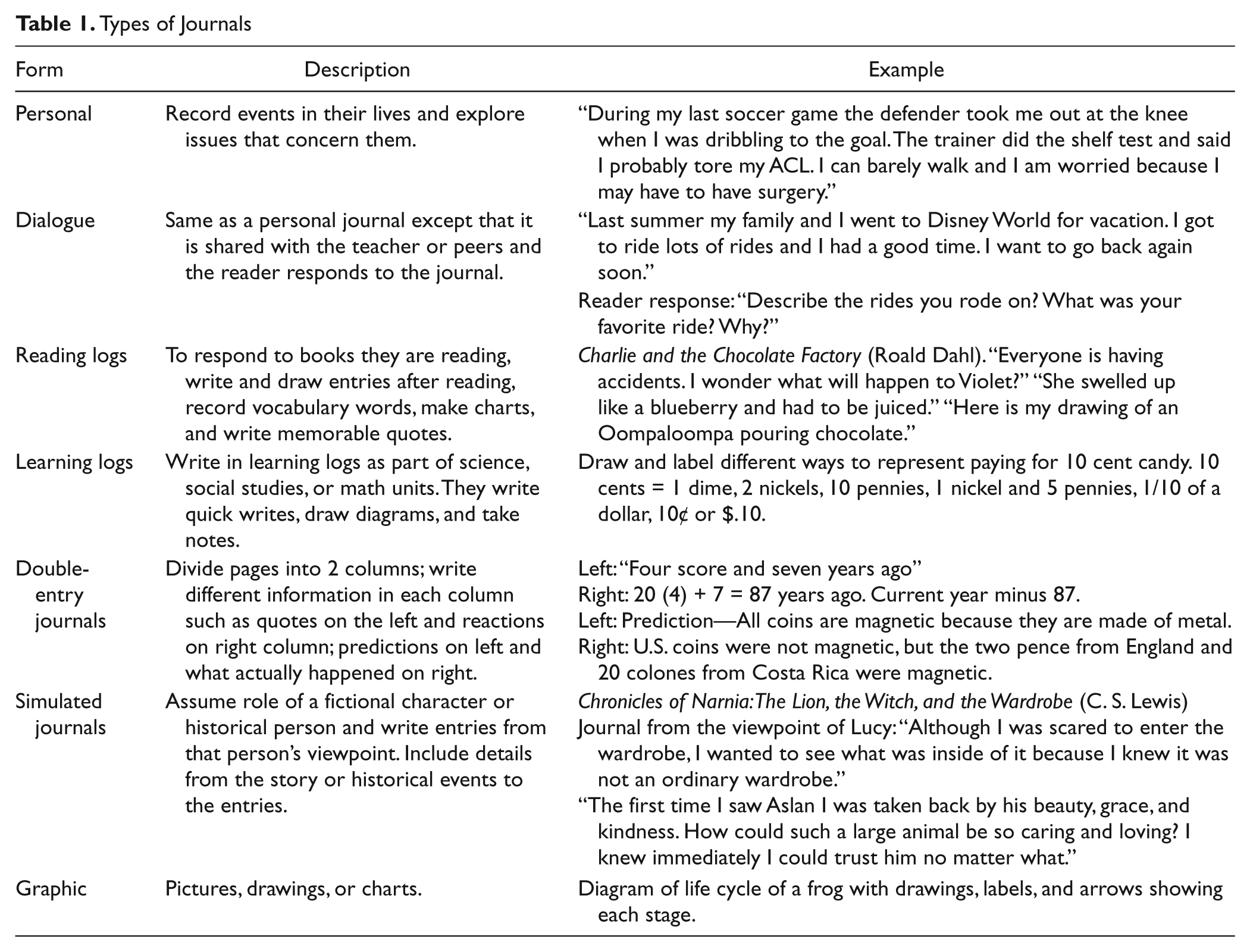
To use journaling effectively in a classroom, careful planning and instruction are required. This process can be broken down into five main interrelated phases within a diagnostic teaching cycle: (a) establishing learning outcomes, (b) planning assessment, (c) planning instruction, (d) implementing instruction, and (e) analyzing student learning. Several steps are required in each of these phases to make the journaling experience successful.
Establishing Learning Outcomes
It has long been established that having clear objectives, providing opportunities for brainstorming, and providing strategies for organizing information prior to writing are effective strategies to enhance students’ writing compositions, according to Hillocks’s (1984) meta-analysis. Although the writing skills of children have improved, there are still many who struggle with the writing process. In a National Assessment of Educational Programs report (Institute of Educational Sciences, 2007), writing results indicated that 12% of 8th graders and 18% of 12th graders scored below the basic level (writing was not tested at the 4th grade level). Regrettably, 94% of students with disabilities scored in the basic and below basic categories in writing. Therefore, to meet the needs of all students, including those who struggle with writing, careful consideration must be given to writing instruction.
Like any other topic or unit taught, journaling lessons take careful planning for effective teaching and learning to occur. Sequencing of skills and selection of materials are of critical importance to ensure students’ understanding of concepts and acquisition of skills related to types and purposes of journal writing.
Determine Goals and Objectives
When planning a unit or lesson, objectives are needed to guide student development and skill acquisition in journaling. Overall unit goals should be established with supporting lessons. Possible goals for a journaling unit may include students identifying journal formats and writing from different perspectives, understanding content by translating accurate information into their journal from multiple resources, and improving individual writing skills.
The lessons should have focused objectives that reinforce the skills for both the process and the product needed for effective journaling and also coincide with national and state learning standards. The new Common Core State Standards for Grades 3 to 5 include standards that strongly correlate to journal writing (Council of Chief State School Officers and the National Governors Association, 2010). For example, for reading informational text, students will identify and determine the relationship between key ideas and details, identify the craft and structure, and integrate knowledge and ideas from multiple sources. For writing informational or explanatory texts, students will introduce, develop, and conclude a topic in a logical manner, include headings and visuals to aid comprehension, and use precise language and domain-specific vocabulary.
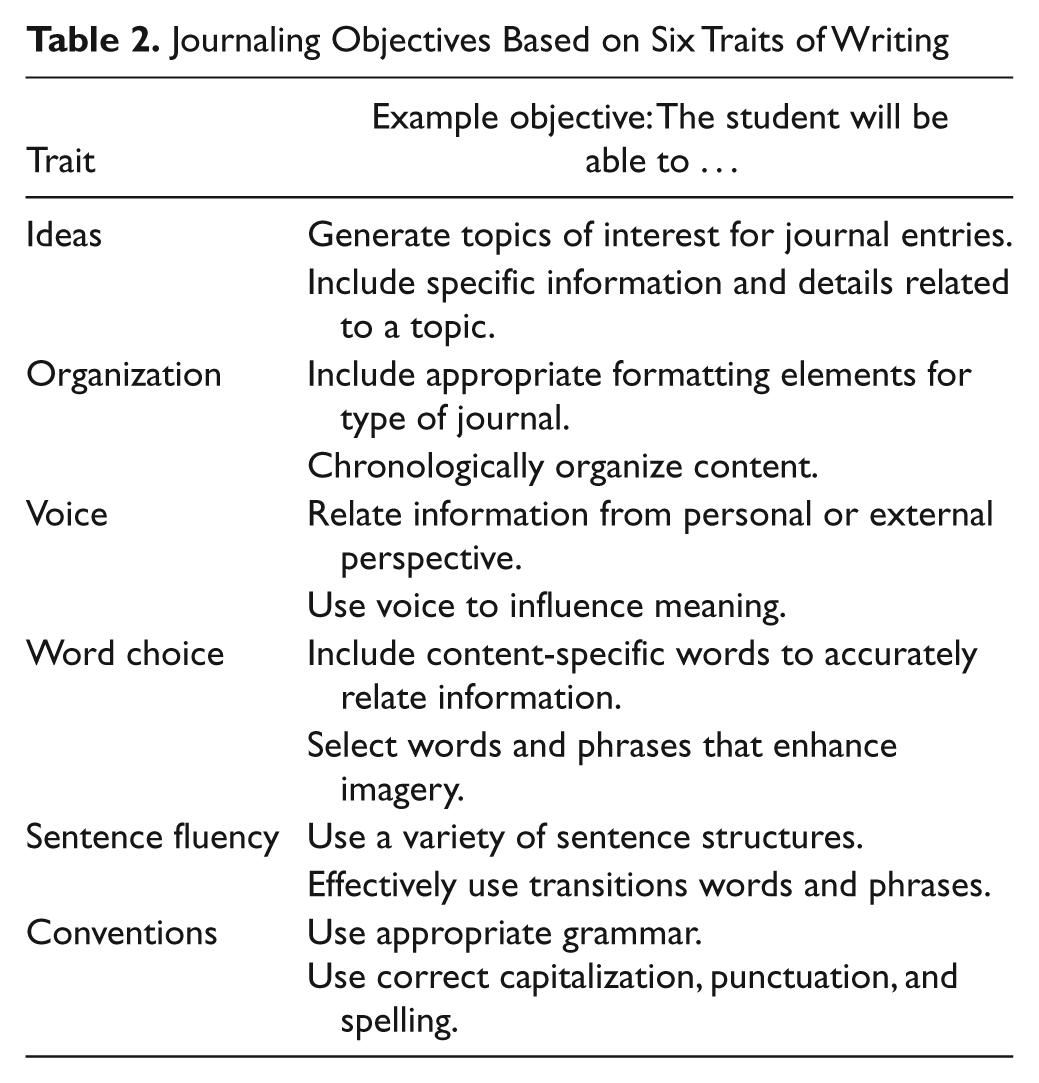
In addition to meeting the learning standards, lessons may include objectives that revolve around the six traits of writing: ideas, organization, voice, word choice, sentence fluency, and conventions (Spandel, 2004). Table 2 provides specific journaling objectives related to the six traits. Once unit and lesson objectives are determined, corresponding assessments should be developed.
Journaling Objectives Based on Six Traits of Writing
Planning Assessment
The evaluation process should begin by assessing the prerequisite skills and background knowledge of the students. This will enable the teacher to plan the lessons and incorporate supports according to abilities and needs of the students. Information can be gathered in a variety of ways such as pretests, student products, observations, and informal questioning. One example would be for the students to write a journal entry of a recent experience prior to beginning the journal unit. After evaluating the student’s initial writing, along with their ongoing writing, the teacher can focus on planning instruction based on their specific strengths and needs.
Student involvement in an ongoing evaluation process that provides guidelines for expectations and specific feedback can improve student writing (Cooper, 1999; White, 2000). Assessment should be directly linked to the unit and lesson objectives. In addition, assessment is continuous for the process and product and should be differentiated to meet the needs of all students. Accommodations for students with learning disabilities should be considered. According to Baker, Gersten, and Graham (2003), guided feedback will help improve the quality of the written product for students with learning disabilities. Specific student feedback should be provided in an oral or written format and used to plan instruction and guide student learning. It is usually more productive to focus teacher feedback on one or two skills that were predetermined objectives for the assignment. Writing conferences are an excellent opportunity for teachers to review work with students on an individual basis. This will allow teachers to identify specific areas of concern and help students refine their entries.
Scoring guides or rubrics are lists of criteria used to support and evaluate student learning (Goodrich Andrade, 2001). They are an effective way to assess student performance related to specific skills and objectives to guide instruction. Scoring guides also provide the students with guidelines for self-assessment. A sample simulated journal scoring guide based on the six traits of writing is provided in Figure 1. Reviewing the scoring guide with students prior to lessons can provide a focus on the overall outcome of the unit. During the writing process, students and teachers can refer to the scoring guide to assess their writing and progress toward the end product.

Simulated journal scoring guide
Planning Instruction
When planning instruction for a writing lesson or unit, teachers need to consider how to teach and model each of the steps in the writing process. The explicit teaching of the writing steps has an impact on the quality of the students’ writing (Baker et al., 2003). According to McAndrews (2008), there are several types of strategies in this process. Prewriting strategies are used to identify the purpose, audience, and genre for writing and then organize ideas for a topic. Next are the drafting strategies in which the students focus on the content of their writing. This is followed by peer- and/or teacher-conferring strategies to further develop and refine their topic. The process then continues with strategies for revising content, organization, and voice, followed by editing strategies for word choice, grammar, punctuation, and spelling. The final step is sharing and publishing strategies to honor their writing. The strategies chosen throughout this process should reflect the needs of the learners within a teacher’s classroom.
Meeting Learner Needs
Students with learning disabilities often pose a unique challenge to many teachers. In addition to other academic areas, students who struggle can experience difficulty mastering basic writing skills (Graham & Harris, 2009). Reading comprehension and spoken language deficits that are often present for students with learning disabilities may interact to create difficulties with written expression (Bender, 2004). Therefore, teachers need to consider the learning styles, interests, strengths and weaknesses, and other unique characteristics of the students.
Although the needs of every student cannot always be anticipated, integrating supports into the lessons can provide significant assistance to struggling learners. During the journaling unit, teachers can provide access to the content for struggling readers in a variety of ways. The mentor text can be tape-recorded or reading buddies can be formed for those students with poor reading skills. A large-print copy of the text or a copy with limited text per page could also be provided (Wood, 2009). If necessary, content can be obtained from additional sources of varying reading levels such as the Internet, science texts, videos, and magazines. Teachers can also use additional visual aids and concrete examples during instruction to help clarify content and expectations (Wood, 2009).
Students who struggle with writing may also need additional support during the journal writing process. With varying levels of ability in a classroom, not all students are able to work through the process at the same rate or proficiency. It is important for teachers to plan writing conferences with each student to review work and monitor progress. Supports during the writing process will vary based on learner needs. Students with learning disabilities (LD) benefit from being taught how to plan their writing through goal setting, brainstorming, and sequencing ideas (Troia, Graham, & Harris, 1999). It may also be necessary to break the amount of work assigned into manageable chunks to help students organize and manage their time more effectively. Some students with LD may need support to produce lengthy or more complex journal entries. The use of pictures and diagrams may enhance their journal entries by providing an alternate way to express content. Students may need a more structured format to use as a guide when writing the journal entries, such as using sentence frames, writing prompts, graphic organizers, or interactive writing in which the teacher and the students share the pen.
Students with LD who have written expression deficits are often able to verbalize their ideas but have difficulty transferring those ideas into written language (McNamara, 2007). For these students, many strategies and accommodations can be provided through the use of technology. It may be beneficial for those students to audio-record their journal entries first and transcribe them at a later time. Computer programs are also available, such as Dragon Naturally Speaking (Nuance Communications, 2010), that allow the students to dictate their compositions to the computer for automatic transcription. This will allow the students to focus solely on what they want to say without the cognitive task of writing at the same time. Computers also have many other applications that are beneficial to students with LD. Providing the option of word-processed entries instead of handwritten entries may facilitate completion and also support students who have fine motor skill deficits.
Resources to aid students with word retrieval, spelling, and other grammatical and language-related skills may include the use of computers, electronic dictionaries, or iPod applications. Word-predication programs have been shown to facilitate writing and reduce grammatical errors (Williams, 2002). In addition, speech-feedback programs also provide additional feedback to students by having the written input read back to the student for revision purposes (Williams, 2002).
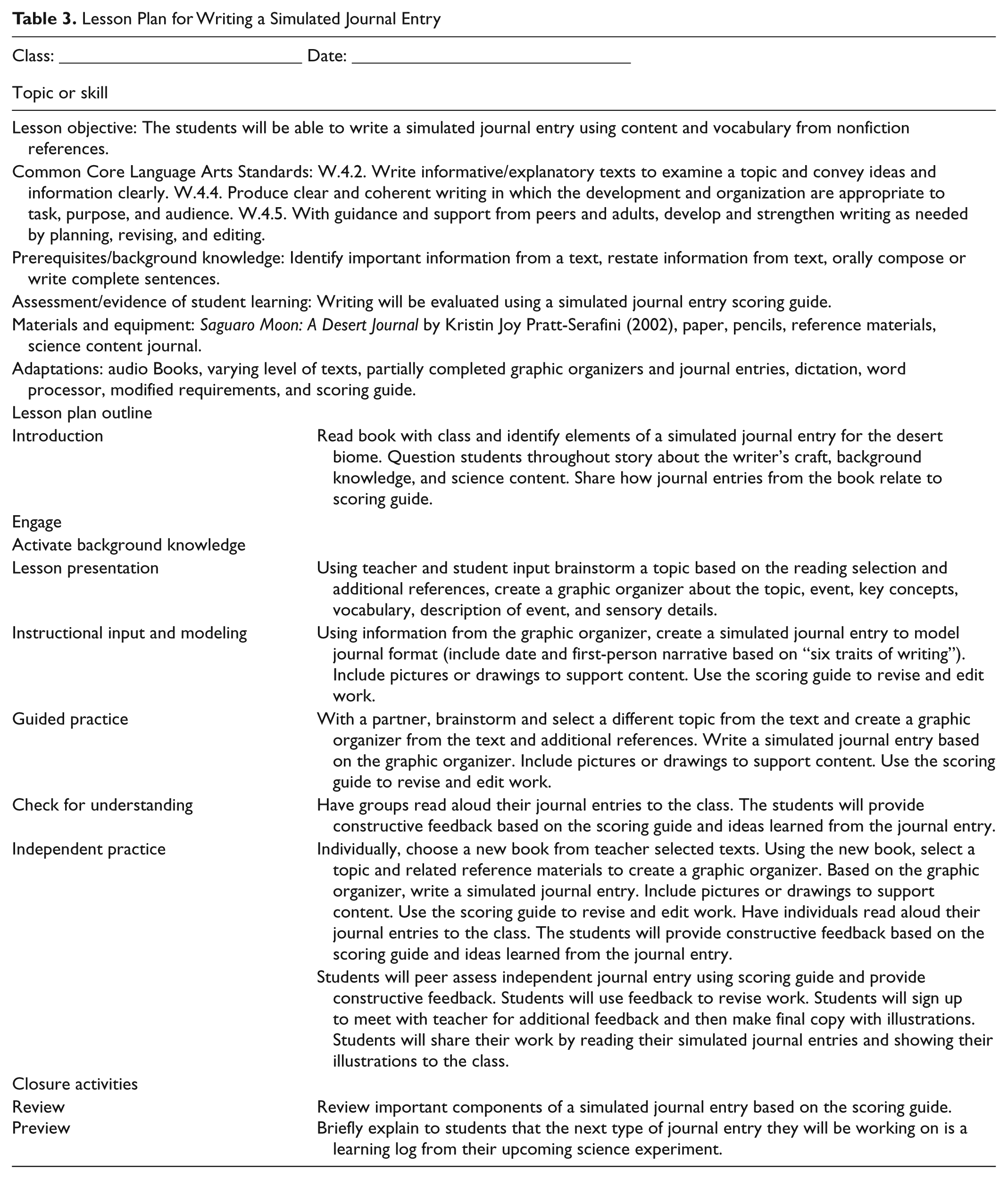
Miss Gomez’s class has been studying the biomes in different regions of the United States. They are currently working on desert regions. The students are very interested in the topic and enjoy learning about the various animals and plants that can survive in the desert. Considering this, Miss Gomez has decided to use learning logs in her journaling lessons. This will provide her with opportunities to monitor student learning and capitalize on student interest and motivation. She will also be able to incorporate pictures and drawings for her students who have learning disabilities. By addressing specific content discussed in class, students will have numerous topics to elaborate on in journal entries.
Miss Gomez’s lesson plan for writing a simulated journal entry can be found in Table 3.
Lesson Plan for Writing a Simulated Journal Entry
Implementing Instruction
The first lesson of the journaling unit should introduce the unit and include general information about types of journaling, purposes for journaling, and examples of adults and children who use journals (see Table 1). Subsequent lessons should focus on specific types of journaling and enhancing writing development through the six traits of writing. Lessons should be scaffolded to provide opportunities for shared writing and guided and independent practice that includes teacher and peer feedback based on a scoring guide. During individual writing conferences, have students read their own composition, thus retaining the voice of the writing. The teacher can then write notes or suggestions on Post-it notes, so that the writer maintains ownership of the composition (Routman, 2005). Providing specific feedback on planning, writing, and revising to students during conferences is beneficial for students with LD (McNamara, 2007).
When introducing each new journal type, it is beneficial to select a mentor text that exemplifies that type of journaling. The teacher and/or students can read the mentor text and identify characteristics such as the author’s craft, language use, syntax, graphics, and format associated with the specific journaling type selected.
Choosing a Mentor Text
When journal writing, teachers need to support students through reading from the perspective of writers and identifying the writer’s craft in mentor texts that use journal writing. Ray (1999) described writing as something we learn to do by examining other writers. It is an organized inquiry in which mentor texts are first read out loud, connections are made, and questions are shared. Next, the teacher guides the students into an inquiry as to how the writer wrote the text through a think-aloud strategy (see Table 4). The teacher then helps the students examine the craft of the text such as the words, how they are put together, the use of punctuation, and the structure of the texts. Students then talk about the craft the writer used and think about other texts that use that craft. Finally, they envision themselves using that craft in their own writing and then attempt to apply it to their journal entry.
Sample Think-Aloud for Journal Instruction

After reviewing a variety of published children’s books that include journaling, Miss Gomez selected Saguaro Moon: A Desert Journal (Pratt-Serafini, 2002). She selected this book because it included a variety of journaling styles and incorporated content related to their science unit on biomes. The author included a daily journal with dates, a Dear Journal greeting, and rich descriptions of the Sonoran Desert. It also included hand-drawn maps, notes, labeled drawings, and newspaper articles. She added definitions and pronunciation keys when necessary. Once she chose the mentor text, Miss Gomez planned the journaling lessons for the week.
Teaching the Lessons
During instruction teachers need to present clear objectives and an introduction to the lesson. They also need to provide models for the writing that is expected. Students then need opportunities to participate in shared, guided, and independent writing with specific ongoing feedback. Students significantly benefit from publishing and sharing their writing orally as it gives them a purpose and audience for their writing. The following is an example of a week of lessons on writing simulated journal entries in science.
On Monday, Miss Gomez introduced this mentor text and guided the students in identifying the crafts the author used while writing the journal entries, including the words she used to help students visualize what the Sonoran Desert was like. She then used a think-aloud strategy to model how to write simulated journal entries for nonfiction (see Table 4). Throughout the week, she provided opportunities for shared, guided, and independent practice of journal writing. During the minilessons, she taught specific journal elements and expectations using the teacher- or student-developed scoring guide for assessment based on the six traits.
On Tuesday, Miss Gomez and the students wrote a shared journal entry. She focused primarily on content, then conventions. She taught how to use texts as resources for writer’s craft, content, sentence structure, vivid verbs, using your senses, and spelling of content words. For spelling of unknown words, the teacher recommended they write letters that represented each of the sounds and then circle the word for later editing. The students then began gathering resources and writing an initial draft for their own journal entry.
On Wednesday and Thursday, students reread, revised, and edited their journal entries based on the rubric, then signed up for a writing conference with the teacher. During the writing conference, the teacher completed the Writing Conference Form using the TAG Strategy presented by Stoner (2007). The teacher provided feedback based on the acronym TAG (
On Friday, students orally read and shared the visuals in their journal entries with the class. After each person shared, Miss Gomez instructed the students to refer to the scoring guide and use the TAG strategy (Stoner, 2007) to provide peer feedback. Miss Gomez asked questions related to the important elements of a simulated journal entry and previewed the next type of journal entry to be taught. As a closing activity, students’ journal entries were bound into a book and placed in the school library for students to read. At the end of the month, each student selected one piece of writing to have published in the class newspaper that is shared with the class, families, and school personnel.
One student wrote a two-page journal entry on food chains and webs. The journal entry began with important information from the text that included definitions of terms and a linear example of a food chain (see Figure 2). The information was then applied to a visual representation of a food web on the following page (see Figure 3).
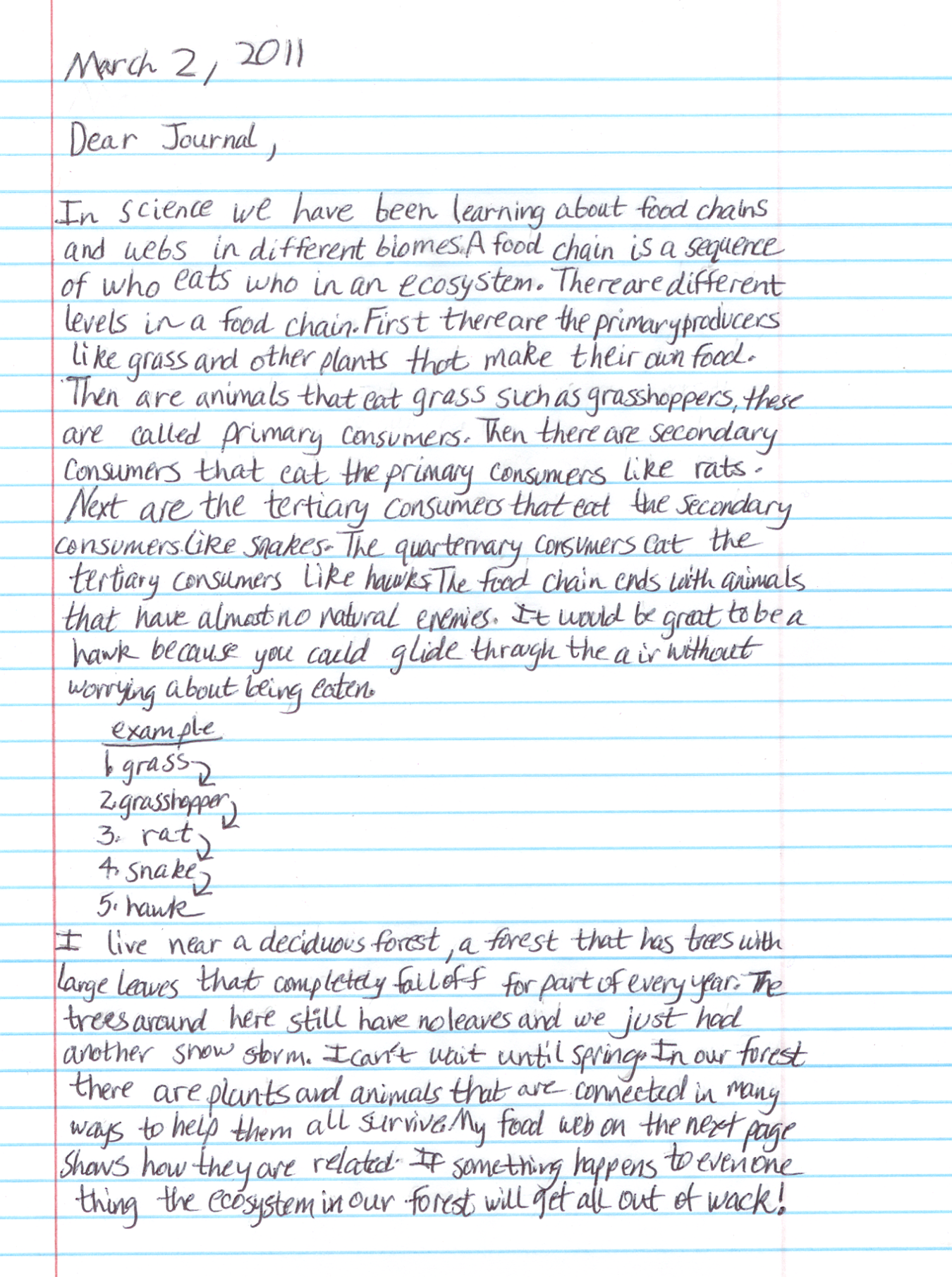
Sample of a student journal entry

Sample of a diagram from a student journal
The previous lessons provide only a sample of what could be taught in a journaling unit. However, lessons may vary and instruction should be differentiated based on student progress and individuals’ strengths and needs. Students may need more scaffolding or support during each step. Others may need additional time to complete their writing. More advanced students may need to concentrate on the development of more complex ideas. The teacher needs to keep the focus on developing the students’ ability to communicate their ideas clearly with an emphasis on content and organization, not just spelling and punctuation.
Analyzing Student Learning
The teacher needs to examine the preassessment writing data and discuss learning goals with the student. Throughout the unit, writing process data from formative and student self-assessments should be gathered and discussed during writing conferences to monitor progress. It is beneficial for the students to develop a writing portfolio where they can keep samples of their writing over time. These samples should include the steps in the writing process, not just final products. The inclusion of scoring guides and specific feedback is also necessary so that individual elements of the writing can be compared. Teachers and students will be able to reflect on the writing and identify specific areas in which the student was successful, has improved, or still needs significant work. Based on all of the data collected throughout the writing process, overall student progress can be determined. During family conferences, artifacts from the portfolio can be shared and discussed to demonstrate the student’s level of proficiency for each writing objective.
Miss Gomez had the students decorate a file folder to use as their writing portfolio. Samples of the students’ work, which ranged from prewriting and drafts to the final products, were placed in their writing portfolios. Additional materials such as high-frequency word lists, descriptive adjectives and verbs, and scoring guides were also included. The writing process was then evaluated by the students and Miss Gomez based on the journal drafts, teacher conference, and finished product. The students then shared their writing through the use of the author’s chair, and journals were published in a class book to be shared in the school library.
Planning Next Steps for Instruction
Teacher reflection is an essential component of the teaching and learning process. Therefore, critical reflection on the strengths and weaknesses of the overall implementation of the previous unit is necessary for planning future instruction.
Using data and information from the previous unit, the teacher will establish new learning goals and objectives for the next writing unit. Lessons should be developed to reteach or reinforce previous writing objectives and introduce new ones. Integrating previously learned skills into new lessons and across content areas will promote the transfer of learning.
Summary
Teaching journaling to students integrates both reading and writing processes. It also supports the new Core Standards for English Language Arts and other content area standards. Journal writing needs to be taught by providing shared, guided, and independent opportunities to read and write for authentic purposes. Journal writing instruction can and should be differentiated to meet the individual needs of all students in the classroom. Continuous assessment and evaluation by the teacher and student enhance the development of writing and encourage effective writing across the curriculum.
Footnotes
The author(s) declared no potential conflicts of interests with respect to the research, authorship, and/or publication of this article.
The author(s) received no financial support for the research, authorship, and/or publication of this article