



Abstract
Self-regulated learning (SRL) is a conceptual model that can be used to design and implement individualized learning strategies for students with learning disabilities. Students who self-regulate their learning engage in planning, performance, and self-evaluation during academic tasks. This article highlights one approach for teaching SRL skills to students with learning disabilities (LD) in inclusive middle school contexts. A strategy is offered to illustrate the importance of integrating student needs, SRL processes, and contextual variables into strategy implementation. A case study is provided to demonstrate how the strategy was implemented by a special education teacher for a sixth-grade student with LD. The data collected by the special education teacher suggested the strategy contributed to improved classroom preparation, on-task behavior, class grade, and teacher perception of student engagement during math class.

Students with learning disabilities (LD) and other high-incidence disabilities are known to struggle with managing and monitoring their learning process. Self-regulation theory provides insight into the struggles and successes of these students as they navigate school. In particular, developing interventions that enhance the self-regulatory capacity is promising for improving academic performance for students with LD.
This article provides a brief overview of interventions targeting self-regulated learning (SRL), highlighting key intervention principles, and illustrating SRL strategy instruction using an intervention model developed for a sixth grade student with LD. A model is proposed that enables educators to target SRL skills in the classroom while emphasizing contextually relevant strategy development. The intervention model was designed to target SRL in the classroom under the assumption that every student with LD will have unique in-class learning challenges. The potential benefits of a model that emphasizes the identification and selection of intervention design features for individuals rather than a one-size-fits-all model are discussed.
Self-Regulated Learning
Self-regulated learning (Zimmerman, 1990) is a social-cognitive model that conceptualizes effective learning as a cyclical process of evaluating cognitive and motivational processes during academic tasks. The cycle is commonly represented in three phases: planning, performance, and self-evaluation. The planning phase involves setting goals and assessing motivation prior to initiating a task. The performance phase includes online assessment of learning and adapting to task demands. The self-evaluation phase involves student self-appraisal about what they learned and whether their learning approach was effective. Self-regulated learners develop the capacity to make adjustments during the SRL cycle through the use of strategies (Pintrich, 2004).
The benefits of SRL have been explored extensively in the professional literature. SRL behaviors have been shown to predict academic achievement (e.g., Wolters, 1999), particularly as students progress through secondary education, because of increased contextual complexity and autonomy of learning (Kitsantas, Reiser, & Doster, 2004). Students who report higher knowledge and use of metacognitive, motivational, and learning strategies have been shown to obtain higher literacy skills (Schunk & Zimmerman, 2007), math skills (Metallidou & Vlachou, 2010), and overall achievement (Ruban, McCoach, McGuire, & Reis, 2003).
However, for students with LD, engaging in SRL can be a challenging process. The difficulties these students experience may be manifest through ineffective and inefficient strategic learning at each stage of the SRL cycle. For instance, students who struggle with planning may be unable to organize their materials or set attainable goals resulting in procrastination. Students who have difficulty with performance may be unable to accurately monitor their progress and performance on a task. This typically leads to excessive time spent on assignments resulting from inaccurate perceptions of knowledge or skill, poor awareness of content gaps, and underestimation of task difficulty (Klassen & Lynch, 2007). Finally, students who struggle with self-evaluation may attribute their success or failures to the amount of effort committed to a task instead of ineffective learning strategies. Teaching students to self-regulate their learning involves promoting awareness of new and different ways to learn (Paris & Winograd, 2001).
For students who struggle with SRL, thoughtful intervention has been shown to improve their strategy identification, use, and monitoring (Baker, Chard, Ketterlin-Geller, Apichatabutra, & Doabler, 2009). A summary of select research articles is provided below to illustrate behaviors typically targeted using SRL strategies, common strategies taught in classroom settings, and measurement approaches useful for documenting change in SRL behaviors.
Interventions Targeting SRL in the Classroom
Recent directives to promote inclusion have stimulated a significant amount of research looking at how to best accommodate students with disabilities in the classroom. Researchers and teachers interested in SRL have contributed to this research by developing and examining a number of different strategies and instructional techniques targeting SRL behaviors—planning, performance, and self-evaluation. Several studies are described to illustrate classroom-based strategies targeting self-regulation. These particular strategies were chosen for several reasons. First, the strategies were grounded in SRL theory. This means that the strategies are intended to increase students’ awareness and control over their own thought processes along the continuum of planning, performance, and self-evaluation. Second, the strategies were tailored to promote critical SRL skills observable in the classroom setting. The target behaviors supported learning and were sensitive to self-regulation. Third, the strategies were implemented within a contextually relevant framework. For the practitioner, this required preassessing individual learning challenges and determining how those challenges were manifested across classrooms or academic tasks. It is important to note each strategy was taught in the context in which it was meant to be applied and sufficient practice was emphasized; both factors are known to promote strategy generalization (Stokes & Baer, 1977).
Planning Phase: Prepared to Learn Strategies
One impact of poor SRL is inadequate preparation to learn, sometimes referred to as “ready set” (Kameenui & Simmons, 1990). Students with LD and other high-incidence disabilities frequently lack key organizational skills, which results in lost materials and forgotten assignments (Bryan, Burstein, & Bryan, 2001). In addition to poor organizational skills, students with disabilities are more susceptible to motivational roadblocks, such as low success expectation and nonconstructive peer influences in the classroom, which contribute to poor participation in the classroom (Boekaerts, Koning, & Vedder, 2006). Classroom preparation checklists have been established as one way to facilitate ready set and improved organization in the classroom for students with LD and attention-deficit/hyperactivity disorder (ADHD; Snyder & Bambara, 1997). These checklists are used to teach behaviors that promote readiness to learn before the student enters the class to facilitate self-monitoring.
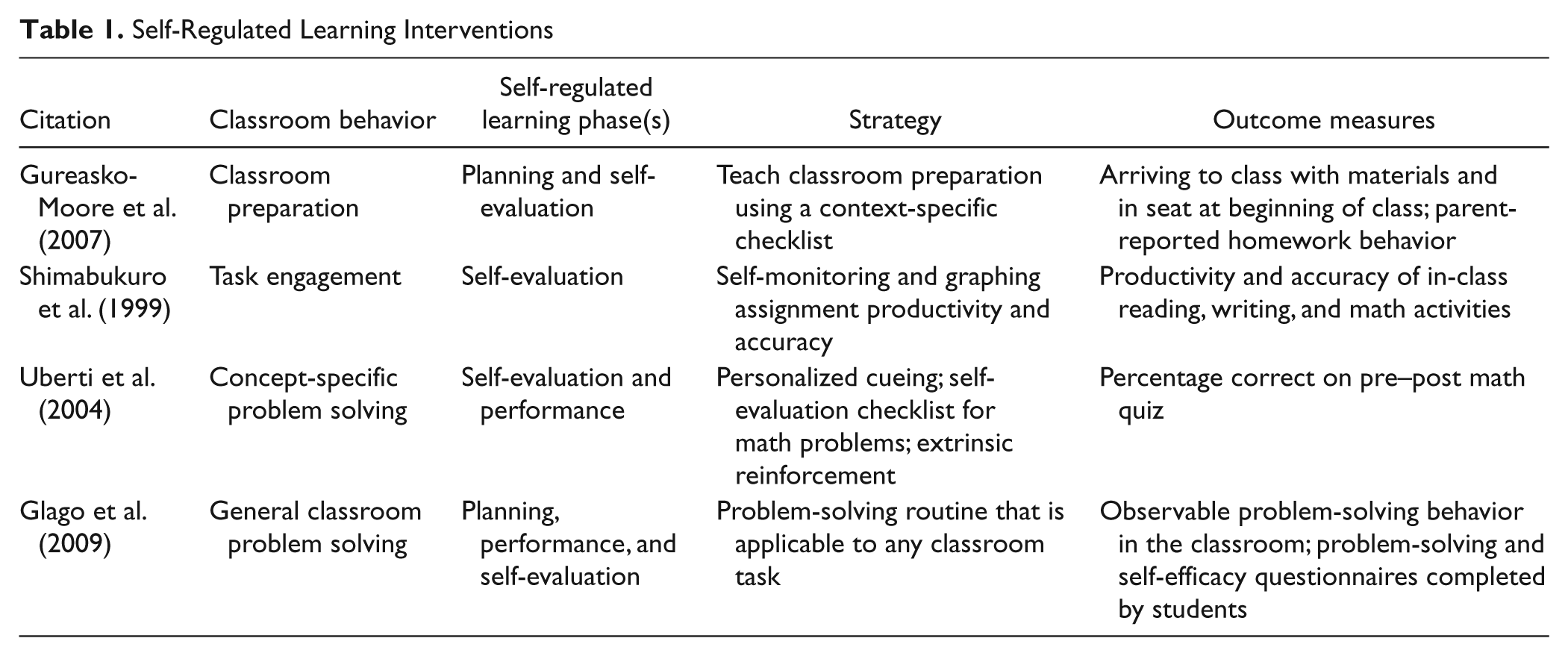
Gureasko-Moore, DuPaul, and White (2007) taught six 11- to 12-year-olds with ADHD a self-regulation strategy to help manage “classroom preparation behavior.” They operationally defined classroom preparation to consist of four expected behaviors: (a) student seated when the bell rang, (b) student made eye contact with teacher when instruction began, (c) student had pen or pencil on desk, (d) student had relevant instructional materials open when the lesson began. The students were taught to self-monitor their classroom and homework preparation during individual training sessions. Following implementation of the self-monitoring procedure, the percentage of teacher-reported classroom preparation behaviors increased across all six participants. The researchers then faded the checklist, instead using student interviews to facilitate self-monitoring. Eventually, the interviews were faded as well, and classroom preparation maintained a high level across students (Gureasko-Moore et al., 2007).
Performance Phase: Problem-Solving Strategies
Students with LD and other high-incidence disabilities are known to have difficulty managing unanticipated problems in classroom settings (Klassen & Lynch, 2007). Examples of these problems could include persisting with an unexpectedly difficult task and seeking help when the teacher is not immediately available. This has been related to avoiding academic work, procrastination, and low persistence during difficult or nonpreferred academic work (Gajria & Salend, 1995; Klassen, Krawchuk, Lynch, & Rajani, 2008). To address this issue, a number of different interventions have been reported in which students were taught basic problem solving strategies to deal with content specific (i.e., math problems) and general classroom challenges (Montague, 2008; Snyder & Bambara, 1997).
Glago, Mastropieri, and Scruggs (2009) reported the results of a study examining the effects of a 6-week intervention targeting classroom problem solving for 21 students in fourth and fifth grades, 15 of whom were identified with LD and the remaining 6 of whom were identified with emotional disability. Half the participants were assigned to an experimental group and half to a control group. The experimental group participated in weekly 30- to 40-min group instructional sessions to learn a general problem- solving strategy. During the sessions, students were taught a five-step problem-solving strategy: (a) identify the problem, (b) think of solutions, (c) pick the best one, (d) try it out, and (e) see if it worked. The results of the study indicated that students in the experimental group learned the strategy and produced problem-solving behaviors consistent with the intervention within the classroom (e.g., asking for help on new, difficult tasks). Students in the experimental group also reported higher self-efficacy, or control over their own learning, compared to students in the control group (Glago et al., 2009).
Self-Evaluation Phase: Self-Monitoring Accuracy and Productivity Strategies
Another approach targeting SRL is teaching students to self-monitor performance of classroom activities. Self-monitoring involves periodic checks of both thought processes and academic productivity. Students who self-monitor their learning recognize when initial expectations (i.e., task requirements or knowledge of the subject) are inaccurate and adjust their approach accordingly (Boekaerts, 1997). Efficient learners evaluate task-specific processes and judge success based on how effectively the strategy facilitated their learning (Belfiore & Hornyak, 1998). Systematic reviews of self-monitoring interventions have demonstrated positive effects on academic accuracy, productivity, and on-task behavior for students with ADHD (Reid, Trout, & Schartz, 2005), LD (Reid, 1996), and emotional-behavioral disorders (Mooney, Ryan, Uhing, Reid, & Epstein, 2005). Below are two examples of self-monitoring strategies targeting SRL in the classroom for students with LD.
Shimabukuro, Prater, Jenkins, and Edelen-Smith (1999) reported the results of a study investigating the effects of a self-monitoring strategy on academic productivity and accuracy for three middle school students identified with both LD and ADHD. The students were in a self-contained, mixed grade classroom in a private school. The participants were taught to self-monitor their academic accuracy in a self-contained classroom during periods of independent work throughout the school day. The students then graphed accuracy (i.e., % correct) and productivity (i.e., number completed) to record and evaluate their performance over time. The results of the study indicated improvement in accuracy and productivity across all three subjects (i.e., reading, math, and writing) as well as increased proportion of time on task, suggesting a functional relationship between self-monitoring, accuracy or productivity, and engagement during classroom activities (Shimabukuro et al., 1999).
Uberti, Mastropieri, and Scruggs (2004) described a strategy targeting math problem solving for third graders in an inclusive classroom. The students were English language learners identified with LD and were selected based on poor math test results. The special educator conducted an individual error analysis for each student and developed task-specific checklists tailored to each student’s mistake pattern. The checklist was used to illustrate the problem-solving procedure as well as teach the students to self-monitor their accurate completion of each step. Stickers and prizes were used to reinforce using the checklists and solving problems correctly. After the end of the 7-day intervention, the participants completed an exam with the rest of their classmates and demonstrated virtually the same concept mastery (Uberti et al., 2004).
Taken together, this sample of SRL strategy instruction research illustrates key principles necessary for designing and implementing strategies. Table 1 summarizes each SRL intervention and the outcome variables described across studies.
Self-Regulated Learning Interventions
Implementation Example
The studies described previously illustrate the effects of strategy instruction on academic behaviors consistent with the SRL cycle. To foster translation of this research to classroom application, a case study is presented. The following vignette illustrates how one special education teacher collaborated with a researcher and classroom teacher to apply the principles of contextually based SRL interventions for students who were identified with high-incidence disabilities. The intervention is consistent with those described earlier in that the student is taught a strategy, the strategy targets SRL in the classroom, and the strategy addresses the needs of the student in a particular context. The intervention is offered as a model for enhancing SRL, which takes into account the student’s needs, the learning context, and the nature of the required academic task.
Chris was a sixth grade boy who was identified with LD. His full-scale IQ was 119; however, his math and literacy skills were well below expected achievement (see Note 1). His special education services included assignment accommodations, in-class assistance from the special education teacher in math and English classes, and extra time for completing exams. Chris was a good athlete and derived much of his academic motivation from participating in team sports. He rarely missed a class; however, the teacher noticed he was a doodler (i.e., drew pictures during class) and liked to be thought of as one of the funny students in class. According to the special education teacher, Chris’s parents and his classroom teachers felt significant barriers to his success in class, particularly math, were poor engagement and difficulty managing classroom materials.
Baseline Data Collection
The emergence of evidence-based practice has resulted in greater emphasis on applying scientifically supported teaching practices in special education (Burns & Ysseldyke, 2009). A key component of evidence-based practice is systematic measurement of student progress following intervention (Cook, Tankersley, & Harjusoloa-Webb, 2008). To monitor Chris’s progress during the intervention, the special education teacher collected baseline and follow-up data. These data included performance assessment and observation measures, and the special education teacher’s approach for collecting and analyzing the data is reported in the subsequent paragraphs.
The special education teacher collaborated with Chris’s math teacher to collect baseline data. Chris’s math grade was a C– at the beginning of the intervention. The special education teacher used the schoolwide behavior support program to measure intervention effects. At the participating middle school, teachers rated perceived effort using an 8-point scale derived from predetermined criteria. Chris’s effort rating in math was a 7 prior to the intervention, one above the lowest possible effort rating. The special education teacher also asked the math teacher to complete a four-item rating scale measuring how frequently Chris brought materials to class (50–75% of the time), his readiness to learn at the beginning of class (50–75% of the time), his engagement during class (25–50% of the time), and how often he worked independently (50–75% of the time).
To triangulate the math teacher’s report, the special educator and research collaborator observed Chris’s classroom preparation and engagement for 5 consecutive days. They found Chris was in his seat and had pencil, paper, and math book 4 out of the 5 days (80%); however, he was looking at or oriented toward the teacher only 1 of the 5 days (20%). Also, the researcher measured the percentage of time Chris was “on task” during math class. On task was defined by standards described in a previous research study (Stahr, Cushing, Lane, & Fox, 2006) and was measured by recording on-task or off-task behavior every minute throughout the 50-min class period. Chris’s average engagement during the 5-day baseline data collection period was 47%.
To measure Chris’s perception of SRL, the special education teacher asked him to respond to four prompts: (a) his main reason for not getting an A in math, (b) his better assessment paradigm—tests or homework, (c) his attribution for success, and (d) his self-evaluation on how he could improve. In addition, Chris was asked to complete the Academic Volitional Strategy Inventory (AVSI; McCann & Turner, 2004). The AVSI is a 20-item questionnaire measuring three different SRL strategies: self-efficacy enhancement, negative-based incentives (e.g., self-reward or punishment), and stress-reducing actions. Using the interview prompts and the results of Chris’s AVSI, the special education teacher determined that Chris’s SRL strengths consisted of using good stress-reducing strategies and active engagement in social information seeking (i.e., asked peers or teachers for help). Areas that contributed to his academic difficulty included low academic self-efficacy (e.g., “Math is just not my subject”) and poor engagement during class (e.g., “When I listen more I get it more easily”).
In summary, baseline data were collected for more than 1 week. The measures included class grades, teacher-reported effort and classroom preparation, direct observation of on-task behavior, and student self-report of SRL. The special education teacher synthesized and interpreted these data to suggest Chris was not arriving to math class oriented to learning and that his level of engagement was not conducive to acquiring important concepts in class. Taken together, low self-efficacy and disengagement contributed to poor concept acquisition and subsequent low exam scores, resulting in a C– in math. The special education teacher and Chris decided they would set a goal to improve his math performance by targeting preparedness to learn and on-task behavior. It was hoped this would improve Chris’s ability to obtain more math concepts resulting in improved exam scores. The special education teacher also set a secondary goal to improve Chris’s sense of control over his own learning by showing him how to prepare for class and anticipate barriers to success.
Systematic Instruction: Model, External Aid, and Practice
The special education teacher, the math teacher, and the researcher agreed that certain behaviors were expected in class and reflected SRL. To clearly define these behaviors and help students, such as Chris, remember these expectations, an acronym was created to teach classroom preparation and engagement skills. Self-regulation in the classroom was operationally defined by four constructs: (a) Materials: bring pencil/pen, paper, and book to class, (b) Anticipate: prepare for barriers to learning in class, (c) Ready to learn: be seated and focused on teacher at beginning of class, and (d) Stay on task. The constructs were combined to produce the acronym MARS.
A strategy was developed to teach students to self-evaluate SRL using MARS. Chris applied the strategy in his math class. The strategy consisted of using an external aid that prompted Chris to remember the four key constructs and to self-evaluate his daily performance on each skill. The external aid is depicted in Figure 1. The special education teacher taught Chris to use the strategy during voluntary homework support time after school. She spent 2 days discussing the importance of each letter and explained the types of behavior indicative of each letter in class. Next, the special education teacher helped Chris practice using MARS during homework completion time after school. Once it was evident Chris had memorized the strategy, MARS was implemented during the regular school day.
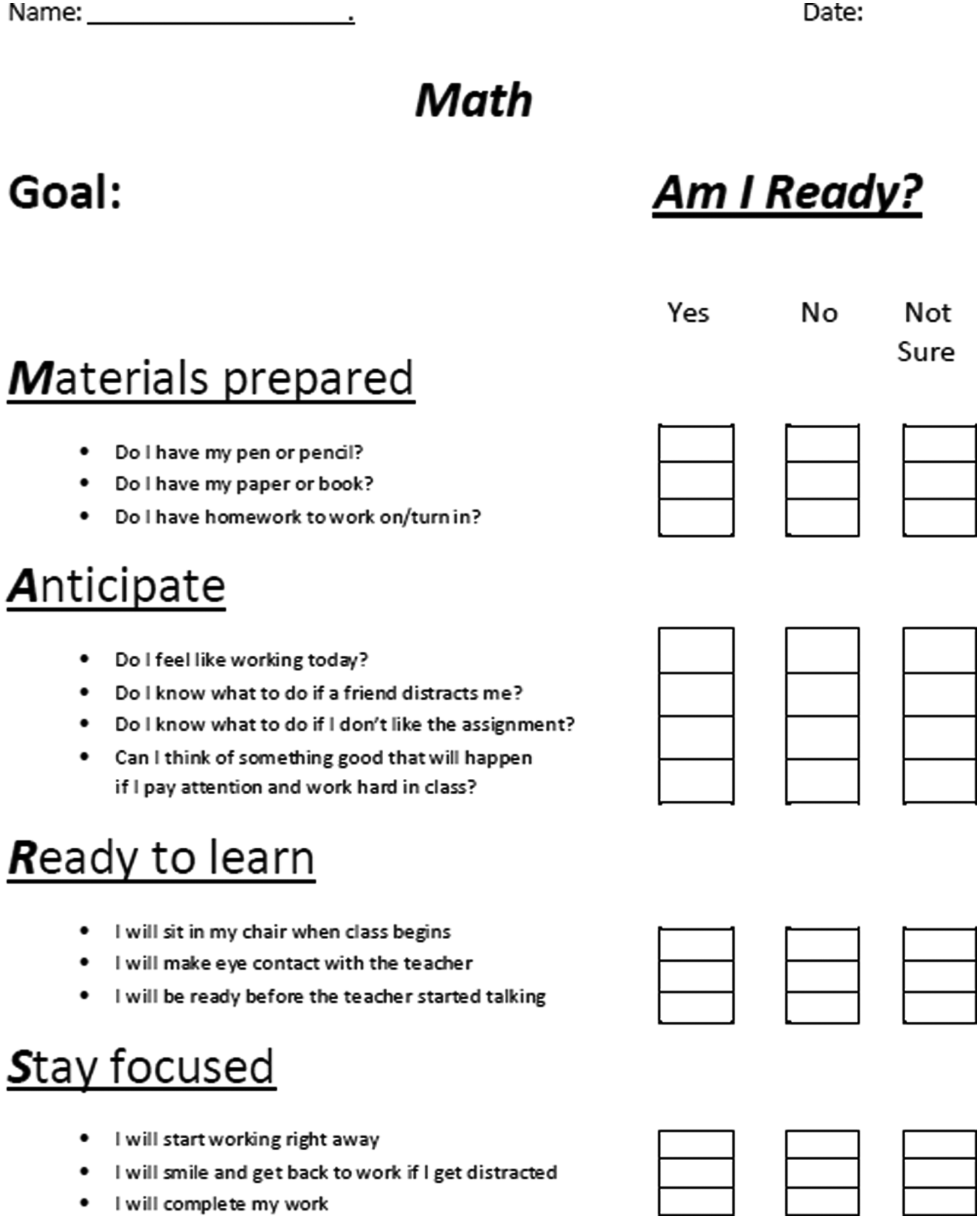
MARS template
SRL: Planning and Self-Evaluation
The MARS template was used to teach Chris classroom preparation and engagement skills and to support his self-evaluation. Each letter was offset with prompts to engage Chris’s readiness to learn (e.g., “I will be in my seat before the teacher starts talking”) and respond to potential barriers to classroom engagement (e.g., “I know what to do if a friend starts distracting me.”) The special education teacher taught Chris to use the MARS worksheet to set goals before class pertaining to preparedness and engagement and to self-evaluate how well he accomplished those goals after class.
Context-Specific Implementation
Consistent with published accounts of self-regulated strategy instruction, MARS was implemented in a contextually relevant fashion. The special education teacher used a check-in/check-out (CICO) paradigm to deliver the intervention. She met with Chris right before math class each day and asked him to complete the MARS checklist, using the letters and prompts to engage Chris in preemptive cognitive-motivational strategy use. During math class, the special education teacher and researcher recorded Chris’s classroom preparation and on-task behavior to evaluate the effect of the intervention. Later in the day, during Chris’s home room period, the special education teacher used the MARS template again to promote self-evaluation. Chris was asked to rate how well he did with each letter and record one area he could improve. During check-out, the special education teacher provided feedback pertaining to Chris’s responses (e.g., discuss how seating choices affected performance) and helped him monitor curricular progress (e.g., homework completion and concept acquisition). Once Chris learned the acronym and accompanying prompts, the special education teacher faded the use of the external aid; however, she maintained CICO until the end of the year unless scheduling conflicts prevented meeting. On average, the check-in sessions were limited to 5 min and check-out lasted no longer than 10 min. To make the intervention more feasible, CICO was conducted in small groups frequently, particularly if students on the special education teacher’s caseload were in the same class or had the same home room.
Results
Baseline data collection and regular progress monitoring helped the special education teacher and collaborators determine MARS produced an immediate increase in Chris’s on-task behavior and classroom preparation. On-task behavior was measured in the classroom twice each week for one month. Chris was rated by the researcher on whether he was on task or off task every 60 s for the duration of the class. An assistant also recorded on-task behavior to evaluate and document interobserver reliability (83.25% exact agreement). Classroom preparation was also recorded (81.25% exact agreement). Four behaviors were recorded as present or absent and were documented at the beginning of class: (a) had pencil/pen, (b) had relevant book, notebook, and material on desk prior to teacher talking, (c) in seat before instruction began, and (d) eyes on the teacher at the beginning of class.
During baseline measurement, Chris averaged 48% intervals on task over a 1-month time frame (on-task data were recorded twice a week yielding 8 data points during the baseline phase). He averaged 50% (2/4) classroom preparation behaviors during baseline. After the intervention was implemented, Chris’s on task average increased to 67% and his average classroom preparation increased to 82.5% (3.3/4). A total of 5 data points were recorded after implementation for on task and classroom preparation.
Additional data were collected to measure the generalized impact of improved self-regulation in class. First, Chris’s math teacher was asked to complete a postintervention readiness to learn rating scale. The teacher’s responses were the same for ready to learn, works independently, and has materials, however the engagement rating increased from 25–50% to 50–75%. Chris’s final grade in math improved from a C– to a B–, and his final effort rating improved from 7 to 6. The special education teacher obtained subjective reports from Chris and his mother indicating he learned the importance of planning to participate in class and was very happy with his improved math grade.
Summary
This article illustrates one model for implementing SRL strategies using a case example to emphasize instructional procedures, contextual relevance, and measuring outcomes. The utility of this model is that MARS seeks to foster multiple aspects of SRL (especially planning and self-evaluation) and can be adapted to meet student needs unique to their particular context. By determining Chris’s SRL needs specific to math class, the special educator selected strategies that fostered planning and self-evaluation of learning in the classroom. Figure 2 summarizes key elements of MARS implementation illustrated by Chris’s case. The results support the hypothesis that Chris’s difficulties were related to not being prepared to learn and to having difficulty managing distracters in the classroom. Improvements in Chris’s classroom preparation and on-task behavior were matched by improved classroom grades and teacher-perceived engagement in class.
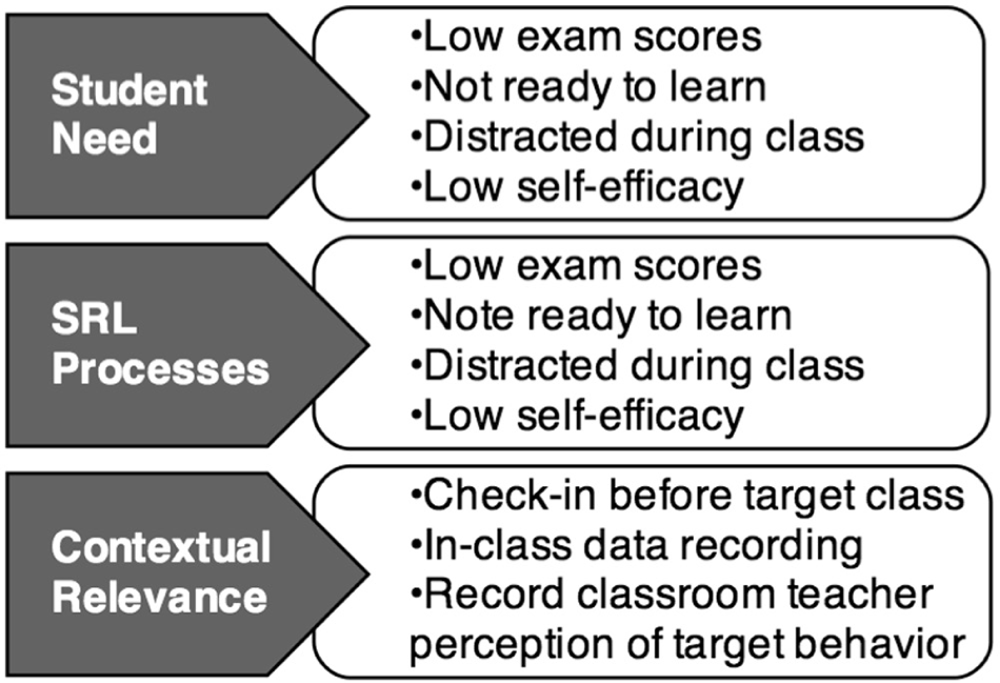
MARS implementation considerations illustrated by Chris’s case
SRL behaviors predict overall academic achievement and concept mastery (Feldman, Martinez-Pons, & Shaham, 1995; Schunk, 1998; Wolters, 1999) as well as success in writing (Graham, Harris, & Mason, 2005) and reading (Horner & O’Connor, 2007). However, students with LD are known to struggle with self-regulation. There is a need to equip educators with instructional models that are both theoretically sound and easy to implement in complex educational settings (Schunk, 2008). Self-regulation interventions improve academic functioning by expanding the student’s repertoire of strategies, use of strategies, and academic self-efficacy (Cleary & Zimmerman, 2004).
The SRL research indicates there are several key design features to be considered when implementing strategies. For instance, SRL strategies should seek to enhance self-regulation processes within the classroom (e.g., classroom preparation, problem solving, and self-monitoring). Next, the SRL cycle should provide a framework on which new strategies are developed. The planning, performance, and self-evaluation phases provide a theoretically based reference for interventionists seeking to identify student needs. Finally, SRL strategies should be implemented and evaluated in a contextually relevant manner. This suggests that educators should endeavor to teach strategies where students will use them, and the target behavior must be observed in context.
As inclusive education becomes the standard for educating students with disabilities, the need for simple, effective, and efficient educational interventions grows. This article highlights how SRL lends itself to strategy implementation in the classroom for students with LD. The MARS strategy is not intended as a one-size-fits-all cognitive strategy; rather, it represents one way for educators to develop unique strategies tailored to the situational and task-specific needs students with LD encounter. Ultimately, promoting SRL entails supporting students to select and use different strategies to meet the immediate challenge presented in a classroom.
Footnotes
Acknowledgements
The authors wish to thank Pam Richard and Gina Caputo for their invaluable contributions.
The author(s) declared no potential conflicts of interests with respect to the research, authorship, and/or publication of this article.
The author(s) received no financial support for the research, authorship, and/or publication of this article