




Abstract
Adolescent students with learning disabilities (LD) often have a difficult time in secondary general education classes for a variety of reasons. One reason is the lack of study skills necessary to successfully navigate through content area courses. As secondary students with LD spend more time in the general education classroom, it is important for them to learn and apply these study skills that help them become independent learners. There are many skills that fall under the broad term of study skills; in this article, five strategies that fall under the umbrella term of study skills are discussed: guidelines for using the explicit instruction model for teaching study habits, time management, self-management, obtaining information from textbooks and lectures, and interpreting visual aids.
The Individuals With Disabilities Education Improvement Act (2004) mandates that students with disabilities have access to the general education curriculum. The content presented in these general education courses at the secondary level (i.e., middle and high school) is foundational for future learning and developing skills to become productive adult citizens (i.e., college and career ready). Moreover, students must understand this information well enough to pass high-stakes state and district-mandated tests, as required by the No Child Left Behind Act (2002). As more students with learning disabilities (LD) are being included in the general education classroom and being held to higher standards and a more rigorous curriculum, many secondary teachers need to find ways to support students develop the skills necessary to access and attain requisite knowledge and skills.
The transition from elementary school to middle school is a time when students are expected to become independent learners with less guidance from teachers (Boller, 2008). New demands such as managing multiple teachers and assignments require students to have organizational skills and self-management strategies. Teachers cannot assume students are able to manage all of these demands and must provide explicit instruction in the area of study skills. The term study skill covers a variety of skills needed for acquiring, recording, organizing, synthesizing, remembering, and using information presented (Hoover & Patton, 1995). When learned and applied correctly, these skills allow students to become effective, efficient, and independent learners (Hoover & Patton, 1995; Paul & Elder, 2002). Successful adolescent students develop study skills in both the management (e.g., study habits, time management, self-management) and cognitive (e.g., note taking, interpreting visuals, using references; Getting & Seibert, 2002) domains. Many would agree that skills from these domains are necessary to be successful in content area courses; the question is where and when these skills should be taught. Secondary teachers believe their sole responsibility is to teach content and expect students to come to their classes prepared with these skills (Scruggs, Mastropieri, Berkeley, & Graetz, 2010), yet the organizational and content demands of elementary education may limit the practicality of teaching study skills in the younger grades. What this means for students with LD is that they may not be taught the skills necessary to become efficient, independent learners. Even if the question of when study skills should be taught can be answered, the question of where must be addressed. School districts may choose to offer study skills as a separate class or integrate the knowledge within content area courses. Regardless of when and where these skills are taught, students must receive explicit instruction to fully understand how to use them in their learning.
Students with LD learn best when they are explicitly taught skills (Graham, Harris, & MacArthur, 2006; Knight, Smith, Spooner, & Browder, 2012; Rupley, Blair, & Nichols, 2009; Ryder, Tunmer, & Greaney, 2008), and teaching study skills is no exception (Bakunas & Holley, 2004; Getting & Seibert, 2002). Explicit instruction follows a sequence of teaching events that help students understand the content or skill being presented. First, teachers assess student background knowledge and provide a rationale for why the skill should be learned. Once the level of background knowledge is determined, teachers model the skill being taught by talking through all of the steps and providing demonstrations. Next, during guided practice, teachers guide student learning by asking several questions, scaffolding, prompting, or possibly completing skills together. Once students reach a high level of understanding (e.g., 85% or higher), they move to independent practice, where they perform the skill on their own. Because students may have difficulty with generalization, once they have successfully used the skill independently it is important that maintenance of the skill is evaluated over time (Waters & Waters, 1992). As with learning any new content, students must be provided ample opportunities to develop study skills in their classroom settings. Although this standard model of explicit instruction is not new to the field, teachers can overlook the importance of adhering to each stage of the sequence when teaching a strategy; that is, teachers view strategies as helpful tools students apply to learn content, and they forget to teach the strategy as content. The model of explicit instruction should be followed for teaching each of the skills within the management and cognitive domains presented in this article.
Management Domain
As mentioned previously, secondary students have many demands on their time (e.g., school, homework, extracurricular activities, jobs, family, friends), and effective organizational and management skills are necessary for success (Decker, Spector, & Shaw, 1992). Many students at the secondary level have poor organizational skills—they forget to write assignments down, lose papers because they have no systematic way of keeping track of them, either don’t complete homework or forget to turn it in, and have difficulty managing long-term assignments. Unfortunately, for many students the lack of organizational skills has a negative effect on their grades. Strong organizational skills are prerequisites for other study skills. First, students must have a system for organizing their materials (Bakunas & Holley, 2004). Students should have a system for ensuring they are bringing the needed materials to class each day. Most classes require students to bring their textbook, writing utensils, paper, and an assignment notebook.
Time Management
Structuring one’s time can be a daunting task for many, but developing schedules and setting goals may lessen the difficulty. Assisting students in developing both weekly and daily schedules is imperative; students need to know when assignments are due, what reading needs to occur, and how to plan their leisure time. Another area of difficulty for many students is planning for long-term assignments such as research papers, presentations, and group projects. Teachers and students should go through the following steps together as soon as a long-term assignment has been given: (a) determine the steps needed to complete the final projects (it may be necessary to list more specific steps needed to complete the bigger steps), (b) assign due dates for when each of these steps should be completed, and (c) list the needed materials for each step.
Study Habits
Identifying a designated study place that is available, comfortable, free from distractions, properly lighted, and the appropriate temperature and has a table or desk with ample workspace is the first step in developing good study habits. If it is not possible to have all of these criteria in place, students should identify one place that is their study place. Once a study place has been determined, students must evaluate their study habits. Following the explicit instruction model, students must be taught to evaluate those habits. The following questions should be asked:
Do I have study time planned into my daily schedule? Have I set goals? Do I have the needed materials? Have I planned for study breaks? Have I scheduled more complex tasks for when I’m most alert?
Figure 1 provides a sample form students could use to organize their time and evaluate their study habits. First, a weekly calendar for school hours is provided for students to record daily homework assignments as well as assignment due dates. Weekends are included so students can include study, work, and family and friend time then as well. The next section is used to record after-school activities, including extracurricular activities, work hours, leisure activities, family time, and study time. The third section is space for students to record long-term assignments and the dates that smaller components are due. The final section provides students with a checklist to remind them to identify a good study place and an organizational checklist. It is not enough to develop the schedule; students must follow through on their plans and realize the impact it has on their learning. Students should keep a log of the time actually spent completing their activities after school. They should then compare the actual times to the amount of time they allotted on their schedule. If the two do not closely match, a student may need continued assistance from teachers in how to realistically plan his or her time.
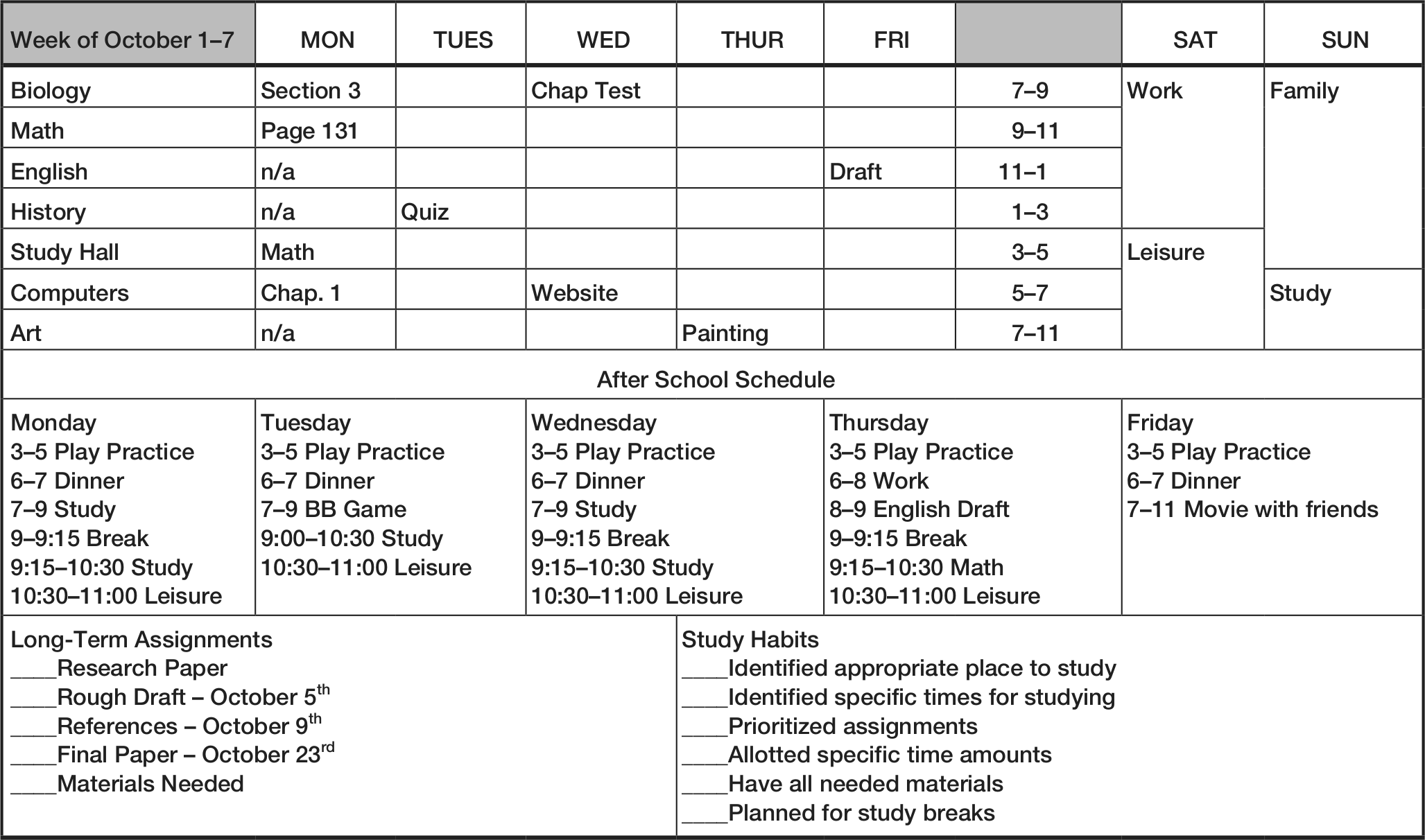
Time management and study habits.
Self-Management
Efficient organization and time management is the first step to becoming an independent learner; however, students must also develop and use effective self-management skills, including self-monitoring, self-evaluating, and self-reinforcing, as needed. Self-monitoring requires students to identify behaviors needing change (e.g., time on task, completing homework assignments) and to then record their own behaviors (Dalton, Martella, & Marchand-Martella, 1999; Gans, 2008; Rock & Thead, 2007). Self-evaluation requires students to judge both how well they understand directions for completing a task and how well they completed a given task or assignment (Harris, Friedlander, Saddler, Frizzelle, & Graham, 2005; Joseph & Eveleigh, 2010; Lee, Palmer, & Wehmeyer, 2009; Levendoski & Cartledge, 2000). For example, prior to beginning an assignment, students should evaluate their understanding of the directions to ensure they know what to do. If not, they should have a strategy (e.g., calling a friend, using a homework hotline) to fix this. Once assignments are completed, students should ask themselves the following:
Was my assignment completed according to expectations set by my teacher? Did I remain focused during the studying?
A simple rating scale of 0, 1, 2 (0 = little understanding, 1 = some understanding, 2 = full understanding) can be used. If students are giving themselves a 0 or 1 in any of the areas, they may need explicit instruction in the area of concern.
Self-reinforcement allows students to identify reinforcers that motivate them to complete tasks, such as watching their favorite television show, playing video games, or spending time with family and friends. Students should generate realistic reinforcers and determine when they should be given these reinforcers (i.e., what needs to be accomplished prior to receiving the reinforcement). To teach these skills, teachers must provide a rationale for each of the skills, stating why each is important and how to use the data to improve their learning. Recording forms will need to be developed so students have something tangible to determine the progress they are making. Figure 2 provides an example data collection sheet, questions for self-evaluation, and a list of possible reinforcers and when they should be given. Teachers should model how to use the data sheets for students. Once data recording has been modeled, students can begin using their forms and working on the behaviors independently, with ample teacher feedback. Prompts and corrective feedback provide the necessary instruction students need when developing skills in self-management. Once students are able to reliably record their behavior, prompts and teacher feedback can be faded. In terms of self-evaluation, the teacher should assist students in developing a rationale that will help with maintenance of effort and serve as a motivational tool.
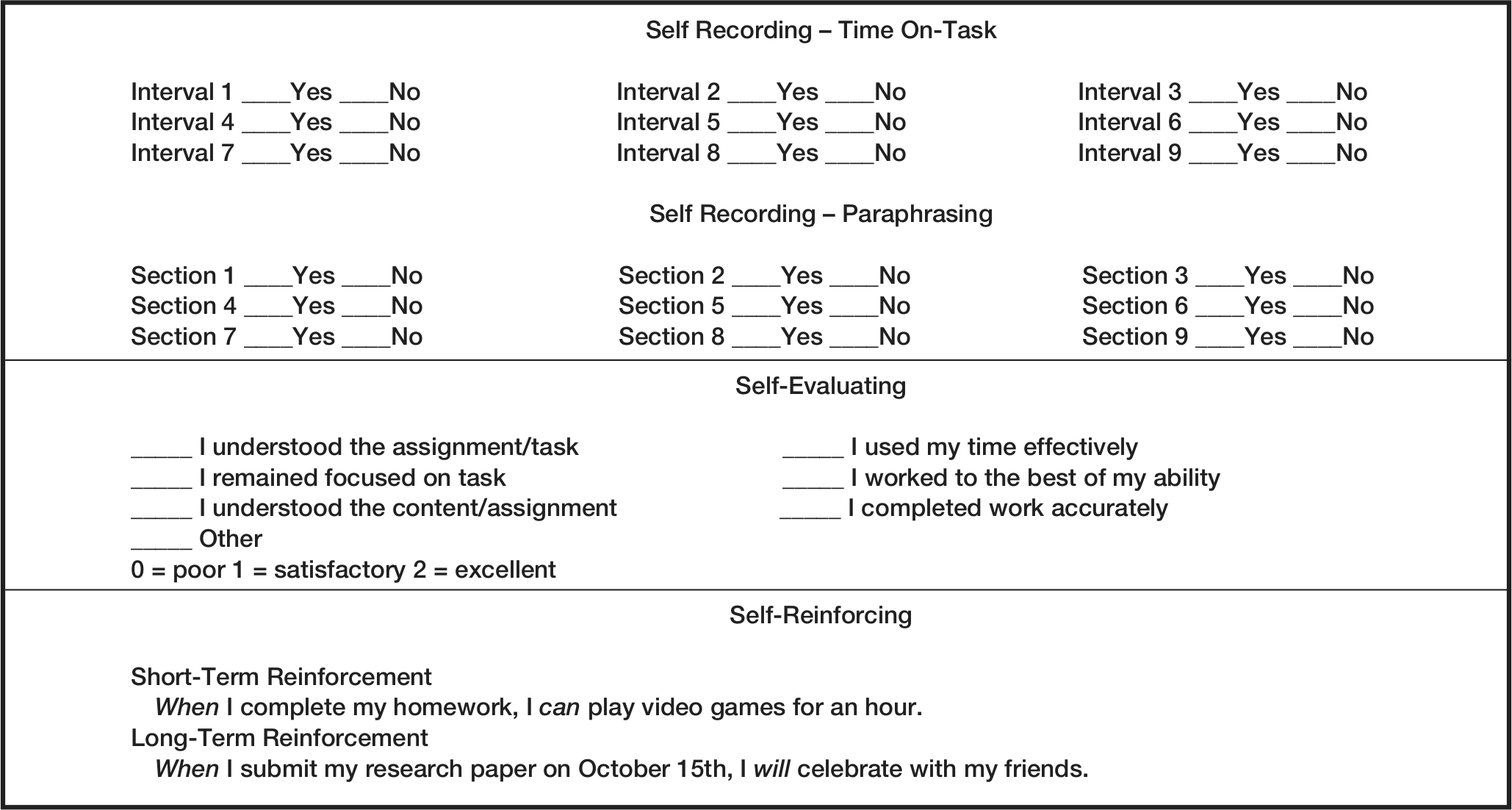
Self-management.
Having effective time management and self-management skills is important, but students must also develop skills that allow them to fully obtain information from lectures and textbooks. Secondary students can use these self-management techniques while learning and implementing the following skills in their content area courses.
Cognitive Domain
Obtaining information from textbooks and teacher lectures requires students to comprehend what they are reading, listen closely to teacher presentations, distinguish important from unimportant information, hold information in working memory long enough to transfer it to paper, and recall critical information for future use. Good note-taking skills, the ability to understand visual aids, and effective use of online reference resources will allow students to better obtain this information.
Abbreviations and Symbols
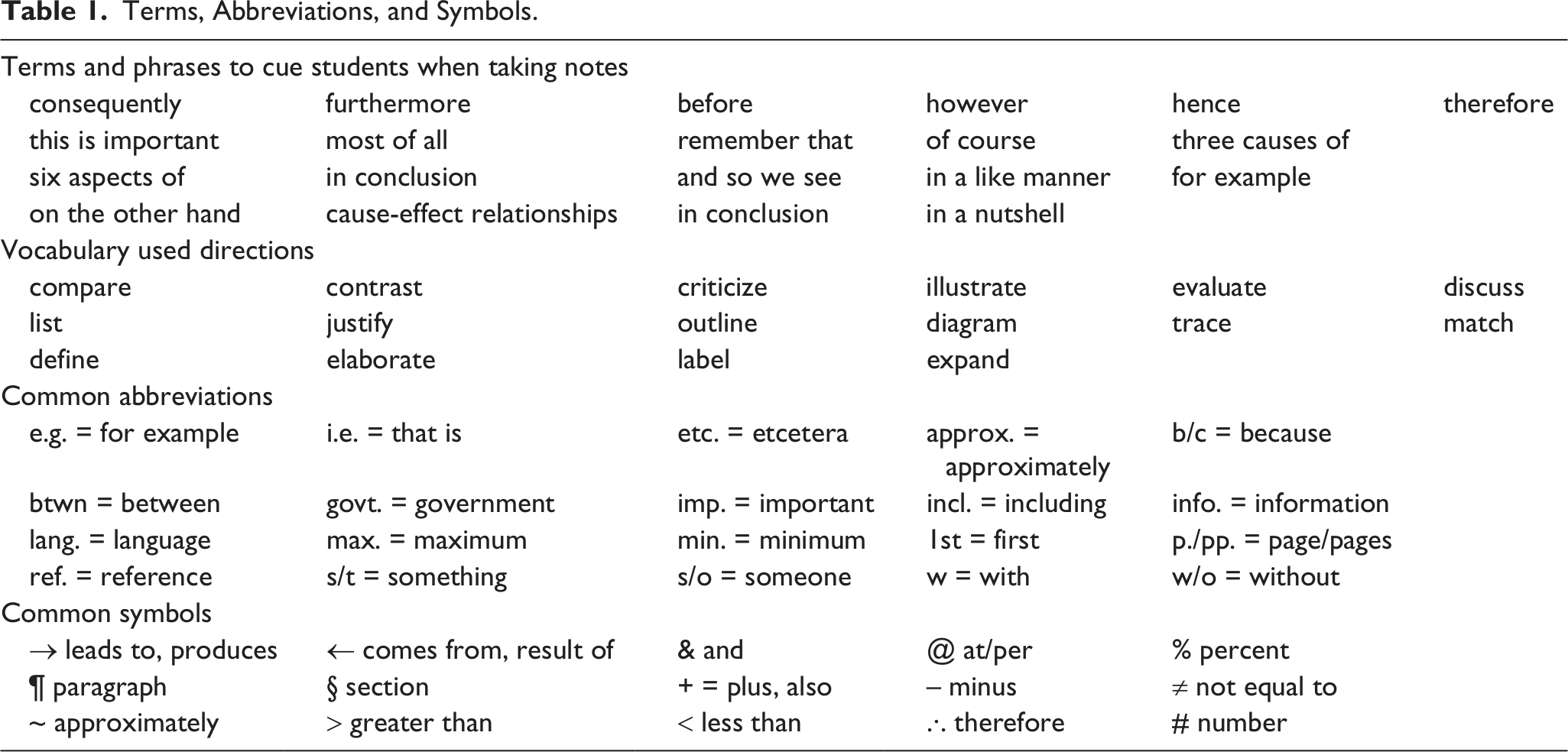
Understanding content-specific vocabulary is necessary to be successful in content areas (Bryant, Goodwin, Bryant, & Higgins, 2003; Roberts, Torgesen, Boardman, & Scammacca, 2008); however, students must also be able to identify and define common terms, abbreviations, and/or symbols used during lectures (Boyle, 2010, 2011). The use of common terms, abbreviations, and symbols (see Table 1) may seem like a simple concept, but students may have difficulty, and as always, teachers must explicitly teach these terms and symbols and then use them in lectures, giving students the opportunity to see them being used.
Terms, Abbreviations, and Symbols.
Note-Taking
In addition to teaching the terms, abbreviations, and symbols discussed above, students need to have strategies for obtaining information from textbooks and lectures. Figure 3 provides one method that allows students to organize the information for future use. First, the preview chapter section is completed prior to reading the chapter, by spending 5 to 10 minutes looking through the chapter to determine the main ideas and to note any visuals that might be helpful in understanding the text. The vocabulary section provides space for students to record important vocabulary terms that (a) they identified while previewing the chapter (e.g., bold or italic words), (b) were used by the teacher during lectures, or (c) they did not recognize while reading. Students should write down the terms and look up the definitions later, if needed. Teachers and students complete these two sections together the first several times the form is used, with teachers checking for accuracy. Once students accurately complete the first two sections with minimal guidance, they can complete them independently without using class time to complete.
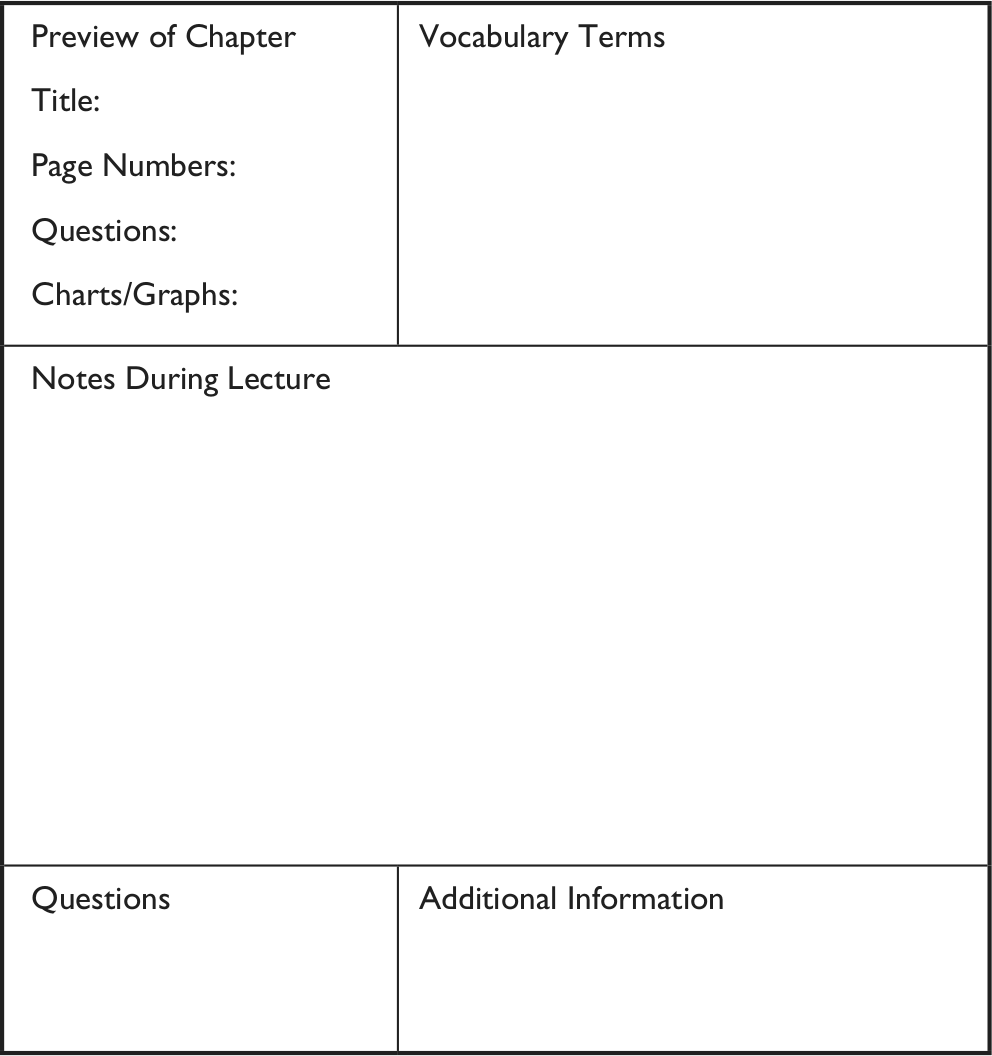
Note taking.
In the notes during lecture section, students record notes from lectures, using keywords, abbreviations, and symbols described above. Teachers cue students using the terms listed and then make sure students record the information. When students have questions or do not understand something during the lecture or while reading, they should write those questions in the questions section so they either remember to ask their teacher or go back to the textbook for clarification. The final section, additional information, is used for students to record either information found in their textbook or other resources after the lectures. As with the other skills described here, teachers check student work to ensure that the content is appropriate and accurate. If chapters are long, it may be more useful to use this form for each section of a chapter rather than completing it on the entire chapter at once.
Interpreting Visuals
Textbooks are full of visuals intended to assist students in understanding large amounts of information, and students are expected to gain a great deal of information from these visuals and other materials provided by teachers. These visuals are helpful for students only if they understand how to use them correctly. When interpreting visuals, students must be able to do two things: understand the purpose for each type of visual (see Table 2) and understand how to extract the information presented. The most common types of visual aids students will encounter in content classes are graphs, tables, charts, diagrams, and maps.
Using Visual Aids.
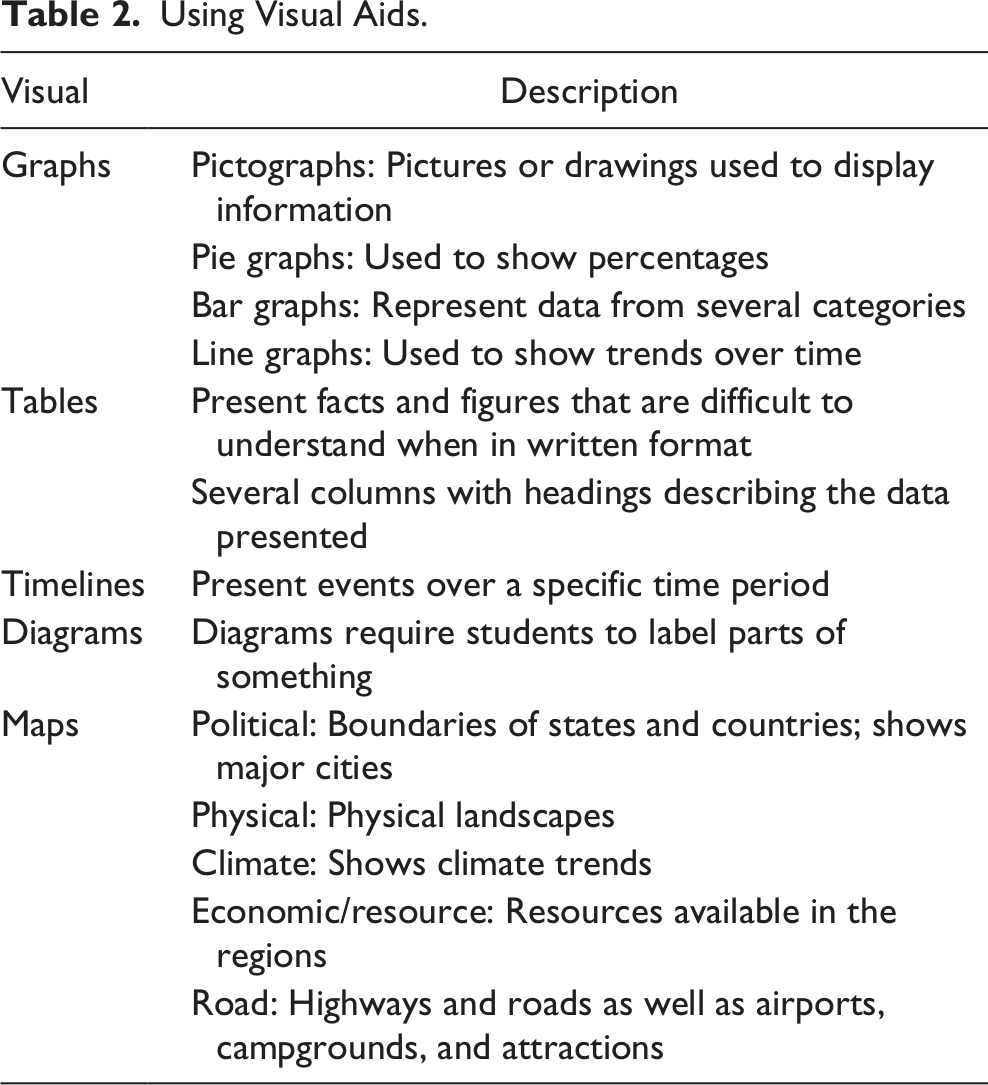
Graphs, which provide data broken into parts, can be categorized by one of four main types (pictograph, bar, line, and pie). Most have four similar structural components that students need to identify: (a) framework, (b) specifiers, (c) labels, and (d) backgrounds (Friel, Curcio, & Bright, 2001). The framework of a graph consists of its axes, scales, grids, and reference indicators. Specifiers refer to the visuals used to represent data on the graphs (e.g., lines, bars). Labels on graphs include the title and headings on the axis. Background includes the coloring, pictures, and so forth included on the graph. Being able to identify the key components of a graph is only the first step; students must also be able to comprehend the graph in three critical ways: (a) translation comprehension—being able to describe the content of the graph in their own words, (b) graph interpretation—requiring students to manipulate the data and look for relationships, and (c) graph extrapolation—requiring students to understand the implications of the data (Friel et al., 2001).
Other helpful visuals include timelines, tables, diagrams, and maps. Timelines are used to show specific dates from important events in our history. Tables are effective tools to use when large amounts of data need to be organized and presented in an understandable format, rather than having to read all of the information. Diagrams are typically used in science classes, and students are asked to label. Finally, there are several types of maps commonly featured in secondary texts. Students must be taught how to use scales, as well as understand the keys and symbols. A critical feature of the four visuals is headings and subheadings that tell more about the specific information provided (Strichart & Mangrum, 2010). Students with disabilities can overlook such critical features, and as such, these aspects of visuals should be highlighted in teaching strategies.
Conclusion
Successful secondary students are able to navigate the many demands (e.g., school, work, leisure activities) placed on them with little guidance from adults. However, secondary students with LD often have academic difficulties and lack study skills that allow them to be successful, independent learners. Implementing the explicit instructional model, teachers are able to provide students with LD strategies for obtaining, organizing, and remembering information. Students with LD who develop these study skills within the management and cognitive domains are able to gain needed information from a variety of activities and reduce their level of frustration and failure.
Footnotes
Declaration of Conflicting Interests
The author(s) declared no potential conflicts of interest with respect to the research, authorship, and/or publication of this article.
Funding
The author(s) received no financial support for the research, authorship, and/or publication of this article.