




Abstract
Teachers, particularly at the middle and high school levels, rely heavily on textbooks to deliver curricular content. Often, students are asked to dive right into the content of a textbook that may or may not contain relevant information, is difficult to navigate, or requires prior content knowledge they do not have. To combat these issues and maximize the utility of textbooks, they must be selected carefully and implemented soundly. Yet, even these steps may not enable all students, specifically those with disabilities, to access them. Fortunately, digital textbooks may be an accessible option for some students. This article provides suggestions on (a) how teachers can carefully select textbooks, (b) effective methods for implementing textbooks, and (c) accessibility ideas for digital text for students with disabilities.
Keywords
As the country has moved beyond the advent of the Individuals With Disabilities Education Improvement Act (IDEIA, 2004), which sought to provide students with disabilities greater access to the general education curriculum, special and general education are no longer allowed to exist independently. Rather, they have been mandated to coexist. In an effort to meet state accountability standards and more recently, the Common Core Standards, special and general education have merged (Abell, Bauder, & Simmons, 2005). Although this merger (e.g., mainstreaming) has resulted in the physical integration of special education students into general education classrooms, mainstreaming has not guaranteed changes in how the curriculum is delivered (Abell et al., 2005). For example, as Abell et al. (2005) pointed out, mainstreaming has not done much to change how students are instructed nor the materials and methods used in instruction. Rather, the curriculum has remained the same, whereas only the physical makeup of the classroom has changed.
Curriculum encompasses all the content, assessments, materials, and learning experiences provided to the student, not simply the topics covered in class (Roger, 1996). An essential curricular component, but one that is often taken for granted, is the classroom textbook. Because nearly all teachers use textbooks to guide instruction and deliver content, textbooks play a central role in the education of all students, including those with and without disabilities (Kulm, Roseman, & Treistman, 1999). Further, when teachers lack the necessary preparation, they tend to rely heavily (even disproportionately) on the textbook (Budiansky, 2001). For example, the National Science Teachers Association reported 23% of middle school teachers have taught subjects for which they had no prior coursework (Budiansky, 2001), which means they are more likely to use their textbooks for instruction. Important findings about textbook implementation have been revealed in studies of typical instructional components in middle and high school social studies as well. First, the majority of middle and high school social studies and science classes move rapidly through the adopted textbook (Mastropieri & Scruggs, 2005). Second, independent activities in these classes often include reading text and writing answers to text-based questions (Mastropieri & Scruggs, 2005).
Given the frequent use and rapid pace of textbook implementation in the classroom, as well as the mandated integration of special and general education students (IDEIA, 2004), it is imperative that textbooks are selected with care and implemented effectively for all students. Although thoughtful selection and sound implementation are necessary, they do not guarantee accessibility, particularly for students with disabilities. Fortunately, advancements in technology offer students with disabilities some viable electronic alternatives. How we conceptualize the textbook, particularly for instructing students with disabilities, has changed dramatically with the emergence of multiple technologies. When a basic textbook will not suffice, teachers now have the option to use digital text. In this article, suggestions for carefully selecting classroom textbooks, implementing textbooks effectively, particularly for struggling learners, and using digital text to support the needs of students with disabilities are presented.
Selection
Most educators would agree that meeting the academic needs of all learners, especially in inclusive classrooms with highly varying skills and abilities, is a daunting task. The textbook is merely one tool teachers have at their disposal to meet those needs. Thus, choosing one textbook to adequately address students’ diverse abilities and disabilities, background knowledge, and interest areas must be done carefully and systematically. Although selection is generally spearheaded by district and school-level administrators, teachers are often involved in the textbook adoption process. Further, they usually have the flexibility to determine the scope and sequence of their course and can use the textbook to reflect these decisions (Kulm et al., 1999). So the question remains, what do educators need to consider before selecting a textbook?
First and foremost, given the accountability requirements for students with and without disabilities, good textbooks must align with state or district benchmarks and standards (Kulm et al., 1999). Namely, because all students, including those with disabilities, are expected to demonstrate proficient knowledge of state standards, it is imperative textbooks contain the tested content. However, when publishers claim their textbook is aligned to state or Common Core standards, many educators fail to realize the textbooks are created with the bottom line in mind. In the past, publishing companies catered to many states, leaving books often containing content unrelated to a particular state’s standards. This leaves teachers sifting through massive amounts of text and materials to determine which textbook offers the most focused approach to the standards covered in their courses (Kulm et al., 1999). Dave Barry, a humor columnist, pointed out American schoolchildren may not have the highest test scores in the world, but they do have the biggest backpacks (as cited in Budiansky, 2001). The point, although meant to be humorous, is clear: hefty textbooks do not necessarily translate to high test scores, as big is not always better. Students do not need textbooks that weigh down their backpacks with superfluous information, but ones that contain the pertinent content. Ultimately, the directors of Project 2061 Curriculum Materials Evaluation, part of a long-term initiative to develop research-based criteria for reviewing curricular materials on behalf of the American Association of the Advancement of Science, asserted that textbooks should be judged on their likelihood of helping students achieve learning goals in a particular content area (Kesidou & Roseman, 2002).
One aim of Project 2061 was to provide a systematic and reliable method for assessing how textbooks aligned to nationally accepted benchmarks and standards in math and science. Project 2061 recognized teachers and administrators lack the time and resources to diligently scrutinize multiple texts (Kulm et al., 1999). Therefore, they created a protocol for both content and instructional analyses of middle school math and science, algebra, and high school biology textbooks. The results of these evaluations are published online (http://www.project2061.org/publications/textbook/default.htm). Although it is beyond the scope of this article to discuss their extensive findings, several core components from Project 2061 as well as some additional components that can be used when selecting textbooks across all content areas, not just math and science, are described (see Figure 1 for a checklist of selection components).
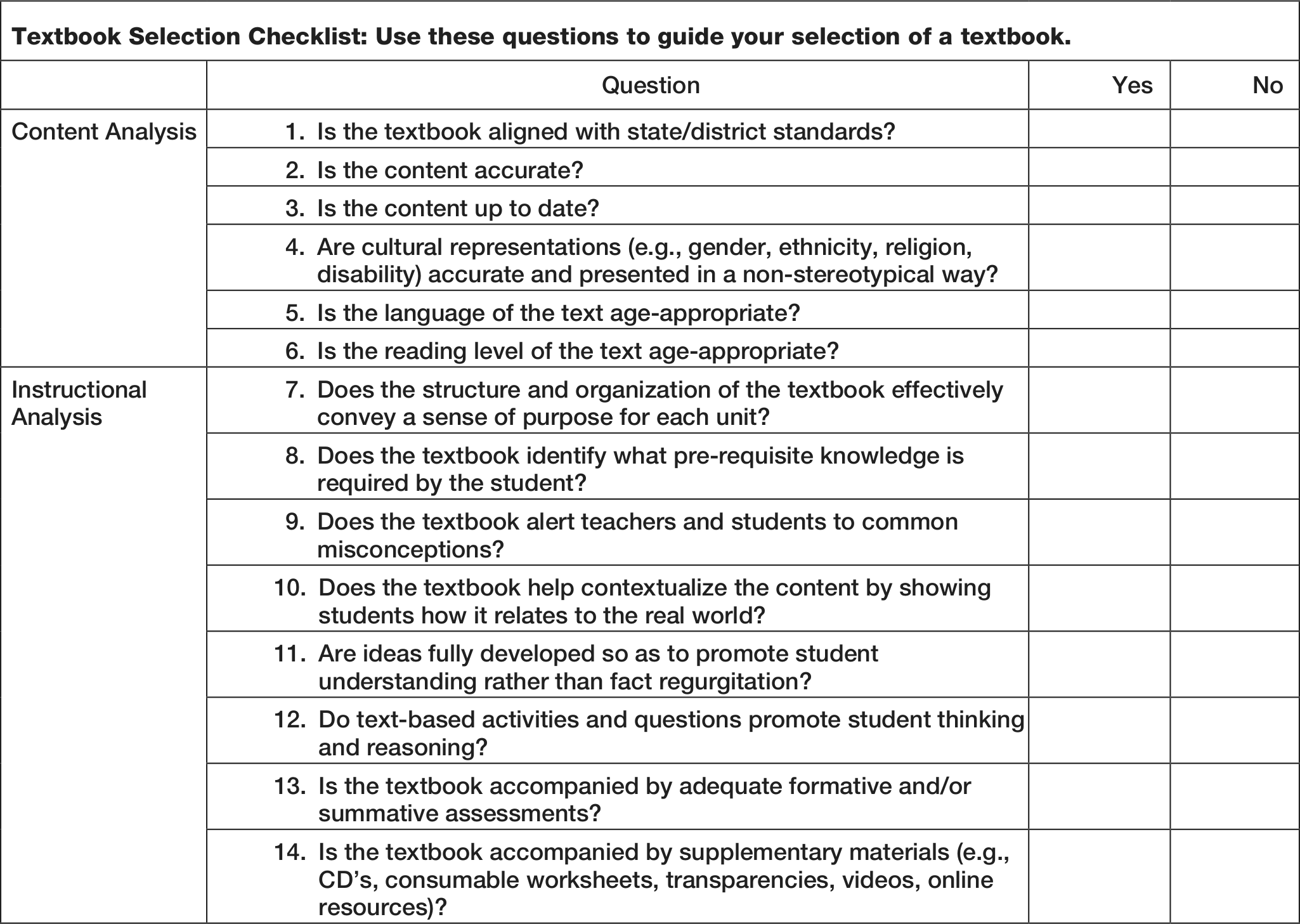
Textbook selection checklist.
Content Analysis
When examining the content of textbooks, several issues must be considered—the first of which is the alignment of text to standards (Kesidou & Roseman, 2002; Kulm et al., 1999). As previously stated, selecting a textbook requires teachers to predetermine the learning goals to which the textbook should be aligned (Kulm et al., 1999). Certainly, this is guided by district, state, or Common Core content standards. In addition, textbook evaluators need to ensure the content is accurate and up to date. Accuracy should not be assumed, as textbooks often contain errant information (Raloff, 2001). Not only should the content be accurate, but cultural representations (e.g., different genders, ethnicities, religions, and physical/mental abilities) also should be accurate and presented in a nonstereotypical way. Clearly, students should not be using textbooks that marginalize them through text, pictures, or graphics. Finally, the language of the text should be age-appropriate and written at the age-appropriate reading level. Namely, the complexity of the text and accompanying activities should reflect the sophistication of the targeted grade level (Kulm et al., 1999). Because many students with learning disabilities (LD) and emotional and behavioral disorders (EBD) may not read on grade level (Vaughn, Levy, Coleman, & Bos, 2002), teachers serving these students in inclusive classrooms may need to adopt multiple textbooks and use additional instructional print materials such as magazines, newspapers, and online articles. Although these are only general suggestions for how to analyze content when selecting textbooks, they represent important themes to guide teachers in selecting the best textbook for students.
Instructional Analysis
In addition to content, the textbook should be analyzed for instructional use (Kesidou & Roseman, 2002). Clearly, teachers need to know not only how to use the textbook but also how useful it can be as a tool for instruction (Williams, 1983). To understand a textbook’s utility, seven key components must be addressed (http://www.project2061.org).
Sense of purpose
First, good textbooks identify a sense of purpose. To determine this, reviewers should look at how the structure and organization of the textbook contribute to effectively conveying a unit purpose through appropriate sequencing and presentation of material (Kulm et al., 1999). For example, teachers may want to consider whether (a) chapter introductions help focus and engage the reader and (b) end-of-chapter summaries are comprehensive. They also may want to examine the arrangement and development of the subject to be sure it is logical, is easy to follow, and coincides with their own scope and sequence for the course.
Build on student ideas
Second, textbooks should build on student ideas. In other words, a sound textbook identifies what prerequisite knowledge is required by students and uses that to build deeper understanding (Kulm et al., 1999). Also, because both teachers and students often have misconceptions about certain topics, it is imperative textbooks recognize and alert teachers and students alike about these misconceptions (Kulm et al., 1999). Often these misconceptions are set apart in margins or in text boxes with arrows or icons to alert readers.
Engage students
Third, high-quality textbooks engage students. Although it sounds clichéd, the text should “come alive” through rich contextual examples that students can relate to real-world experiences. This is particularly important because classroom walls often create a decontextualizing environment where students often ask, “When I am ever going to use this?” (Lane, Menzies, Bruhn, & Crnobori, 2011). When students can see and experience the real-world functionality of the content they are learning, their intrinsic motivation to learn improves (Lepper, 1998). This is particularly important for struggling students, such as those with LD or EBD, who often lack motivation because of repeated failures in school. To keep students with LD and EBD engaged, teachers need to select textbooks that contain high-interest content (Coleman & Vaughn, 2000).
Develop ideas
Fourth, textbook evaluators should examine how well the book develops ideas. As Kulm et al. (1999) pointed out, for students to understand the content, they have to be able to connect concepts or ideas to actual skills they can apply. In the standards-based movement, this can be difficult as textbooks are often overstuffed but undernourished (as cited in Budiansky, 2001). In other words, many textbooks are filled with facts but lack the development necessary for student understanding (Budiansky, 2001). Teachers need to consider if the content is developed sufficiently to meet the standards they are covering.
Promote student thinking
Fifth, as an extension of developing ideas, textbooks should promote student thinking. For example, teachers should examine if the questions and activities provided, particularly in supplementary materials like textbook-based worksheets, encourage students to explain their reasoning and understanding of concepts (Kulm et al., 1999).
Assess student progress
Sixth, how the textbook assesses student progress should be considered. Many textbooks are accompanied by formative and summative assessments, as well as test generators to help teachers design assessments. It is important teachers understand how these assessments (a) align with predetermined learning goals for students, (b) assess students’ ability to apply the content, and (c) can be used to inform future instruction (Kulm et al., 1999).
Enhance the learning environment
Finally, textbooks should enhance the learning environment, which may be done with supplementary materials. To reach students of varying abilities and needs, specifically those with disabilities, the textbook should be accompanied by supporting materials such as consumable worksheets, transparencies, and electronic support such as CDs, videos, and online resources. These materials will help enhance the content of the text for students who need more support to understand the text (Kulm et al., 1999).
Although this is not an exhaustive list of textbook components, these guidelines should prove helpful in selecting a textbook. Certainly, other checklists and rating scales for textbook evaluation exist. For example, as seen online, many states and districts have created textbook evaluation forms that are freely available. The components addressed here represent a sampling of perhaps the most systematic and comprehensive national effort to create research-based criteria for evaluating curricular materials (http://www.project2061.org). Once a textbook has been selected based on content and instructional analyses, teachers need to plan how to effectively implement the textbook in the classroom. Unfortunately, some teachers may assume incorrectly that students know how to navigate a textbook. In the following section, suggestions teachers can use to help students make sense of their textbook are presented.
Implementation
Because teachers, particularly in middle and high schools, rely so heavily on textbooks, they must not only know how to use them effectively but also be able to teach their students to use them effectively as well. Sometimes, teachers mistakenly believe students are fluent in using a textbook. Although this assumption is understandable given students’ frequent exposure to textbooks, all textbooks are different and thus require instruction on how to use them. Two simple strategies teachers can use when implementing textbook-based instruction in their classes are (a) introducing the textbook to students, and (b) preparing students to read with greater focus and understanding by activating prior knowledge.
Introducing the Textbook
Prior to assigning students any work requiring the textbook, the teacher must introduce the textbook to the class. One way to introduce the textbook is by having students complete a “textbook scavenger hunt” before they ever use the book for instructional purposes (see Figure 2). A textbook scavenger hunt is an activity done in teams or individually requiring students to learn the structure and organization of the book. Namely, students are asked to (a) identify textbook features (e.g., colors of headings and subheadings, table of contents, appendix, glossary, etc.) and (b) find specific information (e.g., the definition of gravity, the year the Declaration of Independence was signed, the formula for calculating density). Because, textbooks sometimes contain an excessive amount of information (Budiansky, 2001), students have to become efficient at finding the pertinent content and knowing where to look when they need clarification or extra support (e.g., glossary, appendix). Before they can make a decision about where to look for help, students must understand how specific features help them. On the scavenger hunt form, questions related to the purpose of the glossary or index and how they might be used could be asked to facilitate understanding about specific features of the text. While students are completing the scavenger hunt, teachers should provide them with labeled sticky notes to bookmark important sections (e.g., table of contents, index, glossary). Bookmarking enables students to quickly find the section they need. Finally, the goal of the scavenger hunt, unlike traditional scavenger hunts, is not to see who can complete it first. Rather, the goal is for students to complete it accurately. By introducing students to textbook features before using it as instructional tool, teachers may help reduce the frustration often felt by struggling readers. This is particularly important for students with reading difficulties and with EBD who often act out to get out of frustrating academic activities such as reading (Gunter & Coutinho, 1996).
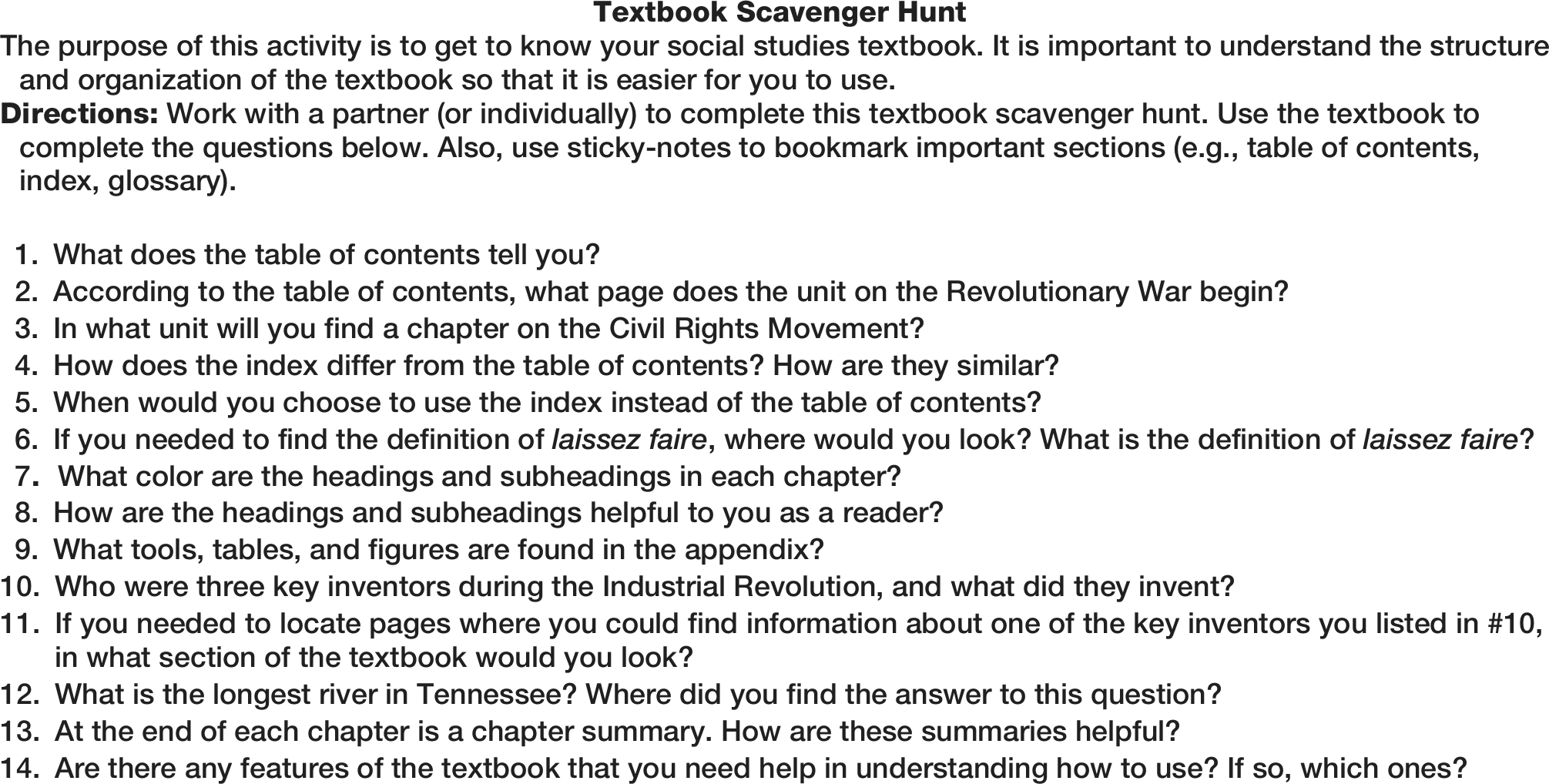
Textbook scavenger hunt.
Preparing Students to Read
Once students have become familiar with the textbook, teachers can begin using it as an instructional tool. Similar to novel-based activities and instruction, textbook-based activities and instruction should involve the use of literacy strategies that enhance students’ comprehension of the text. Essentially, it is the teacher’s responsibility to help students read to learn and, thus, make sense of what they are reading. Some of these comprehension strategies such as preteaching vocabulary and using graphic organizers are discussed in other articles of this special issue. Thus, this article focuses on only one, activating students’ prior knowledge (Barton, Heidema, & Jordan, 2002), which is particularly important for reading comprehension in the content areas (e.g., math, science, social studies). Prior knowledge, some contend, is the single most important resource in learning with texts (Vacca & Vacca, 1999), as it is a critical factor affecting reading comprehension and proficiency (Torgesen et al., 2007). Drawing on their own background knowledge prepares students to make sense of new information by building connections with the text and formulating new ideas based on their existing knowledge (Barton et al., 2002; Bransford, Brown, & Cocking, 2003). Although many methods for activating prior knowledge exist, three are addressed here: probing questions, anchored instruction, and anticipation guides.
Probing questions
First, when beginning a new topic, teachers can ask probing or thought-provoking questions (Stipek, 1993). For example, a history teacher might begin a lesson on the 1960s by asking, “If you could go back and live during the sixties, would you want to? Why or why not?” Or a biology teacher introducing a chapter on genetics might ask, “What do you predict the offspring of a white pig and a brown pig will look like?” Asking questions that require students to speculate or predict raise interest and promote curiosity (Stipek, 1993), which in turn may help students to read more purposefully. Probing questions also can alert the teacher to students’ background knowledge and gaps or misconceptions that need to be addressed (Barton et al., 2002). By addressing these gaps early through discussion, activities, and instruction, teachers can prepare students to make sense of the text they read later (Barton et al., 2002).
Anchored instruction
A second strategy to prepare students for reading texts and improving comprehension is anchored instruction (Bransford, Sherwood, Hasselbring, Kinzer, & Williams, 1990), which has been particularly beneficial for students with high-incidence disabilities such as those with LD (Bottge, Rueda, Grant, Stephens, & LaRoque, 2010). Anchored instruction is most useful when a student lacks prior knowledge on a given topic. If a student has no knowledge about a topic, it is virtually impossible to read and comprehend a text on that subject. When no prior knowledge exists, it is useful to provide the student with the necessary knowledge prior to engaging the text. This can be done through the process of anchoring (Bottge et al., 2010).
Anchors can take many forms (e.g., field trips, pictures). Perhaps the best anchors involve video with dynamic images and sound (Hasselbring & Williams-Glaser, 2000), making abstract information more concrete for students (Heo, 2007). In most research studies on anchored instruction, video has had greater impacts on student learning than other forms of instruction. For example, video has been shown consistently to contextualize expository text and result in better comprehension (Rose, Hasselbring, Stahl, & Zabala, 2005; Strangman, Hall, & Meyer, 2003). The reason is that the ability to perceive dynamic, moving events facilitates comprehension. In science classes, for example, young students may need to see waves and strong winds to deeply understand these concepts; older students may be helped by viewing moving scenes that illustrate acceleration versus constant velocity. Not only is anchored instruction highly effective, it is also highly motivating to students (Brown, Collins, & Duguid, 1989). In application, this could mean students who are asked to read a text will be more motivated to do so when provided anchored instruction. Given the decreased motivation of struggling learners (e.g., students with LD and EBD), anchored instruction offers an easily implemented tool for motivating students.
Although some textbooks come with anchor videos, when this is not the case, alternatives such as Discovery Education’s Streaming Plus and YouTube exist. In addition, short movie clips also may be effective. For example, science teachers may introduce a chapter on simple machines and then have students create a Rube Goldberg machine, which is the combination of multiple simple machines working together to accomplish a simple task. To anchor instruction, teachers could show the scene from the movie The Goonies (Bernhard & Donner, 1985) where the gate to the house is opened by a Rube Goldberg contraption. Regardless of the video selected, teachers must ensure videos support the text by providing the background knowledge for students to build an accurate mental model about the content they will be reading. Also, it is helpful if the videos are engaging, promote curiosity, and demonstrate real-world relevance.
Anticipation guides
A third useful strategy for helping students comprehend text is the use of anticipation guides (see Figure 3). An anticipation guide contains a list of teacher-generated statements about the text content. Teachers should select these statements to identify students’ prior knowledge, address common misconceptions, and highlight key concepts in the assigned reading (Barton et al., 2002). Most important, the statements should align with the curricular objectives or standards. Before reading, students complete the anticipation guide by writing that they agree or disagree with a statement or whether they believe the statement to be true or false. A class discussion of these statements sets the stage for reading the text (Duffelmeyer & Baum, 1992). Then, after reading, students return to their anticipation guides and make decisions (i.e., agree or disagree) about the same statements. Duffelmeyer and Baum (1992) suggested teachers have students take this further by defending their answers with information gleaned directly from the text. By requiring students to justify their answers, students must interact with their text and think critically, thus fostering comprehension (Duffelmeyer & Baum, 1992).
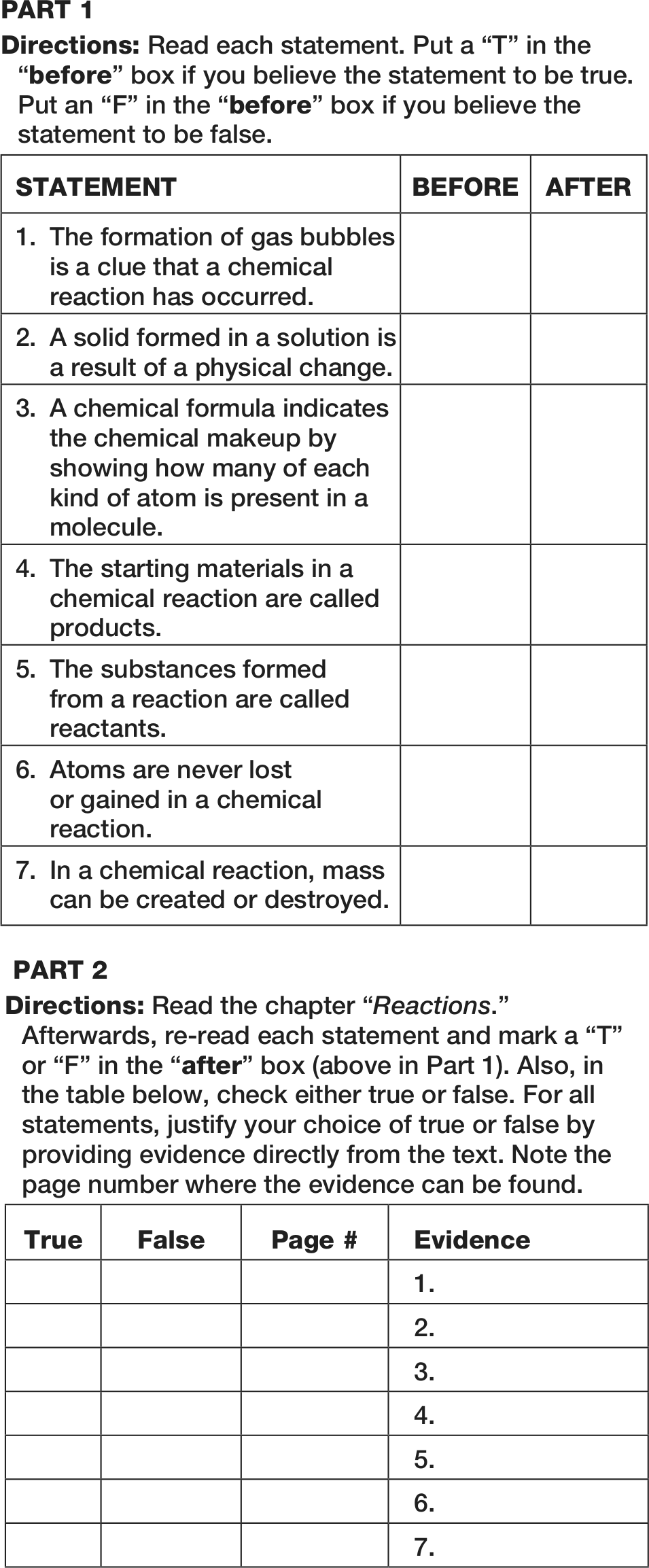
Anticipation guide.
Summary
Introducing the textbook to students through a textbook scavenger hunt and helping students to comprehend what they read by activating prior knowledge are proven strategies for using the textbook effectively in class. The hope is that for students who struggle because of a disability or who lack background knowledge, these strategies may increase text accessibility and, thus, alleviate some of the frustration often felt when reading textbooks. However, it is safe to assume that even these research-based methods will not be enough to reach every student in the classroom, particularly those with disabilities. In light of this, digital text has become a realistic and practical approach to supporting students with disabilities access their textbooks.
Digital Text
As noted previously, textbooks often serve as the primary curricular material in K–12 classrooms and work reasonably well for most students. However, for students with sensory or motor disabilities or low cognitive abilities and/or those with LD, reading a basic textbook may seem impossible. Until recently, there were few alternatives or modifications that would allow students to access information from a text if they had difficulty reading. Fortunately, federal legislation and rapidly emerging technologies have made it easier to provide struggling students with electronic modifications (e.g., digital text) that make the textbook more accessible.
Federal Legislation
With the reauthorization of IDEIA in 2004, the law introduced the National Instructional Materials Accessibility Standard (NIMAS). The purpose of the NIMAS was to “facilitate the provision of accessible, alternate-format versions of print textbooks to pre-K–12 students with disabilities.” IDEIA (2004) specified the term print instructional materials include printed textbooks and related printed core materials that are written and published primarily for use in elementary school and secondary school instruction. By law, publishers are required to provide electronic forms (i.e., NIMAS files) of their textbooks to state and local education agencies. These NIMAS files can be used to create accessible formats (e.g., Braille, audio, digital, large print) of print instructional materials in a much more efficient way than traditional methods such as physically digitizing books page by page on a flatbed scanning device.
In theory, NIMAS text can benefit all students with disabilities. In reality, however, the percentage of students eligible for NIMAS is fairly small. Typically, students who are blind or visually impaired are eligible; in some cases students with physical disabilities are eligible. Students with LD, who make up nearly 40% of all K–12 students with disabilities (U.S. Department of Education, 2011), may qualify under NIMAS guidelines; however, most do not. Only students with LD who are certified by a medical doctor as having a physical dysfunction preventing them from reading in a normal manner qualify for NIMAS. Students with nonphysical factors such as (a) cognitive or behavioral disabilities, or (b) attentional deficits are excluded. This exclusion has its origin in the Chafee Amendment (1996), which allowed for the creation and availability of alternate-format text materials to meet the educational needs of the blind and other people with disabilities. The interpretation of the Chafee Amendment, which is a copyright law, not an education law, has limited material availability to a small subset of all people with disabilities, primarily those who are blind and visually impaired.
Accessible Textbooks
For the many students with LD who are not covered by the Chafee Amendment, the textbook represents a tremendous barrier to learning. Nearly 80% of students with LD have associated reading problems so considerable they cannot read and understand grade-level material (Lerner, 2003). For these students, reading and understanding text in science, social studies, and literature are beyond their ability. Furthermore, reading for pleasure is something that they seldom do.
Fortunately, several states have attempted to broaden the number of students with LD who can access NIMAS-formatted textbooks by either requiring publishers to provide digital versions of the textbook or giving preference to those publishers who do (e.g., Arizona, California, Georgia, Kentucky, New Mexico, and New York; Perl, 2003). For example, the Kentucky Department of Education requires textbook publishers to make digital text formats available. In addition, they have made digital text reader software available for every school in the state so students with print disabilities can access digital versions of classroom textbooks. Kentucky’s schools acquired a site license for TextHELP’s text reader product called Read & Write Gold (RWG). As a text-reading support tool, RWG offers a number of features to help students access difficult text. For example, if students are unfamiliar with the meaning of a word, they can easily access a speaking dictionary and thesaurus. RWG also allows students to customize the program and select personal preferences for the text-to-speech output, such as voice gender, speed, and pitch. The voice output may be heard through computer speakers or discretely through personal headphones if students are around other people. RWG has proven to be a very powerful tool for many of Kentucky’s students who do not decode or comprehend well enough to read grade-level text independently (Hasselbring & Bausch, 2005). To a large degree, the success of this statewide project has hinged on making NIMAS text files available to Kentucky’s students (Hasselbring & Bausch, 2005).
BookShare
Although NIMAS represents an important step toward making textbooks available to students with disabilities, as mentioned previously, many students are still NIMAS ineligible under the current law. Several third-party organizations that report they are “Chafee compliant” provide NIMAS-formatted files for a variety of materials, including textbooks. One such organization is BookShare, which has more than 127,000 digital books, including textbooks, available to all U.S. students with qualifying disabilities. Students with LD can qualify if an educational professional (e.g., family doctor, special education teacher, school psychologist) certifies the student meets eligibility requirements. For example, a student with LD who has an individualized education program indicating text accommodations must be made can qualify for a BookShare membership and, thus, access to the digital library.
To get started with BookShare, teachers can use the BookShare website (http://www.bookshare.org) and find all of the information they need to get a free membership for a qualified student, search the library of digital books, download books, learn about which technologies can be used with BookShare books, and even download free computer software applications for reading BookShare books. In addition, BookShare offers free online guides and training videos for teachers. With access to digital text and accompanying software, students can hear the text through synthesized speech (i.e., text to speech), see the text on an electronic device or printout, highlight the text, and change text features (e.g., font size, margins, spacing). The hope is that digital text will provide a medium for success that traditional textbooks do not offer many students with disabilities.
Cloud computing
Finally, the rapidly evolving field of cloud computing will soon make digital texts even more accessible for students with disabilities. New programs like Bookstream, published by Don Johnston, Inc., allow schools to create a library of electronic texts and then assign students the rights to access them. The student can access the text using any number of devices such as smartphones, iPads, computers, and e-book readers. And, they can access books from multiple devices because they reside on a cloud server. This is unlike texts acquired from BookShare, which reside only on the device to which the file was saved. When students are at school, they may use a school computer to read the text. The down side of this is if computers stay at school, students cannot access the text from home. With Bookstream, however, when students go home they can read the same text they were reading on the school computer on their own home device, such as a smartphone, iPad, or home computer. Clearly, all students do not have electronic reading devices (e.g., iPad) at home, eliminating the cloud option. When this is the case, teachers need to make arrangements for students to bring school-based devices home so that students have maximum access to digital textbooks acquired at school.
Final Thoughts
Digital text has changed the way students can access and read their school textbooks. It allows some students with disabilities an opportunity to use a textbook they may not have been able to use otherwise. Clearly, access through organizations like BookShare and the technology of cloud computing is just the starting point for helping students with disabilities to read textbooks. Regardless of if students are using digital textbooks or traditional ones, it is imperative textbooks are selected carefully; then, they must be implemented soundly in the classroom. This involves introducing textbooks to students through activities like textbook scavenger hunts and then preparing students to read using strategies such as probing questions, anchored instruction, and anticipation guides. These strategies will help maximize the full power and potential of the textbook as an instructional tool for students with disabilities.
Footnotes
Declaration of Conflicting Interests
The author(s) declared no potential conflicts of interest with respect to the research, authorship, and/or publication of this article.
Funding
The author(s) received no financial support for the research, authorship, and/or publication of this article.