



Abstract
Disability-related legislation offers two different support systems for youth with disabilities: one of entitlement to services and one of eligibility for resources. This article offers guidance for individuals with disabilities, and the families and service providers who support them, as they prepare to navigate the transition between support systems and learn the rights and responsibilities involved in postsecondary education, employment, and adult living options. Also included are recommendations for instructing students in their rights and responsibilities.

Graduation: A New Beginning
Every spring educators, families and students hear the words, “Today is the first day of the rest of our lives,” repeatedly echoed from graduation stages across the nation. This statement holds true for all individuals, including those with disabilities. The completion of high school or aging out of services provided by the Individuals With Disabilities Education Improvement Act (IDEIA, 2004) is not the finish line; it is the beginning of new learning, work, and life experiences. Although the job of special education support personnel may end at this point, the instruction they have provided should assist these young adults as they transition into new adventures and support systems. However, one of the primary roadblocks to successful secondary transitions for youth with disabilities is a lack of knowledge of and understanding about postsecondary resources (Madaus, Gerber, & Price, 2008; Wagner, Newman, Cameto, Garza, & Levine, 2005).
Without postsecondary services, many young adults with disabilities struggle to gain and maintain employment (Fabian, 2007), attain postsecondary education (Finn, Getzel, & McManus, 2008), sustain needed medical services (Bryan, Stiles, Burstein, Ergul, & Chao, 2007), and establish community connections (Trainor, 2008). Thus, it is important that youth with disabilities and their families are aware of the postsecondary resources available. Even more imperative is the need for individuals with disabilities to know their rights and responsibilities regarding these resources and services (Hanley-Maxwell, Pogoloff, & Whitney-Thomas, 1998).
What Do Students Know About Support Services?
Many young adults with disabilities are not aware of the special education services they were entitled to and received while in public school, nor were they included in the individualized education program (IEP) process (Van Dycke, Martin, & Lovett, 2006). Postschool outcome data show that these same individuals are also not aware of the eligibility criteria needed to access postsecondary supports and services or the myriad of responsibilities associated with a postsecondary life that involves multiple support services (Carter, Lane, Pierson, & Stang, 2008; Wagner et al., 2005).
In an effort to help close the awareness gap regarding postsecondary resources, and to help promote the effectiveness of an individual’s advocacy efforts as he or she begins to access these resources, this article differentiates between services that students with disabilities are entitled to and services that individuals with disabilities may be eligible to obtain by (a) briefly reviewing differences in disability-related legislation, (b) providing four first-person rights and responsibility tables across four major transition domains, and (c) offering instructional ideas to promote this knowledge in students with disabilities.
Differentiating Between Entitlement and Eligibility
Three major pieces of legislation govern services for individuals with disabilities the United States: (a) IDEIA, a 2004 reauthorization of the 1990 Individuals With Disabilities Education Act, (b) Section 504 of the Rehabilitation Act of 1973, and (c) the Americans With Disabilities Act (ADA, 2008), as amended in 2008. This legislation provides two different support systems for individuals with disabilities: one of entitlement and one of eligibility.
When preschool to 12th grade students are suspected of having a disability, they become entitled to evaluation services provided by the school. If students are identified for special education services, they again are entitled to services mandated through IDEIA 2004. These services include a free, appropriate public education to be provided in the least restrictive environment as indicated through an IEP. As warranted, these services are available through the 21st year of the student’s life or graduation from high school.
Once students graduate from high school or reach the age of 22, IDEIA—along with its rules and regulations—no longer applies. Students must transition from the world of entitlement services that IDEIA provides to a world of services that is girded by eligibility criteria required by Section 504 and the ADA. These eligibility criteria mandate that services be available only when an individual with a disability self-identifies as having a disability or is in need of supports. In addition, provision of services occurs only when the individual supplies acceptable documentation of a disability and of a reasonable need for support.
Just because students were entitled to special education services under IDEIA does not mean that they will automatically be qualified for specialized adult services, which are governed by Section 504 and the ADA. Eligibility must be established before services can begin. In very practical terms, this means that when students with disabilities graduate from high school or reach an age beyond those supported under IDEIA, they cannot expect to continue to receive adult services simply by showing their last IEP as proof of disability (Getzel & Briel, 2006).
Adult service providers, such as the Department of Rehabilitation Services, local career–tech centers, community colleges, universities, the Social Security Office, and local housing authorities all have different eligibility procedures that must be followed. There is no guarantee that individuals with disabilities will automatically qualify for services. Also, unlike in public school settings, many adult agencies have waiting lists that range from several months to several years. Family members and educators must be aware of these wait times and apply for many adult services long before individuals need them.
Rights and Associated Responsibilities
Because transition into adulthood crosses so many postsecondary life domains, an awareness of the differences in eligibility requirements is important, along with an understanding of the rights and responsibilities associated with each area. In addition, individuals with disabilities must be able to self-identify, that is, be able to talk about their disability and the supports that work best for them. This self-disclosure is a critical survival skill for individuals with disabilities in the world of eligibility because as adults they must be the ones to notify service providers about their disability and needed accommodations. The need to self-identify is one of the most challenging requirements in the transition from the world of entitlement to the world of eligibility (Brinkerhoff, McGuire, & Shaw, 2002; Getzel & Thoma, 2008). Assisting individuals in this process requires enabling them to take ownership of their legal rights and responsibilities. In line with this thinking, we have developed four tables organizing legal rights alongside individual responsibilities in four transition domains: (a) transfer of rights at the age of majority, (b) employment, (c) postsecondary education, and (d) independent living. These tables provide the legal rights and responsibilities afforded to individuals with disabilities in a person-first format in which the individual can gain the knowledge of his or her legal role in navigating these transition domains.
Transfer of Rights at Age of Majority
Age of majority is a legal term that refers to the age at which an individual is no longer considered a minor. In most states, this occurs at the age of 18 or 19. Upon reaching the age of majority, an individual becomes legally able to exercise the rights accorded to adults (Lindsey, Wehmeyer, Guy, & Martin, 2001). For individuals with disabilities receiving public school services through an IEP, this transfer of rights was added into the 1997 Amendments to IDEA to highlight the fact that these rights pertain to all individuals, unless they have been determined incompetent through legal proceedings. If the individual is still receiving school services upon reaching the age of majority, the parent’s rights in special education transfer to the individual/student. Other rights that transfer at the age of majority include such considerations as making a will, entering into a contract in one’s own name, obtaining medical treatment without parental consent, applying for credit, and getting married (Lindsey et al., 2001).
Along with these rights come a myriad of responsibilities for which many families and individuals are not prepared (National Center on Secondary Education and Transition & PACER Center, 2002; Storms, O’Leary, & Williams, 2000). Table 1 contains a first-person list of many of the rights and responsibilities regarding the transfer of rights at age of majority.
Age of Majority Rights and Responsibilities.

Postsecondary Employment
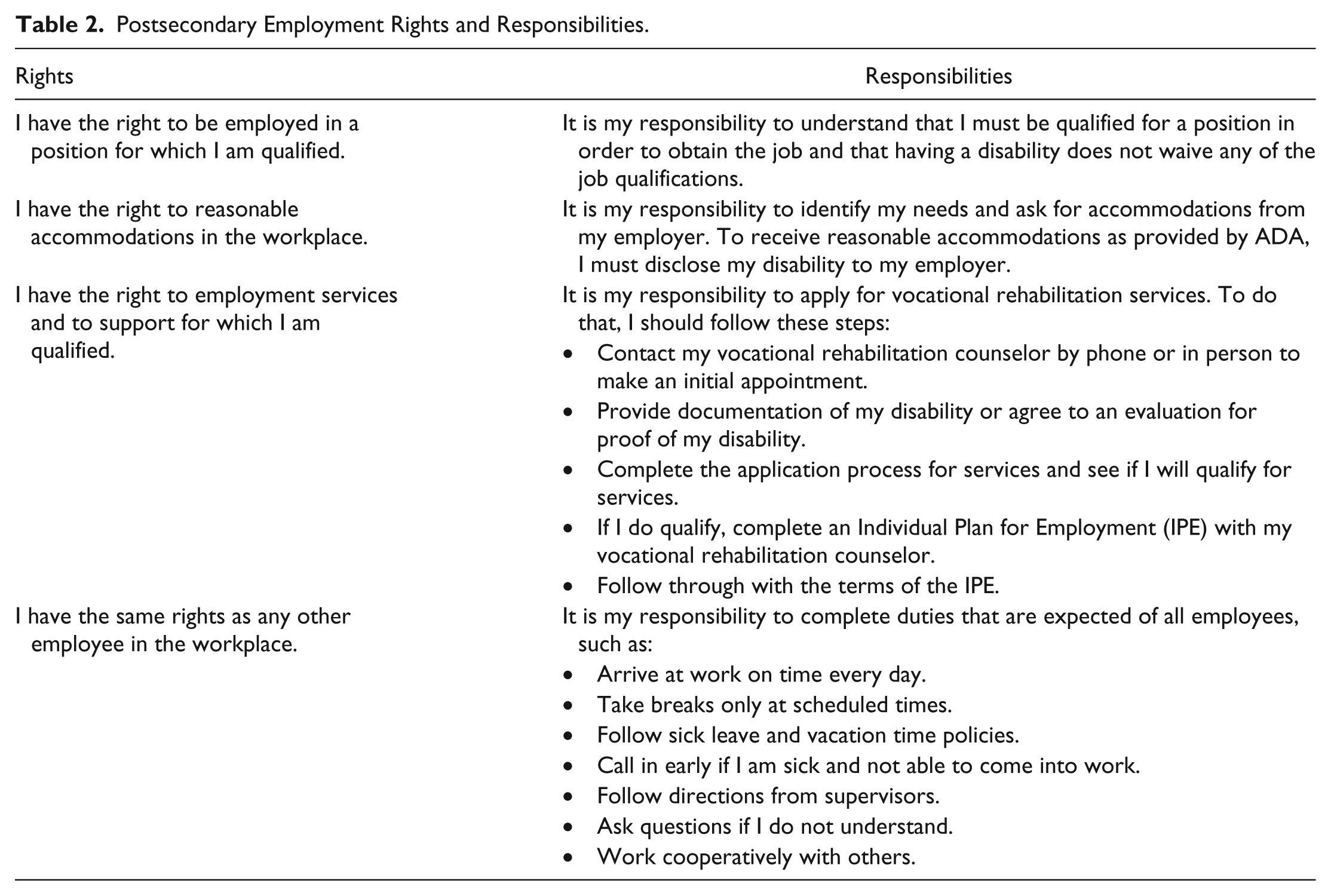
Employment is highly valued in U.S. society, not only because it provides monetary support but because it has a direct bearing on social standing and self-worth (Luft & Kock, 2001). Individuals with disabilities value employment just as highly as others, and it is a contributing factor to their quality of life (Roessler & Schriner, 1991). Unfortunately, people with disabilities often encounter barriers to employment that center on the following: (a) their understanding of the ADA and its implications for employment, (b) their understanding of their disability and willingness to acknowledge it, and (c) their willingness to self-identify to their employers (Price, Gerber, & Mulligan, 2003; Wehmeyer & Bolding (2001). Table 2 provides a list of many of the rights and responsibilities regarding postsecondary employment for individuals with disabilities.
Postsecondary Employment Rights and Responsibilities.
Postsecondary Education
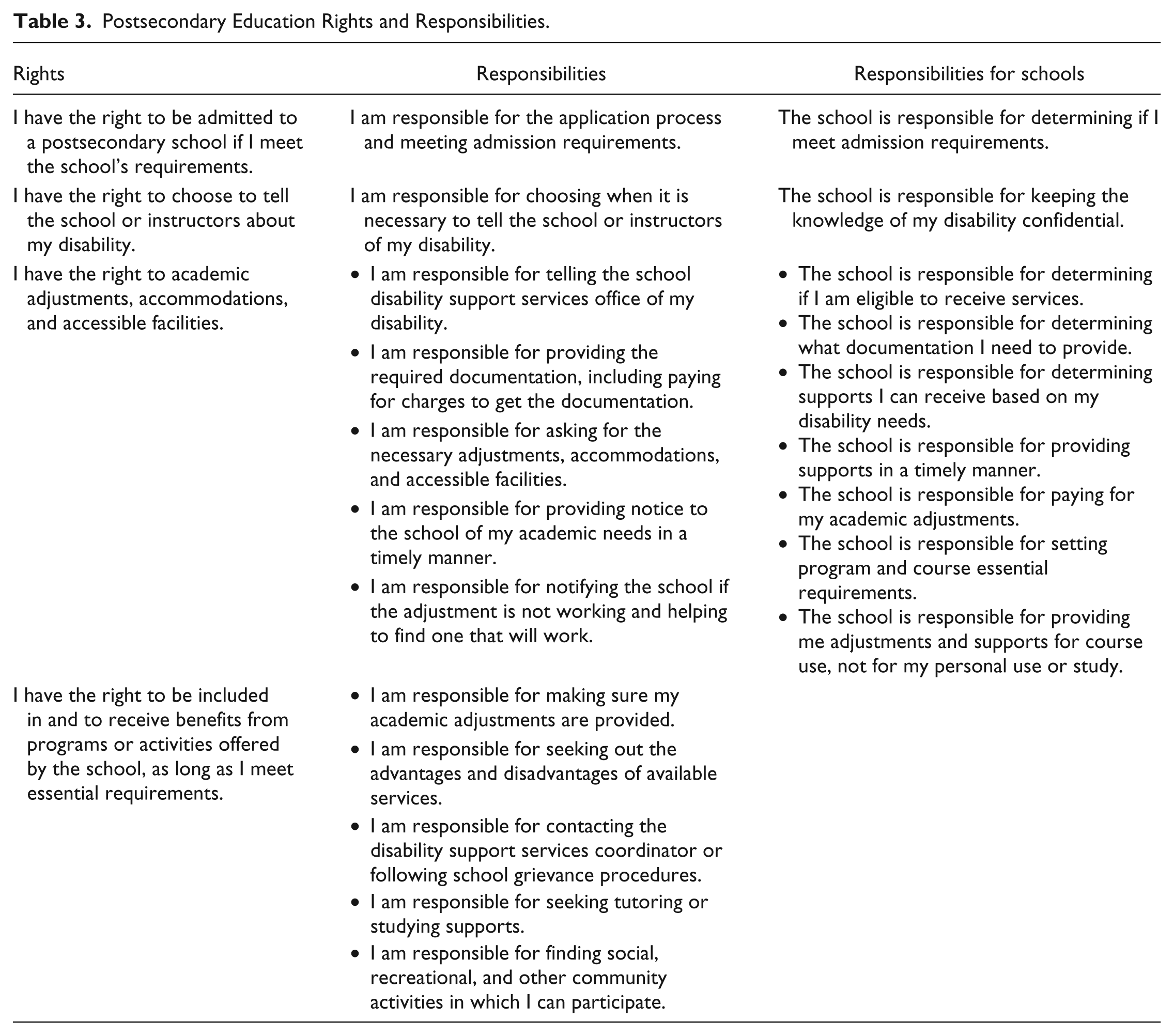
More students with disabilities than ever are choosing to continue their education after high school. When compared to their nondisabled peers, a smaller percentage of students with disabilities complete postsecondary education (Murray, Goldstein, Nourse, & Edgar, 2000). The ability to access academic accommodations and supports plays a critical role in the postsecondary success of students with disabilities. Students who previously received services under the supportive umbrella of IDEIA are not necessarily prepared to advocate for their rights when they leave secondary settings. For students with disabilities to advocate for their learning needs, they must have knowledge and understanding of their rights and responsibilities provided under Section 504 and the ADA (U.S. Department of Education, Office for Civil Rights, 2003, 2007). Table 3 presents a first-person description of students’ rights and responsibilities with regard to postsecondary education and the responsibilities of the educational institution they choose to attend.
Postsecondary Education Rights and Responsibilities.
Independent Living
A person’s home not only reflects his or her personal values, standards, tastes, and outlooks but also “emphasizes principles of freedom and self-governance of resources” (Wehmeyer & Bolding, 2001). Over the past few decades there has been a shift toward establishing consumer-controlled services for adults with intellectual disabilities (Nerney & Shumway, 1996). With this movement of consumer-controlled services, adults with intellectual disabilities are making choices to live independently. Some choose to move from parents’ homes to relatives’ homes to self-owned homes. Other residential choices range from independent apartments to heavily supervised apartments with live-in staff; from one-resident foster care homes to six-resident places; from paraprofessionally staffed group homes to professionally staffed homes; and from privately owned, intermediate care facilities to large establishments (Anderson, Polister, Prouty, & Lakin, 1996).
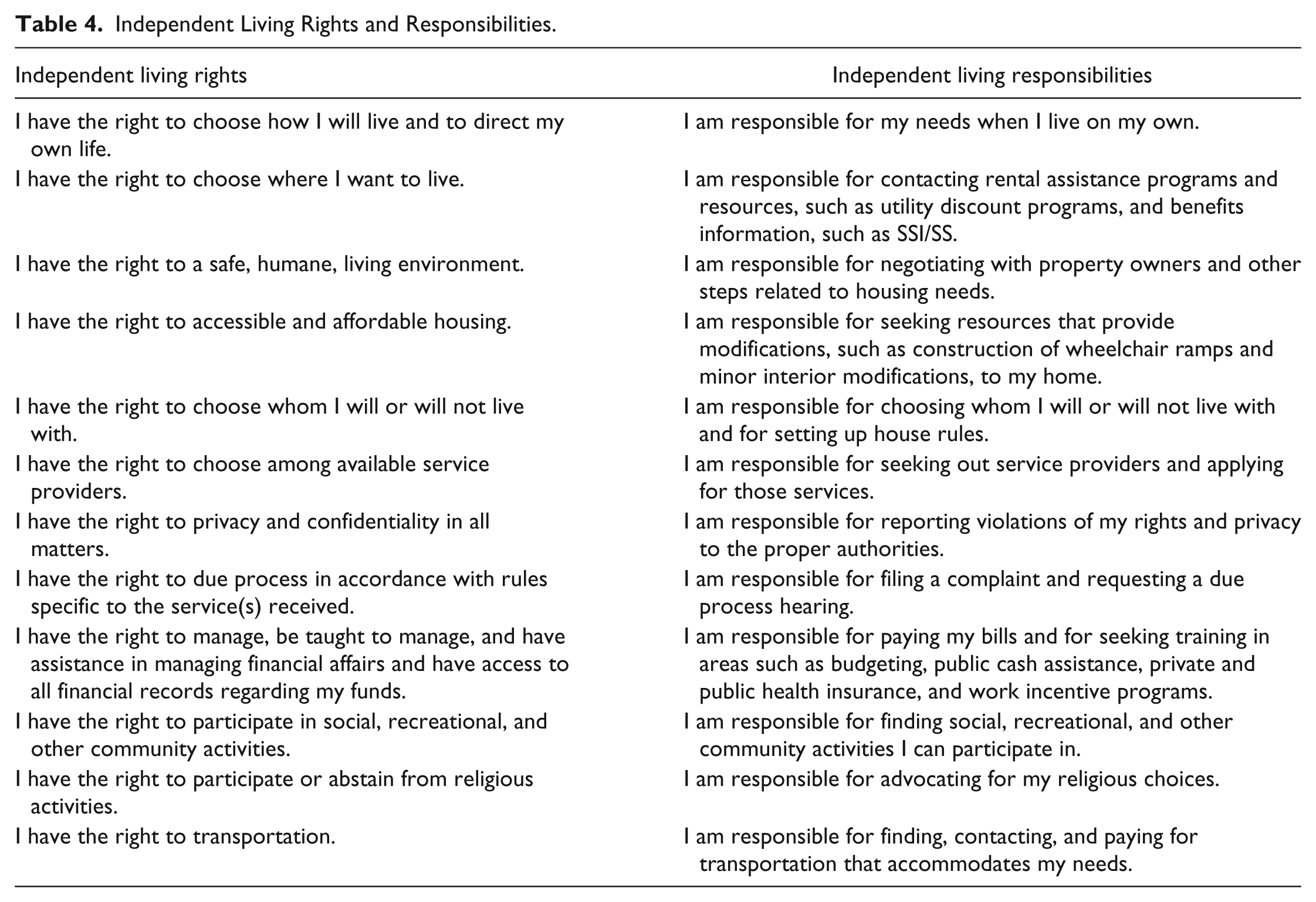
When planning residential choices, families, teachers, social workers, and support personnel should start preparing individuals with disabilities for independent living needs several years prior to graduation. Many states have waiting lists for independent living facilities and services. Students and adults with intellectual disabilities should explore and understand their rights and responsibilities regarding independent living and the services offered by their community (Montana Disability Services Division, n.d.). Table 4 lists the rights and responsibilities regarding independent living for individuals with intellectual and other significant disabilities.
Independent Living Rights and Responsibilities.
Teaching Rights and Responsibilities
A variety of instructional techniques can be utilized to teach legal rights and responsibilities to students. The most appropriate instructional method depends on the individual learning needs of each student. The provided rights and responsibilities tables offer a tool for teachers to use when assisting students in developing personal responsibility for their future postsecondary education, employment, and independent living environments. These tables can act as an instructional tool that teachers can use to lead a discussion of the application of each personal right and responsibility. Alternatively, teachers can use the content contained within the tables to develop lessons around specific components, utilizing an appropriate instructional technique for the needs of the students. Research has supported the use of several instructional techniques for students with disabilities, including explicit systematic methods and the use of cognitive strategy approaches such as mnemonics, structured steps, visualization, verbalization, graphic organizers, and multisensory instruction (Archer & Hughes, 2011; Forness, Kavale, Blum, & Lloyd, 1997; Minskoff & Allsopp, 2003; Sabornie & deBettencourt, 2009; Schumaker, Nolan, & Deschler, 2003). Several examples of how the content of the rights and responsibilities can be taught using these instructional techniques are provided.
Explicit Systematic Instruction
Explicit systematic instruction consists of the following five steps: (a) introduction, (b) modeling, (c) guided practice, (d) independent practice, and (e) generalization (Minskoff & Allsopp, 2003). An explicit systematic instructional process can be utilized to teach the content contained within the rights and responsibilities tables. For example, the right and responsibility “I have the right to choose whom I will or will not live with, and I am responsible for choosing whom I will or will not live with and for setting up house rules,” from Table 4, is introduced by discussing with students their choices for future living environments and presenting three steps to developing household rules: (a) identify personal living environment likes and dislikes, (b) compare likes and dislikes with roommates’ likes and dislikes, and (c) create a list of rules based on a compromise from the comparison of personal and roommate likes and dislikes. The teacher then models the three steps using the concept of developing general household rules (e.g., having guests over, using electronics, controlling noise levels, keeping the environment clean). Third, the teacher guides the students through practice of the three steps by developing kitchen rules (e.g., sharing the refrigerator, managing dishes, cleaning the kitchen). Fourth, the students independently practice the three steps to develop chore rules (e.g., vacuuming, taking out the trash, mowing the lawn). Finally, the teacher assists the students in generalizing the right to set up household rules by enlisting family members to work through the process with students at home. Similar application lessons could be developed using other information from the rights and responsibilities tables.
Mnemonics
Teachers can develop mnemonics using acronyms or acrostics of words that assist students in remembering the new information (Minskoff & Allsopp, 2003). For example teachers could use the “It’s a BRESe [pronounced breeze] to know your employment rights” statement. The postsecondary employment rights information contained in Table 2 can be used to create the mnemonic BRESe; the right to Be employed, Reasonable accommodations, Employment services, and Same rights as other employees. Another mnemonics example developed from the information in Table 4 is called the “CAP of protective rights for independent living.” These rights help provide protection through Choice, Accessibility, and Privacy.
Structured Steps
Some of the rights and responsibilities statements focus on situations in which students can use a structured steps or step-by-step process to apply the rights and responsibilities information. For example, the Postsecondary Education Rights and Responsibilities can be used to assist students in the application process for postsecondary training. The mnemonic ADA can represent the steps of Apply, Disclose, and Access. These steps are a general outline of the rights and responsibilities information. Additional steps under these headings can be created. Please note that not all students would be able to use ADA as a mnemonic and keep a clear understanding of the difference between this and ADA.
Visualization
To incorporate visualization into instruction, teachers can use pictures as cues to prompt students (Minskoff & Allsopp, 2003). For example, teachers could use a picture of a person holding an open book while looking at himself in a mirror to represent the Age of Majority Rights and Responsibilities (see Table 1) component of “know about my disability and how it affects my ability to learn.” Another visualization technique for Table 1 could include a picture of an officer who has the rank of a “major” in the military services to represent all the things that individuals become “in charge of myself when I reach age of major
Verbalization
Students can use verbalization of the rights and responsibilities content in two different ways: verbal rehearsal of the process and vocalization of the steps as they complete them (Minskoff & Allsopp, 2003). Students verbally rehearse the information learned using repetition or a rapid-fire technique. For example, a teacher could use the rapid-fire technique with students by quickly flashing visualization picture cues created for the Age of Majority Rights and Responsibilities information (see Table 1) and asking the students to provide the associated stated right or responsibility. Both repetition and rapid-fire response time are designed to increase student automaticity with the new information (Schumaker & Sheldon, 1999).
Graphic Organizers
Students and teachers use graphic organizers to visually organize information through the use of techniques such as graphic webs, charts, and Venn diagrams. The rights and responsibilities statements provided use a table format to organize the information. However, other graphic organizers that better meet the needs of the students can be developed to represent the information. For example, a student could create a web of Postsecondary Education Rights and Responsibilities using My Rights, My Responsibilities, and the School’s Responsibilities as three branches. Venn diagrams provide a graphic organizer to process rights from Table 3, such as “I have the right to be included in and receive benefits from program or activities offered by the school, as long as I meet essential requirements and I have the right to be admitted to a postsecondary school if I meet the school’s requirements.” Students acknowledge these rights by graphically displaying the commonalities between the requirements of the school or activity and their skills and abilities.
Multisensory Instruction
Teachers meeting the multisensory learning needs of students will need to prepare auditory, visual, and motor learning experiences for students (Minskoff & Allsopp, 2003). Motor opportunities to learn the rights and responsibilities statements could include opportunities for students to write the statements, find or create the visual cues and verbal rehearsal cards, and act out scenarios in which they would use the information. For example, students could act out a scenario of locating and accessing recreational activities to apply their knowledge of understanding their rights and responsibilities associated with independent living (see Table 4) and then apply this information in a real situation. Table 2, Employment Rights and Responsibilities, presents the structured steps to the employment responsibility “It is my responsibility to apply for vocational rehabilitation services.” To create a multisensory learning opportunity for this right, teachers and students can incorporate visualization by integrating pictorial representations of each step and invite a speaker to talk to students about the process or visit the Vocational Rehabilitation Services office for a walk-through of the process.
Final Considerations
Understanding the differences between entitlement and eligibility in regard to secondary transition services for individuals with disabilities is critical. The journey from the world of entitlement to the world of eligibility is a journey that must begin long before transition into adulthood occurs. It is also a journey that requires the cooperation of families, students, self-advocates, educators, and service providers. This teamwork approach is needed to address that myriad of rights and responsibilities that encompass the world of eligibility. With the use of the provided first-person resources, students can have the opportunity to understand the actions they must take to participate in the eligibility process and, ultimately, to experience successful adult outcomes.
Footnotes
Declaration of Conflicting Interests
The author(s) declared no potential conflicts of interest with respect to the research, authorship, and/or publication of this article.
Funding
The author(s) received no financial support for the research, authorship, and/or publication of this article.