




Abstract
A large percentage of students with disabilities are being educated in the general education environment for a majority of the academic day. Many educators have chosen co-teaching as the most appropriate method of educational service delivery to meet the needs of this population of students. To ensure the success of this delivery method, co-teaching teams should engage in active communication, co-planning and preparation, shared instructional delivery and assessment, and conflict resolution. This article presents a variety of tools and resources that co-teaching teams might use to establish a successful classroom environment for all students.
Keywords

More than half of all students with disabilities in the United States are educated in the general education classroom for more than 80% of the academic school day (U.S. Department of Education, 2011). No Child Left Behind (NCLB, 2002) and the Individuals With Disabilities Education Improvement Act (IDEIA, 2004) support the inclusion of students with disabilities in the general education classroom. Although not mandated by NCLB or IDEIA, co-teaching has quickly become a preferred means for providing educational services to students with disabilities in the general education classroom environment (Ploessl, Rock, Schoenfeld, & Blanks, 2010; Pugach & Winn, 2011).
Co-teaching is commonly defined as general and special education teachers planning, delivering, and assessing instruction together in a single classroom (Friend & Bursuck, 2012; Murawski, 2009; Pugach, Johnson, Drame, & Williamson, 2012; Salend, 2011). Teachers strive to develop a classroom community in which all students are valued and included (Friend & Bursuck, 2012; Friend & Reising, 1993; Murawski, 2009; Salend, 2011). Co-teaching can be strengthened through the use of research-based tools. With proper structures in place, general education and special education teachers can successfully provide services to students with disabilities in the general education classroom. There are four main research-based activities that have been indicated to increase the effectiveness of co-teaching (Ploessl et al., 2010). These are (a) communication, (b) co-planning, (c) shared delivery of instruction and assessment, and (d) conflict resolution. This article explores tools that were created to support co-teachers in developing strong partnerships in these areas.
Communication
Communication is essential to the success of any collaborative partnership, allowing for individuals to develop and foster relationships (Stivers, 2008). Co-teaching teams should make purposeful plans to communicate with each other about their beliefs, philosophies, and feelings toward the academic achievement of students in their classrooms, as well as their perspectives on shared roles and responsibilities in the classroom (Conderman, 2011; Knackendoffel, 2007). One strategy co-teaching partners can utilize for effective communication is to complete and analyze a beliefs survey and a responsibilities checklist to better understand each other’s perspectives and teaching styles (see Figure 1).

Co-teaching beliefs survey.
Co-teaching teams should complete this beliefs survey at the beginning of each academic year prior to the instruction of students, although it could be done with more frequency to reflect on the progress of the co-teaching team (Friend, Cook, Hurley-Chamberlain, & Shamberger, 2010). When completing the beliefs survey, general and special education teachers individually reflect on critical concepts that must be in place to deliver high-quality classroom instruction (e.g., behavior management, lesson plan delivery, student learning). Each teacher selects a teaching practice from the different conceptual areas that most aligns with their teaching philosophy, making any additional notes that might be needed to further describe their belief about that teaching practice. Once each teacher has completed the survey, the co-teaching team compares responses and identifies any areas where there is a unified philosophy that can be enhanced by the team, as well as any discrepant views that may need to be addressed prior to the beginning of the school year.
Following the discussion of the concepts related to their teaching philosophies, the co-teaching teams should complete the responsibilities checklist (see Figure 2). Both teachers should maintain responsibility of classroom structures and procedures (e.g., grading, contacting parents, classroom management), but it is helpful to assign roles of primary responsibility to streamline the work that must be accomplished in the classroom (Knackendoffel, 2007). This responsibility chart lays the foundation for the equal contribution of each member of the co-teaching team, ensuring that both individuals take responsibility for the classroom environment. As with the beliefs survey, the responsibilities chart may be revisited throughout the academic year to ensure that both partners are contributing to the success of the classroom environment.

Co-teaching responsibilities checklist.
By completing these forms, communication can begin on expectations and responsibilities for each educator’s role in the classroom. In addition, any discrepancies or disconnects can be identified and teachers can problem-solve ways to adjust their practice to complement the other teacher’s style. With effective communication (in both preparation and execution of co-teaching classrooms), co-teaching teams are able to take shared responsibility for the environment and the students who are being educated in the classroom.
Co-planning and Preparation
High-quality lesson planning is essential for the success of any lesson, but particularly important in a co-taught classroom, as it delineates learning objectives and activities to ensure that stakeholders are working in tandem for the ultimate success of students (Austin, 2001; Dieker, 2001; Mastropieri et al., 2005). High-quality lesson plans should provide an area to choose the co-teaching model or models to be implemented and the responsibilities of both co-teachers. Different co-teaching lesson plan formats are available for use; one example can be found in Figure 3. This lesson plan is designed to capture the information required for an explicit lesson plan (e.g., standards addressed, lesson objectives, instructional sequence, assessment) but also to plan for the incorporation of co-teaching methods and strategies. When developing these lesson plans, it is important for teachers to consider the different models of co-teaching they might use to best deliver instruction.

Co-teaching lesson plan format.
There are six models of co-teaching commonly used in school environments (Friend & Bursuck, 2012; Murawski, 2009; Pugach et al., 2012; Salend, 2011). A brief overview of these models can be found in Table 1. When considering which model to utilize, both teachers should fully consider their lesson plan and objectives, as different models better lend themselves to mastering specific objectives (e.g., differentiated objectives might be best met using station teaching, varied assessment outcomes might lend itself to alternative teaching or parallel teaching). Next, the lesson activity should be taken into consideration. Co-teachers should consider types of grouping or environmental changes that might need to occur to support that activity (e.g., group work, rearranging classroom furniture). These are all factors that will determine which co-teaching model to use. Another variable to consider when selecting a co-teaching model is assessment. Co-teaching teams should consider the types of assessments that will be used and the model of co-teaching that is most conducive to that assessment.
Overview of Co-teaching Models.

This lesson plan format also addresses the needed classroom setup and materials that are required for implementation. While planning, teachers should consider the physical elements in the classroom environment that may support or hinder the implementation of the co-teaching lesson. If classrooms are overcrowded, it might not be conducive to use some of the co-teaching models, such as parallel teaching or station teaching. Some classrooms, such as science classrooms, have lab tables or permanent seating that cannot be moved and may affect the co-teaching model chosen. Once a plan has been developed, teachers should assign specific responsibilities to ensure accurate implementation of the lesson plan. Idol (2006) found that co-teachers often reverted to using the one teach–one assist model when the lesson was not thoroughly co-planned prior to instruction; careful consideration of the specific co-teaching model to be implemented allows for the optimal use of co-teacher skills.
Student academic and behavioral needs also need to be addressed when choosing a model, and co-teachers should carefully collect and analyze student assessment data to determine student needs. The model chosen should address the diverse learning needs of all students in the classroom; some students may require more support and other students will need more enrichment. Assessment data can also be used as a reflection tool to determine the effectiveness of instruction. Understanding the diverse needs of students allows co-teachers to determine a model that will best meet the needs of the entire group.
A final variable to consider is the content knowledge of co-teaching teams, as familiarity and comfort with content are essential to the provision of clear and explicit teaching. Current practice suggests that it helps to assign special educators to one content area that they feel most comfortable with to develop their co-teaching proficiency versus a variety of different content areas (Brigham, Scruggs, & Mastropieri, 2011; Mastropieri et al., 2005; Scruggs, Mastropieri, & McDuffie, 2007). This helps increase the comfort that special education teachers have with the content areas and increases the amount of instruction they may be able to deliver.
It is important to remember that in any given lesson there may be more than one co-teaching model used. Group instruction may use one model and then guided practice or independent practice may require other models (e.g., one teach, one assist for the delivery of new information, station teaching for independent practice to support varied levels of need). The ability to be flexible and respond to the needs of the student and the lesson is a skill that is acquired through practice and is essential to the impact of this delivery model.
Co-teachers should commit to a schedule of collaborative planning to reflect on the lesson plans and ensure the effectiveness of instruction (Carter, Prater, Jackson, & Marchant, 2012; Gately & Gately, 2001). However, finding adequate time to plan and develop lessons together may be difficult within the constraints of the school day. Therefore, the use of technology and specific co-planning tools can expedite the process to maximize time (e.g., use of email, Google Docs). When planning together, teachers might find it useful to come together with a preset agenda to make efficient use of planning time (Tannock, 2008). An example of a co-teaching meeting agenda can be found in Figure 4.
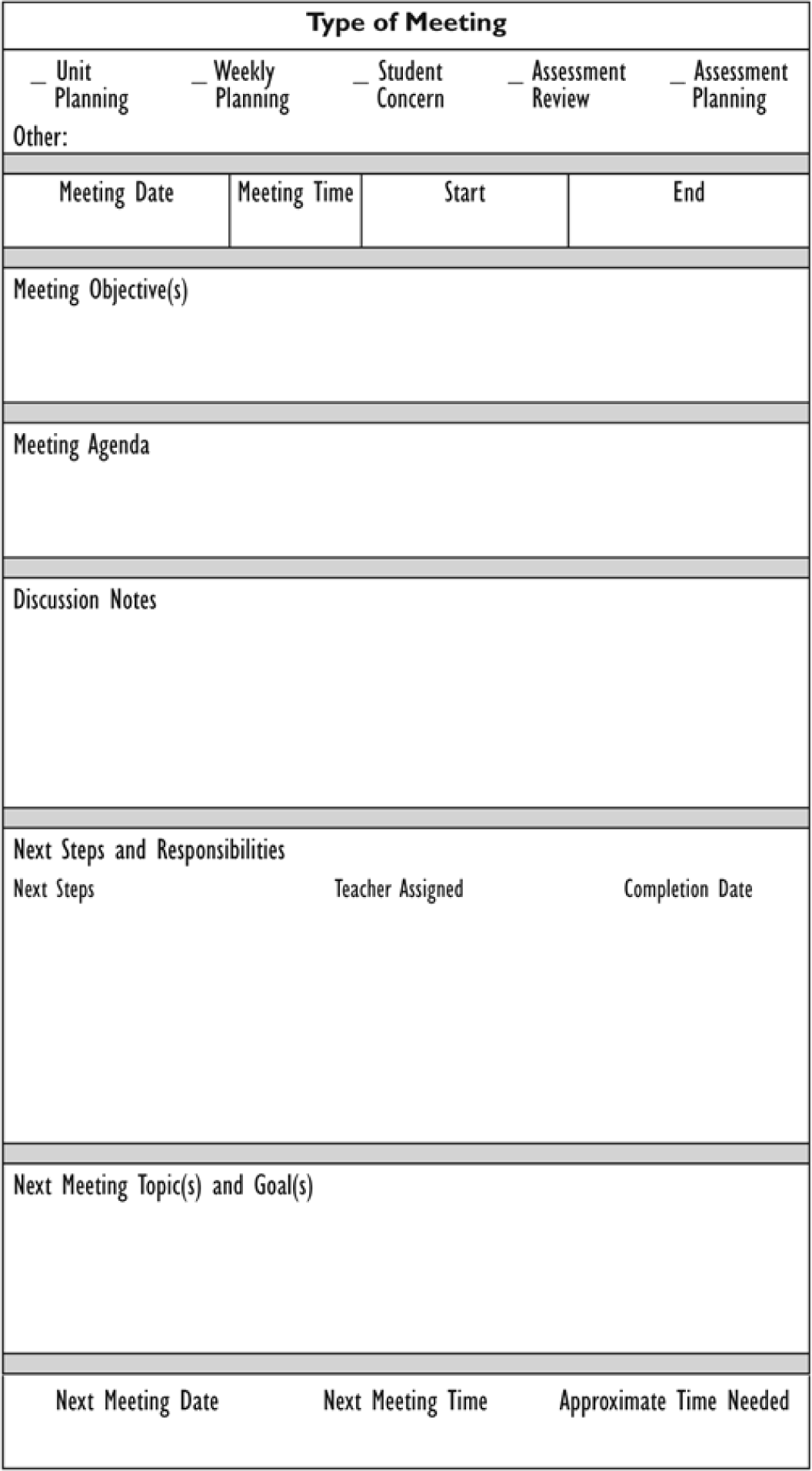
Co-teaching meeting agenda.
When developing a co-teaching meeting agenda, teachers should determine the type and purpose of the meeting. This determination can help to focus the conversation; if topics or issues arise that are unrelated to the meeting’s topic, co-teaching teams can schedule another meeting to be prepared with the necessary information. Co-teaching teams should set objectives that can be accomplished by the end of the meeting (e.g., writing 1 week’s lesson plans, evaluating student projects, discussing adaptations). These objectives can be used as a measure of the meeting’s success and focus. An agenda should be established that allows the co-teaching team to meet the stated objectives. During the meeting, participants can take notes about topics that are discussed. At the conclusion of the meeting, the co-teaching team should determine any next steps related to action that needs to be taken and set deadlines for achieving these next steps. This meeting structure helps to make the most efficient use of time and ensures that topics and tasks of importance are addressed.
Instructional Delivery and Assessment
When delivering instruction, it is important that both educators deliver substantive instruction and are viewed as integral to the classroom environment. If co-teaching teams feel confident in the content, this becomes easier as both teachers are more likely to be comfortable delivering new instruction and supporting student learning (Austin, 2001; Mastropieri et al., 2005; Scruggs et al., 2007). However, if there is a member of the co-teaching team who feels less confident in the content areas, there are still ways for that person to deliver substantive instruction. In these situations, teachers may review the previously learned material during the introductory parts of the lesson, complete guided practice with students following the delivery of instruction, or oversee independent practice for small groups of students. Whatever model is chosen, it is important that both teachers feel as if they are integral to the instructional delivery process.
One of the most critical roles both teachers should share is in analyzing student data to guide further lesson development and decision making (Dieker, 2001). Both educators should monitor student progress to ensure that all students are making academic growth, both during the delivery of instruction and at the end of units of instruction. This monitoring can occur through observation during instruction, independent work completion, formative assessments throughout instruction, or summative assessment techniques (e.g., quizzes, assessments). Regardless of the method chosen, the co-teaching team should be able to collect student assessment data, track and analyze student progress, and make instructional decisions based on student data. At the end of the lesson, teachers should reflect on how well students achieved and how well the lesson was delivered and then make changes to their instructional techniques to ensure student growth (Dieker, 2001).
Conflict Resolution
To minimize the chance that conflict may occur, teachers can be proactive by discussing instructional-related issues and philosophies at the beginning of the academic year (Conderman, 2011). However, even with appropriate communication and planning, conflicts may arise between members of a co-teaching team. To reduce the impact of these conflicts, teachers should develop a process for conflict resolution that they both can agree to. Once this process is determined, co-teaching teams should put it in writing (see Figure 5 for an outline of a conflict resolution plan). This way, both teachers know that if conflict arises there is a fair and equitable process in place that allows them to air their thoughts and feelings. According to Sinclair (1998), conflict resolution begins by both teachers identifying the issue and then developing alternative courses of action. As a team, both teachers should analyze the risk and benefits of each course of action and then choose the best course of action to help solve the issue. After the course of action has been tried, the co-teaching team should evaluate the effectiveness of the intervention. It is important to assume responsibility for consequences, correct potentially negative consequences, or reengage in the decision-making process.

Outline of conflict resolution plan.
During conflict resolution, it is important for teachers to remember to use effective communication skills, such as staying calm, using positive body language, and limiting defensive reactions (Conderman, 2011), keeping in mind that both educators share the common goal of student success. By being proactive and building a solid plan for the delivery of content, as well as for if conflict occurs, teachers can work to ensure high-quality academic success for all students in a co-teaching classroom.
Conclusion
With a large percentage of students with disabilities receiving instruction in the general education classroom environment for a majority of the day, it is important to implement instructional delivery techniques that best support student understanding. Co-teaching is an instructional delivery method that has gained favor in recent years and is consistently used to provide educational supports to students with disabilities. When implementing co-teaching, it is important that general and special education teachers rely on research-based methods that will lay a foundation for a strong partnership, thereby increasing the chance that students will academically achieve in co-teaching environments. With proper supports and tools in the areas of communication, planning and preparation, instructional delivery and assessment, and conflict resolution, co-teaching teams can be prepared with the necessary resources for addressing the needs of all students in the classroom. In addition, the groundwork laid through the use of these tools allows teachers to engage in reflective practice and to change course if data indicate that students are not achieving at the desired level.
Footnotes
Declaration of Conflicting Interests
The author(s) declared no potential conflicts of interest with respect to the research, authorship, and/or publication of this article.
Funding
The author(s) received no financial support for the research, authorship, and/or publication of this article.