



Abstract
Practicum experiences, a crucial component of preservice teacher preparation, help establish the foundational knowledge and skills necessary for beginning special education teachers (SETs). Preservice SETs need cooperating teachers (CTs) who support preservice SETs in proper emotional development (i.e., feeling like a teacher), who can model and support preservice teachers in the development of effective practices (i.e., acting like a teacher), and who promote the cognitive processes involved in instructional decision making (i.e., thinking like a teacher). When CTs are mindful of the learning needs of beginning special education teachers while also embracing the knowledge and skills they can bring to the partnership, they are more likely to help preservice teachers develop the skills needed to succeed on their own. This article presents strategies from the literature that CTs can use to effectively support their preservice SETs as they begin to feel, act, and think like a teacher.
Keywords

Practicum experiences are a crucial component of preservice teacher preparation (Maheady, Jabot, Rey, & Michielli-Pendl, 2007). Within a practicum, or field experience, preservice special education teachers (SETs) are placed in a more experienced teacher’s classroom to observe, support, and teach under the careful supervision of the cooperating teacher (CT), with guidance and collaboration from a university supervisor (Brownell, Ross, Colón, & McCallum, 2005). These structured learning opportunities provide beginning SETs a context for situating their knowledge and skills learned in university methods courses in practice as well as provide them with an opportunity to receive mentorship from a teacher who has experience navigating school systems as a special educator (Youngs, Jones, & Low, 2011).
Carefully crafted field experiences help establish the foundational knowledge and skills necessary for beginning SET effectiveness. It is during these structured learning experiences that preservice SETs gain understanding about the complexities of teaching that are unique to special education and begin to move through and between the stages of beginning teacher development (Conway & Clark, 2003; Haritos, 2004). This is important because the roles and expectations of general and special educators, particularly during the beginning years, vary greatly (Youngs et al., 2011). Specifically, in addition to the content and pedagogical knowledge all teachers must possess, SETs must also be able to create and modify curricula, write individualized education programs (IEPs), and utilize assistive technology to help deliver instruction so students can access the general curriculum, all while ensuring they are in compliance with federal laws (e.g., Individuals with Disabilities Education Improvement Act, No Child Left Behind; Youngs et al., 2011). Special education teachers are also likely to experience higher levels of work-related stress than general education teachers (Stempien & Loeb, 2002). These differences suggest that preservice SETs need CTs who can model such effective special education practices—practices that are different from those of their general education counterparts—and help them come to understand their own roles and expectations. CTs must be cognizant of their students’ learning as well as the learning and skill development of their preservice teacher. Despite the complexity of this role, CTs are often provided little guidance by the university in supporting the development of beginning teachers and are instead left to sink or swim with minimal support (Valencia, Martin, Place, & Grossman, 2009).
The CT is one of the most powerful influences on the development of the preservice teacher. Successful preservice–CT relationships can foster increased confidence, improve instructional practices, and lead to more substantive analyses of practices for both the preservice SET and the CT (Aiken & Day, 1999; O’Brian, Stoner, Appel, & House, 2007). Because this relationship has implications for the quality of services students with disabilities receive, the relationship between the CT and the preservice teacher is an important area to address. Therefore, the purpose of this article is to provide CTs with effective and practical strategies to support preservice SETs’ development so that CTs can thoughtfully support novice SETs as they begin to feel, act, and think like teachers.
Emotional Development—Feeling Like a Teacher
Teaching special education can often be an emotionally intense experience for preservice and in-service teachers alike. Often special educators have ambiguous roles in schools and are required to manage a lack of structured curricula, varying or unique settings or service delivery, and students with challenging behavior (Youngs et al., 2011). Beginning SETs are at a greater risk for experiencing stress as a result of these conditions, and if they lack coping skills, it can result in them leaving the profession (Stempien & Loeb, 2002). For example, many teachers of students with emotional and behavioral disorders experience higher levels of stress than other SETs and also have lower levels of job satisfaction (Stempien & Loeb, 2002). CTs can use field experiences as an opportunity to help preservice teachers develop coping skills to deal with stress and help them learn to feel like teachers by engaging in affective coaching, which encompasses “collegiality, respect, and emotional, support” (O’Brian et al., 2007, p. 271).
Establishing Positive Communication
Positive, ongoing communication is one way to provide emotional support during a preservice field experience (Graham, 2006). Frequent communication among the CT, preservice SET, and university supervisor helps preservice SETs translate knowledge acquired from coursework to practical settings (Brownell et al., 2005). In addition, positive communication fosters a sense of collegiality between the preservice SET and the CT (O’Brian et al., 2007). This sense of collegiality with more experienced teachers is important for helping novice special educators feel supported and successful (Stempien & Loeb, 2002). If positive communication is not established, CTs and preservice SETs may struggle to engage in authentic discussions, or it may prevent a sense of camaraderie from developing in their classroom.
Providing Emotional Support
Teaching special education is a complex and stress-inducing job, especially for beginning teachers. Issues unique to special education that can contribute to an increase in stress include dealing with paperwork, facing inadequate teaching materials and resources, working with paraeducators, and helping families navigate the special education process (Stempien & Loeb, 2002). Often, preservice SETs struggle with feelings of inadequacy or lack of acceptance by the school staff. In addition, preservice SETs enter into their field experiences with varying levels of self-efficacy, which can affect their ability to feel confident in their instruction for students with disabilities (Payne & Manning, 1990).
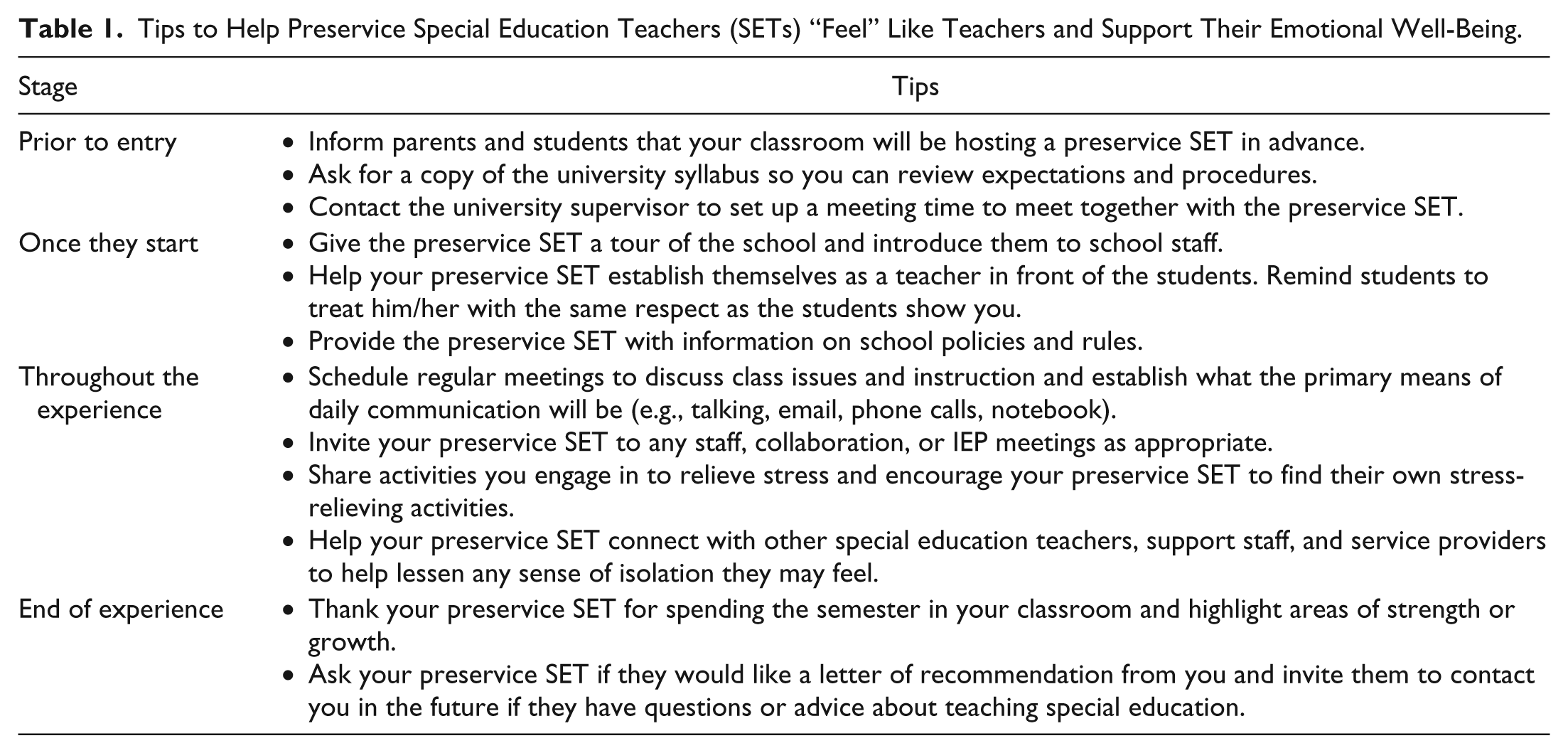
Cooperating teachers can help alleviate some of the negative emotions and stress their preservice SETs feel by helping them cope with these emotions in a healthy manner. In doing this, they support the preservice SETs in establishing coping strategies that will carry them throughout their career (Greer & Greer, 1992; Stempien & Loeb, 2002). CTs can facilitate this positive development by helping their preservice SETs develop realistic professional goals and expectations, engaging in conversations at work that allow them to vent their concerns, modeling appropriate stress-reducing strategies, and helping them deal with the sense of isolation that often comes with teaching special education (Greer & Greer, 1992; Stempien & Loeb, 2002). One area where CTs can offer emotional support is in helping their preservice SETs realize that in teaching—especially in special education—not everything will always go as planned. Often lessons fail or are hijacked by inappropriate student behavior, fire drills, or substitute staff. CTs can model how to appropriately deal with such interruptions as opposed to becoming angry or frustrated. Explicitly addressing these emotional needs during preservice field experiences can help prevent teacher burnout and feelings of inadequacy in the future. Table 1 provides some practical tips for CTs to use to help support the emotional development of their preservice SET.
Tips to Help Preservice Special Education Teachers (SETs) “Feel” Like Teachers and Support Their Emotional Well-Being.
Development of Practices—Acting Like a Teacher
In addition to providing supports for appropriate affective development, CTs can aid in developing preservice SETs’ practices (Feiman-Nemsar, 1998; Norman, 2011). The roles and responsibilities of SETs are multifarious, and getting used to the myriad of responsibilities SETs are expected to manage takes time and support (Billingsley, Griffin, Smith, Kamman, & Israel, 2009). CTs can make this time most meaningful through scaffolding the preservice SETs’ learning experiences (Pellett, Strayve, & Pellett, 1999) and through collaborative joint work or co-teaching (Norman, 2011).
Scaffolding Responsibilities
Scaffolding can help support teachers as they move through conventional stages of beginning teacher development, including (a) concerns about self, (b) concerns about tasks, and (c) concerns about their impact on students (Conway & Clark, 2003, p. 466). Although some posit that teachers move sequentially through these stages (Rutherford & Hall, 1990), others suggest that they experience each stage simultaneously (Haritos, 2004). Regardless, while moving through or between these stages, CTs can provide a gradual release of responsibility by giving the preservice teacher a task more complex and challenging than the one before it. In this way, CTs respect the level of expertise novices hold and provide them with tasks appropriate to their developmental level.
To become more competent in the development of practices as preservice SETs move through and between the typical stages of beginning teacher development, scaffolding can advance from modeling to providing appropriate practice (Pellett et al., 1999). Observing a CT as a model can help a preservice teacher learn about the different elements of a lesson plan or learn new pedagogical tools (Feiman-Nemsar, 1998; Norman, 2011). For example, scaffolding could be used to help preservice SETs become familiar with providing explicit decoding instruction. The preservice SETs may first observe the CTs providing instruction, then they may provide instruction in a one-on-one setting and later transition into small group instruction.
Second, preservice teachers can engage in appropriate practice through opportunities to “practice and refine what they have observed through progressively sequenced activities” (Pellett et al., 1999, p. 2). They can advance from working with students on smaller scales to working with a classroom of students to working collaboratively with the CT. When CTs promote a gradual release of responsibility, preservice teachers feel respected and receive ongoing and appropriate opportunities to improve their practices. In this way, preservice SETs have opportunities to improve their pedagogical skills, emphasizing concerns about their impact on students over concerns about the self and tasks (Conway & Clark, 2003).
Engaging in Joint Work
Scaffolding preservice SETs’ development through a gradual increase of responsibility is important; however, engaging in joint work is another piece to this complex relationship. Major components of joint work include working with the preservice SET as a co-teacher (Killian & Wilkins, 2009), collaborative lesson planning (Norman, 2011), coaching (Buck, Morsink, Griffin, Hines, & Lenk, 1992), and collaboration with other educational professionals, including general education teachers (Arthaud, Aram, Breck, Doelling, & Bushrow, 2007). This joint work helps preservice teachers to engage meaningfully in a collaborative professional community, focusing on student learning and critical reflection (Norman, 2011).
Highly effective CTs view their preservice SET as a partner versus an instructional replacement or aide (Killian & Wilkins, 2009). These highly effective CTs work as co-teachers with their preservice SET instead of taking turns (i.e., one teacher working/teaching at a time), the most common approach to field experience. Co-teaching during field experiences “enhances the learning opportunities for students, combines the knowledge and strengths of both teachers, and models a positive adult working relationship” (Bacharach, Heck, & Dahlberg, 2008, p. 43). Furthermore, when planning is approached collaboratively, CTs help ensure preservice SETs are adequately prepared for implementation of instruction. CTs can incorporate preservice SETs in lesson planning through dialogue (Talvitie, Peltokallio, & Männistö, 2000). Talking through the elements of the lesson provides novice teachers an opportunity to think through the delivery of the lesson’s content, anticipate students’ errors, prepare instructional materials, and plan for transitions. Coaching can also positively affect the preparation of special educators because it enhances transfer of training, increases desirable teaching behaviors, improves collegiality, and reduces isolation commonly felt by SETs (Buck et al., 1992). Because more and more special education students receive services in the general education classroom, joint work can and should involve collaborating with the general education teacher (Arthaud et al., 2007).
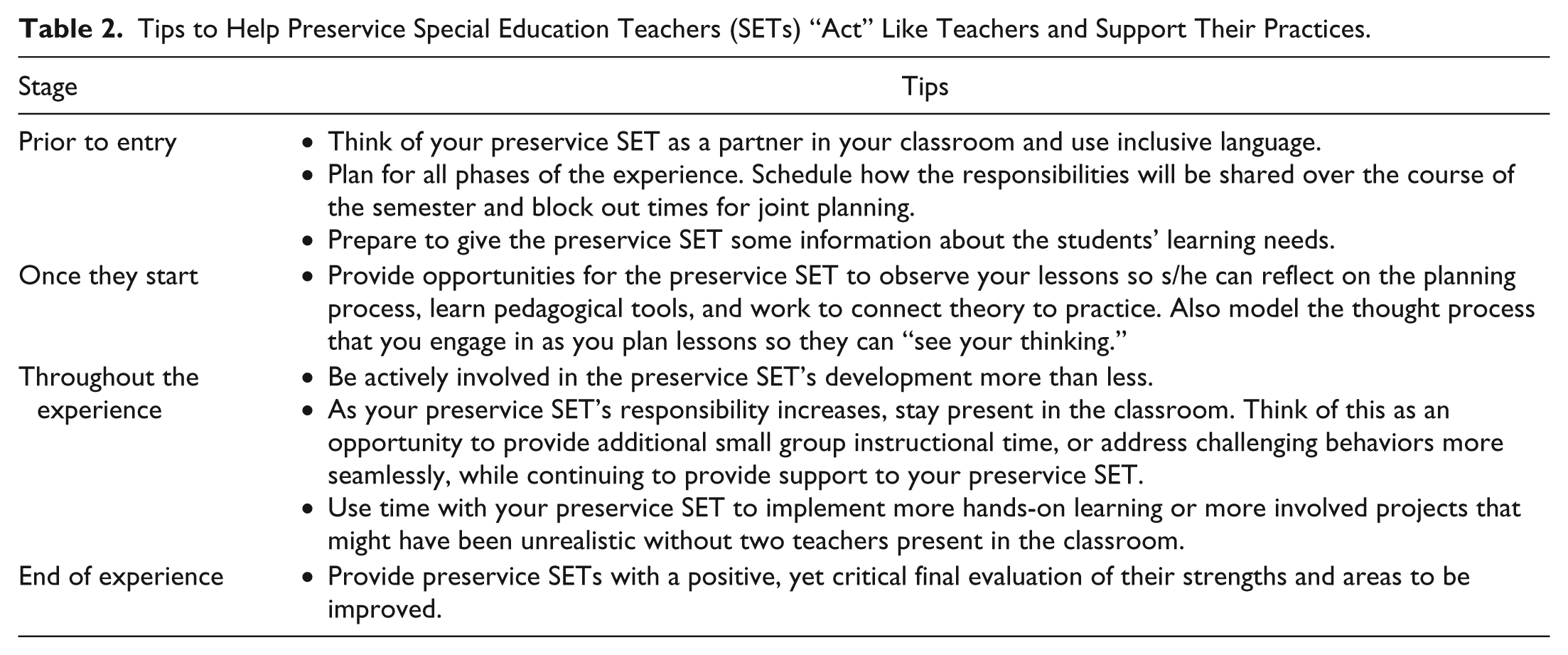
Cooperating teachers may have an even more powerful impact by pairing scaffolding responsibilities and engaging in joint work (Bacharach et al., 2008). Preservice SETs that experience this type of partnership may be more likely to be prepared to teach within co-teaching instructional settings, collaborate with colleagues to best meet the needs of diverse learners, and be better equipped with the skills and knowledge necessary to affect student learning outcomes. Following these helpful hints (see Table 2) before, during, and after the preservice teacher’s field experience can help ensure that CTs are scaffolding instructional opportunities and engaging in joint work.
Tips to Help Preservice Special Education Teachers (SETs) “Act” Like Teachers and Support Their Practices.
Promoting Critical Analysis —Thinking Like a Teacher
Cooperating teachers can promote growth in the preservice teacher’s capacity to implement effective practices and respond to students’ needs by providing frequent and structured opportunities for the preservice teacher to think critically about instructional practices. In addition to engaging preservice teachers in reflective discourse about their instructional practices, CTs can support preservice SETs’ development by modeling teacher-like thinking and including preservice SETs in their teacher evaluation process.
Fostering Reflective Practices
Cooperating teachers play a valuable role in fostering the analytical development of preservice SETs through structured, open-ended feedback (Boydell, 1986). For example, a CT may observe a preservice SET conducting a small group intensive reading lesson with students with reading disabilities and then help the preservice SET to analyze the instruction in terms of intensity, explicitness, cohesiveness, and the quality and quantity of practice opportunities provided to students. After the observation, the CTs may ask the preservice SETs to describe the students’ responsiveness to their instruction. Next, the CTs may push the preservice SETs to consider how they can adapt future instruction to be more tailored to the students’ immediate needs. This type of structured discourse focused on the preservice SETs’ instructional decisions and practices will help the novice SET improve instructional skills, increase the capacity to analyze instruction, and promote the development of critical discourse on how instruction affects student learning. Understanding the features of effective discourse and being able to identify effective instruction will support preservice SETs in engaging in more substantive analysis of instruction necessary to improve practices (Sims & Walsh, 2009).
Supporting Teacher-Like Thinking
In addition, CTs can promote reflective practices by making explicit their implicit thought processes through oral narration of their decisions as they work alongside their preservice SETs. Feiman-Nemsar (1998) suggested CTs use the strategy of thinking aloud as a way to “make visible and explicit what is usually invisible and implicit” (p. 69). This focused discourse about practice will inadvertently provide the preservice teacher access to the common technical vocabulary in teaching (Grossman & McDonald, 2008). Swanson (2010) cautioned that beginning teachers may not value this transparency; novice teachers often just want to be instructed what to do. However, as preservice teachers develop confidence and their instructional repertoire becomes more sophisticated, they will feel less overwhelmed by the thought processes of the CT and begin to engage more critically both in thought and in discourse.
Engaging in Evaluation
Although the relationship between CTs and preservice teachers has traditionally been nonevaluative in nature, recent accountability policy has created changes to how teachers are formally evaluated and has increasingly emphasized teacher effectiveness (Benedict, Thomas, Kimerling, & Leko, 2013). These changes provide an opportunity to teach preservice SETs about the realities of the teacher evaluation process. With increased emphasis on teacher effectiveness, it is likely that CTs’ responsibilities may grow to encompass evaluation. CTs may formally evaluate their preservice teacher’s instructional performance, report these observations to the preservice teacher’s institute of higher education, and engage in a postconference with the preservice teacher about his or her observations following the lesson’s implementation.
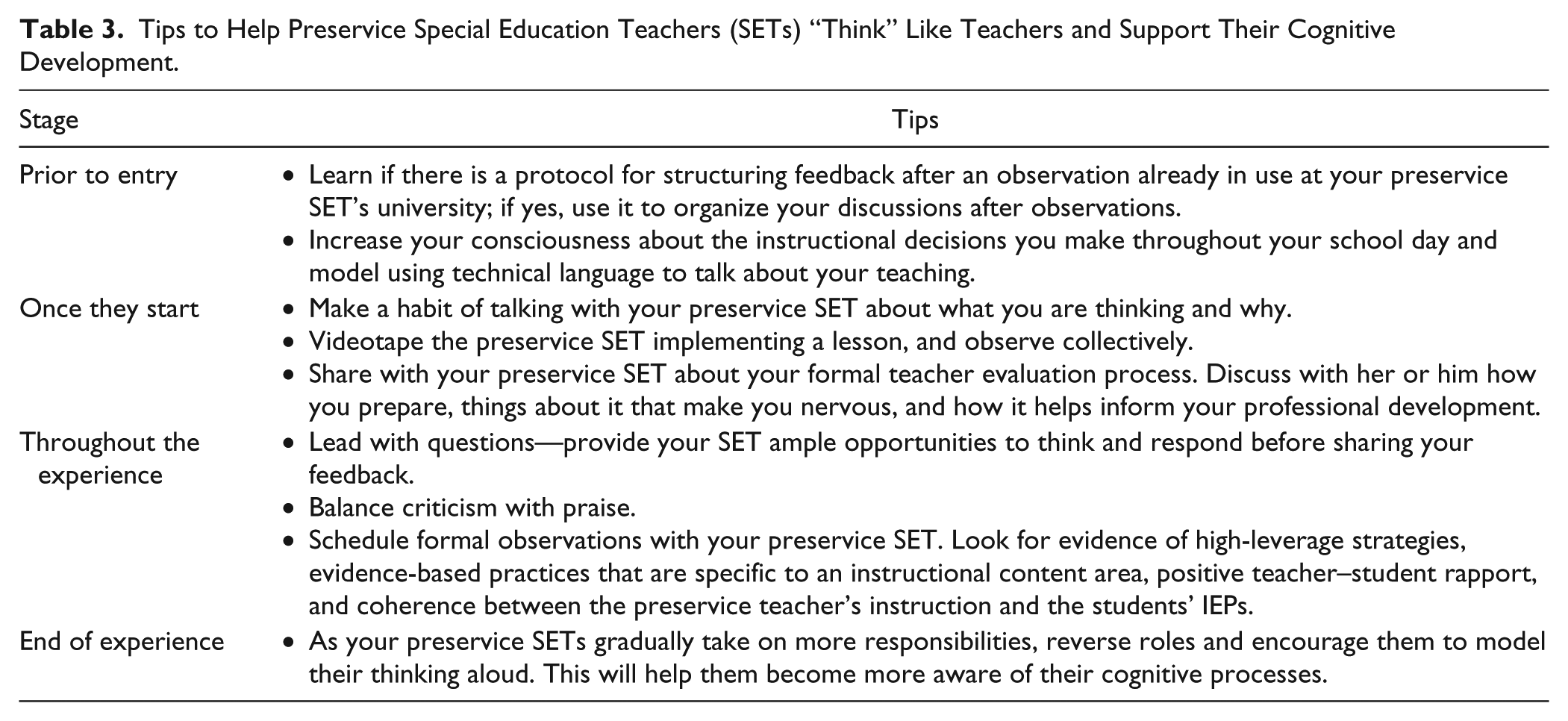
Some teacher preparation institutions will provide the CT a guide to follow during the formal observation. However, CTs who are not provided a guide should explicitly look for evidence of the following while observing the preservice teacher: (a) implementation of high-leverage strategies (e.g., stating the lesson’s objective, modeling during direct instruction, providing wait time after asking a question), (b) implementation of evidence-based practices specific to a content area (e.g., providing encoding instruction using plastic letter tiles to promote decoding and spelling skills; Weiser & Mathes, 2011), (c) positive teacher–student rapport (e.g., during the lesson the preservice teacher interacts with the students in a caring and respectful manner), and (d) evidence that the lesson is tailored to the students’ individualized needs, is aligned to students’ IEP goals, and integrates the appropriate accommodations and assistive technology. After the observation, CTs should choose the most critical elements from each observation area to discuss with the preservice teacher as well as provide focused feedback so preservice SETs are not overwhelmed (Swanson, 2010). Feedback should be balanced and showcase the preservice teacher’s strengths as well as target areas for improvement (Killian & Wilkins, 2009). Table 3 provides some helpful tips to support CTs in promoting “teacher-like thinking” and engaging in evaluation with preservice teachers.
Tips to Help Preservice Special Education Teachers (SETs) “Think” Like Teachers and Support Their Cognitive Development.
Conclusion
Preparing preservice special education teachers to be confident, instructionally competent, and cognitively capable is a challenging task. These accomplishments would not be possible without the leadership and expertise of welcoming CTs. From building preservice SETs’ confidence to teaching them to think and reflect like a teacher and supporting them in establishing a core set of classroom practices—CTs have a significant influence on preservice SETs’ growth. This growth results in improved outcomes for students with disabilities. However, the development of these areas—feeling, acting, and thinking like a teacher—is not linear. Instead, these areas are interconnected, and by supporting a preservice SET in one domain, CTs are also fostering development in the others. To establish a positive relationship that allows for preservice SET development and a successful co-teaching relationship, CTs and SETs must be able to successfully plan, communicate, and instruct together (Bacharach et al., 2008). When CTs are mindful of the learning needs of beginning special education teachers while also embracing the knowledge and skills they can bring to the partnership, they are more likely to help preservice SETs develop the skills needed to swim on their own.
Footnotes
Acknowledgements
The authors wish to thank Melinda Leko for her feedback and guidance on earlier drafts of this article.
Declaration of Conflicting Interests
The author(s) declared no potential conflicts of interest with respect to the research, authorship, and/or publication of this article.
Funding
The author(s) received no financial support for the research, authorship, and/or publication of this article.