



Abstract
Tier 2 supplemental instruction within a response to intervention framework provides a unique opportunity for developing partnerships between speech-language pathologists and classroom teachers. Speech-language pathologists may participate in Tier 2 instruction via a consultative or collaborative service delivery model depending on district needs. This article describes steps and suggestions for the development and implementation of a collaborative Tier 2 program for kindergarten.

Response to intervention (RTI) is a multitiered system integrating assessment and intervention to maximize student achievement for struggling learners at increasing levels of intensity (Fuchs & Fuchs, 2006). RTI is described as a general education initiative requiring close collaboration between general and special education personnel, including speech-language pathologists (SLPs) (Moore & Montgomery, 2008). The core academic curriculum (i.e., general education) comprises the first tier. Tier 2 focuses on students who are not responsive to general education instruction. If a student is not successful in Tier 2, the student may move to Tier 3, which is intense instruction (e.g., special education placement).
Tier 2 is the primary tier that distinguishes RTI from previous models of preventative services within the public schools (Ukrainetz, 2006). This tier is conceptualized as noncategorical short-term, relatively intense, high-quality instruction (Justice, 2006). It is within the second tier that SLPs may provide a unique role in collaboration with general education teachers. Districts often concentrate RTI on early reading instruction because there is a strong research base supporting the prevention of reading difficulties through early intervention (National Institute of Child Health and Human Development, 2000). Because of rich research documenting relationships between early reading achievement with phonological/print awareness, literacy experiences, and vocabulary, most early reading Tier 2 programs focus on these components. Specialized training in phonological awareness, literacy, and oral language makes SLPs well suited to participate in Tier 2 instruction for kindergartners to prevent reading disabilities (Schuele & Boudreau, 2008).
Many school-based SLPs desire specific guidelines for Tier 2 service delivery (Consolini, Carson, Miller, & Johnston, 2009). However, Individuals with Disabilities Education Act of 2004 (IDEA, 2004) included broad reference to RTI components, which leaves interpretation of specific implementation policies and procedures to local education agencies (Reutebuch, 2008). In other words, there is more than one way to deliver Tier 2 instruction. SLPs have the opportunity to design programs to fit the needs of a specific school population or structure (Ehren, Montgomery, Rudebusch, & Whitmire, 2007). The SLP may consult with teachers, provide direct instruction outside the classroom, and/or provide classroom-based instruction. SLPs may adopt different roles and participate in various programs depending on district needs. Tier 2 programs in which SLPs directly provide instruction with a general education teacher have evidence to support their application (Koutsoftas, Harmon, & Gray, 2009; Ukrainetz, Ross, & Harm, 2009). This column describes an SLP and general education teacher collaborative program for Tier 2 instruction in kindergarten classrooms, outlining appropriate steps for development and implementation.
Step 1: Knowing Roles and Contributions
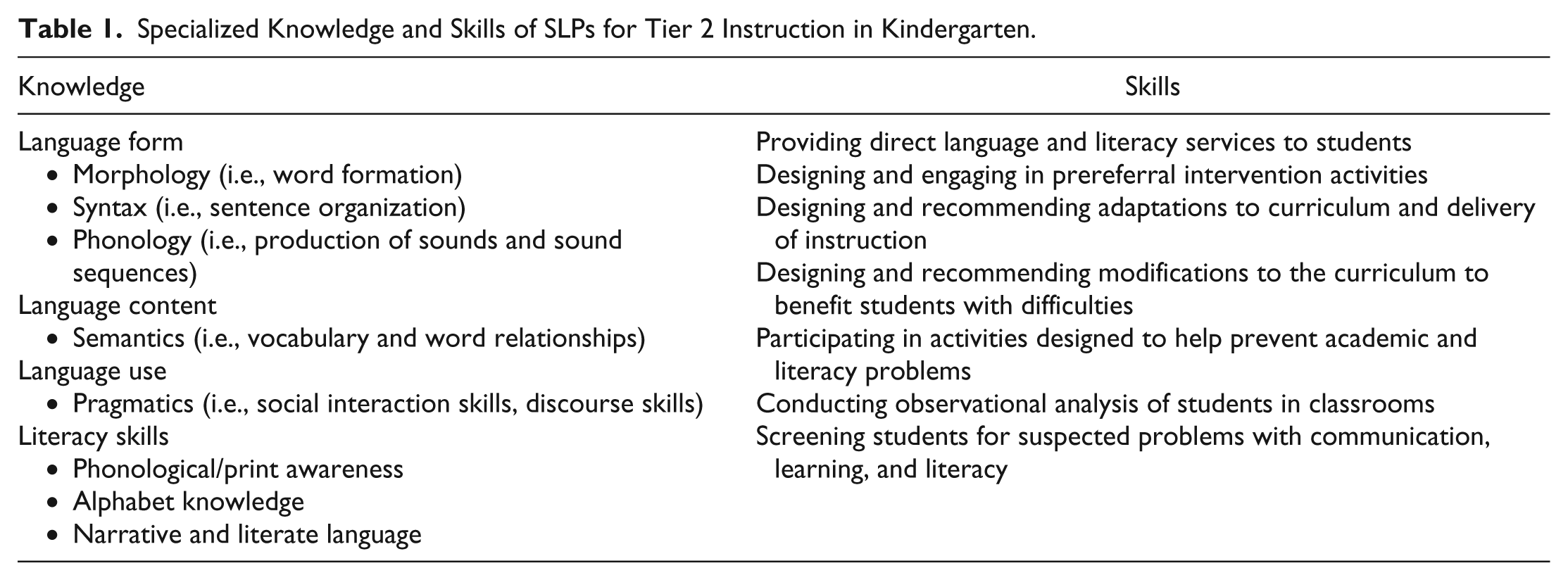
Defining and understanding roles is important for program development. This may best be addressed during weeks prior to the beginning of the school year. During initial meetings, role definition and prior cross-disciplinary training should be considered. The role of SLPs in schools today bears little resemblance to the role established by pioneering professionals (Harn, Bradshaw, & Ogletree, 1999). If general education teachers have not worked closely with SLPs, they may not know the potential contribution of SLP services. Table 1 highlights specialized background of SLPs for Tier 2 language and literacy instruction (American Speech-Language-Hearing Association, 2002; Paul, 2007). Although SLPs may have knowledge and skills for Tier 2 service delivery, cross-disciplinary training in curriculum implementation may be lacking. Gathering benchmark information and key elements of the kindergarten curriculum is critical. Teachers can review the curriculum, and SLPs can explain areas in which they may contribute.
Specialized Knowledge and Skills of SLPs for Tier 2 Instruction in Kindergarten.
Preparatory meetings should also include discussions of prior experience with Tier 2 collaborative programs. Potential classroom service-delivery methods may be considered. To initiate the conversation, collaborative partners can rank models for classroom-based instructional approaches in order of perceived effectiveness (Friend, Cook, Hurley-Chamberlain, & Shamberger, 2010).
Center teaching: Each teaches at a separate center or the SLP teaches the Tier 2 center and the teacher circulates among the other four centers.
Parallel teaching: The SLPs and teachers present the same material to half the class in which students in Tier 2 RTI are equally distributed.
Alternative teaching: The teacher works with most students, and the SLP works with the students enrolled in Tier 2.
Such discussions provide opportunities to develop shared goals and objectives and identify strategies for implementation of the program.
Step 2: Obtaining Administrative Support
Programmatic development and implementation involves change in professional roles and/or responsibilities. The workload of one or more collaborative partners could be altered. As such, instituting a new program requires administrative support. It is critical to present a potential plan of action to administrators that has consensus among the collaborative partners and sufficient procedural detail. However, collaborative partners need to meet with administrators early in the process to garner support and obtain information to successfully embed the Tier 2 program within the existing classroom framework. Initiating new collaborative programs may best emerge in conjunction with supportive leadership at higher administrative levels.
Administrative behaviors that contribute to successful implementation of SLP–teacher collaborative programming are documented (Moore-Brown, 1991; Schetz & Billingsley, 1992). Table 2 includes a list of questions based on such research to identify areas of strength and weakness in administrative support. Responses to these questions may facilitate meeting preparation and success. For example, if the school principal has not demonstrated knowledge of an SLP’s contribution to literacy and curriculum, background information could be included as an agenda item. In another example, if there is no clear long-term goal for staff development, opportunities to request permission to pursue RTI training may be presented. In a final example, if no formalized collaborative programs are in place at the school, an overview of the benefits may be discussed.
Preparatory Questions for Administrative Meeting.

During meetings with school administrators, current terminology should be used to describe how the new program fits into the picture of IDEA (2004). The potential roles of the general education teachers and SLPs can be discussed. SLPs may highlight potential impacts on service delivery. These include (a) preventing inappropriate referrals for speech and language difficulties, (b) increasing time dedicated to collaborative and consultative models of service delivery, (c) increasing prevention interventions outside of the individualized education program (IEP) process, and (d) examining if a student’s speech and language issues are or are not contributing to behavioral and academic challenges. SLPs may need to schedule a separate meeting with the special education director to revise her workload schedule.
Finally, collaborative partners should note that classroom scheduling and core curriculum would remain unchanged. Rather, the existing curriculum would be enhanced and supplemented. It should be noted that materials for program implementation are not beyond the current materials used to provide speech and language services or the current curriculum. This may alleviate administrative concerns about the cost of the program.
Step 3: Planning and Communicating
Once the school year begins, setting aside time to discuss program implementation and student performance is critical. Direct and indirect modes of communication may be used. Direct modes primarily consist of scheduled meetings. The partners may select a time during their conference periods for approximately 20–30 min. It is important to have a scheduled meeting time because it decreases unproductive informal meetings. For example, if SLPs “stop by” kindergarten classrooms to get feedback on a plan, activity, or student before or after their other duties (e.g., treatment or assessment sessions), they may interrupt the teacher during core teaching time. Further, informal meetings when one or more partners are not available could result in additional, separate meetings. The consequence may be that one partner is not adequately informed. Communication breakdowns can occur.
As weeks progress, general education teachers may need to schedule parent conferences during the designated meeting time. SLPs may be required to participate in unexpected meetings for students enrolled in special education. If this occurs, the partners may need to have a secondary meeting time (e.g., briefly after school).
When needs arise outside of scheduled meeting times, partners should use indirect modes of communication (e.g., email). This can facilitate communication with the team and time management. Additionally, one partner should take the responsibility to send a weekly email to the principal, collaborative partners, and other support staff regarding weekly curriculum objectives and lesson plans. This can facilitate meeting productivity.
Step 4: Accessing Classroom and Curriculum
Program implementation requires mutual participation in the classroom context. Since SLPs may have limited exposure to classroom dynamics, classroom observations during large and small group instruction may be beneficial. The purpose of observations is to increase understanding of classroom operations and coordinate SLP participation within the classroom. The intent is not to evaluate classroom management or teaching methods, which should be clarified with the teacher. To maintain open communication and transparency, all partners should be aware of the types of questions comprising the observation.
Where does the teacher stand/sit to present information in large and small group settings?
Where do the students stand/sit to present information in large and small group settings?
Is the environment relaxed or fast-paced?
Which areas of the classroom are more or less noisy?
How does the teacher cue the students for transition to centers?
Answering these questions can help guide SLPs as they take an active instructional role in the classroom. For example, if the partners select a teaching model that uses instructional centers, determining the Tier 2 location is important. Knowing where the teacher and students are situated in the classroom and where active, noisy centers are in relation to other centers is helpful. Understanding the pace of the classroom can help SLPs modify their presentation style and/or discuss their style with the classroom teacher to facilitate transition across centers.
Step 5: Implementing Tier 2 Instructional Components
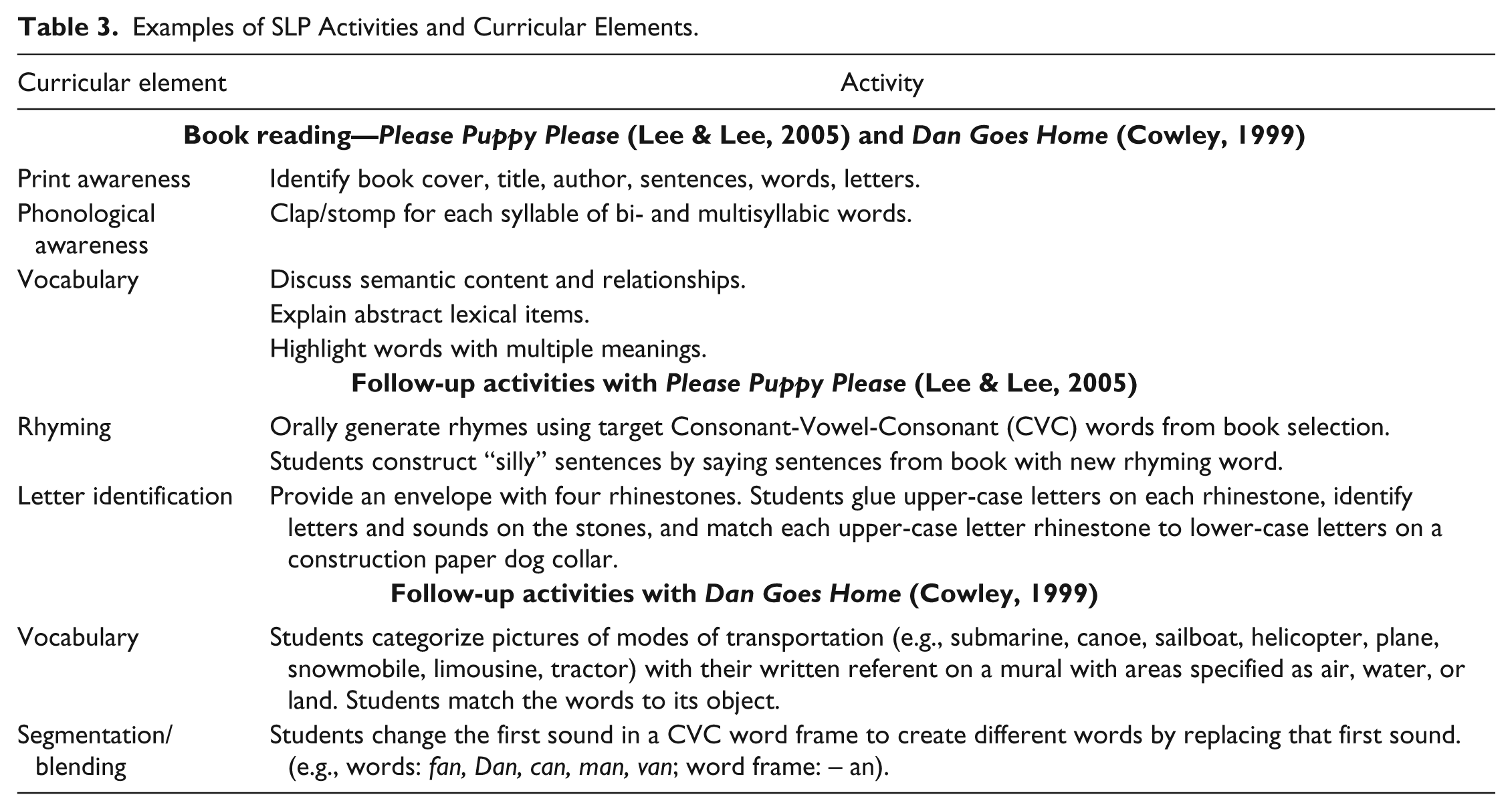
After concluding discussions about roles, schedules, classroom structure, and curriculum objectives, the partners must determine program objectives. The focus of an SLP lesson within a classroom context will most likely include skills associated with print awareness (e.g., upper- and lower-case letter identification, spoken and written word correspondence), phonological awareness (e.g., rhyming, syllable/phoneme blending and segmentation), and vocabulary within meaningful literacy contexts. Interactive book reading with follow-up activities targeting vocabulary and print/phonological awareness skills is a suggested instructional format. Table 3 provides examples of potential SLP lessons and curricular elements.
Examples of SLP Activities and Curricular Elements.
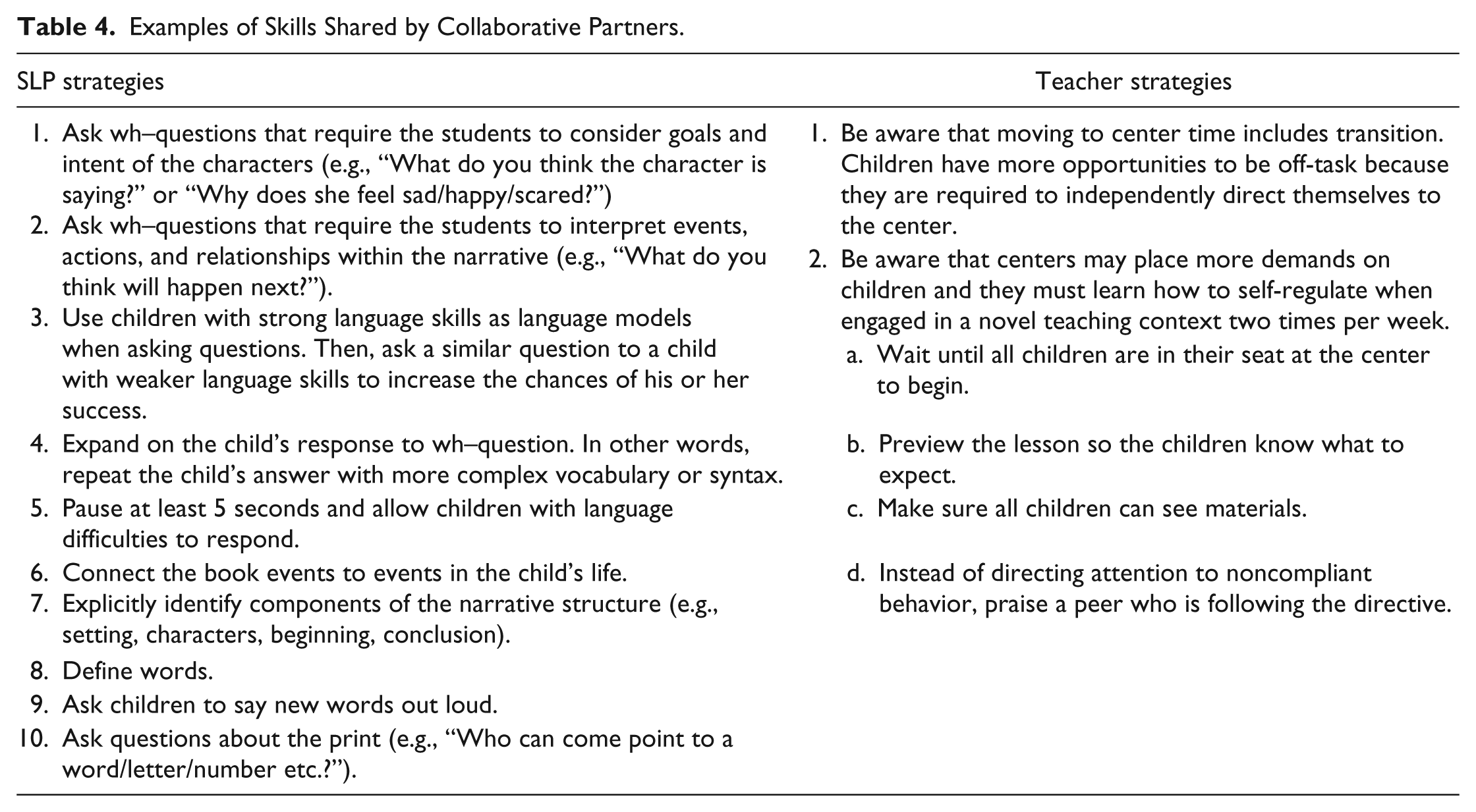
Lesson plan development may be a primary focus for collaborative planning. During scheduled meeting times, discussions may focus on language and literacy targets, activities, and student progress. Additionally, at that time collaborative partners may provide consultation and suggestions for effective implementation of specific activities and general classroom activities. For example, SLPs may contribute methods to increase literacy and language opportunities within the current lesson plans. Teacher consultation with SLPs may describe behavior management methods and curriculum integration (see Table 4).
Examples of Skills Shared by Collaborative Partners.
SLPs and general education teachers have the opportunity to design programs to fit the need of their specific school and classroom structure. Program focus and professional responsibilities for program objectives may change based on discussions during meetings. For example, if students are not making progress in vocabulary, the partners may decide the program focus should shift to vocabulary. If one component of Tier 2 instruction emphasizes storybooks as a context for vocabulary and literacy development, these components could remain. However, rather than targeting phonological awareness within a majority of follow-up activities each week, the partners may decide that only one activity per week is sufficient. On the other hand, if the teacher includes many vocabulary enrichment activities with less emphasis on phonological awareness during instruction throughout the day, SLPs may increase the amount of phonological awareness tasks provided in lessons.
Step 6: Monitoring the Collaborative Process and Student Performance
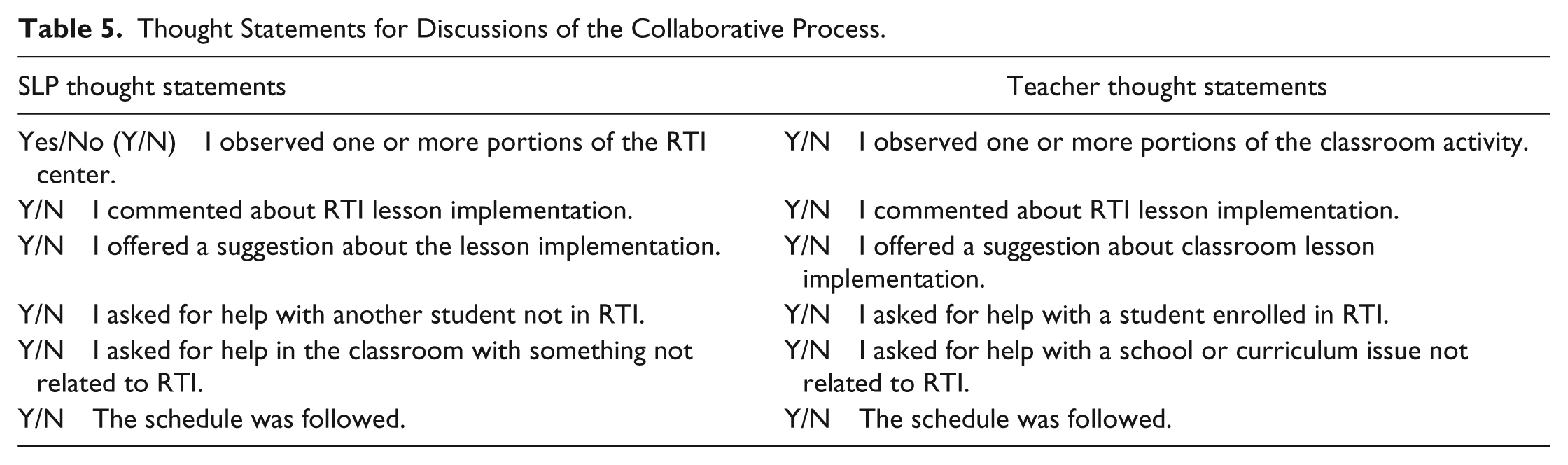
Keeping a journal that remains in the classroom is useful to document types of activities, skills being taught, nature of student work, and materials being used by teachers and students (Ehren, 2000). The partners decide the type of content to be included. For example, the partners may use the journal to document changes in the logistics of classroom procedure and use meeting time to discuss other collaborative components. Table 5 provides a series of thought statements to identify behaviors that more or less contribute to a successful collaborative program. The thought statements may be useful to prompt discussion about the program and perceptions of personal contribution. The collaborative partners can make notes related to the thought statements for discussion in weekly meetings. The team may identify areas of strength and weakness and change as needed. This type of documentation along with student outcomes can be useful to maintain or alter program implementation.
Thought Statements for Discussions of the Collaborative Process.
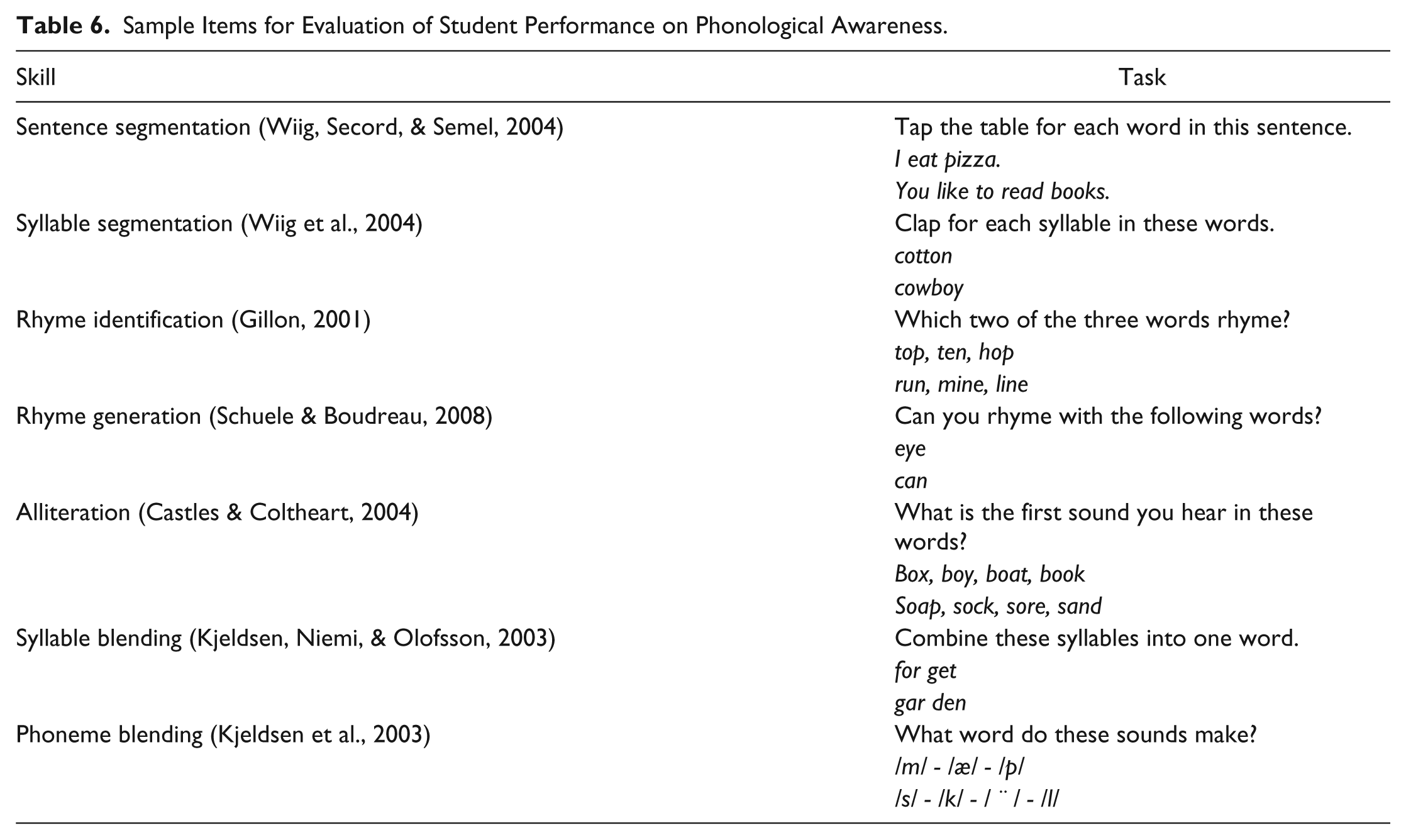
Monitoring student progress is the responsibility of general education teachers and SLPs. Each contributes different types of evidence of student performance. It is important to determine the type of data each partner will provide. Division of skills for progress monitoring should streamline data collection, not create additional work. Methods could include checklists, audio recordings, work samples, standardized tests, program-specific tests, or curriculum-based measures. For example, SLPs may develop program-specific probes on print and phonological awareness skills. Table 6 provides a sample of phonological awareness tasks presented in order of earliest developing and less complex to later developing and more complex (Schuele & Boudreau, 2008).
Sample Items for Evaluation of Student Performance on Phonological Awareness.
Conclusion
There are many facets to RTI and more than one way to deliver services. This column included steps for development and implementation of a collaborative Tier 2 instructional program. These steps were designed to fit within an existing kindergarten program. Following a review of mutual professional contributions, classroom structure, and curriculum, a program can be developed in which instructional plans are developed in concert with ongoing curriculum themes, book selections, and weekly targets to address the unique needs of any district.
Footnotes
Declaration of Conflicting Interests
The authors declared no potential conflicts of interest with respect to the research, authorship, and/or publication of this article.
Funding
The authors received no financial support for the research, authorship, and/or publication of this article.