




Abstract
Check-in/check-out (CICO) is a resource-efficient, mentor-based, Tier 2 intervention. Various problem behaviors of students with and without disabilities across traditional and alternative school settings have been impacted positively by CICO. Not all students respond to the traditional, five-step approach, however. This article provides an overview of three resource-efficient adaptations educators may consider prior to designing resource-intensive, Tier 3 (i.e., individualized) interventions for students who do not respond to traditional check-in/check-out.
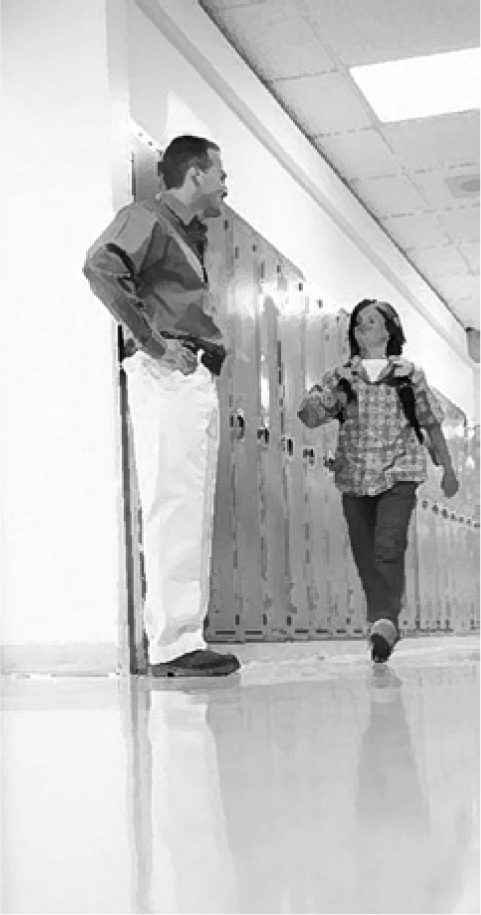
Many teachers, paraprofessionals, and administrators have reported high rates of satisfaction with a Tier 2 intervention known as check-in/check-out (CICO; Filter et al., 2007; Hawken & Horner, 2003; Todd, Campbell, Meyer, & Horner, 2008). This intervention is based on the premise of pairing students who are unresponsive to school-wide (Tier 1) interventions as indicated through rates of problem behavior and/or discipline contact with adult mentors to monitor daily behavior. Various problem behaviors of students with and without disabilities across traditional and alternative school environments have been impacted positively by CICO, and the intervention is noted as being effective and efficient. Educators report it requires limited training and resources (Ennis, Jolivette, Swoszowski, & Johnson, 2012; Hawken, MacLeod, & Rawlings, 2007; Hawken, O’Neill, & MacLeod, 2011; Swoszowski, Jolivette, Fredrick, & Heflin, 2012). In fact, a 1- to 2-hour training and copies of CICO point sheets may be all schools need to begin implementation with 10 to 30 students at a time (Crone, Horner, & Hawken, 2004; Lane, Capizzi, Fisher, & Ennis, 2012). Furthermore, the intervention requires minimal time throughout the school day to be implemented with fidelity. Traditional CICO was designed as a five-step process: (a) check-in, (b) point feedback, (c) check-out, (d) home component, and (e) return to school (Crone et al., 2004). Prior to implementing the five-step process, several prerequisite steps must be addressed. Each prerequisite step and traditional component will be discussed in detail.
Prerequisite Steps
Prior to implementing CICO, educators must first form a CICO team (Crone et al., 2004), which is typically composed of two or more members (e.g., teacher, counselor, administrator). In schools/facilities where school-wide positive behavioral intervention and support (PBIS) is in place, the CICO team is considered an extension of the PBIS team and works in collaboration with the larger leadership team. In addition, CICO teams may serve as part of school Response to Intervention (RTI) teams (e.g., Tier 2 teams, personnel support teams). The CICO team members are responsible for collaborating with PBIS/RTI teams to identify students who are unresponsive to Tier 1 supports and who require more targeted Tier 2 supports as well as routinely evaluating implementation of CICO and responsiveness to implementation. Second, the CICO team identifies possible CICO mentors. The relationship between the mentor and student is the central, most important component of the intervention; therefore, it is important to consider these relationships when selecting mentors. It is not necessary for the mentor and student to have a previously established relationship, but it is recommended that adults with positive rapport with students be chosen and asked to volunteer. It also is necessary to consider scheduling when identifying mentors. Most often teachers, teaching assistants, and counselors serve as mentors because they have consistent schedules and can be available to students across the school day and throughout the school year. Third, CICO teams work with PBIS/RTI teams to determine the criteria by which they will identify students for CICO. Office discipline referral (ODR) data are commonly used for identification, with two to five ODRs earned as well as teacher referral noted as the most standard criteria for identification throughout the CICO literature (Crone et al., 2004; Horner, Sugai, Todd, & Lewis-Palmer, 2005). Fourth, once possible mentors have been selected and students identified as needing support, the CICO team determines the mentor-student pairs, and the mentors are trained. In this training, mentors learn the procedures for the check-in and check-out components. Teachers responsible for awarding students points throughout the school day (i.e., a detailed description of all CICO steps follows) are trained as well. These trainings, which are conducted by the CICO team or an outside person with Tier 2 expertise, last 1 to 2 hours each to establish the rationale for the intervention, role of each mentor or teacher, and an opportunity for mentors to role play the CICO intervention components to mastery. Finally, CICO teams prepare the materials needed to complete intervention daily. Most often this includes development of a CICO point sheet as well as an agreed upon reward for meeting the daily point goal. See Figure 1 for point sheet examples.
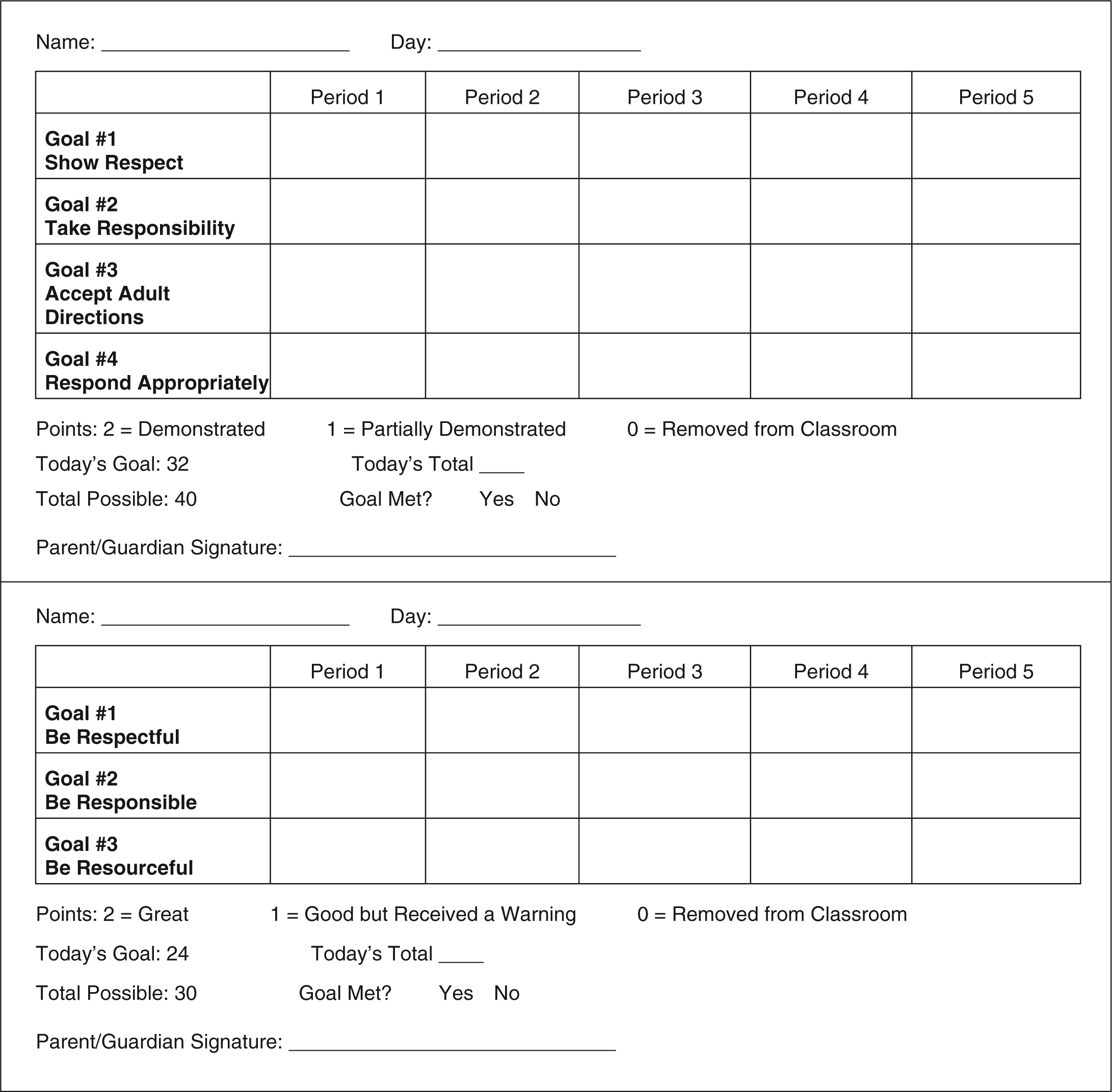
Check-in/Check-out Point Card Examples.
Traditional Check-in/Check-out
Check-in
Once the prerequisite steps have been addressed, traditional CICO can be implemented. Prior to the start of the school day (or within the first 10 minutes of the day), the mentor and student meet individually and privately. The mentor gives the student his or her point sheet and reminds the student of the daily CICO point goal (e.g., 32 points). This is typically 80% of possible points to be earned (e.g., 40 points possible).
Point Feedback
Students earn points for demonstrating the targeted expectations and receive feedback on the CICO point sheet. These expectations traditionally are tied to the school-wide expectations (e.g., be respectful, be responsible, be resourceful). Each period of the school day is reflected on the point sheet (e.g., reading, math), and points are awarded at the conclusion of each period by the teacher responsible for instruction during the period. The most common system for rating responsiveness to expectations involves scores of 2, 1, and 0, with 2 indicating full demonstration of the expectation, 1 indicating partial demonstration of the expectation—some reminders of appropriate behavior required, and 0 indicating the student did not demonstrate the desired expectation.
Check-out
At the end of the school day, 5 to 10 minutes prior to dismissal, the mentor and student meet individually and privately to determine if the student earned the point goal for the day (e.g., 32 points). When the student meets the point goal, he or she earns an agreed upon reward. This reward typically is consistent with the school-wide system. If the student does not meet the point goal, the student and mentor discuss the scores. During this time, it is appropriate for the mentor to ask the student about his or her point earnings. The mentor and student may discuss areas of difficulty (scores of 0 and 1) and how to handle challenging situations more appropriately in the future. For example, if a student earned scores of 1s and 0s during P.E., the mentor might ask what happened during P.E. Imagine the student states that she was the last student to be picked for the volleyball team and was picked to be on the “stupid kid” team, so she refused to participate. An appropriate discussion would be for the mentor to address the issue of being “the last student picked.” The mentor might ask the student how she could handle this situation differently in the future. Appropriate responses to look for include (a) she will remember that there will be times when she is picked first and times when she is not, (b) she will communicate her frustration and concerns to the P.E. coach, and (c) she will find one person on the team that she does like and stand near that person during the game instead of refusing to participate.
Home Component
At the conclusion of the school day, the point sheet is sent home with the student. The mentor reminds the student to take the point sheet home, have it signed, and return the sheet to school the following day.
Return to School
The point sheet is returned to school daily and the cycle begins again. See Table 1 for a description of each traditional CICO component.
Traditional Check-in/Check-out (CICO) Steps for Implementation.
Responding to Check-in Check-out
A majority of students will respond to the traditional, five-step CICO intervention as indicated by (a) decreased office discipline contact, (b) increased engagement, and (c) decreased percentages of problem behavior (Campbell & Anderson, 2008; Hawken & Horner, 2003; Mong, Johnson, & Mong, 2011; Simonsen, Myers, & Briere, 2010). However, as with any intervention, there will be times when students do not respond. Students may show variable but not consistent positive response, increased problem behavior and discipline contact, or no change in behavior (Swoszowski, McDaniel, Jolivette, & Melius, 2013). Several factors may contribute to limited responding, such as delayed mentor contact and reinforcement, inappropriate types of reinforcement, and setting events not addressed through traditional CICO (Campbell & Anderson, 2008; Ennis et al., 2012; March & Horner, 2002). When a student is not responsive to a Tier 2 intervention such as CICO, it is common for educators to begin planning for Tier 3 supports, including functional behavioral assessment (FBA) of problem behavior and development of a behavior intervention plan (BIP). Certainly, Tier 3 supports are appropriate for some students, specifically for those students who (a) demonstrate the most intense, repeated problem behaviors and/or (b) are a danger to self or others (Scott & Caron, 2006). The harsh reality of Tier 3 interventions, however, is that they often are complex, require a significant portion of educators’ time, and can burden teachers and administrators as they may require substantial additional resources such as planning time and materials (Scott & Caron, 2006).
Given this information, CICO teams may want to consider three possible adaptations to the Tier 2 CICO intervention prior to moving on to more intensive, restrictive, Tier 3 supports. Prior to considering adaptations, however, CICO teams must identify criteria to determine if students are unresponsive to CICO. For example, teams may deem students demonstrating (a) less than 40% improvement, (b) no change, or (c) an increase in problem behavior as indicated by ODRs, discipline contact, and/or frequency of problem behavior as unresponsive to traditional CICO (March & Horner, 2002; Swoszowski et al., 2013). Next, teams will want to consider possible adaptations to CICO including (a) additional checks, (b) function-based reinforcement, and (c) addressing setting events at the Tier 2 level (Ennis et al., 2012; Swoszowski et al., 2012). Teams should consider each adaptation individually for the most efficient implementation of adapted CICO and should plan to implement consistently the adapted intervention for 6 to 8 consecutive weeks before making additional adjustments. In some cases; a combination of adaptations can be considered to most effectively address the needs of a particular student. Again, a minimum of 6 to 8 consecutive weeks of consistent implementation of the adapted intervention will be necessary before teams can determine if a student is responding to the adapted CICO intervention positively and according to the predetermined criteria (Crone et al., 2004).
Additional Checks
One potential adaption to the traditional five-step process involves an additional check-in. Students requiring supports beyond what is available at the school-wide level consistently demonstrate higher rates of problem behavior and/or more intense problem behavior than their same age peers to warrant Tier 2 supports (Crone et al., 2004). These students require additional, explicit instruction regarding behavioral expectations and contingent reinforcement for displaying appropriate behavior. As noted earlier, this is provided through check-in, point feedback, and reinforcement at check-out in the traditional CICO cycle. For some students, however, meeting with the mentor at check-in and check-out may not provide for attention and reinforcement frequently enough to maintain appropriate behavior throughout the school day. It may be that the student needs more frequent contact to remain on track toward reaching behavioral goals. In addition, reinforcement offered only once daily (at check-out) may not be often enough for some students who are incapable of delaying gratification for a full school day. An additional check at midday may be sufficient for providing increased mentor contact as well as increased rates of reinforcement. This midday check involves: (a) The student and mentor meet privately at the middle of the school day; (b) the mentor and student discuss the daily point goal (e.g., 32 points); (c) the mentor and student determine if one half of the points (e.g., 16) were earned by midday; (d) if one half of points have been earned, the student receives an agreed upon reward (e.g., a gotcha or PAW ticket); (e) if the student has not earned one half of the point goal at midday, the mentor and student discuss the points earned, discuss areas of difficulty (scores of 0 and 1), and work to get back on track to earning 2s; and (f) the discussion ends on a positive note (e.g., “Keep up the great work! I know you can earn the points to meet your goal for the day.”). This midday check was evaluated in a study by Swoszowski et al. (2013) and involved adding a midday “check-up” for students unresponsive to the traditional five-step CICO cycle. The additional check resulted in decreased problem behavior for students exposed to the additional midday check-up. See Table 2 for a description of CICO including a midday check.
Adapted Check-in/Check-out (CICO) Steps for Implementation.

Function-Specific Reinforcement
A second potential adaptation involves determining the function of a student’s problem behavior and adapting the available reinforcement to match the determined function. When students demonstrate problem behavior, they do so in an attempt to fulfill numerous functions including (a) to gain access, attention, or sensory stimulation and (b) to escape a task, demand, or sensory stimulation (Iwata, Dorsey, Slifer, Bauman, & Richman, 1982; Maag, 2004). The CICO intervention is based largely on the relationship and interaction between the mentor and student; therefore, it is assumed that students demonstrating problem behavior to gain adult attention will likely have their behavioral function addressed through the check-in, check-out, and point feedback portions of the CICO intervention (March & Horner, 2002; McIntosh, Campbell, Carter, & Dickey, 2009). Research has supported this assumption and has indicated that students demonstrating certain problem behaviors also respond to CICO (Ennis et al., 2012; Hawken et al., 2011; Swoszowski et al., 2012). When it appears a student is not responding to CICO, it may be that the function maintaining the student’s problem behavior (e.g., peer attention, escape from task) is not being addressed through CICO. To make this determination, CICO teams should discuss the perceived function of the student’s behavior. Further, the team should determine if the reinforcement component in place is addressing the perceived function. Conducting a full FBA (i.e., interview and direct observation) will be time intensive and more appropriate at Tier 3; however, conducting a brief functional assessment interview (FAI) is recommended (March & Horner, 2002). See the steps for addressing this adaptation in the following:
Conduct an FAI such as the Functional Assessment Checklist for Teachers and Staff (FACTS; March et al., 2000) or the Preliminary Functional Assessment Survey (PFAS; Dunlap et al., 1993) with one to three of the educators most familiar with the student and his or her behavior at school (this should take approximately 15 minutes per interview).
Evaluate the FAI results to determine the perceived function (e.g., attention, access, escape task or demand).
Consider the currently available reinforcement in place (i.e., attention from mentor, verbal praise, and gotcha buck). Does this reinforcement provide the student with the perceived function?
If yes, consider another adaptation (i.e., additional check, setting events).
If no, alter the available reinforcement to match the perceived function. For example, if the perceived function is escape, a more appropriate reinforcer would be to allow the student 10 minutes of free time at the end of the school day or to provide the student a homework pass for meeting the CICO point goal. If the perceived function is peer attention, a more appropriate reinforcer would be to allow the student 10 minutes of free time with a peer or time to work on as assignment/homework with a peer helper for meeting the CICO point goal.
Addressing Setting Events
A third possible adaptation to traditional CICO involves addressing setting events. A setting event is the context or environment in which the problem behavior occurs (Iwata et al., 1982; Maag, 2004). When a student is not responding to the five-step process, it may be that one specific class period or event is serving as the catalyst for inappropriate, undesired behavior or that once a student gets “off course” with behavior at a certain point in the school day, he or she is not able to get back on track; thus, the overall point goal is impacted greatly by one context. For example, in the illustration noted previously, the student had difficulty in P.E. when teams were being selected. Assuming this is a consistent problem environment and/or activity, team selection during P.E. would be considered a setting event for that student. It is common for students to display increased problem behaviors when faced with difficult or boring tasks and prior to or following transitions within the school environment such as before or after lunch and at the start or end of a school day. Additionally, certain days of the week such as Monday and Friday are significant transition days as students spend the weekends at home under home expectations that can vary greatly from school expectations. The CICO team should consider setting events as a possible adaptation for nonresponders according to the following steps:
Analyze the CICO point sheet to identify patterns of problem behavior (e.g., class periods where 1s and 0s are common, times when reading aloud or completing large amounts of reading or material are common, periods preceding or following a transition).
If a certain class period is identified, consider the instructional methods and content of this class. Is this a class where lots of group activities are assigned? Is this a class where high levels of reading or reading aloud is required? Is the instruction too difficult or too easy (and therefore not engaging) for the student? It also may be helpful to assess instruction using a classroom/environmental checklist such as the one available at: http://www.pbis.org/pbis_resource_detail_page.aspx?PBIS_ResourceID=192.
If the setting event appears to be related to home transitions, it is recommended that parents be involved in developing the plan for adapting CICO to address the setting event. While educators cannot control what happens in the home environment, and can only ensure manipulation of the variables evident in the school setting, parent participation may certainly enhance the effectiveness of the program development through (a) informing educators about the home obstacles so they can be discussed within the school environment and (b) providing for consistency of plan implementation across school and home settings.
Finally, develop a plan for addressing the setting event:
This can be as simple as adding a discussion to check-in and check-out in which the mentor and student discuss the setting event specifically and discuss more appropriate ways to respond to the context/environment. For example, if the setting event is determined to be math class (where many assignments can be too difficult and therefore frustrating to the student), the mentor and student can discuss self-control strategies to use to respond to the difficult math tasks such as (a) taking a moment to calm down and use positive self-talk when feeling frustrated, (b) attempting to answer the math problems he or she is most comfortable with prior to addressing the more difficult problems, and (c) asking the teacher for help in a calm and respectful manner. If the setting event is determined to be the transition between lunch and math class, the mentor and student can discuss this transition each morning during check-in and can talk about how this time of day can be problematic for the student. Pre-teaching the behavioral expectations for math class may be sufficient to support the student with a more successful transition. An additional reward can be added for (a) earning a set number of points during the period identified as the setting event, (b) earning a set number of points across several periods (e.g., first two periods of the school day), or (c) successfully transitioning either to school, between periods, or between activities.
For setting events linked to instructional methods and content of the class, teachers should specifically consider if adjustments to instruction or academic accommodations are needed. If, for example, it appears the student’s problem behavior is triggered by tasks requiring computation of numerous math problems or by completion of word problems, the teacher may want to reduce the number of problems the student is required to complete, pair the student with a peer helper to read the word problems, or allow the student a choice (e.g., complete the odd or even numbers or front or back of the assignment).
Cautions and Caveats
It is important to note that these adaptations are recommendations for altering the traditional CICO program to make this program more effective for nonresponders and to provide resource-efficient options for altering a research-validated method prior to applying more intensive approaches. Despite numerous adaptations, there are times when students may still demonstrate limited responding. In these instances, teams will want to consider Tier 3 interventions. It also must be noted that at no time should teams abandon the CICO intervention due to lack of responding if, in fact, this lack of responding may be linked to implementation difficulties or error. If the intervention is not being implemented accurately and consistently, teams must address areas of concern. One area noted throughout the literature as being implemented with the lowest rates of fidelity (i.e., 41% or less; Filter et al., 2007) is the home component. While parents may not consistently view the point sheet, discuss point earnings with their child, sign the CICO point sheet, or return the form to school, students can still demonstrate high rates of responding to the overall intervention (Filter et al., 2007). It is not suggested that this component is not critical or that it not be included in the traditional five-step process. Instead, it is recommended that teams work to support accurate and consistent implementation of all steps and adaptations and refrain from abandoning the intervention due to lack of consistent implementation. Unfortunately, it seems educators are quick to deem an intervention as ineffective or not appropriate for students when faced with an obstacle in intervention. The main tenet of this article is that perseverance for both responders and nonresponders is a key measure necessary for selecting and applying the most resource-efficient, appropriate intervention for all students.
Conclusion
A Tier 2 intervention, CICO, has been documented throughout the literature as an effective intervention for addressing the problem behavior of students who are unresponsive to Tier 1 supports and require more targeted intervention. Furthermore, it is noted as being an effective and efficient approach that is appealing to educators as it can be implemented with 10 to 30 students within a school at one time and with limited resources (Crone et al., 2004). While many students will respond to the traditional five-step approach, not all students will demonstrate behavior change in response to CICO. When students do not respond to Tier 2 interventions, educators typically initiate resource-intensive, Tier 3 interventions including completion of FBAs and development of BIPs. Before engaging in Tier 3 supports, which can drain teacher and administrator resources, educators should consider several adaptations to traditional CICO (i.e., additional checks, function-specific reinforcement, and addressing setting events) as these adaptations may impact student problem behavior in a resource-efficient, effective manner. Educators will want to ensure that all intervention components (traditional CICO or adapted CICO) are implemented consistently and accurately for a minimum of 6 to 8 weeks before considering the intervention ineffective or making adjustments to the intervention.
Footnotes
Declaration of Conflicting Interests
The author declared no potential conflicts of interest with respect to the research, authorship, and/or publication of this article.
Funding
The author received no financial support for the research, authorship, and/or publication of this article.