




Abstract

Why not set up a school in an apartment complex? After all, that is where children reside before and after they attend an actual school, and that is where they are during the summers when their actual school is closed. It is also where you will find their parents after work. And why not unite this school at an apartment complex with the school attended by the apartment youngsters? This is exactly what we did in Seattle when we linked a school at an apartment complex with an elementary school.
We are not the only ones to think that education or services generally should be taken to the people, rather than expecting them to go where the services are ordinarily offered. An article in the New York Times (Winerip, 1994) described the educational offerings in a shopping mall—indeed, the world’s largest mall—in Bloomington, Minnesota. The school space there is used for high school, adult education, and graduate courses. The goal is to serve 200 high school students, offer six university courses, and provide several adult education programs. Other mall schools were noted in that article: the Oglethorp Mall in Savannah, Georgia, for 60 high school students; the Park City Mall in Lancaster County, Pennsylvania, which serves 50 high school dropouts; and the Dufferin Mall in Toronto.
One Washington state legislator strongly supports community programs. In a recent article in the Seattle Times, she described the Cities in Schools movement as an example (Veloria, 1994). According to her, that organization has served many children throughout the United States since its inception 30 years ago. The idea behind this program is that communities bring their resources directly to children, rather than expecting children to seek help on their own. In New London, Connecticut, intervention therapists go to homes and work with families. They serve as advocates for single mothers, giving pointers on managing their lives and being responsible parents. The underlying premise of their program is that when caseworkers go to homes they can quickly identify problems and rectify them after observing families in their homes on several occasions (Nordheimer, 1991).
More in line with our project is the apartment school program in the Los Angeles area, developed by individuals at the University of Southern California (USC) with the EEXCEL Apartments (Hentschke & Salveson, 1993). They established educational support systems in affordable housing projects with the purpose of improving the quality of life and economic condition of residents in neighborhoods surrounding the USC campus. After-school tutors in the apartments assist students in Grades 1 through 12. They track classroom assignments of students to determine preparedness, attendance, and test scores. Incentives such as rent reductions are offered to encourage parental involvement. Resident counselors, who train the tutors and live in the apartments, are doctoral candidates from USC. Several USC units in addition to staff of the School of Education are involved in projects within the EEXCEL Program. They include personnel from the schools of Business, Cinema Television, Social Work, Dentistry, Nursing, Pediatrics, and Public Administration.
Background
In 1990 Thomas Lovitt, a professor in special education at the University of Washington, and a doctoral student, Colleen Stump, collaborated with Leslie Perry, principal of Hazel Valley Elementary School in Burien, Washington, through a Fair Start grant. The idea of the grant was twofold: (a) to provide support to Hazel Valley teachers in their efforts to accommodate children with disabilities, and (b) to assist those who were at risk in their classes. In order to carry out that assignment, Lovitt and Stump followed a seven-step plan:
They met with teachers and invited them to express their concerns about working with children who are difficult to teach.
They met with the principal to establish a plan for proceeding with this joint venture. The principal noted a few school problems and mentioned themes identified by her staff for concentrated planning.
They arranged their schedules to visit Hazel Valley the same day every week.
The principal posted a sign-up sheet in the teachers’ lounge for those who wanted a university helper to visit, which included what to look for during visits.
Lovitt and Stump took over a few classes for teachers so they could meet with the other university member to discuss a plan, visit a colleague’s classroom to observe an interesting lesson, or meet privately with one of their students.
The university assistants carried out a few after-school sessions with teachers. These were on topics that had come up during discussions with teachers or were stimulated by visits to their classrooms. Three topics were reading comprehension techniques, micro-computer programs, and self-management practices.
Lovitt and Stump set up and helped conduct a few classroom research projects. In one, a cross-age tutoring project was arranged in a kindergarten class. The plan was to help kindergartners attain proficiency in early reading and arithmetic skills.
In another project, Lovitt and Stump assisted a special education teacher to set up self-management programs with several of her children. The team also helped a second-grade teacher organize and evaluate an expressive writing program. For a complete description of this project see Stump, Lovitt, and Perry (1993).
While working with staff at Hazel Valley, Lovitt and Stump learned that of the 400 or so students in the school, about 100 lived in a neighboring apartment complex, the Juanita Apartments. The staff had grave concerns about many of these children; these concerns included (a) a higher rate of qualification for special education programs, (b) a lack of homework completion, (c) insufficient parent support in school and the child’s educational progress, (d) lack of parental supervision during the hours immediately following school dismissal, and (e) 100% of the students lived at or below poverty level. In addition to those concerns, the school nurse noted that a disproportionate number of the children living in the Juanita Apartments had health problems, some of which were chronic.
The principal and school counselor met with parents at the Juanita Apartments several times. At those meetings they discussed the need for the parents’ support and offered suggestions on how to motivate children and communicate with them. Although the principal and school counselor were gratified by the attendance and enthusiasm of parents at those meetings, they were unable to schedule regular sessions because of the many other demands on their time. Perry and Lovitt decided that in order to have a significant impact on children and their parents at the apartment complex, they needed to take education and related services to them. Thus began a series of meetings, phone calls, and letters.
The managers of the apartments had two boys attending Hazel Valley, and they were supportive of the apartment-school idea. Perry and Lovitt met with them and sought their opinion and advice on setting up the after-school classrooms. The next step was to communicate the idea of a school to the owner of the apartments. Lovitt phoned him to explain the project, and followed up the conversation with a letter that provided more details. During the phone conversation the apartment owner was initially skeptical. Because there was a fair amount of vandalism at the apartments, he thought the convening of children in a central place would enable them to expand their troublesome activities. Lovitt explained that although the youngsters would be together, they would be in classrooms and supervised by teachers. He mentioned also that we planned to work with the children’s parents. The owner agreed to support our project and ultimately gave us a modest discount for the rent. (The owner now mentions the apartment school in his newspaper advertisements.)
Having obtained permission and support from those key individuals, we began developing a plan to seek funding. In drafting the plan, Lovitt and Perry enlisted the help of the Hazel Valley teachers. A proposal that outlined the steps and components of our idea was sent to the Kellogg Foundation. While we were designing our plan, a listing of funding priorities from Kellogg came to our attention. Because they were committed to education, schools, and at-risk children, we thought our program would be a good match. What followed was a 2-year period of negotiations, during which time we were site-visited by a Kellogg representative, asked on two occasions to submit additional or clarifying information, and informed on two occasions that we would not be funded. Meanwhile, as we were conferring with individuals from Kellogg, Perry was pursuing funding for the project from the Highline School District. During the late spring of 1993, we received good news from both sources. Kellogg said they would support us for l year if we reduced our budget, and Highline came up with funds from a Chapter l grant. Those combined moneys enabled us to start our apartment project. What follows are descriptions of the procedures and results of this project.
Project Description
Before describing aspects and features of our project, we will note at the outset one of its extremely important and, as far as we know, unique aspects: We formed an affiliation with a school (Hazel Valley Elementary School) and an apartment complex (Juanita Apartments) that is home for a large number of children who attend the school.
Objectives and Aims
The primary objective of our program was to assist approximately 50 youngsters academically and socially. We were greatly concerned about their overall school performance, especially their ability to read. We were also committed to enhancing the children’s social skills. A secondary objective of our project was to assist the children’s parents to better support their education. Not only have we provided them assistance in managing, motivating, and caring for their children, but we also attempted to further their own educational and raise their educational levels and aspirations.
Student Selection
To identify children to be served in the Juanita Apartment School, the Hazel Valley principal gave her teachers lists of students in their classes who lived in the apartments. She asked them to rate the students on several at-risk factors (e.g., special education services, disciplinary infractions, free lunch participant, absences from school, academic difficulties). Names of students who had the highest “scores” were then given to teachers at the Hazel Valley school, who contacted the children’s parents. They informed the parents that their children had been identified as needing extra assistance and described the school goals, schedules, and other matters. The children whose parents agreed to their participation formed the classes. (All the children living in the apartments are welcome to attend the school, not just those who were targeted. The teachers accommodate “drop ins,” i.e., those not identified as needing special help.)
Teacher and Staff Selection
Two veteran teachers were selected as instructors at the Juanita Apartment School. We also engaged two experienced paraprofessionals to work with the teachers. The teachers work 5 hours a day, from 2:00 p.m. until 7:00 p.m., and the aides for 4 hours, from about 2:30 p.m. until 6:30 p.m. In addition, a parent specialist, funded from another grant, assists at the apartment school 5 hours a day. Her duties include checking with parents when their youngsters are absent from Hazel Valley and driving parents to Hazel Valley for conferences and volunteer work. She also arranges appointments for parents and their children with various services (e.g., medical and dental) and offers ideas on childrearing and meal planning.
Curriculum
The curricular emphasis during the school year at the Juanita Apartment School is on academics. Oral reading, comprehension, and mathematics scores of youngsters living in the apartments are significantly lower than scores of other children attending Hazel Valley, and average scores of Hazel Valley children are among the lowest in the district. The curriculum during the summer months also focuses on academics. There are actually two summer terms. The first begins 1 week after the regular school ends in June. It runs daily for 3 morning hours for 3 weeks. The second term begins 3 weeks before school starts at Hazel Valley, that is, during the second week of August. The purpose of this second term is to prime the students in reading and other academics so that when school begins at Hazel Valley they are well into the academic routine. Prior to the start of summer school, apartment teachers meet with teachers at Hazel Valley who have students in the apartment summer school. The meetings are intended to determine precisely what each student should work on during the summer.
Schedule and Physical Arrangements
In Apartment 1, intermediate-age children attend classes on Mondays and Wednesdays from 3:30 p.m. to 6:00 p.m. and primary-age children attend on Tuesdays and Thursdays from 3:30 p.m. to 6:00 p.m. There are approximately 13 children in both age groups. In Apartment 2, the younger children come in daily from 3:30 p.m. until 4:30 p.m., and the older children from 4:30 p.m. to 6:00 p.m. On several Saturdays, children from both apartments go on field trips. These include art galleries and museums, the Seattle Science Center, and the local library. The apartment children also have library cards that they proudly use when visiting the library.
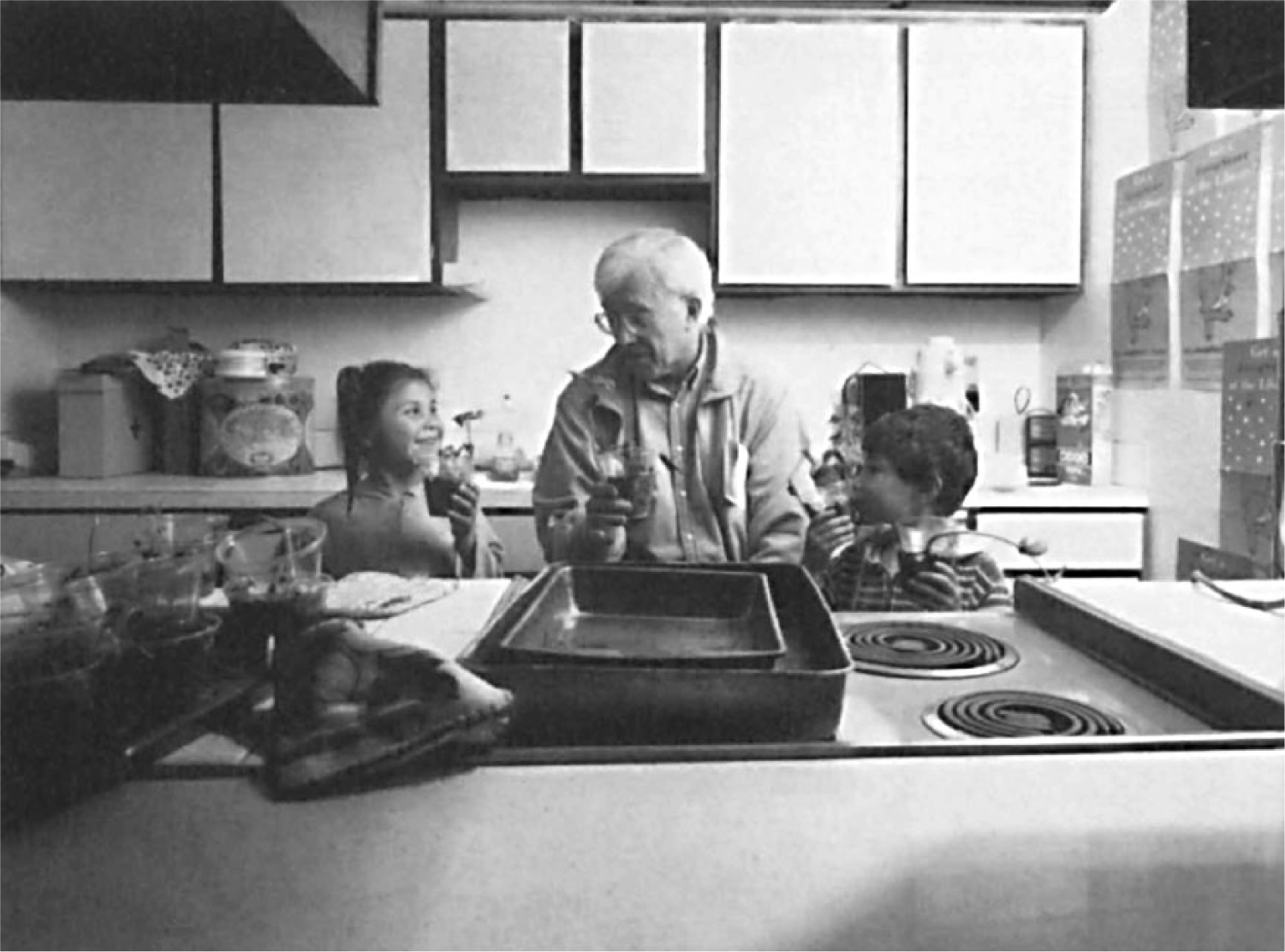
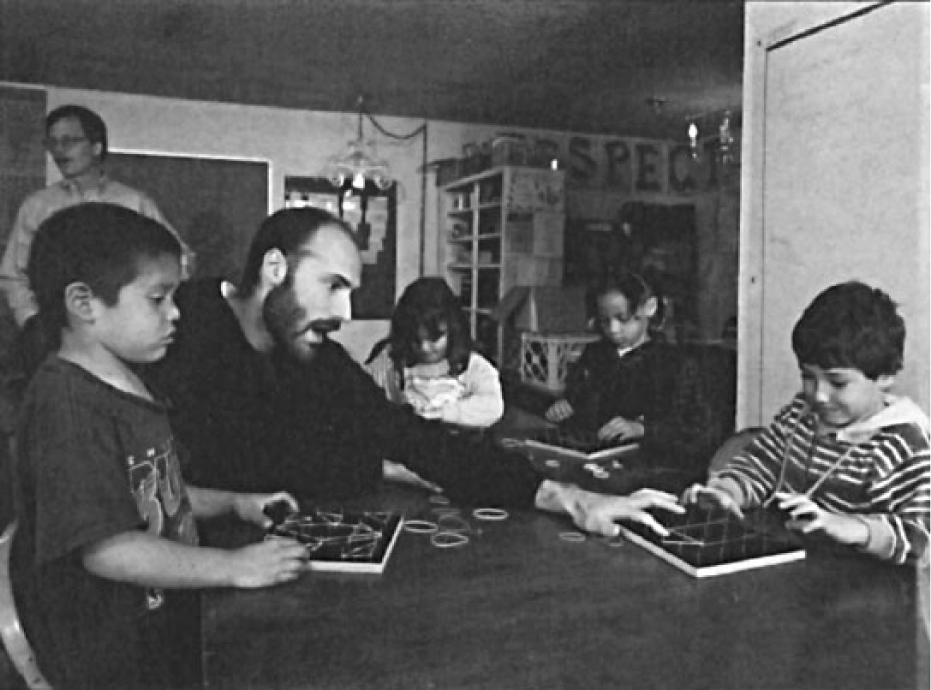
The manner in which space in both apartments is structured for a school is comparable. The small bedroom is the computer and listening room. It houses two computers, a printer, and a few computer programs. There is also a table with a tape recorder and several headsets. The large bedroom serves as the game room, housing board games, puzzles, and paints. Most of the drop-in children come into this room. The living room and dining room areas are arranged as work areas for reading and homework.
Communication Between Juanita and Hazel Valley Teachers
It is extremely important for teachers at both locations to communicate. To facilitate this, Juanita teachers visit Hazel Valley regularly to check with their students’ elementary school teachers. Moreover, several Hazel Valley teachers who have children in the Juanita Apartment School go there to visit them and their teachers. One important result of these contacts was that in October 1994, during parent conference time, 95% of parents from the apartments came to Hazel Valley to meet with teachers. Four Hazel Valley teachers scheduled appointments with parents at the apartments who could not attend the regular school, thus generating 100% parent contact. This was a considerably higher rate of participation than for previous years. To further facilitate communication, there are fax machines at the apartment school and Hazel Valley. Using that mode of communication, teachers at Hazel Valley send comments to Juanita School teachers about children and offer suggestions for their instruction. At the other end, Juanita School teachers keep Hazel Valley teachers informed about students’ progress and request help with instructional techniques.
High School Tutoring Program
Ten students from nearby Highline High School visit the Juanita School regularly to assist children with school assignments, play games, and generally serve as role models. These young adults, members of the Future Business Leaders of America Club, help out for two or three afternoons a week for 3 or 4 hours. Beyond fulfilling expectations from that organization, they do not receive credit for their work from the high school, and they are not expected to carry out a community service commitment as are some high school students. The tutors were trained by the parent specialist.
During the second year of operation at the Juanita Apartment School, the high school tutoring program was expanded to include 20 ninth graders from Evergreen High School. These students are supervised by a vocational teacher at that school and provide tutoring services at the apartments 2 days a week. The ninth-grade tutors participate in an orientation program and their interactions are monitored carefully. They receive credit for their participation. Most of the students at the Juanita Apartment School eventually will attend nearby Evergreen High School.
Adult Education Program
This important program schedules afternoon and evening sessions to accommodate participants. About 39 adults attend per week, 16 of whom are parents of children attending the Juanita Apartment School. Most are assisted with basic skills: reading, arithmetic, and writing. There also is a GED training program for nine adults, one of whom has passed all five components of the exam (and registered for community college), and two have completed one or more of the tests.
Other Agencies and Schools
The director of Chapter 1 programs in the Highline district coordinates the work of the parent specialist (described previously). She has provided materials for instructing tutors and has helped greatly in obtaining supplies and furniture for the apartments from both the school district and neighboring stores. A community service officer with the King County Police Department spends about 10 hours a week at the apartments. Because there have been a fair number of calls to police from tenants at the Juanita Apartments—mostly for domestic violence—it has been extremely helpful to have her involved with the project. The entire Burien Police Department has access to the apartments and uses them during nonschool hours to write reports, visit families, and establish a presence. A member of the Division of Social and Health Service, whose main responsibility is to connect parents with that agency and other social services, puts in 10 hours a week at the apartments. As another affiliation, children at the Juanita Apartment School are joined with students from nearby Chinook Middle School through a Partners in Learning grant. Children from both schools write to one another at least once a week. This program has greatly encouraged the Juanita students to write.
Results
Included in this section are summaries of children’s reading achievement and representative comments of most individuals associated with the program.
Pupil Achievement
We keep data on oral reading for 26 students in the two classes whose students are lowest in reading. As of June 15, 1994, we had obtained considerable data. Those children took two, 1-minute timings once every 2 or 3 weeks using grade-level material. For one, they read the same story each timing. For the other, they read a different story each session. The students progressed through the basal reader one story at a time. On average, the children had 10 pairs of timings from January 1994 until mid-June. Results showed that 25 of 26 pupils’ correct rates increased more than 10 words per minute (wpm) on the same story and 20 of 26 increased more than that amount on the different story. Moreover, 15 of 26 students’ rates exceeded 100 wpm by June on the same story and 11 of 26 surpassed that rate on the different story.
With respect to standards, the rate increases noted on the same and different stories, particularly on the latter, are commensurate with gains of average-achieving students. As for the numbers of pupils who exceeded 100 wpm on either type of story, that figure is also commendable, for reading authorities often view reading rates above that figure as quite satisfactory.
Pupil Comments
The most frequent responses from students at the Juanita Apartment School to four questions were the following. The numbers indicate how many individuals responded to each item. Where numbers are not given, they were not available.
What do you like most about the Juanita Apartment School? Computer (mentioned by 7). Reading (3). We got a great teacher (2).
What do you like least about the Juanita Apartment School? Nothing (5). Reading (3). Doing framework (2).
How has the Juanita Apartment School helped you with your work at Hazel Valley? Helped with homework (7). Helped with reading (6). Helped with math (2).
If you could change something at the Juanita Apartment School, what would that be? Nothing (7). Change reading to game time. Play basketball.
Parent Comments
The most frequent comments of parents to four questions were as follows.
What changes in your child have you noticed as a result of attending the Juanita Apartment School? Better attitude (3). Enjoys him(her)self at the school (3). Improved reading (2).
What do you or your children like best about the Juanita Apartment School? Go to school and don’t get in trouble (2). Going there to meet other people (2). Children get help (2).
What do you or your children like least about the Juanita Apartment School? Nothing (10). Should be open longer hours (4). Sometimes doesn’t like the other kids (2).
Do you have suggestions for improving the school? Nothing (8). Longer hours (3). Parents should be more involved (2).
Parent Education Program
Following are comments from four women who attended adult education classes.
I don’t think I would have tried to get my GED quite yet if it was not here. I have taken one test and passed. The parent specialist gave me the courage to do it; she had faith in me and knew I would pass when I did not. This program is great for everyone. I have my diploma, but I like that I can come in and refresh my memory. Most of all I would like to thank a great teacher for contributing her time to help us better educate our lives. I’m really glad that I got to take this GED class ’cause I feel that I’m learning a lot [more] in this class than in high school. I’m thankful for the program because I get across to people the point of me being here in the first place and that is, I don’t need seven periods of high school to get an education or prove that I have much knowledge.
Hazel Valley Teacher Comments
The most frequent responses from eight teachers to three questions were as follows:
Have you noticed any changes in the children that might be attributed to the Juanita Apartment School? Positive attitude. Improved math, reading, writing skills. Increased homework return.
What is the most important gain that could come from having the Juanita Apartment School? Homework supervision; providing positive learning activities. Enhanced parent/school/child relationships. Academic support.
What could be done to make the Juanita Apartment School an even more rewarding situation? Continue involving the parents. Establish additional apartment schools. Maintain communication between students, Hazel Valley, and Juanita teachers.
Juanita Apartment School Teacher Comments
The most frequent responses from apartment teachers and aides to three questions were as follows:
Have you noticed any changes in the children that might be attributed to the Juanita Apartment School? Students are completing more homework. Increased reading ability. Students are more outgoing and playful than they were at first.
What is the most important gain that could come from having the Juanita Apartment School? Nurturing of a community. Let them know they have a safe place to go. Help them develop a positive attitude toward school and academics.
What could be done to make the Juanita Apartment School an even more rewarding situation? Set up more apartments for more students. More time for staff to plan and prepare (2). Increase communication between Juanita teachers and Hazel Valley teachers (2).
Tutor Comments
The most frequent responses from high school tutors were as follows:
How do you expect to help the students at the apartment? Help them with their self-esteem, although math and reading skills are important. I expect to help students by being there for them and allowing them to trust.
What do you expect to gain from the tutoring experience? Everyone needs to help other people in order to help themselves. I expect to gain the trust of kids, and hope that I get more familiar with children.
Since you have been working with the children have you noticed any positive changes? Manners and acceptance of others have improved greatly. Yes—they are more open and are more willing to work and listen.
Other data could be kept in an effort to describe the complete picture of our project. Among those additional data would be to record the number of emergency police calls to the apartments, the number and intensity of gang-related activity at the apartments, and the extent to which acts of vandalism are noted at or near the apartments.
Generalizable Components
When we explain our project to others, they are generally impressed. They then ask how it can be replicated. Although our project is unique, there are nonetheless several important components we believe are generalizable to other situations. Indeed, our model has been used to set up two other projects in the same school district.
In addition, the Juanita Apartment School recently was selected from among 120 candidates in Washington State to receive a 1994 Golden Apple Award, which acknowledges excellence in education. The school received a trophy, a check for $500, and a $3,000 scholarship to be awarded to a student entering college. Moreover, the school was featured in a television program that described the Golden Apple III award winners in Seattle in January 1995.
What follows are 10 features of our project that are transferable to similar programs.
Locating an Apartment and Neighborhood School. It is important to have individuals from both places who are committed to carrying out such a project, and, obviously, there should be a need for it. We believe there are thousands of individuals and circumstances that evidence those needs. Not only is it necessary to identify an elementary school and an adjoining apartment complex; it is also critical to bring the apartment owner and manager into the scheme of things.
Hiring the Teacher and Aide. The teacher, and if possible the aide, should have many of the following abilities: know a great deal about teaching children and adults; ability to communicate effectively with parents; capable of working with individuals from community and state agencies; willing to set up an operation in apartments located in rather dangerous neighborhoods; able to collaborate with school teachers who serve their children during the day; flexible when dealing with all of these individuals (particularly the children) yet have a plan; able to work with, direct, and supervise the efforts of others; able to see the big picture of helping children and their parents; able and willing to carry out assignments on a schedule that is different from the usual school routine.
Selecting the Children. In our experience, 20 children is about as many as a teacher, an aide, and a few volunteers or tutors can manage at one time under these circumstances. This is especially true if the children in the apartment school are in grades kindergarten to 6 and have significant academic and social needs. There are a number of ways in which to assign children to apartments if there is more than one unit. One option is to schedule primary-age children to one unit and intermediate-age youngsters to another. With that arrangement, teachers are better able to group youngsters by ability with respect to academic and social activities. Another option is to simply place youngsters in one or another apartment according to families or friends, without regard to their ages or grades.
Deciding on the Curriculum. The emphasis of our project is on academics. We intend to bring the children up to standard in reading, arithmetic, and other academic areas. One way in which we focus on academic needs is by having teachers at Hazel Valley give week-long homework assignments to the children. These are written in the children’s notebooks and they carry them back and forth between Hazel Valley and the Juanita Apartments. Our particular focus is on reading. In accord with our objective to raise reading scores, we have identified a dozen or so youngsters in each apartment who most desperately need assistance in reading. We work with them individually at least three times a week for 30 minutes each session. Simple procedures for teachers, aides, tutors, and volunteers have been written for them to follow as they assist the children.
Setting Up Work Stations and the Schedule. We have established four stations in each apartment, one in each of the bedrooms, one in the living room, and one in the dining area. In the small bedroom there are two computers, and in the large bedroom there are games and books. We have set up the reading table in one corner of the living room, and have the homework table in the dining area. We intended to have about four children at a time at the reading table, about six at the homework table, three in the computer room, and five or so in the game room. Ordinarily, there is an adult at each of those stations.
When youngsters arrive at the apartment school at 3:30 p.m., they have a light snack (e.g., juice and graham crackers). At 3:45 p.m. they go to one of the work stations. They stay at those stations for about 30 minutes and then switch to another. There are, of course, other options for scheduling the children. One is to alternate days; schedule younger pupils for M–W–F and older youngsters for T–Th. Another plan is to have all the children come every day in shifts; the younger children could be scheduled for the first hour or so and the older youngsters for the next couple of hours. We have tried both options and they are equally effective.
Building Links Between the Elementary School and the Apartments. Teachers at the elementary school must be a part of the project. First, they need to identify youngsters who will attend the apartment school—those who most need help. Once the children are involved, these teachers should tell the apartment teachers about the children’s specific needs and give them ideas for teaching the children. It is the responsibility of apartment teachers to keep regular school teachers informed about the children’s progress at the apartments. Moreover, apartment teachers should visit the elementary school at least twice a week to check in with their children and the teachers there. Apartment teachers should request assistance and advice from the regular teachers and inform them about the progress of the children.
Building Links Among the Elementary School, Apartments, Community, and Other Groups. Individuals from several agencies other than the elementary school and apartments are involved with our project: the University of Washington (a faculty member in special education and some students), Chapter 1 (the director and a parent specialist), an individual from the Division of Social and Health Services, a community service officer, and businesses in the area. Once individuals from a number of agencies are assembled, an “administrator” must see that this network pulls together and that each member benefits from the project.
Setting Up and Maintaining a Tutoring Program. The most important reason for involving tutors in a project such as ours is that more children can be offered one-on-one instruction. Tutors of several types could be selected: senior citizens, parents of children in the apartment school, and volunteers from businesses. Currently, 20 students from a nearby high school come to our apartments regularly to tutor children. It is necessary to train tutors, and it is important to monitor their efforts once they are involved in the program. Our initial tutor training program consisted of notebooks for individuals, a video presentation, and homework assignments. From time to time, meetings were scheduled with tutors to discuss procedures and to solve problems noted during the tutoring sessions. The current tutor training program was implemented by a vocational teacher at Evergreen High School and includes a training manual for tutors.
Arranging Adult Education Classes. A parent specialist is assigned half-time to our project. Her responsibilities include calling on parents whose children were absent from the regular school. Her most time-consuming activity, however, is the management of adult education classes. Sessions are scheduled regularly throughout the week, some during the day and others after dinner. At those times she assists parents with their basic skills, and provides information about community resources and childrearing practices. She has also organized a GED training program for adults, many of whom are parents of children attending the Juanita school.
Keeping Data. It is important to obtain a variety of data for a project such as ours, for information of one type will not “tell the story.” We keep the following data: Numbers of children who attend the apartment school regularly and the number of “drop ins”—those who have not committed themselves to regular attendance. Testimonies about the program generally and the achievements of children who attend the school from teachers at the elementary school, apartment teachers, the children, the children’s parents, and tutors. Additional data regarding opinions and perceptions could be acquired from local business people, individuals from agencies who work with the apartments or tenants, and the apartment manager or owner. Number of individuals in the adult education program. More specifically, we acquire indicators of their progress, numbers in the GED program, and of those, how many have passed certain tests. Reading scores of children. We gather oral reading and arithmetic computation data from target children. Those timings are from books they are assigned at Hazel Valley. Attendance of these children at their elementary school. This is a particularly important indicator of a project’s success. Chances are, youngsters from apartments such as ours have missed several days of school. Interactions of parents with the regular school teachers. It is important to increase the time that more parents from the apartments visit the elementary school, and important for regular school teachers to visit parents at the apartments.
One of the authors works with children on their science project in the apartment school kitchen.
An aide assists children in playing games.
Conclusion
New schools continue to open in cities and suburbs throughout the nation, often at considerable expense. Although the services they provide are certainly valuable, perhaps there is another way to successfully “market” educational services to students, either exclusively or in association with regular schools. Perhaps many children and youth would be just as well off if schools were set up in apartments, shopping malls, churches, industrial parks, or office buildings. These schools or school affiliates would certainly be more mobile and definitely less expensive to build and operate. Not only would these “convenience schools” greatly serve children and youth, but they would also greatly accommodate their parents and other adults. Why not invest significant amounts in communities throughout the country to test this out?
Footnotes
Editors’ Note
The fourth decade of Intervention and School and Clinic began with its transition into the journal it is today. The articles published were representative of the research being conducted in the areas of reading, math, content area instruction, social skills, inclusion, and transition. The field had broadened its scope to look beyond the boundaries of school for students with disabilities. The articles during this decade represent the varied interests of authors such as Dr. Sharon Vaughn, Dr. Michael Epstein, Dr. Floyd Hudson, Dr. John Lloyd, Dr. Monica Lambert, Dr. Diane Pedrotty Bryant, and Dr. Brian Bryant. We selected an article written by Dr. Thomas Lovitt, Ms. Leslie Perry, and Mr. Stanley Hughes because it represented the physical translation of research into practice. That is to say, Dr. Lovitt and his team actually implemented the research-based program suggested in their article. The Kellogg Foundation and the school district in which the project was implemented sponsored the program. We believe that this article represents Intervention in School and Clinic at its best.
This paper was originally published as: Lovitt, T. C., Perry, L., & Hughes, S. (1996). Linking an apartment school with an elementary school. Intervention in School and Clinic, 31(4), 238-245.