



Abstract
There is a growing need for the inclusion of direct, explicit vocabulary instruction in the early elementary grades. Young children are entering school with a wide range of early literacy experiences, including vocabulary knowledge. Those students who are limited in their vocabulary knowledge are at a greater risk for later language and reading difficulties. When providing intensive vocabulary instruction to students who are at risk for language and reading difficulties, it is important to use features of effective instruction and intervention, including (a) direct, explicit instruction that includes extensive teacher modeling; (b) teacher and material scaffolding that carefully controls the level of task difficulty (e.g., moving from easier to more difficult tasks throughout the instruction); and (c) numerous practice opportunities with immediate and specific feedback.
The need for quality vocabulary instruction in early elementary school is becoming more and more apparent. Children are entering school with a wide range of oral language skills, and many children begin kindergarten with levels of vocabulary knowledge that are significantly lower than those of their peers (Hart & Risley, 1995). This vocabulary gap only grows larger in the early grades (Biemiller & Slonim, 2001). These young children who enter school with limited vocabulary knowledge are at greater risk for later reading difficulties, particularly, reading comprehension difficulties (Catts, Fey, Zhang, & Tomblin, 2001). Moreover, research has indicated that students receive very little formal vocabulary instruction or intervention before the third grade (Baumann, Kame’enui, & Ash, 2003; Wanzek, in press).
Research also suggests that vocabulary knowledge develops somewhat independently from beginning reading skills, such as decoding (Storch & Whitehurst, 2002). Therefore, instruction and intervention that targets only early reading and decoding skills may be inadequate to meet the needs of students who are at risk for language and vocabulary difficulties (Catts, Hogan, & Adolf, 2005; Vellutino, Tunmer, Jaccard, & Chen, 2007). Consequently, there is a growing sense of urgency to enhance vocabulary development in the primary grades through instruction and intervention that specifically target vocabulary growth (Biemiller, 2001; Catts et al., 2005).
This article outlines a multi-tiered approach to supporting vocabulary development in the primary grades and describes ways to intensify vocabulary intervention that supplements Tier 1 classroom instruction for students experiencing language and learning difficulties.
Multi-Tiered Instruction
A multi-tiered system of support (MTSS) provides a promising framework for meeting the needs of the full continuum of students, particularly, those students who are at risk for experiencing learning difficulties. In a response-to-intervention (RTI) or an MTSS framework, classroom teachers instruct their whole class using quality research-based tools and methods. Children who are at risk for academic difficulties are identified through universal screening of all students, and these students are provided with intensive small-group intervention that supplements classroom instruction. Teachers and interventionists monitor students’ progress by determining how students are responding to the intervention and use these data to intensify or modify instruction.
Much of the research on the effectiveness of RTI or MTSS models has examined improving children’s beginning reading skills. However, it is important for researchers and practitioners to look beyond early code-based skills and to determine how other areas of literacy, specifically, vocabulary, can be supported through a multi-tiered approach. Students who are at risk for literacy difficulties often have fewer experiences with language before entering school, resulting in less-developed vocabulary knowledge. These children are less likely than their peers with higher vocabulary skills to benefit equally from Tier 1 instruction by itself. For example, current research has found that students’ overall vocabulary knowledge measured at prescreening is highly predictive of their response to Tier 1 vocabulary instruction (Coyne et al., 2010; Senechal & LeFevre, 2002; Vellutino et al., 2007). Through the use of RTI or MTSS supports, students who are identified as at risk at the start of kindergarten can immediately be provided with supplemental Tier 2 intervention. The goal of this intensive, targeted intervention is to prevent the widening of the vocabulary development gap (Coyne et al., 2010).
Effective Vocabulary Instruction (Tier 1)
Recent studies have examined the effects of direct vocabulary instruction on targeted word learning of young, elementary-age students (Beck & McKeown, 2007; Biemiller & Boote, 2006; Coyne et al., 2010). Components of effective classroom vocabulary instruction include providing (a) student-friendly definitions or synonyms of target words, (b) contextual support of target vocabulary words through the use of authentic literature and/or meaningful sentences, and (c) extended opportunities to interact with words though a variety of activities. Studies that have included these components have demonstrated consistent positive effects on students’ vocabulary learning (Marulis & Neuman, 2010).
In a multi-tiered approach, a primary goal is to support the vocabulary learning of all students through consistent, high-quality, evidence-based Tier 1 classroom vocabulary instruction. Recent studies have used the Elements of Reading: Vocabulary program (EOR-V; Beck & McKeown, 2007). The EOR-V program is appropriate because (a) it is a widely available commercial classroom vocabulary program, (b) it includes all the components of effective vocabulary instruction, and (c) it has evidence of effectiveness (Apthorp et al., 2012; Beck & McKeown, 2004). A major goal in the selection process should be to align an effective Tier 1 vocabulary curriculum with a well-designed Tier 2 vocabulary intervention to support the vocabulary development of kindergarten students. Although EOR-V was chosen for the study, any coordinated, consistent approach that includes the components of effective vocabulary instruction can anchor quality Tier 1 instruction.
The EOR-V program includes 15- to 20-min daily vocabulary lessons that progress in a 5-day sequence, and there are a total of 24 weeklong lessons. Each week, all students in the classroom are introduced to five new, sophisticated words (e.g., peculiar, perilous, fleet, idle, transform), taught and reinforced through the variety of weekly activities. Each target word includes a student-friendly definition, a picture card illustrating the word, and an anchor sentence that provides a supportive, meaningful context. Some EOR-V activities include listening to authentic literature that includes the target words, viewing and discussing the photo cards, and participating in increasingly challenging oral discussions about the target words.
Intensive Vocabulary Intervention (Tier 2)
Although research suggests that high-quality Tier 1 classroom vocabulary instruction can increase the vocabulary learning of all students, students with higher initial levels of vocabulary knowledge benefit more from Tier 1 instruction than students who are at risk with lower levels of vocabulary knowledge (Coyne et al., 2010). Therefore, to truly meet the needs of all students, it is critical to provide students at risk for language and learning difficulties with small-group vocabulary intervention that supplements and extends Tier 1 classroom vocabulary instruction. Small-group Tier 2 intervention should be provided by trained personnel and should meet either in the classroom or in appropriate pullout settings.
A central feature of Tier 2 intervention in a tiered model of support is its increased level of intensity. There has been a substantial amount of research done on effective instruction for students with, or who are at risk for, learning disabilities. From these studies, specific practices have been noted to be successful for enhancing students’ learning (Coyne, Kame’enui, & Carnine, 2007; Coyne, McCoach, & Kapp, 2007; Vaughn, Gersten, & Chard, 2000). Features of effective instruction and intervention for at-risk students include (a) direct, explicit instruction that includes extensive teacher modeling; (b) teacher and material scaffolding that carefully controls the level of task difficulty (e.g., moving from easier to more difficult tasks throughout the instruction); and (c) numerous practice opportunities with immediate and specific feedback. A primary way to intensify instruction for students who require supplemental intervention is to focus intently on these principles of effective instruction in small groups of three to five students.
The goal in developing a small-group Tier 2 vocabulary intervention is to design activities that clearly align with Tier 1 classroom vocabulary lessons and emphasize principles of effective instruction in each day’s lesson. The intervention provides students with extensive modeling, carefully scaffolded prompts to ensure success and elicit elaboration, additional opportunities to practice, and specific feedback targeted to individual student needs. Students also have multiple opportunities to discuss target vocabulary in multiple contexts through a variety of challenging, but scaffolded, conversations with interventionists, as well as their peers. During this intensive supplemental intervention, students relearn and review the target vocabulary and concepts taught during the Tier 1 classroom instruction.
The Tier 2 supplemental vocabulary intervention is designed to support extended language use as well as teach target vocabulary. Interactive activities provide students with opportunities to (a) discriminate between examples and non-examples of pictures representing the target words, (b) use target words to describe pictures and to discuss personal experiences, (c) discuss connections between target vocabulary and other words and concepts, and (d) participate in meaningful conversations with peers about the target words. Each of the 4 days of activities is meant to increase students’ exposure to the target words and provide extended opportunities to practice and interact with the new vocabulary. Figure 1 shows a 4-day overview of the activities in each intervention lesson.
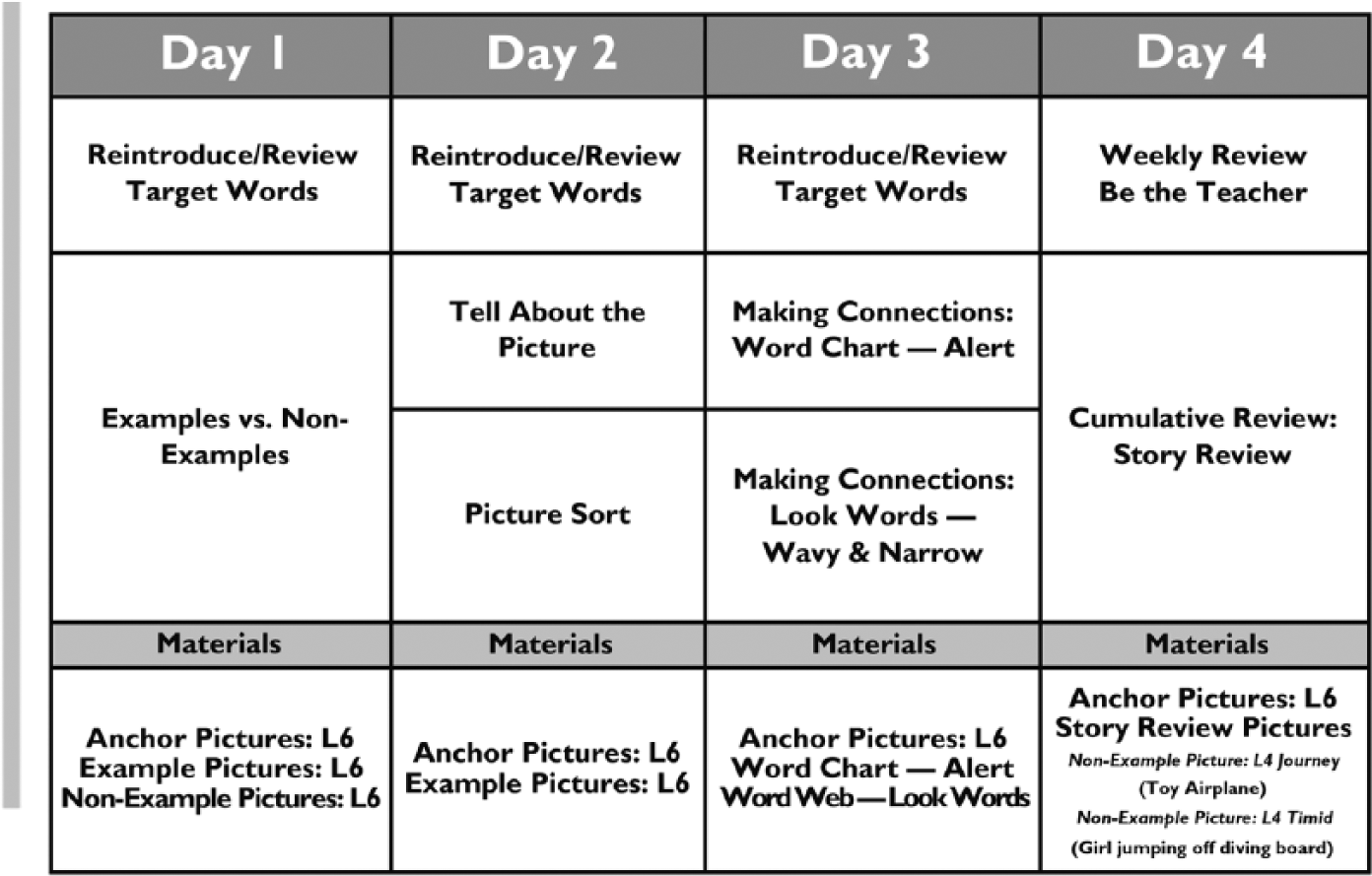
Example of early vocabulary intervention 4-day lesson overview.
Day-by-Day Interventions
Throughout each day’s lesson, teachers (or other trained personnel) provide very specific prompts that encourage extended language use. These prompts offer targeted feedback to students and are designed to elicit elaborated language use. For example, after asking a student to tell about a picture using the word sprinkle, a teacher may follow up by using this menu of prompts (see Figure 2): (a) scaffolding: “Great sentence! Can you say it again using our magic word, sprinkle?” (b) extending: “Great sentence! Can you tell me a little more?” or (c) modeling: “Great job! Now try saying, ‘The girl sprinkles candy on the birthday cake.’” Each of these responses provides immediate and scaffolded feedback to students in order to support their vocabulary learning and extend their use of oral language.
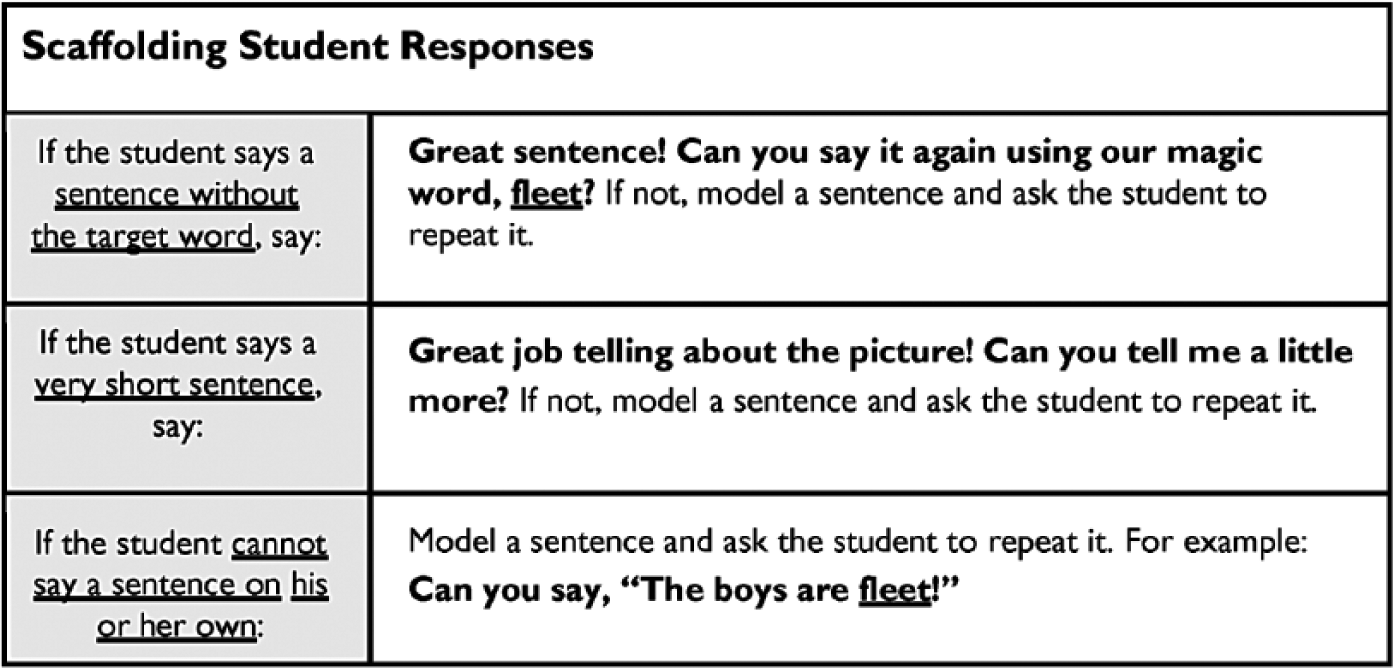
Examples of statements to use when scaffolding student responses.
On Day 1, the teacher reintroduces students to target words from the classroom Tier 1 instruction and provides a student-friendly definition. For each target word, there is an anchor picture illustrating the word and a sentence that describes the picture and uses the word in a supportive and meaningful context. After the teacher explicitly models the definition and anchor picture/sentence, students have opportunities to practice pronouncing the word and repeating the definition and the anchor picture sentence. Students are then presented with pictures representing examples and non-examples of the target word. They have to discriminate between the two types of pictures, explaining why each is an example or not of the vocabulary words. Throughout this activity, the teacher continually supports students through targeted and supportive corrective feedback using a menu of scaffolded prompts.
On Day 2, students are reintroduced to the target words, definitions, and sentences. The teacher then provides students with multiple opportunities to describe and discuss the example pictures using target vocabulary. Finally, the students play a picture sort game. Each student selects a picture and identifies the target word it illustrates. During individual turns, students are supported in using extended language to justify their choice. Figure 3 provides descriptions of sample intervention activities.
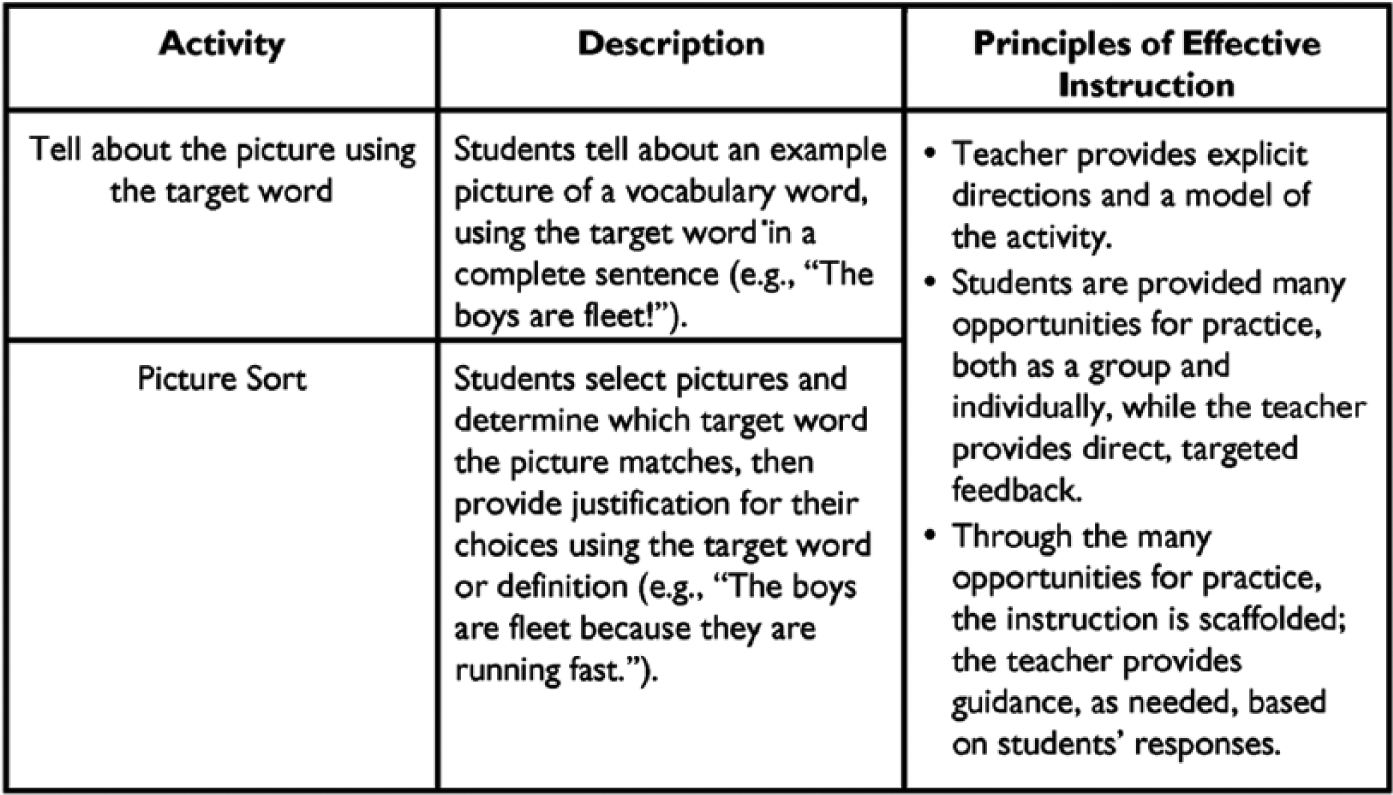
Sample activity descriptions.
The activities for Day 3 are designed to have students make meaningful connections between target vocabulary, other words and concepts, and larger semantic categories. Through explicit modeling and scaffolding from the interventionist, students create word webs and/or word charts using target vocabulary. These graphic organizers allow students to make explicit connections among new words they have learned from previous lessons. Students also connect newly learned vocabulary to words and concepts they already know and relate words to larger semantic categories. For example, students make webs of “do” words (e.g., pursue, collide, sprinkle), “feel” words (e.g., timid, frantic, displeased), and “look” words (e.g., gorgeous, peculiar, ancient). When creating the word charts and webs, students have multiple opportunities to practice using the target word to make a personal connection to the word while extending their language use through interventionist-guided discussion. Figures 4 and 5 provide an example and description of an activity using a graphic organizer to guide students in making connections with target vocabulary words.
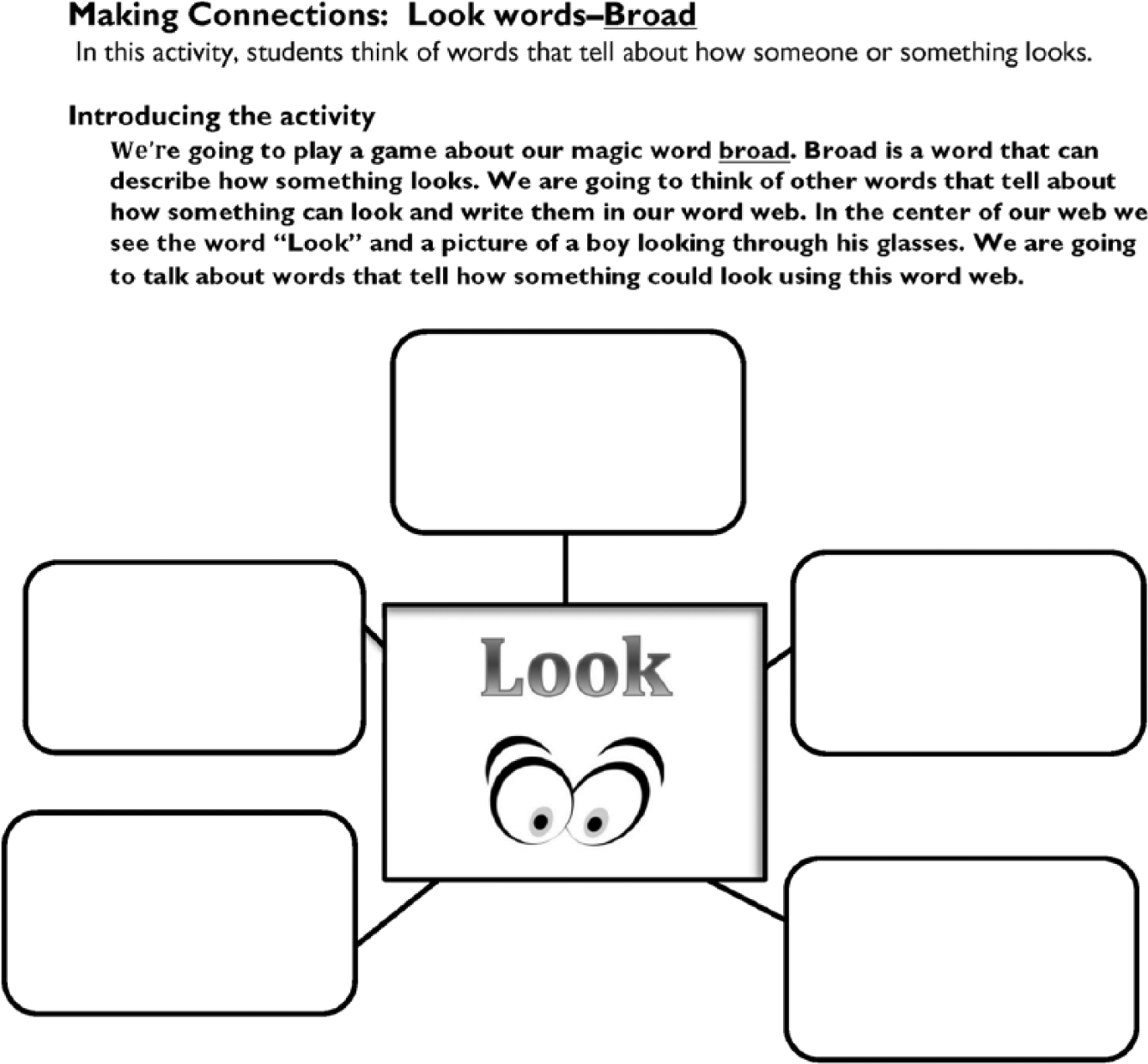
Example of vocabulary intervention graphic organizer.
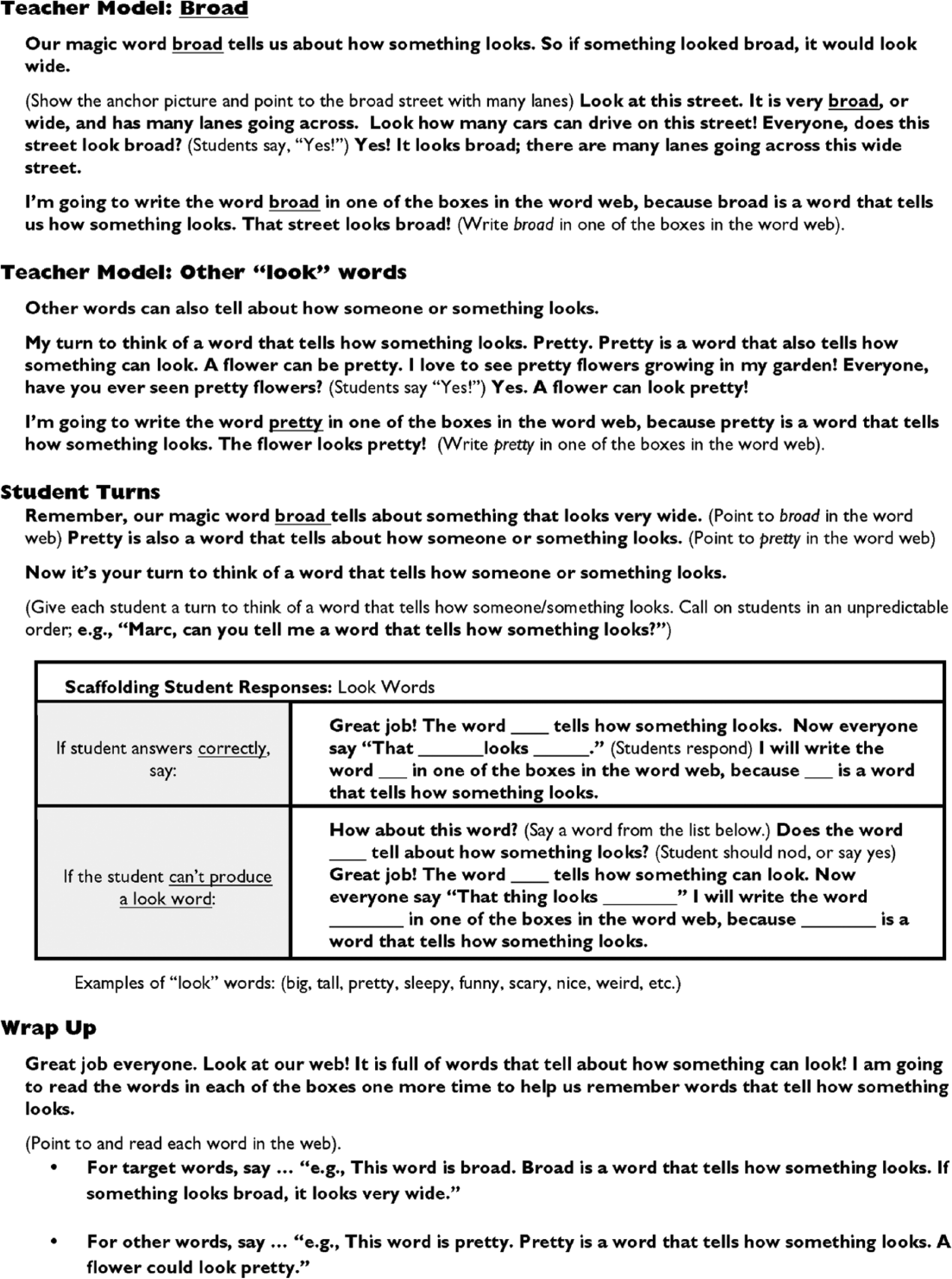
Example of vocabulary intervention graphic organizer lesson guide.
Day 4 provides a review of vocabulary words introduced that week as well as a cumulative review of previously taught vocabulary. To review weekly vocabulary, students play a “Be the Teacher” game. During this game, each student in the small group asks the others to tell about the example pictures for the week’s words. The students use similar language that the teacher has modeled in each of the lessons. Throughout this activity, the teacher provides explicit models and scaffolded feedback as needed.
After each child has an opportunity to be the teacher, the teacher completes a cumulative review. Review activities include a Story Review or a Word Category Review. During the Story Review, students listen to a short story throughout which the previously introduced target words are embedded. Students raise their hands when they hear the words and are called on to tell the definition. At the end of the story, the children provide brief retells of the story’s events. During the Word Category Review, students play an “I Spy” game. Target words from semantic categories (i.e., look, do, or feel words) are selected from previous lessons. The teacher presents two pictures to the students and asks them to choose which picture shows the word the teacher says aloud. For example, the teacher says, “I spy with my little eye someone who looks . . . drenched. Raise your hand if you can guess which picture I am telling about.” Students then choose which picture shows the word drenched.
Research Findings
In a recent study (Coyne, 2011), kindergarten classroom teachers implemented evidence-based Tier 1 classroom vocabulary instruction (i.e., EOR-V) with all students for an average of 20 to 30 min per day, 5 days per week, for 20 weeks. At the beginning of the year, all students were screened on the Peabody Picture Vocabulary Test (PPVT; Dunn & Dunn, 1997) to determine students’ overall receptive vocabulary knowledge. Students who scored in the 30th percentile and lower on the (PPVT) screening were identified as at risk and received the supplemental Tier 2 intervention described above in additional to Tier 1 classroom instruction. Intervention groups consisted of three to four students and were taught by school-based interventionists (e.g., paraprofessionals, special educators, speech language pathologists). Groups met for approximately 30 min per day, 4 days per week. Target word learning was evaluated weekly for both Tier 1 and Tier 2 students using a curriculum-embedded assessment that evaluated learning of each week’s words.
At the end of the intervention period (i.e., 22 weeks), vocabulary learning was assessed by researcher-developed measures of expressive and receptive target word knowledge. On the expressive measure, students were asked to provide definitions of target words. On the receptive measure, students were asked to point to one of four pictures that illustrated target words. Results of the regression discontinuity analyses indicated that at-risk students who received the Tier 2 intervention in addition to Tier 1 classroom instruction demonstrated statistically significantly more growth than predicted on both the expressive measure (d = 1.19) and the receptive measure (d = 0.88).
These results indicated that at-risk students who received Tier 2 intervention in addition to Tier 1 classroom instruction learned significantly more target vocabulary than would have been predicted if they received only Tier 1 classroom instruction. Additionally, and more importantly, at-risk students who received the supplemental intervention learned target vocabulary equally as well as their not-at-risk peers who received only Tier 1 instruction. A multi-tiered approach to vocabulary instruction and intervention, therefore, was able to counteract the achievement gap, at least for vocabulary words taught during instruction.
Summary and Implications
Students are entering school with significant differences in language skills and vocabulary knowledge, and there is growing recognition for the importance of vocabulary instruction and intervention in the primary grades. As schools are shifting to multi-tiered and RTI models, practitioners should consider the benefits of supporting early vocabulary development within a tiered approach. This article provides examples of how to intensify small-group vocabulary intervention that is also closely aligned with classroom instruction by focusing on principles of effective instruction. By providing direct, explicit vocabulary instruction and intervention within a multi-tiered model through the use of school-based personnel (i.e., paraprofessionals, reading specialists, special education teachers, etc.), schools can support young children who are at risk for later language and vocabulary difficulties and can perhaps begin to close the vocabulary gap.
Footnotes
Declaration of Conflicting Interests
The author(s) declared no potential conflicts of interest with respect to the research, authorship, and/or publication of this article.
Funding
The author(s) received no financial support for the research, authorship, and/or publication of this article.