



Abstract
While often recommended as a strategy to use in order to solve word problems, drawing a diagram is a complex process that requires a good depth of understanding. Many middle school students with learning disabilities (LD) often struggle to use diagrams in an effective and efficient manner. This article presents information for teaching middle school students with LD about diagrams and how to use them to solve word problems.
A major component of mathematics instruction is solving word problems. Solving a word problem requires students to draw on multiple knowledge bases and skills both accurately and efficiently (Baroody, 2011; National Research Council, 2001). These knowledge bases include (a) conceptual understanding, which refers to an integrated and functional understanding of mathematics concepts (e.g., rational numbers, fractions, decimals), operations (e.g., division), and relations (e.g., 0.05 is the same as 5/100 is the same as 5%); (b) procedural knowledge, or fluency, which refers to the skill in performing procedures (e.g., performing calculations with fractions) efficiently, accurately, and appropriately; and (c) strategic and adaptive knowledge, or the ability to engage in mathematical inquiry, reflection, and justification as well as selecting appropriate methods and strategies for formulating, representing, and solving problems (Baroody, 2011; National Research Council, 2001). Central to strategic and adaptive knowledge is the ability to represent a word problem. A diagram is an often-recommended approach for representing a word problem, particularly as students work toward higher levels of mathematics in the middle or high school grades.
In general, a diagram can be thought of as something that stands in place of something else, such as the expression of a concept (Smith, 2003). The strength of a diagram is that, like any visual representation, it can be used as a cognitive tool both to help understand a problem situation and, subsequently, to solve the problem. Further, it provides a visual referent that students can use in a metacognitive manner to monitor progress and self-correct where necessary (van Garderen, 2006). Unfortunately, for many students, in particular, students with learning disabilities (LD), their ability to use diagrams as a cognitive tool for solving word problems is lacking.
Challenges Students May Experience When Using Diagrams
While poor procedural and conceptual knowledge of mathematics itself may interfere with the ability to represent the problem using a diagram in a meaningful way, poor understanding and use of the diagram may also interfere with solving the problem (Rittle-Johnson, & Alibali, 1999; van Garderen, Scheuermann, & Jackson, 2013; van Garderen, Scheuermann, & Poch, 2014). In general, it has been found that students with LD, including students in middle school, use significantly fewer diagrams to solve mathematics problems (van Garderen et al., 2013). More importantly, when they do use a diagram, it is often lacking in the details needed to solve the word problem (van Garderen & Montague, 2003; van Garderen et al., 2013).
Specifically, findings from research focused on how students with LD use diagrams to solve word problems have highlighted several difficulties they may experience (van Garderen et al., 2014). First, these students may lack a sound conceptual understanding of what a diagram is and its purpose as a tool for solving word problems. Many students do not recognize that a diagram is more than a picture; rather, it is a representation that displays the quantitative and/or relational information found in the word problem. Second, students regularly have difficulty generating a diagram that accurately and efficiently represents the word problem. In particular, numbers may be recorded incorrectly, or key information may be left out. Third, students often use their diagrams in a limited manner, not recognizing that it can serve as a tool throughout the problem-solving process to help them understand, solve, and monitor their problem solving. Further, they may generate a diagram that is inappropriate for a given problem situation (e.g., using a table rather than a line diagram to represent a situation involving distance), restricting their ability to understand and solve the problem. Fourth, students who do not use the diagram as a tool to support their reasoning often get “lost” in the problem-solving process as they fail to keep track of where they are in the process of using the diagram or the diagram itself becomes unmanageable. In some cases, the students’ excessive focus (e.g., drawing every item named in the problem) on the diagram restricts their ability to connect back to the problem and recognize what they are solving for (e.g., too many crossed out items). Fifth, for many students with LD, a diagram is not perceived to be of benefit or worthwhile to the problem-solving process. In some cases, it is something they believe that only young children might use.
Addressing the Challenges
Although the use of a diagram can be a powerful strategy for solving word problems (Gersten et al., 2009), middle school students with LD are not necessarily using a diagram to their advantage and, consequently, are missing out on the benefits a diagram can contribute to their word problem–solving process. Clearly, there is a need for targeted instruction and intervention to address these concerns. The instruction needs to specifically focus on (a) developing the conceptual understanding of a diagram and (b) using diagrams when solving word problems. The remainder of this article provides detailed information on how to teach about diagrams for solving problems and sample snapshots demonstrating its implementation.
Content to Be Taught
Many textbooks lack the critical information teachers and students need to develop diagrammatic abilities and productively use diagrams to solve mathematical word problems (van Garderen, Scheuermann, & Jackson, 2012). Therefore, an ongoing challenge for many special education teachers is knowing what exactly should be taught related to using diagrams for solving mathematics word problems. When teaching students about diagramming word problems, instructors should focus specifically on diagrams (Phase 1) and how to use diagrams as a part of the problem-solving cycle (Phase 2).
About diagrams (phase 1)
When teaching about diagrams, there are six key topics that should be addressed. The topics include (a) what is a diagram, (b) why should a diagram be used, (c) when should a diagram be used, (d) which type of diagram should be used and why, (e) how to generate a diagram, and (f) how to use a diagram (van Garderen et al., 2014). Within each topic, there are several key ideas that need to be highlighted. This information, along with sample instructional activities and corresponding assessment, can be found in Figure 1.
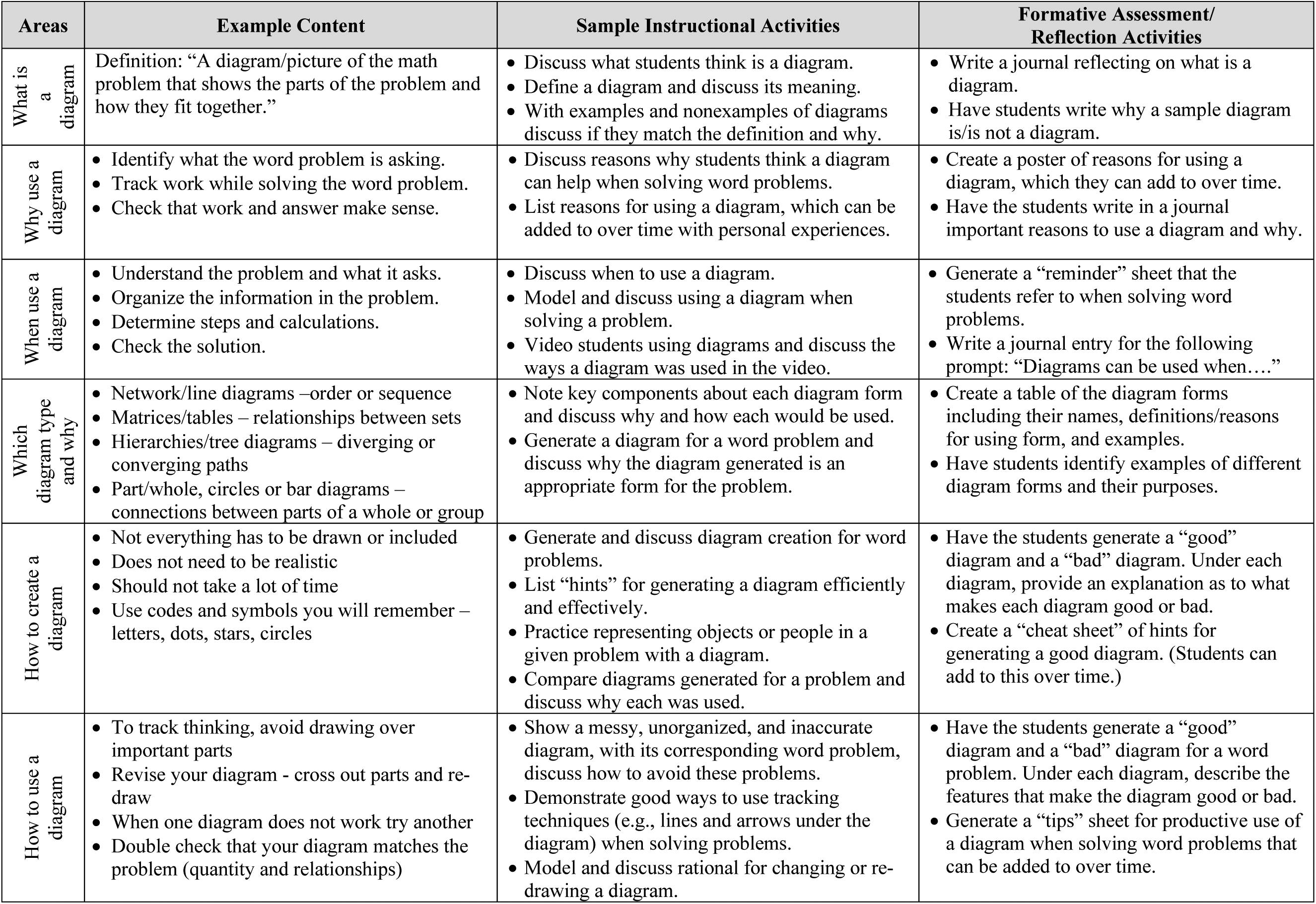
Phase 1: About diagrams. Components and recommendations for implementation.
Solving word problems using diagrams (phase 2)
The second key instructional component to be covered is how to use diagrams as an integrated part of the problem-solving process. To do this, the students need to be taught a systematic problem-solving strategy. Although there are a number of various strategies available for solving word problems for older students (e.g., Solve It!; Montague, 2007), regardless of the strategy used, students with LD need to be taught a method that incorporates diagrams (Montague, 2007; Vaughn, Wanzek, Murray, & Roberts, 2012).
The “Draw-It” Problem Solving Cycle (see Figure 2) is a strategy that can be used to solve word problems using diagrams. This strategy is based on the work of van Garderen (2007) and Carlson and Bloom (2005). There are three important things to realize about this strategy in general. First, the “Draw-It” Problem Solving Cycle involves four major steps (i.e., orient, plan, execute, and check). Although the steps are presented in a linear fashion, it is important to recognize that solving problems is not necessarily a linear process, and as a result, this strategy is presented as a problem-solving cycle. This is important as too often, the Polya’s Problem Solving Steps (i.e., understand the problem, devise a plan, carry out the plan, and look back; Polya, 1945) are received by students with LD as a linear solution-finding sequence that, when followed, would guarantee correct answers, which is not always the case. Second, within the problem-solving cycle, when to use a diagram is clearly indicated. Third, because each word problem is unique and contains a different structure and mathematical emphasis, a metacognitive routine is embedded throughout every step of the problem solving cycle. For each step, three metacognitive phases are included:
Ask: Focus on what needs to be done.
Do: Act and/or produce.
Check: Confirm that what was produced or done matches the problem.
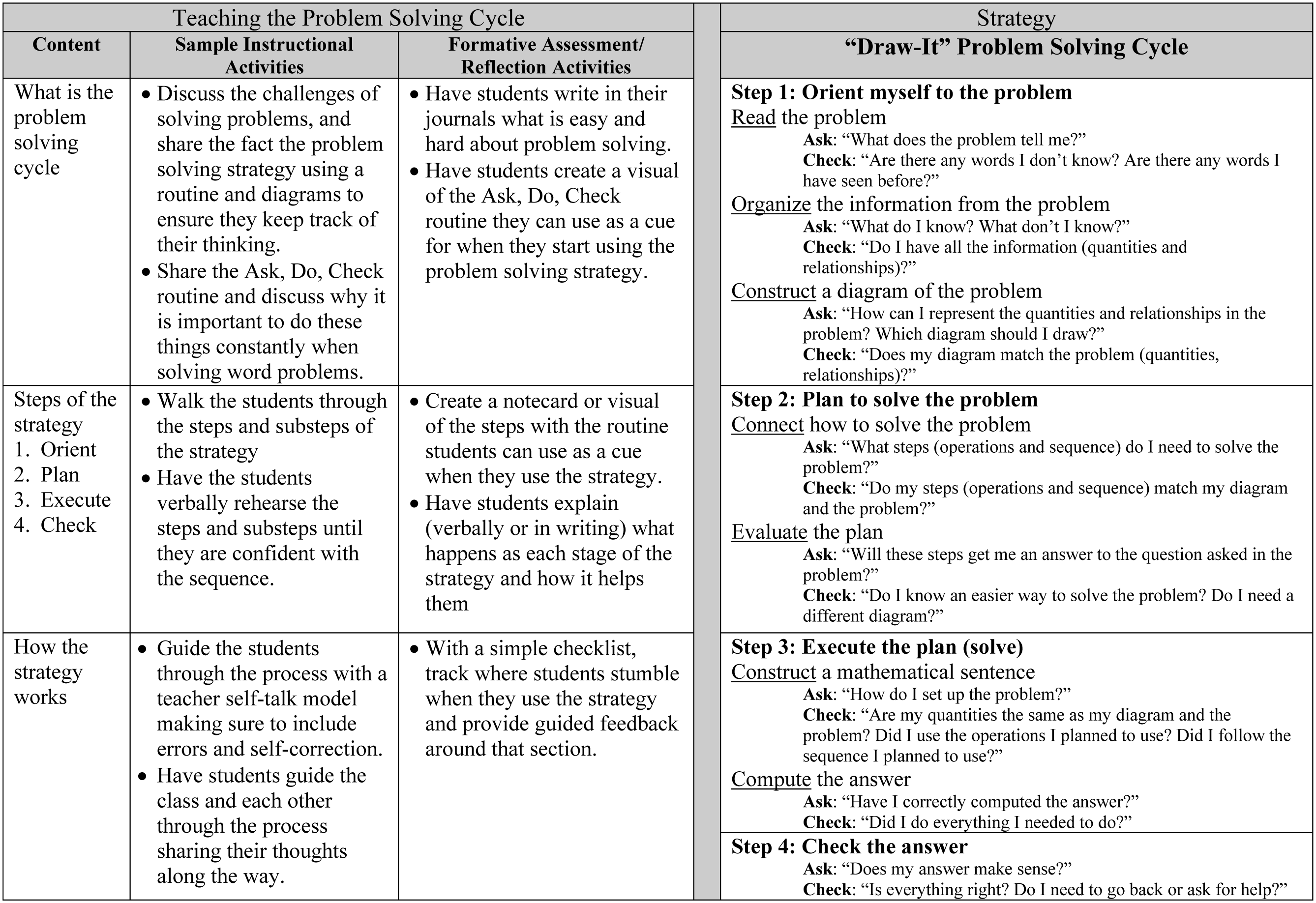
Phase 2: Using diagrams. Components and recommendations for implementation and the “Draw-It” Problem Solving Cycle.
Each step of the problem-solving cycle involves a different set of actions. The first step is orient myself to the problem. During this step, the students complete three substeps: Read the problem, organize the information, and construct a diagram of the problem. The key focus of this step is to identify what information and mathematical knowledge is present in the problem. The students are encouraged to not try and solve the problem at this stage but rather to focus on what information the problem is sharing with the students and what mathematical knowledge they have to contribute to the problem.
The second step is plan to solve the problem. This is where the students take a closer look at what the problem is asking them to do or the question that is posed in the problem. This is done by completing two substeps: conject and evaluate. This is a very purposeful pause in the problem-solving cycle where the students are challenged to develop a plan to solve the problem and determine if their plan will work or if there is an easier way to complete the problem.
The third step is execute the plan. Here, finally, the students are charged with working the problem and finding a solution. Part of the reason the process is called a cycle is because the students may be in the middle of this step when they realize their plan will not work and they need to go back to Step 2 and develop a new plan on how to approach the problem. This step occurs in two stages. First, the students construct a mathematical sentence that matches their plan, and second, they compute or work the answer for said sentence.
The fourth step is check the answer. Part of the cyclical process of this strategy requires the students to be constantly checking their work, but here at the “end” of the cycle, they double-check what they have done until now and confirm that all of the details are in place. Suggestions for teaching the “Draw-It” Problem Solving Cycle (“what” and “how”) can also be found in Figure 2.
Sample Instructional Sessions
To demonstrate how the instruction of the content outlined above can work, the following sections provide snapshots of instruction within each phase to illustrate what has been recommended in the preceding sections. The intent here is to provide a picture of how this instruction could be implemented by any special education teacher and not to provide a script to be followed.
Phase 1: about diagrams
Given the often-limited understanding many students with LD have about diagrams, it is recommended that initially instructional time be dedicated specifically to the concept of diagrams. This instruction should focus on the conceptual aspects of diagrams (i.e., what, why, how, and where). Once the foundational understanding has been laid, it would be important to introduce the students to different diagram forms that can be used for different types of word problems. Each form should be introduced separately and some time spent on understanding the purposes they have. It is important to note that the understanding of each diagram form will develop over time, particularly when given opportunities to use them to solve word problems. In Figure 3, the middle school special education teacher (Mrs. O) is introducing the student (Sam) to one diagram form, line diagram. This is an initial session for this content. (See Note 1.)
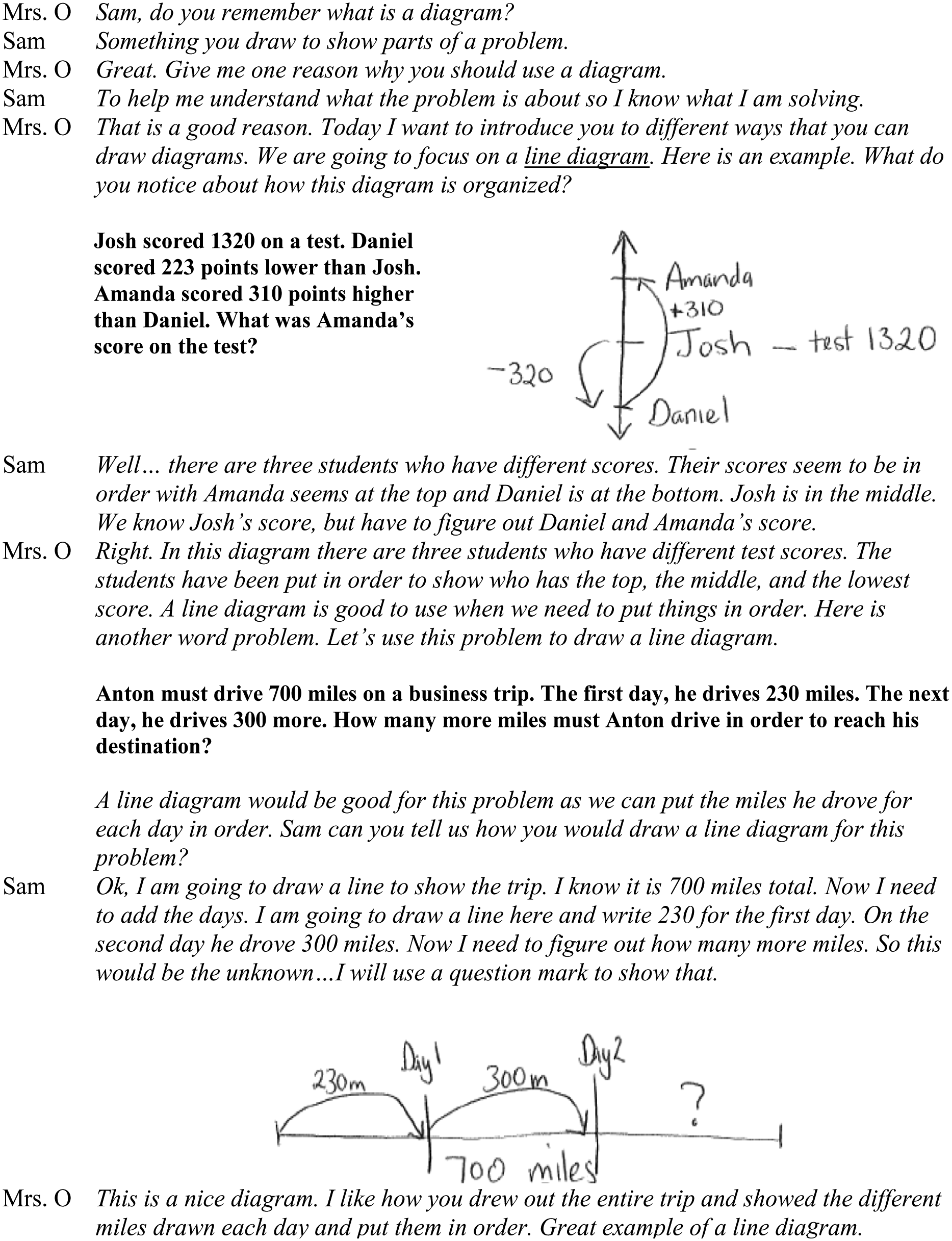
Sample of teacher introduction of line diagrams.
Phase 2: solving word problems using diagrams
Although it is possible to improve their knowledge and understanding of diagrams, it cannot be assumed that students with LD, even students in middle school, will use it as a part of the problem-solving process (van Garderen, 2007). Therefore, once students have an understanding of diagrams, they need to focus on how to use them when solving word problems. When introducing the strategy, it is important to initially present each step individually to ensure the students understand what each step means and involves as a way to help internalize the process. Further, instruction needs to highlight that self-monitoring and checking occurs throughout the process and not just at the end, and time should be spent memorizing the various steps and metacognitive routines in order for the process to be internalized.
In the example contained in Figure 4, the middle school special education teacher (Ms. O) introduces the first step (orient) to Sam. She models the cognitive processes involved within the step. In her modeling, she draws two diagrams in order to determine the best way to represent the problem information.
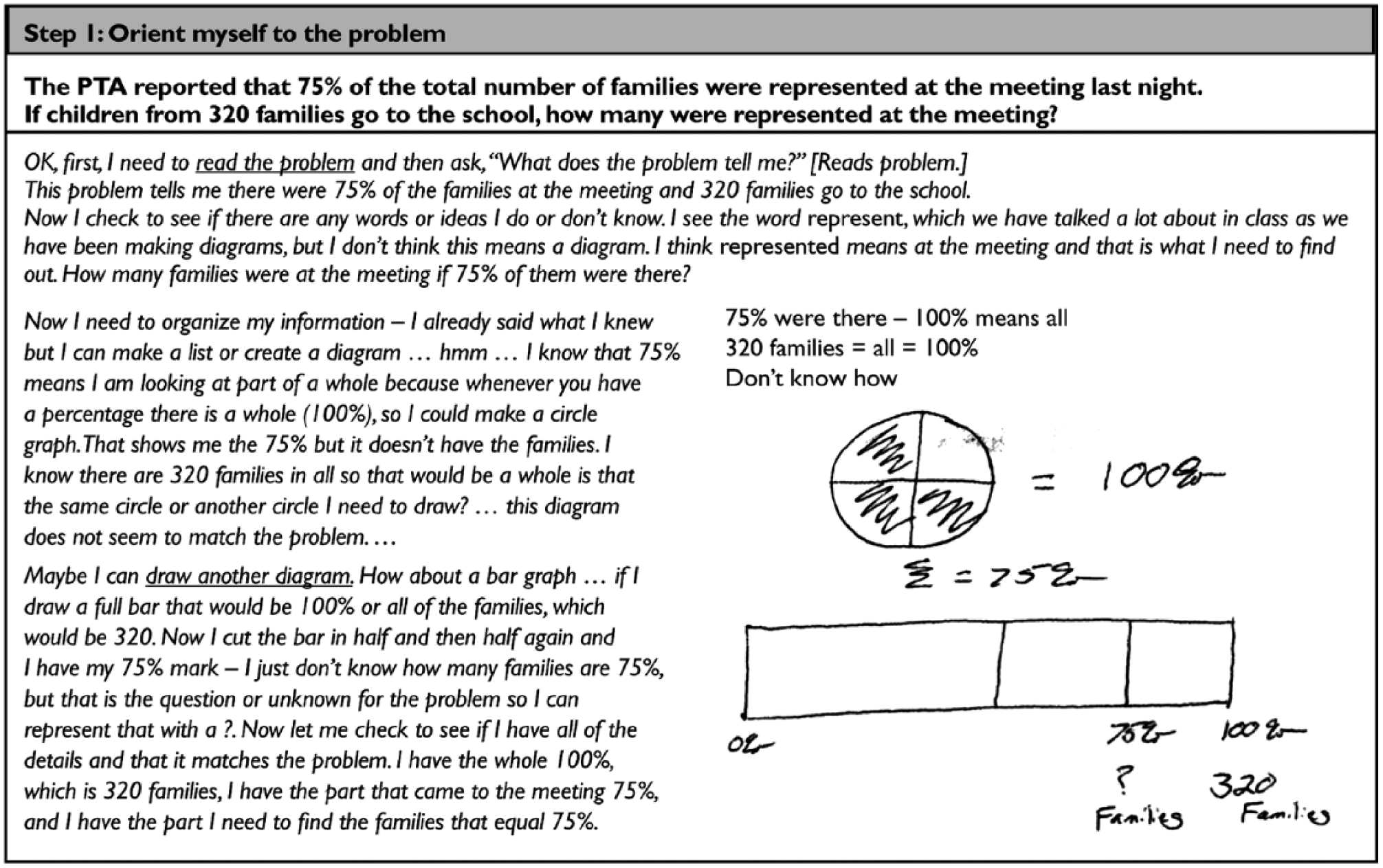
Teacher modeling Step 1 of the “Draw-It” Problem Solving Cycle strategy.
Once Ms. O finishes modeling the first step, she moves on to the second step: planning how to solve the mathematics problem. In this step, Mrs. O emphasizes and models how to use her diagram as a way to decide go about solving the problem. See Figure 5 for the dialogue.
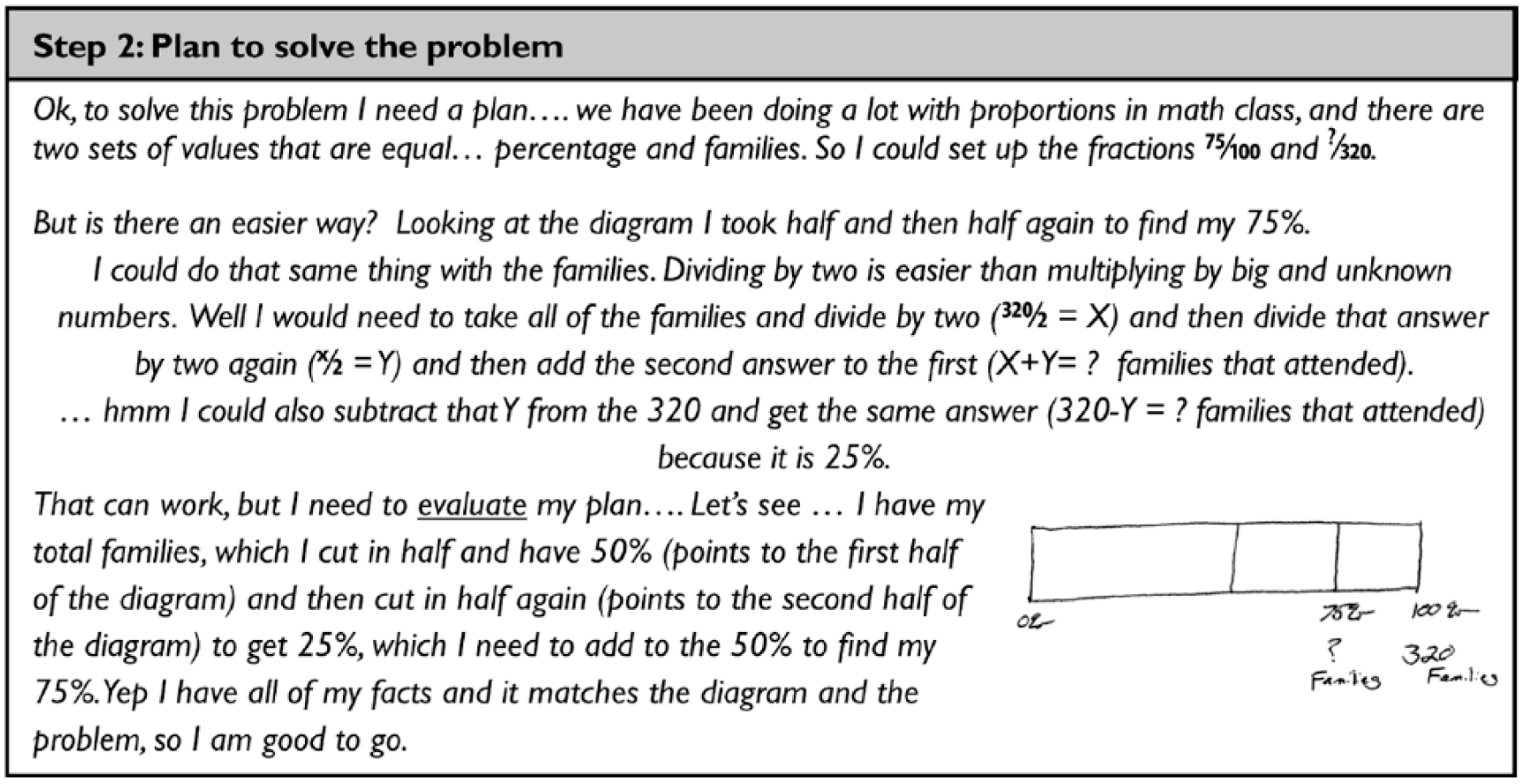
Teacher modeling Step 2 of the “Draw-It” Problem Solving Cycle strategy.
After evaluating her plan to solve the problem, Ms. O then models how to execute her plan, the third step of the problem-solving process. She takes the sentences she had constructed while planning and then computes the answer. As she computes the answers to her mathematical sentences, she adds that information to her diagram. See Figure 6 for the dialogue.
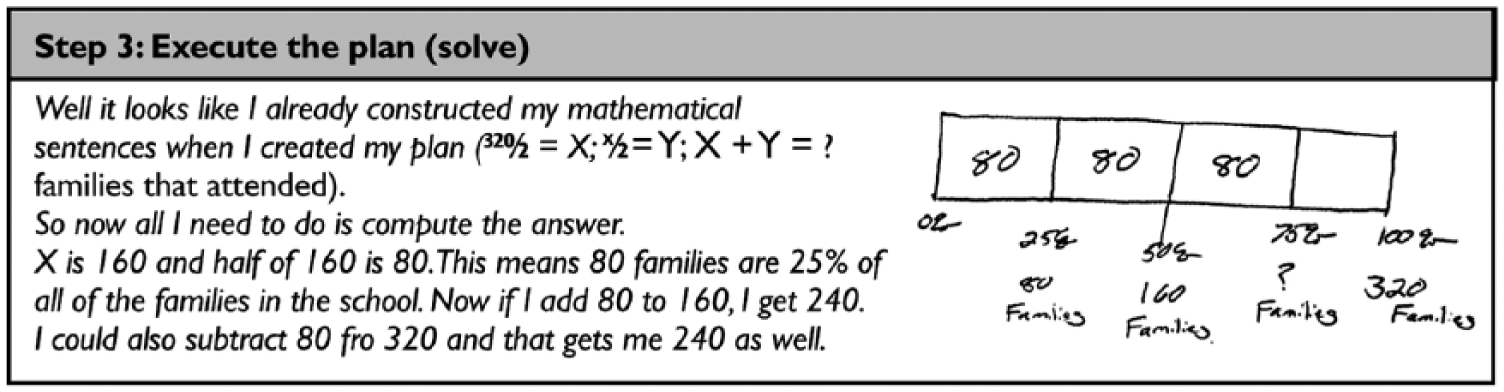
Teacher modeling Step 3: Execute the plan (solve) of the “Draw-It” Problem Solving Cycle strategy.
The final step Ms. O models is checking for the answer. As a way to check her answer, she carefully demonstrates checking her answer via her diagram to make sure that all the information in the diagram makes sense and connects back to the word problem. See Figure 7 for a snapshot of the dialogue. After she finishes modeling the process, she has the student (Sam) model solving a word problem using the “Draw-It” Problem Solving Cycle. As she had done, she instructs Sam to think aloud. Where necessary, she provides support and immediate corrective feedback to help him both use a diagram and the “Draw-It” strategy.
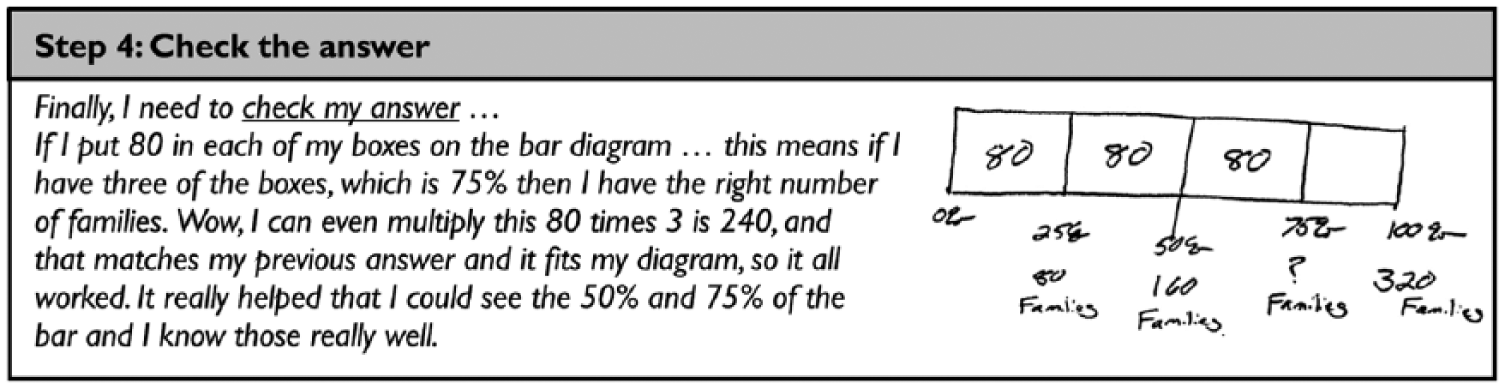
Teacher modeling Step 4: Check the answer of the “Draw-It” Problem Solving Cycle strategy.
Final Thoughts
Many middle school students with LD need systematic and explicit instruction focused on how to solve mathematics word problems. Several strategies incorporate the use of diagrams as a part of the problem-solving process that can be of assistance, yet that benefit is often lost because students do not have a well-developed understanding of diagrams. Therefore, before expecting students with LD to strategically and adaptively solve word problems using diagrams, special educators first may need to explicitly and systematically teach their students about diagrams, including the different types of diagrams (e.g., line, bar, tables), how they are used (e.g., order, relationships, connections), and why to use them (e.g., clarify problem, track work, check answer). Once students have a solid grasp of the concept and functions of a diagram, they can be introduced to and begin to apply specific strategies (e.g., “Draw-It” Problem Solving Cycle) that support their problem solving across the full range of mathematical strands.
Footnotes
Declaration of Conflicting Interests
The author(s) declared no potential conflicts of interest with respect to the research, authorship, and/or publication of this article.
Funding
The author(s) received no financial support for the research, authorship, and/or publication of this article.