




Abstract
Teacher educators are expected to provide preservice special education teachers with extensive knowledge about a variety of topics as well as allowing candidates a chance to engage in higher-level thinking about content. Today, some teacher educators are thinking “outside the box” when it comes to instructional delivery by moving beyond the traditional lecture format for instruction. This article discusses three alternatives to lecture-style instruction: (a) interteaching, (b) video-based reflection, and (c) content acquisition podcasts. Each of these strategies is a way to improve candidates’ engagement with the material while improving learning. The features and benefits of each approach are provided in addition to steps for using these strategies within teacher preparation.
Ever since Shulman (1986) differentiated content knowledge from pedagogical knowledge, and then recombined them into the construct known today as pedagogical content knowledge (PCK), teacher preparation programs (TPP) have taken steps to address the interdependent role these concepts play in teacher development (Brownell et al., 2014). Although the construct of PCK is relatively easy to understand in the abstract, it is difficult to translate into practice—especially when teaching students with disabilities. To illustrate, in special education, the content knowledge, (i.e., the theories, principles, and concepts), that forms the foundation of practice is vast and multifaceted in unpredictable ways (Lignugaris/Kraft, Sindelar, McCray, & Kimerling, 2014). Preparing general or special education preservice educators to conceptually understand and then implement practice(s) to address numerous and already complex interactions between pedagogy and content is hard enough (Kunter et al., 2013) without further considering how both might need to be uniquely reshaped to address individual student needs (Zigmond & Kloo, 2011). It is therefore important for TPPs and individual teacher educators to carefully consider effective ways to package and deliver content and practices to meet the learning needs of preservice educators.
Given infinite possible combinations and interactions of content, pedagogies, and student characteristics across the various grade levels and content areas, trying to predict learning needs at a random point in time is functionally impossible (Lignugaris/Kraft et al., 2014). As a result, TPPs face a quandary trying to offer coursework and field experiences that provide preservice educators with the knowledge and experiences needed to effectively apply the construct of PCK across the broad scope of students with disabilities (Maheady, Smith, & Jabot, 2014). Not for lack of trying and desire, it is impossible for preservice teachers to walk away from their preparatory programs ready to do it all. An understandable response on the part of TPPs is to add more requirements and content to existing courses and programs (Lignugaris/Kraft & Harris, 2014). However, the point at which adding more content offers diminishing returns in the form of overwhelmed students and lack of retention is currently unknown.
To summarize the problem at hand, there is a massive amount of information preservice educators need to know and understand to complete various roles in the field (König et al., 2014). This deluge of information needs to be covered during the relatively short time that preservice teachers have for their formal preparation coursework and experiences (Vernon-Dotson, Floyd, Dukes, & Darling, 2014). As a result, methods that teacher educators use to convey content to preservice teachers should be closely scrutinized (Kennedy, Thomas, Aronin, Newton, & Lloyd, 2014). Considering and managing the impact various content and pedagogies have on preservice candidates and their performance as teachers is an emerging idea that requires careful consideration in light of existing theory and emerging empirical evidence (Ruiz-Gallardo, Castaño, Gómez-Alday, & Valdés, 2011). This article discusses three approaches for delivering content that are grounded in appropriate learning theories and demonstrate promise for use in preservice teacher preparation.
Challenges in Conveying Content
It is essential that preservice teachers be immersed in preparatory coursework and experiences to help them develop knowledge, skills, dispositions, and habits needed for success (Brownell et al., 2014); however, the law of diminishing returns cannot be ignored. In other words, attempting to convey so much information about teaching during relatively short courses packaged together within a handful of semesters can be counterproductive for some students (Clark, 2009). Even enthusiastic and motivated preservice teachers can be overwhelmed during preparatory coursework and experiences (Feldon, 2007), and important content is likely to be either underdeveloped or outright missed (König et al., 2014; Kunter et al., 2013).
Instruction that prepares preservice educators to learn and implement applied pedagogies first requires a solid base of content knowledge (Desimone, 2011). Breakdowns in knowledge can, but do not always, precede poor implementation of instructional practices (Carlisle, Kelcey, Rowan, & Phelps, 2011; Kunter et al., 2013). Therefore, preparing preservice educators to implement evidence-based practices for teaching students with disabilities by talking about them in the abstract (i.e., via lecture or another similar format) may put a tremendous strain on the teacher when attempting to implement without a visual or experiential point of reference (Dieker et al., 2009). Using approaches such as modeling videos, video self-modeling, and direct observation of peers or models can help novice teachers improve their practice. Instructors within TPPs could be engaged in dialog and action research attempting to find matches between the topography of content or pedagogies being taught and instructional methods that result in measureable learning and application of skill. Of course this is easier said than done, and the field needs systematic programs of research to help accomplish this charge.
Given the important relationship between content knowledge and the application of knowledge through pedagogy (Kunter et al., 2013; van den Bogert, van Bruggan, Kostons, & Jochems, 2014), the delivery of content knowledge within TPPs should be grounded in appropriate learning theories and have empirical data to support their use (Clark, 2009; Kennedy, Driver, Pullen, Ely, & Cole, 2013). In regard to (a) interteaching, (b) video-based reflection, and (c) content acquisition podcasts, although there are other qualified practices within TPPs that reflect principles of effective content delivery, these approaches are sufficiently different from one another and employ features from which teacher education faculty can immediately benefit when planning and delivering instruction. All three are unique and innovative approaches to instruction that can improve learning by delivering content in an interactive and effective manner.
Interteaching
Traditional lectures in university teaching have been disparaged for several reasons, including a uniform pace of delivery that may not be appropriate for all students and passive rather than active student engagement (Boyce & Hineline, 2002). One alternative to traditional lecture-based classroom instruction is a method called interteaching (Saville, Lambert, & Robertson, 2011; Saville, Zinn, & Elliott, 2005; Saville, Zinn, Neef, Van Norman, & Ferreri, 2006). Interteaching is an interactive approach that combines features of several other behavioral models, including a personalized system of instruction and precision teaching (Saville, Lambert, et al., 2011). Interteaching is the use of paired discussions during class that are facilitated by teacher-created preparation guides to improve engagement and learning. Following these sessions, lectures clarify any content that is still unclear. Interteaching is proposed as a solution to issues with lecture-based instruction, because it allows students some degree of self-pacing, more control over their own learning, as well as the ability to actively engage with the material instead of passively taking it in (Boyce & Hineline, 2002).
Features of Interteaching
The first step of interteaching is to provide candidates a preparation guide several days before class with questions to guide that day’s discussion (Saville et al., 2005; Saville et al., 2006). The guide is intended to cover a modest amount of material (10 to 15 pages from a chapter or article, depending on the length of the class session) and typically includes 10 to 12 questions (Hallahan, Kauffman, & Pullen, 2012; Saville, Lambert, et al., 2011). The guide gives candidates a chance to prepare on their own before class and provides an advance organizer of important content. See Figure 1 for an example of a preparation guide.
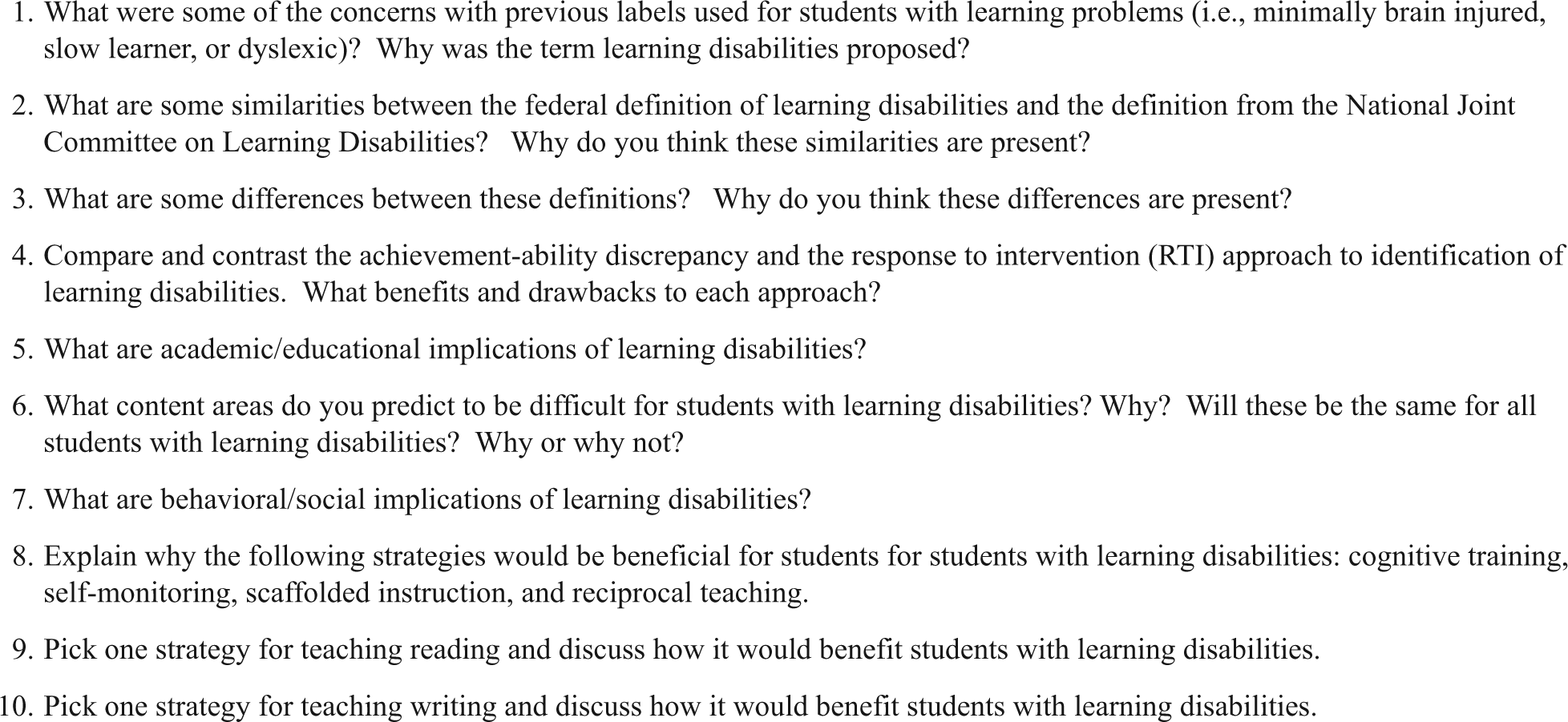
Sample preparation guide for a learning disabilities chapter in an introductory textbook.
The next step is for students to work in pairs and complete the preparation guide together (Saville et al., 2005; Saville et al., 2006). Students are typically allowed to choose their own partners, although there is a caveat that they may not work with the same person more than three times during a semester (Saville et al., 2006; Saville & Zinn, 2009). One possibility to help assign partners is to change the directions for students to pair up from class to class, such as “partner up with the person to your left” or “partner up with the person behind you.” During this discussion time, the instructor circulates and provides support, such as answering questions and clarifying information (Saville et al., 2005). The paired discussion time should take up approximately two thirds of the class period (Saville et al., 2005).
At the end of class, students fill out an interteaching record (i.e., 5 to 10 minutes), which provides the instructor with information on which questions were difficult to answer, those that were easy to answer, and whether students require any clarification (Saville et al., 2005; Saville et al., 2006). Figure 2 contains a sample interteaching record form. The first part of the following class session (i.e., about a third of the time) is then spent lecturing and clarifying anything from the previous class that is still unclear. The lecture portion appears to be a critical component when examining cumulative grades (Saville, Cox, O’Brien, & Vanderveldt, 2011). Students who received a lecture either during the following class period or immediately following the paired work on the question guide had higher course grades overall than students who did not hear a lecture to help clarify materials. These differences were not always significant on individual exams but resulted in a cumulative effect over the semester (Saville, Cox, et al., 2011). Thus, the strategic use of lectures or faculty-led discussion, paired with facilitated student engagement, is a promising practice in the delivery of content knowledge.
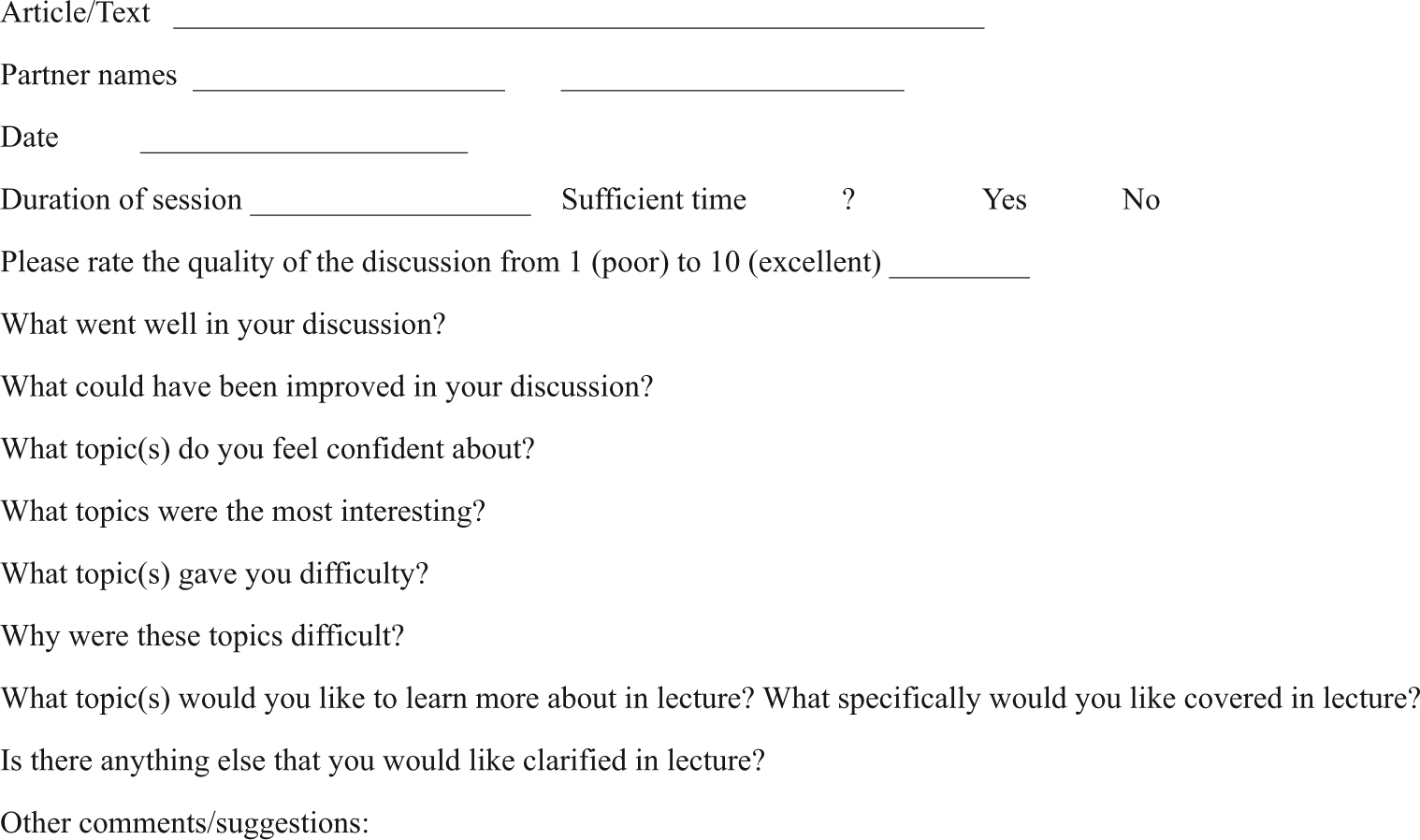
Sample interteaching record.
Another important feature of interteaching is frequent assessment; the recommended number is at least five assessments per semester (Saville, Lambert, et al., 2011). This gives students multiple opportunities to recall and demonstrate what they have learned; research in cognitive psychology also supports the important role that frequent recall has on long-term memory (Baddeley, 2007). Saville and colleagues recommend that assessments include one to two essays and then a variety of more objective questions (e.g., multiple choice, fill in the blank). All questions should directly relate to the preparation guides used in previous class sessions (Saville, Lambert, et al., 2011). However, weekly postdiscussion quizzes did not enhance exam scores (Saville, Pope, Lovaas, & Williams, 2013), possibly because interteaching already includes many review elements. One other component to interteaching is the use of participation points worth 10% of the final grade, which gives students credit for attending class and participating in the discussion sessions (Saville, Lambert, et al., 2011).
Benefits and Considerations of Interteaching
Interteaching may benefit instructors and candidates in a variety of ways. Instructors may enjoy interteaching because the records that the candidates fill out at the end of class inform what will be covered at the lecture at the beginning of the next class session. This helps instructors focus in on crucial details and areas of difficulty (Saville et al., 2005). Instead of preparing a lecture to cover the entirety of material, energy can be focused on beneficial content for students. Candidates and instructors have greater interaction with each other during interteaching compared to traditional lectures, which may increase rapport (Saville et al., 2006).
Interteaching appears to promote student learning by encouraging active participation via the discussion sessions (Saville et al., 2006). In addition, since students have already studied via the interteaching discussions, they may get more out of subsequent lectures (Saville et al., 2006). The discussion sessions also serve to increase student engagement since students are allowed to work at their own pace. Student reports indicate that they enjoy interteaching more than lectures and they feel that they learn more than a lecture format (Saville et al., 2006). The prep guides also offer students a way to focus their learning and studying on the most important materials, which may be helpful for test taking by explicitly linking prep guide content to tests (Saville et al., 2006). In sum, early studies on interteaching have demonstrated stronger learning outcomes on multiple choice and essay questions when compared to lecture-alone conditions (Saville et al., 2005; Saville et al., 2006).
When considering interteaching, it is important for teacher educators to be aware that a shift will be required for themselves and the preservice teachers in their courses. This method may initially require significant preparation time (Saville et al., 2005), particularly on the part of teacher educators. In addition, preservice teachers may also see their workload increase (Ruiz-Gallardo et al., 2011). Teacher educators can address this by carefully designing their course to keep workload manageable for preservice teachers, however this may reduce the amount of content that can be covered during the semester. There is a trade-off, however, between the amount of content that can be covered and how deeply the content can be covered. For these reasons, interteaching may work best when a depth of understanding is critical.
Applying Interteaching
Although interteaching can be used at any point during a course, it may be a challenge to change the entire structure of a course all at once. One solution is to select several topics from the semester in which students might benefit from extended discussion about the material. These subjects could include areas where in-depth understanding is necessary (i.e., parts of an IEP) or times when comparing and contrasting two similar topics can help clear up misunderstandings (i.e., accommodations versus modifications). For each of these topics, a prep guide can be created and given to students prior to class. When students come to class, they can pair up to discuss the answers to the questions while the instructor circulates to clarify points and facilitates discussion. An interteaching record can then be given to students, which will help the instructor determine which points are still difficult or confusing, and these areas can be used to begin the lecture during the next class period. Interteaching is a method that could be used to structure and deliver content in numerous TPP courses. The cooperative learning of interteaching would be appropriate for enriching student knowledge in a variety of areas, including basic special education knowledge (e.g., laws and policies) and characteristics of different disabilities. In addition, interteaching could also add depth to discussions of specific evidence-based practices for working with students with disabilities.
Video-Based Reflection
Special educators’ primary role as academic and behavioral problem-solvers requires them to analyze situations and apply effective practices across a range of settings and content areas (Lignugaris/Kraft & Harris, 2014). To facilitate this analysis and application, special education programs have historically relied on field experiences; and researchers emphasize the importance of supervised field experiences in special educator preparation (Brownell et al., 2014). An important part of field experiences is reflection, which has traditionally been done through journaling (Bayat, 2010), but for preservice teachers, journaling without direction can lead to unproductive reflection, or description void of analysis (Davis, 2006). One technique that can provide this direction is video-based reflection, in which candidates record lessons then watch the videos later with the support of a teacher educator.
Features of Video-Based Reflection
To apply video-based reflection within teacher preparation, preservice teachers record themselves teaching and then watch the videos in a supported environment to spur productive reflection of field experiences. Video-based reflection and video clubs have proven effective in increasing teacher reflection (e.g., Bayat, 2010; Blomberg, Sherin, Renkl, Glogger, & Seidel, 2014), and with the latest technologies, they can be implemented in almost any setting. Current research suggests five principles teacher educators should consider when instituting a video-based reflection program for preservice teachers.
Involve Expert Coaches
Novice teachers and teacher candidates often have difficulty focusing on the significant aspects of a video; therefore, guidance is often necessary to promote productive reflection (Davis, 2006). Without prompting, preservice teachers tend to focus on observed events instead of analyzing patterns and integrating instructional theories and ideas (Bayat, 2010). Preservice teachers demonstrate more depth of analysis when an expert teacher or teacher educator guides their observations and reflections (Blomberg, et al., 2014). In addition, discussing the videos with someone else adds a social component that has been shown to be effective in teacher reflection (Laparo, Maynard, Thomason, & Scott-Little, 2012).
Integrate With Classroom Learning
Discussions about videos must take place within the context of what preservice teachers are learning in class. If video clips are used in isolation, teachers may make inaccurate judgments (van Es & Sherin, 2010). Coordinating video observations and classroom learning allows preservice teachers to make connections between theory and action and provides them with the vocabulary to describe and analyze what they see. It also shows them how their concepts of themselves as teachers correspond to their teaching in practice (Bayat, 2010).
Discuss Short, Focused Clips
Viewing an entire class period of teaching can easily overwhelm novice teachers; it is better practice to use short clips that focus on a particular aspect of teaching. In addition, focusing on one or two particular aspects of instruction allows for in-depth analysis of details and helps teachers develop the “ability to notice” (van Es & Sherin, 2010, p. 156) significant aspects of the classroom and connect those aspects to a broader context.
Utilize Authentic, Complex Situations
Authentic and complex videos better prepare teachers by allowing them to focus on the essential aspects of instruction (Blomberg et al., 2014). Exposure to complex situations can help preservice teachers develop flexibility and apply knowledge in problem solving. In addition, novice teachers benefitted from more intense scaffolding and guidance at first, but their ability to independently analyze and problem-solve increased with time (Blomberg et al., 2014).
Focus on What Happened
Some teachers tend to focus on what should have happened rather than what did happen in a classroom. This promotes negative thinking and does not lead to solution-based ideas. Alternatively, if teachers pay attention to what actually took place, particularly when they directly focus on one aspect of the classroom, they are more able to notice patterns and draw conclusions about their practice (Sherin & Linsenmeier, 2011; Sherin & van Es, 2009). Preservice teachers should be guided to focus on the events that occurred in the video to develop their abilities to draw conclusions about their teaching.
Benefits and Considerations of Video-Based Reflection
Video-based reflection is effective for increasing productive teacher reflection (e.g., Bayat, 2010; Blomberg et al., 2014). Implementation of video clubs increased mathematics teachers’ use of pedagogical, higher-level questions and an “increased focus on student mathematical thinking” (Sherin & van Es, 2009, p. 30; see also van Es & Sherin, 2010). In addition, with the latest technologies such as smart phones and tablets, video-based reflection can be easily implemented in almost any setting. Therefore, video-based reflection can be a relatively easy to implement strategy that leads to better teacher reflection. Novice teachers often are not able to notice and interpret classroom events or reflect on their practice while they are actively teaching (see Feldon, 2007; König et al., 2014). This reduces the potential positive impact of reflecting on teaching, which requires that teachers be able to describe and analyze a situation, then generate problem-solving strategies for dealing with similar situations in the future (König et al., 2014). Viewing selected clips along with experienced support for interpretation and analysis allows teacher candidates to perform this reflection separate from the act of teaching, which results in deeper reflection that can lead to improved practice (see Sherin & van Es, 2009).
When incorporating video-based reflection into a TPP, there are some factors to consider. One is that video-based reflection can increase the amount of time required for observations of field experiences. Teacher educators must watch the videos prior to conferencing with the preservice teachers and select appropriate clips to highlight during the discussion, which can be a time-consuming process. Another consideration is the need for additional technology training. Although video technology is readily available, recording a classroom video that can be easily seen and heard is not always intuitive, and video formats need to be sharable, which may require the use of a video-viewing platform. If TPPs decide to edit videos to facilitate the focus on particular clips, video editing software will need to be made available, along with training and support for use of the program.
Applying Video-Based Reflection
Four important aspects of using video-based reflection within a TPP include (a) the technical requirements associated with candidate use of video recording (e.g., access to video recording technology, capacity to select and upload brief video clips to an appropriate platform for instructor use, receipt of appropriate permissions), (b) consideration of appropriate courses and content in which to use video-based reflection, (c) the development or selection of reflection guidelines or tools, and (d) the allocation of time for video-based coaching. With innovations in video technology, cameras are easier to access and use than ever, and password-protected collaborative online platforms make it simple to upload and share videos between candidates and instructors, while maintaining student confidentiality. Courses that lend themselves to video-based reflections are those with clear connections to practice, such as methods courses and courses related to classroom or behavior management. This allows teacher educators to highlight video clips that directly relate to content and skills taught in the course. Guidelines for the reflections should be closely tied to key course content to keep the reflections focused and connected to candidate learning. Teacher educators can either watch the videos in one-on-one meetings with their students, or they can use the video club format described by Sherin and Linsenmeier (2011) wherein supportive groups of preservice teachers watch and discuss each other’s video clips. It is important to develop and maintain a focus on positive, productive reflection rather than using the videos to promote criticism and negative thinking.
Content Acquisition Podcasts
Features of Podcasts
Finally, content acquisition podcasts (CAP) are short, multimedia-based instructional materials that can deliver instruction for any content area (Kennedy, Hart, & Kellems, 2011). CAPs are enhanced podcasts in that they use still images and recorded narration to deliver instruction. However, CAPs are set apart from generic enhanced podcasts in that they reflect Mayer’s cognitive theory of multimedia learning (Mayer, 2009) and 12 accompanying evidence-based instructional design principles (Mayer, 2008) to shape the looks and sounds of instruction (Kennedy & Thomas, 2012). A sample CAP can be viewed at https://vimeo.com/72439473. The theory and empirical research behind CAPs are described in detail in other publications (Kennedy, Kellems, Thomas, & Newton, 2014; Kennedy, Thomas, et al., 2014). Readers are also encouraged to watch a CAP on multimedia design principles available at https://vimeo.com/89716786. There is a two-part CAP on how to produce a CAP available at https://vimeo.com/24179998 (pt. 1) and https://vimeo.com/24182724 (pt. 2).
Teacher educators can use CAPs to provide preservice teachers with condensed lectures constrained to only contain key information on a given topic. To illustrate, whereas a generic podcast may be a simple recording of the instructor’s actual lecture, CAPs occupy a much smaller portion of time and content. One common use of CAPs is to assign students a reading from the course textbook and supplemental journal articles, and then provide a CAP or CAPs, which learners can use either as an advance organizer or as a review mechanism (Kennedy et al., 2012). Because CAPs are multimedia-based and permanent products, preservice teachers can continue to view them beyond the confines of specific courses similar to how they might use an old textbook, chapter, or article. They can also be used within interteaching, as part of the advance learning process, or as a remedial intervention to help improve performance on questions. Teacher educators might also opt to use CAPs as one tool preservice teachers can learn from in conjunction to address any issues brought up during reflection on videos. Readers are invited to visit www.SpedIntro.com for a free repository of CAPs developed for use in special education coursework and professional development.
Benefits of Podcasts
Given the need to maintain student engagement and learning, CAPs are instructional tools capable of supporting learner engagement and cognition (Ely, Kennedy, Pullen, Williams, & Hirsch, 2014). They support cognition because (a) of their design features (e.g., learner-sized chunks of content, (b) key information is prioritized while extraneous details are omitted), and (c) CAPs function as a supplement to other more traditional learning activities (e.g., lectures and reading a textbook or journal articles). Student engagement is supported by CAPs’ vivid images and limited use of redundant on-screen text, and they can be personalized by the instructor of a course.
Content acquisition podcasts have a growing base of evidence supporting their use with preservice teachers (see Kennedy, Kellems, et al., 2014). This evidence base crosses numerous topics, including characteristics of students with learning disabilities, autism spectrum disorders, and traumatic brain injuries, important evidence-based practices such as curriculum-based measurement and positive behavioral interventions and supports, and other critical topics all teachers should know such as phonological awareness. One study reports on how preservice teachers were taught to develop CAPs for use in inclusive K–12 settings (Kennedy, Aronin, Newton, O’Neal, & Thomas, 2014). In addition, research groups other than Kennedy and his team are now creating CAPs and using them in their own teaching and research (see Hart & More, 2013).
Applying Content Area Podcasts
Content acquisition podcasts can be used as a learning tool in any course. As noted, this tool lends itself to delivering short bursts of instruction for any topic identified by an instructor, and can be consumed by the intended audience at times and locations of their choosing. Empirical research supporting CAPs has largely taken place during an introductory course in special education, however, Kennedy and members of his research team use CAPs during all courses as a way to supplement instruction, provide reteaching to students who need a refresher on a topic, and in professional development (Kennedy, Kellems, et al., 2014). A limitation and criticism of CAPs is that they are two-dimensional in that they are not inherently interactive. Although comprehension and discussion questions are embedded within CAPs in an attempt to stem this criticism, viewers always have the option to ignore that feature.
Conclusion
Within special education teacher preparation the volume of content knowledge required for teacher candidate preparation is significant (see Council for Exceptional Children, 2012). Teacher educators can take advantage of new technologies and forms of pedagogy to increase candidate acquisition and retention of content. To recap, interteaching is a method to encourage active student engagement during class via paired discussions focused on a teacher-created preparation guide. Video-based reflections spurs focused, productive reflection on teaching practices. And finally, CAPs offer a method to package and deliver high-quality instruction for a variety of topics in formats users can easily use at any time.
Footnotes
Acknowledgements
The authors wish to thank Dr. Kristin Sayeski and three anonymous reviewers for their helpful edits and comments on an earlier version of this article.
Declaration of Conflicting Interests
The author(s) declared no potential conflicts of interest with respect to the research, authorship, and/or publication of this article.
Funding
The author(s) received no financial support for the research, authorship, and/or publication of this article.