




Abstract
This article describes how the qualitative research tradition known as positionality can be used as a method to support classroom equity. The text describes three ways teachers can use a spoken approach to positionality in their day-to-day practice. Classroom vignettes illuminate how these spoken methods of positionality can address the latency of power and privilege in 21st-century teaching and learning contexts. The didactic use of positionality to stimulate the kind of reflective student discussions associated with culturally responsive educational reform is also evidenced. Conceptual consideration of positionality methods to support classroom inclusivity for students with disabilities is suggested.
The changing sociodemographics of the United States suggest the diversification of students attending public schools and the emergence of a new mainstream (Enright, 2011). Garcia and Cuéllar (2006) reported that in “a mere 35 years, White students will be a minority in every category of public education as we know it today” (p. 2220). Yet student outcomes suggest a system engulfed by inequality (Crosnoe & Turley, 2011). On numerous academic measures, Black and Hispanic students, for example, score significantly lower than White students (Lee & Bowen, 2006; Reardon & Galindo, 2009). In addition, educational attainment for students with disabilities is far lower than that of their peers without disabilities (Nelson, Benner, Lane, & Smith, 2004). As diversity increases, stratified achievement outcomes suggest the further erosion of learning opportunity (Zeichner, 2012). Developing policies and practices that meet the authentic needs of America’s emerging new mainstream is an economic as well as a social justice imperative (Flores & Oseguera, 2013).
To facilitate reform at all levels of the institutional schooling spectrum, a comprehensive definition of diversity is prudent. Although diversity was initially used as a technical term to describe racial and ethnic student characteristics, the concept has evolved to suggest inclusivity for all historically marginalized groups of students (Pohan & Aguilar, 2001). Today’s educational discourse defines diversity as the acceptance of difference across a litany of discriminatory grounds including gender, race, ethnicity, income, language, religion, sexual orientation, and disability (Darling-Hammond, 2011). This expansion of the diversity concept has significant implications for teachers because the variance of diversities students bring to standardized learning environments imply the variance of forms of discrimination within the ecology of any classroom. While students with disabilities share theoretical ground with those academically disadvantaged by social and cultural characteristics, a generic ethos of inclusivity may not be sufficient to address how institutional ablesism (Hehir, 2002) subjugates students with disabilities in ways that being socially or culturally diverse does not (McPhail & Freeman, 2005).
To increase educational opportunity for all, diversifying teaching practices is a central piece of the equity puzzle (Ladson-Billings, 2006). Yet despite a need for classroom approaches that promote inclusivity, “strategies used to deal with [classroom diversity issues] have not been well conceptualized or researched” (Sue, Lin, Torino, Capodilupo, & Rivera, 2009, p. 89). This gap leaves teachers without the pedagogical resources to implement sound educational reform (Yosso, Smith, Ceja, & Solórzano, 2009). Accordingly, this column describes a method that draws directly from classroom events to raise critical questions about educational equity for student discussion. The method, known as positionality, can be used to address specific instances of privilege and power as they arise organically within everyday classroom dynamics. Such a method may be useful for teachers willing to explore with their students the discomfort of all forms of discrimination enacted within standardized learning contexts. Such willingness is pragmatic to advance equity-minded reform.
Methods of Positionality in the Field and the Classroom
Stemming from the interpretive traditions of anthropology (Geertz, 1988), positionality is a research method to mitigate bias (Milner, 2007). The method relies on disclosures of position that play in the decision-making processes of human subjects research (Atkinson & Hammersley, 1994). In application, positionality is achieved not only by candid admission of one’s biographical orientation, but also by subsequent self-reflection to bracket, not exclude, this orientation from the research design and process (Tufford & Newman, 2012). The need for such a method is based on the assumption that social, cultural, and political dynamics exist between a researcher and his or her subject (Lincoln & Guba, 1985). These dynamics are based on factors such as education, class, race, ethnicity, gender, and disability (Mickelson, 2003).
Because its principles are consistent with the pedagogical aims of culturally responsive classrooms, positionality has been adapted for use in teaching and learning contexts (Martin & Van Gunten, 2002). In diverse classroom situations specifically, positionality is a term used to acknowledge the dynamics of power, privilege and difference that exist between a teacher and her or his students. The assumption is that in the classroom or the field, disclosures of position can reduce the diffusion of bias into either research or teaching spheres (Milner, 2007).
So how does positionality work on a practical level? In research contexts, methodologists recommend both written and spoken practices that acknowledge bias to the self, to the subject, and ultimately to the reader of the study’s final manuscript (Creswell, 2007). To acknowledge bias to the self, reflexive journaling can be used throughout a study’s design and implementation (Anderson, 1989). Reflexive journaling is an example of how positionality can be actuated through the method of writing. Qualitative scholars also enumerate authorial techniques that support the integrity of positionality disclosures within a final manuscript (Van Maanen, 2011). Consent forms also use writing to disclose researcher bias to participants. Interview methods offer guidelines for verbal disclosures of positionality (Kvale, 2008).
Yet while qualitative methods reinforce a standard of biographical transparency for researchers, teacher transparency is not an historically sanctioned educational practice (Salvio & Boldt, 2009). Positionality by teachers arguably subverts the public policy discourse that conceptualizes teachers as distributors of value-neutral knowledge (Palmer & Rangel, 2010). Public schooling assumes that standardized pedagogies, curriculums, and tests abate instructional bias at the classroom level. Public funding remains focused on increasing academic standards (Dowd & Tong, 2007). Empirical consensus on best equity practices in classrooms remains uncertain (Stillman, 2011).
This column describes a spoken approach to positionality with students during classroom discussion. Classroom vignettes are used to illustrate the utility of this spoken method to stimulate the kind of reflective discussions associated with culturally inclusive educational reform (Morrison, Robbins, & Rose, 2008). While the vignettes focus on ethnic, racial and socioeconomic diversity issues, a goal of this article is to suggest an opportunity to consider if and how the positionality can be adapted to facilitate discussion regarding the ways in which traditional classrooms marginalize learning disabled students even as they promote inclusivity for other diversity characteristics.
Positionality as a Spoken Practice
There are three ways teachers can use a spoken method of positionality in everyday practice.
Positionality-on-action uses hindsight to acknowledge instances of bias after the fact.
Positionality-in-action uses spontaneity to acknowledge biases as they may arise organically within everyday classroom dynamics.
Positionality-for-action uses foresight to acknowledge bias and to engage students in critical discussion to improve classroom equity in the future.
The details of each method are explained using vignettes of events that occurred at a Title I urban high school where 92% of the student body qualified for free or reduced-price lunch. The campus stood at the gentrified border of high and low-income neighborhoods. Starbucks and Whole Foods were within walking distance. The classroom context was a student club themed by the field of anthropology. Ethnography Club, as it was nicknamed by members, comprised nine 11th graders (i.e., eight Latino/a students and one Filipino). The club was supervised by Ms. Leonard (see Note 1), and met weekly on Tuesday afternoons in her language arts classroom. Over the course of the academic calendar year, the club successfully designed and conducted a pilot study of campus culture.
Positionality-on-Action
It was early in the fall semester that Mariela brought a plate of her mother’s homemade pupusas for club members to consume as a snack. What started as a good-natured philanthropic gesture escalated into partisan disputes over Latin American cuisines. Rosa, whose family was from Guatemala, commented that the pupusas were technically not pupusas, but gorditas. Mariela, however, insisted her mother’s Mexican pupusas were pupusas. Melissa, also Mexican, concurred, and good-naturedly decreed Mariela’s homemade pupusas to be “the absolute best pupusas in the world.” José and Michal, both Columbian, chimed in that their mothers’ arepas put all pupusas to shame. Rosa shot back that the boys had never tried her grandmother’s pupusas. At this, José suggested that Quint, the Filipino, be called on “like Switzerland” to referee the stalemate. Quint deferred: “What do I know? Rice is rice.” Quint’s wit received a round of applause, and Ms. Leonard steered discussion on to “real ethnography club business.”
In the days that followed, Ms. Leonard reflected on her decision to cut the discussion short. After all, the Ethnography Club’s mission was to study campus culture, and what was “the great pupusa debate” if not a superlative example? To amend the oversight, Ms. Leonard went to three local markets, purchased a pupusa, a gordita, and an arepa, cut them up, stabbed the small bites with toothpicks, and arranged the whole lot on a cafeteria tray covered by a paper napkin. Ms. Leonard unveiled the tray’s contents with a confession: “Last week I said the pupusas debate was not real ethnography club business. I was wrong.”
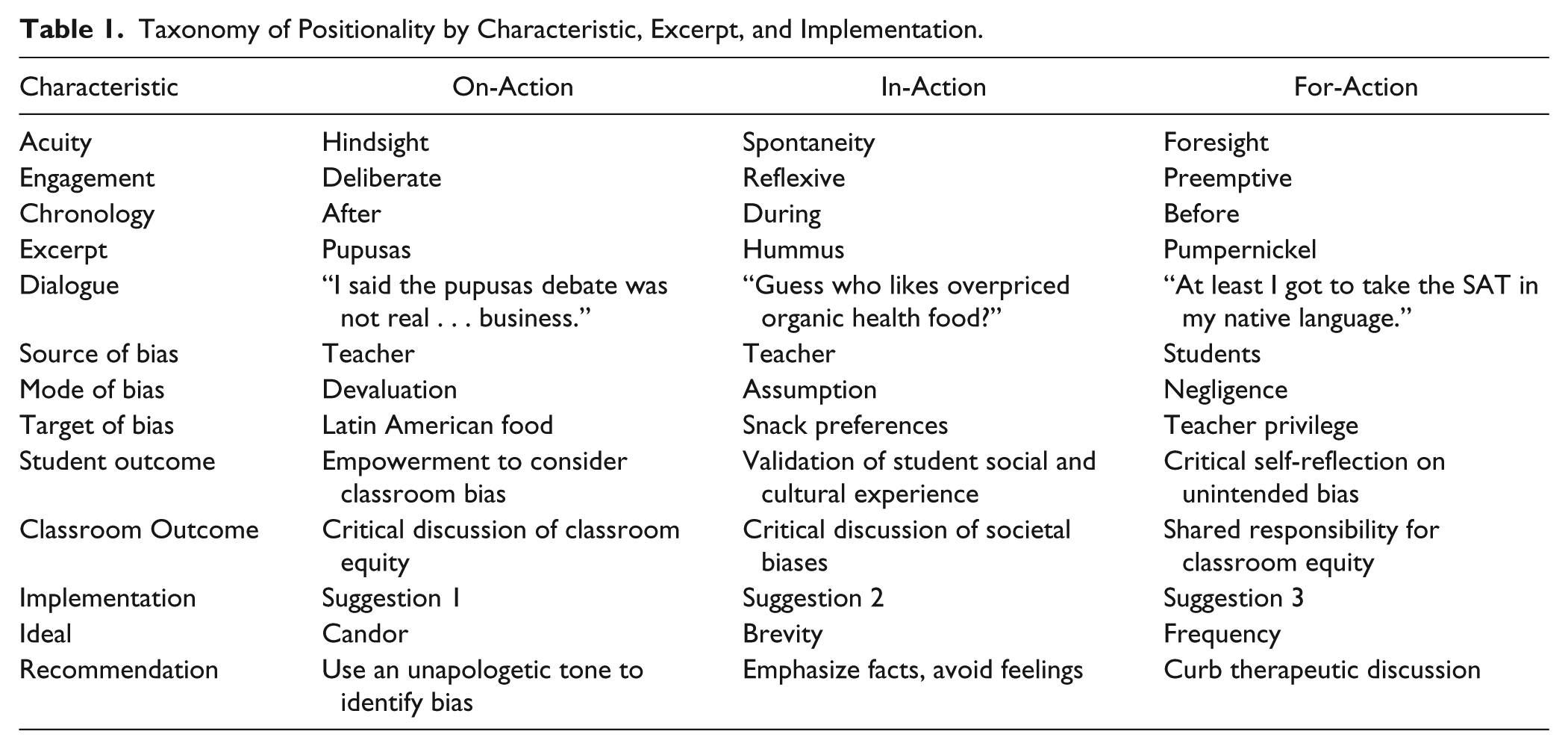
This hindsight declaration exemplifies positionality-on-action (see Table 1 for a taxonomy of positionality by characteristic, excerpt and implementation). Subsequently, students were invited to taste the samples and to deliberate the biases that may have triggered Ms. Leonard’s self-proclaimed “equity blooper.” Mariela responded by saying Ms. Leonard was just “trying to keep us on track.” José was adamant she “certainly wasn’t trying to be prejudiced on purpose.” While students ultimately acquitted Ms. Leonard of diversity infringement, her use of the positionality-on-action method had given the group an occasion to consider the plausibility of teacher bias. Such student empowerment is a hallmark of culturally responsive pedagogy (Villegas & Lucas, 2002). Parenthetically, snacks to palliate afternoon hunger became a club tradition.
Taxonomy of Positionality by Characteristic, Excerpt, and Implementation.
Positionality-in-Action
Positionality-in-action occurred the week Ms. Leonard succumbed to the convenience of the nearby upscale grocery store. She bought pita bread and a tub of hummus. Students devoured the pita, but left the hummus untouched. When Ms. Leonard asked what was wrong with the hummus, José offered, “We don’t want to offend you.” He pointed to the hummus, “But what is that stuff?” As it turned out, none of the Latino students had ever eaten it. Quint, the Filipino, reported, “My grandma made me try it once, but I didn’t like it.” Ms. Leonard responded: “It’s just beans.” Then, with a drawl of self-deprecation, added, “Guess who likes overpriced organic health food?”
This impromptu rhetorical statement exemplifies positionality-in-action. The question provoked a flurry of anecdotes regarding Whole Foods culture. Mariela, for example, reported that the clerks “always do a double-take when they see me with my iPhone. They think I probably stole it from one of the real customers.” José described his daily shortcut across the parking lot to his apartment building three blocks away: “The ladies in yoga pants always steer their shopping carts away from me.” Impersonating José, Michal stood up with his fist in his jeans’ pocket to mime a hidden weapon: “Wanna come over for dinner, lady? My mom’s making aguachile de camarón!” Quint offered a different perspective: “I don’t know what’s wrong with you guys, but when I go in there the White ladies ask if I’ll tutor their kids in math.”
Their flair for sarcasm notwithstanding, students subsequently considered one another’s stories with patience and philosophical insight. By conversation’s end, students had identified patterns including the profiling of Latinos as delinquents and Asians as savants. They also reported the unspoken conflicts between capitalist and health food cultures. Rosa observed the “hippie clerks with little nose rings” disliked the patrons with “big diamond rings.” Mariela noted the irony of how many environmentally conscious shoppers drove gas-guzzling SUVs.” Ms. Leonard’s use of positionality had created another opportunity for students to engage one another in a culturally responsive conversational manner.
Positionality-for-Action
It was bagel week that Ms. Leonard used positionality to advance critical discussion on equity issues with her students. To avoid the possibility of wasted food, Ms. Leonard had ordered all plain bagels and one pumpernickel for herself. The first to arrive was José who right away reached for the pumpernickel. Ms. Leonard was happy to surrender her preference and told José, “Those were my grandma’s favorite.” Her attention was diverted as the rest of the members arrived, but she turned back to José in time to catch his face upon the first bite. He squinted his nose, stopped chewing and hunted for a napkin in which to discard the offending morsel. After some goading, he confessed, “I thought it was chocolate.”
The remainder of students were suspicious to learn that the bagel’s pigment did not fit its expected flavor, and Ms. Leonard found herself explaining the taste and texture of pumpernickel. The discussion evolved to other “weird stuff” Ms. Leonard had eaten growing up with a Russian Jewish grandmother. She even Googled pictures. Mariela recoiled with nausea at the goopy broth of gefilte fish: “I’m not kidding! I think I might really throw up.” “You poor thing,” said Mariela about cold borscht and the inevitable glop of sour cream Ms. Leonard’s grandmother promised would make it more delicious. Quint joked that drinking a “beet milkshake” was tantamount to childhood cruelty. As the laughter subsided, Ms. Leonard deadpanned, “I may have had to drink beet milkshakes, but at least I got to take the SATs in my native language.”
The weight of the comment demonstrates positionality-for-action. Unlike the previous examples where Ms. Leonard used positionality to call attention to the biases of her own classroom conduct, this remark exposed students to the liabilities of joking about social injustice. Ms. Leonard pointed out the farce of dietary disadvantage suppressed the underlying reality of privilege she lived as the offspring of college-educated parents. Students humbly recognized the paradox of disregarding Ms. Leonard’s superseding social and cultural privilege to have a laugh about inequality. José acknowledged the irony of “poor kids making a joke at their own expense.” At Quint’s suggestion, the Ethnography Club members pledged shared responsibility to “call each other out” on unintended bias. In this instance, Ms. Leonard’s use of positionality-for-action created an opportunity for students not only to conceptualize a communal approach to classroom equity, but also to formalize a commitment to self-regulated behavioral reform.
Implementation
What follows are guidelines that can support the translation of spoken positionality into classroom practices that benefit students with disabilities. In review, spoken positionality can be used to address specific instances of privilege and power as they arise organically within everyday classroom dynamics. Although focused on ethnic, racial, and socioeconomic forms of discrimination, the vignettes suggest a baseline criterion for teacher implementation may be a willingness to explore the discomfort of all forms of discrimination enacted within standardized learning contexts. To support this comprehensive equity intention implementation should be context dependent (Morrison et al., 2008). Positionality as described herein creates opportunities to acknowledge the situated diversities within classrooms. As such, it is important to keep in mind the use of positionality will be inextricably tied not only to the developmental and cognitive dispositions of students, but also to the relational dynamics of the class as a whole. Despite these caveats, to facilitate implementation, a generic introduction by teachers is practical. As a first action, teachers might present positionality in a classic dictionary style that validates its academic utility. To offset the formality of this traditional introduction, teachers can follow up with a straightforward demonstration of how positionality mediates personal experience. This step can be accomplished through the use of “I statements” related to a generic physical characteristic such as height, hair color, or shoe size. The intention is to create a low stakes opportunity for students to practice equity-minded discourse. In the case of Ms. Leonard, for example, she might declare, “I am five feet two inches tall.” Perhaps she adds that because of her height, she has never worn a pair of pants that did not need to be hemmed. The candor of the height disclosure invites students to voice the otherwise unspoken physical power dynamics implied by a teacher not quite tall enough to reach the pull on the ceiling-mounted projector screen. A single student comment that alludes to this threat is adequate.
Spoken positionality is a method to acknowledge, not resolve, otherwise unspoken diversity issues. Confidence using these methods with students will develop from practice, hence the recommendation to scaffold its use with progressively complex forms of bias. Productive implementation strategies include a tone that is unapologetic, yet accountable for all classroom forms of social, cultural and institutional discrimination. The principles of candor, frequency, and brevity collectively reinforce the need to balance positionality with other classroom priorities. Sustainable use of positionality methods will necessarily limit curricular digression and conserve the resource of time. Candor fosters a classroom culture that acknowledges bias without stigmatization. Generic positionality demonstrations are deliberate to support candor by segregating positionality facts from feelings. Frequency emphasizes the importance of repetition to establish cultural practice. Brevity is strategic to constrain student hyperbole on and diffuse hypersensitivity to issues of gender, race, ethnicity, class and disability. Teachers may need to curb the compulsion toward dialogue with restorative conclusions. Heavy-handed or therapeutic use of positionality during classroom discussion can be unproductive. Note that these principles (i.e., candor, frequency, brevity) inter-animate to support equity-minded community behaviors.
A final word of advice to teachers is to resist evaluating success based on discernible student outcomes. Classroom equity cannot be measured simply by the content of student dialogue. Two philosophical ideals will be useful to keep in mind. First is the premise that while all forms of discrimination require sensitivity, there is no formal hierarchy to oppression. Second is the understanding that positionality is merely a point of departure toward the development of transformational practices to support equity for all learners, including those with special needs.
Discussion
To recap, positionality-on-action, positionality-in-action, and positionality-for-action are three ways teachers can address the underlying dynamics of power and privilege that pervade everyday classrooms interactions. Positionality-on-action uses hindsight to make public the otherwise hidden equity dynamics that may have gone unnoticed in the past. The pupusas incident demonstrates the utility of on-action positionality to amend the lapse, however brief, in Ms. Leonard’s judgment denouncing the academic value of the ethnic food discussion. Positionality-in-action uses spontaneity to highlight equity dynamics as they occur in the midst of classroom activities. The hummus incident demonstrates the utility of in-action positionality to acknowledge the inaccuracy of Ms. Leonard’s well-intentioned assumption that everyone appreciates an organic snack, especially one purchased from a posh grocery store. Positionality-for-action involves foresight to recognize classroom opportunities to raise equity consciousness and implement communal reform. The pumpernickel incident demonstrates the utility of for-action positionality to expose the incongruity, joking aside, of conferring disadvantage to a teacher whose immigrant family roots have no bearing on her privileged upbringing in a household with high levels of parent educational attainment.
Reflections by the members of the Ethnography Club imply the impact positionality can have on students. It was months later that Quint told Ms. Leonard, “It’s cool how you made fun of yourself and you weren’t embarrassed to admit you don’t come from where we come from.” Rosa concurred: “I hate it when teachers pretend they can relate and then they drive home in a new Volvo station-wagon.”
In closing, Ms. Leonard’s experience suggests how positionality-on-action, positionality-in-action, and positionality-for-action can be used to promote authentic dialogue on the realities of power and privilege endemic to classrooms. Generic discussions of equity lack the potency of direct experience to stimulate critical reflection. The specificity and flexibility with which positionality can exhume otherwise latent bias is its didactic strength. As such, its nimbleness to situated dynamics suggests the suitability of positionality to address classroom instantiations not only of sexism, racism, and classism, but also of the ableism that infiltrates even the most socially and culturally sensitive educational settings. As an equity tool, spoken positionality can encourage communal reflection not only on the range of diversities that characterize 21st-century students, but also on the particular furtiveness with which intractable biases inhabit otherwise diversity-conscious classrooms. As educators, we may firmly believe in diversity’s ideals, but as institutional agents, we are yet suspended in a complex web of systemic conditions that propagate inequality (Geertz, 1988). Tactics to illuminate the classroom threads of this web are necessary to amend the patterns of subjugation that reduce educational opportunity for America’s emergent new mainstream.
Footnotes
Declaration of Conflicting Interests
The author declared no potential conflicts of interest with respect to the research, authorship, and/or publication of this article.
Funding
The author received no financial support for the research, authorship, and/or publication of this article.