



Abstract
A code of ethics serves as a compass, guiding professionals as they perform the roles associated with their profession. These codes are evidence to the public that professionals are concerned about the services they provide and the individuals to whom they are provided. Codes of ethics should be living documents, changing focus as the fields they represent change. The purpose of this article is to provide a review of the current and historical changes to the Council for Learning Disabilities’ Principles of Ethical Practice and encourage discussion and reflection on employing these standards. In support of the latter, five case studies are presented to afford opportunities for practitioners to engage in professional discussions aimed at improving the services and practices provided to students with learning disabilities in general education settings.
Keywords
Two key elements in defining a true profession are the presence of a uniform set of rules and behavioral standards that can regulate the behavior of its members, and enforcement of the rules when desirable behaviors are absent. As the field of education endeavored to gain status as a profession, discussions about the professional standards and ethics of educators became more prevalent (Rich, 1984). Essential to any professional organization is a document detailing the ethical obligations of its members. The purpose of a code of ethics is to serve as a compass, guiding professionals as they perform the roles associated with their profession (Scanlon & Glover, 1994). A code of ethics is essential for any profession, serving as evidence to the public that professionals are concerned about the services they provide and the consumers, patients, or students whom they serve.
Codes of ethics in professional organizations in the field of education have shaped the behavior of their members for decades. Although codes of ethics vary in content, structure, complexity and focus, codes of ethics in education generally encompass how professionals
engage with students and sometimes their families,
engage with professional colleagues,
handle information related to students,
practice and perform their duties and responsibilities,
commit to and represent their profession, and
possess content information or specialized skills related to the organization.
The Council of Learning Disabilities (CLD) is a professional organization that has offered clear and relevant codes of ethics for its membership and the broader field. The purpose of this article is to share information on recent revisions to CLD’s Principles of Ethical Practice. Further, the article provides five case studies representing complex ethical dilemmas related to individuals with learning disabilities (LD). A framework provides an impetus to stimulate discussion and promote reflection about serving students with LD, especially in general education classroom settings.
Standards for Ethical Practice
The Council for Learning Disabilities is an international organization composed of professionals from diverse disciplines, committed to enhancing the education and quality of life for individuals with LD across the life span. CLD developed its first ethical standards document (i.e., code of ethics) in 1979 as part of the organization’s statement on professional standards (i.e., then the Division for Children with Learning Disabilities). In 1994, after recognizing the importance of standards and ethics, CLD created a standing committee to oversee this essential organizational structure. The Committee on Ethics and Standards has worked to keep the code current with regular reviews and revisions. In essence, the committee created a living document responsive to general changes in the field of education, with particular attention to changes in the field of LD. There have been two revisions to the CLD code of ethics, one in 1995 (Buck, Polloway, & Robb, 1995) and a second in 2008 (Gurganus, Skinner, & Watson, 2008).
The 1995 revisions reflected educational and societal changes, reaffirmed ethical professional behavior, and provided principles that were impartial and global in nature. For example, the increasing cultural diversity of student populations in public schools prompted changes that recognized the importance of respecting and addressing diversity. Other adjustments made during the 1995 revisions were to recognize the critical need to determine procedures for the interface between special education, high-stakes testing, and standards-based education. The final document, CLD Principles of Ethics, was composed of 27 ethical principles categorized into five goals for professionals within CLD. The Standards and Ethics Committee recommended sharing the document with CLD membership, state departments of education, local school districts, and university faculty in personnel preparation programs (Buck et al., 1995). Further, it suggested case study scenarios be developed to ensure preservice trainees have sufficient instruction on the tenets and application of the principles.
The second revision occurred in 2008 and emphasized the importance of expanding the spirit of the CLD code of ethics, Principles of Ethics document, to address the dispositions, skills, and actions of teachers of students with LD. The document was renamed CLD Principles of Ethical Practice and maintained the format with principles categorized into five professional goals for professionals in CLD, under which 28 ethical statements were divided. Along with these modifications, the Standards and Ethics Committee focused on dissemination of the document and instruction about ethical practices among preservice teachers. Six case studies focused on ethical practices teachers may encounter when working with students with LD. The cases were designed to inform novice teachers about potential challenges they may face as teachers of students with LD while providing faculty in institutions of higher education with materials to supplement instruction and foster discussion. Literature on professional standards suggests the importance of direct instruction in ethics in educator preparation programs (Bull, 1993; Spendlove, Barton, Hallett, & Shortt, 2012).
Revisions in 2014
Key to the 2014 revision was recognition of the instructional placement of students with LD across the country. The U.S. Department of Education reported that more than 66% of students with LD spent most of their day in a general education classroom, and an additional 23% spent some of their day in a similar setting (Kena et al., 2014). These data suggested that general education teachers provide a large portion of the instruction received by students with LD. As such, a new population of education professionals should be aware of ethical considerations related to students with LD. Previous versions of CLD’s Principles of Ethical Practice focused on the needs of professionals within CLD, which primarily was constituted of faculty and graduate students in institutions of higher education but also included special education K–12 teachers and administrators. Individuals who do not constitute CLD’s traditional membership increasingly provide services to students with LD in schools; therefore, there is a need to expand our audience related to these principles.
Promoting the ethical standards related to individuals with LD outside of the organization’s membership was a central theme of the 2014 committee. The revisions, presented in the Figure 1, include shifting the responsibility of ethical practices solely from CLD members to other professionals who work with individuals with LD. This change supports the organization’s mission to advocate for individuals with LD. Additionally, CLD’s goals include fostering collaborative networks with and among professionals who serve individuals with LD and expanding its audience to educators, researchers, administrators, and support personnel. Finally, the revisions acknowledge the importance of using culturally responsive practices when working with individuals with LD. By sharing the newly revised standards with other professional organizations, CLD hopes to inform the practice of a wide range of professionals who work with individuals with LD. Similar to the 2008 revisions, the 2014 committee developed five case studies to support the review and dissemination of these revised standards.
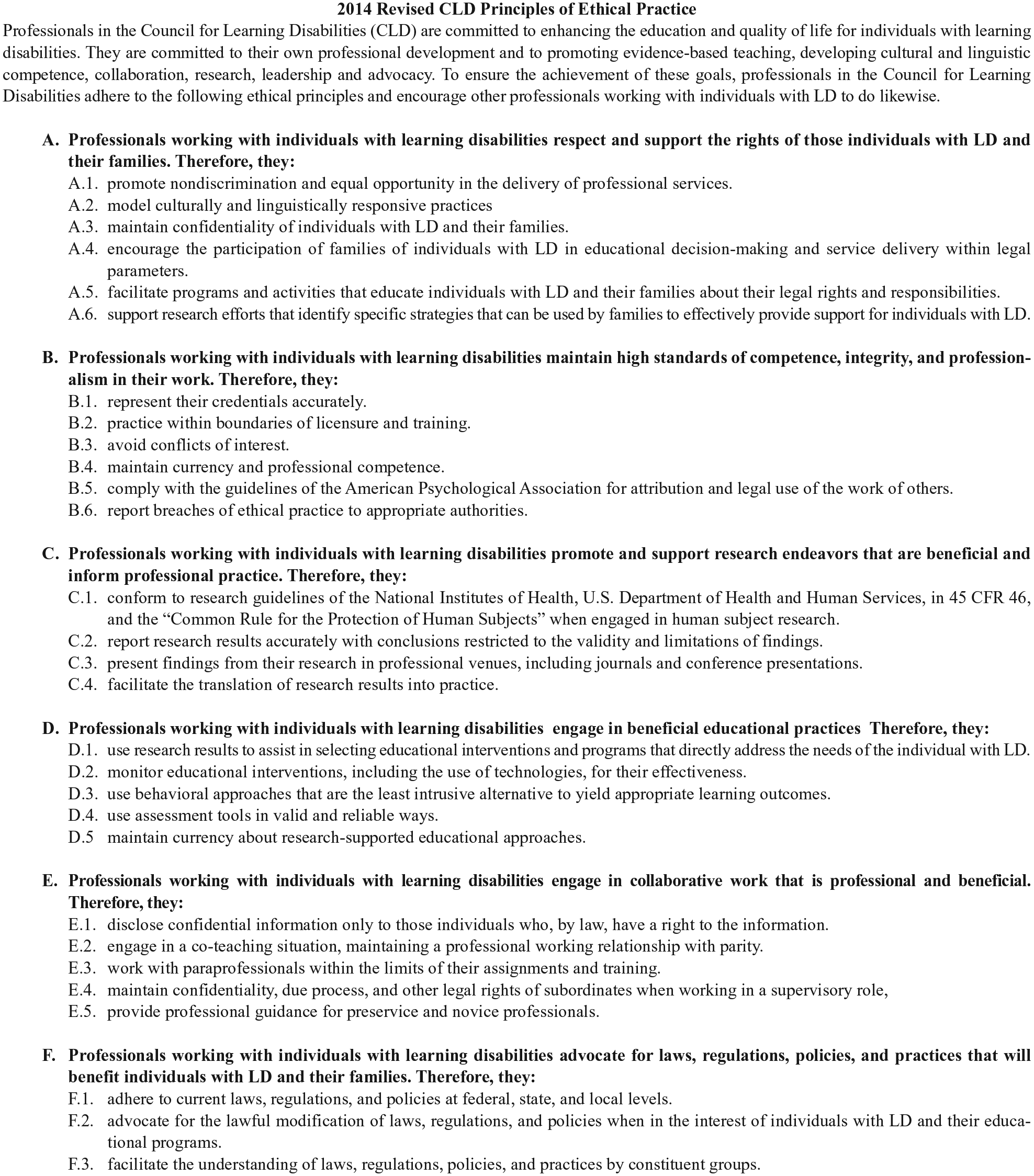
2014 revised Council for Learning Disabilities Principles of Ethical Practice. Reprinted with permission of the Council for Learning Disabilities.
Case Study Teaching
Often, professionals use case studies as educational materials that provoke discussion and critical thinking, through the provision of real-life scenarios highlighting theoretical concepts within practical situations (Popil, 2011). Research supporting the use of case studies, or case-based learning, suggests it is an effective method of teaching ethics in a variety of disciplines, including teacher education, nursing, criminal justice, and business (Dinç & Görgülü, 2002; Kunselman & Johnson, 2004; Skinner, Gurganus, & Watson, 2009). Case study pedagogy facilitates “easy comprehension of the theories of ethics and philosophical principles” (Dinç & Görgülü, 2002, p. 263) as well as provides opportunities for application, stimulating the acquisition of knowledge based on the professionals’ needs and interests (Dinc & Görgülü, 2002).
Case studies serve multiple purposes in the preparation of preservice and in-service teachers. Masingila and Doerr (2002) suggested case studies expose preservice teachers to the complexities of real-world scenarios and provide them with opportunities to reflect on their own emerging practices. Additionally, case study learning allows in-service teachers to connect prior methodological learning and experiences to situations they may encounter when working in the field (Hemphill, Richards, Gaudreault, & Templin, 2015). One recommendation is to use them as a means of promoting conceptual change in preservice teachers (Goeke, 2008). As an assessment tool, case studies assist the reader in framing a response to a practical situation (Schwartz & Webb, 2014). Perhaps the greatest value case study pedagogy brings to teacher education is the generation of reflection and dialogue.
Teacher reflection is a necessary tool for responsive instructional practice (Etscheidt, Curran, & Sawyer, 2012). When using case studies, learning occurs through deep and engaging discussions or written reflection. This is especially so when case study instruction is carefully planned and embedded into curriculum of a preparation program and/or instruction about specific theories, concepts, or ideas, such as ethics.
Warnick and Silverman (2011) offered a case analysis framework that fosters the systematic examination of ethical practices presented in cases developed for teaching about ethics. Although “the framework does not produce absolute answers, it leads to a process that increases procedural objectivity in ethical decision making” (Warnick & Silverman, 2011, p. 273). The tool is composed of nine steps, which fosters cases analysis adapted specifically for teachers. The steps may serve as the foundation for class discussion and/or writing about ethical dilemmas in teaching. Slight modifications to the framework helped align the framework to CLD’s Principles of Ethical Practice (see Figure 2). The goal is to have the cases analyzed with the organization’s ethical standards in mind.
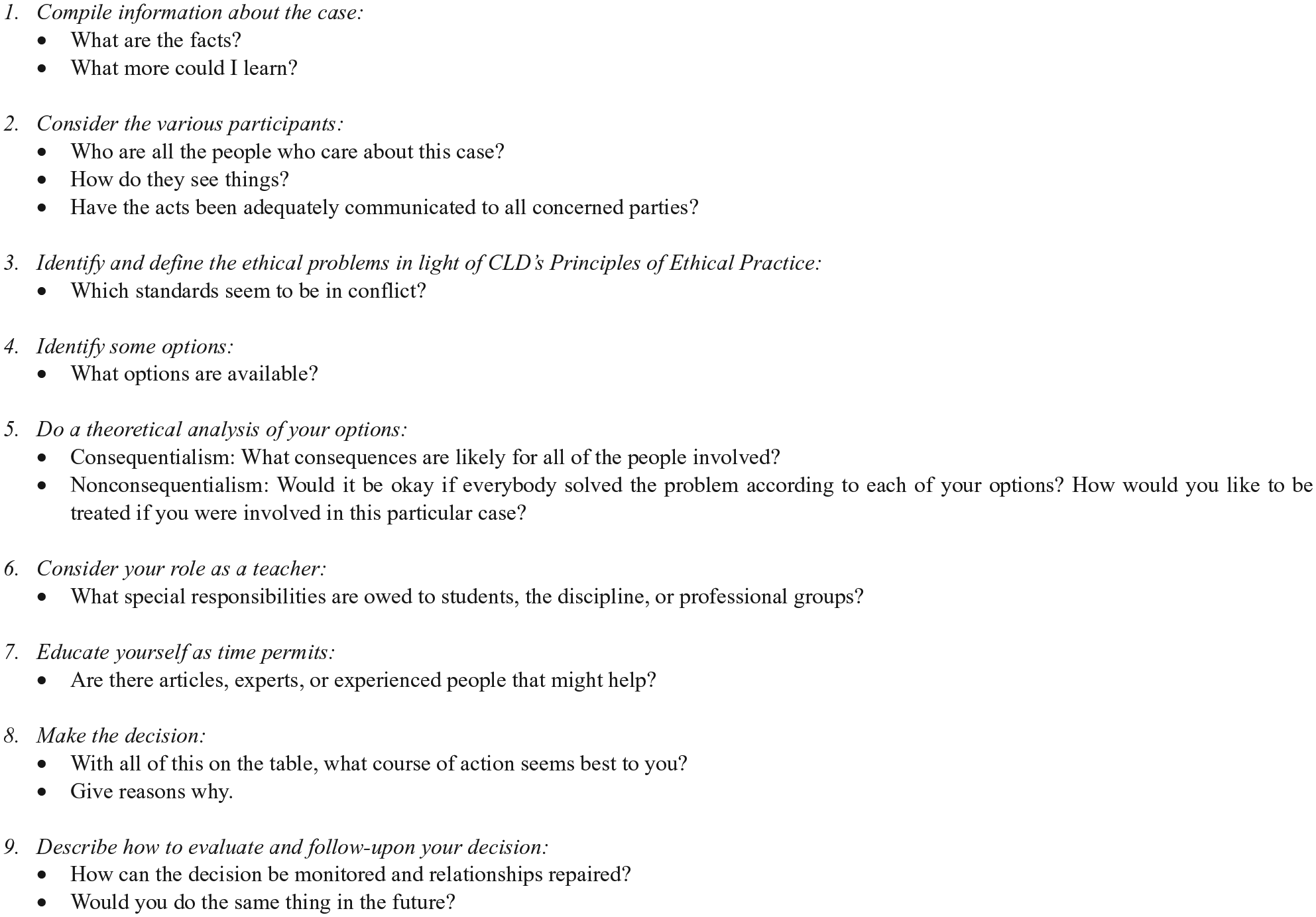
A framework for case analysis. Adapted from “A Framework for Professional Ethics Courses in Teacher Education,” by B. R. Warnick and S. K. Silverman, 2011, Journal of Teacher Education, 62(3), p. 278. Copyright 2011 by Sage. Reprinted with permission.
Case Studies
The committee intends for the following cases to foster discussion about ethical issues that may arise in general education classrooms serving students with LD. The cases involve the following issues: (a) collaboration between general education and special education teachers, (b) data collection and record keeping, (c) special education eligibility decisions, (d) instructional accommodations, (e) using social media in the classroom, and (f) evidence-based practices. Questions related to ethical challenges follow each case. Table 1 provides the ethical practice in question and the grade level or subject focus of the case (see Note 1).
CLD Principles of Ethical Practice Represented by Case Studies.
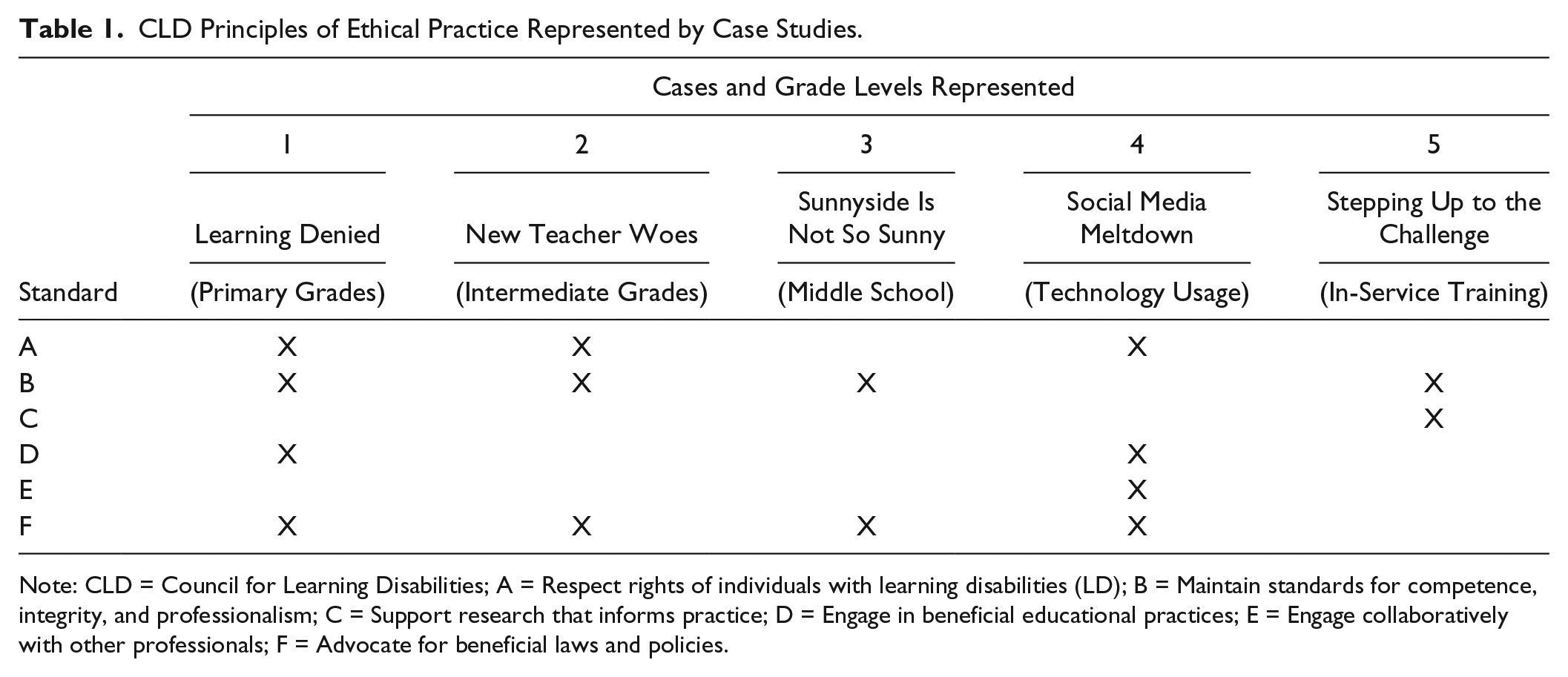
Note: CLD = Council for Learning Disabilities; A = Respect rights of individuals with learning disabilities (LD); B = Maintain standards for competence, integrity, and professionalism; C = Support research that informs practice; D = Engage in beneficial educational practices; E = Engage collaboratively with other professionals; F = Advocate for beneficial laws and policies.
Learning Denied
Rachel Rank, an experienced second-grade teacher, had a diverse classroom of students: five who were English language learners (ELL), three who received special education services, and two who received both ELL and special education services. Ms. Rank often felt stressed about having large numbers of students with special needs in her classroom. This year, a third of her class received some form of support or assistance. Rachel’s preservice teacher preparation program required all graduates to obtain ELL certification. Yet, she was not always clear about how to plan for and provide modified instruction or accommodations to these students. Rachel had not planned to work with struggling learners, yet her classes seem to have an increasing number of this population.
Seeing her struggles, the lead second-grade teacher and principal encouraged Rachel to attend professional development sessions targeting instructional strategies for culturally and linguistically diverse students. However, even after attending several full-day training sessions, Rachel continued to lack the willingness to ensure optimal learning outcomes for her students. Rachel was hopeful she would continue to get by with minimal adjustments to her current second-grade lessons.
Among the group was Yuna, a Vietnamese student whose learning disability in reading was recently identified. Yuna struggled with decoding, which affected her word identification and subsequently her reading comprehension. Ms. Rank handed out a passage and asked students to summarize the story after reading. Yuna and the other ELL students could not complete the assignment independently because of the advanced level of the passage. Ms. Rank’s classroom procedure was to ask peers to assist struggling students by reading the passage aloud. Sam sat next to Yuna and frequently assisted her with her work. “Class, Sam, is going to read the story aloud. This will be a great help to Yuna and the others who are learning our language.”
Later, when Yuna and the other students went to their ELL and special education teachers, they complained about the way Ms. Rank treated them. Specifically, the students expressed feeling frustrated and embarrassed while in their general education classroom. Ms. Figaro, a novice ELL teacher, and Ms. Rosemont, a novice special education teacher, decided to suggest Ms. Rank implement inclusive strategies for her students. Ms. Rank welcomed the suggestions and agreed to have Ms. Figaro and Ms. Rosemont come to her room and coteach some of the reading lessons, saying, “After all, these are your kids!”
When Ms. Figaro and Ms. Rosemont entered Rachel’s classroom, Ms. Rank divided the class into two groups. Yuna and the other students receiving support services were in one group, while all other students were in the second group. Ms. Rank directed Ms. Figaro and Ms. Rosemont to take the students with special needs to the back of the classroom as she handed them the materials that the students had not finished the day before. “You guys can take your students to the table in the back. Here are the materials they have not been able to complete this week. It would be very helpful if you could get them caught up.”
Although Ms. Figaro and Ms. Rosemont were uncomfortable with Ms. Rank’s directions, they did as requested and spent the class period working with the students at the table in the rear of the classroom. As new teachers, they did not want to offend Ms. Rank or perceive her as difficult. However, this was not what they had in mind. After the lesson, the two teachers requested a follow-up meeting during Ms. Rank’s planning period. Ms. Figaro said, “Hi, Rachel! We enjoyed working in your classroom today. We would like to schedule weekly meetings with you so the three of us might plan instruction together. What do you think?” Rachel smiled reluctantly but remembered how pleasing it was to have the extra help in the classroom. Ms. Rosemont continued, “We have found that students with learning challenges benefit from differentiated instruction, coplanning, and coteaching. We also can incorporate principles of universal design in our planning. We have some supplemental materials, like graphic organizers, that we would love to share. All of your students may find them beneficial. Maybe next week we can get together and discuss opportunities for the students to work in a variety of cooperative arrangements.”
Over the next several weeks, the three teachers met during Ms. Rank’s planning period. Ms. Figaro and Ms. Rosemont listened attentively to Rachel’s concerns and ideas and discussed evidence-based approaches for helping students with learning difficulties. When they cotaught in Rachel’s classroom, they modeled effective teaching practices and actively engaged all students in learning. Students began to develop their own strategies for learning and remembering. Ms. Figaro smiled when she heard Rachel discuss the merits of coteaching and her success with diverse learners in the teacher workroom.
Questions for Reflection and Discussion
What ethical issues are embedded in this case?
Which of CLD’s Principles of Ethical Practice were violated?
How did Ms. Rank practice (or not practice) within boundaries of licensure and training?
Consider and discuss other scenarios that might have occurred as a result of Ms. Rank’s work with the students with special needs in her classroom.
What culturally responsive practices is Ms. Rank utilizing?
List strategies used by Ms. Figaro and Ms. Rosemont that affected Ms. Rank’s attitude and actions.
New Teacher Woes
Lisa Rodriguez, a fifth-grade general education classroom teacher, was preparing for an upcoming IEP meeting for a student who had a learning disability. Ms. Rodriguez was a 1st-year teacher and recognized the importance of advocating for all students in her classroom. However, Lisa remained a bit hesitant about her abilities to provide appropriate accommodations, modifications, and individualized instruction for her students receiving special education services. When she had questions, she was hesitant to seek assistance for fear of appearing ill prepared by the administration and her peers. Lisa attempted to maintain thorough documentation and paperwork essential to the progress of all students. Unfortunately, she had neglected to collect pertinent data needed for an upcoming IEP meeting. Keeping paperwork organized, attending grade-level and parent meetings, attending to the demand of district testing, and serving as an after-school cheer coach for the neighboring middle school kept her very busy. Though well meaning, she had not been consistent in providing regular interventions and individualized instruction that her students receiving special education and those considered for Tier 2 instruction needed. She knew that data were requested in preparation for and during the IEP meeting, but she was worried that because of her record keeping, there would not be enough information for the committee to make decisions. Surely, this would result in embarrassment and a reprimand by the administration. She vaguely remembered Scott’s results on some of the missing assignments. She decided to fill in some approximate data to avoid any consequences. After all, it is no big deal, right? At least she would appear prepared for the IEP meeting!
As Lisa gathered materials for the IEP meeting before school one morning, her friend Karen Smith entered her classroom. Karen had been Lisa’s high school classmate. They both were excited when Molly, Karen’s daughter, was assigned to Lisa’s class. The two chatted about community news and Molly’s progress. Karen casually inquired about the progress of students in Lisa’s class. As Karen was a longtime friend, Lisa felt there would be no problem sharing information about her students. Their conversation was a natural segue into her frustrations about data keeping. Lisa shared her dilemma related to the upcoming IEP meeting. As she vented her frustration, Lisa revealed her plans to supplement the missing data. Karen seemed so understanding and Lisa felt better after having vented her frustrations to her longtime friend. “It’s hard being a new teacher and it felt good to share this with someone who genuinely cares! Now just enough time left to prepare for this afternoon’s meeting.”
Questions for Reflection and Discussion
What ethical issues are embedded in this case?
Which of CLD’s Principles of Ethical Practice were violated?
What are possible scenarios that might occur as a result of Ms. Rodriguez’ dilemma?
Discuss steps that schools might take to prevent problems like those experienced by Ms. Rodriguez.
Sunnyside Is Not So Sunny
Rob Evans was a 1st-year school psychologist at Sunnyside Middle School. He had been teaching special education for over 9 years, serving as a resource teacher and an inclusion specialist. Having recently earned his master’s degree, he was excited to begin a new phase in his career. Recently, Rob processed a special education referral for possible LD for Jay, a 12-year-old sixth grader referred for challenges with reading, writing, and math along with some minor behavioral incidents at school. Jay’s elementary school records reflected his struggles during his fourth- and fifth-grade years. These problems were exacerbated by a few behavior challenges that caused him to be suspended twice during fifth grade. Jay came into middle school having performed poorly on last year’s state-level exam and with suggestions from several teachers that he be referred for special education under the category specific LD.
However, during the first 4 months of the sixth-grade year, the Student Success Team (SST) made recommendations for Jay in all subjects, allowing him to have the opportunity for reteaching, small-group test administration, and quiet environments to complete his work. All of Jay’s teachers reported he was maintaining average grades and that he was passing at that time. His teachers generally described Jay’s academic effort and work habits as satisfactory.
Rob observed Jay in class as part of the assessment process. Jay appeared prepared and organized for class and demonstrated an appropriate level of engagement and activity. He worked cooperatively with his peers and responded to the teacher’s requests. During testing, Jay was attentive, able to carry on a conversation, communicated typically for his age, and developed an overall good rapport with Rob. Assessment results suggested that Jay was an intelligent and creative young man. Taking into account individual assessment and classroom data, Rob and the IEP team could not support an eligibility determination. Simply, Jay did not have a learning disability and did not qualify for special education services. Though the fifth-grade file left little doubt that Jay had some problems in previous years, Rob and the school psychologist suspected Jay had matured and that the support he was receiving in sixth grade would have been helpful in fourth and fifth grades. The district behavior interventionist also contributed to the evaluation and noted that Jay’s inappropriate behavior may have been rooted in not being able to keep up with the work and his embarrassment about his performance. Rob was pleased that he would be able to make a favorable report to Jay’s parents.
A few days before the meeting, Rob received a call from Darrell Stevens, Sunnyside’s principal. Mr. Stevens invited Rob to a nearby restaurant after school to see how he was adjusting to his new role as school psychologist at Sunnyside. During this casual meeting, Mr. Stevens shared his pride in the reputation of his middle school. “Sunnyside is a model school. We have strong teachers who prepare our students to perform well on the state-level exam. In fact, we have maintained some of the highest scores not only in our district, but across the state, for the last 5 years. I take personal responsibility for the success of my school.” Rob was aware of the school’s reputation for strong performance and had begun to learn of Mr. Stevens’ “hands-on approach” for managing the teachers, curriculum, and school.
“I’m so glad that you’ve come to be part of the Sunnyside team! I hear you have completed your assessment of Jay. My family and his family have been friends for years. Our boys play baseball on the same team. Jay is quite a third baseman.” He continued by discussing Jay’s academic and behavioral issues prior to coming to middle school. “Regardless of the class, Jay has struggled for many years. This is well documented. You know, everyone would agree that a smaller educational setting for academic instruction would be beneficial. Using all of the data, can’t you simply find an area of weakness that would qualify Jay for special education services?” Without giving Rob an opportunity to respond, Mr. Stevens’ continued, “His test scores are likely to negatively affect Sunnyside. Our reputation and the community’s perception must be considered; this is why I’m so attuned to the referral process.” Mr. Stevens shared his belief that if Jay received special education services, his scores would not be added to the school’s overall scores. “We need to maintain our exceptional status. This is the Sunnyside way.”
Shocked by the conversation, Rob abruptly ended it and noted the need to pick up his children from childcare. He headed home puzzled. Rob could not comprehend that he was asked to place Jay in special education even though no learning disability was evident. He believed in the assessment process and had seen it work many times. Why couldn’t Jay continue to receive support through SST or 504? He wondered if his job was in jeopardy, but the impact of labeling a student erroneously goes far beyond a job. That evening Rob reviewed his notes from his special education law class and pondered the request made by his principal. He decided to go against Mr. Stevens’ request to “beat the system” and misinterpret the assessment results. Instead, Rob planned to follow the Individuals with Disabilities Education Improvement Act of 2004 regulations.
Questions for Reflection and Discussion
What ethical issues are embedded in this case?
Which of CLD’s Principles of Ethical Practice were violated?
Under which Principles of Ethical Practice did Rob Evans operate?
Consider possible options that Rob Evans might explore.
Social Media Meltdown
Donna Knotts, the ELL teacher at Taylor High School, just returned from an energizing conference on incorporating technology into the classroom. She couldn’t wait to try out some of the great tools that she learned! Donna knew that her school had a technology usage policy but, in her excitement, did not take the time to find out what it said. She knew she wanted to use technology to help her students improve their writing skills and build community. The students came from a variety of backgrounds, with varying levels of reading proficiency. However, being high school students, they all seemed to be adept with applications of technology, such as social media, iPad apps, and gaming. Ms. Knotts worked with her students to create a classroom Facebook group to encourage them to build community and experience authentic writing events.
Ms. Knotts used the LCD projector and SmartBoard in her classroom to have the students develop the class Facebook page together. Aya, a student with LD, was extremely engaged in this process and pleased that several of her suggestions were used. Ms. Knotts encouraged all of the students to “like” the page and showed them how to do so, using her personal account as the example. As soon as the bell rang, Aya discreetly used her cell phone to “like” the page and share it with her friends.
Later that evening, Ibrahim Amin, a student in Ms. Knotts’ class, “liked” the class Facebook page, and suddenly, images of Ms. Knotts began popping up on his newsfeed. These images showed her consuming alcohol and engaging in other activities that were not school appropriate. In addition, several of her status updates included comments about students with LD that were descriptive enough such that Ibrahim discerned their identities. A few comments even noted frustrations she experienced from time to time working with her students. His newsfeed also included posts and comments directed toward Aya from other students at the school. These communications were veiled insults that he recognized as bullying, but her responses indicated she was unaware of the intended messages. Ibrahim was offended by Ms. Knotts’ disclosures and upset by the way Aya was treated online. Unsure of what to do, he showed his mom, who was a teacher at the elementary school. Mrs. Amin contacted her principal, who then contacted Mr. Benson, the high school principal, to notify him of the concern. Mr. Benson went online to research the claim before e-mailing Ms. Knotts to request a meeting the next day.
Questions for Reflection and Discussion
What ethical issues are embedded in this case?
Which of CLD Principles of Ethical Practice were violated?
What responsibilities does the school district have regarding technology use?
How can social media be responsibly integrated into the school curriculum?
Evidence Based or Not, That Is the Question
Research and education are among the main tasks of university professors, and this was the focus of Dr. Resa Brooks, until she received tenure and promotion. With concentrated effort and a great deal of time spent on research, writing, and presenting at national/international conferences, she was tenured and promoted to associate professor based on her research on learning styles. For the next 15 years, Dr. Brooks developed learning styles assessment inventories and other learning styles materials. She taught undergraduate and graduate courses at her university and provided professional development seminars based on her learning styles work. She was recognized in her local area and was frequently called upon to provide professional development in local school districts.
Recently, her work brought her unwanted media exposure on a local television program. In an early morning interview, one of her junior colleagues, Dr. Abeke Obi, whose research focused on evidence-based instructional strategies, questioned learning styles research. Dr. Obi also had communicated her concerns about their program’s overemphasis on learning styles in a recent department meeting. She called learning styles an urban legend. “There are fundamental problems in regards to both the diagnosis of learning styles and the alignment of instruction to these styles” (Kirschner & van Merriënboer, 2013). “We are mistaken to equate cognitive strengths with learning styles.” She continued by saying, “Searching the research literature for specific empirical evidence on learning styles, you can’t find any support.” Dr. Brooks simply replied, “Students learn better and more quickly when teaching methods match their preferred learning styles. Frankly, our students and local teachers enjoy hearing about learning styles.”
Lakeland ISD, a local school district, had contacted Dr. Brooks with an interest in contracting her to conduct a full-day professional development seminar on inclusive practices for their newly hired teachers. She eagerly agreed to the opportunity and planed to provide a seminar format she had used in many previous professional development sessions. The training would begin with a background on learning styles. Participants would take a learning styles inventory and then break into groups based on styles. She usually used an engaging activity to encourage discussion within the groups about learning styles preferences. Once back in the large group, Dr. Brooks would dedicate the remaining 2 hours to teaching the group about how to teach to various learning styles. As the seminar date approached, Dr. Brooks was contacted by the Lakeland ISD’s central administration, wanting to verify the seminar’s agenda and the research supporting the use of learning styles. Dr. Brooks began to read recent work related to learning styles and found that some researchers had concerns about the validity of learning styles. “Of course they are wrong about this,” she thought. She had an intuitive feeling about learning styles—after all, this had been her life’s work. She communicated with the district that there was sufficient evidence for using learning styles, although she was unable to locate research that clearly supported the practice as evidence based using more recent guidelines. Dr. Brooks delivered her seminar to the Lakeland teachers in her usual format; however, she could hear some of them discussing the validity of learning styles as an evidence-based practice. Some teachers left eager to assess the learning styles of their new class, while others questioned the information provided.
Questions for Reflection and Discussion
What ethical issues are embedded in this case?
Which of CLD’s Principles of Ethical Practice were violated?
How is Dr. Brooks translating research into practice?
What responsibilities does Dr. Obi have?
What responsibilities does the school district have?
Conclusion
These revisions and the accompanying case studies strive to engage all educators and service providers by enhancing their knowledge and application of ethical standards in serving individuals with LD. As an international professional organization dedicated to individuals with LD, the CLD has led the charge in establishing, disseminating, and maintaining the ethical principles to guide all services designed to enhance the learning and life experiences of individuals with LD. Currently, the majority of students with LD receive services in general education settings. For this reason, the new revisions have placed an emphasis on issues related to the activities in general education classrooms and the preparation of supporting personnel. The cases provide a forum for discussion, critical thinking, and problem solving regarding several ethical issues education professionals may face in today’s schools.
Footnotes
Declaration of Conflicting Interests
The authors declared no potential conflicts of interest with respect to the research, authorship, and/or publication of this article.
Funding
The authors received no financial support for the research, authorship, and/or publication of this article.