



Abstract
The reauthorizations of the Individuals With Disabilities Education Act emphasize that students and parents are to be considered equal partners in the individualized education program (IEP) process. This article addresses how to move from compliance with the law to facilitating meaningful involvement of high school students and their parents in IEP and transition planning. This article offers recommendations of an effective way to facilitate student-led IEP meetings. These three phases of IEP can support teachers’ roles in facilitating student and parent involvement in student-led IEP meetings. This article provides a model of how best practices in pre-IEP, IEP, and post-IEP meeting protocols can be implemented and outlines practices for developing reciprocal relationships with students and parents to facilitate meaningful involvement in educational planning.
Jay is a 15-year-old African American male who has been attending the same urban sixth to twelfth grade school since the sixth grade. Jay is an only child who lives with his mom, Carmen, in a single parent household. Jay was referred for special education identification assessment in middle school. His individualized education program (IEP) indicates a generalized learning disorder. In middle school, Jay’s special education support services included part-time push in support by the special education teacher(s) in some of his general education classes. His special education teacher in eighth grade recommended additional support for Jay for high school, and his services were switched to Integrated Co-Teaching in ninth grade where Jay’s special education teacher provided support in all of Jay’s academic content classes. Upon his entrance into 9th grade, his teachers noted a change in that Jay was focused on improving the quality of his writing and academic work, was respectful in class, and was considered a leader by his peers. At the time of his initial transition focused IEP meeting, Jay was enrolled in the 10th grade. At this time, Jay’s special education teacher wanted Jay to take an active role in his IEP development and transition planning. Jay’s teacher provided supports for Jay’s involvement in pre-IEP meeting planning, leadership during the IEP meeting, and post-IEP meeting contact. This process of teacher support and facilitation of student involvement is aligned with the intent of the Individuals With Disabilities Education Act (IDEA, 1997, 2004) provisions (see Note 1).
The IDEA reauthorizations in 1997 and 2004 placed students at the center of educational planning. Specifically, IDEA included the provision that the IEP and transition plan should be based on the individual child’s needs, strengths, preferences, and interests. Beginning not later than the first IEP to be in effect when the child is 16, the transition IEP must include measurable postsecondary goals based on age-appropriate transition assessments related to education, employment and, independent living skills (IDEA 614(d)(1)(A)(i)(VIII)). With respect to student involvement in decisions regarding transition services, IDEA provides that a student with a disability should attend his or her IEP meeting if the meeting will consider the needed transition services for the student. Thus, students with disabilities have been expected to have greater opportunities to make choices about their preferred transition outcomes and be more directly involved in all phases of the education decision-making process. In fact, each student is to be part of the team that establishes goals and determines what educational and related services will be provided to assist in reaching the student’s specific goals.
Student Involvement in IEP Development and Transition Planning
While many teachers, administrators, researchers, and policy makers agree on the importance of student and parent involvement in IEP and transition planning, there have been many reports on the lack of meaningful involvement in the IEP process. For example, Martin, Marshall, and Sale (2004) surveyed 1,638 IEP meeting participants and found that students reported low levels of meaningful involvement in the process. Researchers have also advocated for providing students instruction in IEP participation. Specifically, instruction should be collaborative and include person-centered planning processes to ensure that students are front and center in the IEP development process (Hagner et al., 2012; Meadan, Shelden, Appel, & DeGrazia, 2010; Myers & Eisenman, 2005; Thoma, Rogan, & Baker, 2001). Furthermore, Martin et al. (2004) suggested that “asking students to attend their IEP meetings without prior IEP meeting instruction may actually cause educational harm” (p. 287).
Student Involvement and Self-Determination
The relationship between opportunities for student involvement in educational planning and self-determination and self-advocacy is well established (Cavendish & Rodriguez, 2013; Wehmeyer, Field, Doren, Jones, & Mason, 2004). Self-determination has been defined as a combination of skills, knowledge, and beliefs that enable a person to engage in goal-directed, self-regulated, autonomous behavior (Wehmeyer, 2005). Scholars of self-determination theory posit that self-determination is enhanced through environmental factors (Deci & Ryan, 1985) such as involving students in decision and choice making as part of the well as educational process (Almqvist & Granlund, 2005).
The importance of school efforts to provide opportunities for student involvement has been echoed in research findings recognizing that student choice is related to positive outcomes (Field & Hoffman, 2002). Research has shown that dropping out of school is more likely to occur in school settings that do not facilitate student participation in educational planning (Alexander, Entwistle, & Kabbani, 2001; Fisher, Frey, & Lapp, 2011). Other researchers have noted that self-determination and decision-making skills cannot be properly developed without the opportunities to utilize them in context (Test et al., 2004). Stang, Carter, Lane, and Pierson (2009) noted the need for “frequent practice opportunities” (p. 95) in schools for youth with disabilities to develop the skills that lead to enhanced self-determination Identified factors that contribute to students’ achievement and positive postschool outcomes include the extent of students’ involvement in decisions concerning course selection, diploma options, postschool education, and employment (Shogren et al., 2007). In sum, research on successful transition planning emphasizes the imperative for students to be taught to be, and supported as, active agents in determining their own needs. As such, they are better prepared to authentically contribute within IEP meetings.
Parent Involvement
The recent reauthorizations of IDEA also make it clear that parents are to be considered equal partners in the IEP process (Landmark & Zhang, 2013). However, parents have historically reported barriers to participation in IEP meetings that include a perceived lack of opportunity to provide input, communication challenges with the school, and disagreement with deficit-based perspectives of their children by the school (Tucker & Schwartz, 2013; Zeitlin & Curcic, 2013). There have been strong critiques of IEP meetings by parents who have often found them to be inauthentic, blameful of mothers in particular, and ultimately alienating (Valle, 2009). In some cases, parents have reported not recognizing their own children as represented by descriptions offered by members of the IEP team, and parents have expressed feeling coerced into signing legal IEP documents (Valle & Aponte, 2002). In addition, dynamics within IEP meetings can be further complicated by an imbalance of power relations in terms of race, ethnicity, social class, and gender (Harry & Klingner, 2006), potentially causing cultural dissonance among parties ostensibly united for the sake of the student. Despite these challenges, the transition-based IEP creates a unique opportunity to mitigate some of these barriers and build students’ self-determination skills. In particular, it is a venue in which efforts among special education teachers, general education teacher(s), students, and parents can cohere to promote students’ engagement in planning for their future.
This article offers a guide for teachers to facilitate student and parent involvement in IEP and a process to facilitate meaningful student-led IEP meetings. Examples presented are based on data drawn from meeting observations, meeting documents, and interviews from a larger mixed methods study that examined the relationship between student and parent involvement in educational planning, self-determination, and graduation trajectories for high school students with learning disabilities. Recommendations for how teachers can facilitate meaningful involvement of high school students and their parents in IEP and transition planning based on the recommended practices are outlined. A teacher’s guide for facilitating student and parent involvement in the three phases of IEP development is provided with critical steps for developing a meaningful IEP through a reciprocal and collaborative process.
A Teacher’s Guide
The guide was created for teachers to facilitate student and parent involvement in each of the three phases of IEP development: before (pre), during, and after (post) planning. The recommendations provided are aligned with the Taxonomy for Transition Planning (Kohler, 1996) that identified five categories of effective practices: (a) student-focused planning, (b) student development, (c) interagency collaboration, (d) family involvement, and (e) program structure. In 2007, the National Secondary Transition Assistance Center cross-referenced the corresponding National Alliance for Secondary Education and Transition standards and quality indicators with the categories in Kohler’s taxonomy, supporting the evidence-based approach in Kohler’s taxonomy. The discussion below focuses on the categories for recommended practice to facilitate student and family involvement in Kohler’s taxonomy as it was intended as a guide/framework for school personnel (see http://www.nasetalliance.org/about/standards.htm for the complete list of standards). The two categories in Kohler’s taxonomy for transition programming that are aligned with the recommended student and family involvement practices presented are outlined in Table 1.
Taxonomy for Transition Programming: Adapted Student-Focused Planning and Family Involvement Categories.

Note. The table includes selected recommended practices that apply to all families participating in the individualized education program (IEP) and individualized transition plan (ITP) process. Adapted from Kohler (1996) and used by permission.
For each stage of the IEP process, step-by-step recommendations for teacher practice are noted.
Before: Developing Student and Family Relationships
Get to know students and their families
Establishing a relationship with families prior to the first IEP meeting can facilitate greater student and family engagement during the meeting. For example, Staples and Diliberto (2010) reported that “building parent rapport at the beginning of the school year sets the stage for open communication and continued involvement” (p. 60). Diliberto and Brewer (2012) recommended that teachers initiate regular communication with parents via telephone, text, or email and provide parents with regular progress reports and examples of student work to foster open communication that is necessary for successful IEP development. Compliance with IEP related legal requirements such as reviewing student academic artifacts and sharing student performance with parents provides an opportunity for teachers to get to know students and their families on a personal basis. This can be accomplished through regular phone or email contact with parents.
Use technology
Research has demonstrated the potential of student portfolios for facilitating student and parent involvement in student-led meetings (Juniewicz, 2003). Specifically, survey data from parents, teachers, and students who utilized portfolios for student-led meetings in middle school revealed that the use of portfolios was “effective in promoting real world skills of responsibility, reflection, self-assessment, and goal setting” and contributed to a “common meaningful purpose” in educational decision making (Juniewicz, 2003, pp. 75–76). Recommendations for portfolio components include (a) the former IEP, (b) standardized and classroom based assessments, and (c) academic artifacts such as recent writing samples and student projects. Over the course of the year, the special education teacher can compile a representation of what the student has accomplished throughout the year. The role of the special education teacher working in inclusive settings is to collaborate with the general education teachers to create a comprehensive overview of the student’s progress. As all teachers gather the materials, they will be able to see how the student has progressed. Google documents can facilitate the collection of timely, useful information from teachers and enhance collaboration. The components of the Google document for this purpose include (a) student academic strengths and needs, (b) social development, (c) goals for each content area, and (d) recommendations for changes in services. An example of the Google document is provided in Figure 1. Be sure to consider privacy issues when using any digital data source that will contain student information that may be subject to regulations of the Family Educational Rights and Privacy Act.

Template for General Education Teacher Input on Student Strengths and Needs.
Student progress can then also be shared with the family during regular phone or email contacts and in the pre-IEP meeting with the student. The promise of technology to transform the IEP process from one that is designed to meet legal requirements to a “working, functional, and timely tool that can be accessed by all interested parties” has been recently noted (Englund, 2009, p. 50).
Conduct a student–teacher pre-IEP meeting
The most recent IDEA reauthorizations related to transition planning emphasize the critical need for students to actively participate in IEP meetings as equal partners in the IEP planning process (Martin et al., 2004). Instruction and support provided to students to facilitate their understanding of their IEP and increase their participation in their IEP meetings have been shown to increase their knowledge of self and improve communication skills and self advocacy (Zhang, 2001). Furthermore, researchers have demonstrated the relationship between increased participation in student-led IEPs and self-determination skills (Wehmeyer et al., 2004). Thus, before the IEP meeting, it is crucial to meet with the student and discuss his or her progress, ideas, and thoughts for the future IEP. Utilizing a set of protocols, the teacher can work through the guided questions provided (see Figure 2 for pre-IEP meeting template).
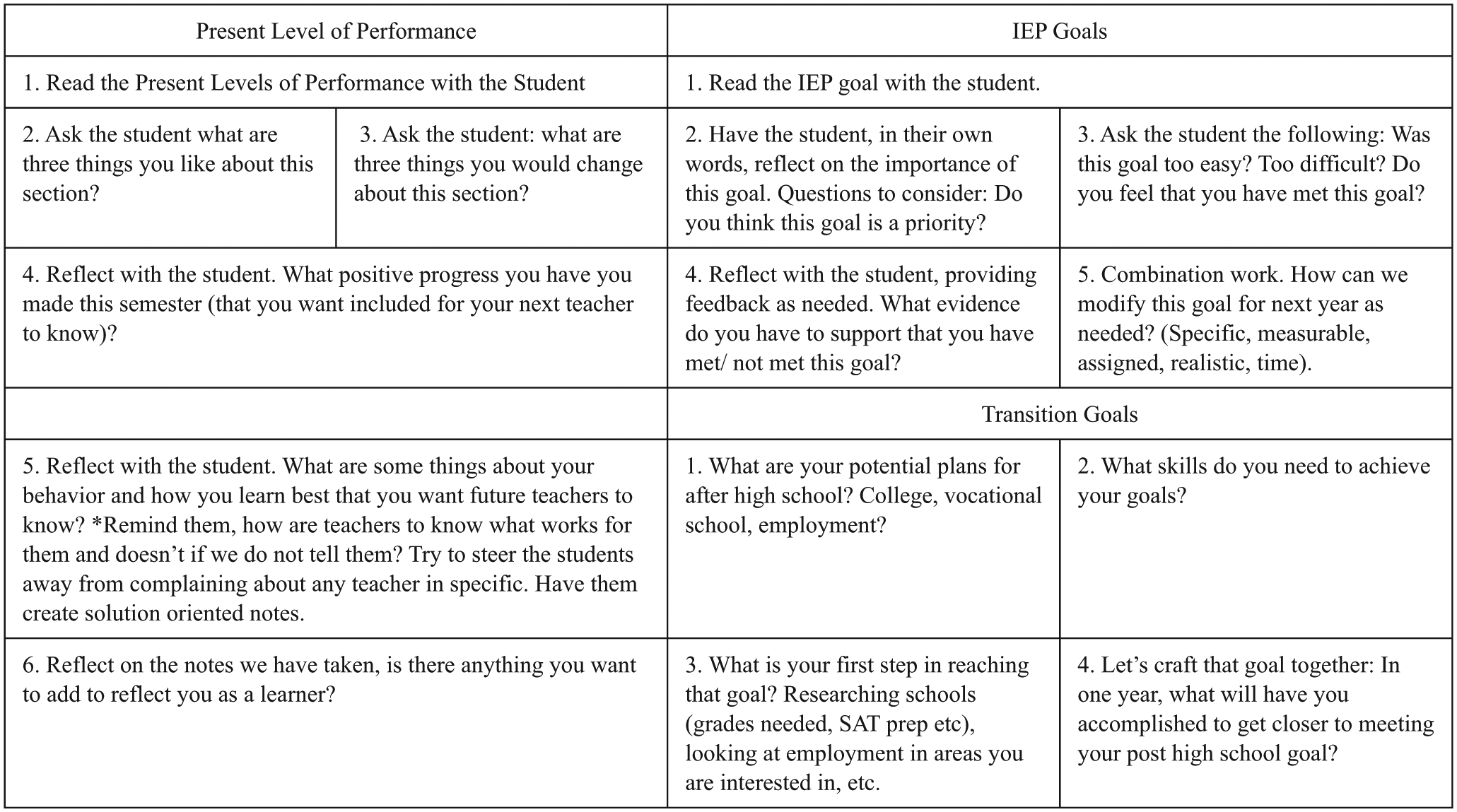
Pre-IEP Meeting Guiding Notes.
The protocol focuses on former goals for students to identify and see their own progress as they evaluate their present levels of performance. In addition, the protocol contains a strategic component of making revised/future goals more complex and attainable, including those in the social/emotional domain, and transitional goals for students to discuss their plans for college or other options. An integral part of the pre-IEP meeting is to have the student read segments of his or her past IEP and discuss his or her progress on attaining the IEP goals and to determine the needs to prioritize for the revised IEP. The teacher and student then work together to revise each section for the upcoming IEP meeting.
During the IEP Meeting
Provide opportunities for students to develop autonomy
One of the main foci of an IEP meeting is allowing a student to present his or her own growth and needs to their parents. The pre-IEP meeting provides a forum for the teacher to guide practice and discussion, and provides students with opportunities to practice self-advocacy skills; thus, students are prepared to participate meaningfully in their IEP meeting. Specific steps for a student-led IEP meeting include (a) allow the students to review the notes made on the pre-IEP meeting protocols and (b) review their progress in goal attainment using academic artifacts and their portfolio, and (c) present their current goals to their parent(s) or guardian. Students often need gentle prompting by the special educator to lead the meeting and adhere to the procedure.
Include parent input on the IEP and write the goals and objectives collaboratively
The IEP meeting provides the “ideal opportunity to facilitate quality collaboration between educators, parents, [and students]” (Fish, 2008, p. 8). As the student presents, the parent is able to reference his or her own copy of the current IEP draft that the student created in the pre-IEP meeting. After the student presents his or her past goals, utilizes his or her own portfolio to show evidence of meeting these goals, and expresses his or her goals for the future, the parent has a chance to revise, edit, and provide feedback on the IEP draft. The IEP meeting provides the venue for the student, teacher, and parent to write the goals together. Once the student states his or her goals, the teacher and parent can provide curricular (e.g., course options, summer courses) and extracurricular options that can help move the student toward the goal.
After the Meeting
Meet with the student
It is important to debrief with the student after the IEP has been written. Generally speaking, students appreciate when their thoughts are discussed and credited to them. This step will also allow the student to reflect on their leadership of the meeting.
Provide follow-up to parents after the meeting
Before the IEP is finalized, it is important to send a draft of the goals. After parents have had an opportunity to reflect on the meeting, teachers can follow up with a summary. A brief email, phone call, or even postcard that (a) thanks them for participation, (b) summarizes teachers’ next steps (e.g., “I look forward to working with Jay on improving . . .”), and (c) opens the door for questions (e.g., “If you have questions about goals, programming, or other issues discussed, feel free to contact me”) can establish a framework of sustained engagement.
Communicate with the student’s future teachers
Write a brief anecdotal log (with practical instructional information) and provide it to the student’s future teachers. Although there is a section in the protocol where the student notes what he or she would like future teachers to know, the combination of recommendations from past teachers as well as the student’s thoughts makes for a thorough understanding of the student.
Discussion
The observations of all three phases of IEP planning and the triangulation of perspectives of this process from teacher, parent, and student support previous research (e.g., Stang et al., 2009) and Kohler’s (1996) recommendations for teachers in the Taxonomy for Transition Planning for facilitating student and parent involvement for meaningful participation in student-led IEP meetings. Specifically, the pre-IEP meetings with Jay were critical to his successful participation in the IEP meeting. Previous research has noted the importance of providing students instruction in IEP participation (Meadan et al., 2010). The development and use of guiding documents (see Figures 1 and 2) for Jay to review his previous IEP goals, discuss the progress that had been made, and develop his own goals for the next school year linked to his transition and postschool plans provided the much needed opportunity to utilize self-advocacy and decision-making skills that are critical to the development of self-determination (e.g., Shogren et al., 2007). These pre-IEP meetings demonstrate a method to provide the frequent practice opportunities called for by Stang et al. (2009).
In addition, Jay’s teacher’s ongoing practice of calling parents to share good things as well as bad things helped to remove the communication challenges noted by Zeitlin and Curcic (2013). Providing ongoing pre-IEP meeting contact with parents helped to open the authentic reciprocal dialogue we witnessed during the IEP meeting. Opening the IEP meeting with the stated purpose of combining ideas along with the provision of the IEP goals to the parent for input before they were finalized also helped to set an atmosphere that facilitated important parent and student input (Tucker & Schwartz, 2013). Thus, this exemplar provides a model of how best practices in pre-IEP, IEP, and post-IEP meeting protocols can be implemented.
Implications for Teacher Practice
In accountability-driven schools, the IEP process can be perceived by school professionals, students, and parents as another form of compliance (Brantlinger, 2004). Instead, the process can be the connector among all three parties if it is genuine and carefully orchestrated by the teacher. In many ways, it can be argued that the IEP meeting can be used to humanize the bureaucratic nature of school processes, as it places the student in the center of the discussion to actively plan his or her future. Previous research verified by this study (Myers & Eisenman, 2005) includes the influence of the teacher who plays a crucial role in envisioning, enacting, supporting, and documenting the entire student-centered IEP process. As teacher efforts in educational planning positively influence the growth of self-determination and self-advocacy in students, it is imperative that the importance of the meeting is clear, becoming an event for which the student must prepare and practice. The teacher must be focused but flexible throughout this process, switching “hats” as needed to be host, prompter, communicator, clarifier, and listener. Ultimately, it is the teacher who sets expectations and facilitates the process, balancing input from all three parties. For the meeting to be authentic, a plan should be co-constructed with the student, yet everything agreed on is recognized as tentative until the parent has been engaged with and had the opportunity to ask questions. This is the opposite of a fait accompli, when IEP teams have made decisions before the parent arrives (Valle & Aponte, 2002). In sum, both students and parents speak for themselves, being welcomed and integrated into school procedures rather than being subjected to them. In addition, using a strengths-based approach as a foundation for the IEP process helps build relationships on success in school and the recognition of student abilities. In turn, this makes students and parents more receptive to take ownership and coplan.
Finally, in viewing the IEP meeting as an opportunity for engagement with students and families, it is recognized that this must be a welcome priority of the special education teacher. It requires a disposition that seeks going beyond simple compliance; it requires a willingness to “make it real.” At each step of the way (i.e., before, during, and after), the teacher must manage many elements of the process to make it successful, including calibrating calendars with student and parent, using technology to obtain for input from all teachers, allocating time, determining space, and ensuring there are no interruptions (e.g., Kohler, 1996). That effort can facilitate a genuinely engaging IEP meeting—with balanced input from a student, parent, and teacher—that allows for the development of a meaningful IEP, strengthened relationships with the family and support of the school’s efforts by the parent, and the critical opportunity to facilitate the development of self-determination and self-advocacy skills of the student.
Footnotes
Declaration of Conflicting Interests
The author(s) declared no potential conflicts of interest with respect to the research, authorship, and/or publication of this article.
Funding
The author(s) received no financial support for the research, authorship, and/or publication of this article.