



Abstract
Poorly developed word recognition skills are the most pervasive and debilitating source of reading challenges for students with learning disabilities (LD). With a notable decrease in word reading instruction in the upper elementary grades, struggling readers receive fewer instructional opportunities to develop proficient word reading skills, yet these students face greater amounts of texts with more complex words. Poor decoders, even those who can fluently read monosyllabic words, often have difficulty with multisyllabic words, yet the average number of syllables in words that students read increases steadily throughout their school years. As such, it is necessary to identify instructional practices that will support the continued reading development of students into the upper elementary years. This article discusses the difficulty involved in multisyllabic word reading and describes five research-based instructional practices that promote the multisyllabic word reading fluency of struggling readers, particularly those with LD.
Proficient readers are simultaneously able to decode letters and sounds in words while making sense of the text that they read. The ability to decode words fluently and the ability to comprehend are mutually important to the process of reading (National Reading Panel, 2000; Pressley & Allington, 2014; Snow, Burns, & Griffin, 1998). For students with disabilities, particularly learning disabilities (LD) in the area of reading, these are often skills that come with much difficulty. Therefore, these students require explicit instruction from their teachers, partnered with continued guided practice.
According to the most recent report by the National Assessment of Educational Progress (2015), only 36% of fourth grade students were performing at or above the proficient level in reading. Deficits in phonological processing that affect decoding skills are the primary challenge for students who struggle with reading in the elementary grades (Blachman, 2013; Leach, Scarborough, & Rescorla, 2003; Shankweiler, 1999; Vellutino, Fletcher, Snowling, & Scanlon, 2004; Yuill & Oakhill, 1991). In the upper elementary grades, the instructional focus shifts from word reading (i.e., teaching students how to read, or decode, individual words) to reading for understanding. With this decrease in word reading instruction, struggling decoders receive fewer instructional opportunities to develop proficient reading skills, yet these students face greater amounts of texts with more complex words. It is no surprise that research shows struggling readers in upper elementary grades continue to struggle in later grades and become at risk for serious academic challenges (Brasseur-Hock, Hock, Kieffer, Biancarosa, & Deshler, 2011; Francis, Shaywitz, Stuebing, Shaywitz, & Fletcher, 1996; Moats, 1999; Partanen & Siegel, 2014; Vaughn et. al., 2003). As such, it is necessary to identify instructional practices that support the continued reading development of students in the upper elementary years. This article addresses the difficulty involved in multisyllabic word reading and describes five research-based instructional practices to promote the multisyllabic word reading fluency of struggling readers. While struggling readers benefit from this type of instruction, these practices are particularly effective for students with LD who have more persistent and severe reading difficulties that require targeted, intensive instruction.
The Difficulty With Big Words
As students move into upper elementary grades, there is a notable difference in the type of words they are being asked to read (Hiebert, Martin, & Menon, 2005). A student with LD who has learned the necessary skills to decode words such as cat, dog, bench, and church is now faced with words such as competitiveness, advertisement, transportation, and measurement. Poor decoders, even those who can read monosyllabic words fluently, often have difficulty with reading multisyllabic words (Duncan & Seymour, 2003; Just & Carpenter, 1987; Perfetti, 1986). These words are more complex, and struggling readers often do not have the skills necessary to read these big words. For example, Shefelbine and Calhoun (1991) found that advanced readers utilize morphological knowledge and accurate letter-sound associations to read unfamiliar multisyllabic words, but poor readers focus on letter units and partial syllables. Similarly, others have reported that adept readers see words in morphological parts whereas struggling readers rely on contextual clues and pictures to identify unknown words (Archer, Gleason, & Vachon, 2003; Bhattacharya & Ehri, 2004).
Difficulty with word reading is an issue for older readers as much as for beginning readers, and their chances of success are greatly affected when instruction does not address these skills. Not only does this difficulty affect their reading fluency, but it also interferes with their ability to comprehend text. Decoding instruction often ends after second grade, but the average number of syllables in words that students read increases steadily throughout their school years. The average fourth grader encounters 10,000 new words each year, and most of these words have two or more syllables (Kearns et al., 2015; Nagy & Anderson, 1984). More importantly, often these words carry the meaning of a text (Carnine & Carnine, 2004). Consider the multisyllabic words that might be difficult for struggling readers in Figure 1.

Fifth Grade Studies Weekly Passage.
Students often skip over or unsuccessfully decode multisyllabic words such as colony, settlements, or unclaimed. However, without the words colony and settlements, the meaning of this passage is impossible to decipher. The word unclaimed provides an important detail about colonized regions. Even with additional comprehension instruction focused on strategies such as self-monitoring or inferencing, the meaning of the passage would still lack clarity. When students allocate too much attention to decoding these multisyllabic words, they may not attend enough to the meaning of the text (LaBerge & Samuels, 1974; Perfetti, 1985; Stanovich, 1980).
Multisyllabic Word Reading
Multisyllabic word reading instruction is effective in improving the word reading skills of struggling readers (Bhattacharya & Ehri, 2004; Diliberto, Beattie, Flowers, & Algozzine, 2008; Lenz & Hughes, 1990; Shefelbine, 1990). Despite promising findings in these studies, recent research reveals new directions for multisyllabic word reading instruction. For example, students’ knowledge of phonics-based rules does not necessarily predict their multisyllabic word reading skills, and no relationship appears to exist between knowledge of syllabication rules and successful reading (Kearns, 2015). Additionally, many struggling readers have deficits in phonological memory (Shankweiler, Crain, Brady, & Macaruso, 1992; Wagner & Torgesen, 1987), which may make it difficult for them to simultaneously process morphologically complex words and recall appropriate strategies. Ultimately, successful reading comprehension relies on students’ exerting less attention when processing and reading words so they can dedicate more attention to understanding texts. This suggests that less cognitively demanding approaches to teaching multisyllabic word reading might enhance reading comprehension.
One approach for teaching multisyllabic word reading is to focus on the development of automaticity by providing multiple opportunities for students to manipulate and read words rather than focusing on rule-based instruction. This helps students acquire word representations through repeated exposures to words and word parts within the context of their larger word units (Cunningham & Stanovich, 1991; Perfetti, 1992; Stanovich, 1996). Specifically, instruction moves from part to whole, introducing morphemes
first in isolation,
then in words, and
finally in connected text.
The following instructional practices align with this progression.
Practices for Multisyllabic Word Reading
In this section, five research-based instructional practices to support students’ multisyllabic word reading development are presented. When students with LD receive supplemental reading instruction, many require continued focus on word study. This need not (and should not) be the sole focus of their supplemental instruction, but it is valuable for students to receive explicit, targeted instruction and opportunities for practice. These multisyllabic word reading practices are best used with students who are proficient decoders of most vowel patterns in monosyllabic words. If students are not proficient in monosyllabic word reading, instruction should first target vowel patterns that students do not know. This ensures they have the necessary decoding skills to begin working with more complex words.
Rather than provide rules-based instruction, these five practices focus on promoting automaticity. These practices are supported by previous research and have been recently investigated as part of a reading intervention developed and tested by our team (Toste, Capin, Vaughn, Roberts, & Kearns, 2016; Toste, Capin, Williams, Cho, & Vaughn, 2016). Across two studies, a total of 175 struggling readers in third through fifth grades were randomly assigned to receive a multisyllabic word reading intervention or business-as-usual reading instruction provided by the school. The intervention was delivered in small groups of 3 to 5 students by a trained tutor. Students who received this reading intervention experienced significant growth on word identification, decoding, and spelling compared to those who received standard reading instruction. Each intervention session included five instructional principles.
Affix Learning | 2 to 3 min
“Peel Off” Reading | 5 to 10 min
Word-Building Games | 5 to 10 min
Word Reading Fluency | 5 min
Connected Text Reading | 10 min
Affix Learning
The first instructional practice to support multisyllabic word reading is learning affixes. Teachers introduce an activity called Affix Bank in which students are explicitly taught high-frequency prefixes (e.g., pre-, dis-, un-) and suffixes (e.g., -ing, -ly, -tive). White, Sowell, and Yanagihara (1989) published a list of the most commonly used prefixes and suffixes in third to ninth grades. Learning these affixes supports greater efficiency when reading multisyllabic words. During Affix Bank, teachers introduce approximately three new affixes each day using the following instructional sequence:
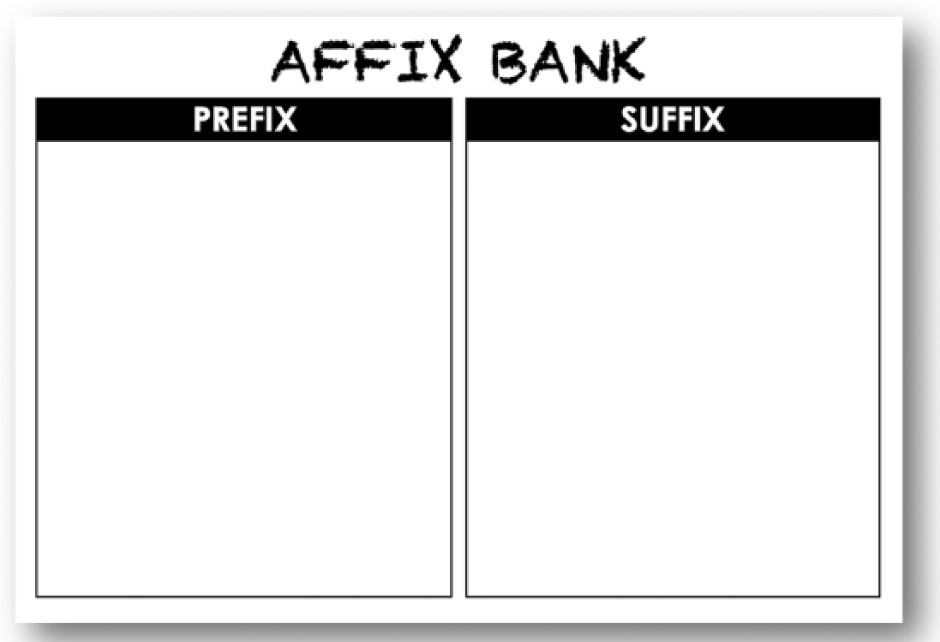
Student Chart for Logging Affixes Learned.
Teaching Affixes That Make More than One Sound
Some affixes correspond to more than one sound. For example, students are taught to say -ed as /ed/ like in the words shouted, needed, or planted. However, it can also made the sounds /t/ (e.g., brushed, kicked, washed) or /d/ (e.g., rained, filled, hugged). It is important to explicitly teach these sounds to students. The following script provides a guideline for this instruction: “The suffix -ed can make different sounds when we see it at the end of a word. There are three different sounds -ed might make. Let’s look at some examples.” To help students understand and recall, the teacher uses a poster or chart that has the three sounds and example words for each. “The first sound that -ed can make is /ed/. Look at the word I wrote on the board. This says ‘shout.’ When we add -ed to the end, it becomes ‘shouted.’ What sound did -ed say in ‘shouted’?” Students repeat the sound. The teacher follows this routine for additional affix sounds. When students are reading words with -ed, they are reminded to flex the sounds (e.g., try each sound for -ed if they are not sure).
Peel Off Reading
Another instructional strategy that supports students’ practice and fluency in reading multisyllabic word reading is breaking apart or segmenting words into their parts. This is often called a peel off strategy, wherein students are asked to read the smaller words or word parts that they already know or can easily decode. The focus is on accurate and fluent word reading, not the meaning of the words or word parts. Teachers can use an activity called Beat the Clock to do this. Students are given a new list with approximately 40 multisyllabic words each day (see Figure 3), and teachers use the following instructional routine:
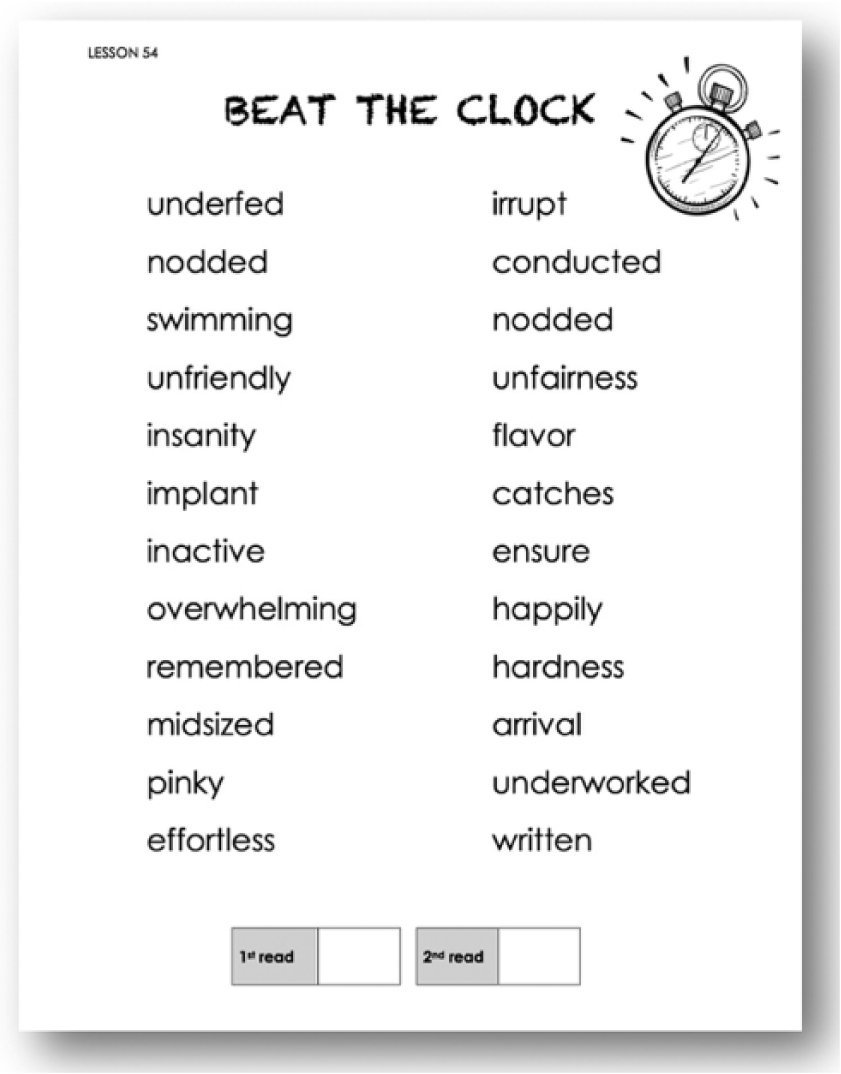
Sample Word List Used for “Peel Off” Reading.
Word-Building Games
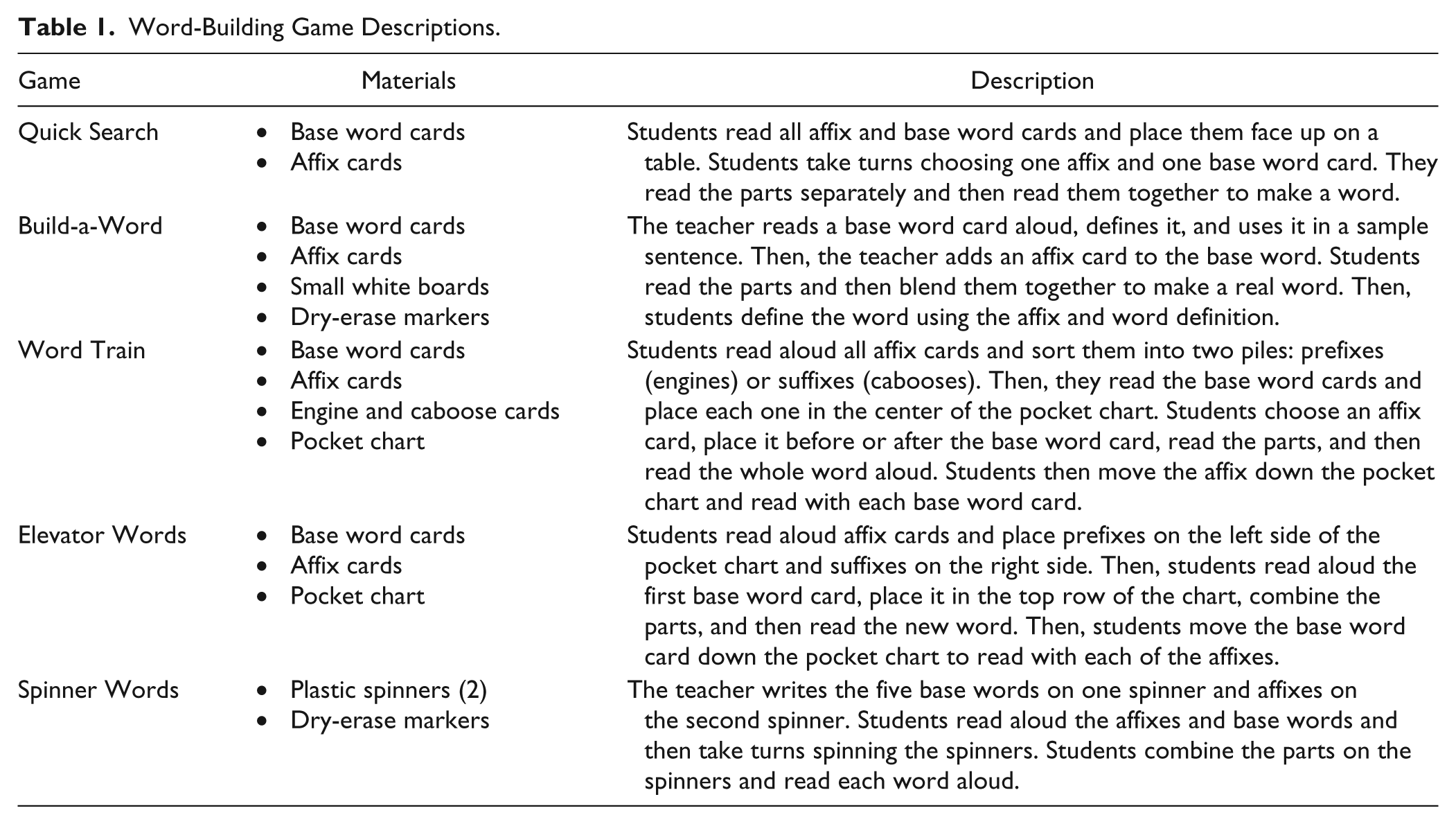
During the instructional practice, students do the opposite of peel off reading; the focus here is on assembling or blending word parts together. To make this practice more engaging, a variety of word-building games that emphasize automaticity of the reading process can be used. Before introducing the game, the teacher first selects a number of base words (e.g., judge, extend, thought, visible, strong). After introducing base words, students then play a game that provides them with multiple opportunities to practice building and reading big words. Students build both real and pseudo (nonsense) words; this ensures that they are able to work on the skills necessary for quick and accurate decoding of unknown words. Table 1 provides descriptions of five different word-building games: Quick Search, Build-a-Word, Word Train, Elevator Words, and Spinner Words. Although these games differ slightly, they follow a similar instructional format:
Word-Building Game Descriptions.
Word Reading Fluency
Researchers have shown that an excellent predictor of student reading fluency is the amount of time students spend reading. For struggling readers, this reading practice should be targeted, for example, words with the same patterns (e.g., phonograms) or multisyllabic words. Student practice should also include immediate, corrective feedback from the teacher. For example, if students do not know the medial sound in the word boil, the teacher might provide a correction by noting which sound was incorrect: “This vowel team says /oi/. What sound? So this word is boil. What word?” If the student reads a word incorrectly or pauses for more than 2 s, the teacher provides the word and asks the student to repeat the word: “This word is colony. What word?” The teacher may also choose to wait until the end of a timed reading to provide corrections, so as not to interfere with the students’ pacing.
One effective instructional practice focused on word reading fluency is the use of timed reading of targeted word lists, which supports students in their reading accuracy and rate. Teachers can implement an activity called Speedy Read, which is simple but highly structured:
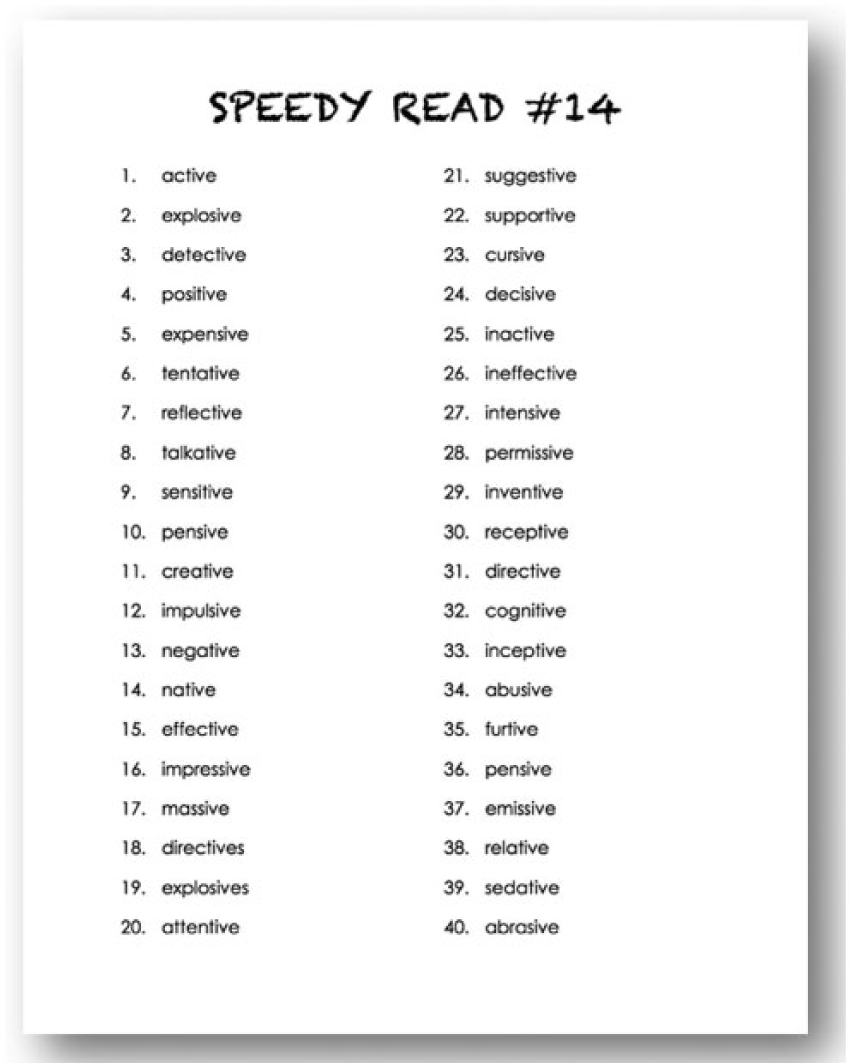
Sample Word List Used for Word Reading Fluency Practice.
“Now it’s your turn to read the words independently. Let’s see how many words you can each read in 30 seconds! ______ will go first. Is everyone pointing? Great. Ready? Go.” Start the timer. After 30 seconds have elapsed, say, “OK, good work! On your Speedy Read chart, write how many words you read correctly in 30 seconds.”
Connected Text Reading
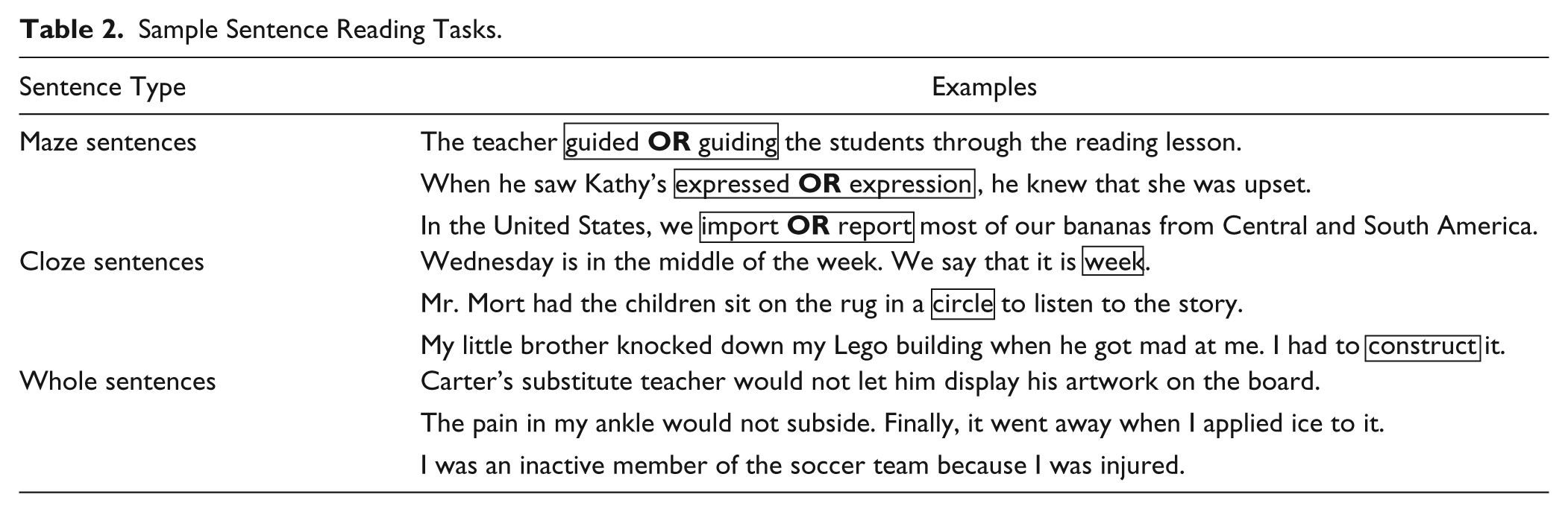
The final instructional practice, while not directly targeting multisyllabic words, moves students’ fluency practice from the word level to the text level. It is important for students to practice their reading with connected text (e.g., sentences and passages). Teachers should be purposeful in selecting text for them to read. For students with LD, who are struggling with reading, gradual integration of multisyllabic words supports skill development. Rather than begin reading long passages immediately, prepare sentences that target multisyllabic word reading skills that students have been practicing. For example, students can read:
maze sentences that require them to select the correct affix for the base word, checking that it makes sense;
cloze sentences that require them to insert the missing affix to complete the word; or
whole sentences with the same multisyllabic words.
Table 2 provides examples of these sentence reading tasks.
Sample Sentence Reading Tasks.
Passage reading focuses on expository text that includes many multisyllabic words. Teachers can use the following routine. Following this format increases the students’ opportunities to practice reading text aloud repeatedly while also providing corrective feedback.
Summary
The set of routines described in this article provides teachers with a series of research-based instructional practices that promote multisyllabic word reading fluency. These practices can be easily integrated into small-group instruction and intervention, either in the general education classroom or resource room setting. They can easily be incorporated into reading goals for students’ individualized education programs. Some sample individualized education program goals might be the following:
Given a list of the 20 most common prefixes and suffixes, the student will read aloud each prefix or suffix accurately within 25 seconds.
Given a list of 20 two- and three-syllable words, the student will read the words automatically (within 1 second) with 95% accuracy.
All five practices are appropriate within daily intervention programs for students with LD; however, teachers may choose to use any combination of these practices based on the needs of their students. One of the fourth graders who participated in an intervention development study (Toste et al., 2016) noted,
A good reader focuses on the words, looking at them and chunking them. You have to know a lot of big words because you’re gonna see a lot of big words when you read. It can be a very important thing. If you don’t know what they say, then you miss them and you won’t know what the story means.
Students understand the challenges that come along with being unable to read words accurately and fluently. Increased skill in decoding multisyllabic words promotes students’ continued development as proficient readers, as well as supporting their achievement into the upper elementary grades and beyond.
Footnotes
Declaration of Conflicting Interests
The author(s) declared no potential conflicts of interest with respect to the research, authorship, and/or publication of this article.
Funding
The author(s) received no financial support for the research, authorship, and/or publication of this article.