



Abstract
Designing homework to mediate executive functioning disorders of students with disabilities is critical to their future academic success. The article explains and defines different executive functions of the brain and how these impact students’ ability to benefit from homework assignments. Specific strategies are provided for designing differentiated homework assignments that mediate executive functioning skills.
I hate homework. I hate it more now than I did when I was the one lugging textbooks and binders back and forth from school. The hour my children are seated at the kitchen table, their books spread out before them, the crumbs of their after-school snack littering the table, is without a doubt the worst hour of my day.
A task designed by teachers for students to complete during nonschool or nonacademic hours is grievously referred to as homework. Researchers report that homework assignments can produce negative effects for students with learning disabilities (LD) including a loss of interest in academics, stress, reduced opportunities for leisure and community activities, and diminished parent-child relationships (Kouzma & Kennedy, 2002; Pressman et al., 2015; Tony, Kelly, & Lanclos, 2003). Yet, others argue that homework encourages self-discipline, develops positive study habits, and provides practice applying concepts (Bryan & Burstein, 2004; Rock & Thead, 2007). Moreover, homework can be beneficial for goal setting, learning how to attain goals, and learning how to solve problems (Hampshire, Butera, & Hourcade, 2014). Homework allows for parent involvement in education and provides a means for communication between families and teachers. As beneficial as homework may be, it can also become a dreadful challenge for many children and their families. When the work is ill fitted to the needs and learning characteristics of children with disabilities or the assignments are just too difficult, children can become resistant to engaging in homework, and parent-child conflict may increase (Dumont, Trautwein, Nagy, & Nagengast, 2014; Pressman et al., 2015).
With the present focus on standardized assessments and the need for students with disabilities to make adequate yearly progress, teachers are now more than ever invested in creating opportunities for students with disabilities to practice learned skills outside of school. Yet, many suggestions for working with students who have disabilities focus on teaching self-management strategies, which fail to address the role of executive functioning abilities. With weaknesses in executive functioning abilities, students with disabilities struggle with the specific tasks of self-management such as goal setting, problem solving, self-monitoring, and self-instruction (Barkley, 2012). Many of these skills are dependent on intact and efficient executive functions. For children with disabilities, conditions are even more complicated when considering the immaturity of their developing brain system.
This article defines executive functioning (EF) and explains the impact of homework on EF. It describes instructional strategies used to support EF and provides specific strategies for designing homework to minimize the load on EF.
Executive Functioning Defined
The ability to engage in purposeful, goal-directed, and future-oriented behavior is dependent on the power and efficiency of the executive functioning of the brain (Suchy, 2009). EFs are those psychological processes that help people anticipate and prepare for the future (Barkley, 2012). EFs are composed of working memory and retrieval, sequencing, initiation, attentional focus, and cognitive flexibility (Langberg, Dvorsky, & Evans, 2013). All of these EFs are dynamic processes working together to enable a person to act in reasonable ways under novel conditions (Barkley, 2012; Suchy, 2009). School-based interventions, such as self-management techniques, often treat EFs as skill sets that can be practiced and promote students’ planning and academic goal attainment. Yet, a closer look at these interventions reveal specific obstacles for students with EF weaknesses.
Executive Functioning and Self-Monitoring
Self-management interventions are often recommended for increasing work performance and self-regulation (Bryan & Burstein, 2004). Gains in homework completion, organization, on-task behavior, academic outputs, and academic accuracy have been linked to self-management procedures (Gureasko-Moore, DuPaul, & White, 2007; Harris, Friedlander, Saddler, Frizzelle, & Graham, 2005). Although there are multiple types of self-management, the most frequently used technique is self-monitoring (Bruhn, McDaniel, & Kreigh, 2015). Self-monitoring consists of a process whereby students observe, record, and track their own (i.e., on-task and off-task) behaviors. The literature suggests that self-monitoring can enhance academic production (Plavnick, Ferreri, & Maupin, 2010). Yet, the effectiveness of self-monitoring interventions varies widely across studies (Briesch & Chafouleas, 2009). More important, certain cognitive processes must be intact for self-monitoring to be effective. For example, students who self-monitor must become aware of their overall behavior, regulate that behavior, and remember to document the behavior consistently. When deficits occur in EFs, specific abilities such as working memory (holding and updating information while mentally working on it), attention shifting (i.e., shifting from one task to another), and inhibitory control (i.e., stopping a response to initiate another) impact student’s ability to consistently apply the tasks required in self-monitoring. Weaknesses in EF may render the self-monitoring interventions ineffective and potentially contribute to even more frustration for the student. While normative differences in the range and pace of growth trajectories of EFs are well recognized, the degree of stress, anxiety, and significant adversity a child experiences can also impede later learning.
Children as young as 1 year old show rudimentary signs of EFs. By age 3 most children can hold and complete tasks involving two rules, showing that they can hold the rules in mind, direct and redirect their attention and stay focused and avoid distractions. By age 5 years, “[children] are capable of shifting their attention from one rule to another that is incompatible with the first, and then back again” (Center on the Developing Child at Harvard University, 2011, p. 4). School-age children have the capacity to retain and use new information, focus attention, control impulses, and make plans. Yet, the full range of EF development continues into adulthood. It is therefore critical that teachers provide supports or scaffold children’s experiences as they practice these emerging skills. Students who may exhibit weaknesses in EFs in the early grades and are provided with the necessary supports can later benefit from self-monitoring in the middle school or high school years (Briesch & Daniels, 2013).
For elementary students, teachers can minimize demands on EFs until the student gains the capacity to learn specific self-monitoring techniques. Minimizing the demands on EFs can be regarded as preconditioning, that is, laying the foundation for the introduction of self-management techniques that occur gradually over time. Unfortunately, studies focusing on the effectiveness of such strategies are extremely scarce. The authors of only one study, by Elliott, Gathercole, Alloway, Holmes, and Kirkwood (2010), attempted to use compensatory strategies to increase working memory, but had no significant results.
When teachers and parents construct the environment to cue students who have working memory deficits, students with LD may learn to adapt their environment to compensate for weak EFs. Students may benefit from the automaticity in routines and practices, thus playing to the students’ existing strengths in EF (Trussell, 2008).
Impact of Homework
Completing typical homework assignments can seriously overload already weakened EFs in children with disabilities. For example, completing homework assignments will require that the student (a) sustain attention to a task, (b) avoid distractions, (c) set goals, (d) make decisions such as “where to start,” (e) look at both the big picture and the details, (f) determine the time for completion, and (g) organize materials. In addition, the student must remain calm when faced with obstacles, shift from one assignment to another, move forward without getting stuck on one part, and remember to turn in the homework.
Not surprisingly, all of these acts are tied to EFs. Remember that setting goals and executing homework assignments require the student to imagine the future completion of the task (Mash & Barkley, 2006). If a child has difficulty imagining the competed assignment, then it is unlikely that he or she will be able to make a plan, let alone execute one. The student with weaknesses in EFs often demonstrate language disorders in metacognition (Marlowe, 2000) and may lack the ability to use inner speech to guide his/her behavior (Barkley, 2012). Therefore, making decisions about where to begin the assignment or how to organize materials increases the time it takes the student to get homework out and decide when to begin. All of this culminates in delaying the start of the assignment and shifting from one assignment to the next in a designated period of time.
Homework assignments typically involve motor skills that may also delay the initiation of the task and prolong the time needed for completion. Moreover, the student must continue to work through these obstacles often without the benefit of willpower or intrinsic motivation to begin and continue through the process (Mash & Barkley, 2006). Learning to overcome these obstacles to successfully engage in more efficient and effective behavior routines becomes almost impossible. Fortunately, there are ways to design homework that can support the students’ executive functioning without diminishing curriculum content.
Instructional Support Strategies and Executive Functions
Teachers who recognize and understand the characteristics of students with EF difficulties can create homework assignments that alleviate many of the challenges facing them. Table 1 links specific instructional support strategies to the different EFs. Because many students with EF difficulties cannot internally regulate their behavior (Barkley, 2012; Best & Miller, 2010; Blair, Zelazo, & Greenberg, 2005), it is incumbent on the teacher and parents to provide the supports necessary to help students compensate for these weaknesses. The use of visual and auditory signs can evoke particular EFs, thereby providing a scaffold for students until self-regulating behaviors gain automaticity within learned routines (Chein & Schneider, 2012). Certainly these supports can be used for all students, regardless of age; however, if initiated during the primary grades, they may often diffuse the early frustrations that can lead to motivational problems at a later time.
Compensatory Instructional Strategies.

Ultimately, teachers would like students to learn to plan, organize, set goals, and execute them successfully, thereby strengthening the already intact EFs. Teachers typically want students to learn to self-manage their behavior and their thinking, so that they can become more independent. Providing compensatory supports does not mean that teachers abandon all hope for students to become more independent. On the contrary, when teachers and parents employ these supports, they will want to encourage students to use them as well.
Compensatory interventions are techniques used by an individual to circumvent a deficit area (Henry & Winfield, 2010). When teachers use compensatory instructional strategies, they encourage students to employ them consistently until the strategies become habitualized (Groot, Wilson, Evans, & Watson, 2002). Other supports can be integrated into homework assignments to help students compensate for weaknesses in EF.
Designing Homework to Support Executive Functions
The following suggestions may help teachers provide the necessary support for students with deficits in EFs to complete homework assignments without modifying the curriculum content. In essence, these suggestions are designed to create a good fit between the EF capacity of the student and the tasks. First, global suggestions are presented to guide the planning and decision making process behind the role and function of homework assignments. Second, ways to modify the assignments at the micro level are illustrated.
General Planning for Homework
Teachers need to consider several factors when planning homework assignments. First, the teacher will want to analyze the content and the scope of the assignment. A task analysis of the assignment itself will allow the teacher to determine the cognitive load of the assignment. A task analysis involves dividing the assignment into small sequential steps. Using task analytic instruction with systematic prompting and feedback has been found to improve students’ mathematics skills (Cihak, Alberto, Taber-Doughty, & Gama, 2006; DiPipi-Hoy & Jitendra, 2004; Jimenez, Browder, & Courtade, 2008). For example, to teach counting two groups of lines, the teacher lists each task for the student. This example can be found in Figure 1.
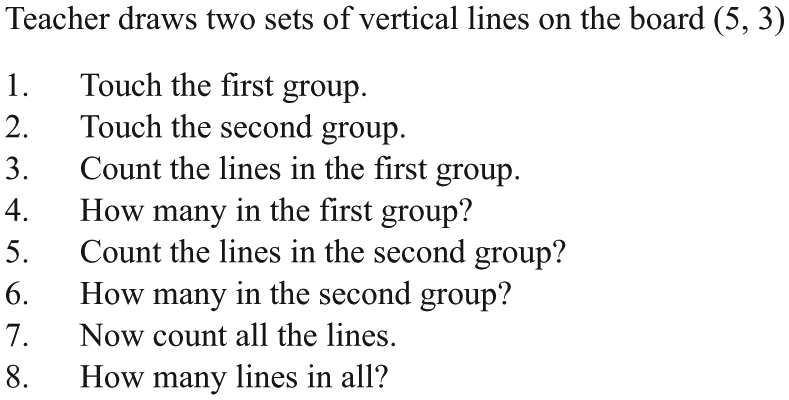
Example of a task analysis.
In addition to conducting a task analysis of each homework item, the teacher will want to evaluate the content of the homework to ensure that no new skills or concepts are introduced. Researchers strongly advise assigning homework to practice already learned skills (Epstein & Van Voorhis, 2012; Margolis, 2005).
Finally, the teacher will want to provide an example of the completed assignment for the students. When students are able to visualize the completed task, they may be more likely to initiate the activity and remain motivated. Providing a completed example supports students’ nonverbal memory, increases sustained engagement, and requires fewer verbal prompts from a teacher or parent (Paas, Renkl, & Sweller, 2003).
Specific Homework Assignments
Designing individualized homework assignments does not change the content of the curriculum presented. Instead the process for completing the homework is adapted to support the students’ completion of the tasks. While the content stays the same, the format becomes quite different. For example, there are several techniques for adapting assignments to reduce the demands on nonverbal and verbal memory. Several of these follow.
Supporting executive functions in content reading
The use of multimodal instruction improves learning using more than only one medium (Shanahan, 2013). When designing homework, the teacher can use iconic or indexical signs (e.g., pictures, symbols) that mark the essential ideas of the task. For example, a homework assignment that reviews a required reading about the effects of a tornado on a small town can be introduced with a simple iconic sign. This sign is displayed at the top of the assignment page along with the topic: “Tornado.” Additional signs can provide beginning and stopping points as the student progresses through the assignment. A green arrow marks the beginning of the assignment and can prompt the student to move to the next step. While these visual markers help remind the student to move sequentially through the assignment, the visual markers can also assist the student who has short-term memory problems (Shanahan, 2013). Moreover, dividing the homework assignment into phases provides the student with progressive markers that signal the attainment of smaller and easier goals that propel movement toward the completion of a larger goal (Lee, Lylo, Vostal, & Hua, 2012). This marking of each task also allows the teacher to monitor whether the student actually completed the homework as intended (i.e., reading the narrative).
Figure 2 is an example of a modified process homework assignment. The original assignment included a two-paragraph narrative at the fourth grade reading level. The beginning of the first paragraph is presented to illustrate how the story could be adapted to maximize readability and to build in scaffolding. The original directions failed to convey the actual purpose of the exercise, which was to use the surrounding text to deduce the meaning of the words rebuild and review. Therefore, the teacher modified the instructions to prompt the actual reading of the story and to analyze the key elements of the words.

Modified social studies homework.
Completing a task analysis of the directions for the homework allows the teacher to see how many precise steps are required to complete the task. Given this information, it is easy to determine the cognitive demand of the assignment. When a teacher becomes aware of this, it may be easier to justify reducing the number of practice exercises that focus on one particular skill. The teacher may be more confident that the student completed the assignment as intended, reading the story and then completing the vocabulary tasks, which increases the likelihood of mastery. Moreover, the student must be able to read the text fluently. This requires that the student engage in multiple opportunities to practice reading the familiar text aloud with fluency before it is assigned as homework. Students can accomplish the homework with a relatively high success rate, a critical element in the design of effective homework (Protheroe, 2009).
From the student’s perspective, the directions become longer but more simplified. Each action is separated to ensure its completion, and the student is able to see the steps in the process. Marking progress through the assignment enhances student motivation (Lee et al., 2012). Because completing a homework assignment is rarely sufficient for motivating the child with LD, it is important to provide reinforcers for the student (Nevin & Grace, 2000). When parents are not available to work with the student at home, the teacher can embed motivational cues within the assignment itself. For example, when designing the modified homework assignment provided above, the teacher may include textual markers to reinforce the student for completing each phase of the homework (Shanahan, 2013). When the student returns the homework, the marked boxes are counted and the student earns points along with his or her classmates. These points can be later applied toward a group contingency reward (e.g., pizza party; Ennis, Blair, & George, 2015).
Supporting executive functions in mathematics
EFs can be easily embedded into homework assignments for elementary math skills. In preparation for designing the homework activity, the teacher will want to conduct an error analysis of the student’s past assignments (Riccomini, 2005). This allows the teacher to determine the areas of difficulty for the student and provide supportive prompts. For example, typical errors made by students when doing addition problems cluster into three major areas of difficulty: facts, component skills (carrying the wrong number, or failing to carry), and inattention to operational signs (Kingsdorf & Krawec, 2014). To avoid these errors, the teacher will want to assign math addition problems of varying complexity, but entail known facts. Thus, a homework math problem set for a third grader might be composed of only facts that the student can solve within a few seconds. This allows the student to rehearse and independently practice known facts for long-term memory. This does not mean that the teacher is limited to assigning only single-digit facts. Using the known facts and placing them within two-digit addition problems will allow the students to practice completion of two-digit addition (without regrouping) and still maintain accuracy and continued practice. For example, for a student who has memorized addition facts from 0 to 4, the teacher can create an assignment with the following computational problems: 4 + 3, 14 + 13, 13 + 41, 421 + 311, 24 + 23, 142 + 131. Because the student understands the concepts of adding multidigit numbers without renaming, he or she can complete the homework with a higher rate of precision.
When students have trouble with component skills such as renaming, it is typically a result of a fundamental misunderstanding with basic place value concepts. Using a decomposition algorithm of subtraction or borrowing method, the teacher should require students to identify where they are going to write their answers before they write them (Fain, Gallagher, & Heller, 2015). Teachers can then correct any errors before they happen and prevent error patterns from forming. When component errors do exist, the teacher must provide remediation and the student must demonstrate adequate success before assigning this skill as homework.
Homework involving math regrouping can also be modified to include visual prompts. One technique is to place an open box above the tens place, signaling the student to carry the number of tens (Stein, Kinder, Silbert, & Carnine, 2006). In some textbooks, students are taught to trace a number already placed above the tens column. This particular prompting circumvents the need for the student to think about where to place the number, and can interfere with learning (Stein et al., 2006). Another suggestion is to prompt the student to circle only the problems that need regrouping. Problems that are circled may be completed first and the others last. Gradually, the box (i.e., prompt) above the tens place is faded, as is the circling.
When students fail to attend to the computational sign, visual prompts can cue students to discriminate between addition and subtraction. For example, the teacher can instruct the student to circle the sign, say the sign, and then circle only the problems that are alike. If there are multiple computational signs, the student circles the sign, says the sign, and then circles the problem in a different color than the others. As with all visual prompts, the teacher will want to gradually fade them, but continue to teach the strategy of circle the sign, name the sign, and compute the problem. This three-step strategy helps the student to focus and provides a routine that can be habitualized (Stein et al., 2006).
Students benefit from review of known concepts and learned skills. Therefore, homework assignments should provide opportunities for cumulative review. This means that all strategies taught should be systematically practiced in homework assignments. Moreover, the types of problems need to be mixed with prerequisite skill items practiced first, to set the stage for the most recently learned skill. Figure 3 provides an example of a math homework assignment adapted to include prerequisite skills. First, the perquisite skill of counting by ones from 100 to 999 is practiced before place value items. Next, the student practices place value of hundreds, tens, and ones. Finally the student practices addition of single digits, two digits, and three digits with and without regrouping. Boxes are placed strategically to cue the student in renaming (Stein et al., 2006).

Example of adapted math homework assignment.
Last, the interactivity and multimodality of digital games makes these especially valuable for practicing learned skills. The presentation of content knowledge through the different modalities including visual, auditory, and haptic senses enhances learning by increasing different channels for information delivery and is particularly useful when attaining basic-knowledge-level content (Ritterfeld, Shen, Wang, Nocera, & Wong, 2009). Feedback is often immediate, and scoring records can be used to document time spent on practice. Edutainment games, those that focus on skill and drill formats (Denis & Jouvelot, 2005), work to help students memorize or practice simple comprehension. Researchers (Lee, Luchini, Michael, Norris, & Soloway, 2004) found that second graders using a handheld game completed three times the number of math problems than students who used paper-and-pencil worksheets. While the research on the impact of learned content using computer games is still in its infancy, using digital games to complete homework assignments appears promising.
Conclusions
Minimizing the demands of EFs on homework assignments can set the stage for students’ later learning of self-monitoring techniques. Self-monitoring requires strong memory and retrieval skills as well as abilities to self-initiate, attend to a task, sequence information, and shift effortlessly from one task to another. All of these psychological processes are dependent on working EFs, which develop over time. Students who exhibit weak EFs need supports to compensate for these weaknesses if they are to be successful with homework assignments. Teachers who provide visual prompts and adaptations to homework assignments can reduce the demands on the EFs of students with disabilities leading to later success in homework completion and accuracy. Multimodel instruction with visual and auditory prompts (Shanahan, 2013) helps students with disabilities initiate and work through tasks sequentially. Clarifying and simplifying directions, using task analysis, and rewarding students for completing short sections of the homework help to keep students focused and motivated. Well-designed homework allows students to practice already learned concepts and skills for later retention and generalization.
Footnotes
Declaration of Conflicting Interests
The author declared no potential conflicts of interest with respect to the research, authorship, and/or publication of this article.
Funding
The author received no financial support for the research, authorship, and/or publication of this article.