



Abstract
An increasing challenge for many secondary special education teachers is preparing students for the writing demands in postsecondary settings. The self-regulated strategy development (SRSD) model of writing instruction, considered an evidence-based practice, is an effective strategy for enhancing the writing skills of students with disabilities, such as learning disabilities or behavioral disorders, at the secondary level. This article discusses the flexibility and practicality of the SRSD model by describing ways in which secondary teachers can effectively use this strategy to enhance the argumentative writing skills of their students in English language arts, science, history, and mathematics and to teach students how to self-advocate through writing. Information about supports, materials, and other resources for teachers to utilize are included.
Keywords
Writing proficiently provides students with a ticket to participate in the global and technological society in which writing is becoming a preferred mode of communication in both professional and social media contexts (Lenhart, Arafeh, Smith, & Macgill, 2008; National Commission on Writing [NCOW], 2004). Yet, writing achievement outcomes for high school students remain at alarmingly low levels. The majority of high school seniors with and without disabilities are failing to meet even minimum writing proficiency levels, and the outcomes are far-reaching. According to recent national writing achievement outcomes, 95% of students with disabilities continue to perform at or below basic levels of proficiency. They are unable to persuade, explain, and convey personal experiences or compose coherent and well-structured texts with logically developed and clear ideas (National Center for Education Statistics, 2012). In college settings, 75% of entering freshmen at 2-year colleges are unable to analyze arguments or synthesize information and are required to enroll in noncredited, remedial college-level writing courses (National Center for Public Policy and Higher Education, 2010). In the business sector, more than 40% of businesses (e.g., from mining and construction to finance and real estate) spend as much as $3.1 billion annually to provide additional writing development for employees who are required to write technical or formal reports or craft written correspondence to colleagues and managers (NCOW, 2004). In addition to poor writing achievement outcomes, several studies surveying high school teachers across the country have reported that teachers receive inadequate in-service or preservice training to teach writing, infrequently assign writing assignments that ask students to analyze or synthesize information, and lack knowledge about implementing evidenced-based writing practices, particularly in secondary classrooms (Applebee & Langer, 2011; Gillespie, Graham, Kiuhara, & Hebert, 2014; Kiuhara, Graham, & Hawken, 2009).
Argumentative Writing and the Common Core
To better prepare K–12 students with academic skills needed for postsecondary settings, many states have adopted the College and Career Readiness Standards (Common Core State Standards Initiative [CCSS]; National Governors Association Center for Best Practices & Council of Chief State School Officers, 2010). The CCSS for English language arts and literacy, in which writing and language are integrated in history, social studies, science, and technical areas, specifies argumentative writing as one of three text types and purposes for writing (National Governors Association Center for Best Practices & Council of Chief State School Officers, 2010). Writing argumentative text places more linguistic and cognitive demands on the writer than other text types (Nippold, Ward-Londergan, & Fanning, 2005). Students must learn how to justify a position on a controversial topic, use logical and supported reasons, and understand the rules for considering in advance what the reader’s position might be (Ferretti & Lewis, 2013). While the CCSS argumentative writing standards provide a road map of where students need to be by the time they complete 12th grade, the standards do not provide teachers with instructional practices for teaching students how to write (Graham, Harris, & Santangelo, 2015).
Challenges for High School Special Education Teachers
According to the CCSS benchmarks for argumentative text and language, secondary teachers are expected to address the following standards: (a) help students identify and use strategies to improve written expression, (b) choose language that expresses ideas precisely and concisely, (c) use valid reasoning and relevant and sufficient evidence, (d) develop claims and counterclaims, (e) clarify relationships among claims, reasons, evidence, and counterclaims, and (f) convey or establish credibility to the reader. The teacher must also find ways to engage students in the process of writing. This includes taking time to plan and organize thoughts or ideas, choose appropriate words and sentence structures, and transcribe and produce text, all orchestrated in a manner that allows the writer to switch attention seamlessly between these tasks during the writing process (Alevriadou & Giaouri, 2015). In order to follow through with a writing task from beginning to its completion, the high school writer with disabilities must be able to focus attention and thoughts during the writing process, plan and organize text according to a purpose, self-regulate and remain engaged in the writing process (Casas & Ferrer, 2012), and spend time in class devoted to developing and honing these specific skills. Yet, the high school writer with disabilities exhibits great difficulty with generating ideas, receives limited guidance or support to overcome writing difficulties, and believes his or her attempts at writing assignments are futile and consequently often unsuccessful (Garcia & de Caso, 2008).
The value of explicitly teaching students writing strategies cannot be overlooked for high school students receiving specialized instruction in pull-out settings or in the general education classroom. From recent research recommendations for teaching writing, multicomponent strategy instruction has surfaced as an effective writing instruction approach for students with disabilities (Graham, Harris et al., 2015).
Writing Strategies Instruction
The self-regulated strategy development (SRSD) framework for writing instruction is well validated, widely used, practical, and readily accepted by many classroom teachers. It involves explicit and systematic instruction designed to teach students to use the SRSD strategies independently through the use of mnemonic devices, graphic organizers, and self-regulation (Harris, Graham, Mason, & Friedlander, 2008). The SRSD helps students control their own behaviors, actions, or thoughts during the writing process, and it has been found to be a highly effective approach for improving students’ genre knowledge, essay structure, and writing quality (Graham, Herbert, Harris et al., 2015; Graham, McKeown, Kiuhara, & Harris, 2012; Graham & Perrin, 2007; Rogers & Graham, 2008).
Within the SRSD instructional framework, students are viewed as active collaborators who work with the teacher and their peers during instruction (Harris et al., 2008). Students learn to manage the processes involved in writing, such as developing their writing knowledge and establishing a purpose for writing, analyzing their audience, organizing and elaborating on their ideas within specific genres, and editing and revising their writing. The SRSD also increases their self-efficacy, self-awareness, and motivation to write (Harris et al., 2008). The six stages include develop background knowledge, discuss it, model it, memorize it, support it, and independent performance. Throughout each SRSD stage, teachers individualize feedback and scaffold support, and students move at their own pace until they have met criteria for moving on to the next lesson. The six stages of SRSD are recursive as well as flexible. That is, teachers may need to reteach or quickly move through instructional components based on individual learning needs. When teachers follow the instructional procedures with fidelity, SRSD has shown to improve the quality of students’ composition (Graham et al., 2012).
Activate and Develop Background Knowledge
During this stage, teachers collect preassessment data and discuss key general writing and genre concepts (i.e., What is argumentative writing? What are the components of a good argumentative essay? When can we use argumentative writing?). For instance, the teacher might show example essays for introduction, body, and concluding parts as well as vocabulary describing argumentative elements and transition words and phrases that glue the paragraphs together. What do you notice the writer does? What stood out or caught your attention? It is in this stage that the teacher might introduce self-regulation as an important skill in the writing process. It is important to note that the SRSD framework is flexible; thus the teacher can focus the discussion on the application of argumentative writing as it relates to the content area targeted. Table 1 illustrates the first stage of SRSD instruction across different content areas (Cuenca-Carlino, Mustian, & Allen, 2017; Hauth, Mastropieri, Scruggs, & Regan, 2013; Kiuhara, O’Neill, Hawken & Graham, 2012; Leins, 2014).
Stage 1: Activate and Develop Background Knowledge.

Discuss It
During this stage, teachers discuss with students their current attitudes toward writing, the role and benefits of learning strategies and when to use them, and good examples of writing. Teachers also discuss the amount of effort and commitment it takes to become good writers and how to overcome challenges and to celebrate milestones no matter how big or small. Teachers also have the flexibility to select the type of strategy they prefer to use during instruction depending on their students’ needs and their teaching objectives. Figure 1 presents three SRSD mnemonics for planning and composing argumentative text. The strategies presented have been used to teach argumentative writing to high school students with disabilities. The decision as to which strategy is appropriate is the teacher’s and is based on his or her teaching objectives or student need. All three mnemonics encourage students to plan and write notes using a graphic organizer before composing their essays. The primary difference between POW+TREE and STOP+DARE is that in STOP+DARE, students are encouraged to first brainstorm arguments for each side and use their notes to select their position (i.e., S = suspend judgment; T = take a side) in STOP before organizing their notes and planning what they want to say by using DARE. In POW+TREE, students are encouraged to select a position from the beginning (i.e., P = pick my idea) in POW and organize their ideas with TREE by brainstorming reasons and explanations to support their position, as well as considering counterarguments and refutations to include in their compositions. In STOP+AIMS+DARE, an additional strategy is included. The purpose of AIMS is to help students plan and write an introductory paragraph for a multiparagraph essay.

Examples of mnemonic strategies.
It is also in this stage that the teacher might introduce transition words (e.g., first, in addition, furthermore, however, in conclusion) and encourage students to add their own to the list. Introducing graphic organizers is also part of instruction during this stage to help students generate and organize ideas prior to writing. Further, counterarguments are emphasized as an important component of argumentative writing. For instance, in history, the teacher might discuss possible history examples and discuss the purpose of using counterarguments with explanations and rebuttals. If teaching self-advocacy skills, the teacher might emphasize the importance of considering others points of view when advocating for needs and wants. When teaching math, the teacher might emphasize the importance of utilizing writing to justify answers to word problems. Once students understand the components of argumentative writing, the teacher might provide multiple examples/models of essays for students to examine.
Model It
Teachers model how to use the self-regulation and writing strategies using think-alouds and explicitly using self-talk statements before, during, and after planning and composing. During this stage, the teacher can use modeling in a variety of ways, ranging from formal modeling of the strategies to cooperative modeling with student input. It is important to note that as the teacher releases responsibility to the students, he or she provides guidance and prompts when needed. Collaborative writing partnerships can also form between teacher and student and between student and student. During this stage, the teacher also introduces the concepts of self-monitoring, goal setting, and graphing progress, and models these behaviors for students while working through the strategies. Table 2 provides examples of essay prompts that can be used to discuss and model argumentative writing across different areas (Cuenca-Carlino et al., 2017; Hauth et al., 2013; Kiuhara et al., 2012; Leins, 2014).
Sample Prompts.

Memorize It
This stage is incorporated into daily review of the writing and self-regulation strategies. Students take time to learn and understand each step of the strategies and when to apply each step. Strategies for memorization may vary across content or mnemonic and may be individualized for students. Frequently, memorization activities are incorporated at the beginning and at the end of each lesson and include a combination of visual practice, oral rehearsal, and written production. Once the student is able to independently recall each step and when it is applied, guided practice is faded.
Support It
During this stage, the teacher gradually releases responsibility of learning to students as students begin using the self-regulation strategies to plan, write, and revise their compositions. Teachers may organize students into pairs or small groups to develop a plan, moving forward to compose their individual essays, or the teacher might organize the class into larger cooperative learning groups, with students taking roles for planning and composing a group essay. The teacher prompts students and gives valuable feedback about the quality of student plans and essays. The teacher may administer weekly writing to monitor students’ progress, with students using these probes to graph their performance and setting new writing and self-regulation goals.
Independent Practice
For the independent stage of instruction, students transition to use the strategy without assistance, shifting responsibility for strategy use across settings directly to the student. Teachers can gradually reduce time allowed for essay writing, remove procedural supports (e.g., graphic organizers, transition word chart, checklists, cue cards), and encourage students to draw their own graphic organizer, add transition words from memory, and use only a checklist to monitor their writing process. Since students are monitoring progress for their essays, the teacher should encourage goal setting for students to support their independence. The transition between stages occurs at the teacher’s discretion over a series of classes until students are independently composing essays following the strategy steps.
Flexibility of SRSD in the Classroom and for the Teacher
The six SRSD stages can be modified, reordered, or repeated if necessary because the focus is on students mastering the use of the strategy independently (Harris et al., 2008). For example, teachers can select or modify the graphic organizers for learning the strategy, charting progress, making self-statements, and goal setting. Teachers bring their own expertise to the lessons and can adapt or further differentiate the writing activities and feedback provided to students (Harris et al., 2008). The SRSD lessons provide sufficient detail for novice to expert teachers to follow and adapt to meet the learning needs of individual students. Additionally, instruction can be provided individually, in small or large groups, and often two, three, or four times a week for 30- to 45-min sessions. Although SRSD is a strategy involving multiple components, one of the many benefits it provides teachers is that the instructional framework is flexible and can be used to teach in a variety of contexts. As we described above, the teacher can select the argumentative strategy that best fits his or her students (see Figure 1). These strategies can be used to teach argumentative writing in a variety of content areas, such as language arts classes (Jacobson & Reid, 2010; Kiuhara et al., 2012), science, social studies (Leins, 2014), civics and mathematics (Hauth et al., 2013), and to understand the magnitude of fractions (Kiuhara, Witzel, Dai, & Rouse, 2017). Additionally, argumentative writing can be used to teach students to self-advocate for needs and wants (Cuenca-Carlino et al., 2017; Cuenca-Carlino, Mustian, Allen, & Gilbert, 2015).
Selecting Formative Feedback Strategies
A hallmark of SRSD instruction is the amount of feedback students receive on their writing from the teacher, their peers, and themselves. The three types of feedback included in SRSD have also shown to have high effect sizes (ES) for improving students’ writing quality (Graham, Hebert, & Harris, 2015):
Teacher feedback (ES = .87). During SRSD instruction, the teacher provides students with individualized feedback on their writing and assists students in setting goals for writing and self-monitoring their writing processes.
Peer feedback (ES = .58). Peer feedback is consistent throughout the SRSD lessons. Students provide feedback to each other by collaborative peer writing and “author’s chair,” where students take turns analyzing and discussing what the student did well and what he or she could work on next.
Students’ self-assessment (ES = .62). Finally, students self-assess their writing by assessing and charting their writing performance on a graphic organizer and setting new goals for the next time they write.
Other formative assessment tools available for teachers to use are holistic or analytic rubrics to assess the quality of students’ argumentative texts. For example, Figure 2 provides an example of an argumentative scoring rubric teachers can use to assess students’ argumentative text. The rubric provides descriptive benchmarks with regard to (a) the quality of the writer’s stated claims, (b) the amount of evidence the writer uses to support those claims, (c) how well the writer anticipated the audience’s concerns or position, and (d) how well the writer uses cohesive devices to link major sections of the text and to provide a clear relationship between the claim, counterclaim, and evidence and reasons.

Example of argumentative scoring rubric.
Implementation Resources
While SRSD may be new to many, there are a number of resources available that can serve to support teachers as they work to include SRSD in their instruction. Table 3 provides a list of resources on SRSD, offering illustrations of how SRSD works. These resources include professional development options, individual and classwide lesson plans with supporting materials, literacy community, connecting experts, researchers, and teachers in the field.
Resources for SRSD Implementation.
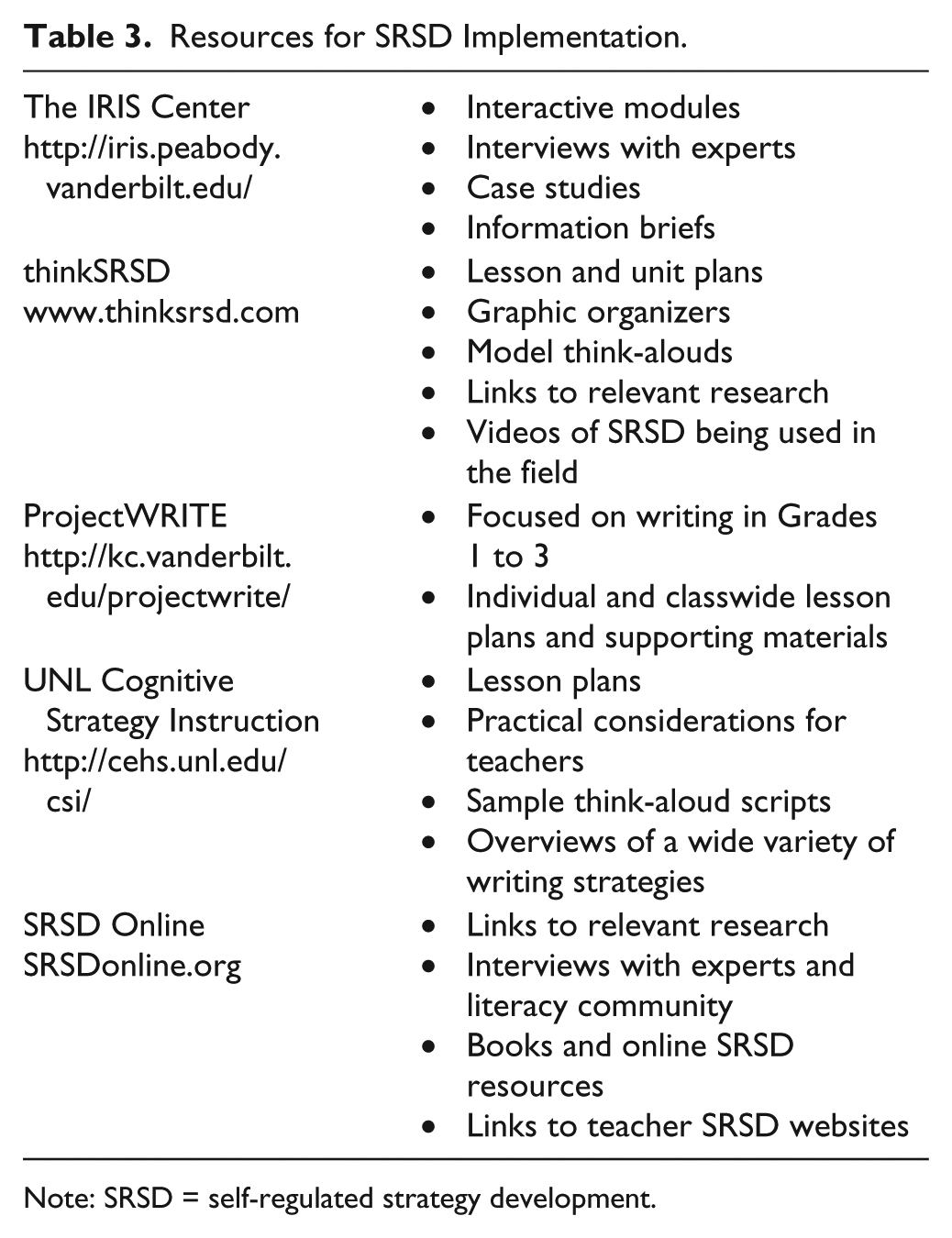
Note: SRSD = self-regulated strategy development.
Final Thoughts
Special education teachers at the secondary level can improve the argumentative writing skills of their students who struggle with the writing process. Equipping these teachers with evidenced-based writing strategies is both timely and relevant, especially with the recent adoption by several states of the CCSS (National Governors Association for Best Practices & Council of Chief State School Officers 2010) and the importance of embedding written language not only in language arts classrooms but also in other content areas. Further, secondary teachers can teach students to use writing as a vehicle for expressing needs and wants, hence enhancing student’s self-determination and self-advocacy abilities, two skills also needed for college and the workforce (Cuenca-Carlino et al., 2015, 2017).
Footnotes
Declaration of Conflicting Interests
The authors declared no potential conflicts of interest with respect to the research, authorship, and/or publication of this article.
Funding
The authors received no financial support for the research, authorship, and/or publication of this article.