




Abstract
Middle school students with learning disabilities often struggle to gain meaning from text. Engaging in self-questioning is an effective strategy for comprehending text, however, middle school students with learning disabilities often do not naturally engage in self-questioning before, during, or after reading. These students may also have difficulty generating questions to ask themselves while reading text. This article presents evidence-based methods and specific instructional scaffolds for teaching middle school students with learning disabilities to generate questions on their own before, during, and after reading. A discussion of how to progress monitor students’ acquisition of self-questioning will also be provided.
Reading comprehension has been defined as a complex process of constructing and extracting meaning via interactions with a text (Randi, Grigorenko, & Sternberg, 2005; Woolley, 2011). Successful readers continuously build and revise mental representations of the text’s meaning and store them in their memory (Woolley, 2011). Reading comprehension may involve several skills, including activating prior knowledge, understanding text structure, identifying main ideas, knowing word meanings, and relating sentences and paragraphs to one another (Randi et al., 2005). Text comprehension may be disrupted if students are unable to engage effectively in all aspects of the process (Cain & Oakhill, 2007).
Due to the complexity of the reading comprehension process and the involvement of multiple skills, comprehending text is a challenging task for students with learning disabilities. Across this nation, a significant number of students with disabilities perform below national averages on reading comprehension measures (National Center for Education Statistics, 2014). Despite the difficulty of reading comprehension, it is critical that students with learning disabilities acquire these skills to engage in lifelong learning. For example, sufficient reading comprehension skills can help students with learning disabilities obtain and perform employment related skills (National Reading Technical Assistance Center, 2010). In addition, reading comprehension facilitates daily living skills, such as understanding ingredients listed on grocery items and content written on medical reports. Finally, the ability to comprehend text opens up new opportunities for social interaction, such as engaging in social media.
Along with lifelong learning benefits, the acquisition of reading comprehension skills helps students with learning disabilities succeed in school. In the middle school grades, text structures become more complex and students move from learning to read to reading to learn (Wanzek et al., 2013). Thus, it is important for students to comprehend what they read to master content in subjects such as social studies and science. Middle school students with learning disabilities who struggle with reading comprehension can be taught comprehension strategies that help them obtain meaning from text while reading (Solis et al., 2012).
An effective comprehension strategy that involves the dynamic interaction between reader and text is self-questioning (Solis et al., 2012). A wealth of evidence supports the use of this strategy for helping students with disabilities comprehend text (Ezell, Kohler, Jarzynka, & Strain, 1992; Johnson, Reid, & Mason, 2012; Rouse, Alber-Morgan, Cullen, & Sawyer, 2014). From a review of studies examining the effects of self-questioning, researchers concluded that self-questioning helped students with disabilities across various grade levels attend to main ideas and details and make predictions about the text (Joseph, Alber-Morgan, Cullen, & Rouse, 2016).
Self-Questioning Strategy
Self-questioning involves students pausing to ask themselves questions that they generate before, during, and after reading (Johnson et al., 2012). Self-questioning helps students manage their learning through generating their own questions (Manset-Williamson, Dunn, Hinshaw, & Nelson, 2008) and checking their understanding of text (McCallum et al., 2011). For example, when students do not know the answer to one of their self-questions, they can adjust their reading (e.g., return to a paragraph) to find the answer. As such, an ongoing dialogue between reader and author can occur before, during, and after reading text when students engage in self-questioning (e.g., Berkeley, Marshak, Mastropieri, & Scruggs, 2011).
Self-questioning can be used when students are asked to read narrative and expository text across various subject areas, such as science, social studies, and language arts (Joseph et al., 2016). Self-questioning may be especially helpful during lessons that contain unfamiliar content or when students experience challenges obtaining meaning from text. This strategy may be used as often as needed when students engage in silent or oral reading activities during individual, small-group, or large-group reading lessons (Joseph et al., 2016).
Self-questioning can easily be coupled with evidence-based comprehension strategies, such as activating one’s prior knowledge about the content, identifying facts and sequences of events, interacting with the author’s written statements, understanding the relationship among written statements in the text, making predictions and inferences about the contents in the text, and summarizing the main ideas of the text (e.g., Johnson et al., 2012; Vaughn & Klingner, 1999). This strategy is cost-effective, portable, and generalizable, as it can be independently used across text genres (e.g., narrative and expository) and across settings (e.g., home and school) using minimal resources (Joseph et al., 2016).
Despite the various benefits of using self-questioning, students with learning disabilities can have difficulty applying the strategy (Rouse et al., 2014). First, they may be unaware of how to use reading comprehension strategies (Jitendra & Gajria, 2011). Furthermore, students with learning disabilities may have difficulty generating questions on their own, knowing when to pause to ask themselves questions, or understanding what types of questions to ask (Crabtree, Alber-Morgan, & Konrad, 2010). As such, it is critical that students are explicitly taught how to apply self-questioning while reading and are provided with sufficient opportunities to practice self-questioning with guided feedback (Almasi, Garas-York, & Hildreth, 2007). An effective way to explicitly teach self-questioning to middle school students with learning disabilities is through most-to-least prompting procedures (Rouse et al., 2014).
Teaching Self-Questioning
Providing most-to-least prompts is a way to scaffold students toward applying self-questioning strategies independently (Rouse et al., 2014). Figure 1 provides an overview of the steps to teaching self-questioning using most to least prompts. Initially, the teacher defines the self-questioning strategy and describes the purpose of using it. For instance, the teacher may state that self-questioning refers to asking yourself questions about a text before, during, and after reading. The teacher could then say, “The purpose of self-questioning while reading is to attend to the details and to check our understanding of the text.”
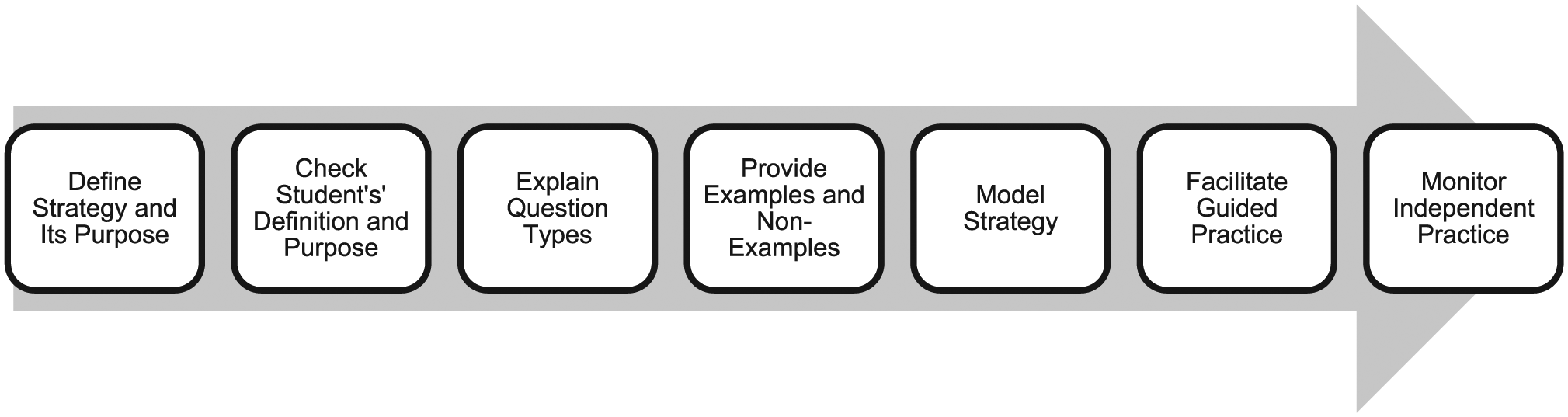
Steps for teaching self-questioning.
Next, the teacher checks for understanding by allowing the students to define and describe the purpose of self-questioning in their own words. The teacher may then provide corrective feedback regarding the students’ definitions and purposes. Corrective feedback should consist of the teacher immediately correcting the error after it occurs and asking the students to respond with the correct response (Heubusch & Lloyd, 1998). For example, if the students provide an incorrect definition, the teacher would say, “Self-questioning refers to asking yourself questions about a text before, during, and after reading.” The students would then repeat the correct definition.
Next, the teacher provides examples of questions and examples of statements that are not questions. This is an important step so that students are exposed to enough examples to make appropriate discriminations when necessary (Carnine, Silbert, Kame’enui, & Tarver, 2004). For instance, the teacher may state that an example of a question is, “What is an atom?” while an example of a statement that is not a question is, “There are atoms and particles in the universe.” Then, the teacher presents a series of examples of questions and statements that are not questions and asks the students to identify which are examples of questions. Students then provide their own examples of questions and examples of statements that are not questions while the teachers deliver corrective feedback. Presenting examples of correct responses and incorrect responses can help students minimize misconceptions about what distinguishes a correct response from an incorrect response (Stein, Carnine, & Dixon, 1998).
The teacher may also describe and provide examples of the various types of literal and inferential questions that one can ask while reading. For instance, the teacher may use the following four question types recommended by Ezell et al. (1992): (a) right there, (b) put it together, (c) author and you, and (d) on your own. Right there is a type of question where the answer is found within one sentence of the text. For example, such a question may be, “In what city did the story take place?” Put it together is a type of question in which the answer is found within two or more sentences that are next to or across paragraphs of the text. Oftentimes, this may pertain to how one event is related to another event described in the text. For example, such a question may be, “What events lead to the main character’s journey to the stranded island?” Author and you is a text question that pertains to that which is implied but not directly found in the text. For example, such a question may be, “Why might the main character feel satisfied living on the island?” On your own is a type of text question that relies on prior background knowledge because the answer cannot be directly found in the text. An example is, “Why did the main character build a fire at night while on the island?” In addition to those four questions types, another question type may involve making a prediction (Vaughn & Klingner, 1999). An example of a prediction question is, “How might the main character find his way back home?” The teacher can explain to the students that not all question types are applicable to all texts.
Afterward, the teacher demonstrates asking herself questions before, during, and after reading a text. She models this through appropriate pausing, asking high-quality self-questions, and providing high-quality answers to the questions. For instance, the teacher may demonstrate self-questioning while reading a chapter on the solar system in a science textbook. She may state, “I will skim the chapter, look at the headings and subheadings, and ask myself a question about the chapter before reading it.” For example, the teacher could ask, “Is there life on any of the planets in the solar system?” During reading, the teacher can demonstrate reading a couple of paragraphs in the chapter and pausing at the end of each paragraph. For example, the teacher could state, “I will read this paragraph aloud, pause at the end of the paragraph, and ask myself a question about the paragraph.” The teacher then demonstrates that she is unable to answer her question. For example, the teacher could say, “If I were able to answer the question, I would read the next paragraph; however, I cannot answer my question so I need to read the paragraph again.” Then, the teacher reads the paragraph again, asks the same question, and answers it correctly.
Next, the teacher guides students to self-question by having them read a passage and practice asking themselves questions pertaining to the text. Students read the next couple of paragraphs in the science textbook chapter aloud, and the teacher verbally prompts the students to pause at the end of each paragraph and ask a question. A verbal prompt could be, “Ask yourself a question about what you just read.” The teacher directs the students to ask for help when unable to generate questions and to return to the paragraph to answer self-questions.
If the students struggle with generating questions, the teacher can direct the students to refer to the topic sentences in narrative texts or the headings and subheadings in expository texts. The students can then turn the topic sentences or headings and subheadings into questions. This strategy of turning headers into questions has been shown to improve the reading comprehension of sixth and seventh graders with learning disabilities when reading social studies text (Berkeley & Riccomini, 2013). Figure 2 provides an example of a worksheet that students can use to record their questions generated from the headings, answer their questions, and self-monitor whether they answered the questions correctly.

Example of self-questioning worksheet using headings and subheadings.
If the students continue to struggle with generating questions, the teacher may remodel appropriate self-questions followed by having the students engage in additional guided practice opportunities. Despite additional modeling and guided practice opportunities, some students may continue to experience difficulty with generating questions. In these cases, teachers may use more intensive supplemental instructional methods such as the cover–copy–compare technique (Konrad & Joseph, 2014). Figure 3 presents an example of using the cover–copy–compare technique to help a student independently generate questions.
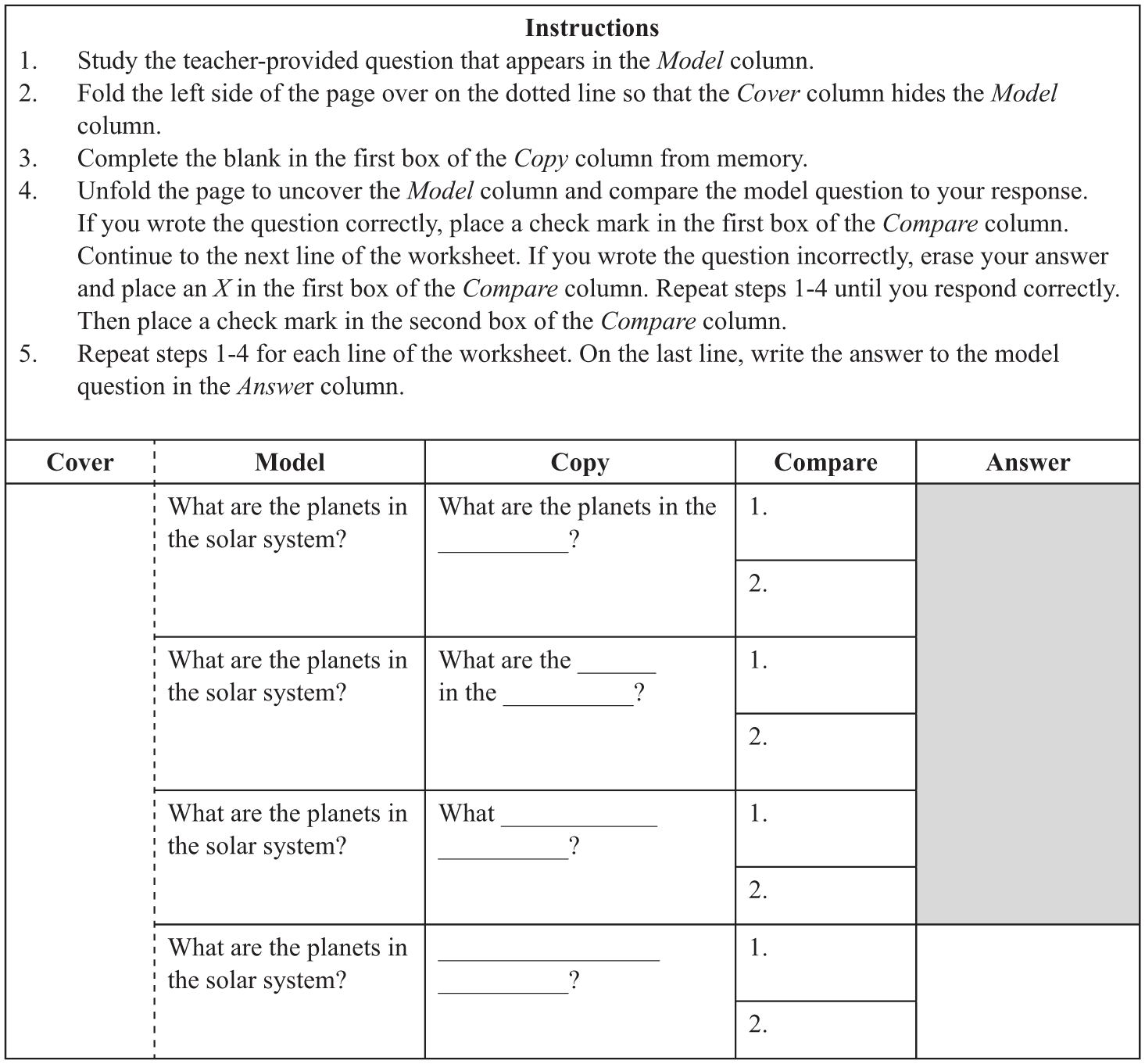
Example of self-questioning worksheet using the cover–copy–compare technique.
When the students demonstrate that they can apply self-questioning without teacher assistance, they are given opportunities to independently practice self-questioning using self-generated questions. Students are expected to silently read paragraphs, practice appropriate pausing, verbally generate high-quality self-questions and answers, and return to the paragraph to correct wrong answers. The teacher provides prompts only as needed. However, the teacher continues to provide immediate corrective feedback regarding questions or answers that are of insufficient quality.
During the independent practice phase, the teacher may provide more structured independent practice opportunities for students who need the additional support. For example, the teacher may allow students to work in pairs to discuss their questions and answers (McCallum et al., 2011; Vaughn & Klingner, 1999). To ensure that peer collaborations are successful, the teacher may need to provide explicit rules and procedures for working together (Delquadri, Greenwood, Whorton, Carta, & Hall, 1986).
While students are practicing self-questioning independently, the teacher may notice that some students have difficulty knowing when to pause and ask questions. To help these students, the teacher can embed visual prompts throughout the text to signal the need to pause and ask a self-question (Manset-Williamson et al., 2008). For instance, the teacher could insert red dots throughout the text, and students pause at each red dot to ask themselves a question. In addition, a worksheet such as the one in Figure 4 can accompany the visual prompts so students can record their questions and answers. Embedded visual prompts have been shown to be effective for helping adolescents with learning disabilities self-monitor their understanding of text and improve their reading comprehension performance (Crabtree et al., 2010).
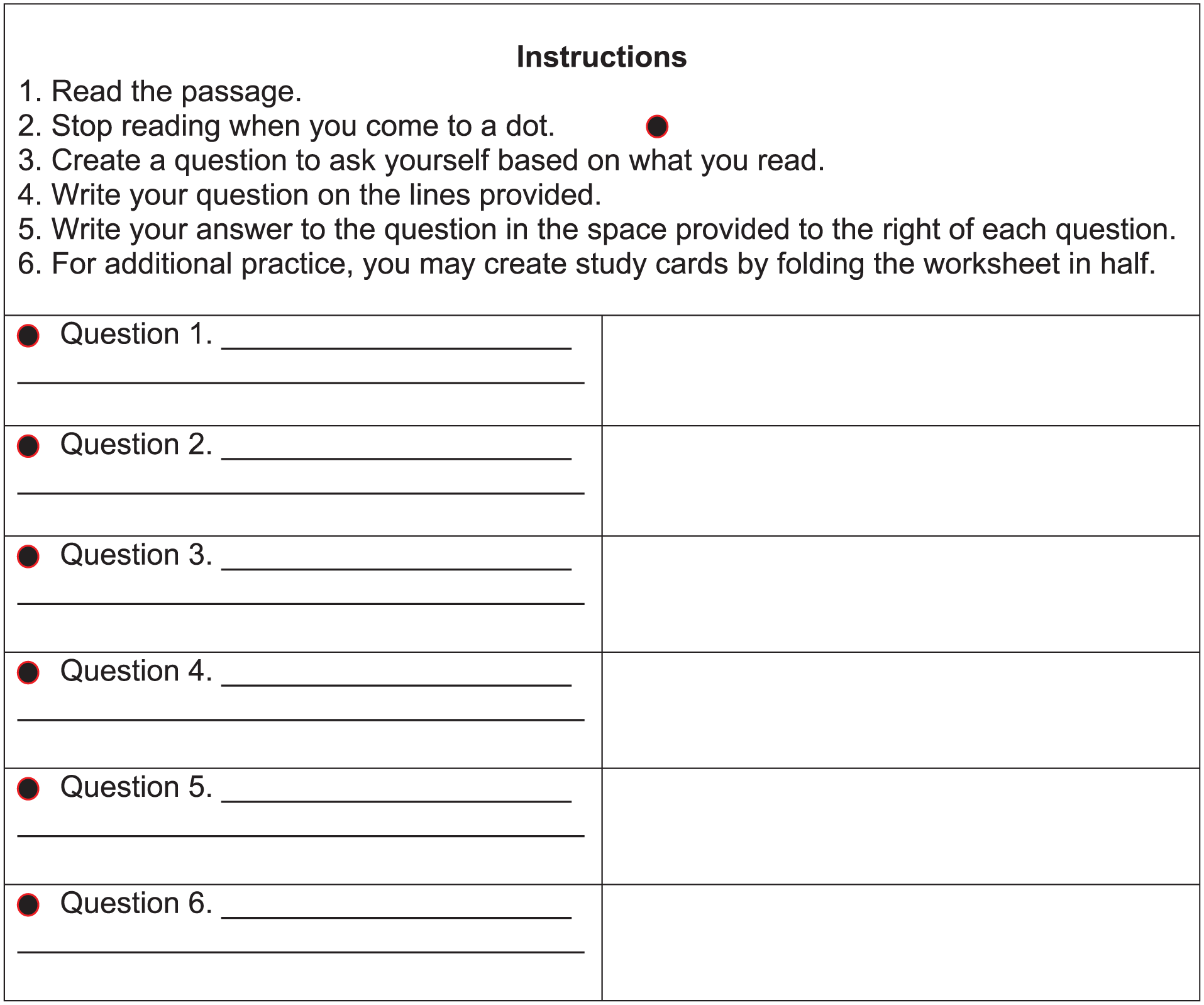
Example of self-questioning worksheet using embedded visual prompts.
Progress Monitoring
It is important that teachers monitor students’ progress while interventions are being implemented to make ongoing instructional decisions based on data (Begeny et al., 2015; VanDerHeyden, Shapiro, & Kovaleski, 2013). Certainly, this principle applies to teaching self-questioning to middle school students with learning disabilities. For example, during lessons in which the teacher observes students asking themselves questions aloud, the teacher can track the quantity and quality of students’ self-questions. With regard to quantity, teachers can track the number of questions by question type (e.g., number of literal and number of inferential questions). The quality of self-questions can be evaluated on several dimensions. For instance, the teacher can evaluate how well the question relates to the critical elements of the text (Rouse et al., 2014). How often the teacher tracks students’ progress depends on how well the students perform the skill. Students who continue to struggle acquiring self-questioning need to be monitored more frequently to make appropriate instructional changes.
Students can also monitor their progress in using self-questioning while reading. When students self-monitor their reading behaviors, they improve their reading performance (Joseph & Eveleigh, 2011). To facilitate student self-monitoring, the teacher can provide structured worksheets that contain prompts for students to track their progress. Figures 2 and 3 provide examples of worksheets that contain a self-monitoring component. In Figure 2, there is designated column on the worksheet for students to record whether or not they can answer their self-question and a column for students to place a check mark if their answer is correct. In Figure 3, there is a column on the worksheet where students mark whether or not their copied question matches the modeled question. Structured worksheets such as those illustrated can serve as permanent products for the teacher and the students to evaluate progress on both the quantity and quality of the self-questions.
Final Thoughts
It is important to restate that reading comprehension is a complex process that involves a multitude of strategies, not just self-questioning (Woolley, 2011). However, certainly, self-questioning should be added to the host of evidence-based strategies for helping middle school students with learning disabilities obtain meaning from text (Joseph et al., 2016). The use of this strategy not only aids students with learning disabilities to actively interact with the contents of narrative and expository texts; it also helps students monitor their understanding of texts while reading (Joseph et al., 2016). Self-questioning can be effectively and explicitly taught in inclusive middle school classrooms that are composed of students with and without disabilities (Berkeley et al., 2011). This strategy is portable and cost-effective when used across diverse learners, text genres, and settings.
Footnotes
Declaration of Conflicting Interests
The authors declared no potential conflicts of interest with respect to the research, authorship, and/or publication of this article.
Funding
The authors received no financial support for the research, authorship, and/or publication of this article.