



Abstract
A primary aim of mathematics programs is to accelerate the achievement of all students, including students with or at risk for learning disabilities (LD) in mathematics. Yet research suggests that many programs fail to incorporate the instructional design and delivery principles that have been validated to meet the learning needs of students with or at risk for LD in mathematics. This article provides special education teachers with a practical guide for assessing and evaluating the extent to which mathematics programs contain validated principles of explicit mathematics instruction. An example illustrates how teachers can apply the evaluation guide and use the results to address potential instructional shortfalls of mathematics programs.
Mathematics programs represent an important instructional foundation for supporting student development of mathematics proficiency (Bryant et al., 2008; Carnine, 1997; Dixon & Carnine, 1993; National Research Council [NRC], 2001). Across the school year, these programs determine the scope and sequence of mathematical content. Mathematics programs also serve as an optimal platform for teachers to deliver high-quality, effective mathematics instruction. Moreover, when well designed, mathematics programs can help teachers meet the instructional needs of students with or at risk for learning disabilities (LD) in mathematics.
Now more than ever, special education teachers are implementing a host of commercially available mathematics programs to teach students with or at risk for LD in mathematics. In some classrooms, teachers are using core mathematics programs. Core mathematics programs are designed to address the full range of learners and focus on the span of mathematical concepts and skills students are expected to learn and know at each grade level. When designed and implemented well, core mathematics programs have been found to improve the mathematics outcomes of typically achieving students and students with or at risk for LD in mathematics (Agodini & Harris, 2010; Clarke et al., 2015). Examples of commercially available core programs include Saxon Math and Everyday Mathematics.
In other situations, special education teachers are using modular mathematics materials, such as Engage NY. Such commercially available materials typically represent a suite of discrete instructional units or modules that prioritize different areas of mathematics. For example, a first grade module on geometric shapes might teach students how to sort and identify different shapes by their attributes. Another first grade module might address early place value concepts.
Finally, in some classrooms, teachers are using mathematics intervention programs. Such programs are typically designed to target one domain of mathematics, such as whole numbers or fractions. For example, Connecting Math Concepts would be considered an intervention program. Given the variety of mathematics programs available (e.g., core programs, modular materials, and intervention programs), it is easy to imagine how some are better equipped than others to meet the instructional needs of students with or at risk for LD in mathematics. Therefore, there is an urgent need to provide special education teachers with a practical guide designed to assess and evaluate the mathematics programs used in today’s classrooms.
Explicit Mathematics Instruction
In recent years, studies on mathematics programs have begun to shed light on instructional approaches that improve the outcomes of students with or at risk for LD in mathematics (Agodini & Harris, 2010; Clarke et al., 2015; Gersten, Beckmann, et al., 2009; Gersten, Chard, et al., 2009). At the forefront of this growing body of evidence is explicit mathematics instruction. Explicit mathematics instruction is defined as a systematic instructional approach used to effectively and efficiently build students’ conceptual understanding and procedural fluency with critical mathematics content (Archer & Hughes, 2011). Research involving students with or at risk for LD in mathematics suggests the importance of embedding validated principles of explicit mathematics instruction within mathematics programs (Clarke et al., 2015; Dennis et al., 2016; Gersten, Beckmann, et al., 2009; Gersten, Chard, et al., 2009; Sood & Jitendra, 2007). This literature base has identified three principles of explicit mathematics instruction.
Instructional scaffolding, the first principle of explicit mathematics instruction, refers to temporary guidance or support provided to students as they learn new mathematical concepts and skills (Carnine, 1997; Coyne, Kame’enui, & Carnine, 2011; Rosenshine, 2012). Such guidance is offered through multiple mediums, including purposefully designed and carefully selected teaching examples and mathematical activities. Because instructional scaffolding is intended to be temporary, the support is gradually withdrawn as students become more independent in their mathematical learning. For example, effective instructional scaffolding in a mathematics program will first introduce less complex teaching examples and then transition to more complex ones as students acquire knowledge of the targeted concept or skill.
The second principle is student practice opportunities. This principle refers to mathematics programs offering students structured opportunities to engage in and work with foundational mathematics content. Critical to the learning of students with or at risk for LD in mathematics are practice opportunities that allow them to verbally convey their mathematical understanding and work with visual representations of mathematical ideas (Gersten, Beckmann, et al., 2009; Gersten, Chard, et al., 2009). Practice opportunities that are followed by timely academic feedback are also essential for supporting the development of mathematical proficiency among students who face challenges in mathematics.
Judicious review is the third principle of explicit mathematics instruction. For students with or at risk for LD in mathematics to maintain new and previously learned mathematical skills and strategies, mathematics programs must offer frequent review opportunities (Coyne et al., 2011; Rosenshine, 2012). When well designed and appropriately spaced over time, such review opportunities enable struggling learners to build procedural fluency with critical topics such as solving number combinations, multistep word problems, and problems involving multidigit operations.
Shortage of Explicit Mathematics Instruction
Despite the importance of explicit mathematics instruction, research suggests that there is wide variability in the extent to which mathematics programs contain principles of explicit mathematics instruction (Doabler, Fien, Nelson-Walker, & Baker, 2012). For example, Sood and Jitendra (2007) examined four Grade 1 programs for inclusion of principles of explicit mathematics instruction, including scaffolded instructional examples and guided student practice opportunities. Results indicated that the principles of explicit instruction were largely absent from the programs reviewed.
Similarly, Bryant et al. (2008) reviewed lessons from kindergarten, Grade 1, and Grade 2 programs for presence of explicit mathematics instruction. One key finding was that that the programs failed to include adequate practice opportunities for students to apply newly acquired skills and strategies in the context of solving multidigit addition and subtraction problems. Another important finding was that the programs provided few opportunities for teachers to demonstrate key mathematical topics and provide timely academic feedback.
In summary, research suggests that some programs reflect the current research base of effective mathematics instruction, whereas others fail to embrace what is known for teaching students with or at risk for LD in mathematics. When mathematics programs lack principles of explicit instruction it makes it difficult for even the most experienced of special educators to meet the instructional needs of students struggling with mathematics. Consequently, it may be necessary for teachers to “look under the hood” of mathematics programs (Carnine, 1997; Carnine, Jitendra, & Silbert, 1997; Dixon & Carnine, 1993).
This article provides special education teachers with a practical guide for assessing and evaluating the extent to which the mathematics programs used to teach students with or at risk for LD in mathematics contain validated principles of explicit mathematics instruction. Specifically, the evaluation guide is intended to provide special education teachers with a measure of the explicit instructional principles that are currently embedded in mathematics programs. Teachers can apply the guide with a variety of mathematics programs, including commercially available core mathematics programs, modular materials, and intervention programs. Moreover, they can use the results to (a) identify instructional weaknesses of mathematics programs and (b) increase the explicitness of particular areas of mathematics programs as needed.
A Guide for Assessing and Evaluating
The evaluation guide is designed to assess and evaluate the degree to which mathematics programs contain three validated principles of explicit mathematics instruction: (a) instructional scaffolding, (b) student practice opportunities, and (c) judicious review. Information necessary for the evaluation guide is collected through a review of lessons in the targeted mathematics program. Lesson reviews should be conducted prior to the start of the school year to allow ample time for necessary instructional adjustments. Three major steps are applied to document the necessary information. These steps include the following.
Select a “Big Idea” of Mathematics
The first step is to identify a critical mathematical topic or big idea recognized in state (e.g., Texas Essential Knowledge and Skills; Texas Education Agency, 2012) or national (Common Core State Standards Initiative, 2010) mathematical content standards. Big ideas represent the critical concepts and skills of mathematics that are considered essential for students’ mathematics proficiency (Carnine, 1997; Coyne et al., 2011). An example of a big idea of early mathematics is place value. Knowledge of place value is critical to learning the base-10 system, composing and decomposing quantities, and using the arithmetic operations of addition, subtraction, multiplication, and division (Caldwell, Karp, Bay-Williams, & Zbiek, 2011).
Locate All Pertinent Lessons
The second step is to locate all lessons that address the targeted big idea, including the first lesson that introduces the concept or skill. The quality of introductory lessons is critical for ensuring high rates of student success. For example, if a program lacks sufficient instructional examples to introduce place value, the probability is high that students with or at risk for LD in mathematics will have difficulty gaining initial understanding of this big idea. In addition to the introductory lesson, it is also important to identify all subsequent lessons that address the targeted concept or skill.
Evaluate the Instructional Components
The third step is to evaluate the identified lessons to determine the extent to which they address three validated principles of explicit mathematics instruction. These principles are drawn from prior reviews of mathematics programs (Bryant et al., 2008; Carnine et al., 1997; Doabler et al., 2012; Sood & Jitendra, 2007) and the growing literature base on explicit mathematics instruction (Archer & Hughes, 2009; Becker, Engelmann, Carnine, & Rhine, 1981; Carnine, 1997; Chard & Jungjohann, 2006; Clarke et al., 2015; Clements, Agodini, & Harris, 2013; Coyne et al., 2011; Dennis et al., 2016; Gersten, Beckmann, et al., 2009; Gersten, Chard, et al., 2009). They include (a) instructional scaffolding, (b) student practice opportunities, and (c) judicious review.
To assess and evaluate the presence of the principles in the identified lessons, teachers should utilize the evaluation guide shown in Figure 1. Broadly, the guide addresses the three principles of explicit mathematics instruction. Across the principles are 13 evaluation questions that address key features of explicit mathematics instruction. Teachers should consider each question to obtain a comprehensive snapshot of their mathematics program.
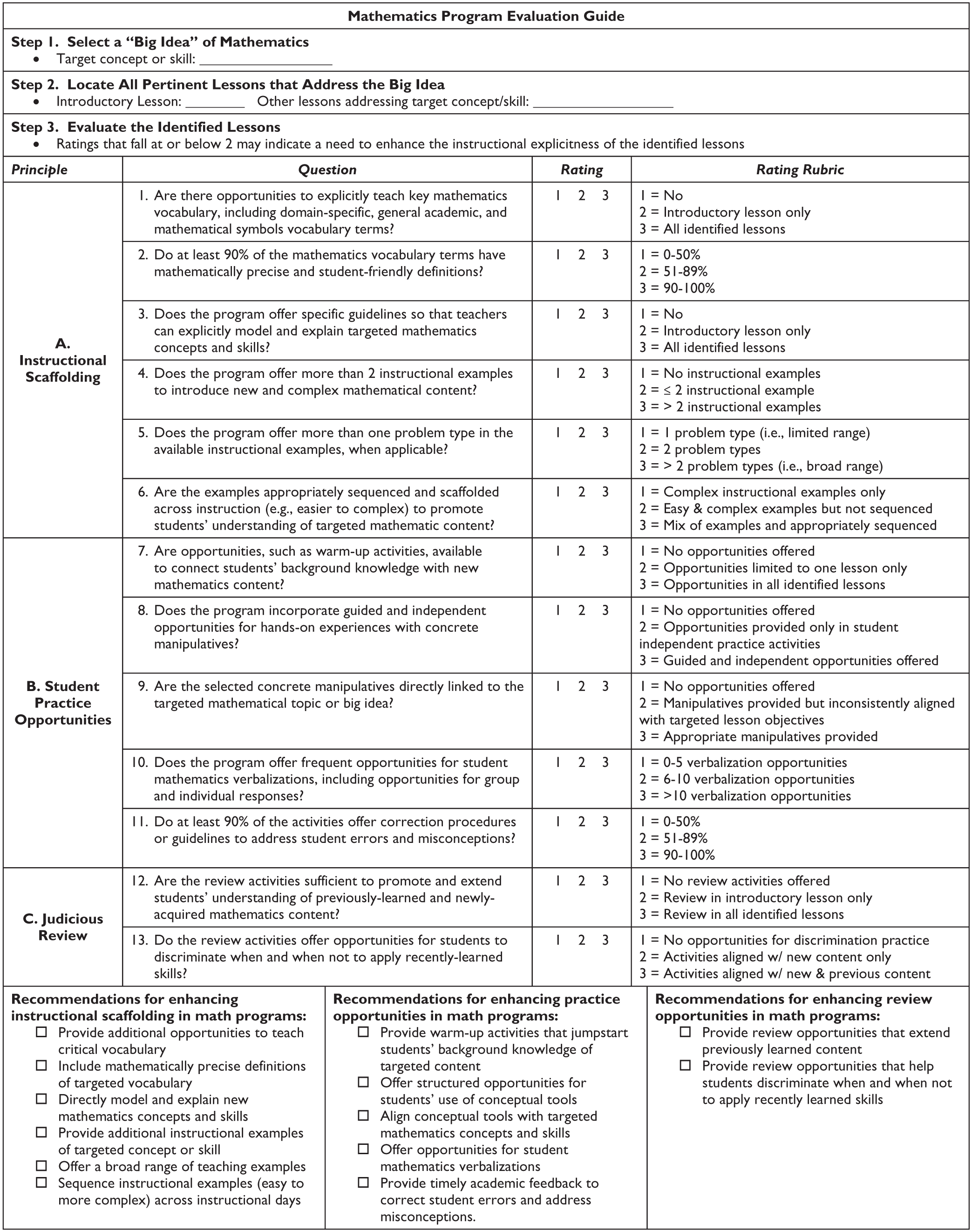
Mathematics Program Evaluation.
Each evaluation question is scored on a specific 3-point rating scale (see Figure 1). For example, a second grade mathematics program will receive a rating of 1, the lowest rating, if lessons pertaining to multidigit addition with regrouping offer a restricted range of instructional examples (i.e., one problem type). A rating of 2 suggests that an instructional principle is inconsistently present in the targeted lessons. For example, a program will achieve a score of 2 if it offers a limited number of instructional examples (i.e., 1 or 2) in the identified lessons. A rating of 3, the highest score, indicates that the principles are consistently applied across the identified lessons. For example, a program will achieve a score of 3 if frequent opportunities for student mathematics verbalizations (i.e., >10 per lesson) are included in the lessons targeting place value concepts.
After completing the evaluation, teachers should consider the rated score for each evaluation question. Ratings that fall at or below 2 may indicate a need to enhance the identified lessons. In the next section, we provide an example for how teachers can apply the evaluation guide to evaluate and assess a mathematics program used to teach students with or at risk for LD in mathematics.
Evaluation of a Second Grade Lesson
In some response to intervention (RTI) frameworks and multitiered systems of support (MTSS), schools are beginning to adopt and mandate core mathematics programs in all general and special education classrooms. While core mathematics programs typically target the big ideas of mathematics, many are not explicit enough for teaching complex mathematics topics to students with or at risk for LD (Bryant et al., 2008; Carnine et al., 1997; Sood & Jitendra, 2007). Therefore, before teaching these students, it is strongly recommended that teachers “look under the hood” of these types of mathematics programs.
To show how teachers might assess and evaluate the extent to which their core mathematics programs contain validated principles of explicit mathematics instruction (i.e., instructional scaffolding, student practice opportunities, and judicious review), the following section provides an example for utilizing the evaluation guide. This example examines a set of activities drawn from a fictionalized second grade core mathematics lesson. The lesson introduces and addresses multidigit subtraction with regrouping (i.e., borrowing), a key skill identified in state and national mathematics standards (see Figure 2). The lesson’s strengths and three potential shortfalls are highlighted along with suggestions for how teachers can address these shortfalls and thus better meet the instructional needs of students with or at risk for LD in mathematics.
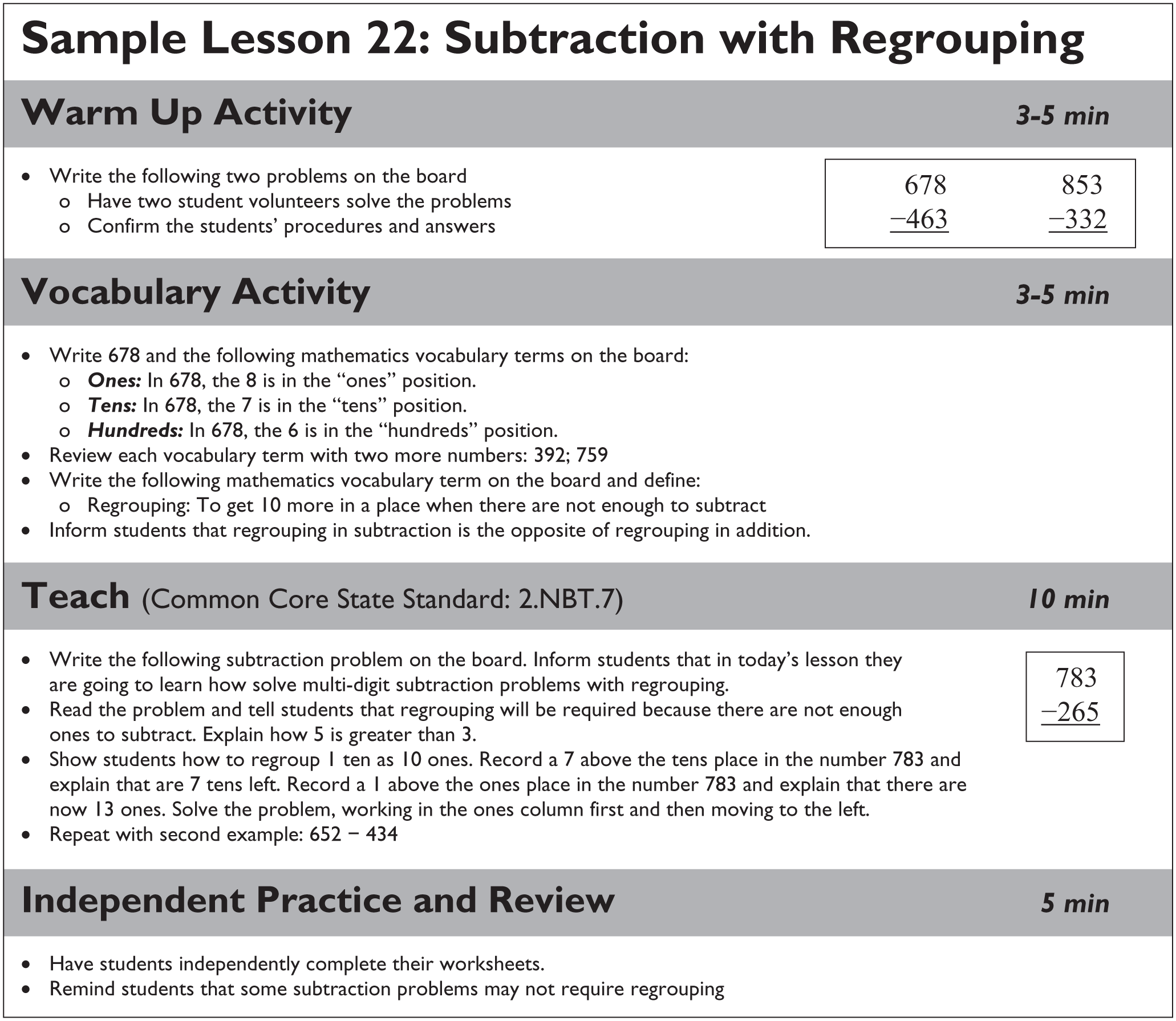
Sample Second Grade Core Mathematics Lesson.
Strengths of the Lesson
As depicted in Figure 2, there are several notable strengths of the lesson. First, the lesson offers a brief warm-up activity (3–5 minutes) to help students connect previously learned material (i.e., subtraction with no regrouping) with the concept to be introduced (i.e., subtraction with regrouping). A second strength of the lesson is that it provides an opportunity to directly teach key mathematics vocabulary terms (Powell & Driver, 2015). For example, to gain conceptual understanding of the targeted content, students need to understand how to apply key vocabulary such as tens, hundreds, and regrouping.
In addition, the lesson offers specific guidelines for teachers to overtly demonstrate for students how to solve multidigit subtraction with regrouping problems. Converging evidence suggests that students with disabilities in mathematics are more successful in developing mathematics proficiency when they are provided unambiguous demonstrations and explanations of new mathematical concepts and skills (Clarke et al., 2015; Gersten, Chard, et al., 2009). Teachers can utilize the lesson’s guidelines to make visible what they expect students to learn. One way teachers can do this is through “think-alouds.” Think-alouds make known a teacher’s thought processes for solving complex mathematics problems, such as multidigit subtraction problems with regrouping. When done well, think-alouds can serve as a valuable instructional tool for teachers to make their reasoning with mathematical concepts, procedures, and vocabulary both public and accessible (Archer & Hughes, 2011; Gersten, Beckmann, et al., 2009). Figure 3 shows an example of a teacher using a think-aloud to overtly demonstrate how to solve a multidigit subtraction problem with a zero in the tens place.
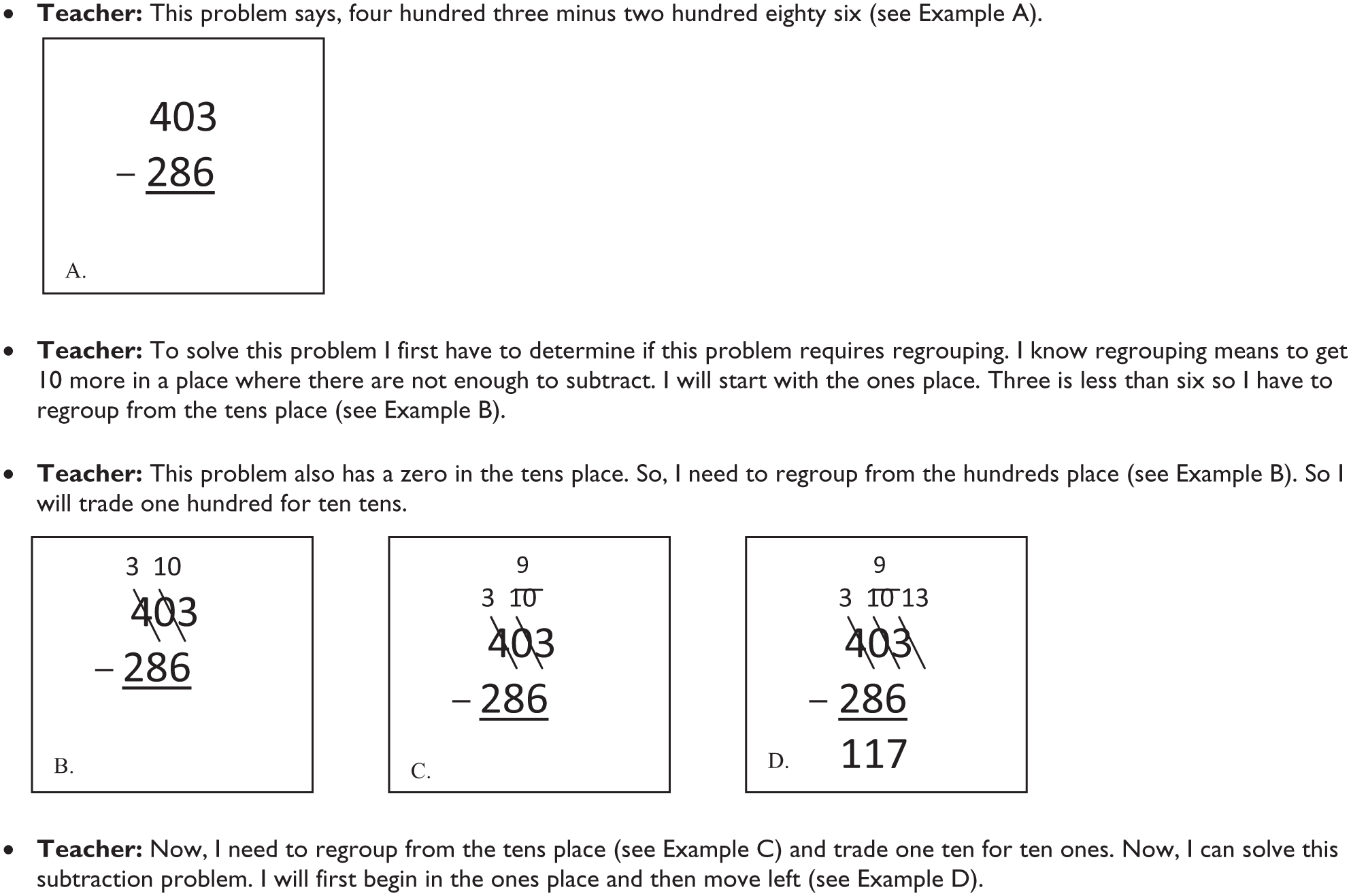
Example of a Teacher Think-Aloud.
Shortfall 1: Instructional Examples
One critical shortfall is that the instructional examples offered in the lesson are limited in number (i.e., only two examples) and restricted to only one problem type (i.e., regrouping from the tens place). Consequently, it is rated a 1 for Questions 4 and 5 on the evaluation guide. When mathematics programs offer little to no instructional scaffolding, it often forces students with or at risk for LD in mathematics to solve complex mathematical problems on their own without sufficient support (Rosenshine, 2012). This can be problematic, particularly for students who have already faced a long line of failure and frustration with mathematics. Therefore, in the event of this shortfall it is critical that teachers include more guided teaching examples that initially offer a high level of instructional scaffolding with a gradual withdraw of that support as students became more independent in their learning. While the number of additional instructional examples to provide will vary based the complexity of the targeted mathematics content, the amount should be sufficient to promote students’ conceptual understanding of targeted mathematics content. Moreover, the examples should be purposefully sequenced across a series of lessons by introducing easier problem types before more complex ones. This way, instruction does not overwhelm students by introducing complex problem types during the initial lesson or activity.
For example, multidigit subtraction problems that contain zeroes in the tens place often pose difficulties for students because these problem types require regrouping across the zero (Fuson & Beckmann, 2012). Therefore, to better ensure that students obtain a high success rate with these particular subtraction problems, teachers should introduce them after students have mastered multidigit subtraction problems that contain numerals other than zeroes in the tens place. Figure 4 shows an example of how teachers can systematically sequence the introduction of different problem types across multiple days of instruction.
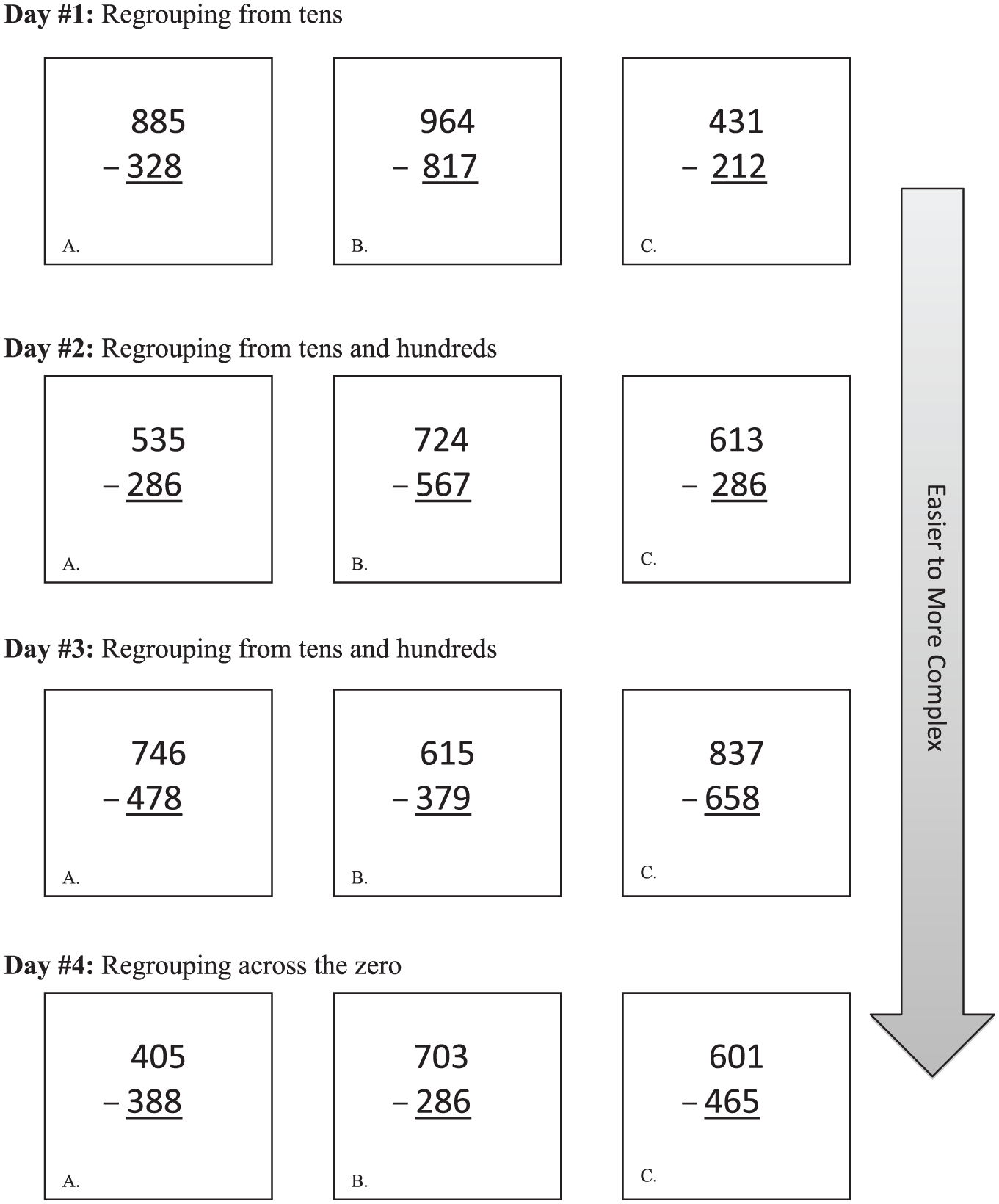
Sequence of Subtraction with Regrouping Problems.
Shortfall 2: Use of Concrete Manipulatives
A second shortfall in the lesson is a lack of structured opportunities for students to receive hands-on experiences with visual representations of mathematical ideas or conceptual tools. The practice opportunities offered in the lesson only permitted students to solve subtraction problems on their worksheets; and it is rated a 1 for Questions 8 and 9 on the evaluation guide. Because such experiences are considered critical for developing conceptual understanding and building mathematical proficiency (NRC, 2001; Wu, 1999), it is important that teachers strategically integrate conceptual tools into their instruction when such opportunities are missing from mathematics programs. Teachers can do this by integrating the selected tools in the first lesson that introduces the targeted concept or skill. Teachers should explicitly demonstrate for students the purpose of the conceptual tools, such as using place value blocks to solve multidigit subtraction problems. Then, teachers should gradually withdraw such tools from instruction after students have begun to grasp a general understanding of the targeted concept or skill. Eventually, this systematic withdraw will help students with or at risk for LD in mathematics to build an important connection between the conceptual and abstract strands of mathematics (NRC, 2001).
Shortfall 3: Student Mathematics Verbalizations
A review also identified that the lesson’s independent practice and review activity was missing frequent opportunities for students to verbalize their mathematical thinking of targeted mathematics content. As such, it is rated a 1 for Question 10 on the evaluation guide. A growing body of research suggests that mathematics verbalizations are associated with increased student mathematics achievement (Clements et al., 2013; Gersten, Beckmann, et al., 2009; Gersten, Chard, et al., 2009). Therefore, when mathematics programs lack verbalization opportunities, it is critical for teachers to frequently engage students with or at risk for LD in mathematics in structured math talk. At the very least, teachers should require students to answer basic factual and procedural questions, such as “Can you tell me the next step in solving the problem?”
It is also important to engage struggling learners in more productive mathematical discourse or math talk. However, mathematics programs often fail to include more cognitively demanding verbalization opportunities (Bryant et al., 2008; Sood & Jitendra, 2007). In light of this, verbalization opportunities that help students access the conceptual level of mathematics may have to be incorporated into mathematics programs. For example, a teacher might have her students verbally justify why mathematical statements, such as “300 minus 246 equals 54,” are true. To stimulate deeper mathematics discussions, teachers might also provide follow-up generalization questions such as, “If 300 minus 246 equals 54 then what does 200 minus 146 equal?” Because this type of math talk can be difficult for students with or at risk for LD in mathematics, teachers should be prepared to guide mathematics verbalization opportunities by simultaneously stating the responses with their students (e.g., “Say it with me. We solved this problem by . . .”).
Conclusion
Special education teachers across the nation are using a variety of mathematics programs in their classrooms. Because of these variations, it is reasonable to expect that some programs are more appropriately suited than others to meet the instructional needs of students with or at risk for LD in mathematics. Some mathematics programs are soundly designed and contain validated principles of explicit of mathematics instruction. In other cases, however, programs fail to reflect the current knowledge base on effective mathematics instruction. Given that many of these weaker mathematics programs are being delivered in today’s classrooms, this article provided special education teachers with a practical guide for evaluating mathematics programs. Specifically, the guide is intended to help teachers assess and evaluate the extent to which the mathematics programs contain validated principles of explicit mathematics instruction. Special education teachers are encouraged to use the information garnered from the evaluation guide to increase the explicitness of mathematics programs used to teach students with or at risk for LD in mathematics.
Footnotes
Declaration of Conflicting Interests
The authors declared no potential conflicts of interest with respect to the research, authorship, and/or publication of this article.
Funding
The authors disclosed receipt of the following financial support for the research, authorship, and/or publication of this article: The research reported here was supported by the National Science Foundation through Grant 1503161 awarded to Christian T. Doabler, Ben Clarke, Nancy J. Nelson, and Hank Fien of the Center on Teaching and Learning at the University of Oregon.