



Abstract
Students with learning disabilities (LD) in reading often struggle to succeed due to difficulties with reading comprehension. Comprehension difficulties can impact access to a variety of text types, including informational texts. Researchers suggest that students with LD in reading require explicit comprehension supports before, during, and after reading. This article outlines the use of a comprehension tool, anticipation guides (AGs), a type of advance organizer especially suited for use with informational text. A brief summary of the literature surrounding the use of advance organizers in elementary settings is provided. General steps for planning and adapting instruction using AGs are also included. In addition, planning and instructional steps are contextualized using a science illustration. Finally, conclusions are offered.
As early as the elementary grades, students with learning disabilities (LD) in reading often struggle to access the content curriculum. This occurs primarily because of difficulties they experience with comprehension of narrative and informational text (Boardman et al., 2016; Meo, 2008). The adoption of Common Core State Standards in English Language Arts has increased emphasis on using informational texts in the elementary grades. Unfortunately, some discipline-specific texts contain complex vocabulary and text structures that can negatively impact students’ ability to access and comprehend information (Bulgren, Graner, & Deshler, 2013). Some researchers have found that instructional strategies such as advance organizers that can be applied across disciplines and reinforced across contexts can be beneficial to improving reading comprehension in students with LD (Darch & Gersten, 1986; Haager & Vaughn, 2013).
Advance Organizers
Advance organizers focus attention on important information and can come in the form of prereading guides, study guides that include headings and subheadings, or identifying vocabulary in advance of reading a piece of text. There is evidence to support the efficacy of advance organizers across genres, disciplines, and among students with or at risk for disabilities (Ortlieb, 2013). In recent years, researchers have examined the use of advance organizers with students in third, fourth, and fifth grade settings. The majority of the participants across studies were students with or at risk for disabilities in reading or were English language learners. Overall, researchers found that advance organizers increased comprehension and content knowledge from pre- to posttests and when treatment and control groups were compared (Box & Little, 2003; Burns, Dean, & Foley, 2004; Hawkins, Musti-Rao, Hale, McGuire, & Hailley, 2010; O’Donnell, Weber, & McLaughlin, 2003; Ortlieb, 2013). Anticipation guides (AGs) are one type of advance organizer suited for supporting text comprehension across disciplines. This article provides suggestions for how AGs can be used to support comprehension of informational science texts.
Anticipation Guides
An AG is an advance organizer that supports comprehension by prompting readers to activate prior knowledge and make connections to new knowledge. For example, before reading a piece of text surrounding the science topic Forces and Motion, students are asked to determine whether they think statements that summarize ideas in the text are true or false (Herber, 1978). Readers may then return to each statement after completing the reading to make any necessary changes to their original thinking (Duffelmeyer, 1994). AGs typically include three to five statements and can be used across disciplines (Adams, Pegg, & Case, 2015; Duffelmeyer, 1994).
Anticipation Guide Templates
Three different types of AG templates are described, varying by complexity and the extent to which each supports in-depth thinking and discussion.
Template A is the most basic. Students respond to each statement before reading by marking true or false. This template does not provide space to mark true or false after completing the reading or space to record a rationale for answers. When considering this template, teachers may ask themselves the following (Herber, 1978): (a) Am I concerned that a more complicated template may confuse students? or (b) Am I only interested in using the AG as a tool to engage students before reading?
Template B allows students to respond before and after reading. Template B, however, does not provide space for students’ rationale for each response. When considering this template, teachers may ask themselves the following (Adams et al., 2015): (a) Do I want the AG to facilitate engagement throughout the reading? (b) Do I want to use the AG as an informal pre- and postassessment measure? or (c) Do I want to use the AG to promote close reading in support of reading comprehension?
Template C is similar to Template B but also includes space to record a reason for each response. Oral conversation accompanied by a written rationale helps solidify students’ understanding of content (Wallace, Pearman, Hail, & Hurst, 2007). When considering this template, teachers may ask themselves the following: (a) Do I want a tool to facilitate engagement throughout the reading? (b) Do I want to use the AG as an informal pre- and postassessment measure? or (c) Do I want a tool that facilitates extended conversations about the text? Template C is used in the example provided throughout this article. Figure 1 provides a completed version of this template.
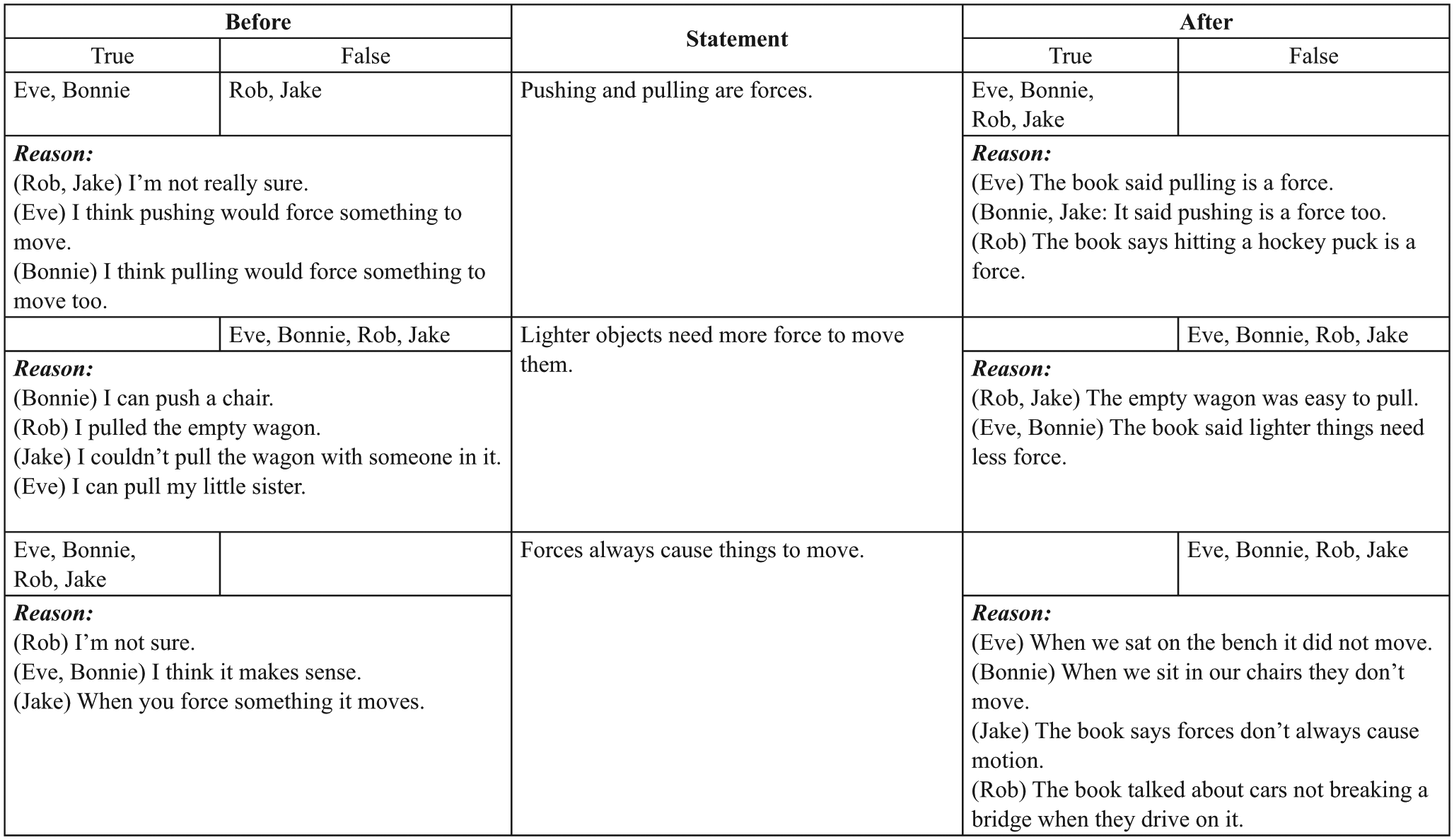
Anticipation guide for forces and motion.
Planning Anticipation Guides
Teachers may consider using the following five steps when planning to use AGs: (a) identify a content discipline topic, (b) identify literacy goal(s), (c) choose materials, (d) create AG statements, and (e) consider how to use think-aloud techniques. The planning process for each lesson may take teachers about 1 hour. The first 20 minutes will involve identifying content and literacy standards and goals. The next 40 minutes will involve examining materials, creating AG statements, and considering think-aloud techniques. If teachers choose to use nontraditional texts, they will also need to set aside time to locate the texts (e.g., supplemental textbook materials or materials located in school or local libraries). Subsequent AGs will require less and less planning time, until teachers are simply adjusting and reusing most materials year after year.
Identify a content discipline topic
District curriculum maps are organized by discipline and typically divided into several units of study across the school year. Teachers often collect several forms of data throughout each unit. The data collected from these assessments will help identify topics within each unit of study with which students struggle. For example, at the beginning of a science unit on Forces and Motion, a teacher notices through informal questioning that a group of students struggles with many of the key concepts (e.g., forces, push, pull). Data collected through informal questioning are further confirmed after administering a written assessment. The teacher then decides to provide additional instructional support for this group of students by focusing on the key concepts (e.g., forces, push, pull) identified using the AG tool.
Science, guided by the nationally recognized Next Generation Science Standards (NGSS), is the content discipline referenced throughout the rest of this article, because it is an area in which students with disabilities often struggle to understand content area concepts (Wagner, Newman, Cameto, & Levine, 2006). If, for example, a third-grade teacher focuses on the topic Forces and Motion, he would begin by examining the NGSS to identify standard(s) that match the topic. An example standard that may correspond with the aforementioned topic includes the following: 3-PS2-B: Objects in contact exert forces on each other (www.nextgenerationscience.org).
Identify literacy goals
Informal and formal assessments will help teachers focus by highlighting the areas with which students struggle. If, for example, curriculum-based measures indicate that students struggle to determine importance in texts, the teacher may develop the following disciplinary literacy goal: Students will orally identify the main idea in a short piece of text that defines and provides examples of forces. Once the instructional goal is identified, the teacher is encouraged to match the goal with the corresponding literacy standard(s). An example of a standard that would be an appropriate match with the aforementioned goal is RI.3.2: Determine the main idea of a text: recount the key details and explain how they support the main idea (www.corestandards.org).
Choose materials
Although traditional textbooks are common, texts such as trade books, magazines, and nonfiction picture books can be more accessible and engaging than textbooks because the organization is typically less complex and they are often accompanied by illustrations to help clarify complex points (Donne, 2011; Ediger, 2002). These texts can help students with LD understand difficult concepts they may encounter in science and are recommended by researchers beyond the scope of using AGs in classrooms (Guthrie et al., 2007; O’Connor et al., 2002). Teachers are encouraged to examine supplemental texts that accompany textbooks and to search their school and local libraries for these kinds of texts. Texts that can be found in school or local libraries that support topics covered in the NGSS third-grade curriculum are provided in Table 1.
Science Informational Text Resources.
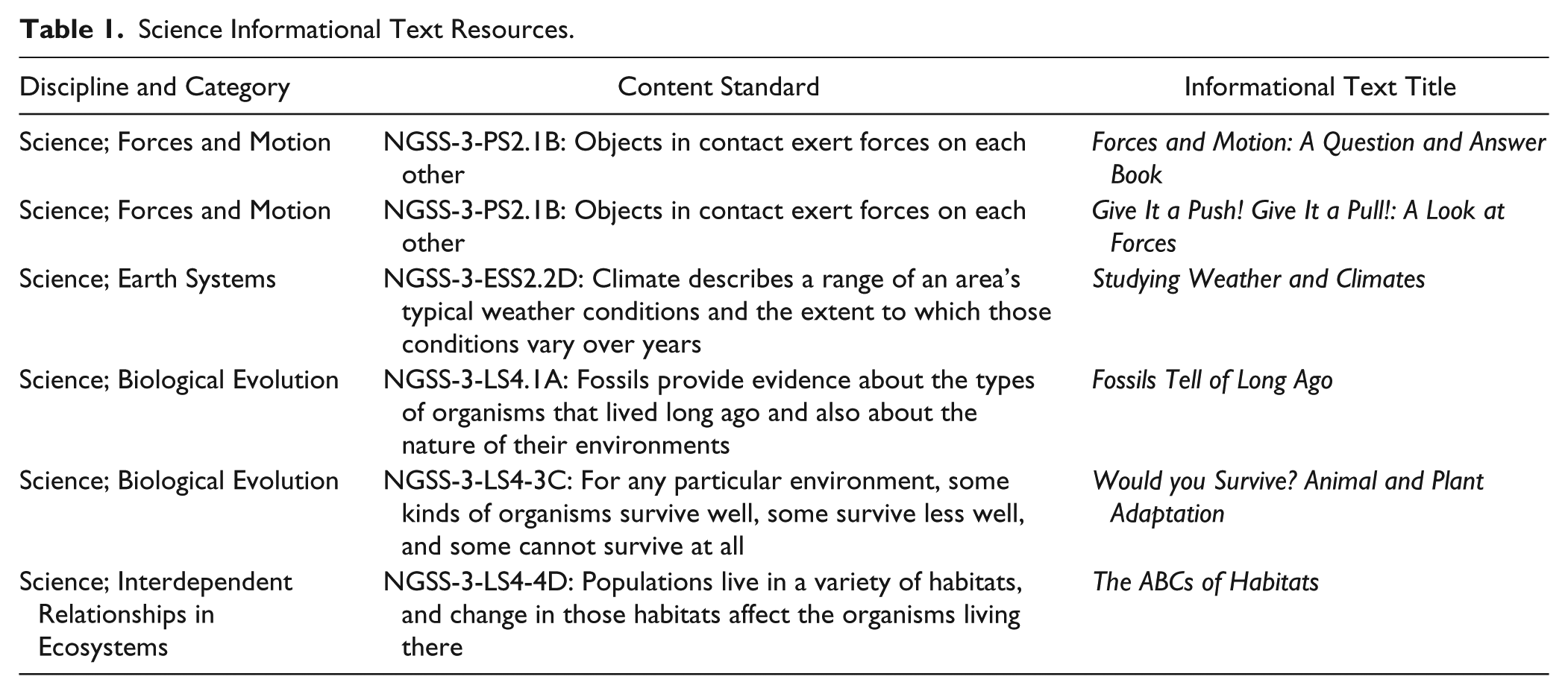
Continuing the example presented earlier surrounding Forces and Motion, a public library search could yield the following text: Forces and Motion: A Question and Answer Book. The teacher would examine the text to determine instructional fit based on target goals and standards. In addition, other kinds of instructional materials such as balls, benches, and wagons can be used in experiments to bolster students’ understanding of how forces work. An experiment allowing students to pull a wagon with and without another student sitting in the wagon, for example, will help students understand the concept of forces and that some objects require greater force to move them from place to place.
Create statements
When creating statements for the AG, teachers may find it helpful to consider the following three guidelines: (a) choose concepts that activate students’ prior knowledge, (b) choose concepts that highlight the main ideas from the text, and (c) choose concepts that highlight things students may not understand well or that may generate argument or debate (Duffelmeyer, 1994). It will be important for teachers to include statements that are both true and false on the AG to encourage critical thinking about the content.
For example, if a teacher chooses to use Forces and Motion: A Question and Answer Book, she would first examine the text for information that could be connected to her students’ prior knowledge. Students will have previously experienced the difference between moving heavy and light objects. Because the text discusses the concept of an object’s weight affecting the amount of force needed to move it, “lighter objects need more force to move them” is an example of a true/false statement that could be used to activate students’ prior knowledge. Next, the teacher examines the text and determines that the primary focus is defining forces as pushing and pulling something. The teacher could, therefore, use “pushing and pulling are forces” as a true/false statement to represent the main idea AG statement. Finally, the text discusses the fact that just because one exerts force on an object does not mean the object will move and provides an example of how sitting on a bench does not cause it to move. The teacher can use the true/false statement “forces always cause things to move” to highlight a possible student misconception.
Consider think-aloud techniques
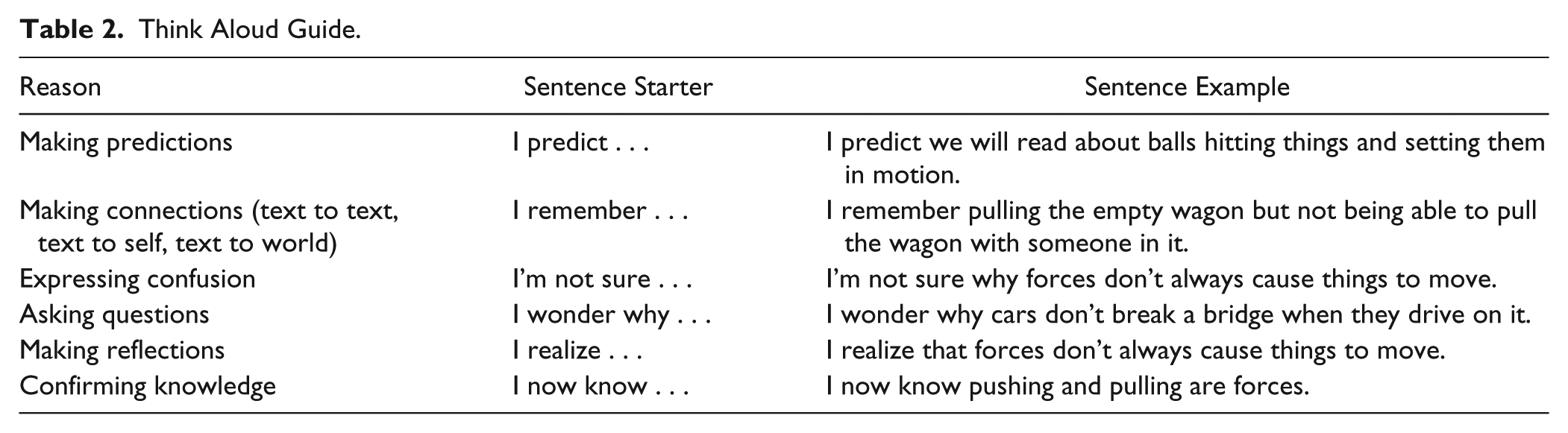
Thinking aloud involves articulating inner speech and is an effective method for modeling comprehension processes while reading (Alvermann, 1984; Ness, 2014). When planning to use this technique, teachers may consider the many reasons to model thinking aloud while reading. A teacher may want to model how to make a prediction about a piece of text, express a reaction to a portion of text, or make a connection to a section of text (Ness, 2014). For example, before choosing a book, most good readers read the title, examine any available illustrations, read the summary on the back, and examine the number of pages. The thoughts that may accompany these actions include the following: (a) Does this title sound interesting? (b) Do the illustrations seem intriguing? (c) Does the summary make me want to read more? and (d) Will I have time to read a book this long? The think-aloud process would involve articulating these questions aloud while engaging in the aforementioned actions. Table 2 provides a more extensive list of reasons to think-aloud, along with possible think-aloud sentence stems that could accompany the aforementioned trade book.
Think Aloud Guide.
Implementing Anticipation Guides
Teachers are encouraged to consider the following four implementation steps during instruction involving AGs.
Introduce the topic and text
Discuss each AG statement
Read the text
Revisit each AG statement
Teachers may need to adapt AGs during each step in several ways, especially when first introducing them, to ensure that students with LD in reading are successful. In the beginning, the instructional process may take as long as 1 hour because students will need to get oriented to the process, and teachers may need to engage in more scaffolding to support students. The amount of time students will need before teachers can fade scaffolds will vary (Boulware-Gooden, Carreker, Thornhill, & Joshi, 2007), but most students should be comfortable with AGs after three to five instructional sessions. Once students become more comfortable with the process, instruction should take closer to 45 minutes. It should take about 5 minutes to introduce the topic and text, 10 minutes to discuss the AG statements, 20 minutes to engage in reading aloud, and 10 minutes to revisit the AG statements.
Introduce topic and text
Teachers are encouraged to begin instruction by introducing the content area topic and accompanying text to students. During this step, teachers may find it helpful to build background knowledge through thinking aloud and questioning. Think-aloud techniques that are typically used while introducing a topic or text include making predictions and formulating questions about the upcoming topic. In addition, teachers can use any images that accompany the text and highlight small portions of the text to support student understanding.
To adapt this step for students with LD in reading, teachers are encouraged to work with small groups of three to five students. This will allow teachers to provide more explicit scaffolds to individual students before reading the text. During the introduction, teachers may also provide students with opportunities to discuss their connections to the topic with each other. This will provide students with extended wait time to organize their thoughts and gain confidence in their ideas before sharing them with the group.
Discuss statements
Once students have some background about the topic, teachers may introduce the AG by describing its purpose and model how to use each section of the AG. Teachers are also encouraged to ask students to respond to each statement and remind them that it is okay to answer questions based on what they think they know about the topic. This portion of the lesson allows the AG to serve as a preassessment tool that measures students’ prior knowledge about the topic, main ideas in the upcoming text, and possible misconceptions about the topic. The information provided might help teachers determine individual student understanding and whether to have the students place particular attention on specific concepts while reading the text.
To adapt this step for students with LD in reading, teachers may choose to project statements using a SMART Board or write statements on large chart paper. This will allow teachers to highlight each statement and minimize confusion that may occur from each student trying to navigate individual AGs. In addition, teachers are encouraged to limit the number of AG statements to three, keep each statement short, and choral read each statement with students. These changes will help focus students’ attention on comprehending each statement. Teachers are also encouraged to allow for oral responses to the AG. This will alleviate any issues students may have with writing fluency or spelling. Finally, because instruction will occur in small groups, when students respond orally teachers will be able to write or type each student’s name or initials next to the true or false options. Teachers will also be able to write a shorthand version of each student’s rationale and identify each rationale using students’ names or initials.
Read text
Teachers are encouraged to read the text and stop at various points throughout the reading to support students through think-aloud techniques. Teachers may also check for understanding through summarizing and questioning. Think-aloud techniques that are typically used while reading text include asking a question to clarify understanding or making inferences about the text. Teachers may enter the lesson with preselected stopping points (e.g., the end of each page or paragraph). However, the data collected while discussing each AG statement may encourage teachers to change some of the decisions they made during planning. This will allow for increased focus on areas of deficit (e.g., main ideas or misconceptions) demonstrated during the discussion conducted before reading.
To adapt this step for students with LD in reading, teachers may read the text aloud or use echo or choral reading to support students. This will allow teachers to minimize any readability issues students may experience.
Revisit statements
Teachers are encouraged to explain to students that this is the time to consider whether they would like to stay with their original thinking about each statement or make changes. Teachers are encouraged to revisit each AG statement and allow students to consider their original thoughts about each statement. Similar to Step 2, discussing each AG statement, students will respond orally and teachers will identify individual responses using student names or initials. This portion of the lesson allows the AG to serve as a postassessment tool to measure what students have learned about the topic. It also helps teachers determine whether students need reteaching and review. For example, if students struggled with misconceptions before the discussion and continued to struggle with the same misconceptions after the discussion, then teachers would strongly consider reteaching and reviewing those concepts.
To adapt this step for students with LD in reading, teachers may support students through modeling and thinking aloud as students make connections to the text and consider whether to keep their original responses or make changes.
Implementing Anticipation Guides in Science
AGs can be used across a variety of disciplines to support comprehension of content area concepts. The example that follows will illustrate the steps for instruction introduced in the previous section through a third-grade lesson surrounding Forces and Motion and is an extension of the planning example provided earlier.
Introduce topic and text
The special education teacher introduces the topic Forces and Motion by asking students questions such as “What do you know about forces and motion?” and “What do you think about when I say forces can set things in motion?” These questions may help students make connections to terms or things they have already experienced. The teacher then introduces the book, Forces and Motion: A Question and Answer Book, in an effort to build students’ background knowledge about the topic. The teacher highlights the cover image of a bowling ball hitting bowling pins and the image in the first chapter of a baseball player using his bat to hit a baseball. Questions such as “How do you think the cover picture illustrates forces and motion?” and “What is the force and what is being set in motion in this picture?” will help students make connections between their previous experiences and the upcoming topic. Throughout the discussion, the teacher provides students with opportunities to think about their answers through extended wait time and think-pair-share activities before asking students to share their thoughts with the small group.
Discuss statements
The special education teacher introduces the AG to students by showing them the three-statement list and explaining that its purpose is to support understanding of the upcoming text before and after reading. The teacher has written the statements on large chart paper. The teacher focuses on the before reading column and encourages students to think about whether they believe each statement is true or false and to consider why they have that belief. To further support student understanding of the AG, the teacher models for students by reading aloud a statement written on a sentence strip. It states, “A bowling ball hitting pins and causing them to scatter is an example of force causing motion.” After reading the statement, the teacher orally indicates that the statement is true and engages in the following think aloud supporting the reason for her decision: “I think it’s the force of the bowling ball hitting the pins that sets them in motion and causes them to scatter.”
The teacher explains to students that they will engage in the same activity. After the teacher reads each statement, students will orally state whether they believe the statement to be true or false. Each student will then provide a reason for his or her response. The teacher reassures students that it is okay to use what they think they know about the topic as a reason for their response. In an example, the teacher reads the following AG statement aloud: “Lighter objects need more force to move them.” The teacher asks each student to orally state whether the statement is true or false. The teacher writes each student’s initials next to true or false for the corresponding statement. Each student is then asked to provide a reason. The teacher writes each reason in the reason section for the corresponding statement and identifies each answer using student initials. Throughout Step 2, the teacher works to ensure that each student has been provided with enough time to consider their responses. A completed sample AG for Forces and Motion is provided in Figure 1.
Read text
The special educator reads the text aloud to students. The text has several brief chapters, but the teacher only reads the first two chapters, which includes the first four pages of the text. The teacher stops at designated points throughout the text to check for student understanding, think aloud, and engage in activities. In an example, when the teacher gets to the portion of the text that states, “Forces don’t always cause motion. Sometimes forces are in balance and objects stay still,” the teacher stops and models thinking aloud by stating, “The book says that when forces are in balance objects stay still. I think that means when things are in balance they are even or equal.” The teacher then questions students by asking, “What do you picture in your mind when you hear the author talk about balance?” The teacher then goes on to engage in an activity that involves each student sitting on the classroom bench. The teacher reminds students that when they sit on the bench they exert force on the bench but the bench is not set into motion by breaking. Therefore, there is a balance between the bench and each student.
Revisit statements
After reading, the special education teacher returns to each AG statement and focuses on the after reading column. The teacher is now interested in whether or not students would like to keep their original responses or make changes. Students continue to provide oral responses. The teacher continues to use initials to note true or false answers and to identify each student’s reason for their thinking. Whether students change their responses or keep them the same, they are expected to support each response using evidence from the text. In an example, when a student changes his mind from true to false regarding the following statement: “Forces always cause things to move,” he refers to the portion of the text that discusses how forces don’t always cause motion.
As a culminating activity, the teacher also engages in additional post questioning and discussion to help solidify student understanding of the content. Questions such as, “What was the reading mainly about?” and “What is one thing you learned from today’s reading?” serve to bolster the AG and focus on the reading’s main ideas. A template summarizing this lesson is provided in Figure 2.
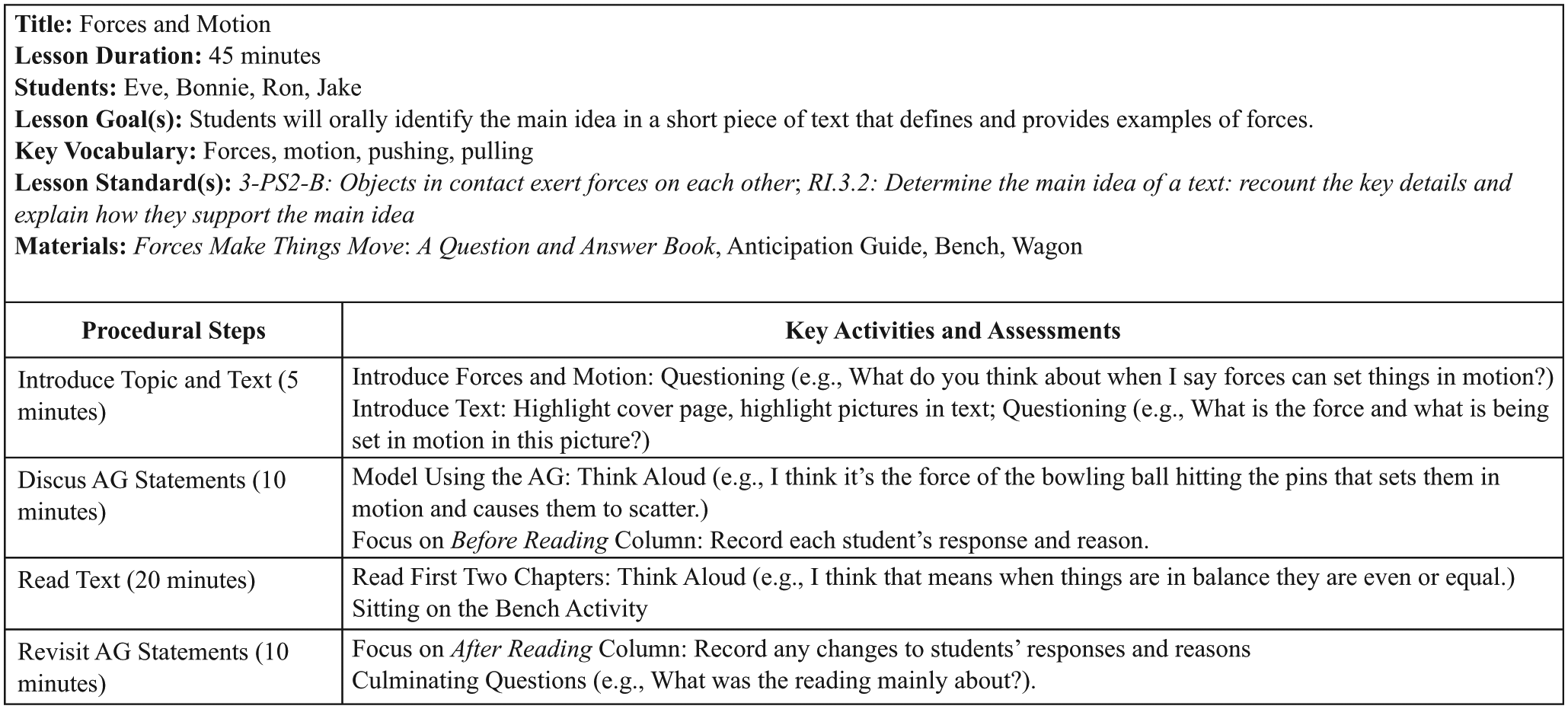
Forces and motion instructional template.
Conclusion
Anticipation guides can be a beneficial tool for promoting deeper comprehension of a variety of texts (Adams et al., 2015; Duffelmeyer, 1994). They can also foster explicit connections between disciplinary content and literacy. AGs are also helpful because they can be used as pre- and post-assessment tools to measure student understanding of content. It is important to note that although this article has focused of students in elementary settings, AGs can be adapted for use with content curriculum in the middle grades. Planning for instruction is best done systematically so that discipline specific standards and goals explicitly influence the materials and AG statements chosen. AGs may require some initial upfront time but can be used repeatedly once teachers have a set framework. Importantly, teachers are encouraged to make decisions about how to adapt AGs based on the needs of their students and remain creative in how they provide supports. Finally, teachers can apply the steps for planning and instruction introduced here across a variety of other content areas, including mathematics and social studies.
Footnotes
Author’s Note
Nicole S. Fenty is now affiliated to Department of Teaching Learning and Educational Leadership in the College of Community and Public Affairs.
Declaration of Conflicting Interests
The author declared no potential conflicts of interest with respect to the research, authorship, and/or publication of this article.
Funding
The author received no financial support for the research, authorship, and/or publication of this article.